

The Deployable City
What if your living and working spaces could travel with you?

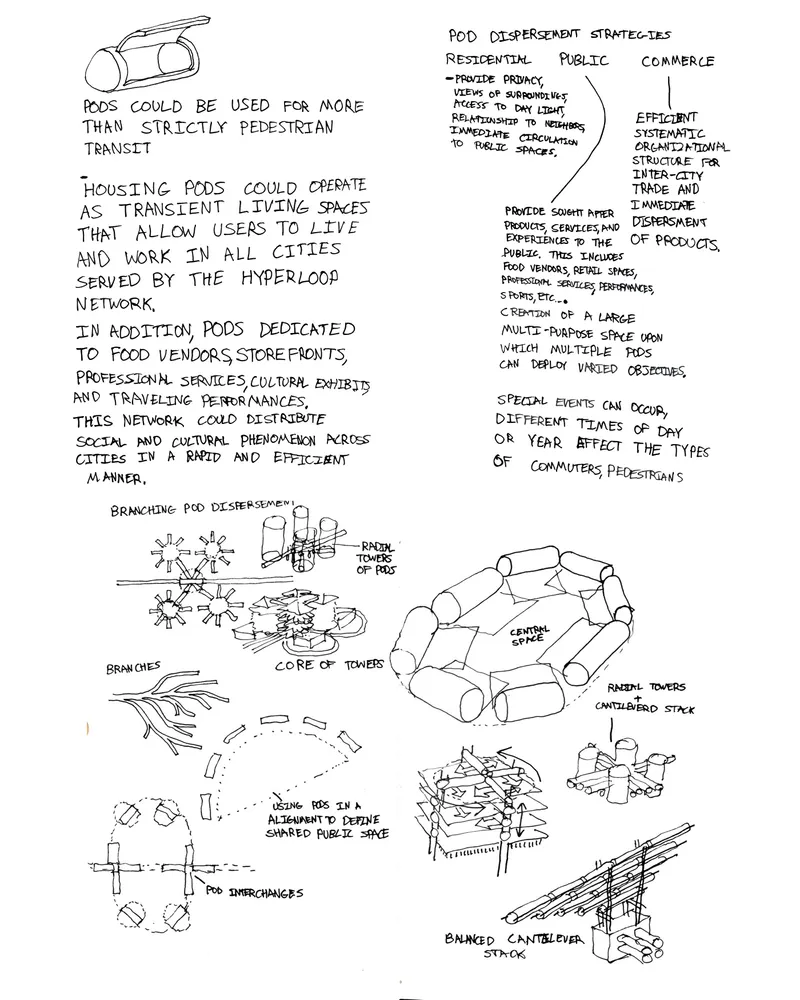
The Deployable City allows for modularized hyperloop pods to be loaded and unloaded from the hyperloop network and immediately deployed within the local context of individual stations. This rapid system of localized storage and deployment of pods has the potential to create urban hubs with highly adaptable programmatic schemes capable of supporting private residences, commercial development, professional services, and wide-ranging cultural phenomena. What if you could live and work in multiple cities within the hyperloop network simultaneously? Further, what if your living and working spaces could travel with you between those cities? A network of deployable cities and its fleet of multi-use modularized pods connected seamlessly by the speed of hyperloop would allow for an entirely new level of inter-city connectivity. The type of connectivity previously unachievable in large countries with hundreds of miles between major cities.
 The foundation of the deployable city is still based upon the mass transit station. The transit component is fundamental to the proper functioning of the deployable city as an urban hub and place of dynamism. The high volume of commuters that would rely on the hyperloop for long distance rapid transit on a daily basis are the same people that would sustain the commercial, and service oriented pods at any given station. Implicit in a high speed transit system is the need to efficiently accommodate large volumes of passengers between stations at regular intervals and provide a convenient ridership experience. The expected daily traffic between Mumbai and Pune of 25,000 passengers was a starting point from which the development of a system of arrival and departure for the station was created. The transit hub is situated within the heart of the station with through traffic passing above and below the main boarding platforms. The boarding platform consists of 10 gates servicing pods headed in either direction that can be loaded and unloaded in 5 minute intervals. This means that the station's theoretical daily passenger capacity would be (10 gates x 20 passengers/pod x 12 intervals per hour x1 2 hours) = 28,800 passengers/day.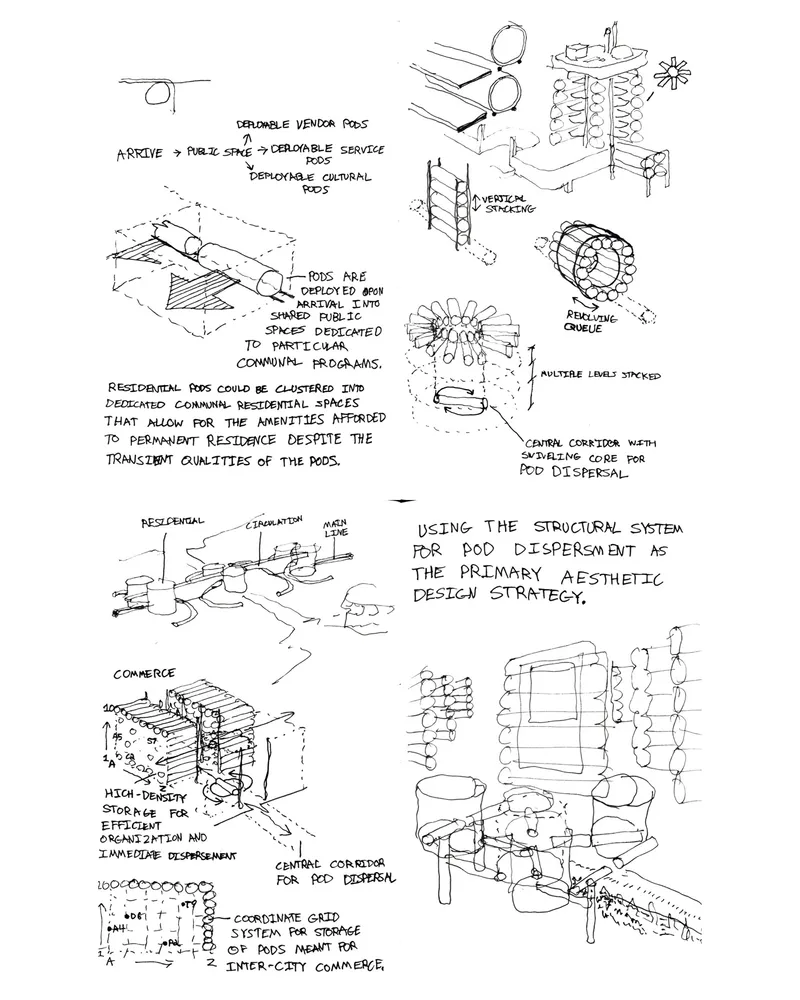
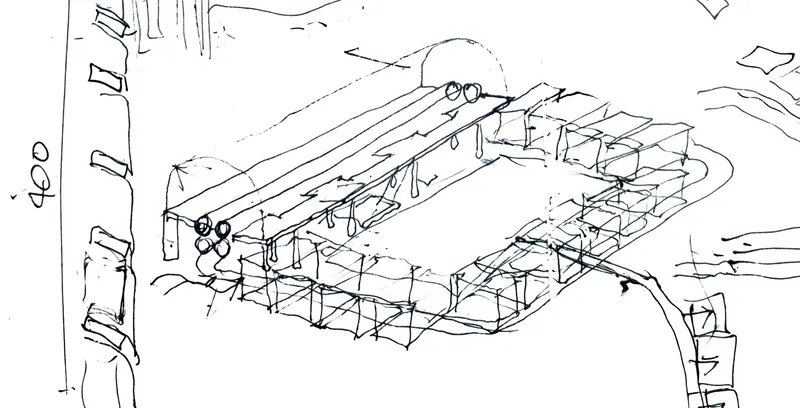
The prototype station for the deployable city aside from the aforementioned relation to mass transit consists entirely of multi-use pods that define public spaces for leisure, recreation, and gathering. The modularized pods are able to travel freely throughout the hyperloop network and then dock at any given deployable city in such a fashion that every pod's entrance relates to the central public space of the station. Pods are efficiently deployed vertically across 4 floors and are organized in a staggered arrangement that affords an individual entrance and front balcony to each pod. Commercial pods such as food vendors, convenience stores, and other retail spaces would occupy the first floor of the station immediately connected to the public space of the ground floor. Residential pods as well as more specific service oriented pods would then occupy the other three floors. Public circulation in the form of balconies, stairs and elevators provides quick access to all four floors as well as additional spaces for gathering on the third floor and a large open park space on the roof of the station. The mixing of program in conjunction with urban amenities, places for gathering, and a constant flux of commuters to and from the station means that the deployable city could operate as a hub for business, community, cultural events, as well as adapt and behave uniquely in relation to specific local contexts. 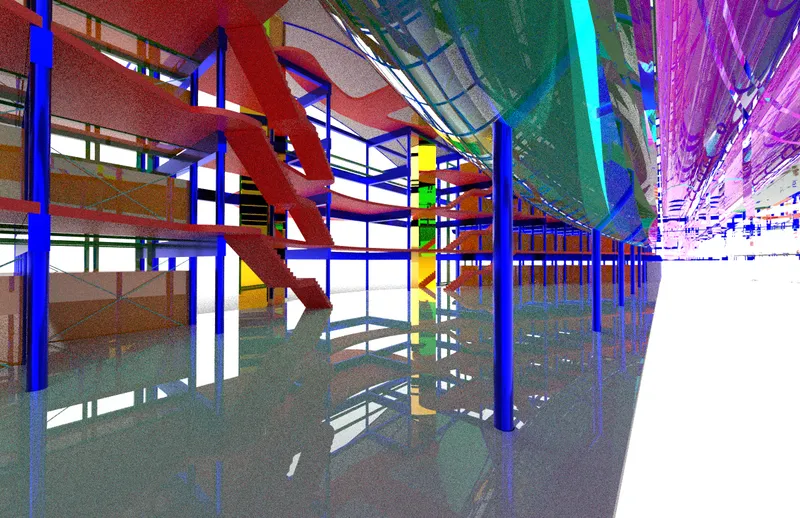
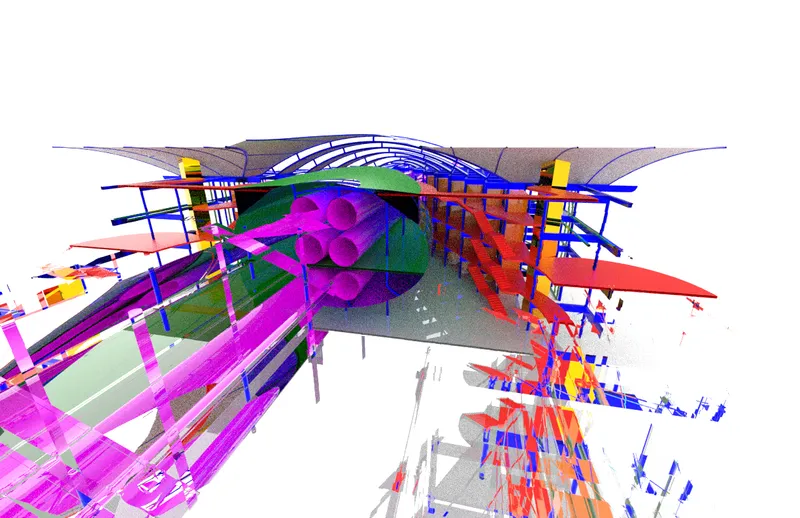
Though modularized transit systems have existed in various forms throughout the last two centuries as a means of easily shipping cargo and creating economies of scale, the hyperloop introduces an entirely new dynamic to trans-regional commerce and communication due to its speed. A modularized cargo system with deployment capabilities at various stops along the hyperloop network presents the opportunity for wide-ranging possibilities of inter-connectedness between global cities despite hundreds of miles of physical separation. A future of highly deployable cities would work as a highly interconnected network of distinct hubs, all with their own local qualities, while also having complete access to all of the amenities, products, services, and cultural phenomena of any other city within the greater network. High-density urban centers sustained by rapid transit have proven to be the most productive, culturally rich, and sustainable types of urban environments, and if the world continues on its trajectory towards total urbanization, a system of deployable cities could prove vital in connecting the cities of tomorrow.

Popular Articles
Popular articles from the community


Opera on the Sea: Driftwood Logic Shapes a Timber Opera House on Estonia's Coast
Trevor Orgill's opera house translates the entangled drift of floating timber into a civic building where wood, water, and music converge.

Temporary Home for Dogs: A Reversed Zoo Rethinks Animal Shelter Architecture
In Bucharest, a sinuous corridor and freed landscape flip the logic of containment, designing a shelter that works to make itself unnecessary.

Tsunami Convergenics: Turning Catastrophic Ocean Forces into Underwater Housing Infrastructure
A speculative underwater settlement off the coast of Onagawa, Japan, treats tsunamis and typhoons as energy sources rather than threats.

The Amber Palace Opera: A Geological Fiction Surfaces on Tallinn's Baltic Waterfront
Pierre Brillard reimagines a Baltic legend as a public landscape, opera house, and waterfront promenade rooted in Tallinn's coastal identity.

Similar Reads
You might also enjoy these articles

Shakur's House: Exposed Brick as an Interior Organiser in a 168 m² Mashhad Residence
Brick moves indoors in this Mashhad residence, where masonry walls, glass partitions and teal planes sequence a compact home without closing it off.

Day and Night Park: A Time-Based Urban Newsstand in Beijing
A temporary urban newsstand in Beijing blending travel, light, and reading through poetic colors, compact form, and community-focused design.

Modernist Patio Renovation in El Masnou, Barcelona by Oliver Segura Arquitectura + Cebrià Arquitectura
Modernist patio renovation blending tradition and innovation with a movable pool, leveled floors, and Catalan materials in El Masnou.

Alto Residencial Coop: Cooperative Housing Development in Santiago de Compostela by Carbajo Barrios Arquitectos
A linear cooperative housing complex blending white volumes and perforated metal façades, enhancing community living, natural light, privacy, and urban integration.

Comments (0)
Please login or sign up to add comments
No comments yet. Be the first to comment!