

Karim+Elias Plants Twelve Rammed-Earth Totems in a UAE Archaeological Reserve
The Desert Relics rises from the sands of Mleiha, a UNESCO site in Sharjah, turning ancient craft into permanent land art.


Mleiha holds traces of human presence stretching from the Paleolithic through the Islamic era. It is one of the most archaeologically dense sites in the Arabian Peninsula, a place where stone tools and Bronze Age tombs sit just below the surface. Building anything here demands a posture closer to reverence than invention. Karim+Elias, the studio led by Karim Tamerji and Elias El Hage, understood that. Their response is The Desert Relics: twelve rammed-earth totems spread across 3,850 square meters of gravel plain, each one shaped like stacked vessels and assembled entirely from desert sand, clay, and water.
What makes the project genuinely interesting is not its scale or its setting, dramatic as both are. It is the decision to use the ground itself as the only material. Rammed earth is among the oldest construction techniques on Earth, and here it is deployed not for shelter but for symbolic weight. The totems do not house anyone. They do not shade anything. They exist to mark a landscape that has already been marked by millennia of civilization, and they do so by literally compressing that landscape into vertical form. Unveiled at the 2024 Tanweer Festival and intended as a permanent installation, The Desert Relics sits at a productive intersection of land art, archaeology, and architectural craft.
Twelve Totems on a Stony Plateau
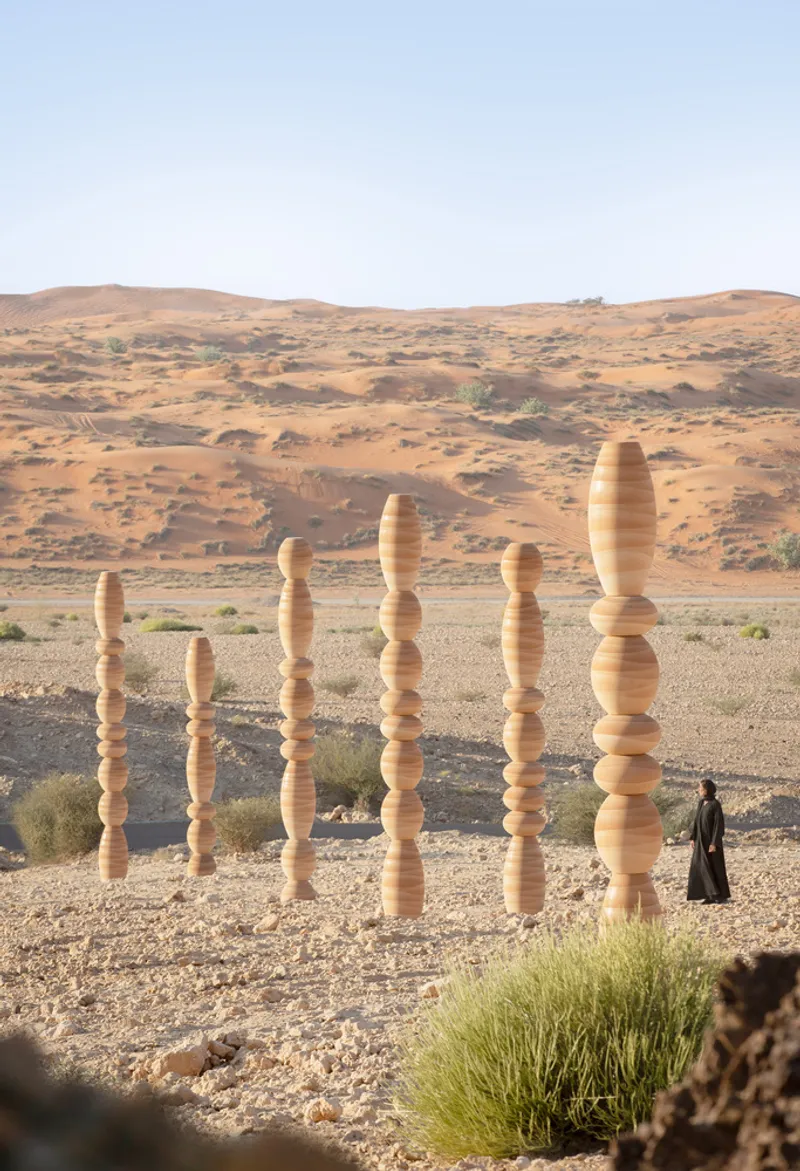

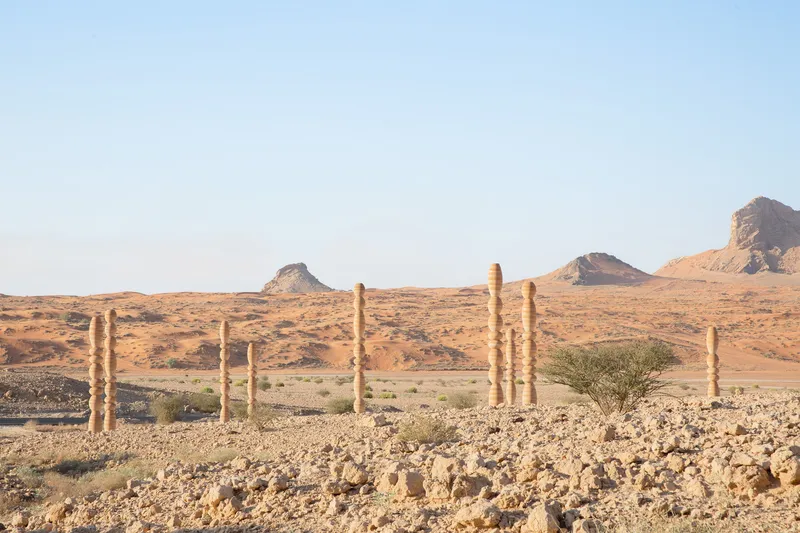
Seen from a distance, the totems read as a loose congregation rather than a rigid grid. Their heights vary, their silhouettes differ, and the spacing between them invites passage without prescribing a route. The arrangement across the rocky plain creates shifting compositions as you move: sometimes they cluster into a dense forest of vertical forms, sometimes they separate into solitary figures against the mountain backdrop.
The choice to work with twelve discrete elements rather than a single monolith gives the installation a quality closer to a discovered site than a placed object. You could imagine stumbling upon these forms the way one stumbles upon standing stones. That is clearly intentional. The design concept revolves around the idea of "unearthing an artifact," and the totems reward that reading by appearing both ancient and entirely new.
Vessel Geometries and Stacked Form
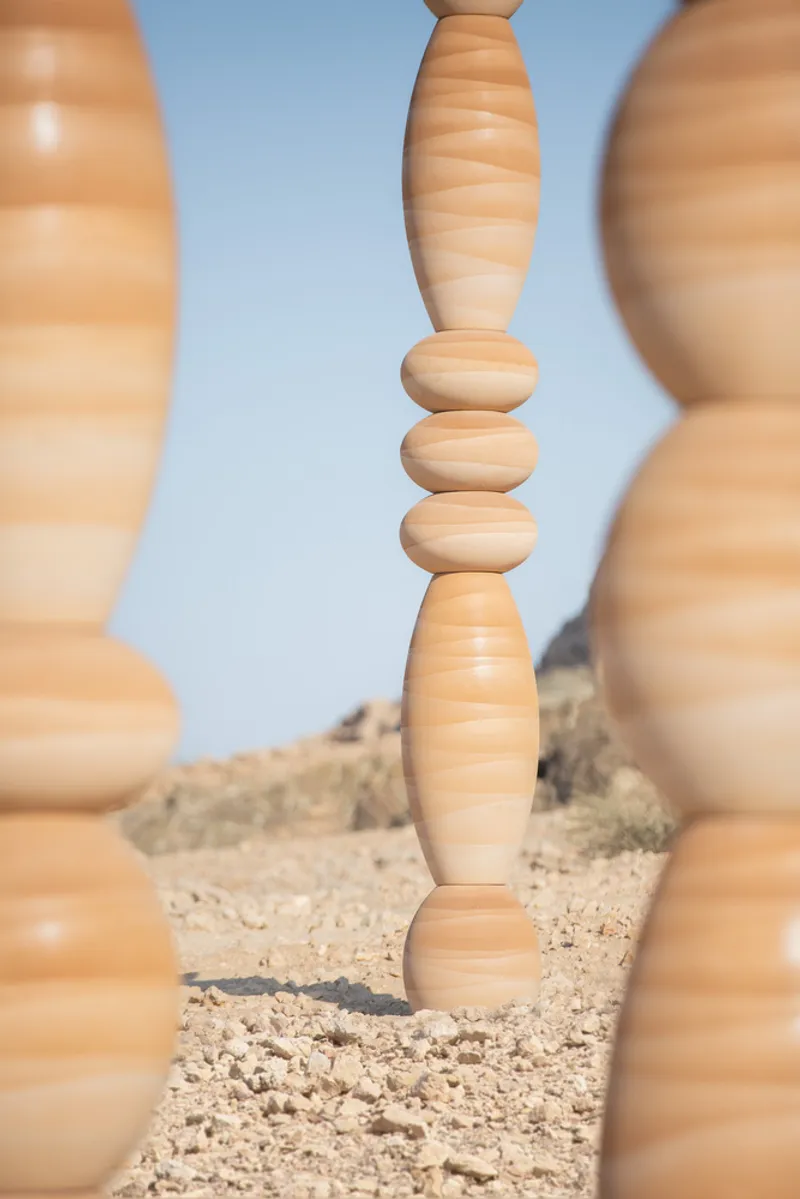
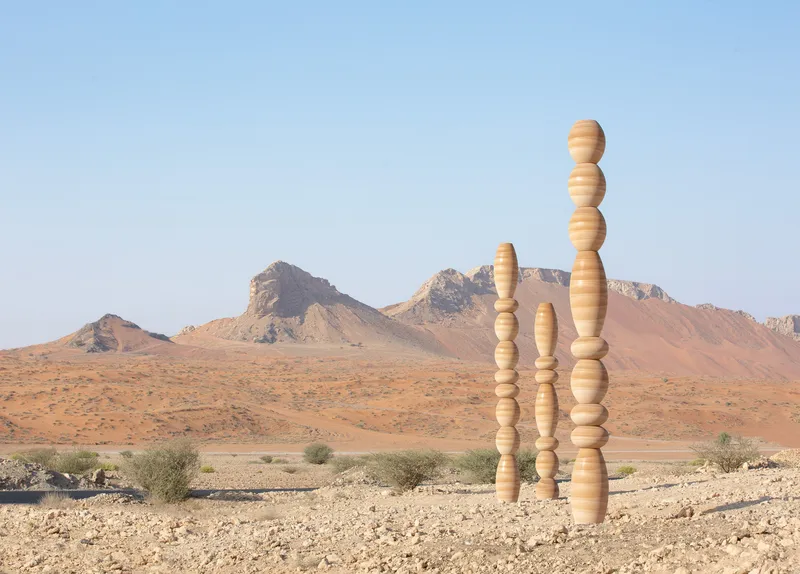
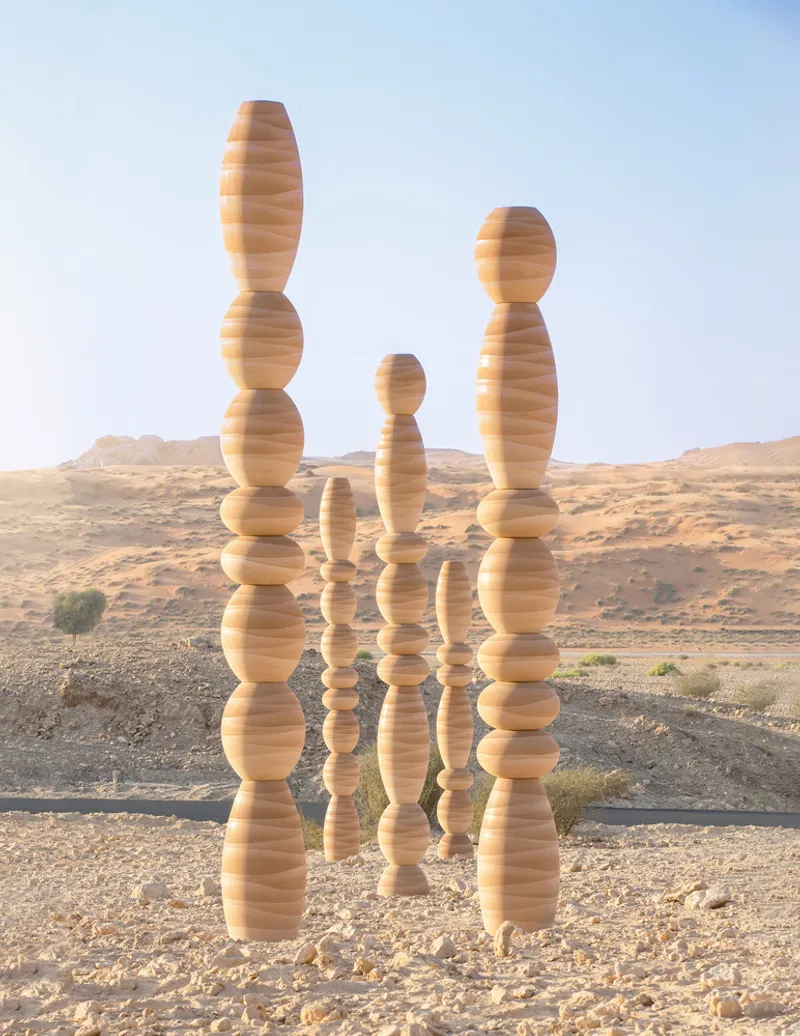
Each totem is composed of stacked segments that swell and contract along the vertical axis: spheres, ellipsoids, tapered cylinders. The forms recall vessel vases, the kind of ceramic artifacts that populate the region's archaeological collections. Karim+Elias describe the ensemble as evoking a "grand bejeweled necklace," and the analogy holds. The segments are threaded onto an implied vertical spine, each one distinct in proportion yet clearly belonging to the same family.
What keeps the vessel metaphor from becoming decorative is the material honesty. These are not smooth, glazed surfaces. They are rammed earth, and their surfaces carry the horizontal banding of compressed layers. The sedimentary logic of the construction mirrors the sedimentary geology of the mountains behind them. Form and process are the same story told at different scales.
Rammed Earth as Cultural Act
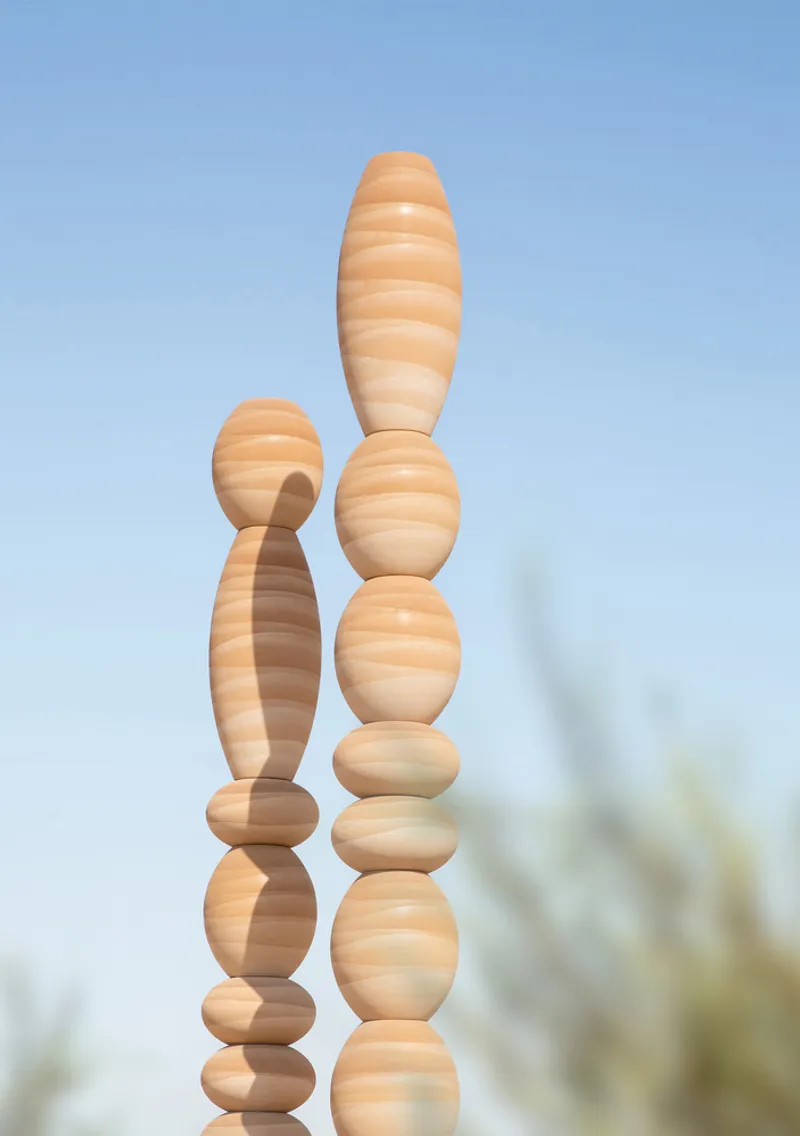


The horizontal striations visible on every totem are not decorative texture. They are the direct record of how the material was placed: layer by layer, hand-compressed within custom moulds. Desert sand, local earth, clay, and water were mixed to achieve natural pigmentation, so the color shifts between totems are not applied but inherent. One column runs warmer, another cooler, reflecting the specific batch of earth used in its construction.
Karim+Elias position themselves as revivalists of a technique that dates back millennia, and The Desert Relics is a convincing demonstration of what that means in practice. Rammed earth is enjoying renewed attention in sustainable architecture, but it is typically used for walls and floors. Using it to create freestanding sculptural forms at this scale is a different proposition entirely, one that requires precise control of moisture content, compaction pressure, and mould geometry. The result is a surface that belongs to the desert in a way that concrete or steel never could.
The Human Figure as Scale Device

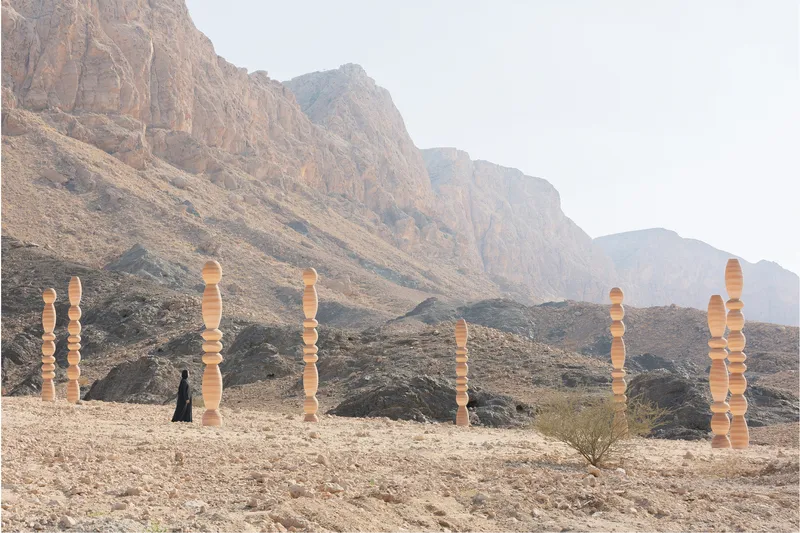
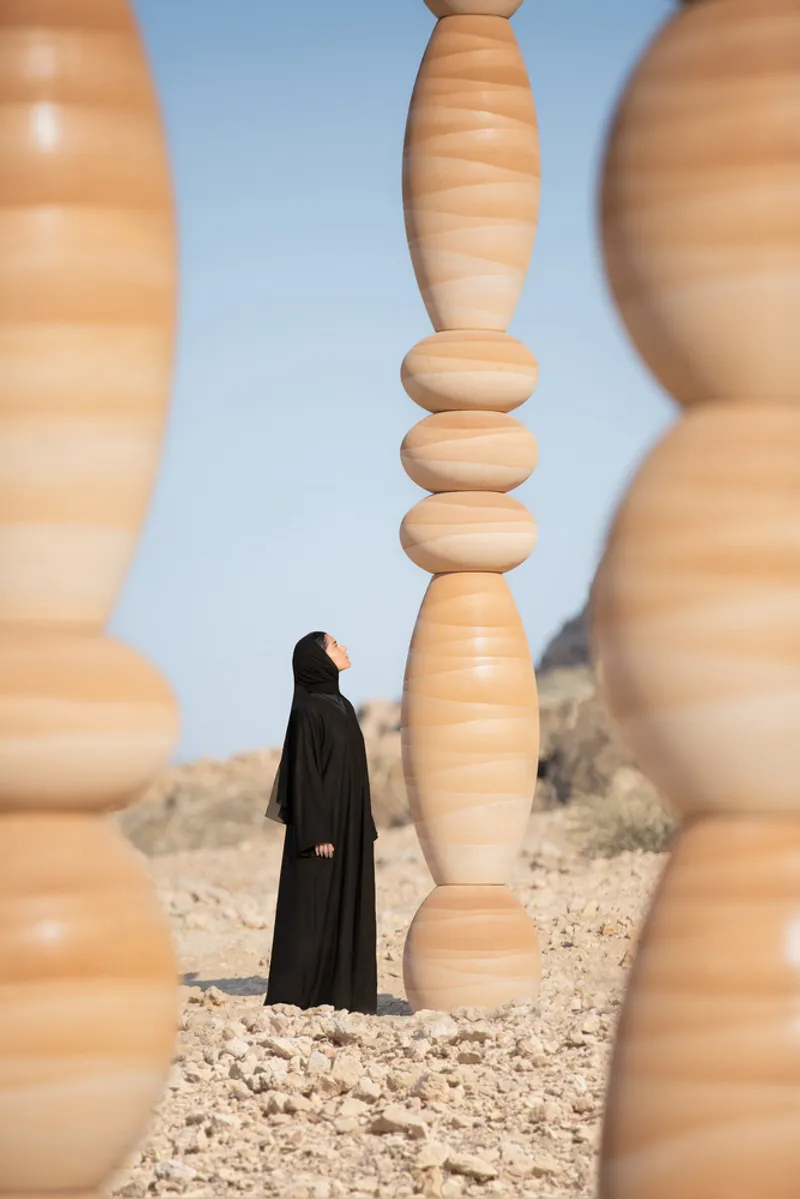
Nearly every photograph includes a figure in black robes, and the inclusion is more than compositional. Against the totems, the human body becomes a measuring stick. The tallest columns appear to reach roughly four to five times a person's height, making them monumental without being crushing. The figure walks between them, pauses beside them, is framed by them. The installation clearly anticipates the body in motion.
The spaces between totems are generous enough for two people to pass but tight enough that the bulging segments occasionally press into your peripheral vision. It is a spatial choreography that owes more to sculpture parks than to architectural plans, and it works because the totems are objects you orbit rather than rooms you enter.
Landscape as Collaborator


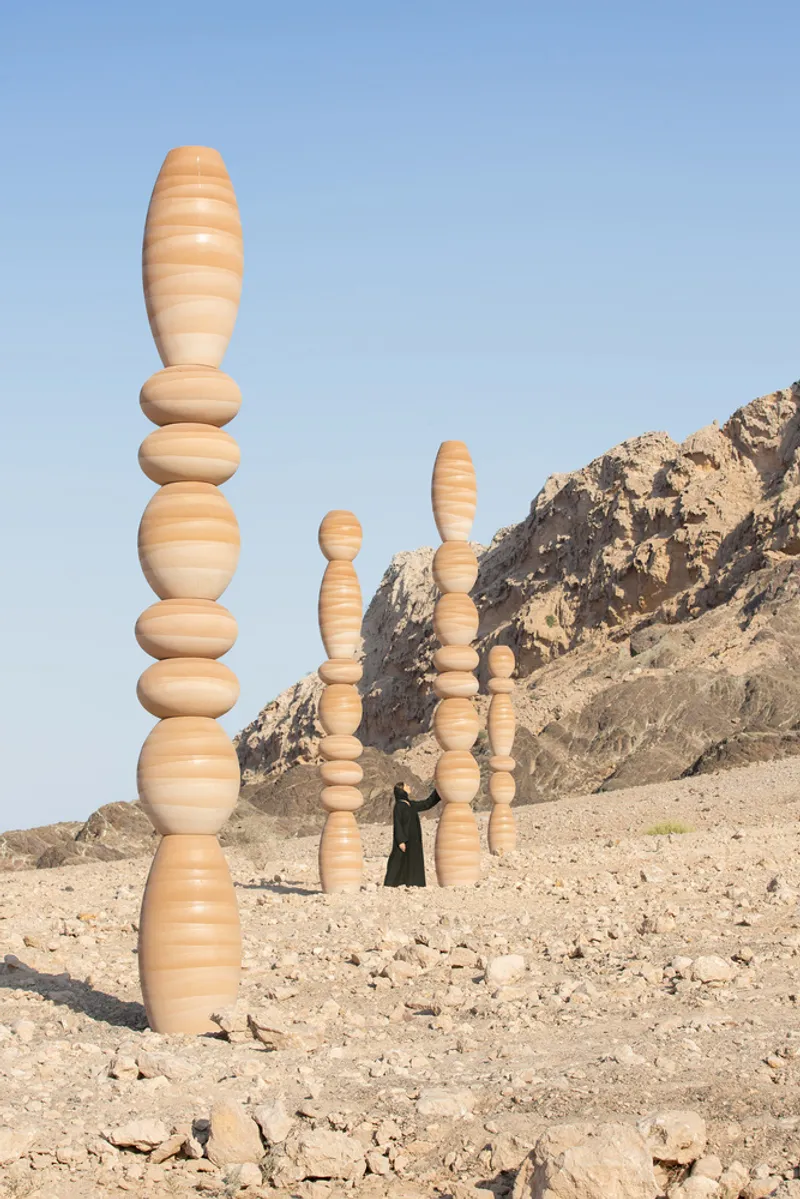
The Mleiha Archaeological Reserve provides a backdrop that would overpower most interventions: towering sedimentary cliffs, rolling dunes, and a palette of ochres and grays that shifts with the light. The Desert Relics survives this context because it does not compete with it. The totems share the mountain's color and texture. A lone tree appears beside one cluster, equating organic growth with the crafted columns in a single frame.
Light is the installation's most important variable. At midday the forms flatten into silhouettes. In the low-angle sun they gain deep shadows between segments, and the layered construction becomes emphatically visible. The project is, in the fullest sense, a piece of land art: its meaning is inseparable from its site, its material is drawn from that site, and its experience changes with the weather and the hour.
Groupings and Intervals
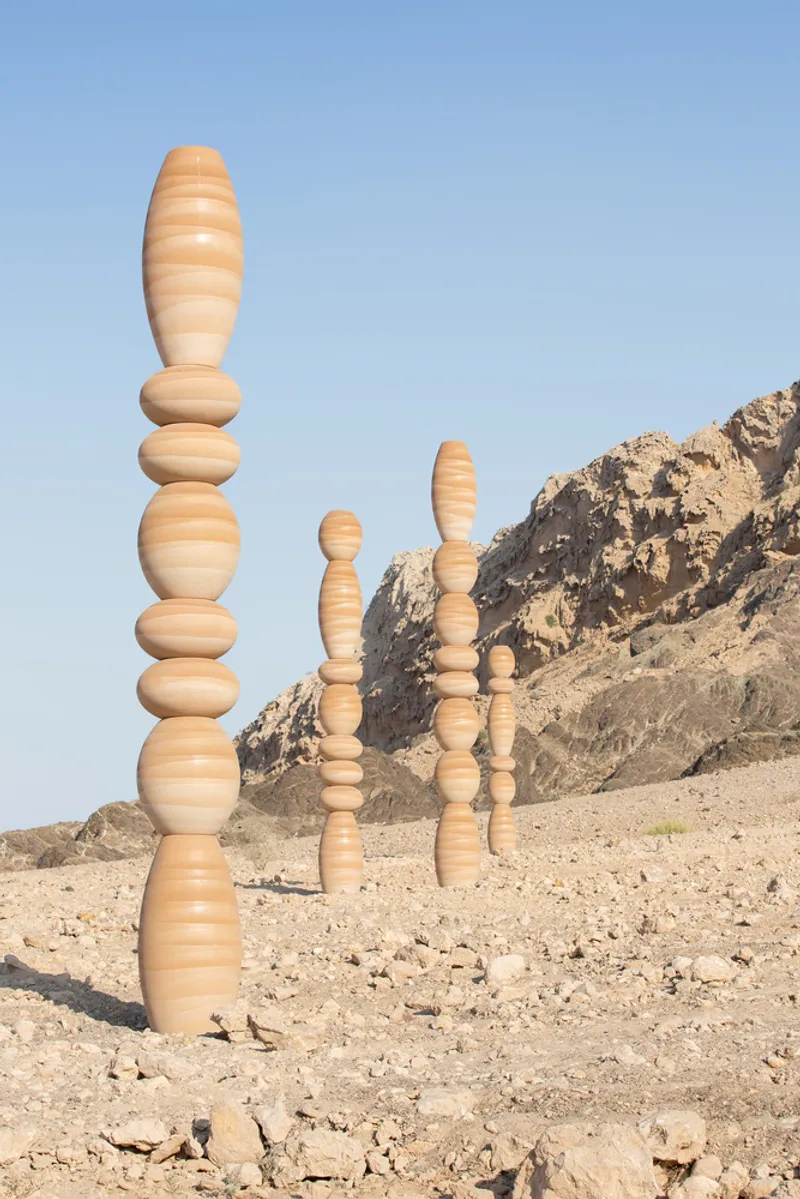
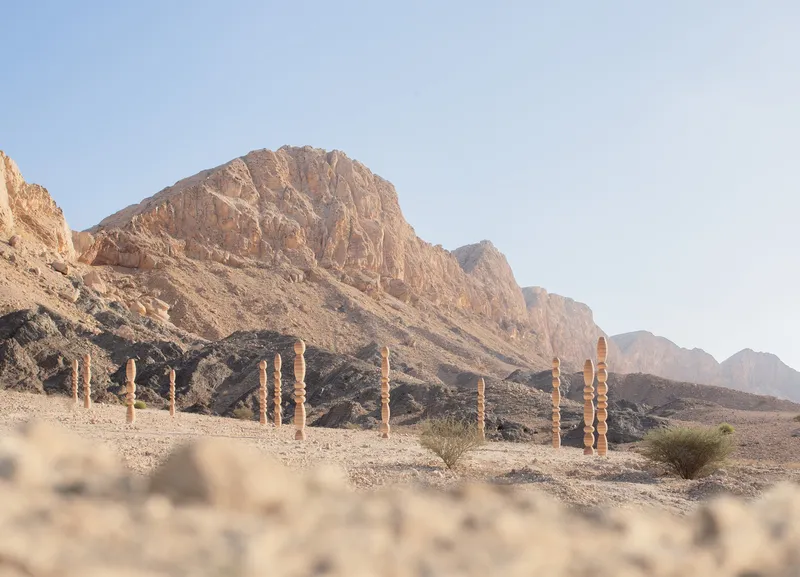
Certain views compress the totems into tight clusters where alternating light and dark grain patterns create a visual rhythm not unlike a geological cross-section. Other views stretch them into a single receding line across the plain. The installation rewards movement: every few steps rearrange the relationships between columns, between columns and mountains, between columns and sky.
The fact that the installation is permanent rather than temporary raises the stakes. These forms will weather. The rammed earth will erode, slowly, over years, mimicking the same geological processes that shaped the cliffs behind them. That trajectory is arguably part of the design. An installation about archaeological relics that itself becomes a relic over time possesses a coherence that purely conceptual gestures rarely achieve.
Plans and Drawings
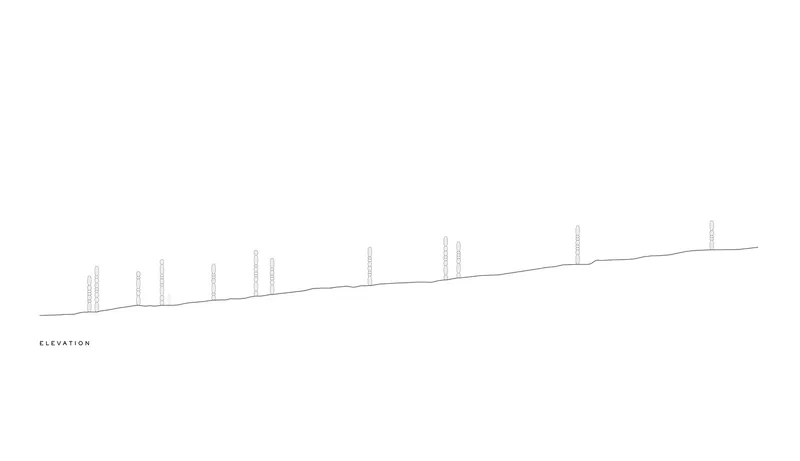
The elevation drawing reveals the variation in totem height and the gentle slope of the terrain. Nine elements are shown in profile, each with a distinct sequence of bulbous and tapered segments. The drawing confirms what the photographs suggest: the totems follow no strict grid, and their relative heights are calibrated to create an irregular skyline that echoes the mountain ridgeline behind them. It is a deceptively simple document for a deceptively simple project, one whose power lies in the directness of the idea rather than in compositional complexity.
Why This Project Matters
The Desert Relics matters because it demonstrates that material and site can carry the entire weight of a project's meaning. There is no parametric bravado here, no imported cladding, no digital fabrication workflow. The technique is ancient, the material is underfoot, and the forms are drawn from the same ceramic traditions that fill the region's museums. Karim+Elias have produced a work that is contemporary precisely because it refuses to perform contemporaneity.
It also matters as a model for how architecture and land art can operate within culturally sensitive landscapes. The Mleiha reserve is a UNESCO-recognized site. Placing anything there is an act of negotiation with deep time. The Desert Relics succeeds because it enters that negotiation on the landscape's own terms: same earth, same color, same patient layering. It adds to the archaeological record rather than interrupting it, and in doing so offers a quiet rebuke to the spectacle-driven installations that dominate the land art conversation elsewhere in the Gulf.
The Desert Relics, by Karim+Elias. Mleiha Archaeological Reserve, Sharjah, United Arab Emirates. 3,850 m². 2024. Photography by Elias El Hage.
About the Studio
Share Your Own Work on uni.xyz
If projects like this are the kind of work you want to make, uni.xyz is a place to publish your own, find collaborators, and enter design competitions.


Popular Articles
Popular articles from the community


Cube Design Draws an Ecological Corridor Between Two Shenzhen Hills with the Nankai Building
Beside Shenzhen's container docks, the Nankai Building pairs stacked balconies with a climbing green screen to connect two hillsides across its height.

U.GA Architects Wraps an Oval Rooftop Pool in Curved Board-Formed Concrete on Busan's Jeollidan-gil
In Busan's Jeonpo-dong, a 454 m² mixed-use block stacks a neighborhood facility, guest rooms and an oval rooftop pool inside spiraling concrete walls.

Jaramillo Van Sluys Arquitectura and Urbanismo Turn a Demolished Registry Lot in Quito into an Orchard Plaza
In Quito's Centro Histórico, a 2,800 m² plaza exposes the San Agustín convent wall and redraws its lost Augustinian orchard in volcanic stone.

David Macias Steps a Doorless Stone and Plaster House Down a Tropical Colombian Hillside
In the humid hills of Colombia, Threshold House replaces the front door with an open void and terraces its 850 m² down the slope instead of fighting it.

Similar Reads
You might also enjoy these articles


Hodi-Mandai Geram
Project Function: Preservation and revitalization of the Intangible heritage and socio-spatial identity of the Hodi by Housing, Cultural Memory Center, Sacred Grove, landscape, local tourism economy


Olio Towers: A Mid-Rise for Performers That Fuses Housing, Rehearsal, and Stage
Located blocks from Houston's Theater District, this modular tower stacks living units around a central performance atrium.

Oasis: Modular Green Housing Carved into Dhaka's Urban Fabric
A shortlisted Plugin Housing entry reclaims unauthorized settlements in Dhaka with stepped concrete volumes, green roofs, and ventilation-driven design.

Black Hole: A Floating Megastructure for the Post-Physical Era
Emiliano Mazzarotto envisions a spherical, self-scaling arena where e-sports, digital hotels, and holographic stadiums replace traditional public space.

Explore Desert Architecture Competitions
Discover active competitions in this discipline

Challenge to illustrate the ruins of Petra

Challenge to reimagine the Iron Throne

Photograph architecture without architects

Illustrate the lost glory of Angkor Wat - Render Challenge
Comments (0)
Please login or sign up to add comments
No comments yet. Be the first to comment!