
The Exodus
/

THE EXODUS.
Who came first the chicken or the egg?
As known, home and house share common features, many, mistakenly think there the same but they’re not. In order to understand we will need to define both of them. In the dictionary House is “a building for human habitation, especially one that consists of a ground floor and one or more upper storeys.” It aims to “provide with shelter or accommodation.” While Home is defined as “a place where one lives permanently, especially as a member of a family or household.” House can be described in other terms as Dwelling or a Shelter. Be that as it may, Home can be a “the town, district, country, that you come from, or where you are living and that you feel you belong to”. The definition extends even further to an intangible definition, for example, Home is where the people you love are, or an environment where ones feel at home and share this environment`s interests and perspectives. Thus the two terms (House, Home) may share few characteristics, but there different in their broadest terms. A House can be a Home, but a Home does not necessarily need to be a House. Therefore, we can argue that a house is more of a tangible entity; while home is intangible entity; so in their relation to each other usually the home is what shapes the house and not the opposite.
“It’s like we were doomed to destroy our planet, some say because of the increasing pollution; i just call human nature.” (IO, 2019)
From the long history of humans, the concept of settling down to establish a home is quite recent concept. Moreover, the search for a better life and new opportunities has always been a human nature. Besides, Humans have existed through a wide range of natural or man-made catastrophes, for instance climatic conditions, environmental hazards, illness, diseases and even wars; those events that have disrupted and impaired their life's and existing. These series of unfortunate but inevitable events frequently results in the dissolution of human settlements constancy, causing forced waves of immigration, constant movement, and the search for a better life.
In the upcoming future, it’s vague whether it’s bright or dark. Utopian or Dystopian; what is certain, and almost definite that a series of inevitable events and catastrophes will change the life on earth as we know it. Whether it’s man-made, global warming or Wars; or natural, such as earthquakes, rising sea levels and diseases. An example of a solution presented by religious methodology when Noah, once built an ecosystem in the form of an enormous ship to continue to live or exist in spite of danger (great flood). Besides the religious preaching behind this story it introduces an inspiration to what we can do if something similar happens. For instance with the rising sea levels, many coastal areas are buried in water. Whether it’s reversible or not, measures should be taken and new ideas should be considered. In the case of total floods, earthquakes, or wars how can People and their homes survive?
“Home form is not simply the result of physical forces or any single causal factors, but is the consequence of a whole range of environmental, Contextual and socio-cultural factors seen in their broadest terms.” (Amos Rapaport 1969)
Shelter is one of the most important need to humans, it’s a prime factor in our survival; and due to this need humans evolved many types of dwellings. In history of architecture the climatic determinist view, still rather commonly held, states that primitive man is concerned primarily with shelter, and consequently the imperatives of climate determine form. However, if the case is as given, why so many different types of houses have evolved in a restricted number of climatic zones? Even if the variance between houses in similar microclimates can be enormous? The form develop as man learn to master more complex building techniques, still somehow that all building forms are part of a progressive development. humans might build to control the environment but the real effect is from the inner social and cultural drive of the environment rather than the physical one, meaning they build as much as the climate allows, and they use technology and materials to come as close as possible to their ideal model of a home.
The evolvement of architecture and building technologies has resulted in the problem of excessive choices. “The difficulty of selecting or finding constraints which arose naturally in the past and which are necessary for the creation of meaningful House form” (Rapaport 1969). This freedom of choice make the concept of criticality and the primacy of socio-cultural and current environmental factors more valid, and all of this implies for the understanding of the house form as well as its choices; however the latter elements should fit to the physical and functional aspects because somehow there essential. Having said that, were presented with the need to design a self-sustaining home that can easily survive disasters.
“Stability in Instability”
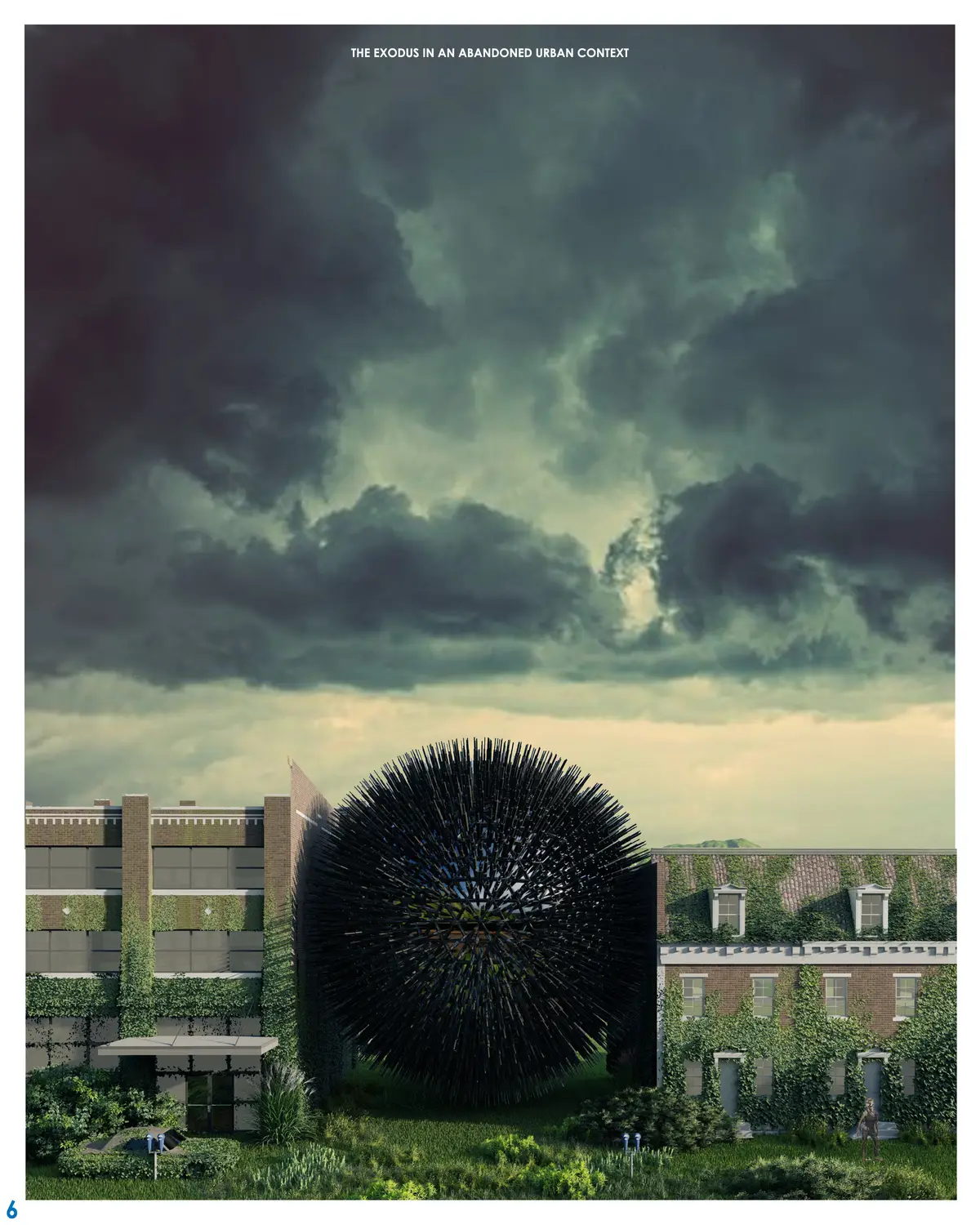
Inspired by the human nature to move, and explore new territories, our proposal addresses stability in instability. Whether people aspire for an opportunity, to move or to reconcile with natural world, or people are forcibly moved due to a natural or a manmade disaster. Our proposal is adaptable to a variety of conditions, based on the location chosen by the user. We achieved that by creating and exterior spikes system inspired by the Sea urchin; this system enhances stability, the spikes are solved mechanically to go in and out, with drills and suction tubes at the end tips. Those spikes however have their own functional needs too, some drill for fresh water, or to stick on steep topographies, or to hold the balloon that carries the home away; this resulted in a neo-futuristic brutal changing form according to the need and context. The interior of is consist of living area and sleeping area, in between mechanical and water recycle and storage on the bottom and a greenhouse for basic organic food on the top. We are proposing a structure that can sustain full potential of human needs. With the ability to move everywhere its user wants.


Popular Articles
Popular articles from the community


Lunar Spiral: Space Architecture Shaped by the Mathematics of the Universe
Lunar Spiral reimagines space architecture through Fibonacci geometry, lunar regolith, levitating habitats, and self-sustaining Moon living.

Hill & Cross Opera: Sculptural Opera House Architecture Shaped by Tallinn’s Landscape and Identity
Hill & Cross Opera reimagines opera house architecture in Tallinn through its sculptural hill, civic plaza, glass wave and a luminous cross.

Conexión: Biophilic Design Reimagines High-Rise Living in Hong Kong
Conexión reimagines high-rise living in Hong Kong through biophilic design, green facades, shared spaces, daylight, water and nature within.

The Musturak Paradise: Senior Living Architecture for a Connected Future in Temara, Morocco
The Musturak Paradise reimagines senior living architecture in Temara via private homes, social spaces, culture, community, and shared care.

Similar Reads
You might also enjoy these articles

Day and Night Park: A Time-Based Urban Newsstand in Beijing
A temporary urban newsstand in Beijing blending travel, light, and reading through poetic colors, compact form, and community-focused design.

Modernist Patio Renovation in El Masnou, Barcelona by Oliver Segura Arquitectura + Cebrià Arquitectura
Modernist patio renovation blending tradition and innovation with a movable pool, leveled floors, and Catalan materials in El Masnou.

Alto Residencial Coop: Cooperative Housing Development in Santiago de Compostela by Carbajo Barrios Arquitectos
A linear cooperative housing complex blending white volumes and perforated metal façades, enhancing community living, natural light, privacy, and urban integration.

Vil Genis School by BPA ARCHITECTURE – Massy, France
Vil Genis School in Massy, France, features sustainable design, south-facing classrooms, community integration, accessible spaces, and modern educational architecture.

Comments (0)
Please login or sign up to add comments
No comments yet. Be the first to comment!