

The Future of Retail: Blending Nature, Commerce, and Community in the Producing and Consuming Marketplace
Discover the Producing and Consuming Marketplace, where architecture meets sustainable retail and community engagement.


The modern consumer's soul yearns for a touch of nature, a connection to the roots of existence. This yearning is not just metaphorical but stands as the cornerstone of the Producing and Consuming Marketplace, an architectural marvel that promises to revolutionize the retail experience. Conceived by Diyar Çevirel and Merve Safa Kılıç, this innovative project has already garnered attention through its nomination for the People's Choice Award in the category of Upcycling Retail. This article delves into the depths of this groundbreaking marketplace design, exploring how it seamlessly integrates production, consumption, and e-retail in an environmentally conscious and user-friendly manner.

Accessibility and Human Flow
At the heart of the Producing and Consuming Marketplace lies the principle of accessibility. By fostering a vibrant relationship with the surrounding roads, the design invites a constant stream of visitors. The clever layout ensures that people are not lost within its confines but are instead guided through the space, allowing them to fully engage with all areas of the marketplace. This circulation is not merely about avoiding congestion; it's a strategic move to enliven the space, making it an inviting hub of activity and interaction.

The E-Retail Evolution
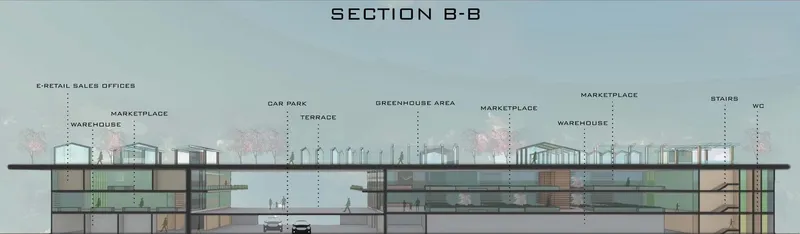
In the digital age, the trust that comes from the tangible experience of shopping is invaluable. The marketplace addresses this by integrating e-retail offices within its structure, creating a symbiosis between online shopping and physical retail spaces. This hybrid model fosters a neighborhood culture that not only serves as warehouse space but also as a community cornerstone. Here, consumer confidence in online shopping is poised to soar, supported by a physical environment that inspires trust and tranquility.

Production Integrated with Consumption
California's abundant arable land has unfortunately led to overproduction and under consumption. The Producing and Consuming Marketplace proposes a solution by incorporating production areas right within the market's layout. Here, visitors can directly engage with the products they consume, from selecting fresh ingredients to utilizing communal kitchens, thereby fostering a deeper connection with food and nature. This design, influenced by the surrounding roadways, ensures that the production space is an organic extension of the marketplace, promoting a sustainable cycle of production and consumption.

Designing for the Era
The marketplace design is a response to the evolving needs of society. In light of the pandemic's impact, there is a heightened need for physical spaces that provide solace and a connection to nature. The Producing and Consuming Marketplace meets this need by designing spaces that are not only conducive to large community gatherings but also offer retreats within the urban landscape. The focus is on creating an environment that supports and strengthens the online shopping experience while drawing people back to communal spaces and the natural world.

The Producing and Consuming Marketplace is not just a structure but a living, breathing entity that embodies the essence of human connection to nature. It's a beacon of innovation that stands at the intersection of ecological awareness, retail evolution, and community building. Through its design, the marketplace heralds a new era of retail—one that respects the soul of humanity and the planet. As Çevirel and Kılıç's vision comes to life, it promises to be a place where life flourishes, products are consumed with consciousness, and communities thrive together.


Popular Articles
Popular articles from the community


Singing Woman: An Opera House That Performs Before the Curtain Rises
Ovidiu Cristian Pavel's conceptual opera house translates Estonia's choral identity into a sculpted waterfront landmark facing the Baltic Sea.


Cube Design Draws an Ecological Corridor Between Two Shenzhen Hills with the Nankai Building
Beside Shenzhen's container docks, the Nankai Building pairs stacked balconies with a climbing green screen to connect two hillsides across its height.

Juan García Correa, John González and Claudia Rueda Sink a Circular Amphitheater into a Manizales Engineering Building
On the La Nubia campus in Manizales, Colombia, the S1 Building folds labs and offices into a hillside of ramped lawns that double as a campus route.

The Amber Palace Opera: A Geological Fiction Surfaces on Tallinn's Baltic Waterfront
Pierre Brillard reimagines a Baltic legend as a public landscape, opera house, and waterfront promenade rooted in Tallinn's coastal identity.

Similar Reads
You might also enjoy these articles

Vereda Arquitetos Renovates a 40-Square-Meter Apartment Inside Niemeyer's Copan Building
A compact unit in São Paulo's most iconic residential tower gets a material overhaul that pairs exposed concrete with bold blue Formica.

Shakur's House: Exposed Brick as an Interior Organiser in a 168 m² Mashhad Residence
Brick moves indoors in this Mashhad residence, where masonry walls, glass partitions and teal planes sequence a compact home without closing it off.

Day and Night Park: A Time-Based Urban Newsstand in Beijing
A temporary urban newsstand in Beijing blending travel, light, and reading through poetic colors, compact form, and community-focused design.

Modernist Patio Renovation in El Masnou, Barcelona by Oliver Segura Arquitectura + Cebrià Arquitectura
Modernist patio renovation blending tradition and innovation with a movable pool, leveled floors, and Catalan materials in El Masnou.

Comments (0)
Please login or sign up to add comments
No comments yet. Be the first to comment!