
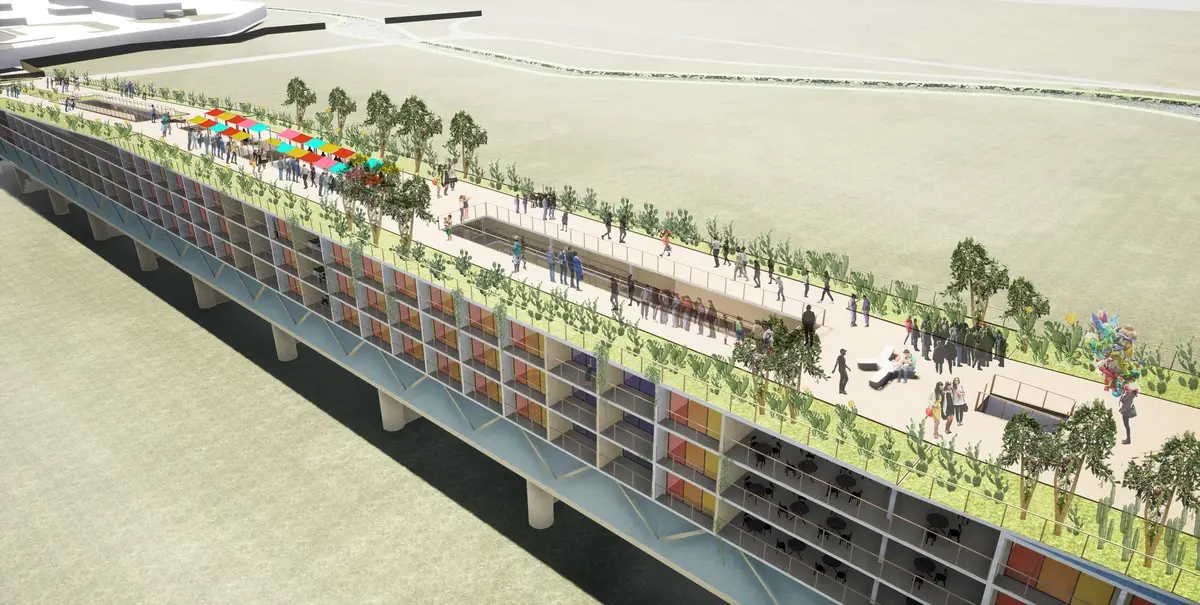
The Green Connector: A Linear Refugee Housing Spine That Farms Its Own Roof
An elevated linear system stacks traffic, courtyard housing and a rooftop farm market to stitch divided urban territory into one shared ground.


Most refugee housing begins with a fence and ends with a waiting room. The Green Connector starts from the opposite premise: that the boundary itself can be built into a place people cross, meet and trade. The project is a linear, elevated structure that works as housing, public infrastructure and productive landscape at once. It treats displacement as a transition toward stable lives rather than a holding pattern, and it gives that transition a physical route.
Designed by 琪琳 李, Shinan Liu, Lu Huilin and Yuming Hou, the proposal was shortlisted in the No Man’s Land competition. The team works from a clear diagnosis: refugee populations are too often isolated from the cities around them. Their answer is a connective urban device that runs across fragmented territory and links people, place and time. A line of inhabited ground replaces a line of separation.
A Boundary Turned Into a Shared Platform
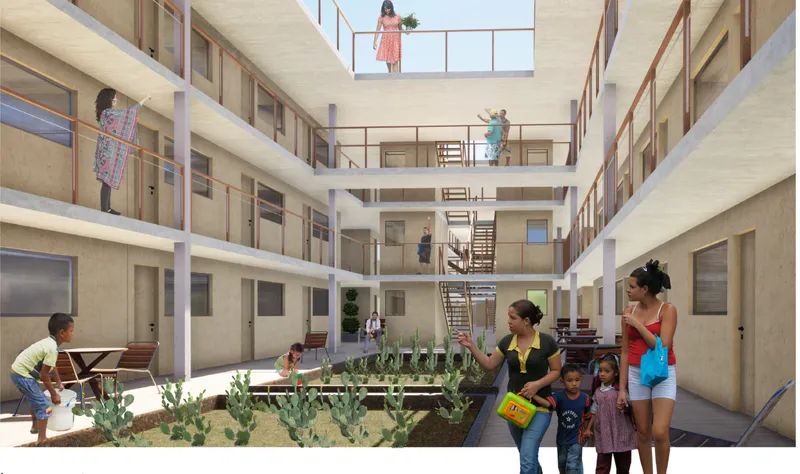
The linear form does the main conceptual work. Physically, it spans divided urban territories. Symbolically, it refuses the logic of the enclave. The architecture is cast as an active mediator, so the building is less an object on a site than a piece of connective tissue. Refugees are not housed beside the city. They live inside a framework that the surrounding community also uses.
This is a sharper position than the usual call for integration. The design commits to a spatial mechanism instead of programming events to bring groups together. Wherever the structure runs, it becomes a common platform, and that commitment shapes every layer below and above it.
Cars Below, Courtyards Between, Gardens on Top
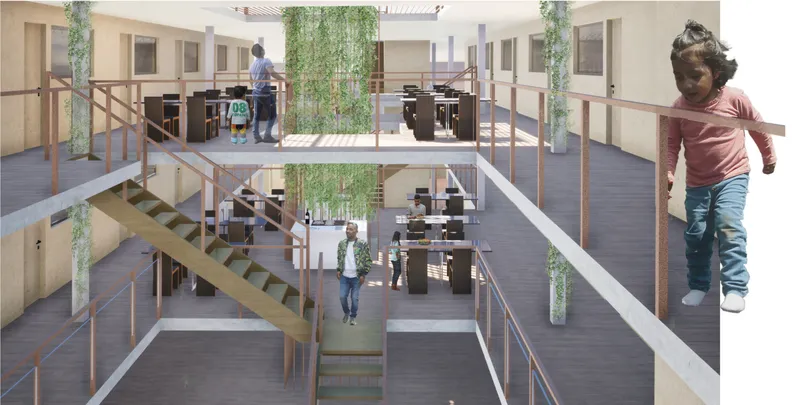
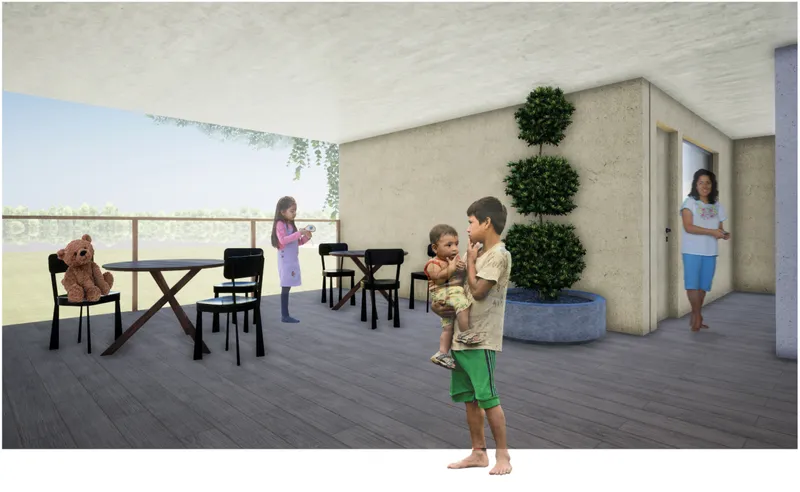
The section is the project's most legible argument. Vehicular and pedestrian circulation are separated, with infrastructure pushed beneath the inhabited levels. That frees the upper floors to run as continuous residential and public environments, uninterrupted by traffic. Mobility serves the building without dictating its life, and the people who live here get safety as a basic condition of daily life rather than something they have to negotiate.
Above the infrastructure, homes are arranged around open courtyards. These semi-private rooms in the plan encourage visibility and casual encounter while keeping a sense of domestic intimacy, which matters for residents rebuilding routines after displacement. Planting inside the courtyards improves microclimatic comfort. Vertical green cores are inserted along the length of the structure, drawing in light and air and giving residents communal points to gather. They read as markers of growth, both ecological and social.
A Roof That Grows Dragon Fruit and Hosts a Market
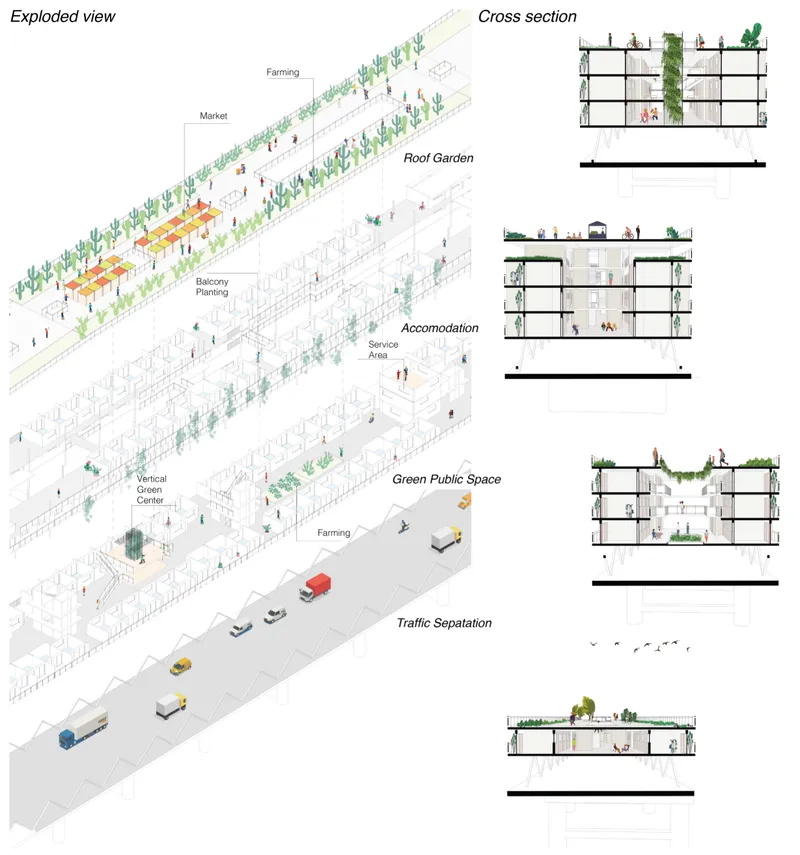
The rooftop is a continuous green corridor of urban farms, market spaces and social gathering zones. It is where residents and visitors share the same ground. The planting palette is specific: edible crops such as dragon fruit, prickly pear and gooseberry support local food systems, and ornamental species give the corridor identity and sensory richness. Cultivation becomes a daily activity built into the living environment, and the building starts to behave like a hybrid of architecture and agriculture.
The market is where this pays off socially. It lets refugees take part in exchange as contributors rather than recipients, so food production turns into income, skills and standing in the local economy. Together with the spaces for skill training and public engagement elsewhere in the scheme, the roof shifts the project's emphasis from shelter to dignity, agency and participation.
Why This Project Matters
The Green Connector shows that refugee housing can be urban infrastructure instead of a parallel world. Its strength is consistency: the layered section, the courtyards, the green cores and the productive roof all serve the same aim of keeping people connected to each other and to the city. Separating traffic below makes the inhabited levels safe, and the shared roof makes integration a daily, spatial fact rather than a policy goal.
The open question, as with any linear megastructure, is how it would be phased and governed over time. That question is worth asking because the proposal is credible enough to raise it. By treating agriculture, commerce and housing as one system, the team has outlined a long-term model in which displaced people help build the future of the place they arrive in, rather than simply waiting there.
View the Full Project
About the Designers
Designers: 琪琳 李, Shinan Liu, Lu Huilin, Yuming Hou
Enter a Design Competition on uni.xyz
uni.xyz runs architecture and design competitions year-round that reward proposals with spatial conviction and real site intelligence.
Project credits: The Green Connector by 琪琳 李, Shinan Liu, Lu Huilin, Yuming Hou No Man’s Land (uni.xyz).


Popular Articles
Popular articles from the community


David Ortega Stacks a Two-Story Mexico City Penthouse Around a Steel Stair and a Pergola-Shaded Roof Terrace
In Colonia Roma, a 300 m² penthouse uses oak joinery, a planted steel stair and a slatted roof pergola to make a new-build apartment feel like a house.

David Macias Steps a Doorless Stone and Plaster House Down a Tropical Colombian Hillside
In the humid hills of Colombia, Threshold House replaces the front door with an open void and terraces its 850 m² down the slope instead of fighting it.

U.GA Architects Wraps an Oval Rooftop Pool in Curved Board-Formed Concrete on Busan's Jeollidan-gil
In Busan's Jeonpo-dong, a 454 m² mixed-use block stacks a neighborhood facility, guest rooms and an oval rooftop pool inside spiraling concrete walls.

Cube Design Draws an Ecological Corridor Between Two Shenzhen Hills with the Nankai Building
Beside Shenzhen's container docks, the Nankai Building pairs stacked balconies with a climbing green screen to connect two hillsides across its height.

Similar Reads
You might also enjoy these articles
Healing Façade: A Modular Chapel System That Restores Ethiopia's Sacred Forests
Winner of the Eco-Chapel competition, this circular timber façade collects water from air to rebuild soil and reforest degraded Ethiopian landscapes.
Kaffeebühnen: Where Coffee Shop Architecture Becomes a Civic Stage in Vienna
A linear sequence of timber boxes, transparent shells, and open yards turns the Viennese café tradition into a public performance space.
Eco Chapel: A Modular Forest Pavilion That Grows Like the Landscape It Protects
Hexagonal timber modules weave through existing trees, turning a chapel into a living system for prayer, education, and reforestation.


Urban Forest: A Vertical Ecosystem for 5,000 Workers in Singapore's Changi Business Park
Radially stacked pods and layered green decks turn a 7-acre plot into 47 acres of ecological workspace projected for 2040.

Comments (0)
Please login or sign up to add comments
No comments yet. Be the first to comment!