
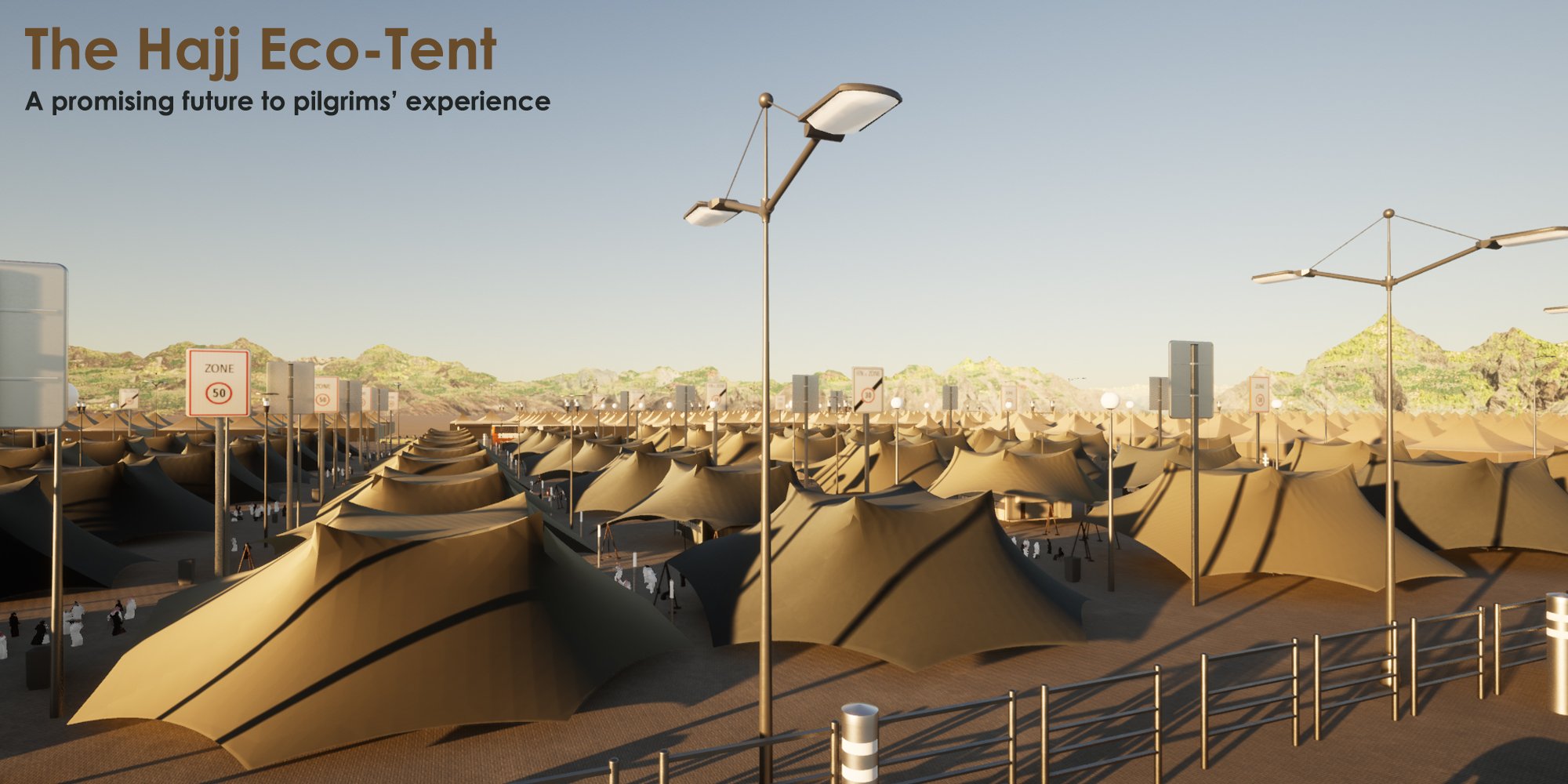
The Hajj Eco-Tent
A promising future to pilgrims’ experience...

The city of Mina is a well-known place for pilgrims, since it is famous by its role in the Hajj pilgrimage and also it is commonly known as the City of Tents due to the huge number of tents found in it. Every year, the city of Makkah in Saudi Arabia receives about three million pilgrims. In the course of a 10-day visit, pilgrims typically spend about four days in Mina. The performance of Hajj pilgrimage is due the eighth and thirteenth day of the Dhul-Hijjah month of the Islamic lunar calendar. It is an annual pilgrimage and one of the most important things that combine all the nationalities and attract all Muslim people from all over the world. Consequently, designers started to handle crowd, services and expand the place to fit the people.
One of the problems of Mina city is that there are about three million of pilgrims that visit that place and it increases every year. Due to the COVID-19, the aim of the design is to make the place fit the same number of people and in the meantime take all the hygienic precautions. Thus, the whole project concern was in this part. It focused on the separation of pilgrims despite the huge number of them. The design of the project is on a square module of 8x8m2. Then, it is clustered of four tents 16x16m2. Each tent consists of ground, first and second floor. Each living module accommodates 26 pilgrims with 26 beds separated by folding wooden partitions to provide more privacy and limit physical contact to prevent the spread of COVID-19. The bed and partitions have a folding mechanism to provide a multifunctional space for pilgrims that is suitable for sleeping, eating, worshipping and communicating with each other. Beds are stored and folded in the wardrobe to maximize the personal space where the pilgrims could pray in their own personal space without interacting with other people. There is a personal built -in wardrobe for each person to keep their belongings safe. All these folding components found in the unit are for giving pilgrims privacy and freedom while practicing religious rituals and also providing group worshipping.
Wall mounted lights for each bed for to be comfortable with an appropriate amount of light that pilgrims need. In addition, there is a marble surfaced packed food counter and storage, disposal pans, sinks for ablution and sanitizing and a coffee bar to drink and relax.
Furthermore, for safety measures a fire-fighting system is applied providing the safest environment for pilgrims. Also, the use of environmental multi-split units for cooling requirements.
The concept of the project is to minimize the physical contact between pilgrims in the living module, although the growth of visitors and to create an ideal environmental quality. This was achieved through applying some environmental treatments such as:
1) The design of clerestory windows to enhance daylight and permit the wind flow beneath the tent structure to the interior. The use of automatic clerestory windows which easily operate with a touch of a button, or automatically in anticipation of needs, not in response to them. A standard sized, touch sensitive wall switch for easy use and a single touch to fully open, fully close or open to an intermediate position. Also, an automatic operation in response to an in-built temperature sensor that allows rooms to be cooled when required while operation in response to pre-set timers which allow windows to be set to operate in anticipation of the building occupant’s daily routine.
2) The exterior walls are made of masonry with thickness 40 cm to delay the heat to be transmitted to the interior (i.e. local available building materials).
3) Light color exterior paint to reflect incident solar radiations on the living module.
4) The tent structure covering the living module where there is a space between the ceiling of the building and the tent so that air can pass in between to promote cooling inside the units. Also, the tents create shade around the unit.
Furthermore, hygienic precautions and treatments are considered as important factors in this project to protect pilgrims from Corona Virus. It starts from the very first moment pilgrims’ step into the living module through several ways which are:
1) The installation of automated temperature and sanitizing unit on the entrance of the unit.
2) The design a shoe holder to avoid theft of personal belongings and avoid spreading of the virus inside the living module.
3) The use of sinks for washing hands, ablution and other needs of pilgrims.
4) The use of treated wooden partitions that are easy to be cleaned and sanitized.
5) The use of nanotechnology self-cleaning tiles for the flooring. With nanotechnology, each tile’s surface is treated with light which creates a protective surface layer that seals any small holes, preventing dirt from penetrating the tile’s surface. The end result is a durable tile that requires no sealing is highly resistant to staining and slipping and is easy to clean. This technique is considered as a solution to the circumstances of Covid-19 virus nowadays, since it is more hygienic than using floor mats or rugs.
6) The use of air-disinfection with UV-light to prevent infection spread by a ventilation and air change technology.
7) The creation of a temporary isolation room to separate the detected patient from the others until the medical team come and diagnose the patient.
Finally, the aim of the project is to create a sustainable and a hygienic environment that satisfies all the needs of the pilgrims with the design of functionality of the space. The design of the tents tried to elevate the pilgrims’ experience by handling crowd through a hygienic and a comfortable barrier-free space that is inclusive and applying different environmental treatments. In this way, the tents of Mina City will be ready for the growth pilgrims in the future.



Popular Articles
Popular articles from the community

Gads Hill Early Learning Center by JGMA: Adaptive Reuse Shaping Community-Focused Educational Architecture
Adaptive reuse transforms fragmented structure into vibrant early learning center with playful façade, natural light, and community-focused sustainable design.
Atelier Macri Concept Store Interior Design by CASE-REAL
Atelier Macri store features a "ko" counter, walnut wood details, cork displays, blending retail, gallery, and seamless customer experiences.


The Ken Roberts Memorial Delineation Competition (Krob)
As the most senior architectural drawing competition currently in operation anywhere in the world, it draws hundreds of entries each year, awarding the very best submissions in a series of medium-based categories.
Treehouse Apartment: A Warm Timber Interior Blending Craft, Play, and Contemporary Living
Warm timber apartment with integrated treehouse, combining natural materials, craftsmanship, and playful design to create a flexible, family-oriented living environment.

Similar Reads
You might also enjoy these articles
Scientific and Educational Monitoring Center of the Yenisei, Krasnoyarsk
Architecture as an instrument for ecological research, education, and environmental awareness along Russia’s largest river.
Development of Andretta Artist’s Village, Palampur, Himachal Pradesh, India
Reimagining Andretta as a living cultural landscape where art, architecture, and community converge to shape a global creative village.
The NEON Culture: Experiential Architecture Shaping Contemporary Urban Life
Exploring how experiential architecture responds to accelerated lifestyles through immersive spaces, adaptive programs, and sensory-driven urban design.

Narwall: Autonomous Offshore Architecture for Extreme Environments
A visionary model of sustainable offshore architecture, Narwall redefines public life, energy autonomy, and resilience in extreme Arctic waters.


Explore Prototyping Competitions
Discover active competitions in this discipline




The Global Benchmark for Architecture Dissertation Awards


Design challenge to reuse E-waste


Packaging challenge - Design meets sustainability
Comments (0)
Please login or sign up to add comments
No comments yet. Be the first to comment!