
The Hard-Drive of the City: A Warsaw Library Structured Like Digital Media
Zachary Pasma designs a future-proof library in Warsaw's Mokotów district, organizing circulation and space like the architecture of a hard drive.


What if a building could be structured the way information is stored on a hard drive? That is the premise behind The Hard-Drive of the City, a speculative public library for Warsaw that treats architectural circulation as a direct analog to digital navigation. Entrances become title sequences. A drone atrium functions as a table of contents. Walkways and ramps serve as an index. The result is a building whose spatial logic is borrowed entirely from the organizational structures of media, old and new.
Designed by Zachary Pasma, the project is sited in Warsaw's Mokotów district, a location chosen for its position within the city's expanding technological network and its proximity to established urban fabric. Warsaw's dual identity as a city of rich architectural heritage and cutting-edge tech ambition makes it a fitting host for a building that asks how libraries might evolve when drones deliver books and cloud storage coexists with physical media. The project proposes a library that is not merely a repository but an architectural hub for community gathering and knowledge exchange.
A Cubic Envelope with Pink Entry Volumes
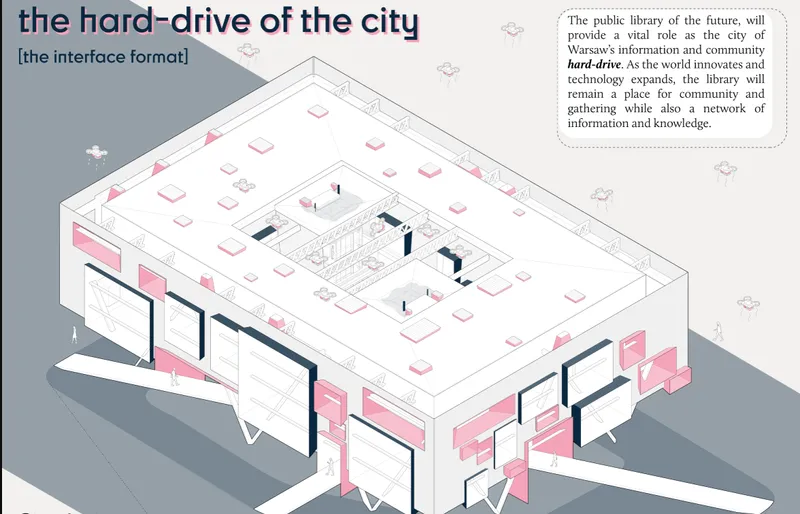
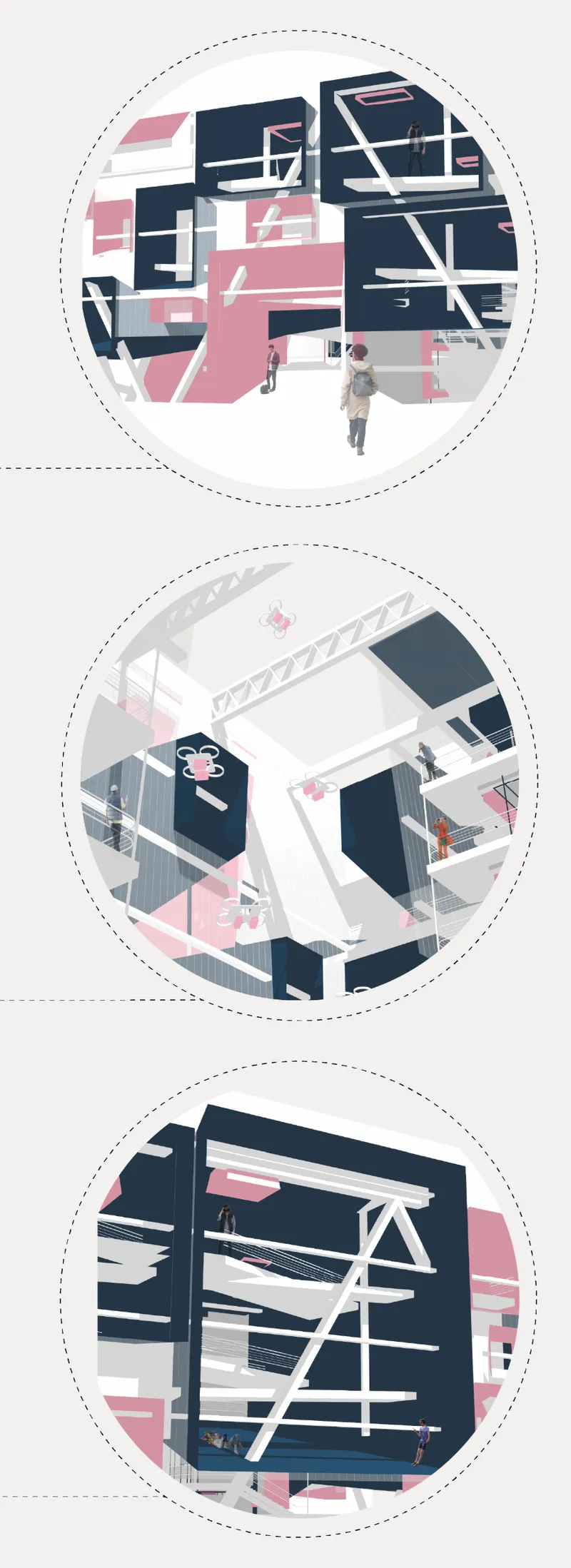
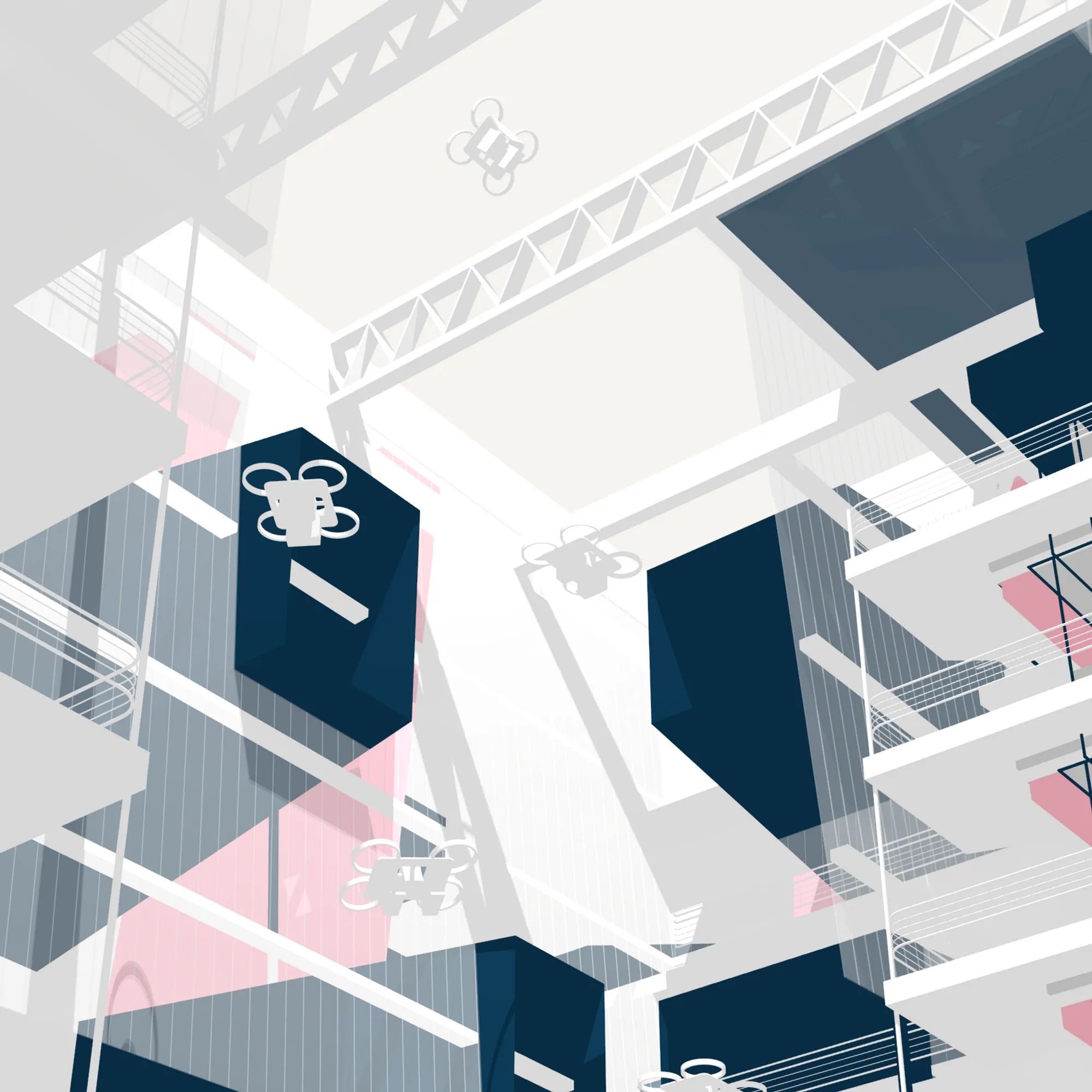
The axonometric drawing reveals the library's formal discipline: a largely cubic envelope with a flat roof, its white perimeter punctuated by pink entrance volumes that protrude outward. These protruding forms are what Pasma calls the "title sequence," functioning simultaneously as entrances and urban passageways that pull the city into the building. The building reads as restrained from the outside, but its sectional ambition is evident in the three circular vignettes that expose diagonal timber bracing, split-level interiors, and figures occupying spaces at varying heights. The gap between the building's calm exterior and its spatially complex interior is the core tension of the design.
Diagonal Timber and Perforated Screens in Section
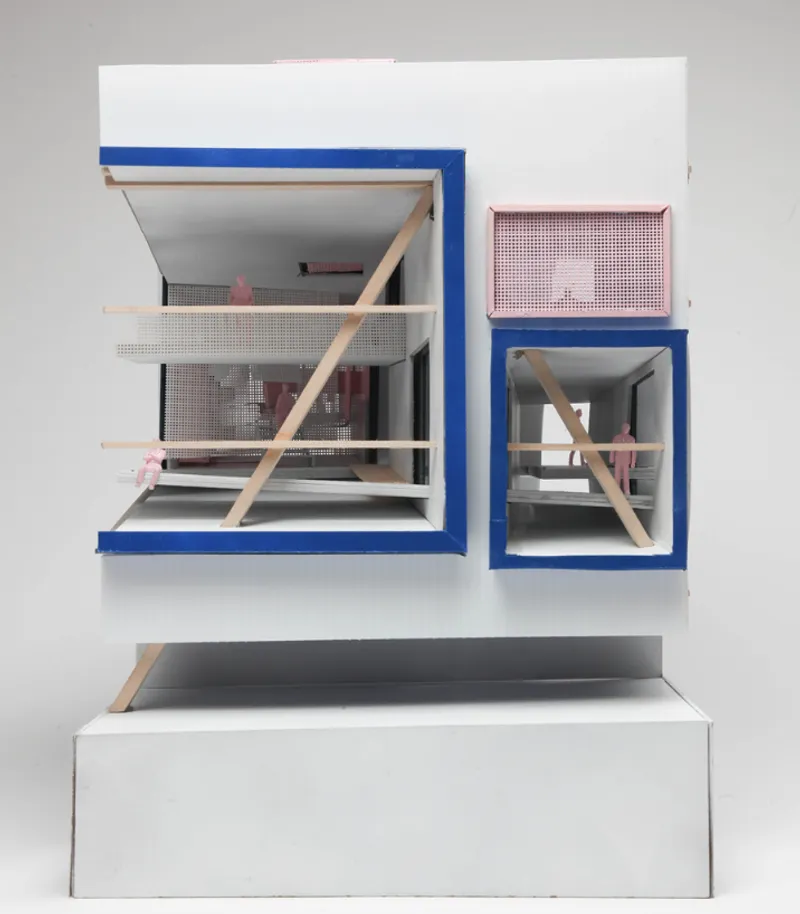
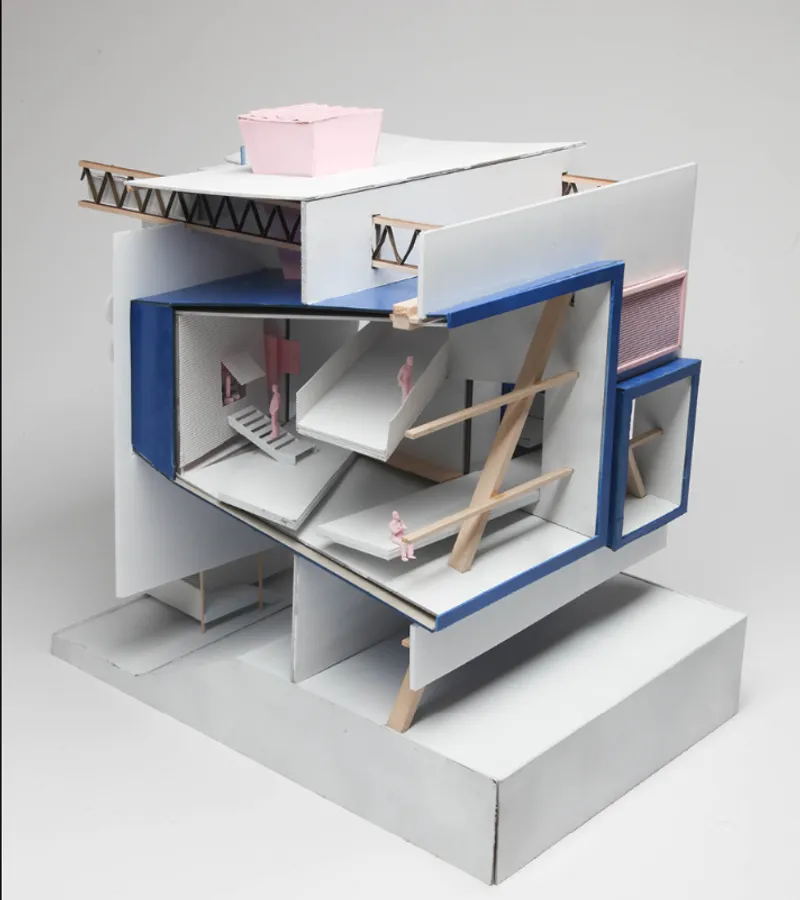
The physical section models are where the project's structural and spatial ideas become tangible. Blue-framed openings carve through white floor plates, while perforated pink screens filter light and views between levels. Diagonal timber struts run across the interior, serving both as structural bracing and as a visible expression of the building's organizational logic. One model cutaway exposes staggered floor plates connected by diagonal timber stairs, with pink figures populating the interstitial spaces between levels. These are not conventional floors stacked on top of one another; they are offset, creating mezzanines and double-height voids that recall the layered, non-linear way information is accessed on a digital device.
The choice of timber for the diagonal structural members is notable. Against the white planes and perforated metal screens, the warm materiality of wood introduces a tactile quality that resists the project's otherwise techno-futurist agenda. It is a smart move: a library that argues for the continued relevance of tangible media should itself feel tangible.
Zigzag Trusses and the Drone Atrium
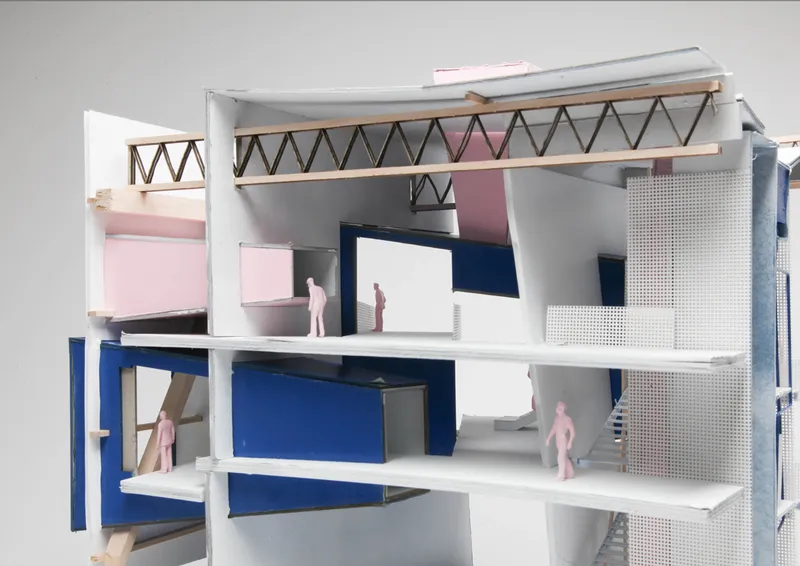
A key section model reveals a zigzag roof truss spanning the building's upper volume, sheltering the split-level interior spaces below. Perforated metal screens appear again here, mediating between zones that Pasma has programmed as varied interactive media spaces. The drone atrium, described as the building's "table of contents," is the vertical core through which drones facilitate media transfer across the city. Pasma argues that while cloud storage continues to advance, tangible media remains essential for historical preservation, and the drone infrastructure is designed to circulate physical books, newspapers, and digital media packages between the library and Warsaw's broader urban network.
Exploded Layers Reveal the Building's Modular Logic
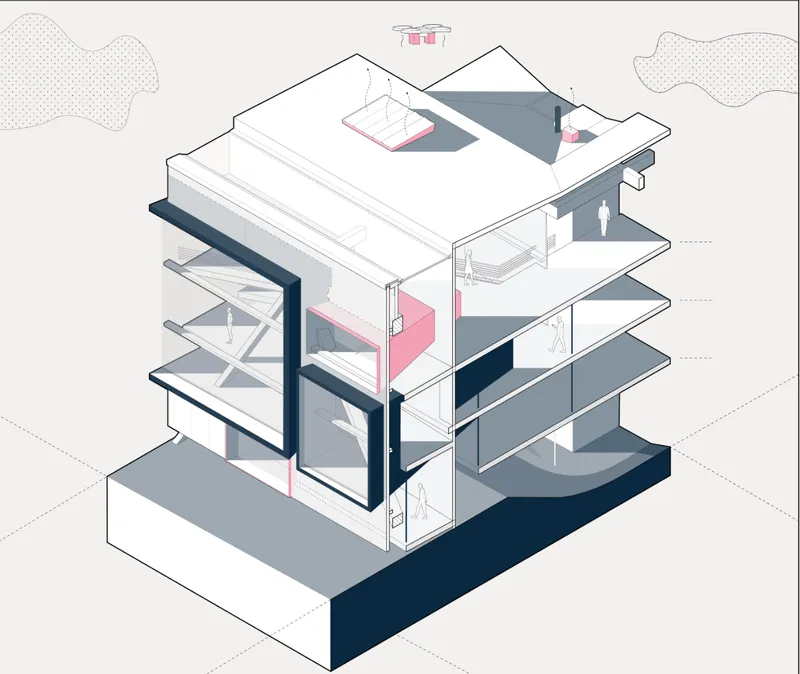
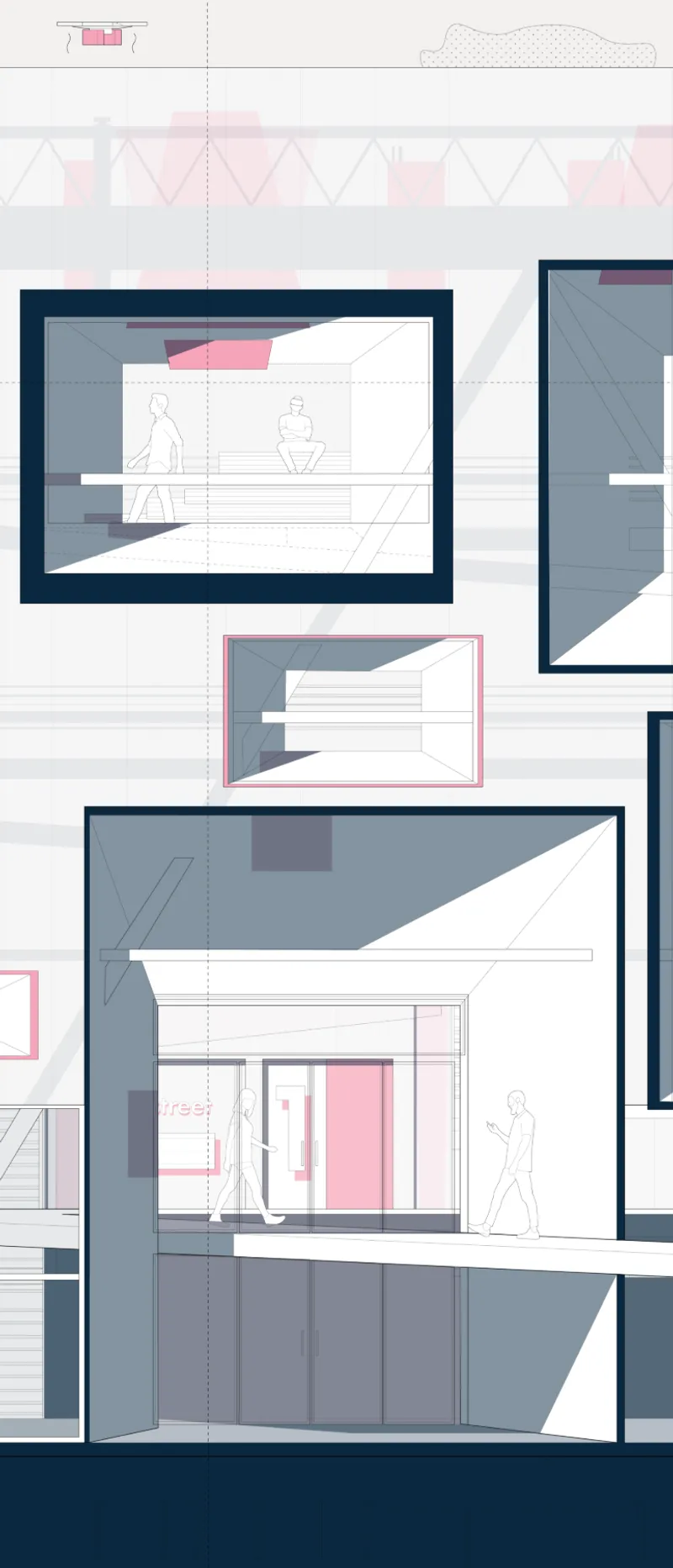
The exploded axonometric drawing pulls the building apart to show its constituent systems: layered floor plates, pink volumes, and diagonal bracing held within the cubic envelope. The modular building blocks and layered skins for thermal insulation are legible here as distinct systems that can, in theory, be reconfigured as the library's program evolves. The accompanying section drawing reinforces this reading, showing multi-level interior spaces with mezzanines, gray floors, and pink accent walls distributed across the full height of the building. The pink elements, consistent across every representation, function as a graphic code for the spaces where users interface most directly with information and with each other.
The fundamental premise of Pasma's organizational framework is that the elements structuring information access have not changed in a century, even as the devices used to interface with that information have transformed completely. Entrances, elevators, stairs, rooms, walkways, and ramps: these are the constants. The project's architectural composition maps each of these constants to a part of a book or a file system. The "info section" houses varied interactive media spaces. The "index" is a network of walkways and ramps. This is not mere metaphor; the spatial sequence is designed to mirror the experience of navigating digital media formats.
Why This Project Matters
The Hard-Drive of the City is valuable less as a literal proposal for drone-integrated libraries and more as a rigorous exercise in analogical thinking. By mapping the structure of digital media onto physical space, Pasma forces a productive question: if the organizational principles of information haven't changed, what exactly should change about the buildings that house it? The answer the project offers is not about form or style but about infrastructure, circulation, and adaptability. The modular construction, the drone pathways, and the split-level interiors are all strategies for a building that can absorb technological change without losing its spatial coherence.
Warsaw's Mokotów district gains, in this proposal, a building that treats the library not as a static monument to knowledge but as a dynamic network node. The physical models, with their diagonal timber, perforated screens, and staggered floors, demonstrate that speculative architecture can still be grounded in material specificity and structural logic. Pasma's project reminds us that the most future-proof buildings are often those that take their cues not from the latest technology but from the enduring patterns of how people seek, organize, and share information.
View the Full Project
About the Designers
Designer: Zachary Pasma
Enter a Design Competition on uni.xyz
uni.xyz runs architecture and design competitions year-round that reward proposals with spatial conviction and real site intelligence.
Project credits: The Hard-Drive of the City, by Zachary Pasma.


Popular Articles
Popular articles from the community


Riyadh For All: Intergenerational Urban Design for Active Aging in Rabat
Riyadh For All reimagines urban design in Rabat with intergenerational co-living, adaptive courtyards, and Moroccan cultural exchange today.

The Earth Pod: 3D Printed Homes for Resilient Refugee Communities
The Earth Pod reimagines refugee housing through 3D printed homes made from clay, combining resilience, self-sufficiency, and rapid shelter.

Lunar Spiral: Space Architecture Shaped by the Mathematics of the Universe
Lunar Spiral reimagines space architecture through Fibonacci geometry, lunar regolith, levitating habitats, and self-sustaining Moon living.

Conexión: Biophilic Design Reimagines High-Rise Living in Hong Kong
Conexión reimagines high-rise living in Hong Kong through biophilic design, green facades, shared spaces, daylight, water and nature within.
Similar Reads
You might also enjoy these articles

Bao Huynh Watercolor Atelier: A Serene Art Retreat in Hội An
Bao Huynh Watercolor Atelier in Hội An blends multifunctional art spaces, sustainable design, local materials, and family-friendly living in a serene environment.

Atelier Macri Concept Store Interior Design by CASE-REAL
Atelier Macri store features a "ko" counter, walnut wood details, cork displays, blending retail, gallery, and seamless customer experiences.

Manuel Vargas Izquierdo Stadium and High-Performance Sports Center: Architectural Excellence in Jalpa de Méndez
The Manuel Vargas Izquierdo Stadium blends sustainable design, inclusive sports facilities, and cultural-inspired architecture, revitalizing Jalpa de Méndez’s public spaces.

KAKR Buluh Awar Hall: Revitalizing Community and Ecology Through Bamboo Architecture
Community built bamboo hall revitalizes Buluh Awar village, empowering youth, restoring ecology, celebrating vernacular craftsmanship through sustainable architecture and culture.
Explore Graphic Design Competitions
Discover active competitions in this discipline


Design a brochure to showcase the effects of the technosphere

Challenge to illustrate ‘A tale of Two Cities’

Deconstructivism - Illustration Design Challenge
Comments (0)
Please login or sign up to add comments
No comments yet. Be the first to comment!