
Hombre de Piedra Drops Shipping Containers into a 200-Year-Old Cattle Shed in Depopulated Rural Spain
In Medinilla, a village of 78 inhabitants, prefabricated modules transform an abandoned stone barn into an A-rated home.


Medinilla, in the province of Ávila, had 3,000 inhabitants in the 1960s. It now has 78. The labor force that once built with local stone is gone, the trades that maintained these structures have largely vanished, and the buildings themselves are collapsing into ruin. Hombre de Piedra Arquitectos, led by Juan Ignacio Vilda Marín, looked at a 200-year-old Castilian cattle shed in this context and asked a pointed question: if you can no longer build conventionally in a place like this, what construction system actually works?
Their answer was shipping containers, fabricated 600 kilometers away in Utrera, Sevilla, by the manufacturer CIMPRA, then trucked to site and lowered by crane through the roof of the existing stone shell. The result, completed in 2024 and winner of the Advanced Rehabitech Awards that same year, is The Hidden House: a home that never was a home, slotted with factory-made modules that treat the ancient masonry not as a wall to be patched but as an archaeological envelope to be preserved. The project is less about aesthetics and more about logistics, economics, and the question of whether inland Spain's built heritage can survive at all.
A Village Emptying Out
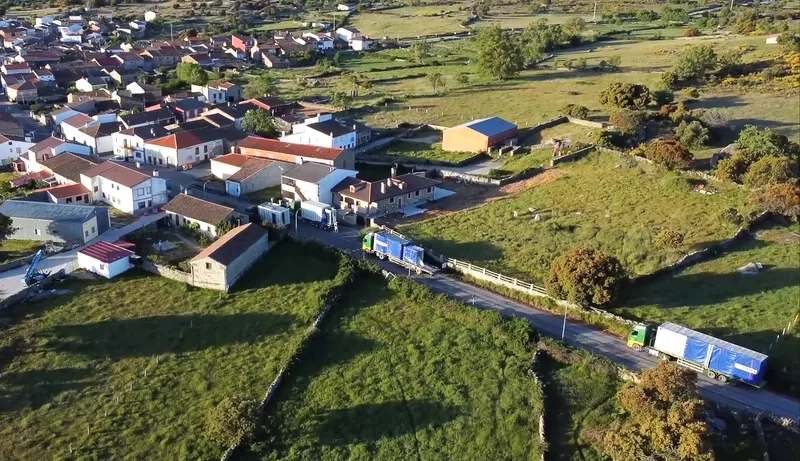
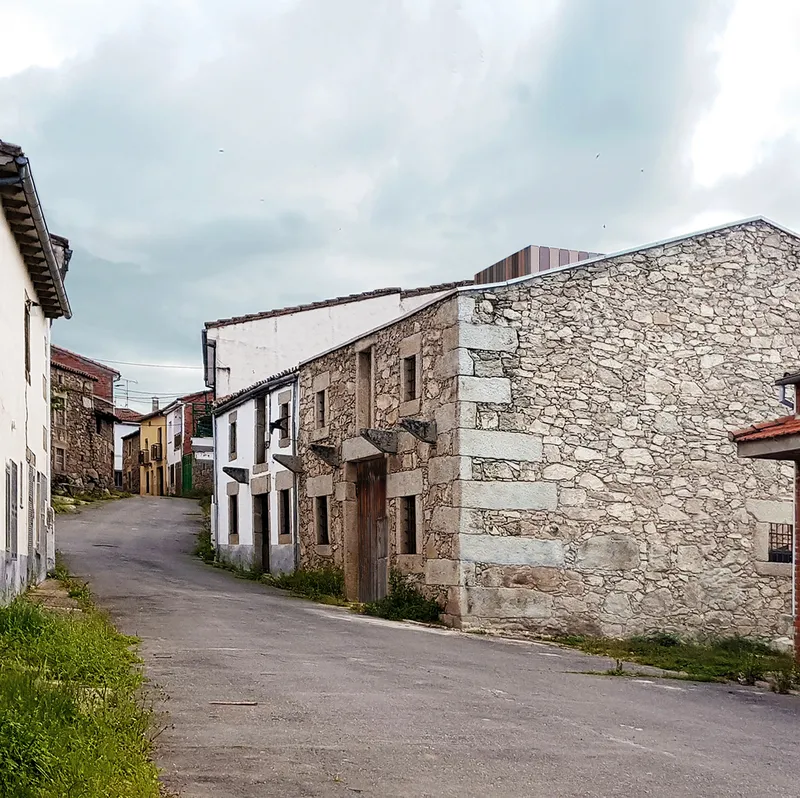
Understanding the house requires understanding the village. Medinilla is one of thousands of settlements across Spain's interior that have been hemorrhaging population for decades. The aerial view reveals the scale of the problem: a tight cluster of stone buildings along a single road, surrounded by open fields, with no visible construction activity anywhere. The streets are narrow and quiet. The facades are a mixture of stone and whitewash, many of them showing their age without anyone left to maintain them.
The architects frame their intervention explicitly as a test case for rural revitalization. If adaptive reuse in a place like this requires importing a full construction crew and all materials from the city, the economics collapse. The shipping container module was chosen precisely because it represents the maximum volume that can be transported by conventional road, making it a logistical unit as much as an architectural one.
The Ruin as Found
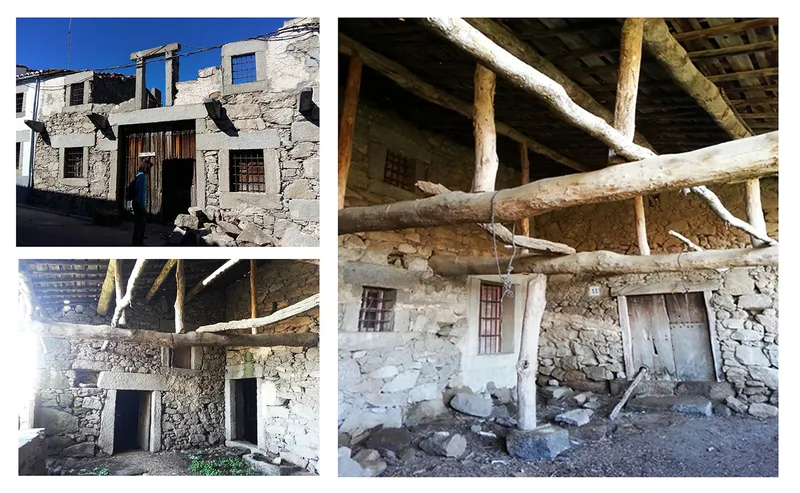
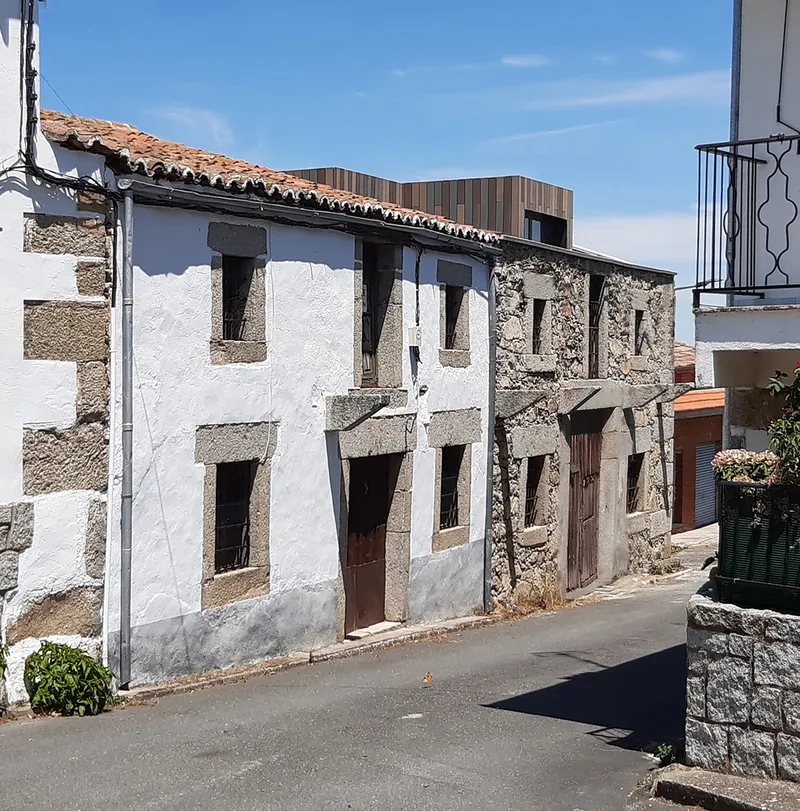
The before images are sobering. The cattle shed had deteriorated badly: timber beams sagging, interior floors collapsed, stone walls still standing but barely. This was never a residence. It had no plumbing, no insulation, no subdivision into rooms. It was a barn, built with the blunt logic of agricultural architecture, thick stone walls holding up a timber roof over livestock. The decision to preserve this shell rather than demolish it is the project's most provocative move.
Hombre de Piedra describes the approach as "almost archaeological," and the phrase is apt. The stone walls are not restored to some imagined original condition. They are stabilized and left exposed, their weathering and patina treated as qualities rather than defects. The new modules inserted within them are legible as foreign objects, deliberately distinct in material and geometry. There is no pretense that old and new are the same thing.
Factory to Site: The Prefabrication Logic
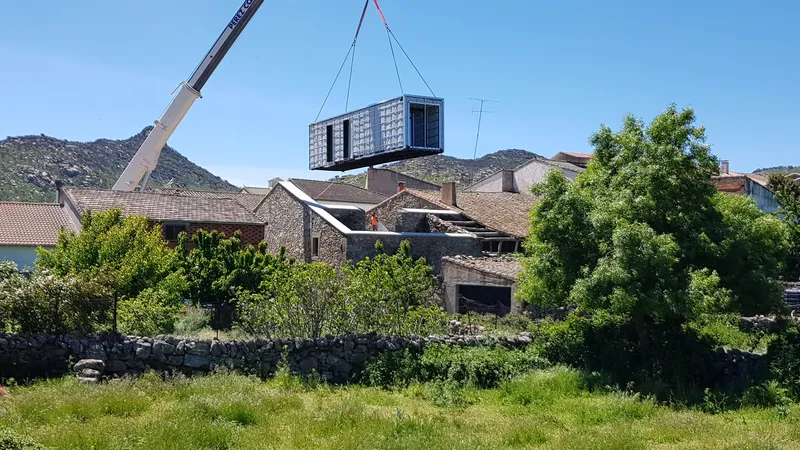
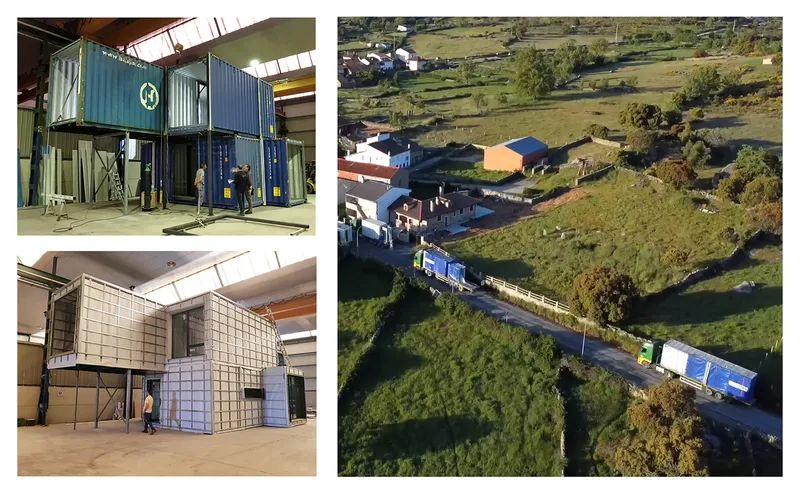
The construction sequence tells the real story. Modules were built by CIMPRA in their Sevilla workshop using HANJIN shipping containers as the structural chassis, fitted out with ROCKWOOL insulation, Knauf interior finishes, Saint Gobain glazing, and Soprema waterproofing membranes. Once complete, they were loaded onto trucks, driven across Spain, and craned into position through the open top of the stone shell. The image of a prefabricated box swinging above the village rooftops, framed by green hills, is both surreal and entirely practical.
This is not container architecture as lifestyle branding. It is container architecture as the only viable construction method in a place where there are literally not enough workers to build conventionally. The off-site manufacturing model sidesteps the labor shortage entirely, concentrating skilled work in a factory environment and reducing on-site activity to assembly and connection. The result is a house that achieved an A energy rating, which would be noteworthy in any context but is remarkable for a retrofit of a 200-year-old barn.
Stone Meets Timber and Metal
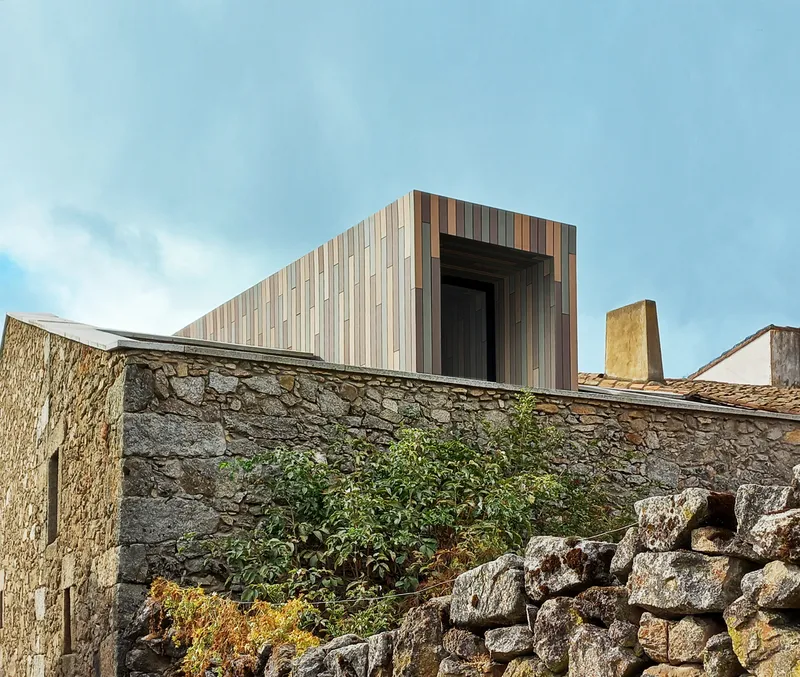
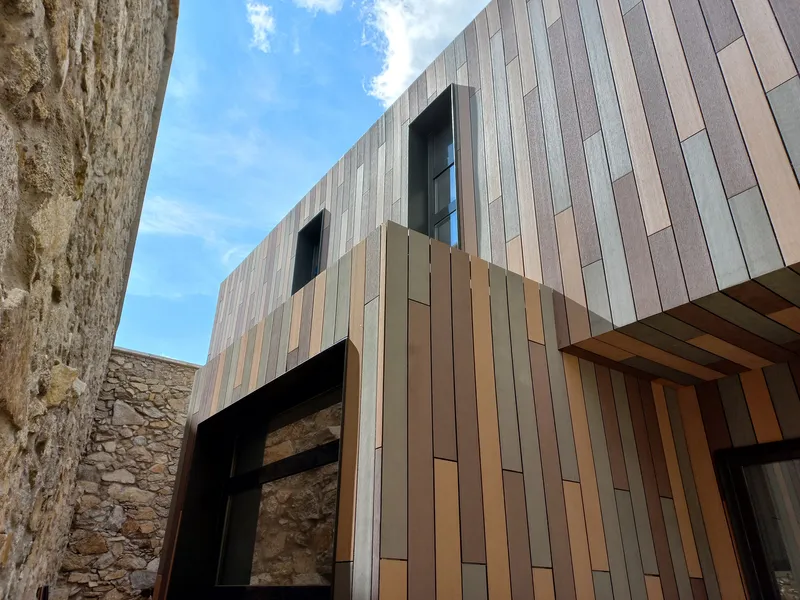
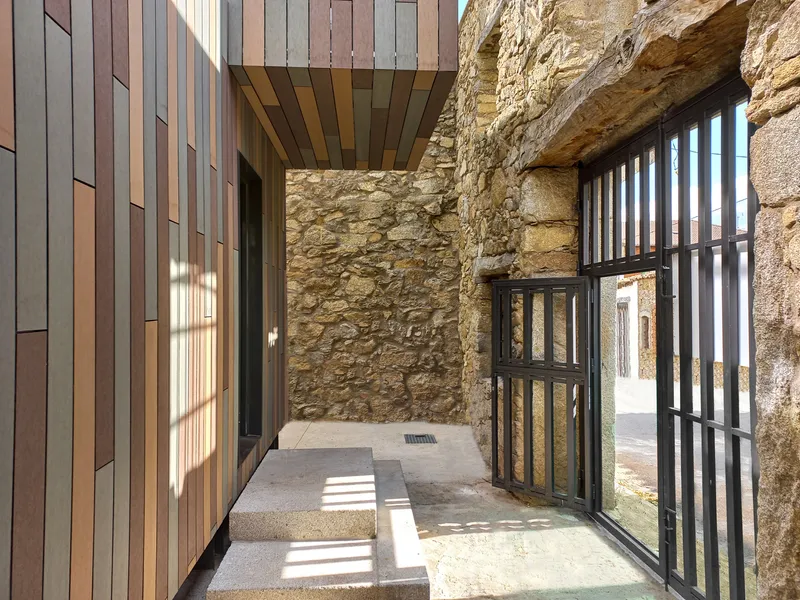
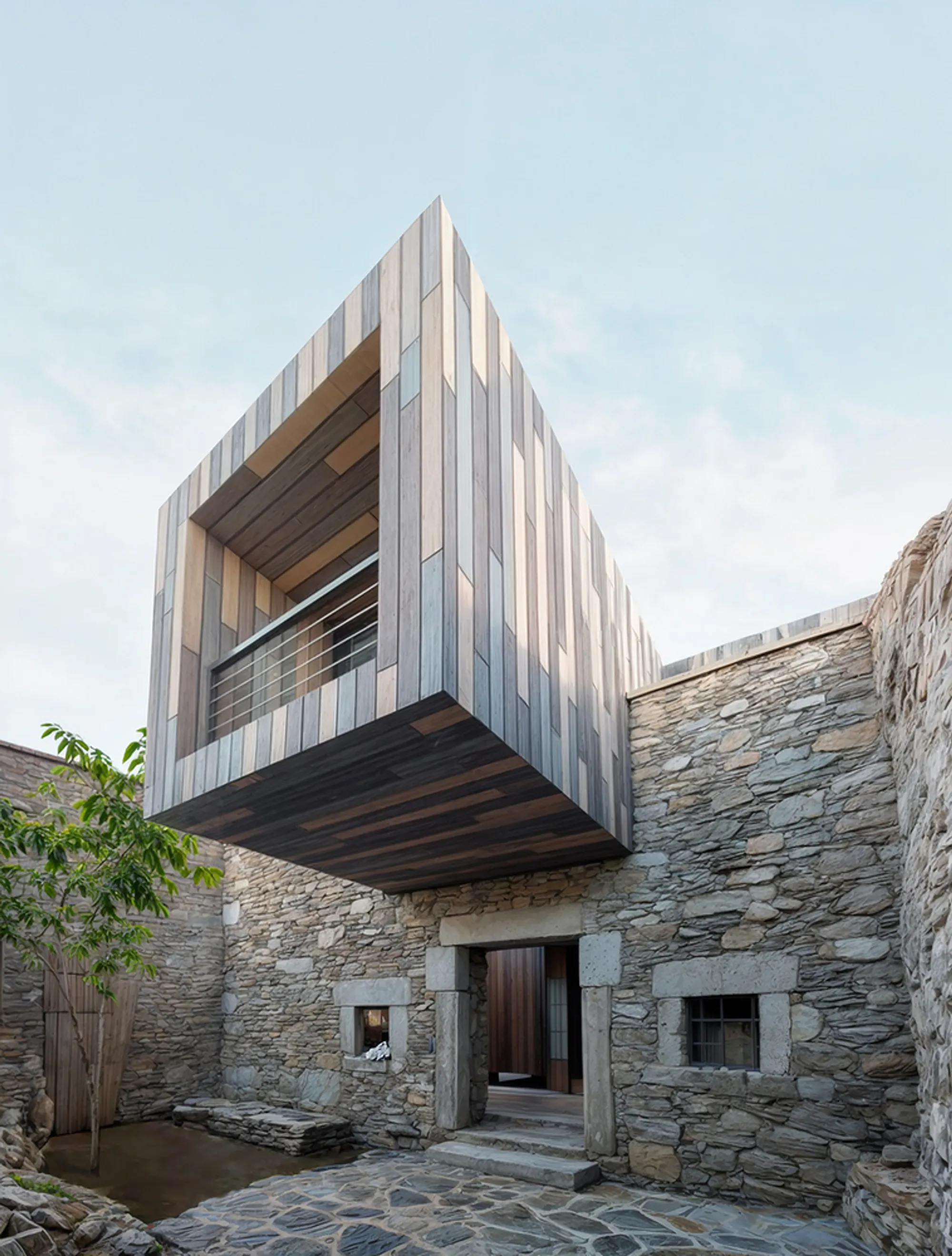
From the street, the intervention reads as a careful dialogue of surfaces. The upper volume projects above the original stone walls, clad in variegated timber planks that will weather over time to gray, gradually closing the chromatic gap between new and old. At ground level, a secondary palette of vertical metal panels in bronze and grey tones creates a more industrial register beside the rough masonry. The effect is layered rather than jarring: you see stone, then metal, then timber, each material occupying its own stratum.
The entry passage between the timber volume and the stone wall is handled with particular precision. A metal-framed gate filters afternoon light into a threshold that belongs neither fully to the old building nor to the new one. These in-between zones are critical to the project's success. They prevent the containers from feeling like intrusions crammed into a ruin and instead establish a measured spatial sequence from exterior to interior.
The Courtyard as Mediator
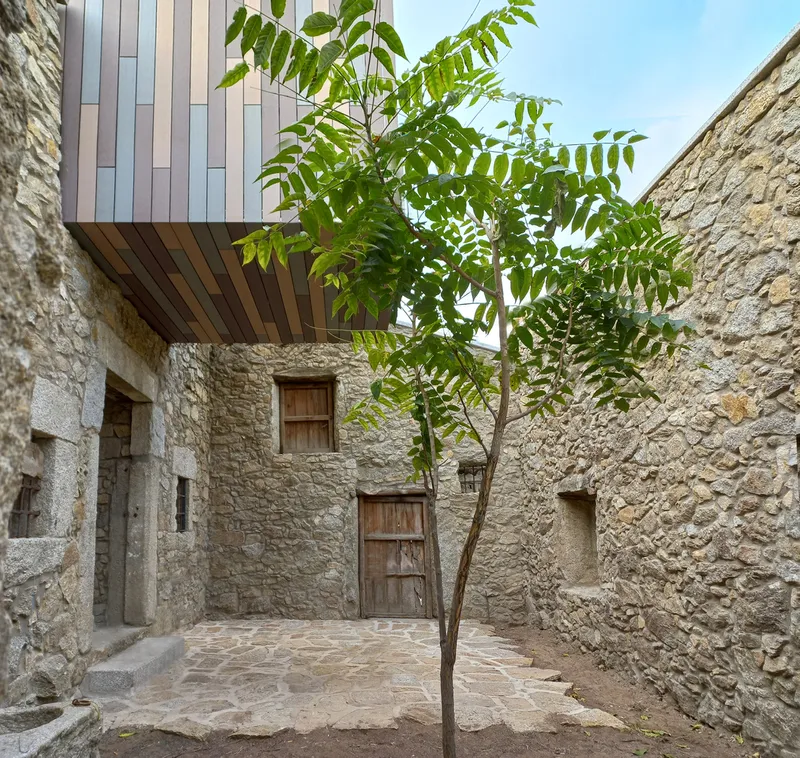
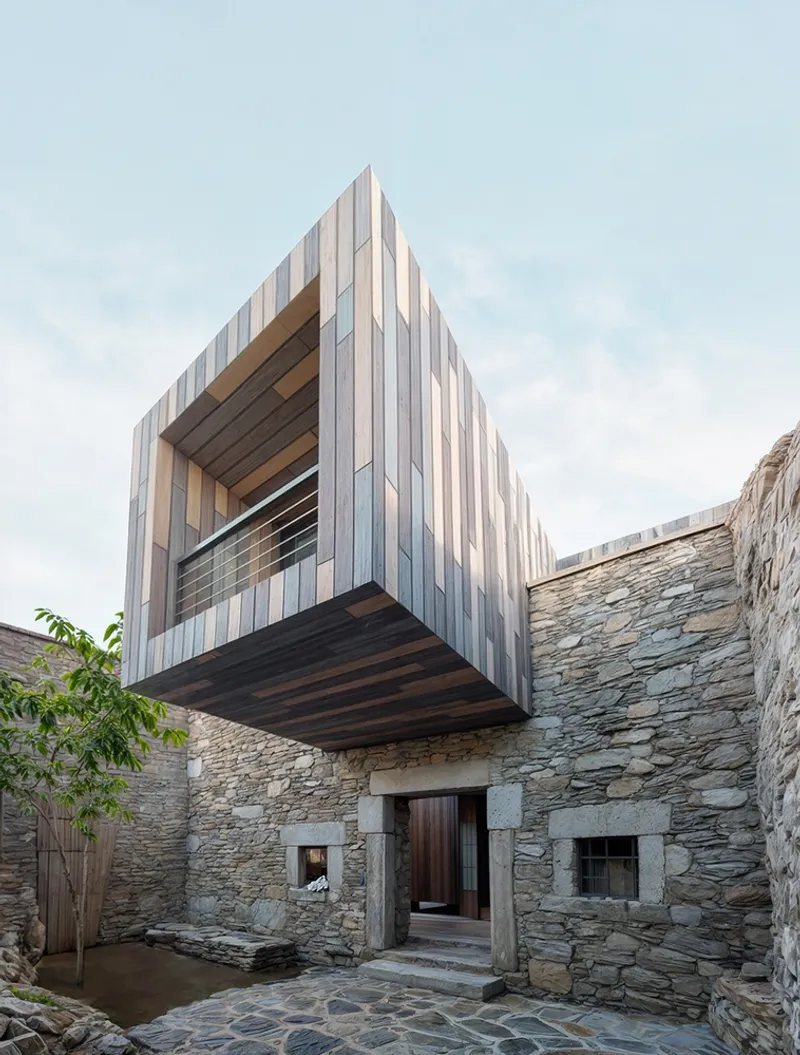
Between the stone shell and the inserted modules, the architects carved out courtyards that function as climate buffers, light wells, and emotional decompression chambers. The most striking of these is paved in stone and planted with a single young tree beneath the cantilevered timber volume. The cantilever is bold: the module floats above the courtyard with its soffit exposed, casting the space below into dappled shade. It is simultaneously a structural statement and a generous spatial gift, creating an outdoor room within the envelope of the old building.
These transition spaces do real environmental work. They draw ventilation through the house, bring daylight deep into the plan, and establish a visual connection to the landscape beyond the stone walls. They also serve a subtler purpose: by holding old and new apart, they allow each to be read on its own terms. The masonry does not need to perform as a modern wall, and the containers do not need to pretend they are vernacular.
Seen from Above and Beyond
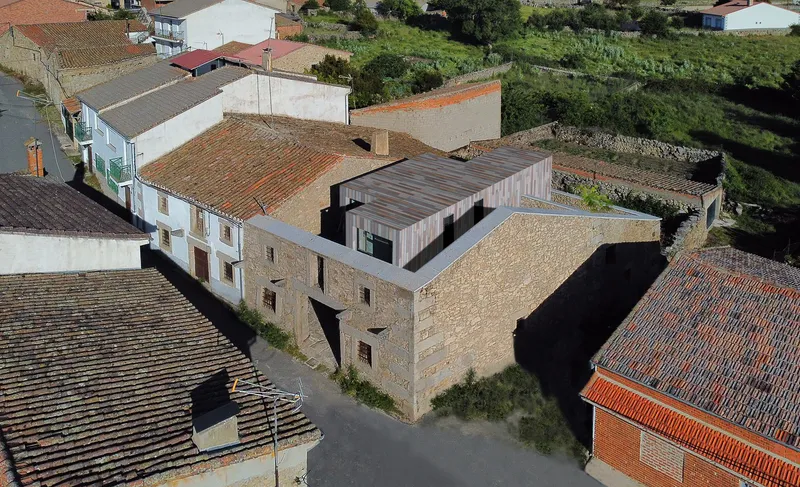
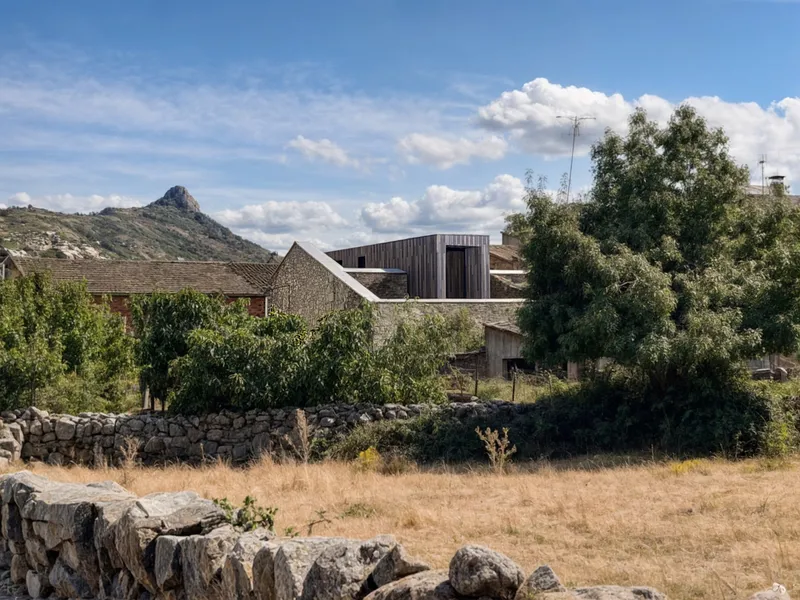
The aerial photograph reveals how the timber-clad volume nests within the cluster of tiled roofs and stone buildings. It is clearly a different animal, its geometry more precise, its surfaces smoother, but its scale is calibrated to sit within the grain of the village rather than above it. From a distance, the volume reads as a warm, woody extrusion rising above surrounding walls and trees, present but not dominating.
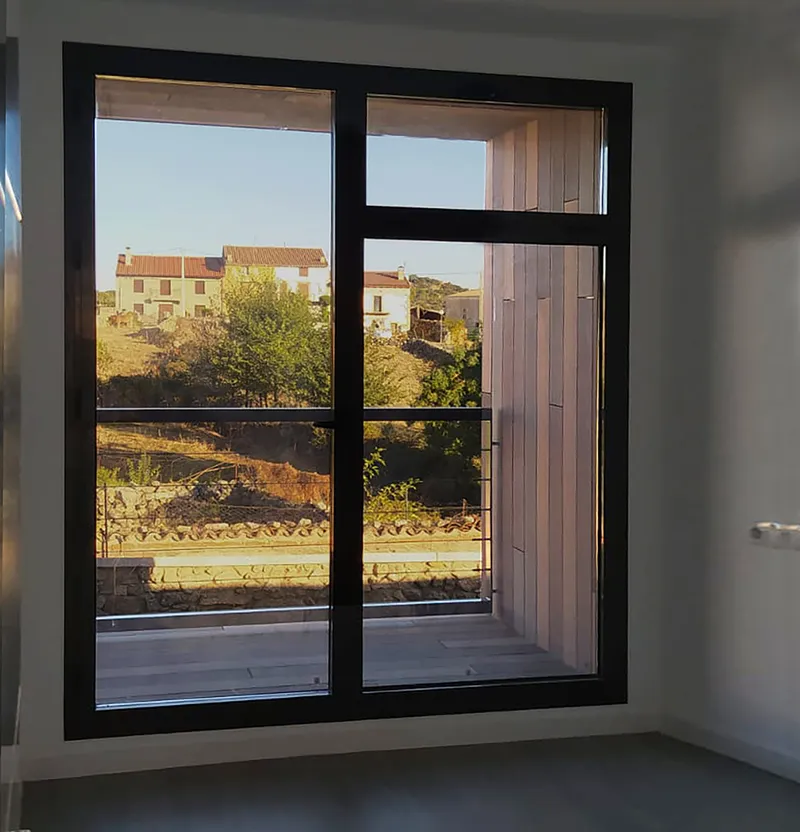
The view from inside through a black-framed window toward the metal-clad facade and neighboring houses is telling. It locates the inhabitant simultaneously in two centuries: looking through contemporary detailing at a landscape of ancient stone. The warmth of the afternoon light in this image is earned, not styled. It comes from the real orientation of the building and the real materiality of the village around it.
Plans and Drawings
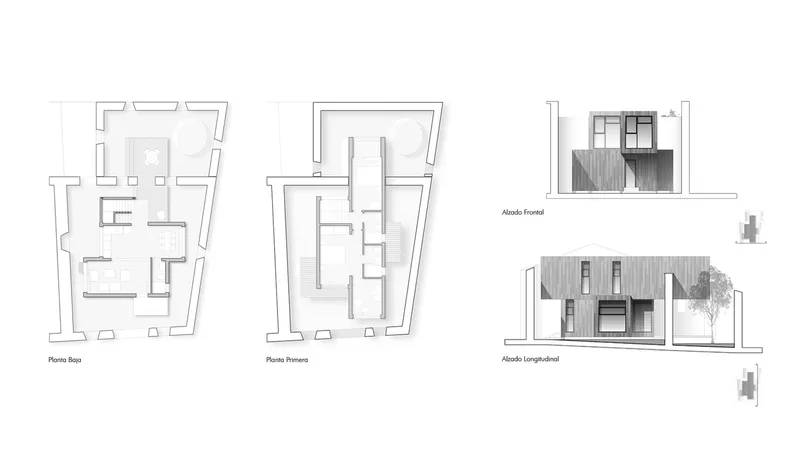
The floor plans and elevation drawings make legible what the photographs suggest: the modular units are organized within and around the stone perimeter walls, with courtyards punctuating the plan at strategic intervals. The elevation confirms the timber cladding as a continuous skin wrapping the upper volume, distinct from the masonry base. The drawings also reveal the compactness of the scheme. This is not a sprawling country house but a tightly organized residence that extracts maximum livability from the footprint of a cattle shed.
Why This Project Matters
The Hidden House matters because it is honest about its constraints. Rural depopulation is not a design problem that can be solved with a beautiful renovation. It is an economic and demographic crisis that makes conventional construction impossible in the very places where the built heritage is most vulnerable. By adopting a prefabrication strategy rooted in industrial logistics rather than architectural fashion, Hombre de Piedra demonstrates a replicable model. The shipping container is not the point. The point is that the entire house was built in a factory where workers, tools, and quality control exist, then delivered to a place where they do not.
The project also avoids the trap of nostalgic restoration. The old stone walls are not rebuilt to look new. The new modules are not clad to look old. The two systems coexist with mutual respect, separated by courtyards that acknowledge the 200-year gap between them. In a country where thousands of rural structures face identical fates, abandoned and deteriorating with no local means to save them, this approach offers something rare: a pragmatic, economically viable, and architecturally rigorous path forward. The 2024 Rehabitech Award recognized as much, but the real test will be whether this model propagates to the next village, and the one after that.
The Hidden House, Medinilla, Ávila, Spain. Designed by Hombre de Piedra Arquitectos (Juan Ignacio Vilda Marín). Completed 2024. Prefabrication by CIMPRA, Utrera, Sevilla.
About the Studio
Share Your Own Work on uni.xyz
If projects like this are the kind of work you want to make, uni.xyz is a place to publish your own, find collaborators, and enter design competitions.



Popular Articles
Popular articles from the community


Hill & Cross Opera: Sculptural Opera House Architecture Shaped by Tallinn’s Landscape and Identity
Hill & Cross Opera reimagines opera house architecture in Tallinn through its sculptural hill, civic plaza, glass wave and a luminous cross.

Riyadh For All: Intergenerational Urban Design for Active Aging in Rabat
Riyadh For All reimagines urban design in Rabat with intergenerational co-living, adaptive courtyards, and Moroccan cultural exchange today.

Lunar Spiral: Space Architecture Shaped by the Mathematics of the Universe
Lunar Spiral reimagines space architecture through Fibonacci geometry, lunar regolith, levitating habitats, and self-sustaining Moon living.

Co-life: Sustainable Architecture for Age-Friendly Community Living
Co-life reimagines sustainable architecture for seniors through courtyards, rammed earth, shared gardens, and spaces designed for belonging.


Similar Reads
You might also enjoy these articles


Hodi-Mandai Geram
Project Function: Preservation and revitalization of the Intangible heritage and socio-spatial identity of the Hodi by Housing, Cultural Memory Center, Sacred Grove, landscape, local tourism economy


Olio Towers: A Mid-Rise for Performers That Fuses Housing, Rehearsal, and Stage
Located blocks from Houston's Theater District, this modular tower stacks living units around a central performance atrium.

Oasis: Modular Green Housing Carved into Dhaka's Urban Fabric
A shortlisted Plugin Housing entry reclaims unauthorized settlements in Dhaka with stepped concrete volumes, green roofs, and ventilation-driven design.

Black Hole: A Floating Megastructure for the Post-Physical Era
Emiliano Mazzarotto envisions a spherical, self-scaling arena where e-sports, digital hotels, and holographic stadiums replace traditional public space.


Explore Architecture Competitions
Discover active competitions in this discipline



Challenge to reimagine the Iron Throne


Photograph architecture without architects


Illustrate the lost glory of Angkor Wat - Render Challenge


Design challenge to reuse E-waste
Comments (0)
Please login or sign up to add comments
No comments yet. Be the first to comment!