
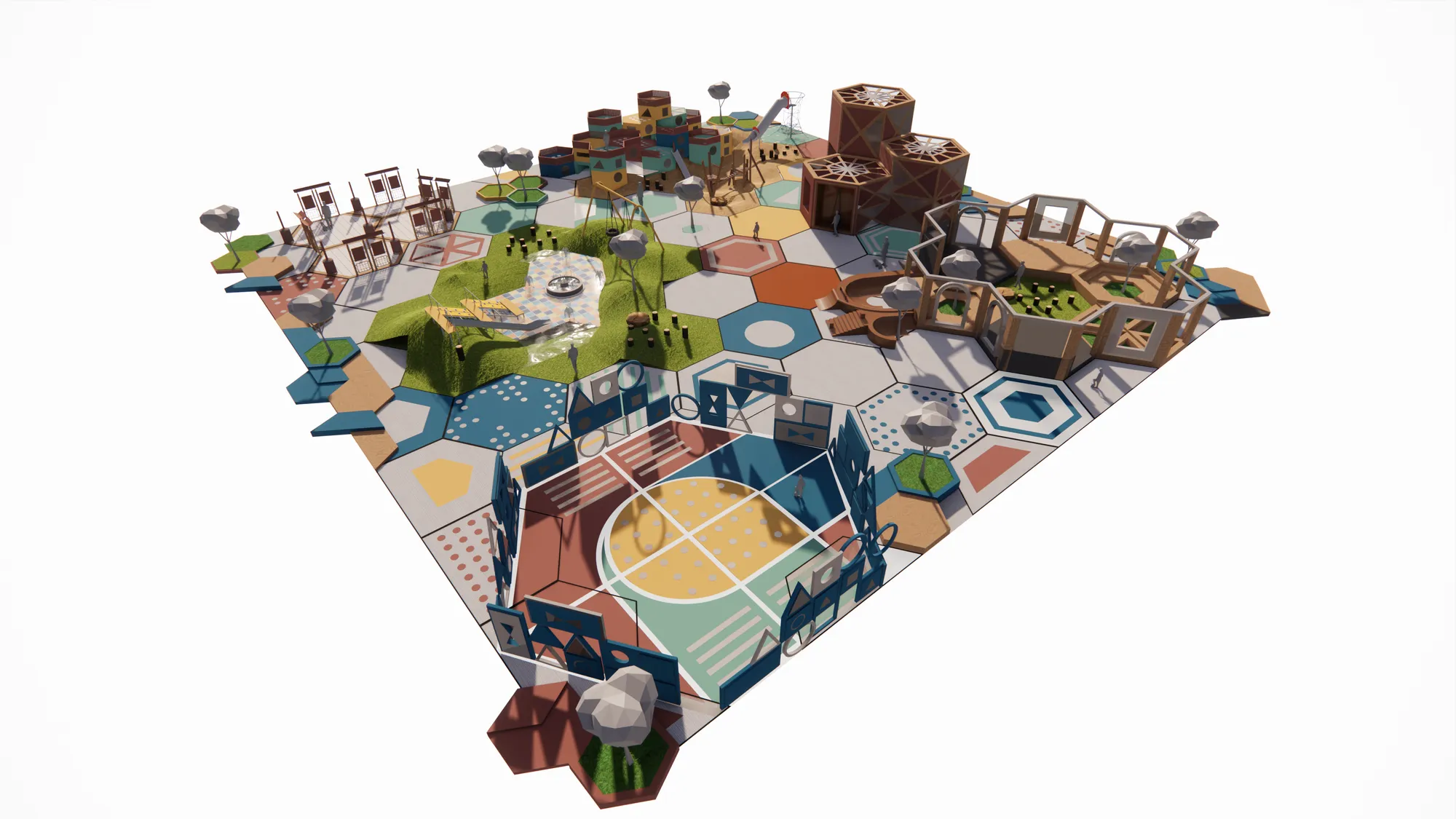
The Hive of Play
A Playground for all

Design Concept and Philosophy
Playgrounds are more than just spaces for recreation; they are environments where children learn, grow, and form connections. The design of this playground is rooted in the philosophy of collective growth, bringing together children of all ages—from toddlers to teenagers—into one interconnected space.
The hexagon, a shape frequently found in nature, forms the conceptual and structural foundation of the design. Inspired by honeycombs, it symbolizes strength, community, and limitless possibilities for growth. Beyond aesthetics, its modular nature allows for seamless connectivity between various play zones, ensuring flexibility and expansion as needed. The playground is envisioned as a developmental journey, where play evolves with the child, fostering physical, cognitive, and social skills at every stage.
Zoning Overview
The playground is structured into interconnected hexagonal zones, each catering to a distinct type of play:
🌿 Green Zones – Soft mounds and natural features for sensory and exploratory play.
🔵 Blue Zones – Interactive tech-driven play areas stimulating cognitive engagement.
🔴 Red Zones – Dedicated to physical activities and sports.
🟨 Yellow Zones – Learning spaces for relaxation and creativity.
The colorful pathways, embedded with soft lighting, serve as both playful guides and wayfinding tools, directing children towards different play experiences tailored to their interests and age groups.
Key Play Areas and Functions
Each play area is designed to stimulate specific aspects of development while maintaining an engaging and interactive environment.
1. AI Wall + Techno Play Area
Function: Interactive digital play
Form: A responsive wall with motion-activated pixelated animations
Purpose: Enhances reflexes, motion-based interaction, and digital literacy
Design Insight: Merges technology with play, encouraging children to engage with dynamic patterns and sensory stimuli.
2. Slide + Climbing Net
Function: Physical challenge
Form: A curved slide with an integrated side net tunnel
Purpose: Improves coordination, strength, and confidence
Design Insight: Encourages vertical movement through climbing and sliding, offering an exciting challenge.
3. Swing + Climbing Wall
Function: Dual sensory-motor development
Form: One side features a climbing wall, the other a swing set
Purpose: Enhances balance, upper body strength, and rhythm
Design Insight: Provides contrasting play experiences in a single module—a mix of relaxation and adventure.
4. Maze and Puzzle Area
Function: Cognitive engagement
Form: A low maze with built-in puzzles and shape games
Purpose: Develops problem-solving skills and spatial awareness
Design Insight: Encourages curiosity, logical thinking, and teamwork through engaging challenges.
5. Water Splash + Mounds
Function: Sensory and natural interaction
Form: Organic grass mounds with integrated splash fountains
Purpose: Offers a refreshing way to stay active while interacting with nature
Design Insight: Enhances sensory play by combining movement with varying textures and temperatures.
6. Football + Basketball Zones
Function: Team sports and competition
Form: Half courts designed for both games
Purpose: Encourages teamwork, sportsmanship, and fitness
Design Insight: Scaled-down courts maintain accessibility for young players while ensuring an engaging experience.
7. Lego Block Furniture – Learn & Play
Function: Modular seating and creative play
Form: Moveable, blocky structures resembling LEGO
Purpose: Promotes collaborative group activities and imaginative role-play Design Insight: Blends resting spaces with play by encouraging creativity even in moments of pause.
8. Skating Area
Function: Coordination and confidence building
Form: A mini skate track with safety rails
Purpose: Provides an introductory space for skating with low-risk challenges
Design Insight: Creates a thrill-filled yet secure skating experience.
9. Seating and Relaxation Zones
Function: Social space for guardians and resting areas for children
Form: Circular benches under stylized canopies
Purpose: Encourages community bonding and ensures a space for relaxation
Design Insight:
The organic canopy design blends with the overall aesthetic while providing shade and comfort. Material and Visual Language To create an immersive and safe environment, the playground integrates a diverse material palette:
Shapes: Recognizable geometric forms (triangles, circles, squares) are used consistently in structures to promote learning through familiarity.
Colors: A mix of pastels and primary tones, ensuring a vibrant yet harmonious experience.
Textures: Soft rubber flooring enhances safety, wood adds warmth, and metal ensures durability. Lighting:Embedded path lights guide movement while adding a touch ofenchantment, especially in evening play sessions.
Inclusive Design Approach
The playground is designed for all ages, ensuring accessibility and engagement across different developmental stages:
Toddlers: Water jets, sensory play, low mazes for safe exploration.
Young Children (5-8): Slides, swings, and puzzles for active engagement.
Pre-teens &Teens: Sports courts, climbing walls, and skating zones for physical challenges.
Guardians & Visitors: Thoughtfully placed relaxation zones, shaded benches, and smooth pathways ensure an inclusive, family-friendly space.
A Playground That Grows With You
This playground is more than a place to play—it is a space to grow, connect, and evolve. Inspired by the structure of a beehive, it nurtures curiosity, movement, and collaboration. Through color-coded pathways, interactive play walls, and dynamic learning experiences , this design creates an engaging, ever-evolving ecosystem that adapts to each child's needs at different life stages. With its modular layout, technology-integrated play, and inclusive approach, this playground stands as a beacon of innovation, fostering an environment where children and communities truly grow together.


Popular Articles
Popular articles from the community


The Musturak Paradise: Senior Living Architecture for a Connected Future in Temara, Morocco
The Musturak Paradise reimagines senior living architecture in Temara via private homes, social spaces, culture, community, and shared care.

Play: Fragments of Their World
Familiar architecture becomes modular playground design, creating safe spaces where displaced children can learn, connect, imagine and play.

Co-life: Sustainable Architecture for Age-Friendly Community Living
Co-life reimagines sustainable architecture for seniors through courtyards, rammed earth, shared gardens, and spaces designed for belonging.

The Ocean Hive: Sustainable Architecture for a Self-Sufficient Civilization at Sea
The Ocean Hive imagines sustainable architecture at sea, where modular habitats, algae, wave power and ocean waste sustain a growing colony.


Similar Reads
You might also enjoy these articles
The Rhythm of Seasons
A Farmers' Market Connecting Nature and the City

More Than a Building-Designing a Living System
More Than a Building-Designing a Living System
Base Beyond
DESERT COMPOUND ARID: TOURISM OF ABSENCE AND ABUNDANCE
Explore Playground Competitions
Discover active competitions in this discipline




Challenge to reimagine the Iron Throne


Photograph architecture without architects


Illustrate the lost glory of Angkor Wat - Render Challenge


Design challenge to reuse E-waste
Comments (0)
Please login or sign up to add comments
No comments yet. Be the first to comment!