

The Hive of Play: Hexagonal Modules That Build a Playground as a Living Ecosystem
A honeycomb-inspired playground weaves tech walls, nature mounds, and sports courts into one modular landscape for all ages and abilities.


What if a playground could grow like an organism, each cell serving a different purpose yet functioning as a single body? The Hive of Play takes the hexagonal logic of a honeycomb and deploys it as an urban design system, where every module hosts a distinct mode of engagement: physical, cognitive, natural, or social. The result is not a collection of play equipment scattered across a park but a continuous, color-coded landscape that treats children's curiosity as the primary organizing force.
Designed by Shreya Bhojani and Tirth Khiroya, this winner entry of the Playground - E competition proposes a modular hexagonal grid that connects AI-powered tech walls, basketball courts, water splash zones, soft nature mounds, and shaded learning nooks into a seamless public ground. The project refuses the usual division between "playground" and "park," arguing instead for a space where a toddler exploring barefoot on a grass mound is just a few steps from a teenager shooting hoops or a parent resting under a tree canopy.
Four Zones, One Interconnected Grid
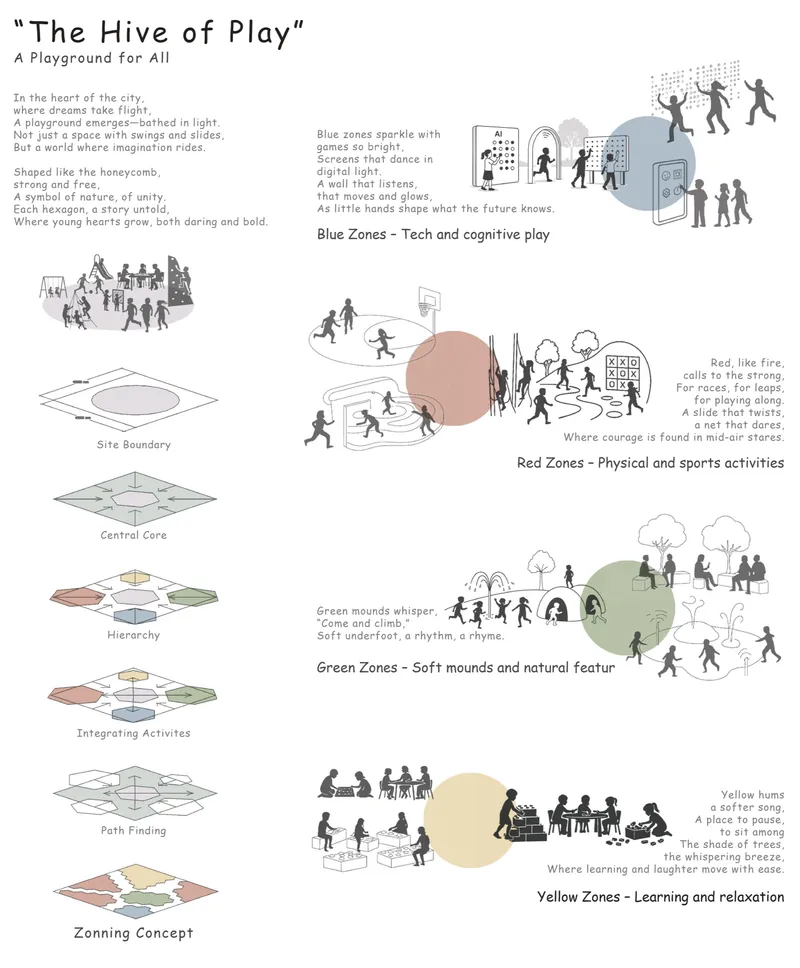
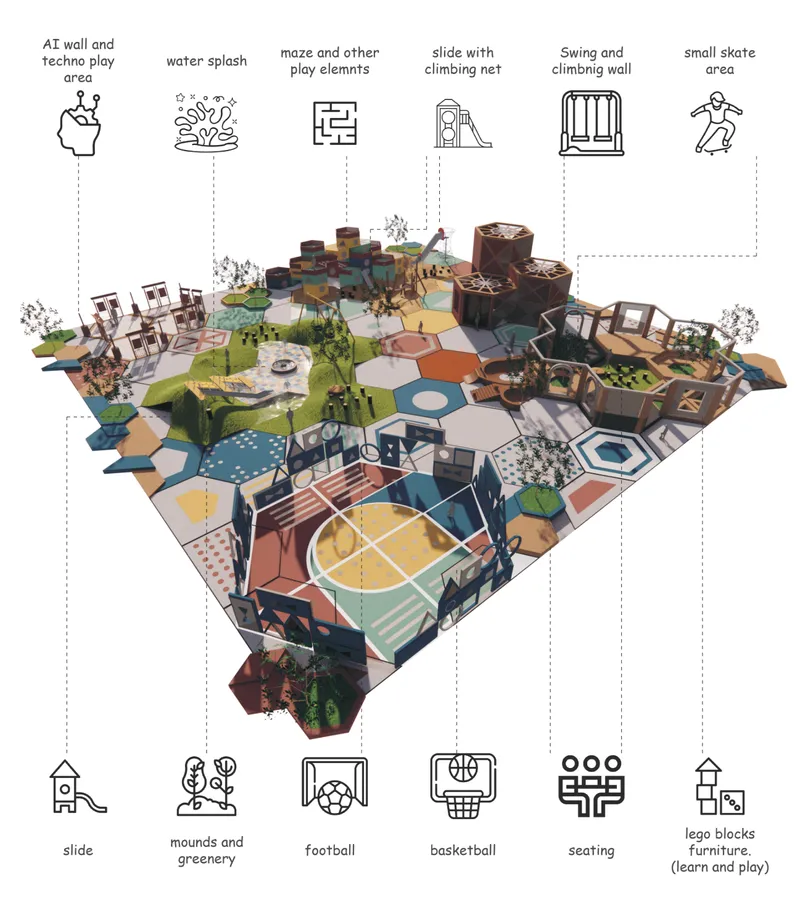
The conceptual diagram lays out the project's organizational DNA: four color-coded zones, each calibrated to a different register of activity. Blue zones host AI-powered walls and responsive screens, turning passive screen time into spatial, problem-solving engagement. Red zones contain basketball courts, football areas, climbing nets, and slides, all programmed for movement and teamwork. Green zones introduce soft mounds, water elements, and tactile landscapes for sensory play. Yellow zones provide shaded seating, LEGO furniture, reading corners, and collaborative learning areas under tree canopies. The axonometric rendering reveals how these zones are not separate enclosures but interlocking hexagonal cells, their colored paving acting as both wayfinding system and visual identity.
What makes the zoning strategy work is its refusal to be rigid. The hexagonal grid allows fluid transitions between zones: a child moves from a climbing structure in the red zone to a water splash area in the green zone without encountering a fence, a threshold, or a dead end. The modular logic means individual cells can be reconfigured or replaced as community needs evolve, making the playground genuinely adaptive rather than fixed at the moment of construction.
Climbing Towers and Geometric Play Walls at Child Scale
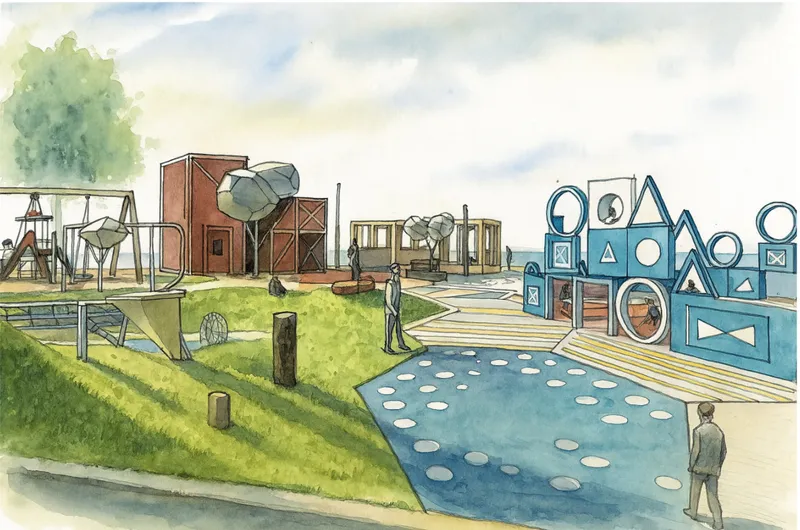
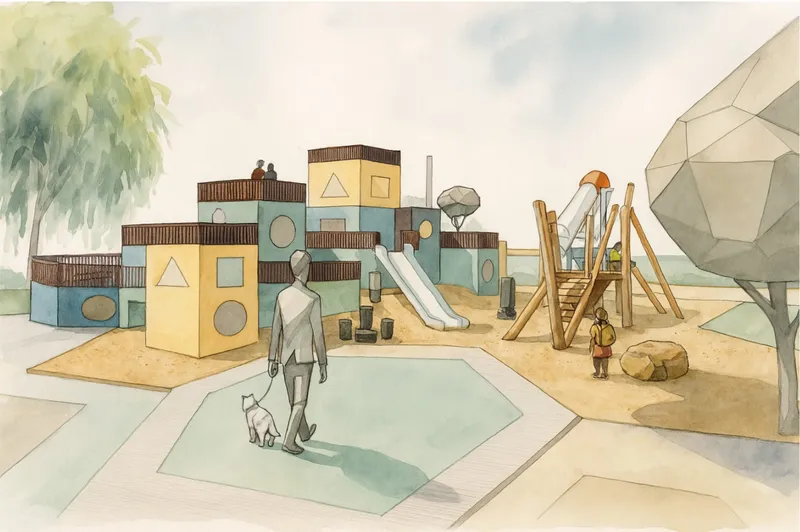
The watercolor perspectives offer a closer look at the individual play modules. Modular climbing towers rise in stacked configurations, their surfaces punctuated with cutout shapes that double as handholds and windows. A geometric play wall provides a vertical surface for climbing and visual interaction, its pattern echoing the hexagonal language of the overall plan. Timber slide structures integrate with the stacked cubes, creating routes through and over the modules rather than simply up and down.
The choice of watercolor rendering is worth noting. It softens the geometry and foregrounds the human figure, reminding the viewer that these are spaces designed around a child's body and imagination, not around structural exhibitionism. The timber and colored surfaces suggest a material palette that balances warmth with durability, while the cutout shapes in the play cubes introduce light, shadow, and peekaboo spatial play into what could otherwise be monolithic volumes.
Grass Mounds and Swings: Where Nature Reclaims the Grid
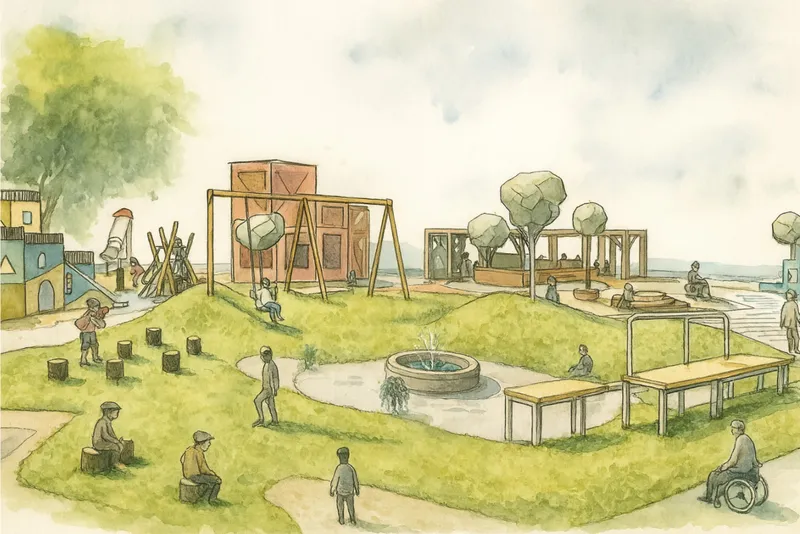
The green zones push back against the structured geometry with terraced grass mounds, swings suspended from timber frames, and seated figures scattered across an open landscape. Here the hexagonal grid softens into organic contours, and the playground becomes something closer to a garden. Barefoot exploration replaces equipment-driven play. The mounds create topography on flat urban ground, offering children the rare experience of elevation change, rolling, hiding, and surveying their surroundings from a vantage point.
This zone serves a quieter social function too. Parents and caregivers sit along the terraces, able to observe multiple play areas simultaneously. The green zone becomes the playground's breathing room, a place where the energy of the red and blue zones dissipates into sensory calm. The contrast is deliberate: the designers understand that a good playground needs moments of low intensity as much as it needs high-octane climbing walls.
After Dark: Illumination Transforms the Playground into a Public Room
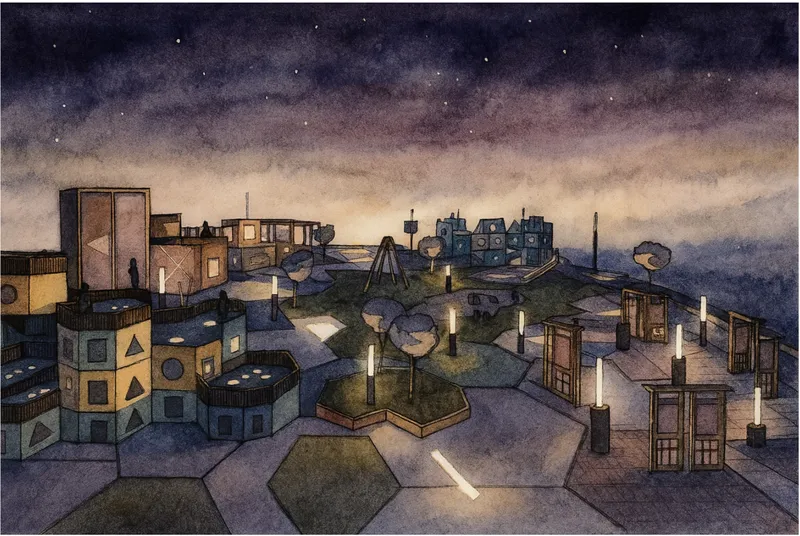
The night rendering reveals a second life for the Hive. Modular play structures glow under integrated lighting, their edges traced with soft illumination that turns the hexagonal paving into a glowing map. The playground shifts from a buzzing activity hub to something closer to a lantern park, where light defines pathways and gathering spots. This is a critical design move: by programming the space for evening use, the designers double its utility and extend its role as a neighborhood anchor beyond school hours and daylight.
The starry-sky backdrop in the rendering is aspirational, but the underlying idea is grounded. Urban playgrounds that go dark after sunset become voids in the public realm, often perceived as unsafe. By embedding lighting within the play modules and along pathways, the Hive maintains spatial legibility and social presence after dark, inviting evening walkers, families, and teenagers to occupy the space on their own terms.
Why This Project Matters
The Hive of Play succeeds because it treats the playground as infrastructure, not decoration. The hexagonal module is simultaneously a spatial unit, a zoning device, a wayfinding cue, and a social connector. By assigning distinct programs to each cell while keeping transitions fluid, the design avoids the common trap of the "destination playground" that offers spectacle but limited reuse. Instead, it proposes a system that can grow, shrink, and reconfigure as a community changes.
Shreya Bhojani and Tirth Khiroya demonstrate a mature understanding of how inclusivity operates at the spatial level. Accessibility here is not an afterthought bolted onto a standard design; it is embedded in the modular logic itself, where every zone offers multiple entry points, varied intensity levels, and overlapping user groups. The project argues, convincingly, that a playground for all is not one that homogenizes experience but one that offers enough variety within a coherent framework for every visitor to find their own way in.
View the Full Project
About the Designers
Designers: Shreya Bhojani, Tirth Khiroya
Enter a Design Competition on uni.xyz
uni.xyz runs architecture and design competitions year-round that reward proposals with spatial conviction and real site intelligence.
Project credits: The Hive of Play by Shreya Bhojani, Tirth Khiroya Playground - E (uni.xyz).


Popular Articles
Popular articles from the community


Manzana Morphosis: Stretching Barcelona's Grid into a Living Landscape for 2050
A radical reworking of the Eixample manzana turns density into a tool for generous public space, vertical ecology, and environmental performance.

Extended Shell: Retrofitting Kolkata's Balconies as Living Urban Thresholds
A modular retrofit system recovers the social and environmental intelligence of Kolkata's historic verandas for contemporary Park Street residents.
Temporary Home for Dogs: A Reversed Zoo Rethinks Animal Shelter Architecture
In Bucharest, a sinuous corridor and freed landscape flip the logic of containment, designing a shelter that works to make itself unnecessary.
Opera by the Sea Estonia: Three Shells Dissolving Architecture into Tallinn's Coastline
A winning opera house proposal replaces monumental form with interconnected shells that blur the boundary between building, park and Baltic Sea.

Similar Reads
You might also enjoy these articles
Yenisei Monitoring Center: A Sun-and-Moon Sphere Anchors a Research Campus on Siberia's Great River
In Krasnoyarsk, shifting square blocks, a glazed central sphere and descending window rhythms turn river science into a public spectacle on the Yenisei.
Andretta Artist's Village: A Node-Based Masterplan That Lets the Hills Write the Plan
A cultural landscape strategy for Palampur's artist colony threads studios, residences and stages along a porous spine shaped by the Dhauladhar terrain.
Street Children Rehabilitation Center: A Brick Campus That Eases Children From Street to Safety
A low-rise courtyard campus where learning streets, uthans and shaded verandahs stage a gradual passage from street into protective, family-scale life.

The NEON Culture: A Field of Pavilions Built for the 24-Hour City
Smaran Alva spreads galleries, stages, clubs and markets across a varied site, treating light, sound and ramped movement as the real building materials.

Comments (0)
Please login or sign up to add comments
No comments yet. Be the first to comment!