
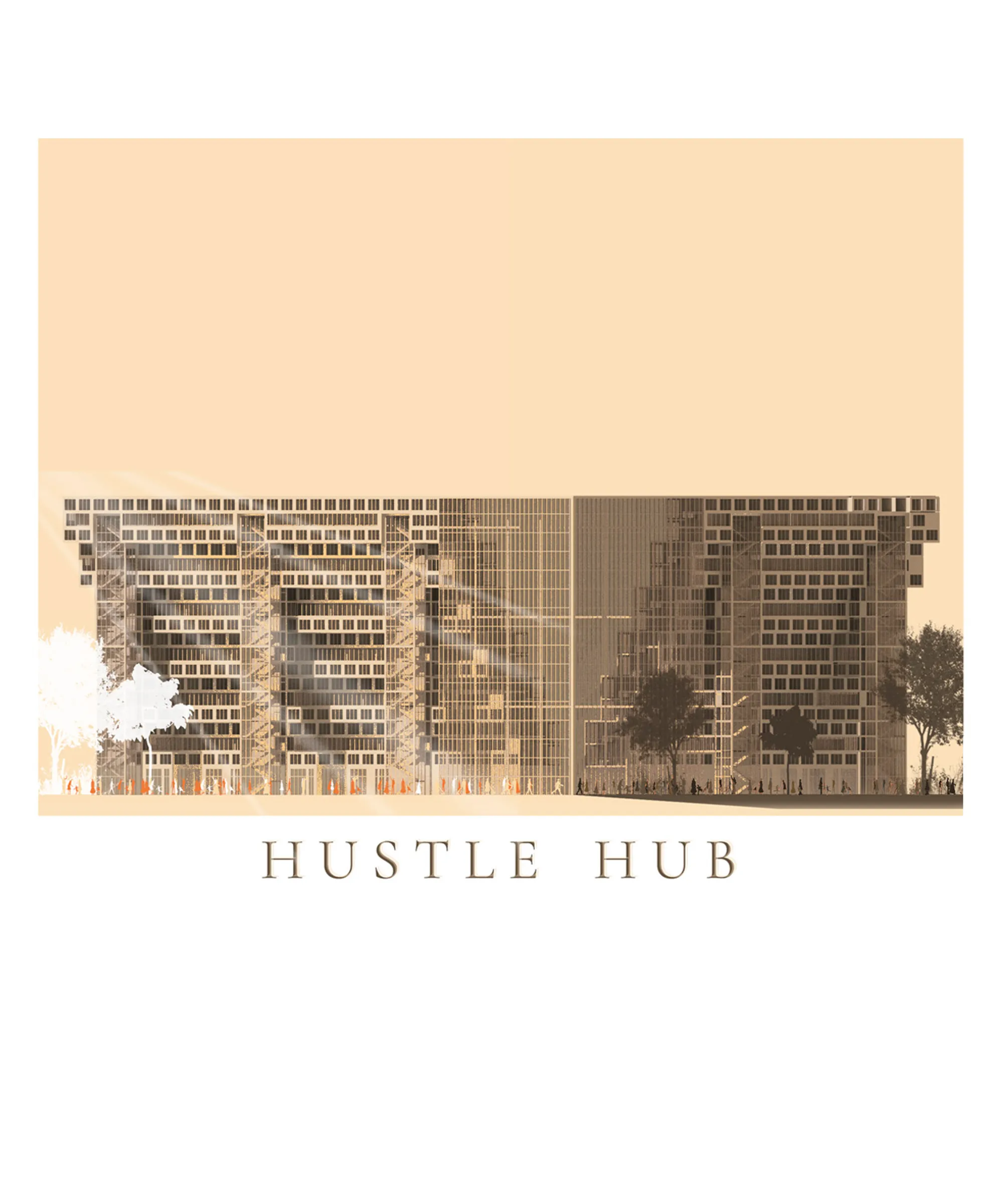
The hustle hub
New vision of the greatest historical heritage.

The competition brief states that one of the most important issues facing modern society today is the question of relocation for the purpose of furthering one's career. People are increasingly eager each year to move to larger cities that allow them to fulfill their ambitions. However, the gap between inflation and incomes grows each year, making it difficult for new local residents to immediately move into their "permanent" home. Therefore, the question of building housing from which each new person wishing to conquer the metropolis could start their journey has arisen. And I want their "individual" journey to begin with no less original, while it is important to note, a convenient home.
The target audience of this project was initially defined as 20-35 year olds. In other words, we were interested in: 1) young people who are starting their adult life experience, 2) people who have moved to a new city for work, 3) local residents who are currently looking for short-term rental housing while they search for a permanent residence. For all of them, at first glance, the quality of the housing may not be the most important factor, but in reality, everyone strives for "simple" comfort. Therefore, the first important part of the idea was to provide a typical comfortable living space.
To search for optimal living space, I turned to the history of typical housing, which touches upon the history of Soviet architecture. Famous constructivist architects in the 1920s approached the question of such housing very seriously. A significant contribution is the F-type apartment designed by Moisei Ginzburg. Through proper mathematical calculations, he found the optimal cubic capacity of living spaces in which a person would feel comfortable. In his cell, the main thing was that when a person entered the apartment, they either went downstairs or upstairs, which completely separated the entrance area from the living area, making the entire space private, which is precisely what is necessary in an apartment designed for a maximum of two people. Also, with this layout, the corridor part, from which the tenant enters their home, is located every three floors, thus greatly increasing the useful area of the house. After studying this type of housing, I decided to use the legacy of the Soviet architect for Hustle Hub, changing the layout of the cell to modern needs of guests. For example, over the last three years, people's requirements for their housing have changed significantly. Post-pandemic trends have led to many of us actively using balconies/terraces in our daily lives. Therefore, in this project, terraces are actively used.




Popular Articles
Popular articles from the community


The Musturak Paradise: Senior Living Architecture for a Connected Future in Temara, Morocco
The Musturak Paradise reimagines senior living architecture in Temara via private homes, social spaces, culture, community, and shared care.

Co-Life: Senior Housing Design That Reconnects Older Adults With the City
Co-Life reimagines senior housing design through healing gardens, shared streets, workshops, and a sustainable community across generations.

Hill & Cross Opera: Sculptural Opera House Architecture Shaped by Tallinn’s Landscape and Identity
Hill & Cross Opera reimagines opera house architecture in Tallinn through its sculptural hill, civic plaza, glass wave and a luminous cross.

Riyadh For All: Intergenerational Urban Design for Active Aging in Rabat
Riyadh For All reimagines urban design in Rabat with intergenerational co-living, adaptive courtyards, and Moroccan cultural exchange today.

Similar Reads
You might also enjoy these articles

Day and Night Park: A Time-Based Urban Newsstand in Beijing
A temporary urban newsstand in Beijing blending travel, light, and reading through poetic colors, compact form, and community-focused design.

Modernist Patio Renovation in El Masnou, Barcelona by Oliver Segura Arquitectura + Cebrià Arquitectura
Modernist patio renovation blending tradition and innovation with a movable pool, leveled floors, and Catalan materials in El Masnou.

Alto Residencial Coop: Cooperative Housing Development in Santiago de Compostela by Carbajo Barrios Arquitectos
A linear cooperative housing complex blending white volumes and perforated metal façades, enhancing community living, natural light, privacy, and urban integration.

Vil Genis School by BPA ARCHITECTURE – Massy, France
Vil Genis School in Massy, France, features sustainable design, south-facing classrooms, community integration, accessible spaces, and modern educational architecture.

Explore Urban Identity Competitions
Discover active competitions in this discipline




Challenge to reimagine the Iron Throne


Photograph architecture without architects


Illustrate the lost glory of Angkor Wat - Render Challenge


Design challenge to reuse E-waste
Comments (0)
Please login or sign up to add comments
No comments yet. Be the first to comment!