
THE MARTIAN LICHEN
An approach to have quality new life on Mars

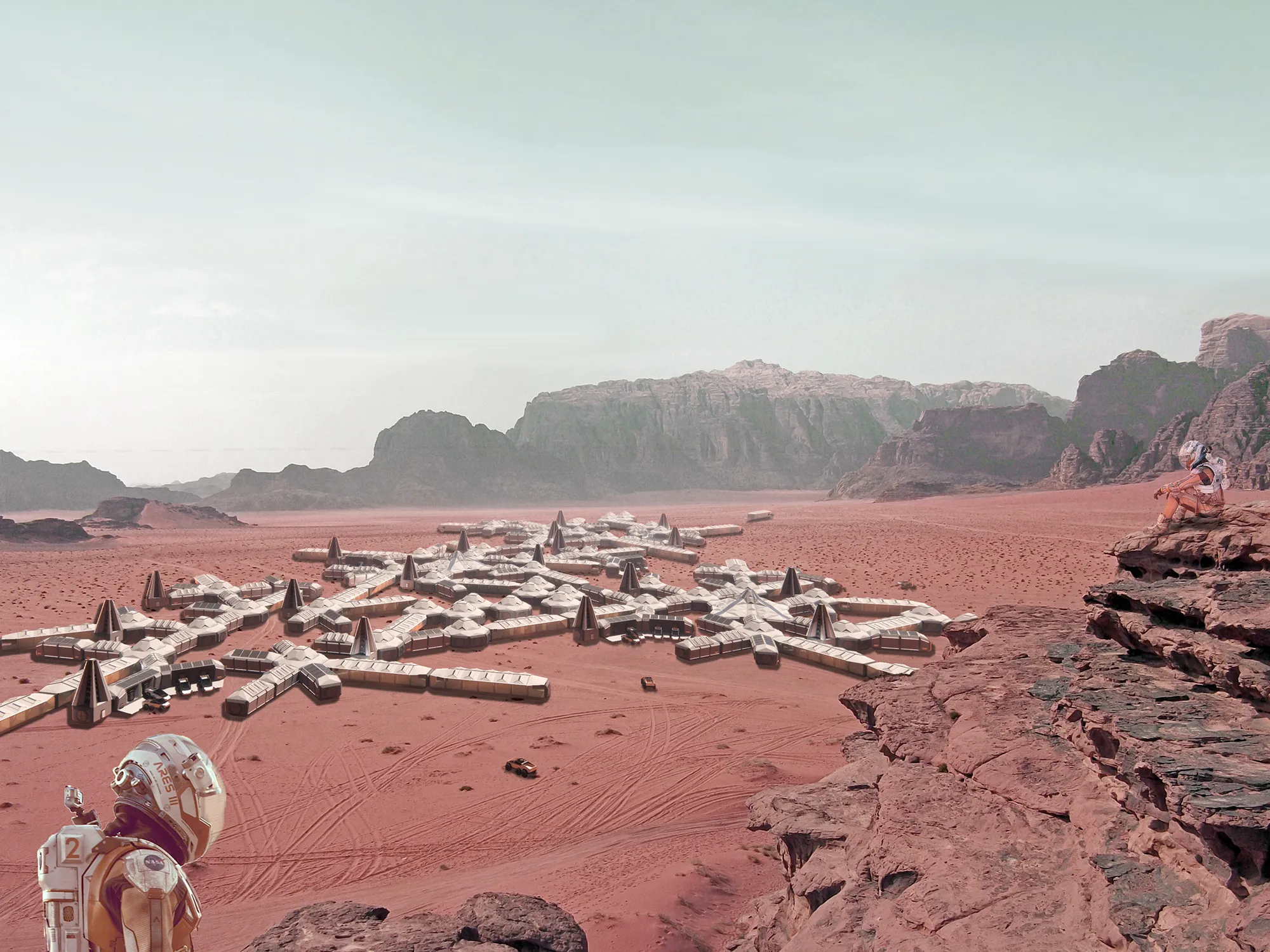
If Mars will be our future, how can we spark life on this planet without an atmosphere, breathable air, or air pressure to sustain the basic human needs for survival? We started to study how life began on Earth. An interesting pattern across all fauna and flora was found to help life thrive. The pattern to self-duplicate and self-similar across all different scales could most efficiently convey nutrition and water to the organism. It is more than a pattern but a tendency to be harmonious with the Universe. It is called fractal design. This pattern is observed across various scales, from the galaxy itself to the cells that assemble all living forms. Through self-repetition, life achieved all the functions needed to survive and grow.
With its self-similar nature, our Martian hub can work as an individual unit that satisfies the residents’ daily needs; it can also become a component of a larger compound that is self-similar to the inhabitant to sustain a larger population with better amenities. Due to the harsh nature of Mars, units should be all independently air-tight in case some nearby units are malfunction. Thinking of the Martian habitat as a living organism that feeds on the ice on Mars, it can reproduce according to its need and adapt to the surrounding environment. Algae are used explicitly for nutrition, oxygen, and biopolymer products inside the units.
Location: Water is undoubtedly the essential resource for surviving on Mars. According to the Subsurface Water Ice Mapping on Mars (SWIM), there are abundant water resources on each polar of the planet. However, the extreme weather and polar night would make the hub not so friendly to live in. There are also many water resources near 15°24'0"S, 10°10'3"E. There is ice in soil ranging from 0 to 5 meters which is easy for the residents to mine the water. It is also near the Beer crater and the Loire Valles.
Units: This colony would become the residents’ permanent housing. Privacy and nice amenity become a must to be considered. Instead of five people using sleeping pods sharing one room, individual living quarters are provided, so the residents won’t feel they are living in temporary housing. The basic module would be all necessary functions, including workstation, living quarters, cafeteria, and farms attached to a community center where people gather to socialize. A primary gathering center could be formed when four to five modules combine. The center could host activities like exercise and gardening, which support residents’ physical and mental health. The component of each module is customizable according to the residents’ behavior. If more farming space is needed, the additional module can be attached. The community center is octagonal shaped. Three to four sides would be utilized to mimic the overall fractal shape to ensure the self-similar pattern is the most efficient and safe organization of the units. The units can be interchangeable and would all sustain life independently.
Material: The Martian hub cluster would be self-sufficient with only essential goods, mainly electronics and robots, to help construct the transport from Earth at the beginning. For our structure, the outer shell would be prefabricated panels made of Martian soil. The insulation and UV protection layer would be two layers of different Aerogels made from silicon and carbon dioxide collected on Mars. The inner layer of biopolymers produced from the Algae farms on Mars creates pressurized indoor. The metal structure would be electrometallurgy made based on what mineral resources we can discover near the Martian inhabitant.
Life-Sustaining: The insulation and UV protection layer would be two layers of different Aerogels. The UV protection layer is made of a compound consisting of SiO2 and TiO2 for its anti-shine and photoprotective properties. The insulation Aerogel layer is made of CO2 and SiO2, a perfect insulator without water interference in the Martian atmosphere. The inflated inner biopolymer pod is made from Algae to provide the air pressure, which will free the residents from the heavy spacesuits. Water is critical for survival, agriculture, and food production. There would be units to mine the ice and send it back to the habitat ecosystem. Exercise is critical for the residents to maintain muscle strength and bone density under only 37 percent of earth gravity. Running treadmills facing a Martian landscape would be placed in different primary gathering spaces along with strength-building equipment.
Purpose of Living: Living on Mars would no longer be for research missions but to continue and prosper human civilization. Martian residents in the habitat would enjoy their lives and pursue their dreams on this challenging but exciting planet. Just like the fractal pattern that made lives possible on earth. This Martian hub’s flexibility and self-sustainability will enable Mars civilization’s adaptation, exploration, and expansion, supporting their primitive curiosity that has been driving humanity’s survival and thrive.


Popular Articles
Popular articles from the community


Co-Life: Senior Housing Design That Reconnects Older Adults With the City
Co-Life reimagines senior housing design through healing gardens, shared streets, workshops, and a sustainable community across generations.

Hill & Cross Opera: Sculptural Opera House Architecture Shaped by Tallinn’s Landscape and Identity
Hill & Cross Opera reimagines opera house architecture in Tallinn through its sculptural hill, civic plaza, glass wave and a luminous cross.

The Musturak Paradise: Senior Living Architecture for a Connected Future in Temara, Morocco
The Musturak Paradise reimagines senior living architecture in Temara via private homes, social spaces, culture, community, and shared care.

The Ocean Hive: Sustainable Architecture for a Self-Sufficient Civilization at Sea
The Ocean Hive imagines sustainable architecture at sea, where modular habitats, algae, wave power and ocean waste sustain a growing colony.


Similar Reads
You might also enjoy these articles

Day and Night Park: A Time-Based Urban Newsstand in Beijing
A temporary urban newsstand in Beijing blending travel, light, and reading through poetic colors, compact form, and community-focused design.

Modernist Patio Renovation in El Masnou, Barcelona by Oliver Segura Arquitectura + Cebrià Arquitectura
Modernist patio renovation blending tradition and innovation with a movable pool, leveled floors, and Catalan materials in El Masnou.

Alto Residencial Coop: Cooperative Housing Development in Santiago de Compostela by Carbajo Barrios Arquitectos
A linear cooperative housing complex blending white volumes and perforated metal façades, enhancing community living, natural light, privacy, and urban integration.
Vil Genis School by BPA ARCHITECTURE – Massy, France
Vil Genis School in Massy, France, features sustainable design, south-facing classrooms, community integration, accessible spaces, and modern educational architecture.



Comments (0)
Please login or sign up to add comments
No comments yet. Be the first to comment!