
System Arquitectura Elevates the Prefab Warehouse into Architecture with Mayoral's Logistics Center
A pleated translucent skin turns an industrial footprint in southern Spain into a luminous, quietly monumental storage building.

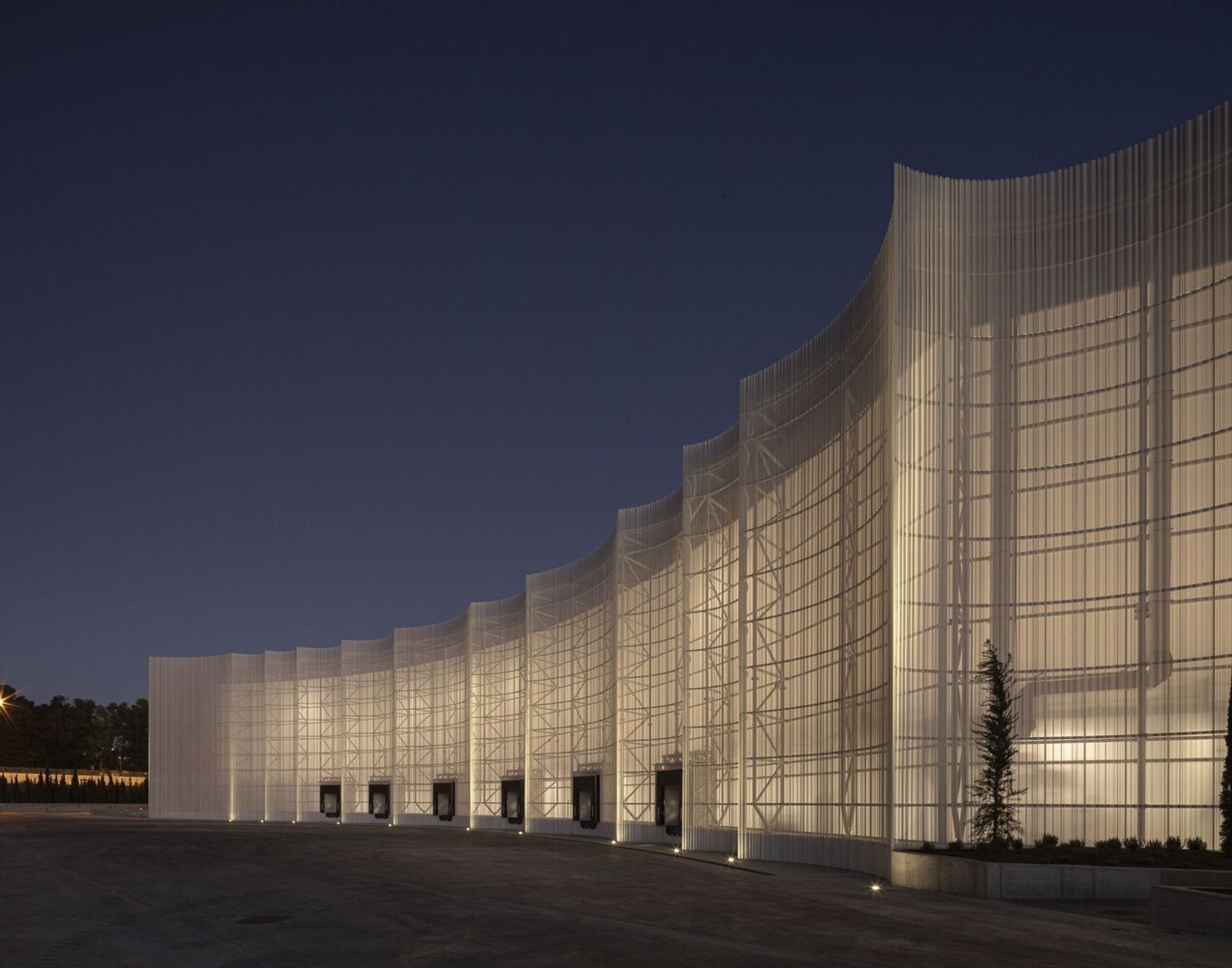
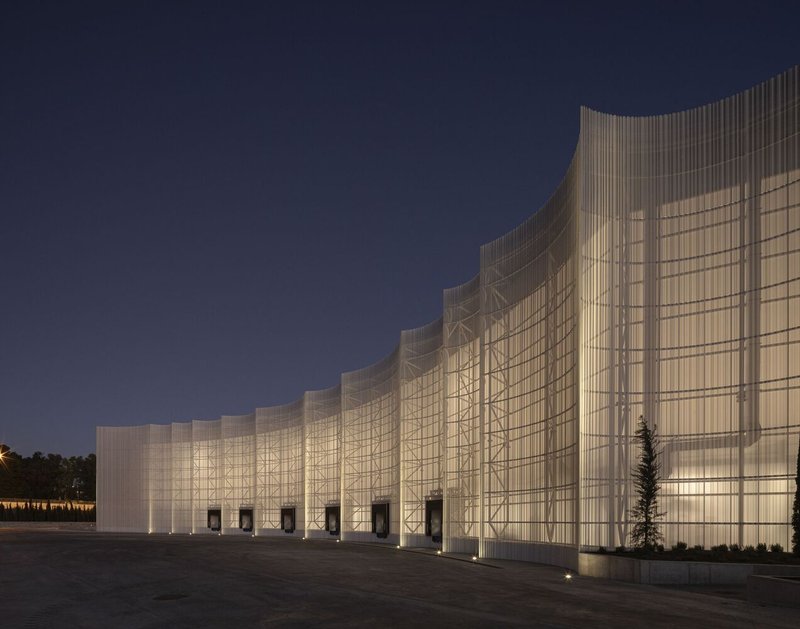
Warehouses are not supposed to glow. They are not supposed to have rhythm, or silhouette, or the kind of presence that stops you on the road at dusk. Yet here is Mayoral's new logistics center, designed by System Arquitectura, doing all three. The building wraps an enormous storage program in a continuous skin of translucent corrugated polycarbonate, pleated into a deep, wave-like profile that catches light during the day and radiates it back at night. It is still a warehouse. It still holds pallets and racking and forklifts. But it refuses the premise that industrial typology must look industrial.
What makes the project genuinely interesting is not simply that it looks good, but how it achieves that appearance through prefabricated logic rather than against it. Every element, from the white-painted steel trusses to the fluted cladding panels, is a catalog component assembled with unusual compositional discipline. The architecture does not fight the economics of logistics construction; it rides them, proving that a limited palette of off-the-shelf parts, deployed with care for proportion and light, can produce something that functions as both infrastructure and civic gesture.
The Pleated Envelope
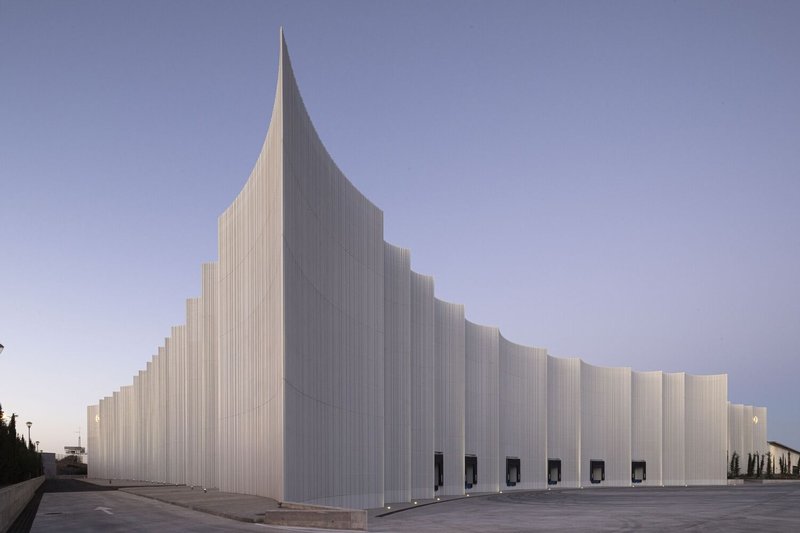
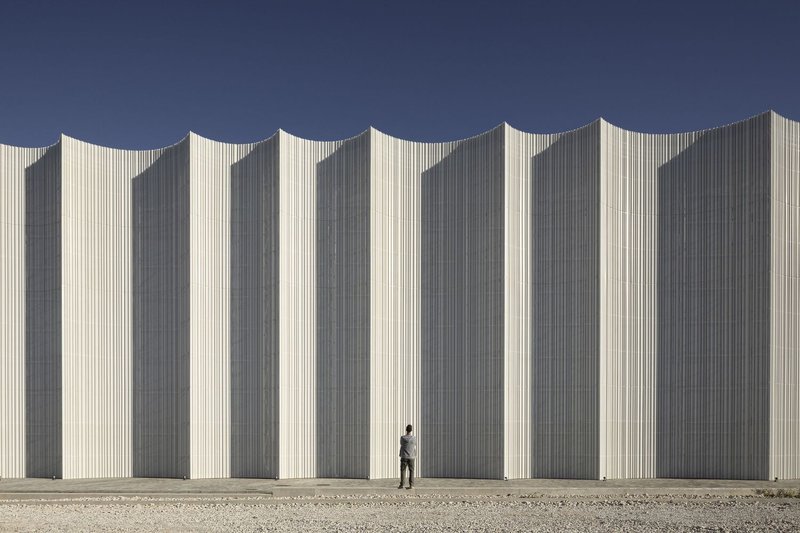
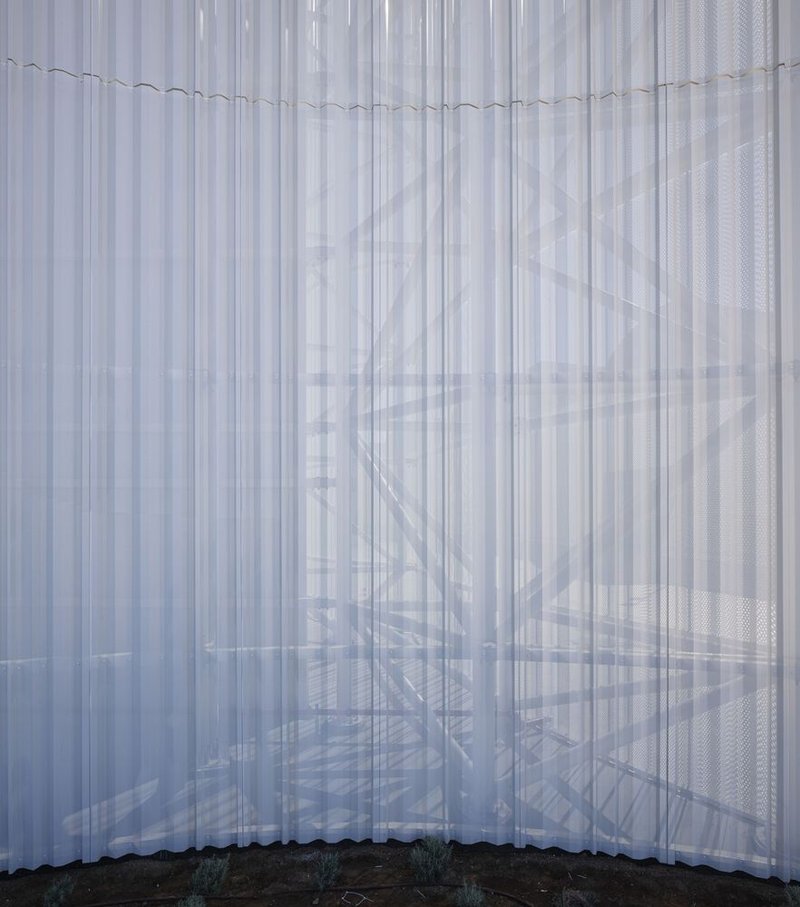
The facade is the project's calling card. Deep vertical pleats run from ground to roofline, creating a corrugated surface that reads differently depending on the angle and time of day. Seen obliquely, the wall collapses into a dense, opaque field of ridges. Head-on, the translucency of the polycarbonate reveals ghostly outlines of the steel structure behind. At the building's corner, the pleats converge into a triangular peak that gives the elevation an almost ecclesiastical sharpness, an unexpected formal move for a shipping dock.
A single figure crossing the gravel forecourt in one of these images tells you all you need to know about scale. The wall is enormous, yet the rhythm of the pleats gives it a textile quality, something woven rather than bolted. It is a neat inversion: the larger the surface, the more tactile it appears.
Light as Material
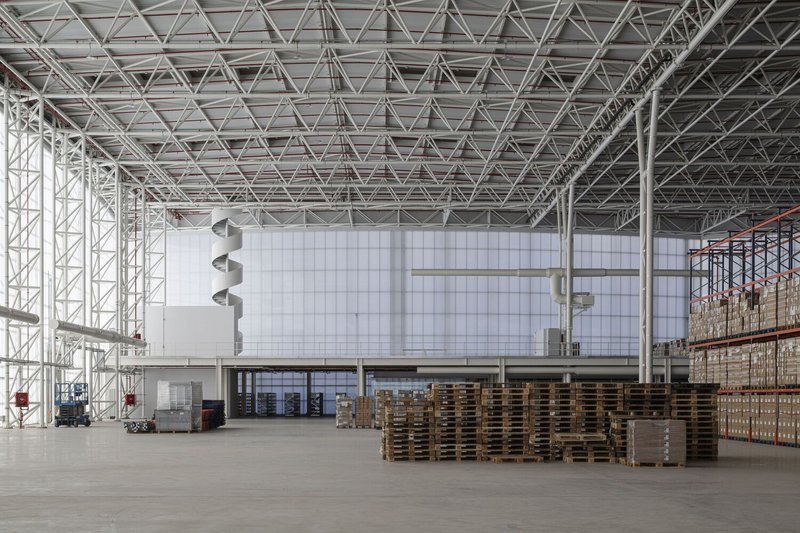
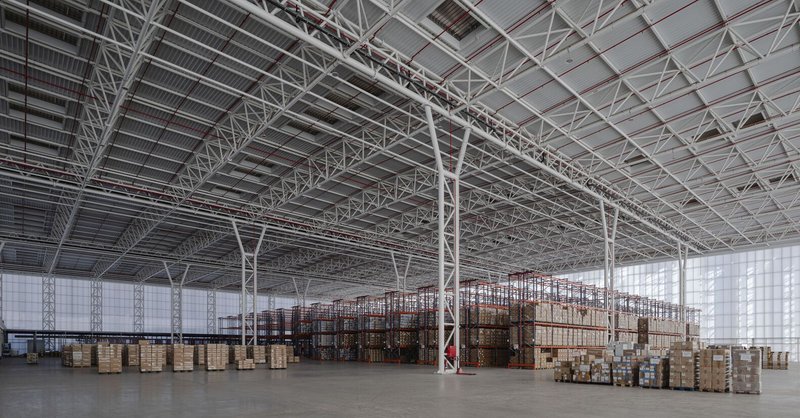
The translucent cladding does real work beyond aesthetics. Inside, the polycarbonate panels flood the perimeter of the warehouse floor with diffused daylight, softening what would otherwise be a fluorescent-lit cave of steel and cardboard. Stacked pallets and wooden crates sit against walls that behave more like screens, filtering exterior conditions into a gentle wash of light that shifts throughout the day.
At dusk, the relationship inverts. Interior lighting turns the entire building into a lantern, its corrugated profile glowing with a warm, rhythmic pulse. The night image of the facade is arguably the project's most striking composition: a long horizontal bar of luminous waves set against a darkening sky. It is the kind of effect that high-budget cultural buildings chase with custom curtain walls. Here it is achieved with warehouse cladding.
The Structural Frame
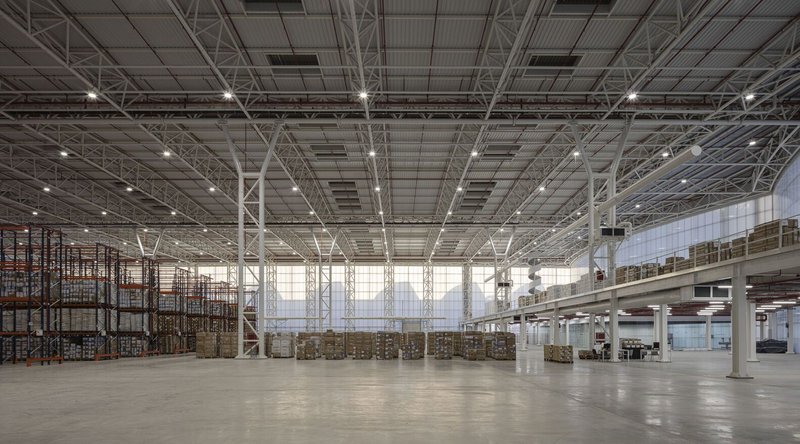
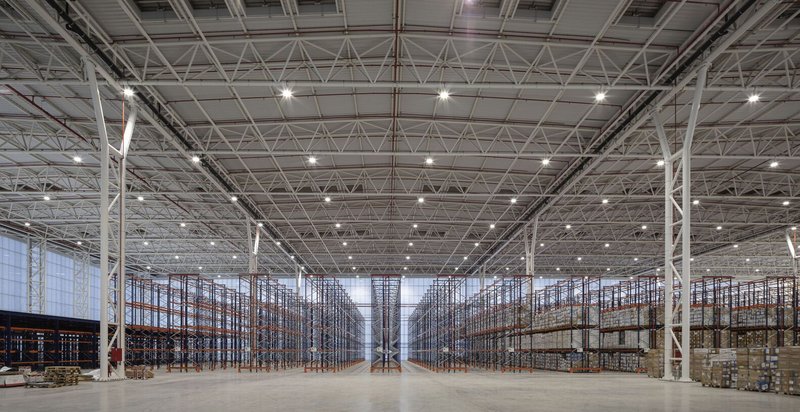
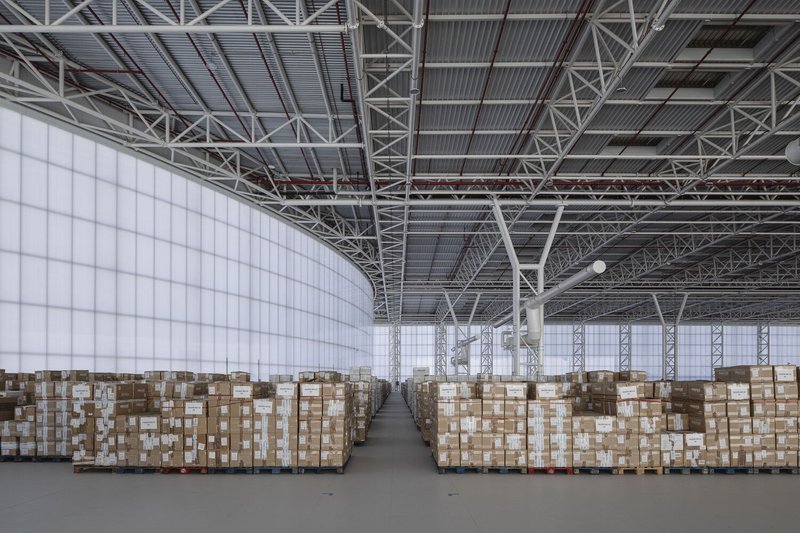
Strip away the skin and the building is a straightforward exercise in long-span steel. White-painted trusses march in regular bays across the full width of the floor plate, their lattice geometry giving the ceiling a graphic density that the architects clearly decided to celebrate rather than conceal. No dropped ceilings, no cable trays running at eye level. Everything is exposed, organized, and painted the same matte white, so the structure reads as architecture rather than engineering.
The polished concrete floor reflects the truss pattern back upward, doubling the visual depth. Walk down the central aisle flanked by symmetrical rows of racking and the perspective effect is powerful: a cathedral of commerce, repetitive and precise, stretching into a vanishing point that feels almost cinematic.
Circulation and the Human Scale
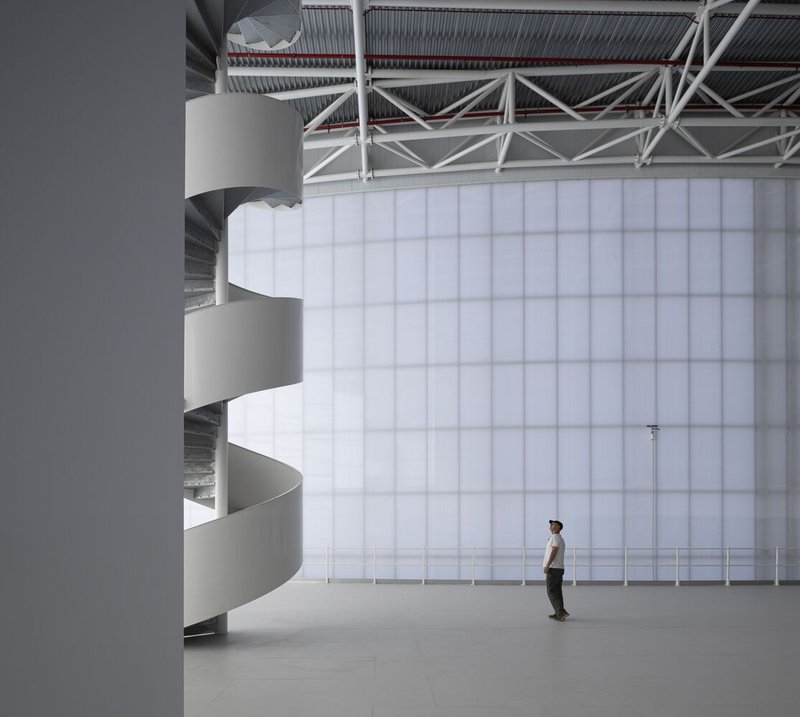
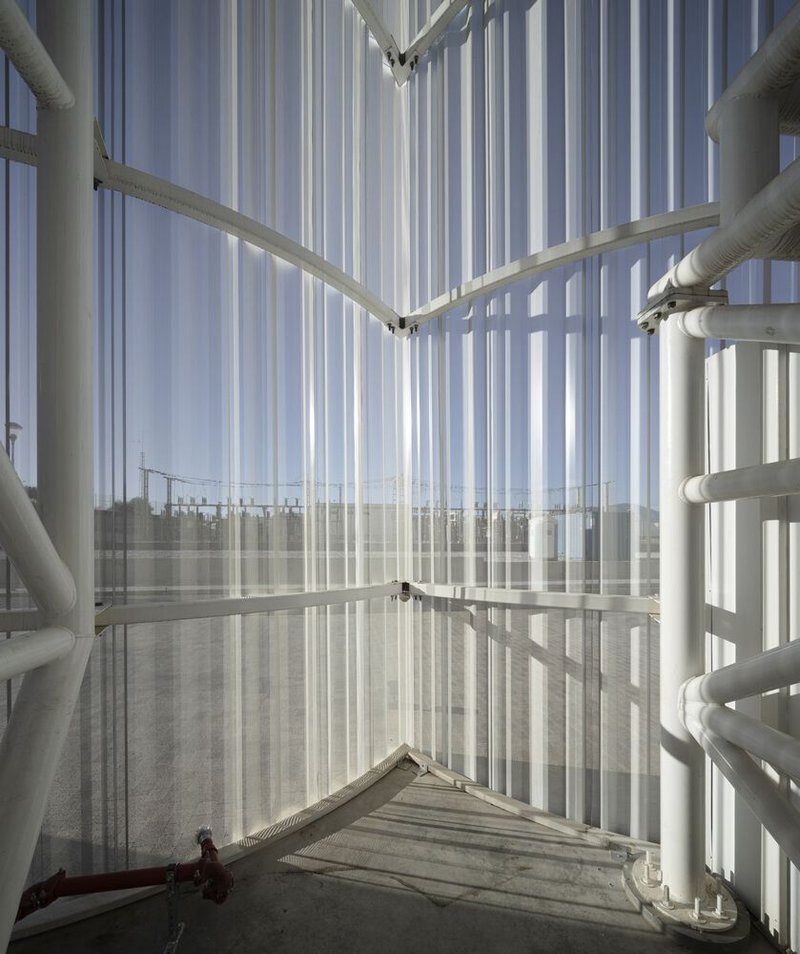
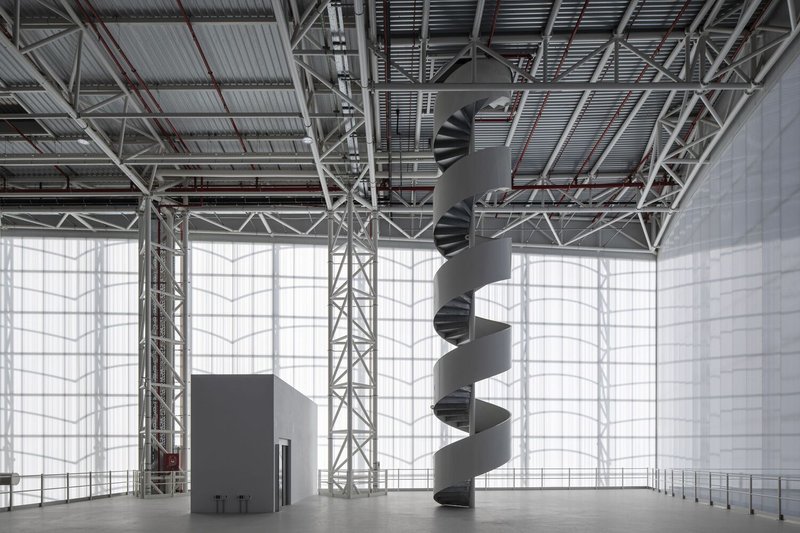
Warehouses rarely acknowledge that people, not just forklifts, move through them. System Arquitectura inserts a series of vertical circulation elements that punctuate the massive floor plate: spiral staircases in concrete and steel, enclosed by translucent polycarbonate enclosures that create intimate pockets of filtered light within the larger volume. These stair towers are the project's most overtly architectural moments, places where the scale contracts and the materials become haptic.
The black spiral stair against the grey service volume is particularly effective. It introduces a deliberate color contrast into an otherwise monochrome interior, marking the vertical connection as a distinct event. It is a small decision with an outsized impact on how the building feels to occupy.
Mezzanine and Interior Layering
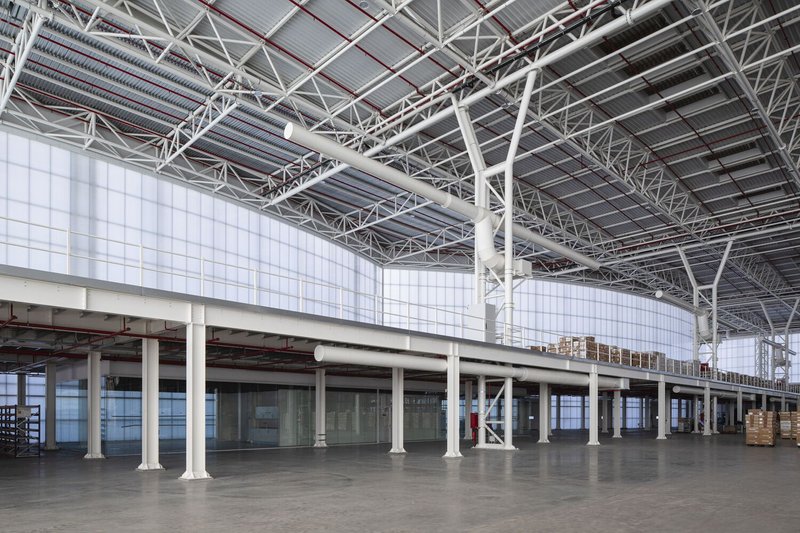
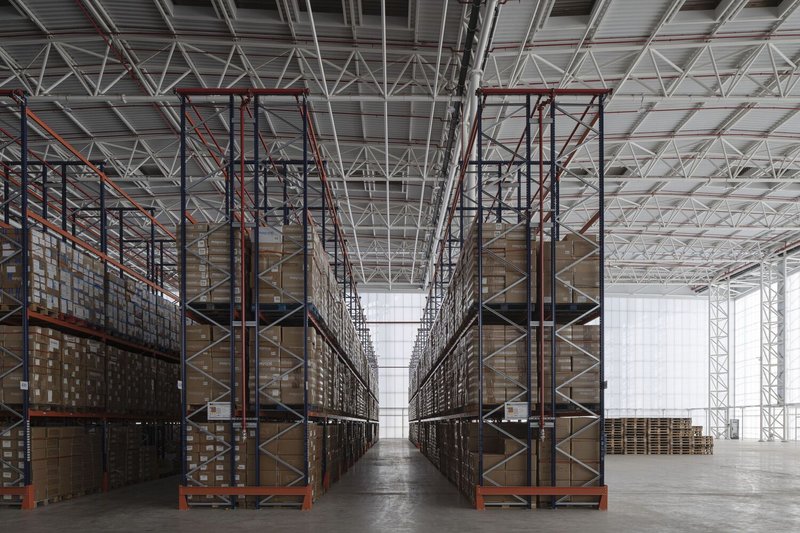
A mezzanine level, supported by slender white columns, introduces a second horizon within the building. The translucent wall panels continue at this elevated plane, maintaining the perimeter glow while creating a more contained zone for operations or oversight. Below, the tall metal racking fills the main volume with a geometric density that rivals the structure overhead. The layering of mezzanine, columns, wall panels, and racking produces a surprisingly rich spatial section for a building type that typically operates on a single plane.
Plans and Drawings
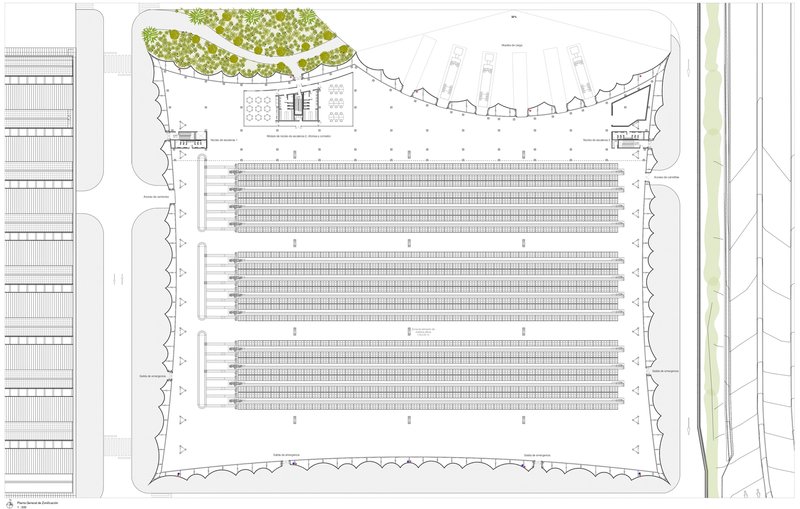
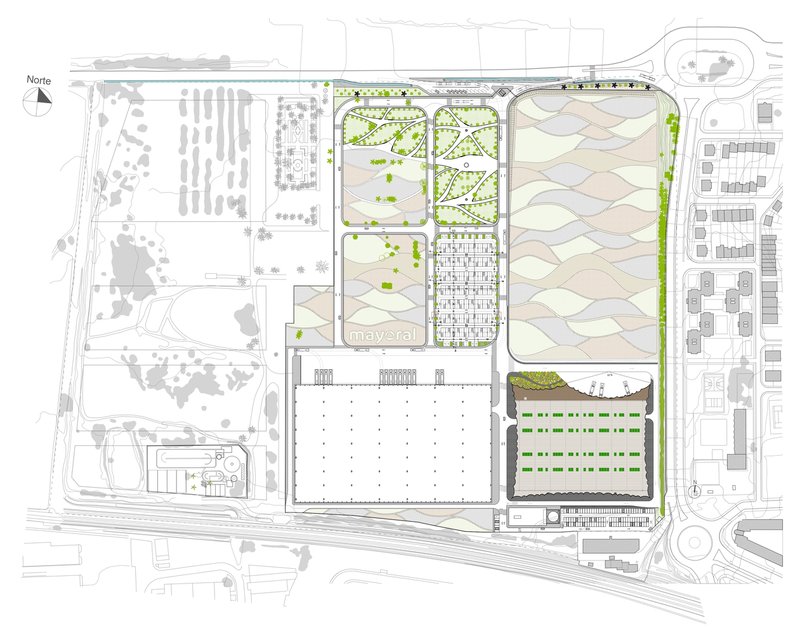
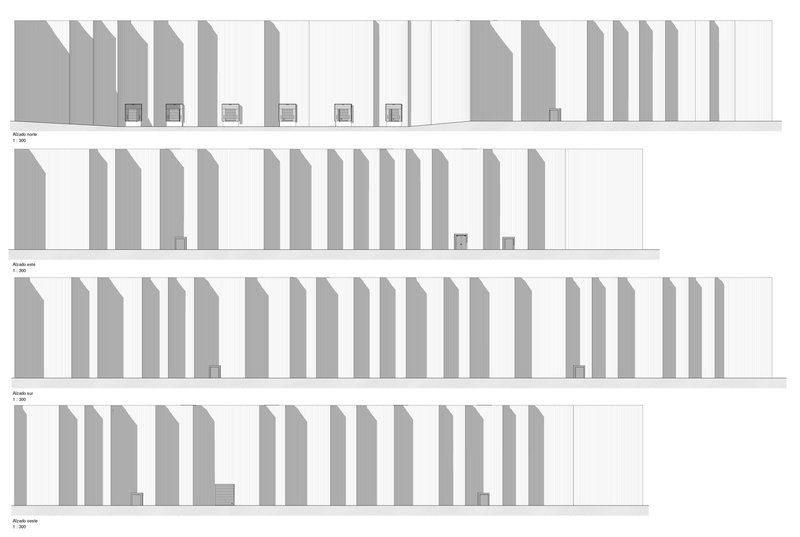

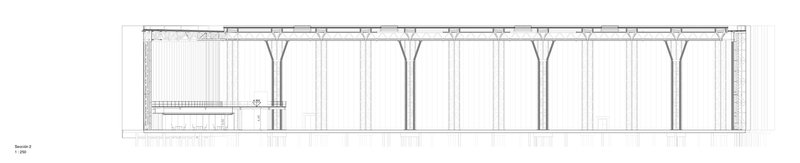
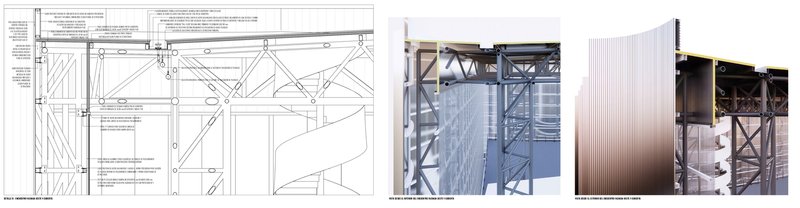
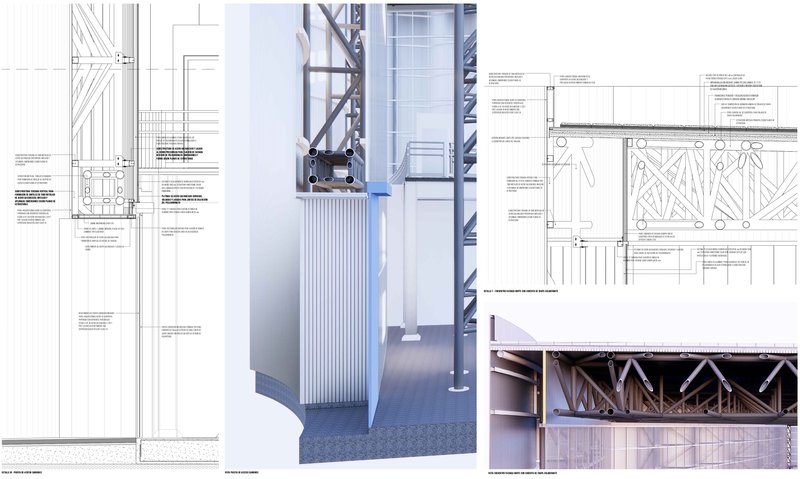
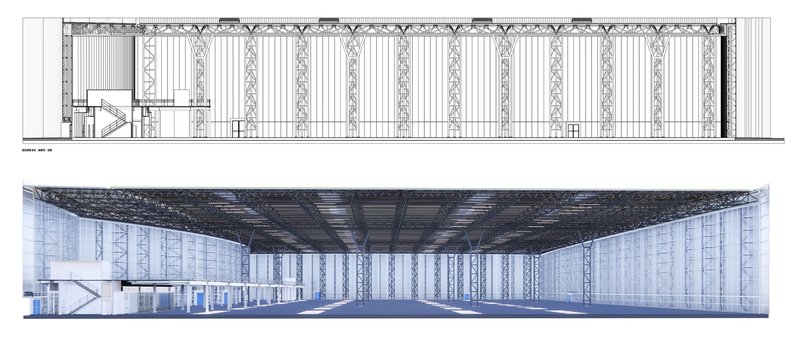
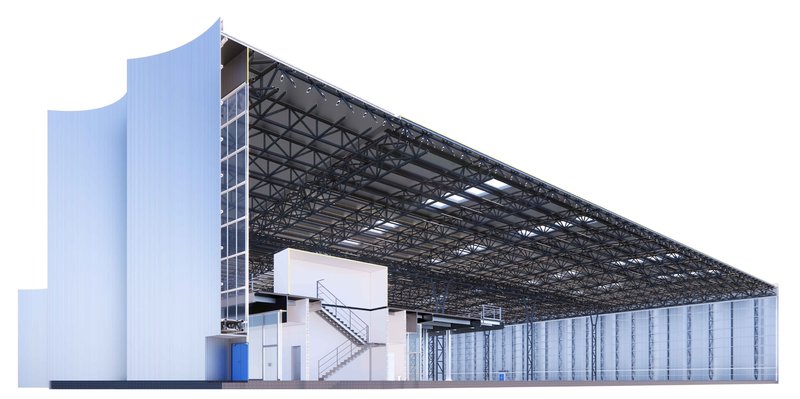
The drawings reveal what the photographs only suggest. The site plan shows the building's footprint as a clean rectangle set within a generous landscape of parking and planted rooftop zones, a deliberate greening strategy for what could have been pure asphalt. The sections are the most telling documents: they expose branching structural columns that spread into tree-like forms to support the roof span, an elegant structural solution that explains the open, column-free floor below.
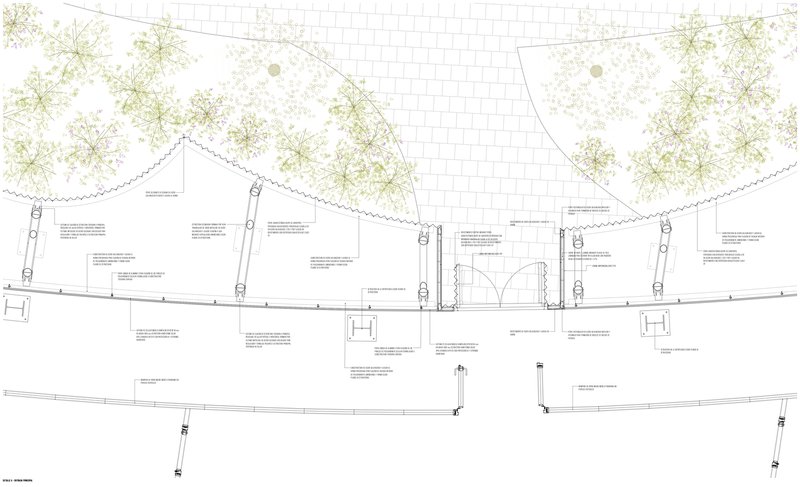
Construction detail drawings paired with site photographs bridge the gap between intention and execution, showing how the fluted column wrappings and corrugated panels meet the steel truss framework. These documents confirm that the project's visual coherence is not incidental. Every junction, from panel-to-truss to column-to-floor, was drawn and resolved before it was built. For a prefabricated building, that level of detailing discipline is what separates architecture from mere assembly.
Why This Project Matters
The logistics warehouse is arguably the most consequential building type of the twenty-first century. It is the architecture of online commerce, of global supply chains, of the last mile. And yet it is almost universally treated as a non-architectural problem, a shed to be permitted, erected, and forgotten. System Arquitectura's Mayoral center pushes back against that resignation without resorting to expensive custom solutions or impractical formal gestures. It stays within the budget and material logic of industrial construction while demonstrating that proportion, light, and compositional intention can transform a shed into a building worth looking at.
The project matters because it makes a case that has implications far beyond this single site. If a pleated polycarbonate skin and a disciplined structural palette can dignify a warehouse on the outskirts of a Spanish city, then the thousands of anonymous distribution centers being built across every continent have no excuse. The tools are standard. The cost premium is minimal. What is required is simply the conviction that infrastructure deserves design, and a client willing to listen. Mayoral, it appears, was.
The Mayoral New Warehouse Logistics Center by System Arquitectura. Location: Spain. Photography by Fernando Alda.
About the Studio
Share Your Own Work on uni.xyz
If projects like this are the kind of work you want to make, uni.xyz is a place to publish your own, find collaborators, and enter design competitions.



Popular Articles
Popular articles from the community

Guangzhou's Twin Towers Interiors Move Like Water
DuShe Architectural Design shapes the lobbies of a massive Guangzhou transit hub with undulating ceilings and deep geological materiality.
A Park Building That Wants to Be a Landscape
Omrania's Operations & Maintenance Building at King Salman Park dissolves industrial program into Riyadh's largest green infrastructure.
Bood Design Bureau Splits a Gilan Residence in Two to Let the Forest In
Double Side House negotiates privacy and openness through interlocking concrete volumes and planted courtyards in northern Iran's humid Caspian lowlands.
Art 1 Office Strips Athens Back to Its Bones
Neiheiser Argyros transforms a 40-year-old Athens office building into a vivid, materially rich workplace anchored by red steel, exposed concrete, and roof

Similar Reads
You might also enjoy these articles

Filtering Space: A Gradual Spatial Experience
From urban intensity to spatial calm.


The Ken Roberts Memorial Delineation Competition (Krob)
As the most senior architectural drawing competition currently in operation anywhere in the world, it draws hundreds of entries each year, awarding the very best submissions in a series of medium-based categories.

Waterfront Redevelopment and Urban Revitalization in Mumbai: Forging a New Dawn for Darukhana
A transformative waterfront redevelopment project reimagining Darukhana’s shipbreaking heritage into an inclusive urban future.

OUT-OF-MAP: A Call for Postcards on Feminist Narratives of Public Space
Rhizoma Design and Research Lab invites artists, designers, architects, researchers, and students to reflect on how feminist perspectives can reshape public space. Selected works will be exhibited in Barcelona, October 2026. Submissions open until 15 April 2026.


Explore Architecture Competitions
Discover active competitions in this discipline




The International Standard for Design Portfolios


The Global Benchmark for Architecture Dissertation Awards


The Global Benchmark for Graduation Excellence


Challenge to reimagine the Iron Throne
Comments (0)
Please login or sign up to add comments
No comments yet. Be the first to comment!