
MISA Architects Builds a 14,000-Square-Foot Maze Rooted in Maratha Wada Traditions
In Ahmedabad's Shela neighborhood, brick vaults and layered courtyards revive the spatial logic of Indian communal living.


A house that deliberately gets you lost is either a failure or a provocation. The Maze House in Shela, designed by MISA Architects, is firmly the latter. At 14,000 square feet, this multi-generational residence borrows the organizational DNA of the Maratha wada, a traditional residential typology defined by interlocking courtyards, deep verandas, and a layered progression from public gathering to private retreat. The result is not a replica of that tradition but a contemporary reinterpretation, one that uses concrete vaults, inventive brickwork, and calibrated level changes to produce a spatial sequence where getting turned around is the whole point.
What makes the project genuinely interesting is its refusal to treat vernacular architecture as a surface treatment. MISA Architects have not slapped a jaali screen onto a conventional plan and called it contextual. Instead, the plan itself is the argument: rooms connect through courtyards and verandas rather than corridors, privacy increases as you ascend, and a central open-air void, reminiscent of Ahmedabad's celebrated baoli stepwells, organizes light, air, and social life in a single gesture. The house is proof that Indian spatial traditions can absorb contemporary construction techniques without losing their core intelligence.
Entering the Maze
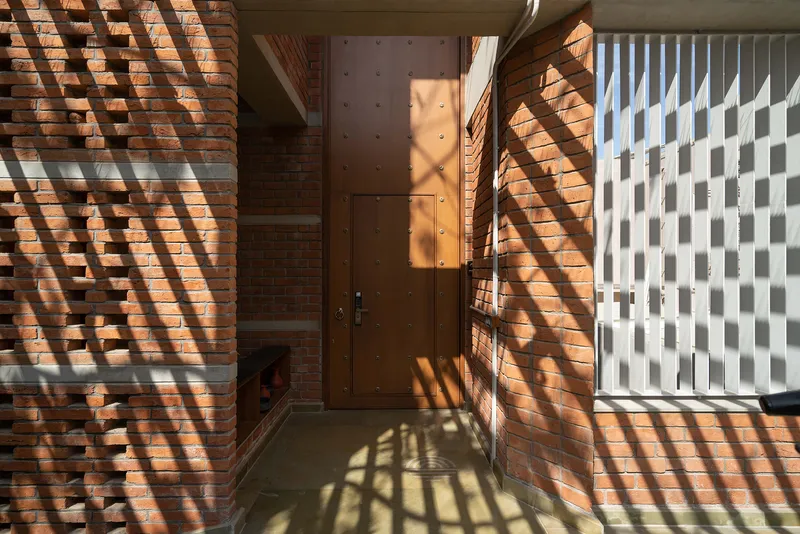
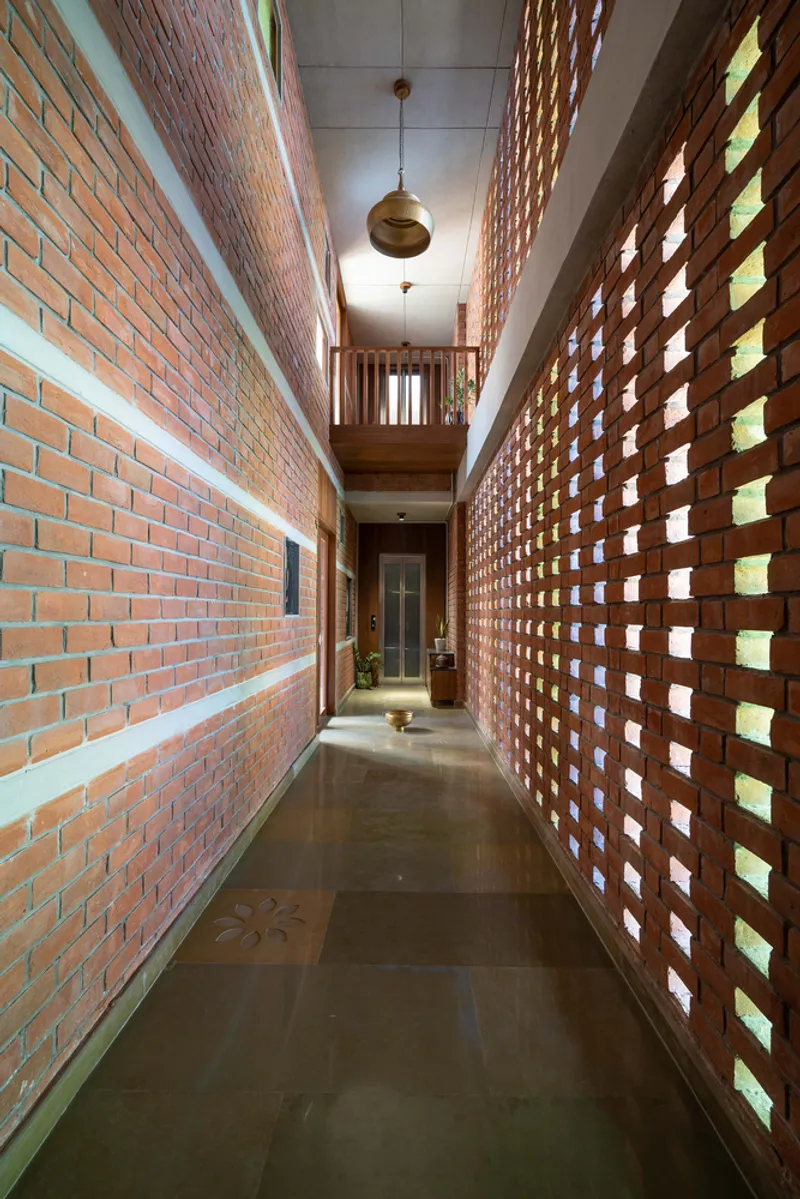
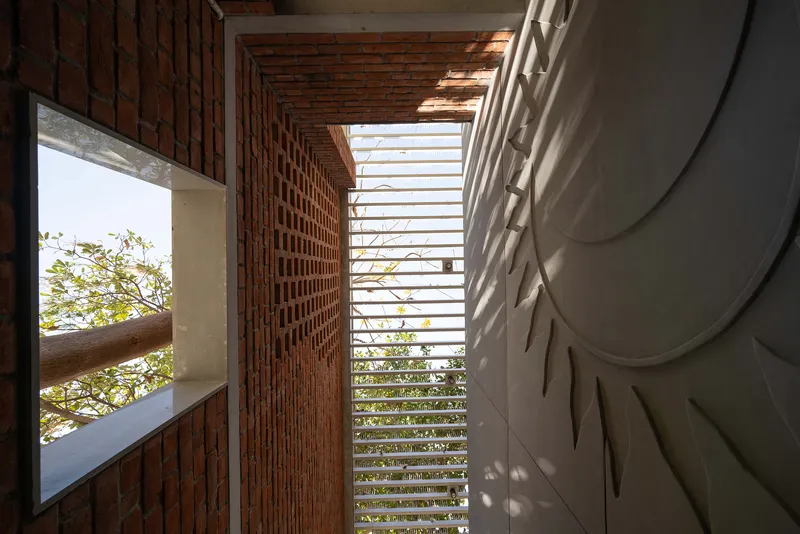
Arrival is deliberately understated. A metal entry door opens into a vestibule where sharp diagonal shadows cut across brick and white screen walls, offering almost nothing of the house's true scale. From there, corridors flanked by perforated brick screens and glass block inserts filter daylight into shifting patterns, guiding movement without revealing what lies ahead. The maze metaphor is not decorative: the plan uses level differences and indirect sightlines so that a wrong turn loops you back to your starting point, encouraging exploration rather than efficient transit.
These transitional spaces do serious environmental work too. The perforated brick walls and horizontal louver screens frame pockets of greenery while acting as passive ventilation channels, pulling air through the plan without mechanical assistance. In a climate as punishing as Gujarat's, this layered filtration of light and breeze is not ornamental; it is survival strategy dressed in good brickwork.
The Courtyard as Organizational Engine
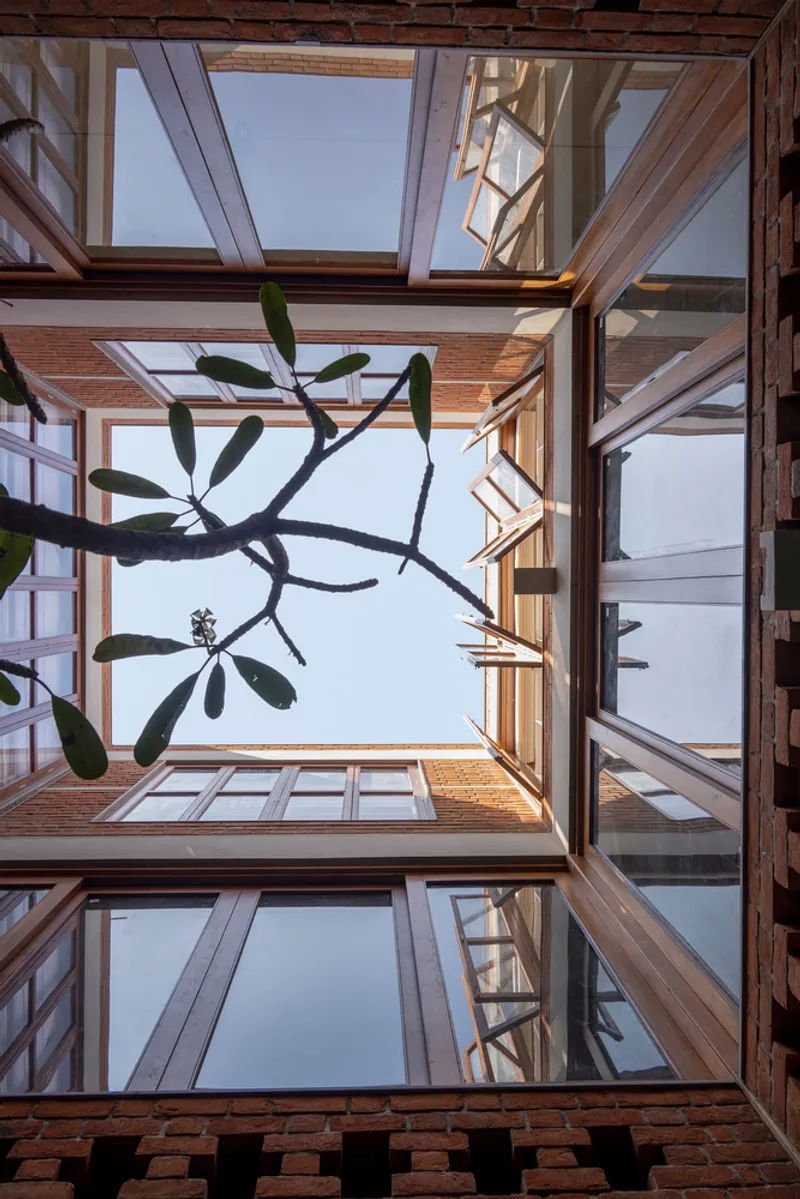
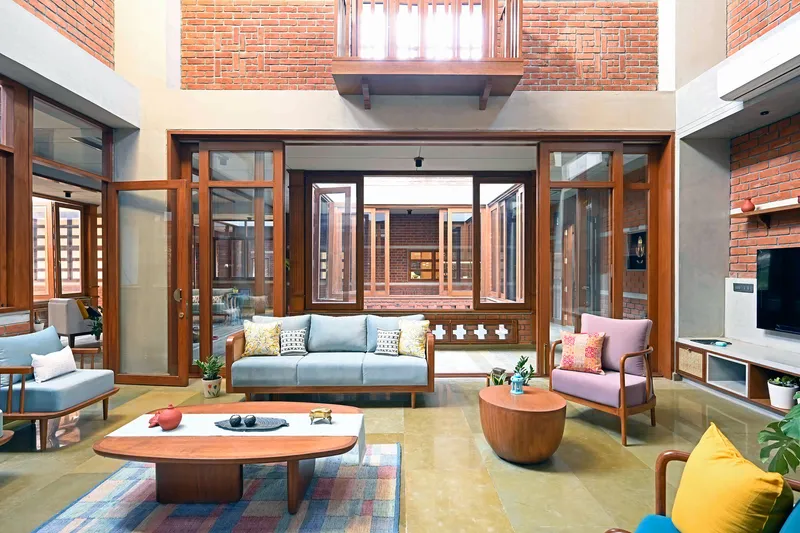
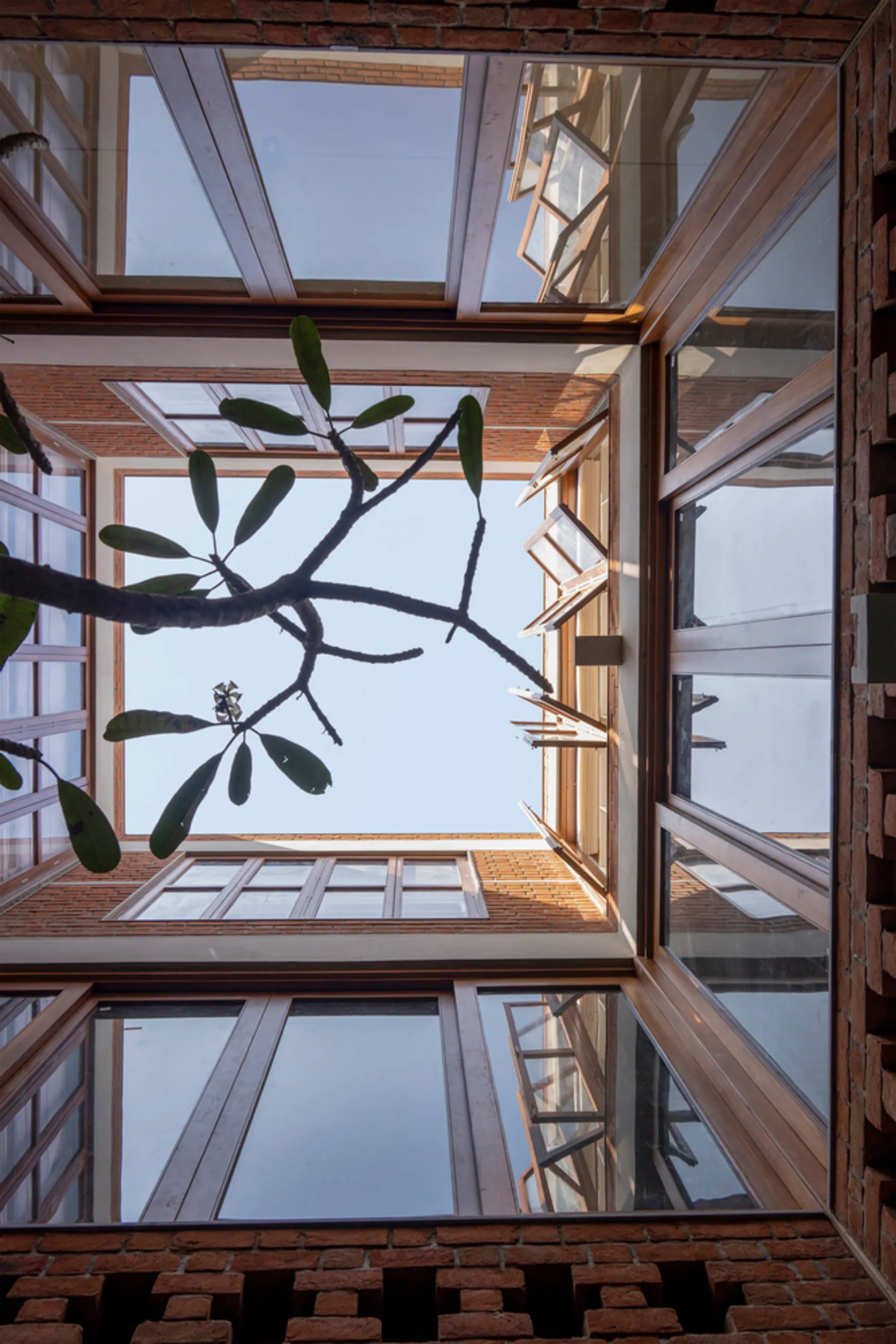
The central courtyard is the social and environmental heart of the house. Looking straight up from its base, you see timber-framed balconies stacking around a plumeria tree that punches through the open void, framing sky and canopy in a single vertical composition. It recalls the proportions of a stepwell more than a typical residential atrium: deep, narrow, and structured to channel north light downward through the section.
The living spaces open directly onto this courtyard through timber-framed folding glass doors, collapsing the boundary between inside and outside. Clerestory windows above the doors pull additional daylight into the deeper rooms. For a multi-generational household, the courtyard operates as a shared commons: visible from every level, acoustically connected, and naturally ventilated. It is the piece that makes the maze livable rather than merely clever.
Brick as Structure, Screen, and Identity
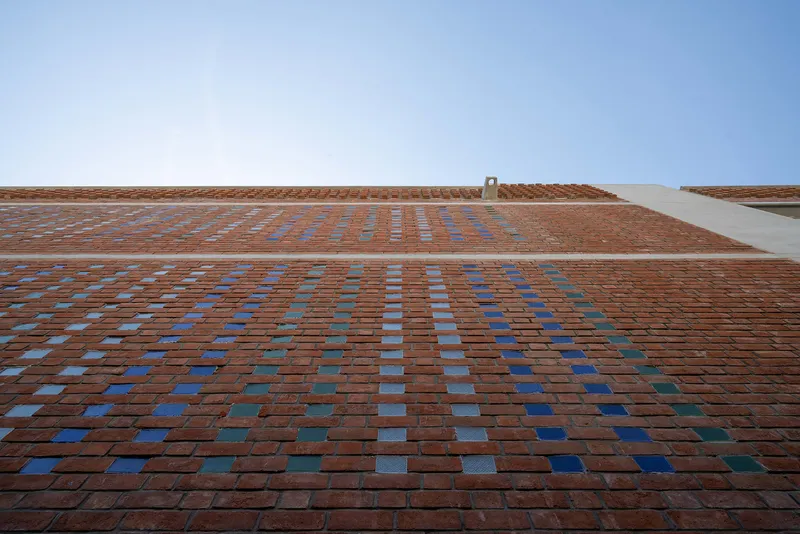
MISA Architects have pushed brick well beyond standard running bond. The facade features interlocking geometries and custom bond patterns that reduce the need for expensive formwork while producing a tactile richness visible from the street. Scattered blue tile accents break up the red field, adding a playful note that prevents the exterior from reading as monolithic. The effect is a facade that looks handmade without looking folksy.
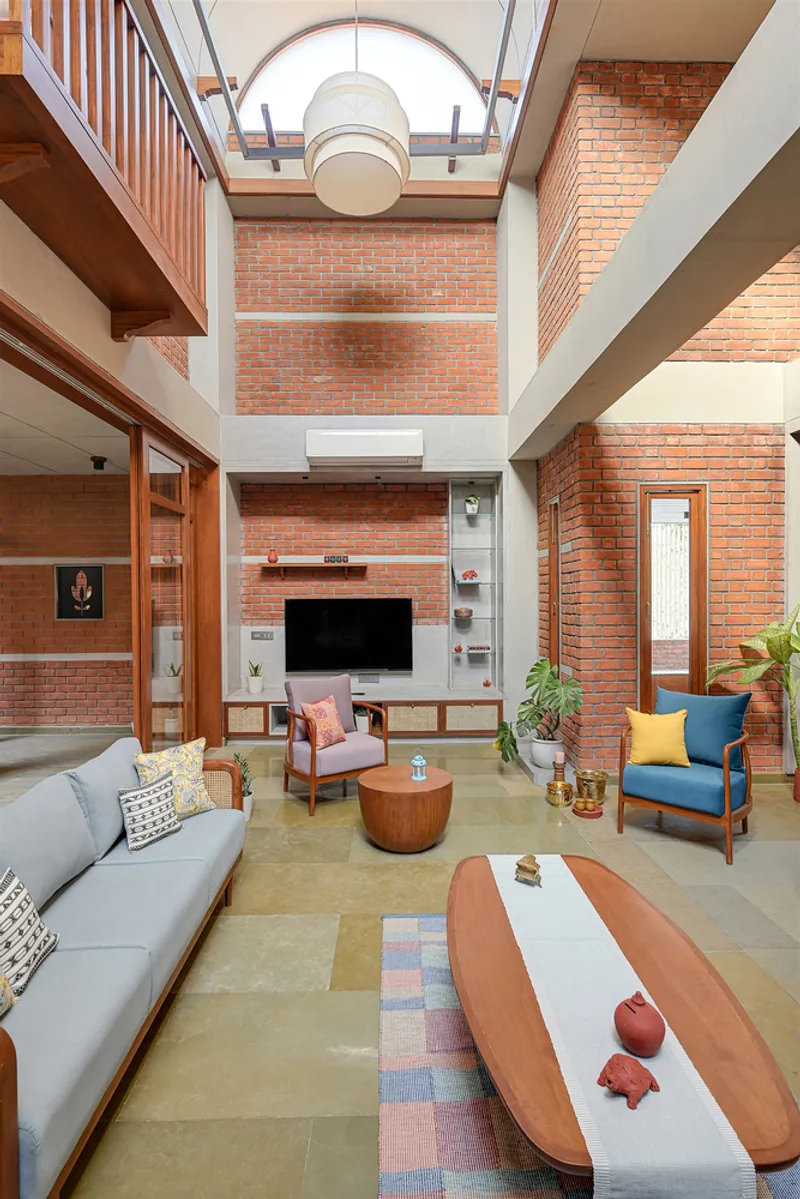
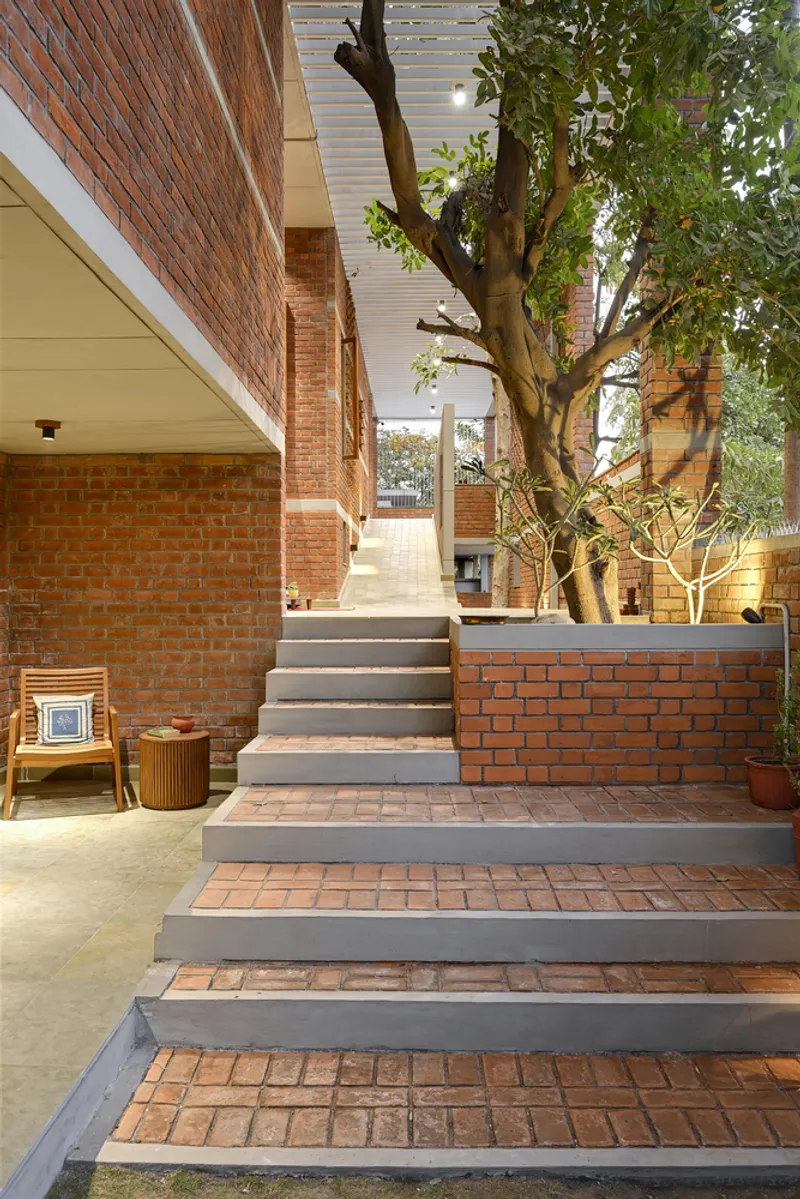
Inside, the double-height living room makes the structural ambition legible. Exposed red brick walls rise to meet an arched skylight, with a spherical pendant lamp hanging in the void as a deliberate counterpoint to all the orthogonal and curved masonry. The outdoor staircase, with brick treads and concrete risers ascending past a preserved courtyard tree, shows the same material discipline at a more intimate scale. Every surface works structurally and atmospherically at once, and the cost savings from these inventive bonding techniques reportedly offset what could have been a much more expensive build.
Vaulted Rooms and North Light
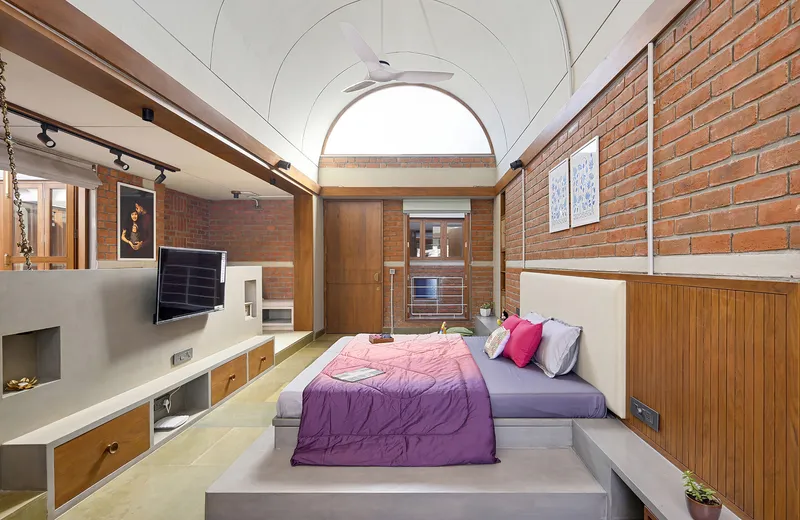
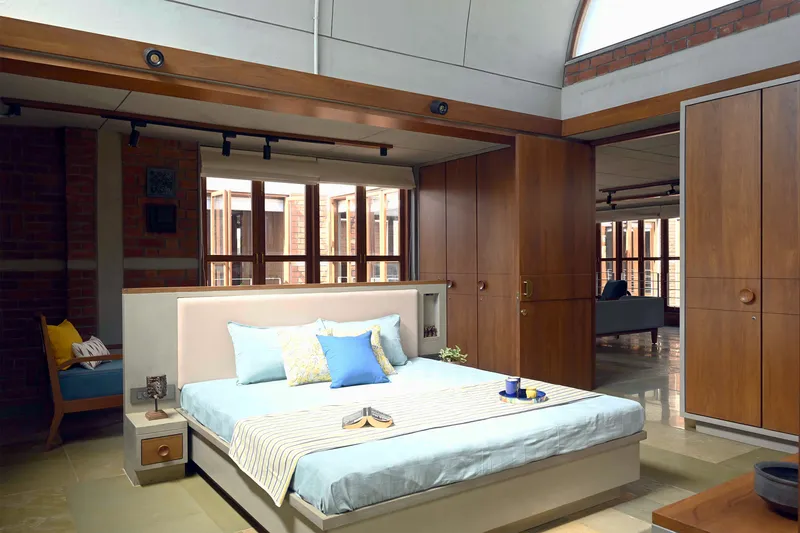
The upper floor bedrooms are defined by concrete vaults that eliminate most of the vertical supports a conventional flat slab would demand. The result is generous, column-free rooms where the curved ceiling creates both spatial volume and a natural path for light. Arched skylights at the vault crowns introduce controlled north light throughout the day, reducing reliance on artificial illumination and softening the quality of the interior atmosphere.
Timber paneling on wardrobe walls and bed surrounds warms the palette without fighting the brick and concrete. Clerestory windows in the bedrooms frame views into the interior courtyard, maintaining a visual connection to the communal heart of the house even in the most private rooms. The vaults are the structural move that allows the maze logic to continue vertically: fewer columns means more freedom to offset rooms, shift levels, and create the unexpected adjacencies that give the plan its labyrinthine character.
Living on the Edge: Terraces and Thresholds
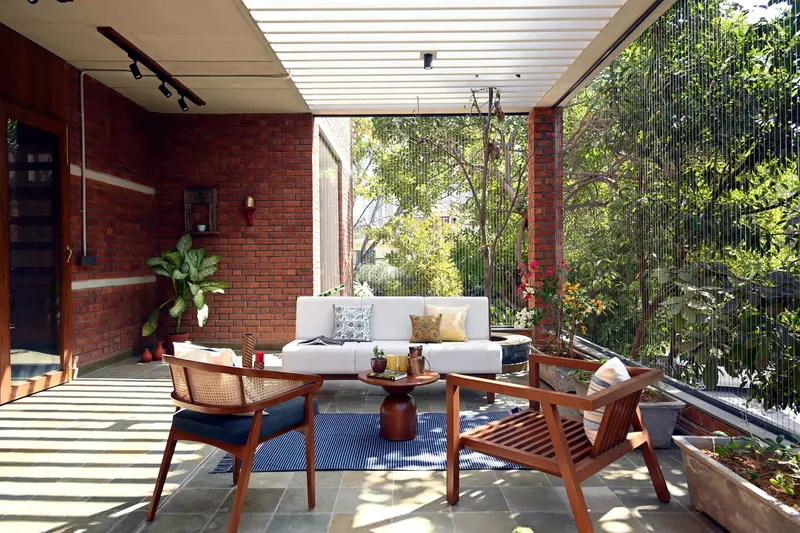
The uppermost levels open onto covered terraces with slatted timber pergolas and cable railings that frame views over the surrounding garden. These outdoor rooms extend the social life of the house upward, offering sit-outs and gathering areas where the breeze is strongest and the privacy is greatest. The progression from the semi-public courtyard at ground level to these intimate rooftop perches is gradual and deliberate, a vertical gradient of exposure that mirrors the wada's traditional layering of social space.
The pergola structure filters harsh Gujarat sunlight into a dappled pattern, making the terrace usable for most of the day. Combined with the courtyard ventilation stack below, the house creates a passive cooling loop that moves air from ground level to roof without mechanical systems. It is a strategy rooted in centuries of local building knowledge, executed here with contemporary framing and detailing.
Why This Project Matters
The Maze House matters because it treats Indian vernacular architecture as a living design method rather than a historical reference. MISA Architects have extracted the organizational logic of the Maratha wada and the environmental intelligence of the Gujarat stepwell, then rebuilt those principles with concrete vaults and innovative brickwork at a scale that serves a contemporary multi-generational family. The project does not romanticize the past; it argues that the past already solved many of the problems modern architects struggle with, from passive cooling to communal spatial planning.
In a residential market that often treats tradition as a stylistic checkbox, this house makes a structural and spatial commitment to its cultural sources. The maze plan is not a gimmick; it is the direct descendant of a building tradition that organized domestic life around shared open space and gradual thresholds of privacy. That the project also lowers construction costs through its brick bonding innovations makes the case even harder to dismiss. The answer, as MISA Architects suggest, was always in the tradition. The skill was in knowing which parts to keep and which to reinvent.
The Maze House by MISA Architects. Location: Shela, Ahmedabad, Gujarat, India. Area: 14,000 sq ft. Year: 2023.
About the Studio
Share Your Own Work on uni.xyz
If projects like this are the kind of work you want to make, uni.xyz is a place to publish your own, find collaborators, and enter design competitions.



Popular Articles
Popular articles from the community


Lunar Spiral: Space Architecture Shaped by the Mathematics of the Universe
Lunar Spiral reimagines space architecture through Fibonacci geometry, lunar regolith, levitating habitats, and self-sustaining Moon living.

Hill & Cross Opera: Sculptural Opera House Architecture Shaped by Tallinn’s Landscape and Identity
Hill & Cross Opera reimagines opera house architecture in Tallinn through its sculptural hill, civic plaza, glass wave and a luminous cross.

Co-life: Sustainable Architecture for Age-Friendly Community Living
Co-life reimagines sustainable architecture for seniors through courtyards, rammed earth, shared gardens, and spaces designed for belonging.

Co-Life: Senior Housing Design That Reconnects Older Adults With the City
Co-Life reimagines senior housing design through healing gardens, shared streets, workshops, and a sustainable community across generations.
Similar Reads
You might also enjoy these articles


Hodi-Mandai Geram
Project Function: Preservation and revitalization of the Intangible heritage and socio-spatial identity of the Hodi by Housing, Cultural Memory Center, Sacred Grove, landscape, local tourism economy


Olio Towers: A Mid-Rise for Performers That Fuses Housing, Rehearsal, and Stage
Located blocks from Houston's Theater District, this modular tower stacks living units around a central performance atrium.

Oasis: Modular Green Housing Carved into Dhaka's Urban Fabric
A shortlisted Plugin Housing entry reclaims unauthorized settlements in Dhaka with stepped concrete volumes, green roofs, and ventilation-driven design.

Black Hole: A Floating Megastructure for the Post-Physical Era
Emiliano Mazzarotto envisions a spherical, self-scaling arena where e-sports, digital hotels, and holographic stadiums replace traditional public space.


Explore Mughal Architecture Competitions
Discover active competitions in this discipline



Challenge to reimagine the Iron Throne


Photograph architecture without architects


Illustrate the lost glory of Angkor Wat - Render Challenge


Design challenge to reuse E-waste
Comments (0)
Please login or sign up to add comments
No comments yet. Be the first to comment!