

The Shore, the Tide, the Current: Exploring an Oceanic Caribbean at ARCO Madrid
Architectural exhibition in ARCO Madrid explores the Caribbean as an interconnected oceanic network through dynamic spatial design, flowing walls, light-guided circulation, and art dialogue.


Architects: Ignacio G. Galán, OF Architects
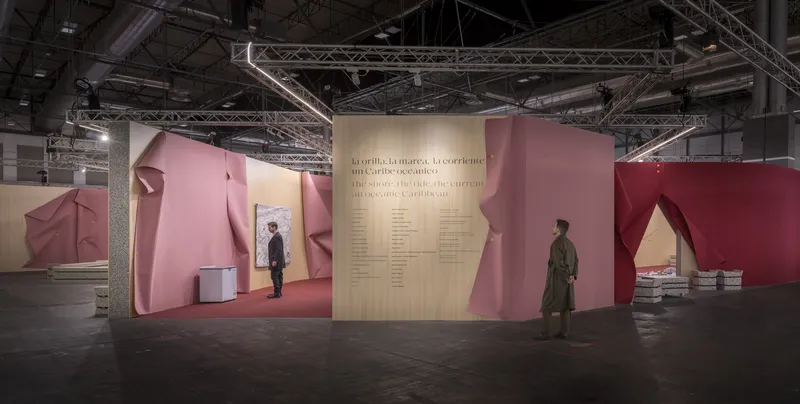
The exhibition “The Shore, the Tide, the Current: An Oceanic Caribbean” presented at ARCO Madrid 2024 offers a powerful spatial and conceptual exploration of the Caribbean as a dynamic and interconnected territory. Designed by architects Ignacio G. Galán, Arantza Ozaeta, and Álvaro M. Fidalgo of OF Architects, the installation transforms the exhibition environment into a narrative landscape that reflects the flows, connections, and historical complexities of the Caribbean region.
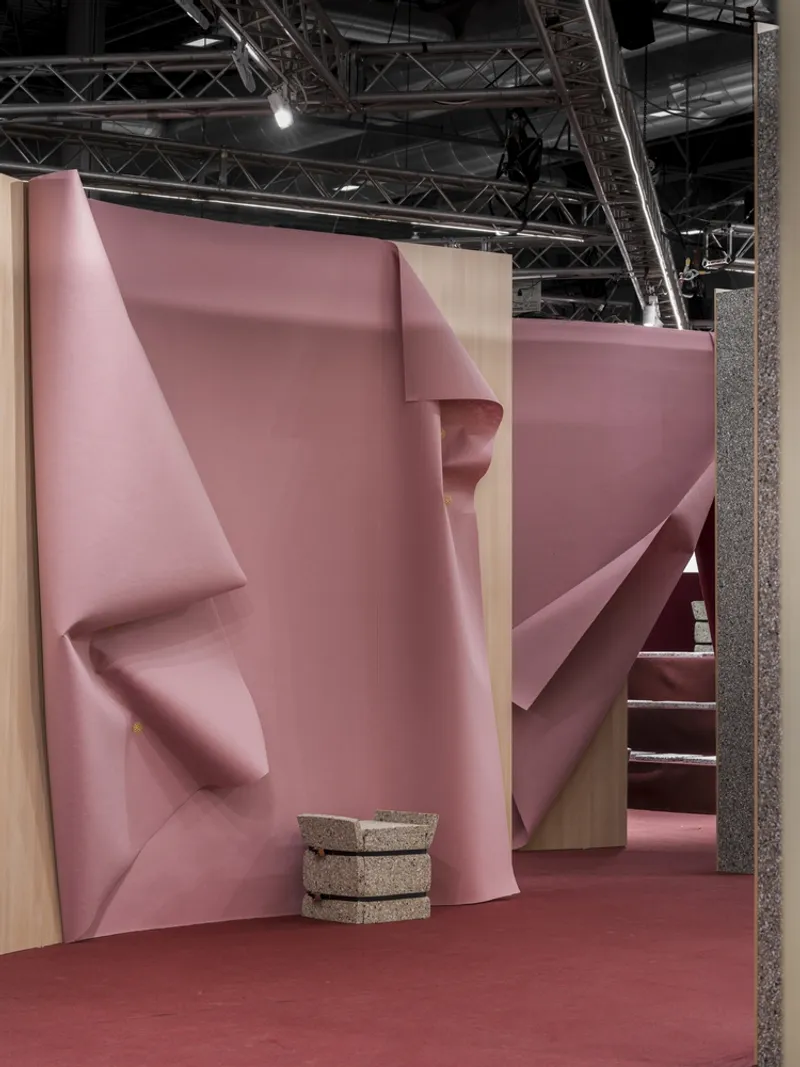
Occupying approximately 800 square meters, the architectural installation was commissioned by ARCO Madrid and curated by Clara Ott, with the curatorial concept developed by Carla Acevedo-Yates and Sara Hermann Morera. The exhibition brings together 24 artworks from 19 international galleries, creating a dialogue between contemporary art, architecture, geography, and cultural narratives.
Rather than presenting the Caribbean as a fragmented collection of islands, the exhibition reimagines it as a vast oceanic network shaped by maritime routes, colonial histories, ecological systems, and cultural exchanges.
Curatorial Vision: Reimagining the Caribbean as an Oceanic Network
The curatorial framework challenges conventional perceptions of the Caribbean as a purely insular and isolated geography. Instead, it proposes an “oceanic Caribbean”, emphasizing the region’s deep historical, ecological, and political connections across continents.
According to the curators, the Caribbean should be understood as a fluid and relational territory defined by ocean currents, trade winds, and migratory movements. These forces historically facilitated colonial expansion, economic exchange, and cultural interaction between Europe, Africa, and the Americas.
This perspective highlights how the Caribbean has long been connected to Atlantic and Pacific networks, both through maritime circulation and through subterranean and ecological systems that enable movement among humans, animals, and natural processes.
The exhibition therefore positions the Caribbean as a continental and planetary system rather than an isolated archipelago, revealing the complex relationships between geography, colonial power, trade routes, and cultural exchange.
Architectural Concept: Translating Oceanic Flows into Spatial Form
The architectural design developed by Ignacio G. Galán and OF Architects translates the exhibition’s curatorial vision into a spatial experience that reflects movement, fragmentation, and connection.
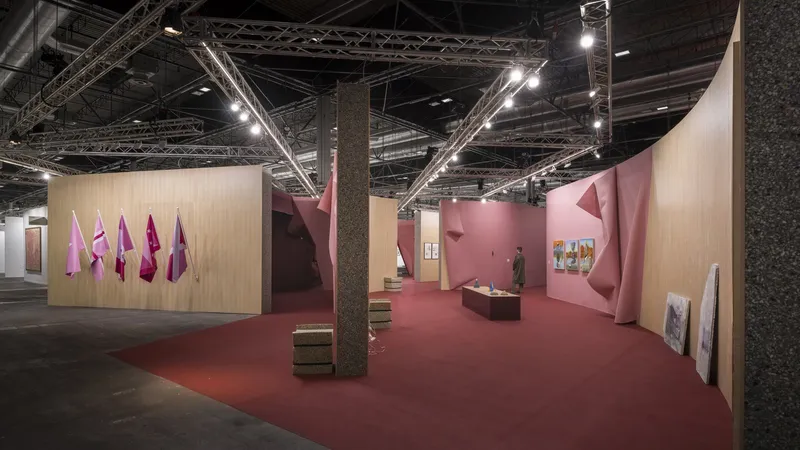
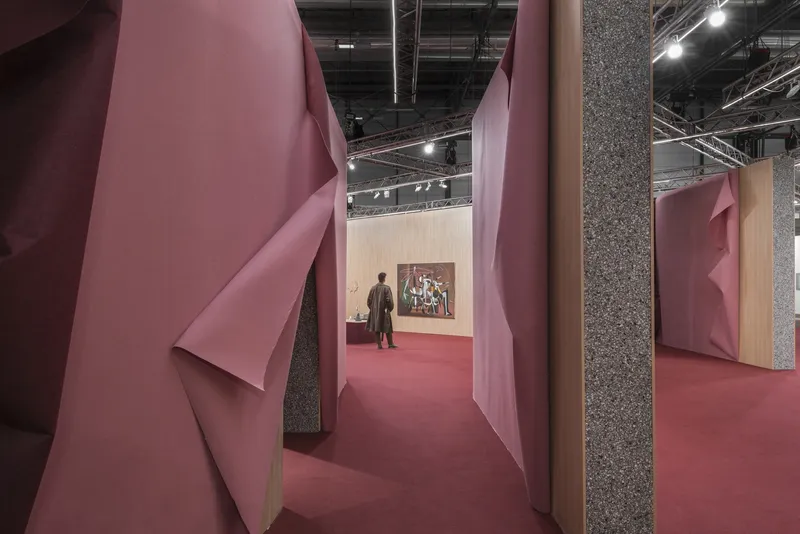
The layout is composed of walls with rigid and undulating geometries, creating a spatial configuration that alternates between expansion and compression. This architectural strategy reflects the dual nature of the Caribbean landscape, simultaneously defined by fluid maritime connections and historical ruptures caused by colonial exploitation and displacement.
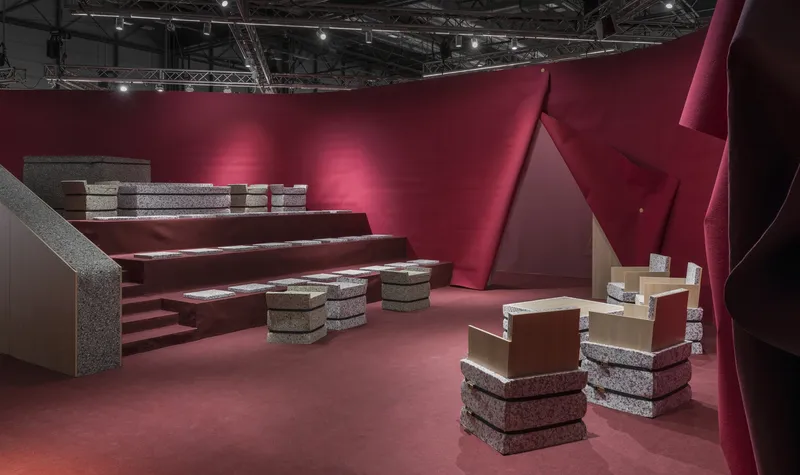
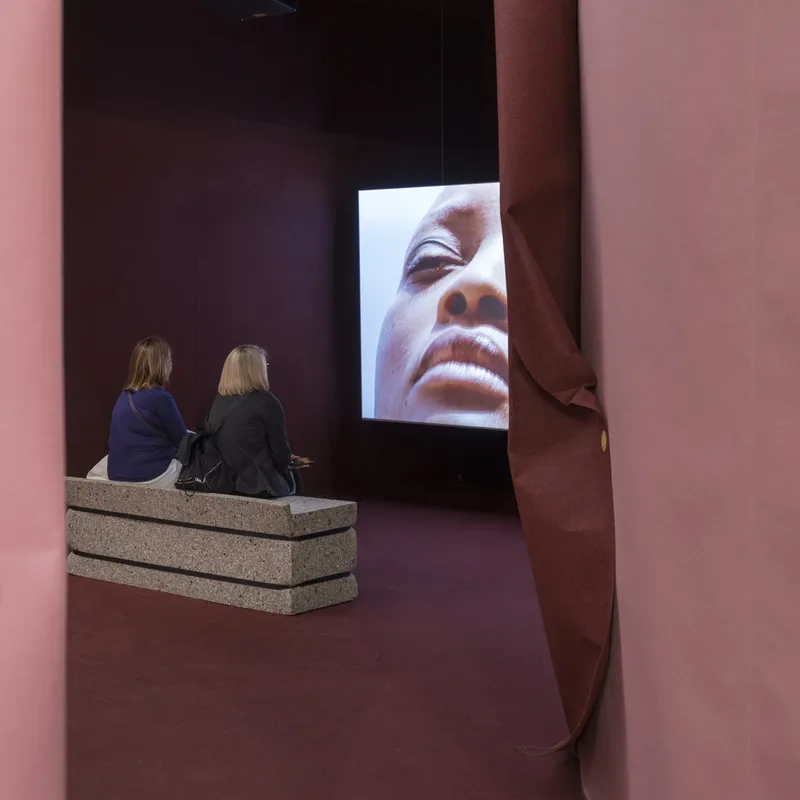
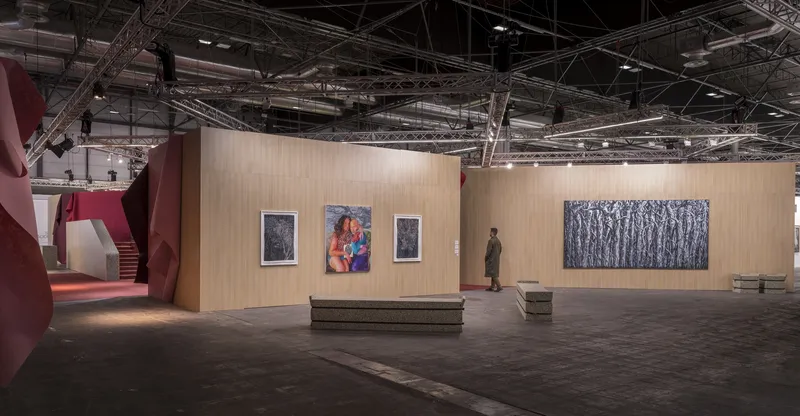
The dynamic spatial arrangement allows artworks to engage in visual and conceptual dialogue while also generating intimate zones for projection spaces, presentations, and a dedicated public forum.
Openings along the perimeter connect the installation to the broader exhibition environment, allowing visitors to experience the installation as a porous landscape rather than a closed gallery.
Navigating the Exhibition: Light, Circulation, and Spatial Narratives
One of the most distinctive elements of the exhibition architecture is a nautical-inspired overhead structure composed of lattice beams. This structural layer functions like a contemporary navigation chart, guiding visitors through the exhibition space.
Integrated linear lighting elements trace routes across the ceiling grid, subtly directing movement and establishing a narrative path through the exhibition. These illuminated lines create visual connections between artworks while also highlighting diagonal circulation routes and cross-views across the gallery.
This design approach reinforces the curators’ vision of the Caribbean as a relational territory defined by intersecting currents and pathways. Visitors are encouraged to explore the exhibition through multiple perspectives and shifting viewpoints, mirroring the complexity of the Caribbean’s geographic and cultural networks.

Materiality and Spatial Atmosphere
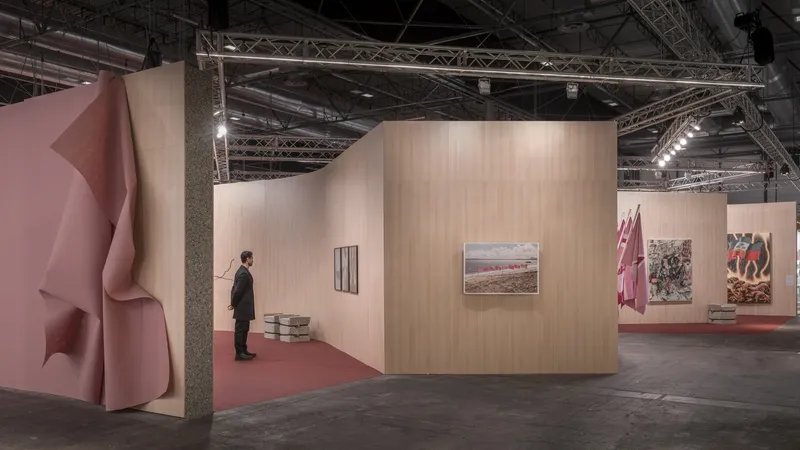
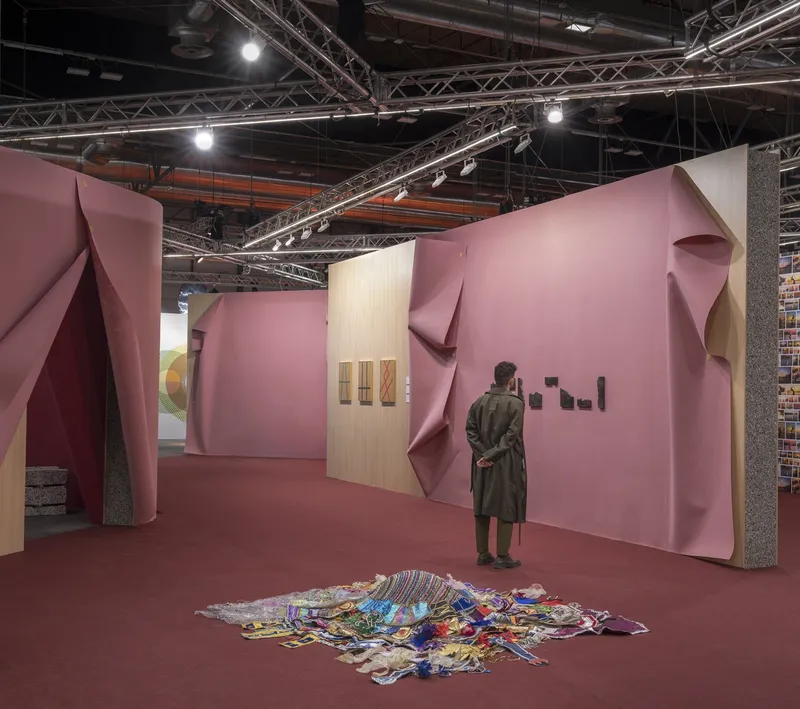
Material expression plays a critical role in shaping the exhibition’s spatial identity. The installation is constructed primarily from wood-paneled walls combined with sections of fair carpeting, creating surfaces that are cut, folded, and twisted.
These manipulated planes avoid forming a stable or unified spatial representation. Instead, they generate environments that feel fragmented, temporary, and unstable, echoing the themes of vulnerability and precariousness explored in the curatorial narrative.
The surfaces create a layered environment where spaces expand and contract, producing moments of openness alongside more enclosed and immersive zones.
Challenging Caribbean Stereotypes Through Color and Furniture
The exhibition’s material palette intentionally challenges stereotypical representations of the Caribbean. Rather than relying on conventional tropical imagery, the installation incorporates unexpected textures and colors.
Pink carpeting covers parts of the exhibition floor, creating a surreal and visually striking landscape. Complementing this palette is a collection of custom furniture pieces wrapped in recycled fluffy insulation, producing objects that resemble irregular stone formations.
These unusual forms blur the boundary between natural and artificial elements, reinforcing the exhibition’s critique of simplified narratives about Caribbean identity.
By rejecting familiar visual clichés, the installation encourages visitors to question dominant representations of the region and to engage with its complex histories, layered geographies, and evolving cultural realities.
A Spatial Dialogue Between Art, Architecture, and Geography
Ultimately, the exhibition demonstrates how architecture can function as an interpretive medium, translating theoretical concepts into physical experiences.
Through its dynamic geometry, navigational lighting system, and experimental material palette, the installation creates a spatial narrative that mirrors the fluid and interconnected nature of the Caribbean world.
The project stands as a compelling example of exhibition architecture that bridges art, curatorial research, and spatial storytelling, transforming the gallery environment into a living map of historical currents, cultural exchanges, and ecological relationships.
All photographs are works of
Imagen Subliminal (Miguel de Guzmán + Rocío Romero)


Popular Articles
Popular articles from the community


U.GA Architects Wraps an Oval Rooftop Pool in Curved Board-Formed Concrete on Busan's Jeollidan-gil
In Busan's Jeonpo-dong, a 454 m² mixed-use block stacks a neighborhood facility, guest rooms and an oval rooftop pool inside spiraling concrete walls.

David Macias Steps a Doorless Stone and Plaster House Down a Tropical Colombian Hillside
In the humid hills of Colombia, Threshold House replaces the front door with an open void and terraces its 850 m² down the slope instead of fighting it.

LT2A and OPEN Architectes Thread a Brick and Glass High School Through a Wooded Belgian Campus
In Braine-l'Alleud, a 3,000 m² wing for Collège Cardinal Mercier pairs pale brick with a glazed colonnade, deferring to a small chapel and a dense wood.

David Ortega Stacks a Two-Story Mexico City Penthouse Around a Steel Stair and a Pergola-Shaded Roof Terrace
In Colonia Roma, a 300 m² penthouse uses oak joinery, a planted steel stair and a slatted roof pergola to make a new-build apartment feel like a house.

Similar Reads
You might also enjoy these articles

Gil Mello Arquitetura Tilts a Single Roof Toward the Waterfalls on a Plateau Above Aiuruoca, Brazil
In Aiuruoca, Minas Gerais, a 200 m² house of local labor and reclaimed poles pairs a low valley veranda with a tall mountain one.
U.GA Architects Wraps an Oval Rooftop Pool in Curved Board-Formed Concrete on Busan's Jeollidan-gil
In Busan's Jeonpo-dong, a 454 m² mixed-use block stacks a neighborhood facility, guest rooms and an oval rooftop pool inside spiraling concrete walls.

Felipe Hess Arquitetos Turns a Blind Stone Wall to the Street and Opens a Brazilian House onto a Courtyard and Canal
A canal-front house in Brazil hides behind painted stone and planting, then opens to an olive-tree courtyard, a reed-ceilinged porch and a curving pool.
David Macias Steps a Doorless Stone and Plaster House Down a Tropical Colombian Hillside
In the humid hills of Colombia, Threshold House replaces the front door with an open void and terraces its 850 m² down the slope instead of fighting it.

Explore Ocean Architecture Competitions
Discover active competitions in this discipline

Challenge to design a portable theatre

Challenge to design a portable music platform

Challenge to design an open learning module for the elderly

Challenge to reimagine the Iron Throne
Comments (0)
Please login or sign up to add comments
No comments yet. Be the first to comment!