

CZWG Architects Sculpt a Salt-Glazed Brick House into the Dunes at Greatstone-on-Sea
On a coastal bend between Dungeness and Greatstone, a faceted residence borrows its geometry from sand dunes and chalk cliffs.


There is a particular stretch of road along the Kent coast where the built environment and the landscape have never quite agreed on terms. Between Dungeness and Greatstone-on-Sea, a line of detached houses from various decades sits at the edge of an Area of Outstanding Natural Beauty, each one negotiating differently with the sand dunes, the wind, and the immense flatness of everything. The Stones House, completed in 2017 by CZWG Architects, is the latest entry in that conversation, and it is by far the most articulate.
What makes this project compelling is not just the formal ambition, which is considerable, but the way it resolves a genuine tension. The street side needs to be robust, private, and responsive to the curve of the road. The sea side needs to dissolve into glass and light. CZWG found a way to do both within a single building, using salt-glazed brickwork as armor on one face and timber and glazing as membrane on the other. The house earned shortlistings for both the Manser Medal and the AJ House of the Year in 2019, and those nominations were deserved. At just over 2,150 square feet across multiple levels with terraces on three of them, it is a compact masterclass in reading a site.
A Brick Face for the Road
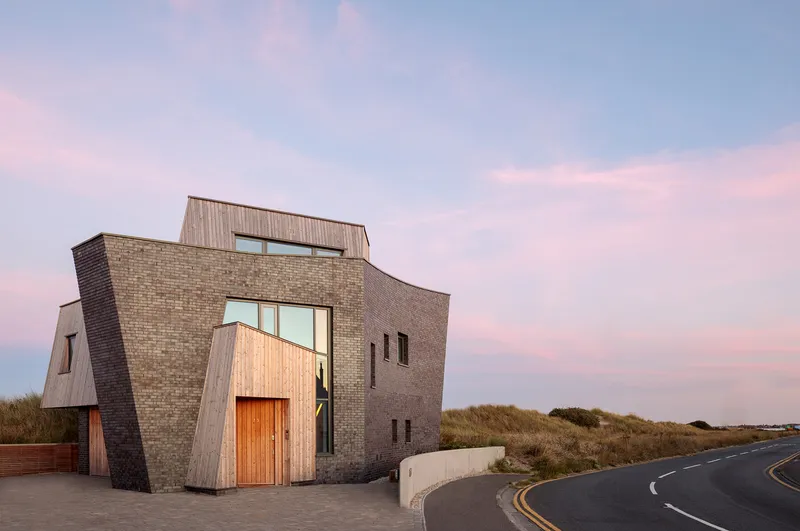
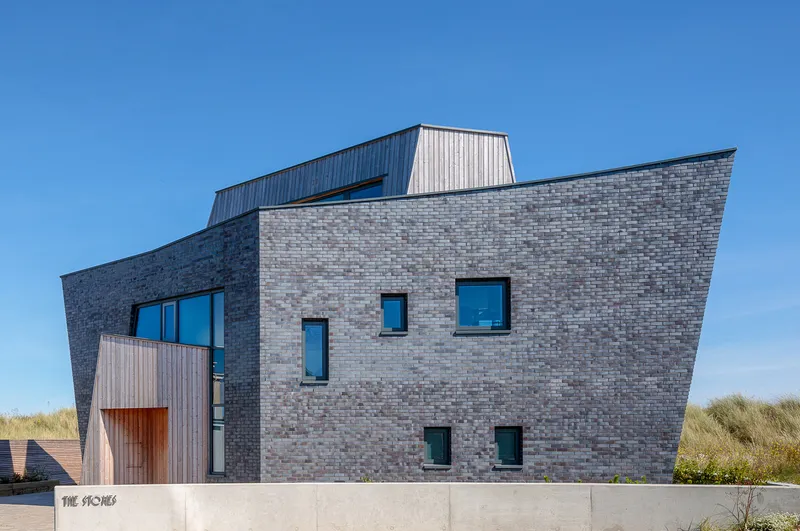
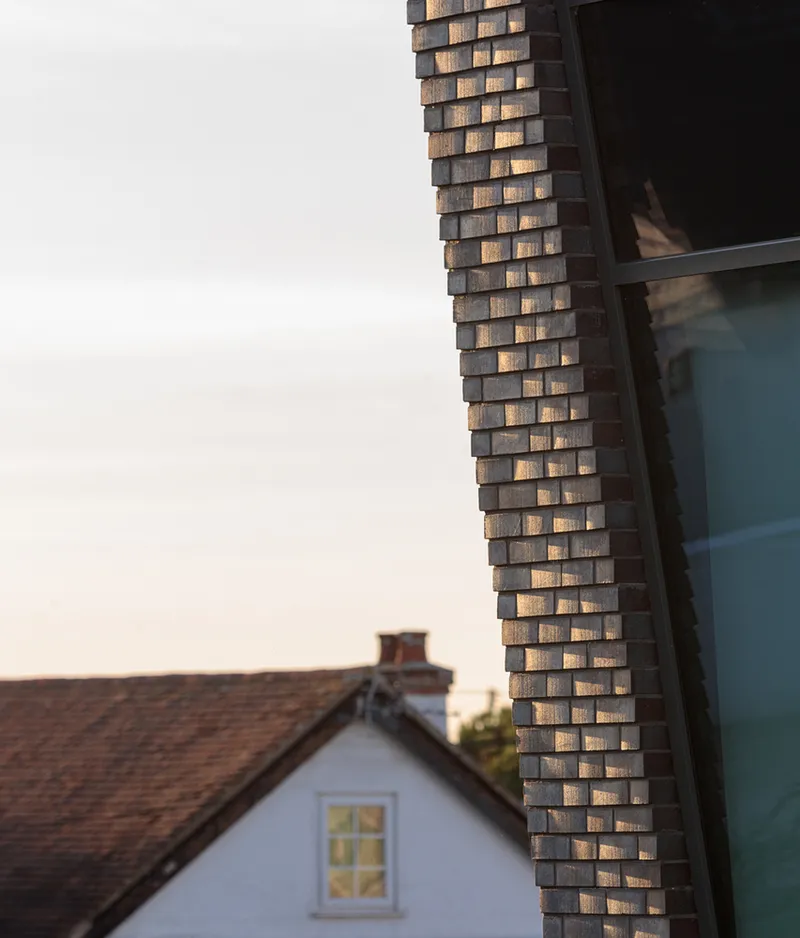
The street elevation is the house's public persona: a faceted wall of salt-glazed brickwork, curved and sloped to accentuate the bend in the road. The bricks are not laid flat and uniform. They project and stagger, catching light at different angles and creating a surface texture that shifts through the day. Small, scattered windows punctuate the mass, offering controlled glimpses outward without surrendering privacy. A zinc-clad volume rises from the roofline, hinting at the more open character of the levels above.
This is the kind of brickwork that rewards close looking. The corner detail, where courses step outward in deliberate misalignment, turns a standard construction material into something almost geological. It recalls the chalk cliffs nearby, or layered sedimentary rock eroded into facets. The choice of salt-glazed brick also makes practical sense: this is a material that handles coastal weather, salt air, and driving rain without flinching.
Coastal Context and Neighbors
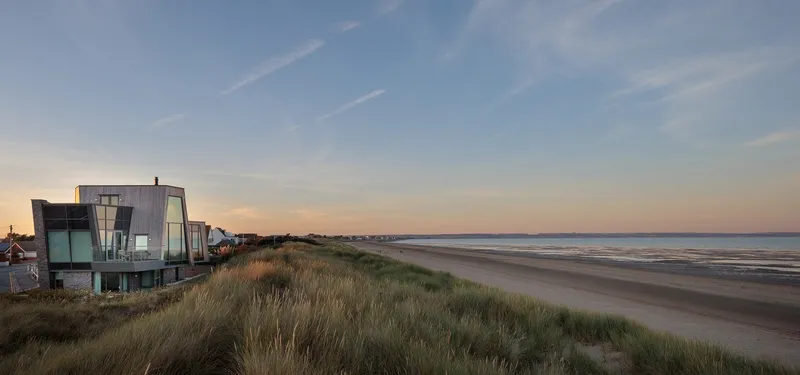
Seen from the beach at dusk, The Stones House takes its place among a cluster of angular beach houses set amid dune grasses. The context is distinctly English in its modesty and in the slightly ad hoc quality of the building line, where no two houses share a vocabulary. CZWG's contribution holds its own through formal clarity rather than volume. It does not tower over its neighbors; it simply occupies its plot with more conviction.
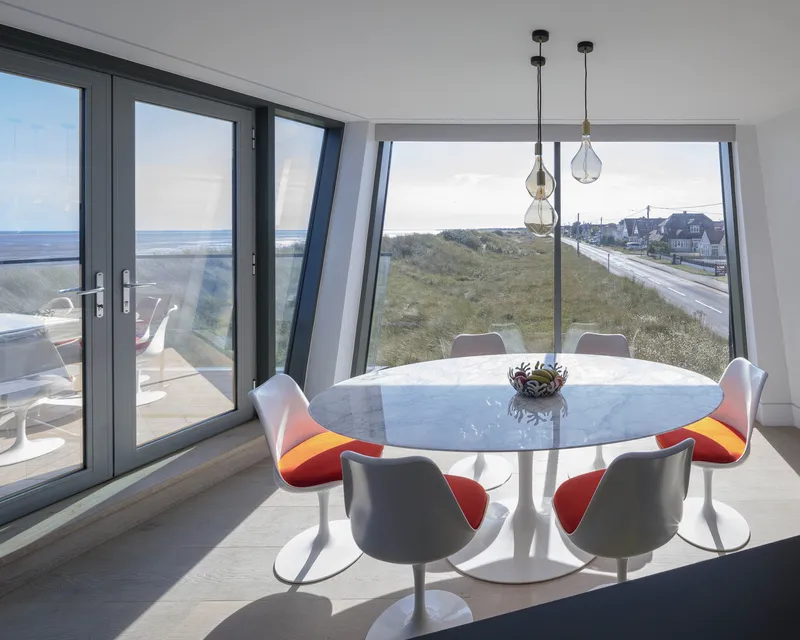
The dining area, set behind canted windows, looks directly out across the dunes toward neighboring houses, establishing a relationship with the streetscape that is neither confrontational nor withdrawn. Pendant lights and a warm timber palette soften the geometry inside, while the angled glazing frames the view as a composed scene rather than an unfiltered panorama.
Double-Height Living, Open to the Sea
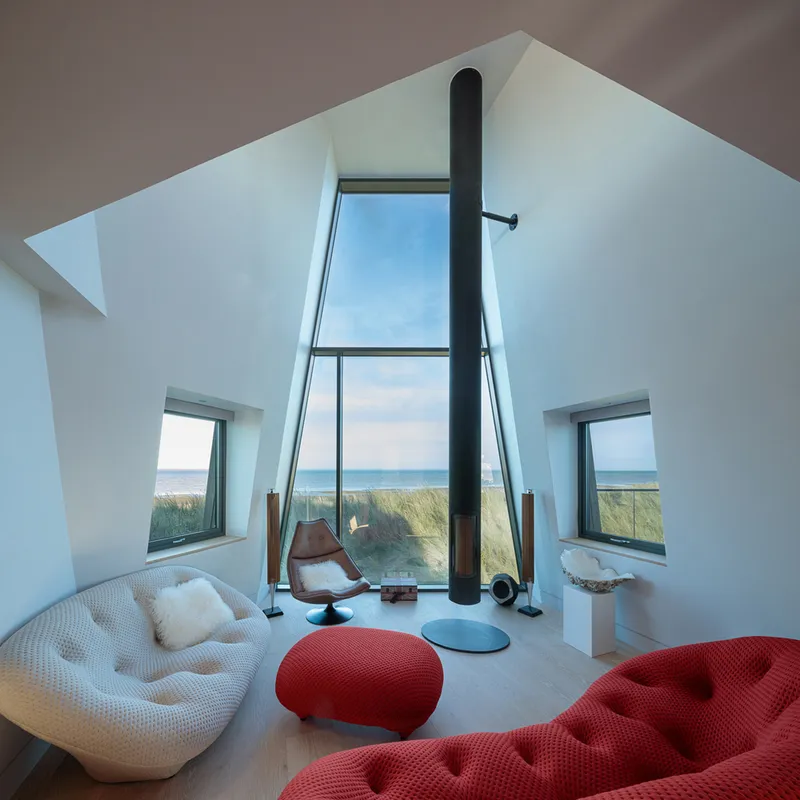
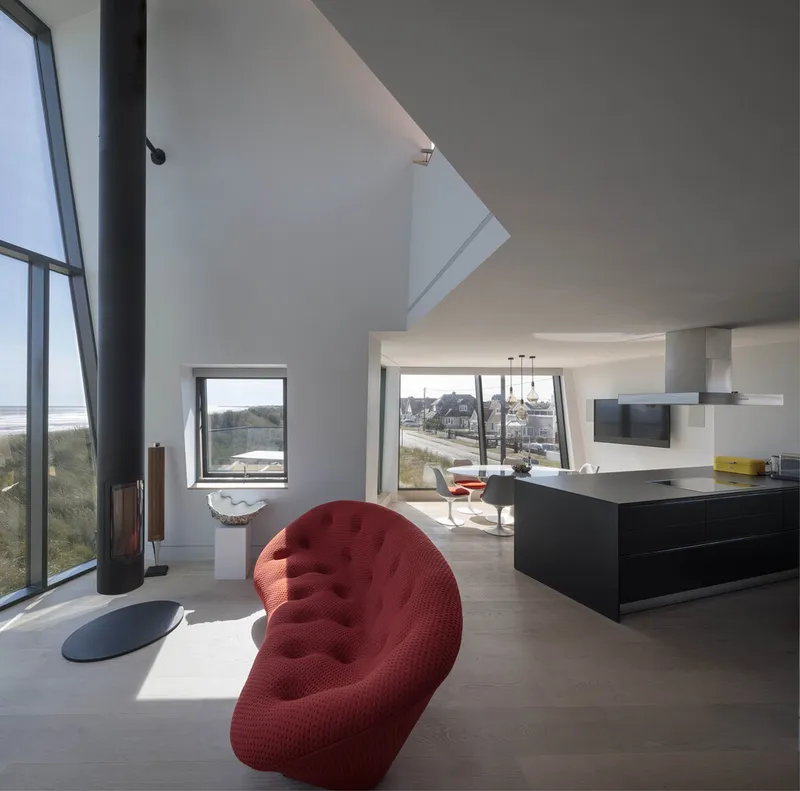
The centerpiece of the interior is a double-height living space on the first floor that opens through a truncated triangular window to the dunes and the English Channel beyond. A black flue from a wood stove runs vertically through the space, grounding the room with a single dark line. The inclined ceiling, clad in natural timber, evokes upturned boat hulls, a reference to local maritime craft that reads as intuitive rather than forced.
A skylight at the apex of the double height pulls daylight deep into the plan, supplementing the coastal light that floods through the seaward glazing. The result is a room that changes character with the weather: bright and expansive on clear days, intimate and enclosed when clouds lower over the Channel. It functions simultaneously as the heart of the house and its most dramatic viewing platform.
Bedrooms in the Dunes
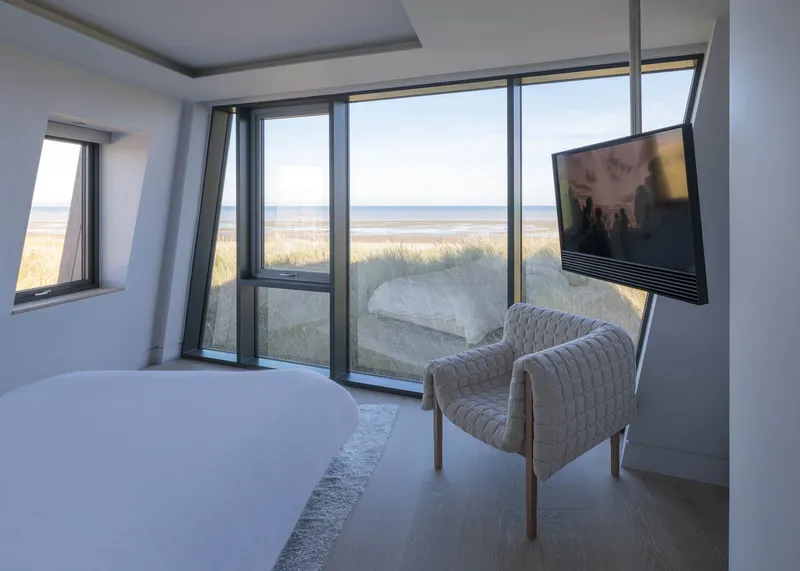
The bedrooms are distributed with care. On the first floor, the master suite shares the elevated vantage of the living area, with floor-to-ceiling glazing that puts the occupant eye-level with the tops of the dune grasses. It is a deliberately immersive arrangement: you wake inside the landscape, not above it. Additional bedrooms on the ground floor are nestled beneath the dunes, more sheltered and private, taking their cues from the low, horizontal quality of the site.
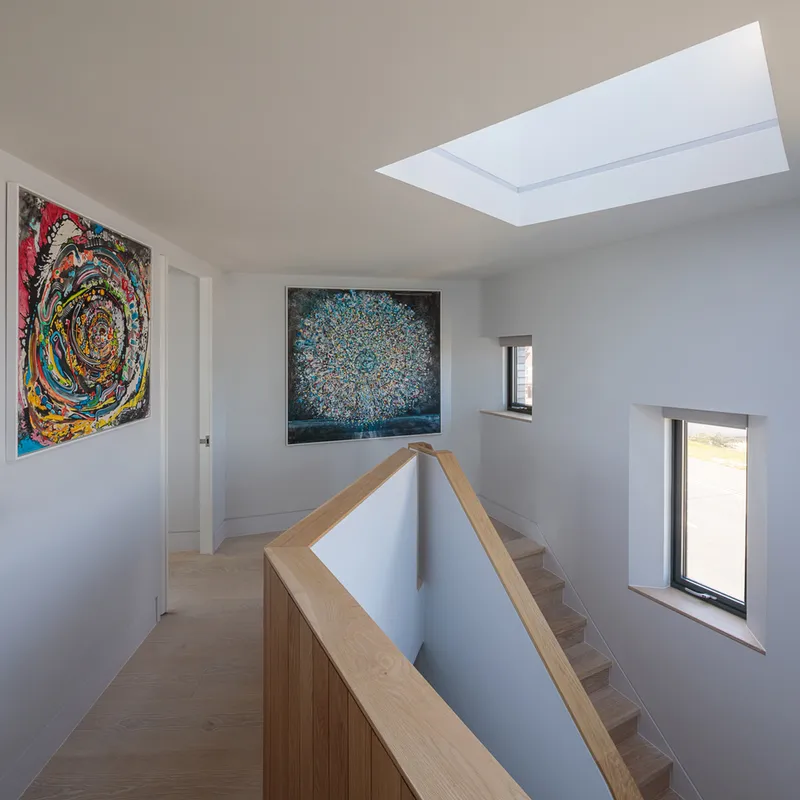
Circulation through the house follows the logic of the geometry. An upper landing with a timber staircase balustrade and a rectangular skylight above white walls acts as a decompression zone between the open drama of the living spaces and the quiet enclosure of the sleeping areas. Light enters from above, keeping the stair core luminous without relying on the seaward glazing.
Thresholds Between Inside and Out
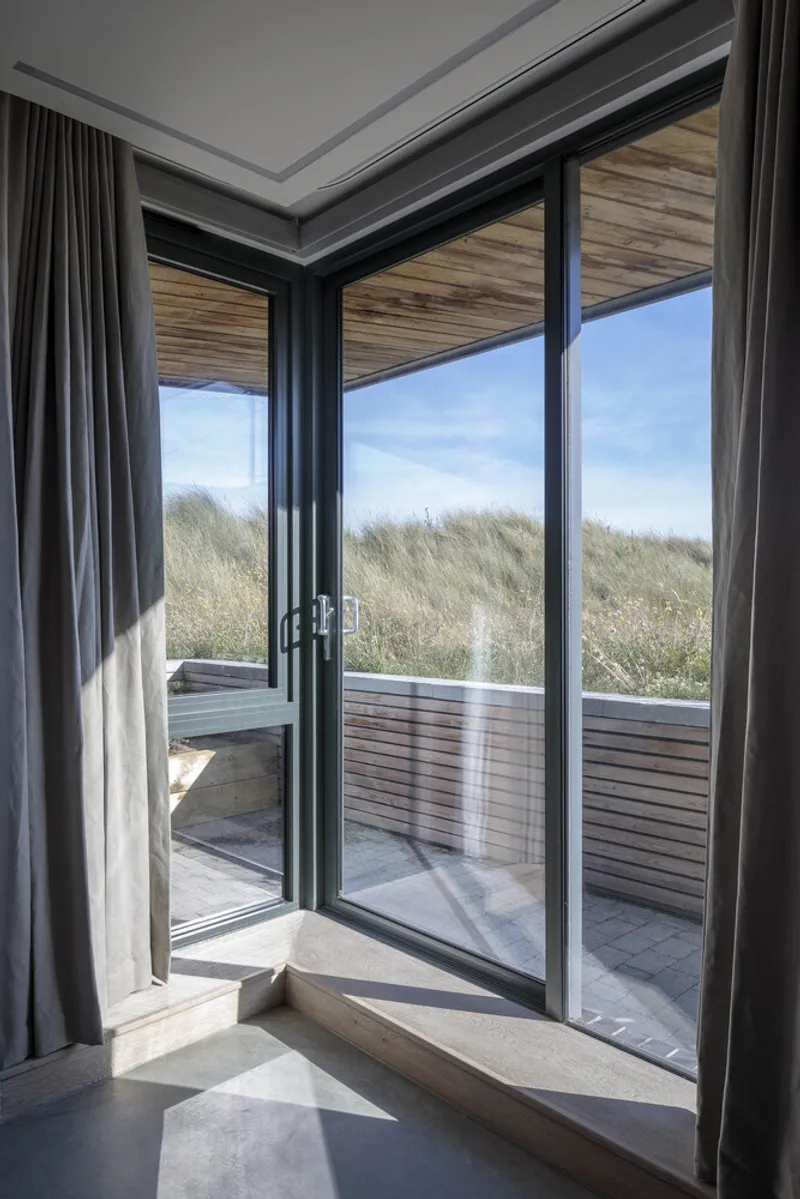
Terraces and balconies appear on three levels, and each one offers a different relationship to the coast. At the ground level, floor-to-ceiling glass doors with a deep timber soffit open onto a slatted deck that steps directly into the dune grass. The transition from interior to exterior is almost seamless: the timber continues from the ceiling overhang to the deck surface, blurring the boundary. A private pathway threads through the grassy dunes to over two miles of sandy beachfront.
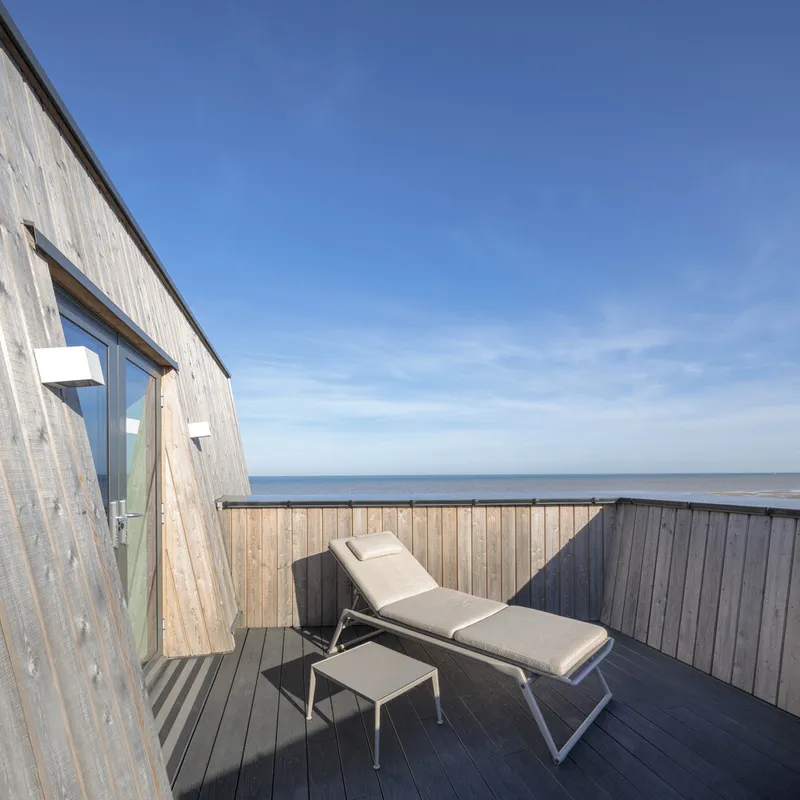
The rooftop deck, accessed from the upper floor, is the most exposed of the outdoor spaces. Timber cladding wraps the parapet, and a lounge chair faces the open ocean under clear sky. There is nothing between you and the horizon line here. It is a vantage point that makes the scale of the coastal landscape legible in a way the lower terraces, sheltered by dune topography, do not. The layering of these outdoor spaces, from intimate to panoramic, gives the house a range of moods within a compact footprint.
Why This Project Matters
Coastal residential architecture in Britain tends to oscillate between two poles: the quietly contextual, which tries to disappear into the landscape, and the self-consciously bold, which announces itself as an aesthetic event. The Stones House does something harder. It engages the landscape on equal terms, borrowing its geometry from the dunes and cliffs while asserting its own identity through material craft and spatial invention. The salt-glazed brick street wall is as tough and specific as the terrain it faces; the timber and glass sea elevation is as open and changeable as the Channel weather.
CZWG have long been known for a certain irreverence in their larger urban projects, but here the register is different: restrained, site-driven, and deeply considered. The result is a house that proves you can build with formal ambition in a sensitive landscape without either dominating it or capitulating to it. In a strip of beachfront houses stretching back decades, The Stones House is the one that future architects will study when they come to build the next one.
The Stones House by CZWG Architects, Greatstone-on-Sea, United Kingdom. 337 m², completed 2017. Photography by Dirk Linder.
About the Studio
Share Your Own Work on uni.xyz
If projects like this are the kind of work you want to make, uni.xyz is a place to publish your own, find collaborators, and enter design competitions.




Popular Articles
Popular articles from the community

EW PARK: Sustainable Architecture Reimagines the Future of Urban Parking
EW PARK reimagines city parking as a modular wooden tower combining automation, solar energy, electric mobility, and adaptable urban design.

Conexión: Biophilic Design Reimagines High-Rise Living in Hong Kong
Conexión reimagines high-rise living in Hong Kong through biophilic design, green facades, shared spaces, daylight, water and nature within.

The Musturak Paradise: Senior Living Architecture for a Connected Future in Temara, Morocco
The Musturak Paradise reimagines senior living architecture in Temara via private homes, social spaces, culture, community, and shared care.

Hill & Cross Opera: Sculptural Opera House Architecture Shaped by Tallinn’s Landscape and Identity
Hill & Cross Opera reimagines opera house architecture in Tallinn through its sculptural hill, civic plaza, glass wave and a luminous cross.


Similar Reads
You might also enjoy these articles


Hodi-Mandai Geram
Project Function: Preservation and revitalization of the Intangible heritage and socio-spatial identity of the Hodi by Housing, Cultural Memory Center, Sacred Grove, landscape, local tourism economy


Olio Towers: A Mid-Rise for Performers That Fuses Housing, Rehearsal, and Stage
Located blocks from Houston's Theater District, this modular tower stacks living units around a central performance atrium.

Oasis: Modular Green Housing Carved into Dhaka's Urban Fabric
A shortlisted Plugin Housing entry reclaims unauthorized settlements in Dhaka with stepped concrete volumes, green roofs, and ventilation-driven design.

Black Hole: A Floating Megastructure for the Post-Physical Era
Emiliano Mazzarotto envisions a spherical, self-scaling arena where e-sports, digital hotels, and holographic stadiums replace traditional public space.


Explore Stone Cladding Competitions
Discover active competitions in this discipline



Challenge to reimagine the Iron Throne


Photograph architecture without architects


Illustrate the lost glory of Angkor Wat - Render Challenge


Design challenge to reuse E-waste
Comments (0)
Please login or sign up to add comments
No comments yet. Be the first to comment!