
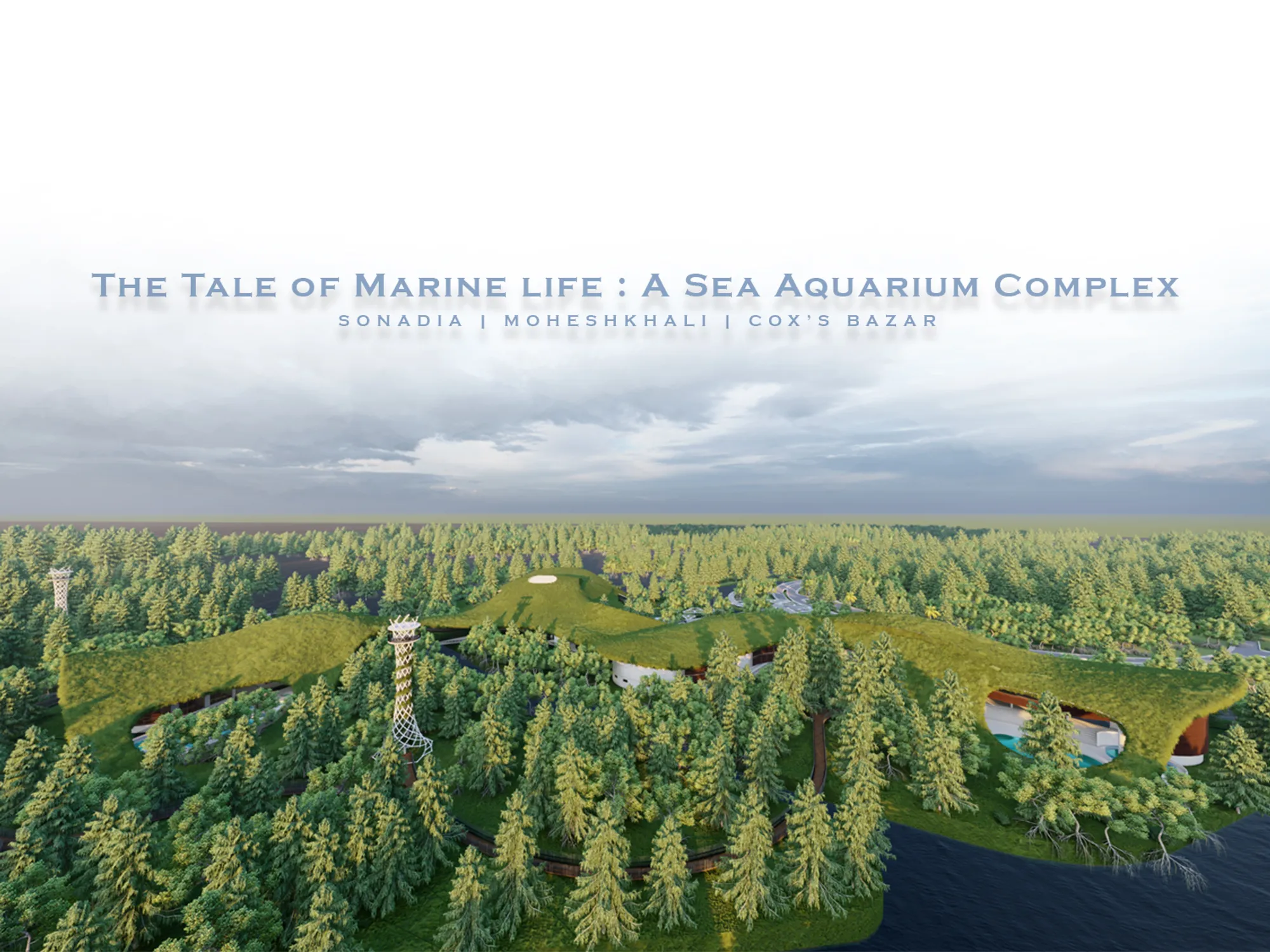
THE TALE OF MARINE LIFE
A SEA AQUARIUM COMPLEX

LOCATION: SONADIA | MOHESHKHALI | COX’S BAZAR
SITE AREA: 20.3 acre
CLIENT: Bangladesh Economic Zones Authority (BEZA)
Name: Faisal Ahamed
Studio: Thesis
Year: 2024
University: Southeast University
A sea aquarium is a marine exhibit that houses and displays saltwater organisms, including fish, invertebrates, and marine mammals in large tanks for public viewing and educational purposes.
Sonadia Island is an attractive place for tourists to enjoy the sea after Cox’s Bazar. People visit Sonadia Island for its pristine natural beauty, rich biodiversity, and unique eco-tourism opportunities. For these reasons, the Bangladesh Government has proposed an eco-tourism park with an area of 910 acres in Sonadia Island, which was later handed over to BEZA. BEZA has taken various tourism-based programs and functions and this project is one of them. Unlike others, this project shines by emphasizing the study and preservation of local marine life.
One of BEZA's initial proposals with Tourism Park is to raise the entire site to 18' above sea level, make it completely flat land, and then start the project. Consequently, the entire eco system or diversity of the area might have been destroyed.
The core idea of the project is to minimize disruption while enhancing sustainability. The design approach was tailored to harmonize with the local ecosystem, incorporating marine life, coastal geography, and unique environmental factors.
The project has goals that focus on the promotion of marine biodiversity, educational opportunities, research and conservation, environmental advocacy, cultural preservation, tourism and recreation, aesthetic appeal, stress reduction and so on.
The design incorporates a strategic roadway design for direct, seamless access to the site, enhancing accessibility and navigation for the visitors. The project comprises three distinct segments:
The Public Exhibition: As the visitors enter, they experience a journey that tells the tale of the ocean. Diverse aquariums featuring different species of coral and fish, sharks and dolphins, tell the story of their individuality. Additionally, the visitors are offered with services like a café and a souvenir shop. The journey continues upstairs, where preserved flora and fauna are displayed. As the journey proceeds to the lowermost floor, the visitors experience an auditorium, a library and a 4D theatre, which serve to broaden their understanding about marine life.
The Semi-Public Exhibition: Displays a few tanks devoted to the preservation and conservation of specific marine life, including fossils, which are essentially accessible to researchers and tourists in particular areas.
The Research Institute: The research facility, which is kept apart, houses 20 researchers and offers research facilities regarding marine life and the existing flora and fauna of the site.
The site has been linked with trails made with locally sourced environment-friendly materials (recyclable wood, bamboo) throughout most of the site, thinking of the ecological impact on the site by reducing the human footprint. Considering the biodiversity of the environment, all the lights of the project will be switched off at dusk so that the birds can sleep in peace. Environmentally hazardous plastics will not be introduced in this project. So that, nature can flourish without any hindrance.
The “Super Roof” of the project is a green roof designed to integrate with the surrounding landscape and watch towers for tourists to view from above and allow them to interact with the site’s fauna. The superstructure is made of concrete and spec truss, with a layer of cocopeat soil, allowing for the cultivation of lush grass that maintains temperature uniformity. “Aquaponic” and “Rainwater harvesting” methods have been adopted for the water management system.



Popular Articles
Popular articles from the community


Co-life: Sustainable Architecture for Age-Friendly Community Living
Co-life reimagines sustainable architecture for seniors through courtyards, rammed earth, shared gardens, and spaces designed for belonging.

Conexión: Biophilic Design Reimagines High-Rise Living in Hong Kong
Conexión reimagines high-rise living in Hong Kong through biophilic design, green facades, shared spaces, daylight, water and nature within.

Hill & Cross Opera: Sculptural Opera House Architecture Shaped by Tallinn’s Landscape and Identity
Hill & Cross Opera reimagines opera house architecture in Tallinn through its sculptural hill, civic plaza, glass wave and a luminous cross.

The Musturak Paradise: Senior Living Architecture for a Connected Future in Temara, Morocco
The Musturak Paradise reimagines senior living architecture in Temara via private homes, social spaces, culture, community, and shared care.
Similar Reads
You might also enjoy these articles

The Rhythm of Seasons
A Farmers' Market Connecting Nature and the City


More Than a Building-Designing a Living System
More Than a Building-Designing a Living System
Base Beyond
DESERT COMPOUND ARID: TOURISM OF ABSENCE AND ABUNDANCE


Explore Oceanarium Competitions
Discover active competitions in this discipline




Challenge to reimagine the Iron Throne


Photograph architecture without architects


Illustrate the lost glory of Angkor Wat - Render Challenge


Design challenge to reuse E-waste
Comments (0)
Please login or sign up to add comments
No comments yet. Be the first to comment!