

THE TOWN UNDER THE ROOF
Craft Center of Traditional Japanese Arts, Akita.

What was the concept behind the project?
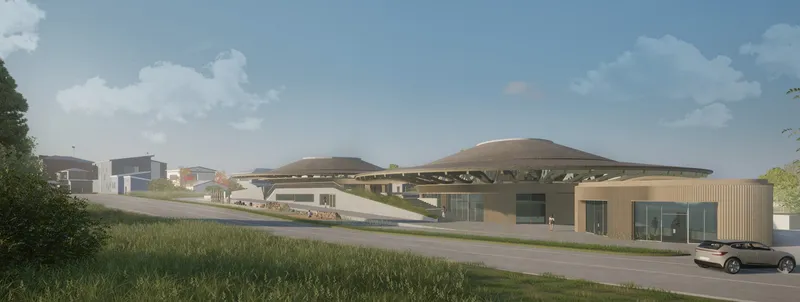
The cultural center of traditional Japanese arts is a small town of craftsmen and artists, a so-called "The town under mushroom hats". This town consists from separate buildings that are of the same scale as the surrounding buildings of Akita – one or two floors high, with several larger cylindrical volumes with roofs that have a large overhang and cover a remarkable part of the lowered courtyard in the center of the complex. Rainwater from them can be collected for watering lawns.


About the project

The height restrictions of buildings to not exceed 10 meters from the ground level, on which the conical roofs of the auditorium and library are raised, are taken into account. Between them is an amphitheater with a the lower row mark of -2.40 m and an ascent to the upper floor to a mark of +3.14 m. The steps of the open amphitheater enter the auditorium building, forming a single bowl about 90 m wide. Various public events may be held there – fests, concerts, presentations. In the center, under the "green roof" there is a small amphitheater for chamber events with tables of the open café around.
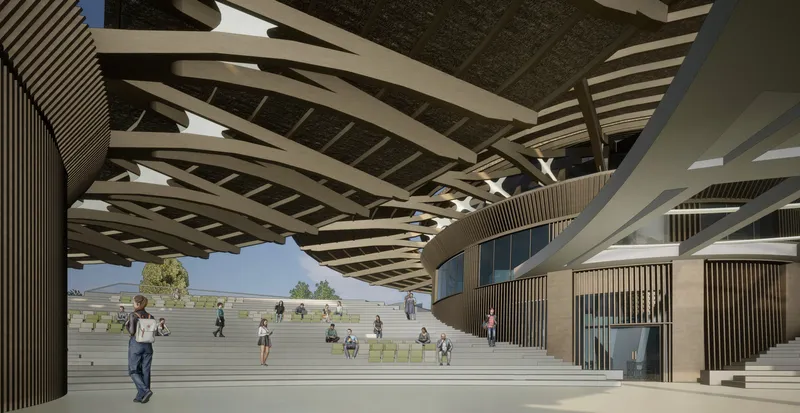
The main purpose of creating this traditional Japanese arts center is craft workshops that are settled along auditorium building and around the core of a complex. Numerous passages among the buildings of the complex create a dense network of various paths connecting all important points and giving the opportunity to attend and see everything.
High roofs capture viewpoints from neighboring streets, and small volumes of the complex create a small-scale environment of a traditional Japanese town.
Along the street, in the foreground of the complex, there is a "garden of ornamental materials" in the form of compositions that show the beauty and diversity of raw materials with which local craftsmen work. These can be: timber, ornamental stone, metal, ceramics, glass and others materials typical for traditional Japanese art. Visitors can experiment with them by trying to assemble something with their own hands. Under the upper steps of the amphitheater there is a souvenir shop and next to it there is also a playground for children and an open café for their parents.

The masters themselves either live in their own houses in the southern part of the complex or temporarily rent them. A triangle garden with a decorative pond is arranged for recreation and general meetings of craftsmen.
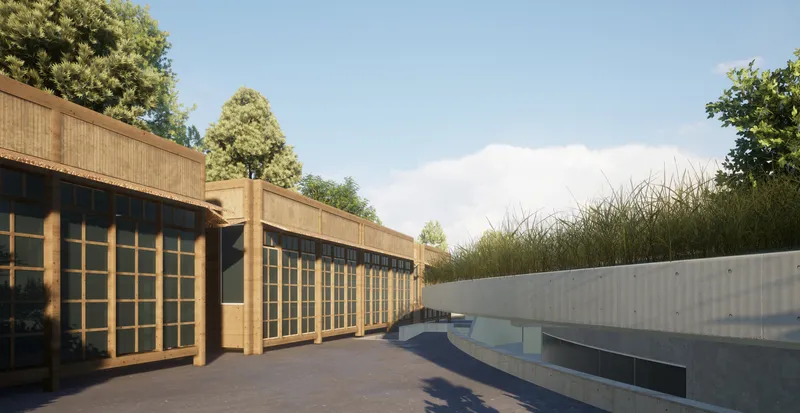
There is a possibility of a ring passage along the perimeter of the territory. All existing trees along this path are preserved.
Between the parking lot of the complex and the central buildings of the Center, decorative ponds are arranged with passages along the perimeter and "through the water", partly with lowered paths. Along the ponds, spectator seats are equipped to observe events held on the water (fireworks festivals, children's boats battles, demonstrations of design objects).
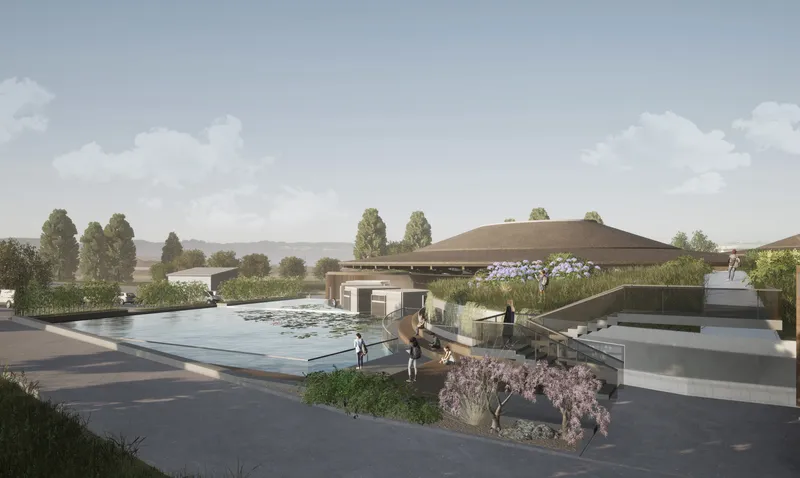
A Visitor Center is provided at the entrance to the complex. The structure of the building includes a separate room for the temporary accumulation of handicraft production waste and subsequent export for processing.
To load the craft workshops and the stage part of the audience it is possible to drive along the inner street of the complex, under the overhangs of the roofs (with dimensions: at least 4.8 m in width and at least 4.2m in height). All buildings and structures are placed at a distance of at least 5.0 m from the outer boundary of the projected territory.
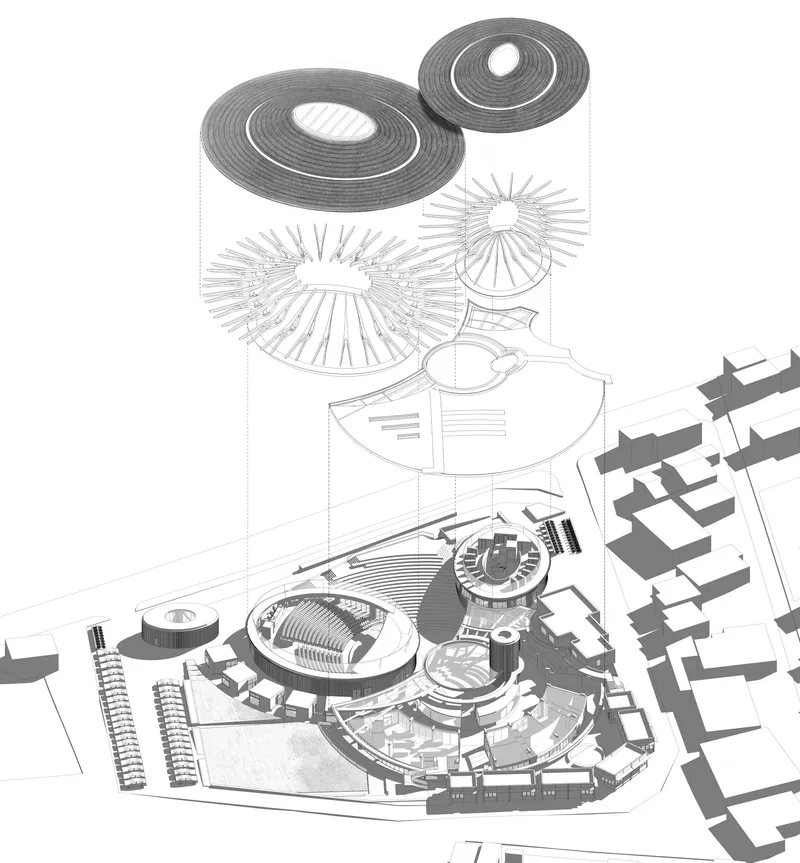
Craftsmen and artists workshops are free–standing strutures with internal dimensions of 5.0x5.0 m and an external height of 3.20 m. In the main area of the studio there is a workplace (with the specifics of production taken into account), places for visitors (with the possibility of appropriate contact with the master), utility rooms (bathroom, pantry). Workshops in the central area of the lower courtyard have similar layouts. One large workshop is designed for a collaborative work of two groups of visitors under the guidance of masters (training, leisure).
The auditorium building is in the form of an elliptical cylinder with external dimensions of 36.5x30.1 m and the height of the walls from 5.0 to 5.9 m. The entrance to the building is from the medium level between the wardrobe level and the foyer. The auditorium with 549 seats has the form of a circular amphitheater that visually continues the outer one. Wide window openings between the amphitheaters can be closed if necessary. The parameters of the steps of both amphitheaters are the same (90x26 cm). The foyer area is proposed to be combined with the auditorium area. There is also a buffet for spectators and recreation places. The audience belonging to the PRM category can access the hall and lobby by elevator with panoramic glazing. There are seats for PRM in the hall. The bathrooms are located on the lower level with a mark of -2.060 m. Fourteen rows of the amphitheater are located in the range of marks from -1.8 to 1.840 m. The equipment rooms are located in the common space behind the spectator seats at the 3.110 mark. The stage floor mark is -1.530. The stage equipment is loaded from the -2.1 mark from the passage through the lower courtyard. Behind the stage there are rooms for the accumulation of actors (the "green room"), storerooms, bathrooms and service rooms. The artistic restrooms and other rooms of the stage complex are located on the second floor behind the stage at 1.440. The roof structures of the hall lean on a number of open trusses made of glued wood with curved outlines. Evacuation is carried out dispersed from all floors of the auditorium building.
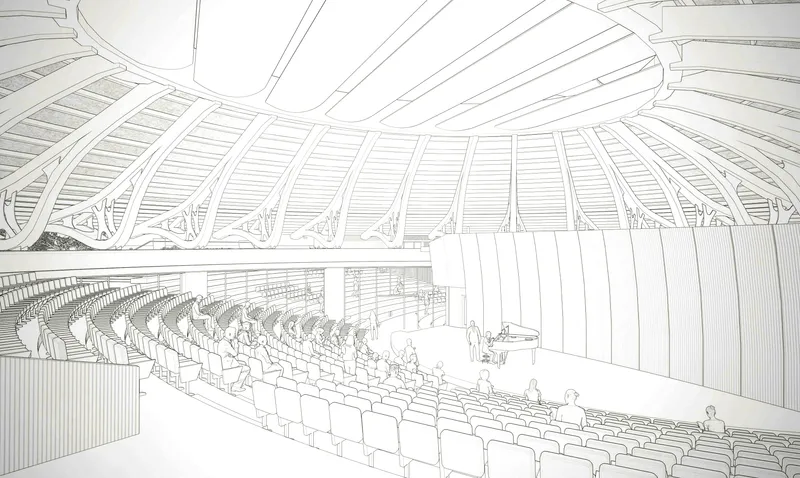
Restaurant and library. In the neighboring three-storey building of a similar shape there is a restaurant (at -2.400), a cafe (at 1.200) and a library (at 4.800). In the central atrium there are two staircases and an elevator shaft, and on the lower level there is a tiny garden. The halls of the restaurant and cafe are facing the amphitheater and the lower courtyard, where various entertainment events are constantly held. The products are loaded from the ring road. The entrance to the library is provided from the external bypass of the territory. The roof structures of the library with open wooden curved trusses are similar to the roof structures of the auditorium. Reading places are located around the atrium and along the exterior walls, and bookshelves are oriented radially.
Green roof over the exhibition hall. Above the central part of the lower courtyard an exploited roof is designed in the form of an artificial hill with a green lawn, ornamental grass and various bushes. Light lanterns are embedded in the coating to illuminate the exhibition hall. An oval hole in the center of the roof provides visitors with a comfortable overview of the performances taking place below. Access to the green roof is via a staircase-elevator tower and two open staircases from ground level.

Administration. The administration building is designed in the forms and orientation characteristic of the surrounding development. On the lower floor, at level -2.4 restrooms for visitors of the complex are provided.
General constructive solutions and materials of external structures The buildings of workshops and residential buildings are designed from wooden structures: a frame made of glued beams, internal partitions made of CLT panels (Cross Laminated Timber). Cladding of facades and roofs – from thermowood.
The supporting structures of the remaining buildings of the complex are designed from monolithic reinforced concrete. Pitched roofs of conical shape are made according to a number of open load-bearing trusses made of glued wood of curved outlines with rigid inserts made of steel sheet. The trusses are installed on a supporting ring reinforced concrete beam. The covering of pitched roofs is made of reeds (layer thickness – 20cm). The exterior walls are lined with thermowood.
Indicators:
- Site area: 11.398 sq.m;
- Height restriction: 10 m;
- Ground Coverage: 51.6%;
- Artist accommodation facility: 10 rooms of 25 sq.m;
- Auditorium: 1160 sq.m;
- Exhibition space: 300 sq.m;
- Workshops/Craft bazar: 400 sq.m;
- Food court: 630 sq.m;
- Library: 270 sq.m;
- Amphitheatre: 700+100+150 sq.m;
- Souvenir shop: 90 sq.m;
- Visitor center: 90 sq.m;
- Room for temporary waste accumulation: 10 sq.m;




Popular Articles
Popular articles from the community


Co-life: Sustainable Architecture for Age-Friendly Community Living
Co-life reimagines sustainable architecture for seniors through courtyards, rammed earth, shared gardens, and spaces designed for belonging.

The Musturak Paradise: Senior Living Architecture for a Connected Future in Temara, Morocco
The Musturak Paradise reimagines senior living architecture in Temara via private homes, social spaces, culture, community, and shared care.

Co-Life: Senior Housing Design That Reconnects Older Adults With the City
Co-Life reimagines senior housing design through healing gardens, shared streets, workshops, and a sustainable community across generations.

AL-JANNAH: Sustainable Architecture and Permaculture for Afghan Widows
AL-JANNAH uses sustainable architecture and permaculture to create resilient oasis of housing, learning, work and renewal for Afghan widows.

Similar Reads
You might also enjoy these articles
Sustainable Architecture Design: Embracing Nature and Modernity at Villa Solsidan
The article explores Villa Solsidan by AndrénFogelström, showcasing its sustainable architecture design and integration with the natural surroundings in Saltsjöbaden, Sweden.

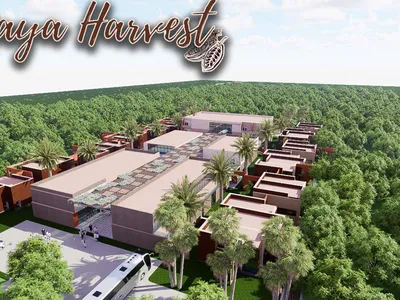
Maya Harvest: A Cacao Resort Village Rooted in Mayan Tradition and Local Craft
Situated within a Tabasco cacao plantation, this shortlisted resort proposal merges vernacular materials with hands-on cultural immersion.
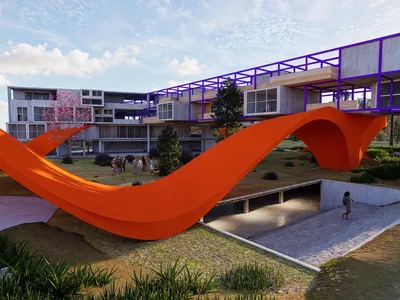
Harmonia: A River-Shaped Community That Grows Over Decades in Boa Vista
Curved pathways and modular grid structures along the Branco River create a phased settlement designed to evolve from 2030 to 2050.
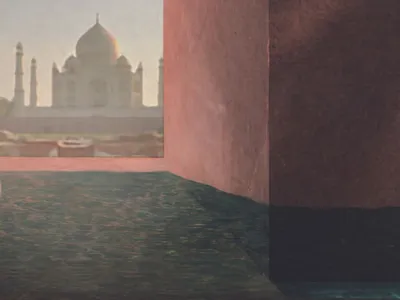
The Architecture of Bathing: A Mughal Hammam Reimagined Across the Yamuna
Charlotte May's honorable mention entry for The Black Taj reinterprets Agra's bathing rituals through red sandstone, water, and framed views of the Taj Mah


Explore Cultural Architecture Competitions
Discover active competitions in this discipline




Challenge to reimagine the Iron Throne


Photograph architecture without architects


Illustrate the lost glory of Angkor Wat - Render Challenge


Bring back Drive In's
Comments (0)
Please login or sign up to add comments
No comments yet. Be the first to comment!