

The Void: An Ocean-Carved Amphitheater That Dissolves Architecture into the Sea Floor
A subterranean cavity shaped by water's logic replaces walls and columns with a single flowing void beneath a rippling public landscape.


What happens when an architect stops building walls and starts carving emptiness? The Void proposes a radical answer: a single subterranean cavity that touches the sea floor, shaped not by structural grids but by the deformations and spatial pressures of the ocean itself. There are no columns, no partitions, no conventional enclosures. Instead, the project produces architecture through subtraction, hollowing out a continuous void beneath a rippling public surface that visitors walk across without immediately realizing they are standing on a roof.
Designed by Beyza Ayaz and Nursima Zengin, The Void was shortlisted in the Athenaeum competition, a brief that asks entrants to envision the architect's dream about architecture, free from the constraints of employers, budgets, or rigid programs. Ayaz and Zengin responded with a project that treats architecture as a critique of accumulation: rather than stacking material, they removed it, letting the resulting negative space become the building's primary experience.
A Landscape You Walk On, an Amphitheater Hidden Below
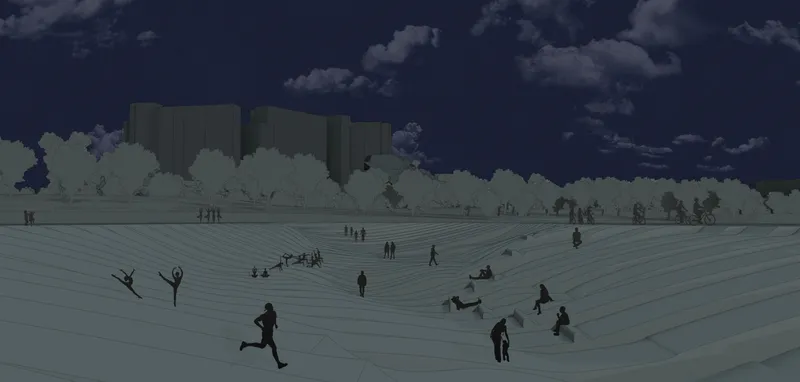
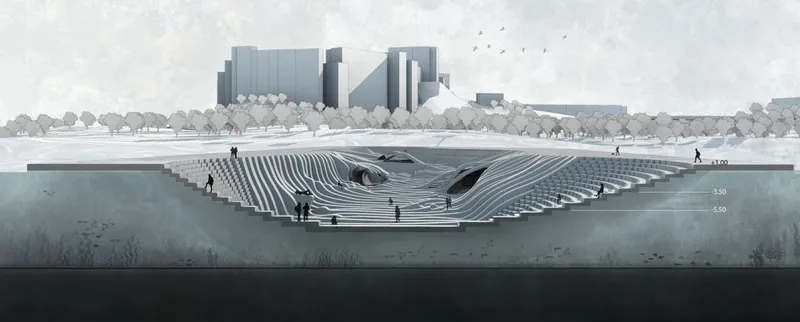
At ground level, The Void reads as a sloping, stepped plaza, its surface undulating like a solidified wave. Visitors move across this terrain as though navigating a coastal landform, the topography gently rising and falling underfoot. But the section drawing reveals the real ambition: beneath this horizontal landscape sits a carved amphitheater bowl, its undulating profile mirroring the surface above in inverted form. Dimension annotations in the section show the precise depth of the excavation, confirming that this is not a casual gesture but a deliberate calibration of the relationship between the public surface and the performance void below.
The Cavity as Concert Hall
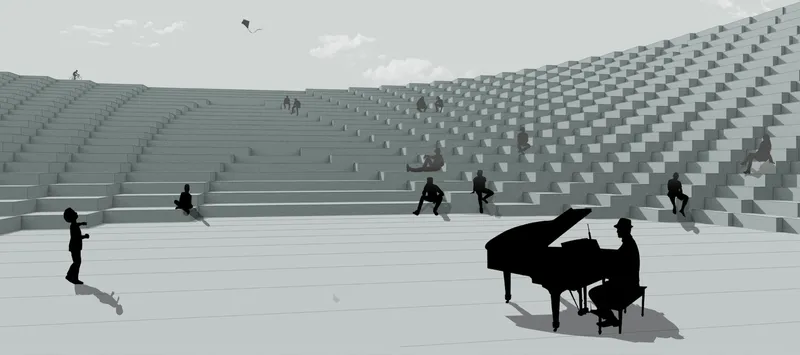
Descending into the amphitheater, the scale of the void becomes legible. Tiered seating wraps the bowl in concentric steps, focusing attention on a flat performance level where a grand piano sits, almost ceremonially, at the lowest point. The cavity's organic geometry means there are no right angles, no proscenium walls, no conventional stage framing. Sound and sightlines are governed entirely by the curvature of the carved form, turning the void itself into the instrument of spatial experience.
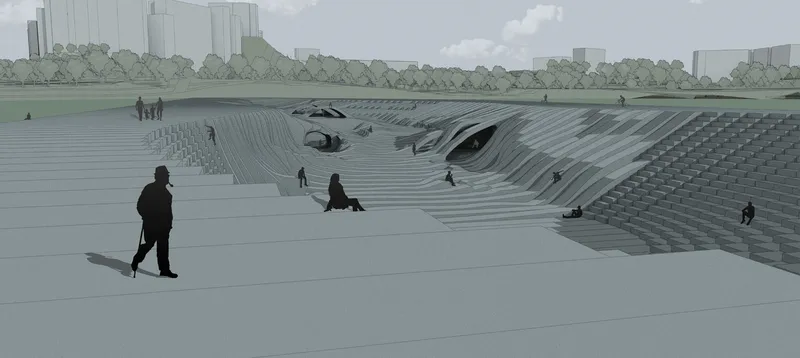
Above, the ground-level perspective shows the same stepped geometry from the opposite vantage. Visitors scattered across the rippling plaza are simultaneously the audience for an outdoor landscape and the roof occupants of the performance space below. The layered program collapses the boundary between public ground and cultural interior into a single continuous topography.
Reading the Section: Where the Sea Floor Meets the City
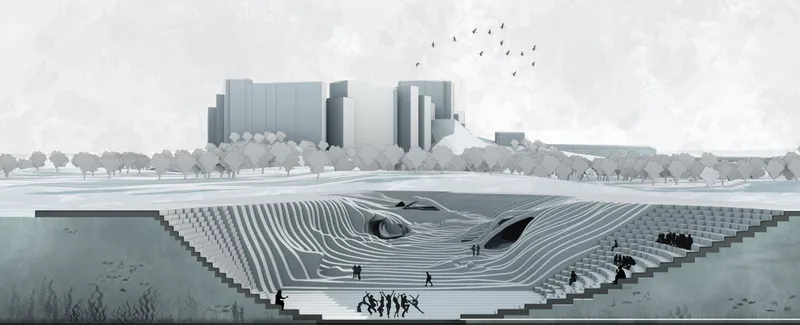
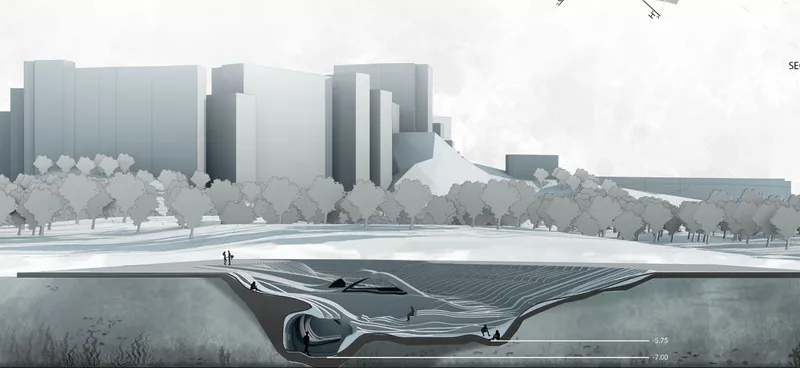
Two section renderings unpack the project's relationship to its waterside context. One reveals the sunken amphitheater bowl against a distant urban skyline, its stepped edges rising to meet the surrounding grade. The other cuts deeper, exposing a flowing interior cavern beneath the horizontal plaza surface. The architects describe this as a space that "merges with the spirit of the void," and the sections make the logic tangible: the cavity's profile is not arbitrary but generated by the interplay between the sea's coastal elevation and the landform's engineered slope. The result is an intermediate space, neither fully interior nor exterior, that harmonizes constructed geometry with the dynamics of water.
The Roof as Public Ground: Skylights and Membrane
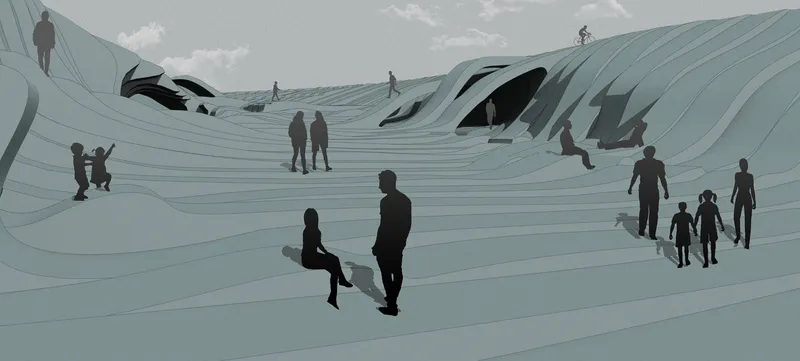
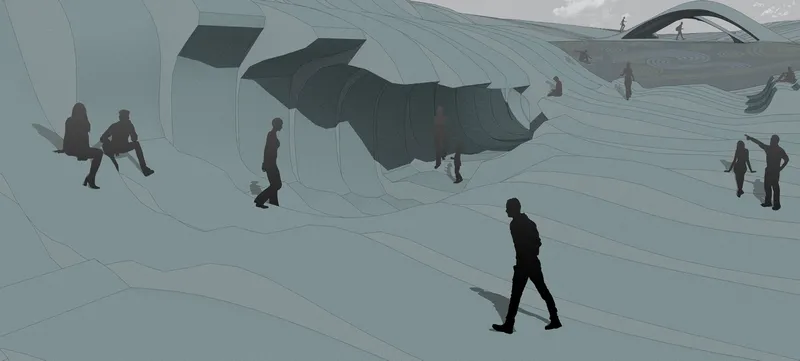
From a wider vantage, the roofscape becomes its own distinct landscape. The pale blue membrane ripples across the site, its surface punctuated by skylight openings that allow light to penetrate the cavern below. Visitors walk, sit, and gather on this undulating surface under open sky, and the skylights serve a dual purpose: they illuminate the amphitheater interior while creating visual connections between the two levels, so that the people above and the performers below occupy the same spatial continuum.
The flowing roof surface avoids any reading as a conventional building envelope. There are no parapets, no fascias, no visible structure. The membrane simply rises from the ground plane, curves, and descends again, blurring the distinction between architecture and terrain. It is precisely this refusal to announce itself as a building that gives The Void its conceptual force.
Why This Project Matters
The Athenaeum brief invites architects to dream without constraint, and Ayaz and Zengin took that invitation seriously. The Void is not an exercise in formal spectacle; it is a sustained argument against accumulation. Where conventional architecture adds material to define space, this project removes it. Where typical designs rely on columns and walls to establish enclosure, this one relies on a single carved cavity and the logic of water. The critique is embedded in the method, not just the manifesto.
What makes the project resonate beyond its conceptual ambitions is that it proposes a genuinely usable space. The amphitheater functions. The plaza invites occupation. The skylights connect levels. The Void demonstrates that radical architectural thinking and spatial generosity are not mutually exclusive, and it suggests that the most powerful way to challenge conventions is to offer something people would actually want to inhabit.
View the Full Project
About the Designers
Designers: Beyza Ayaz, Nursima Zengin
Enter a Design Competition on uni.xyz
uni.xyz runs architecture and design competitions year-round that reward proposals with spatial conviction and real site intelligence.
Project credits: The Void by Beyza Ayaz, Nursima Zengin Athenaeum (uni.xyz).


Popular Articles
Popular articles from the community

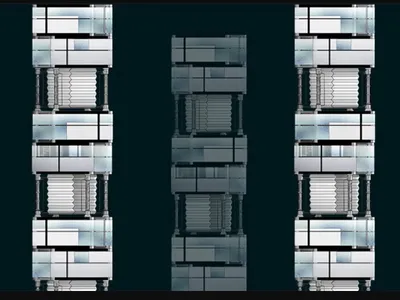
Tsunami Convergenics: Turning Catastrophic Ocean Forces into Underwater Housing Infrastructure
A speculative underwater settlement off the coast of Onagawa, Japan, treats tsunamis and typhoons as energy sources rather than threats.
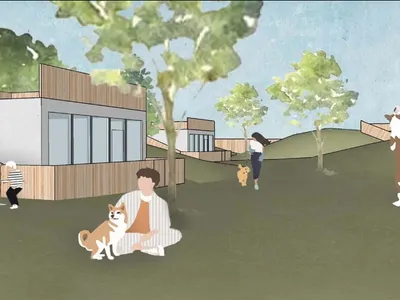
Temporary Home for Dogs: A Reversed Zoo Rethinks Animal Shelter Architecture
In Bucharest, a sinuous corridor and freed landscape flip the logic of containment, designing a shelter that works to make itself unnecessary.
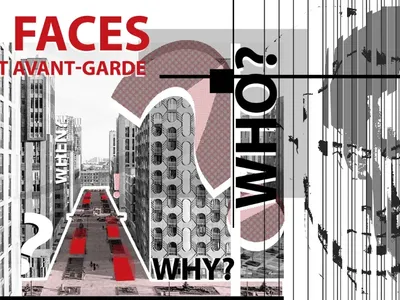
Faces of the Soviet Avant-Garde: Turning Moscow's Street Names into an Open-Air Museum
A network of sculptural installations across a Moscow residential district transforms forgotten architect names into spatial encounters with cultural memor

Opera on the Sea: Driftwood Logic Shapes a Timber Opera House on Estonia's Coast
Trevor Orgill's opera house translates the entangled drift of floating timber into a civic building where wood, water, and music converge.

Similar Reads
You might also enjoy these articles

Day and Night Park: A Time-Based Urban Newsstand in Beijing
A temporary urban newsstand in Beijing blending travel, light, and reading through poetic colors, compact form, and community-focused design.

Modernist Patio Renovation in El Masnou, Barcelona by Oliver Segura Arquitectura + Cebrià Arquitectura
Modernist patio renovation blending tradition and innovation with a movable pool, leveled floors, and Catalan materials in El Masnou.

Alto Residencial Coop: Cooperative Housing Development in Santiago de Compostela by Carbajo Barrios Arquitectos
A linear cooperative housing complex blending white volumes and perforated metal façades, enhancing community living, natural light, privacy, and urban integration.
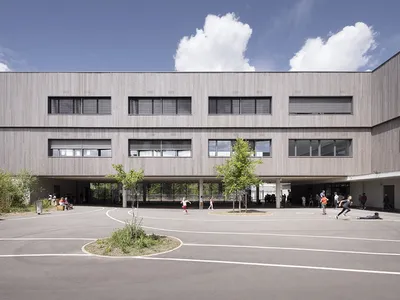
Vil Genis School by BPA ARCHITECTURE – Massy, France
Vil Genis School in Massy, France, features sustainable design, south-facing classrooms, community integration, accessible spaces, and modern educational architecture.


Comments (0)
Please login or sign up to add comments
No comments yet. Be the first to comment!