

Thought Parallels Crowns a Kerala Home with a Coconut Wood Roof That Reclaims a Lost Tradition
Ananda House in Kerala channels dense urban constraints into a vertically expressive residence anchored by local craft and climate logic.


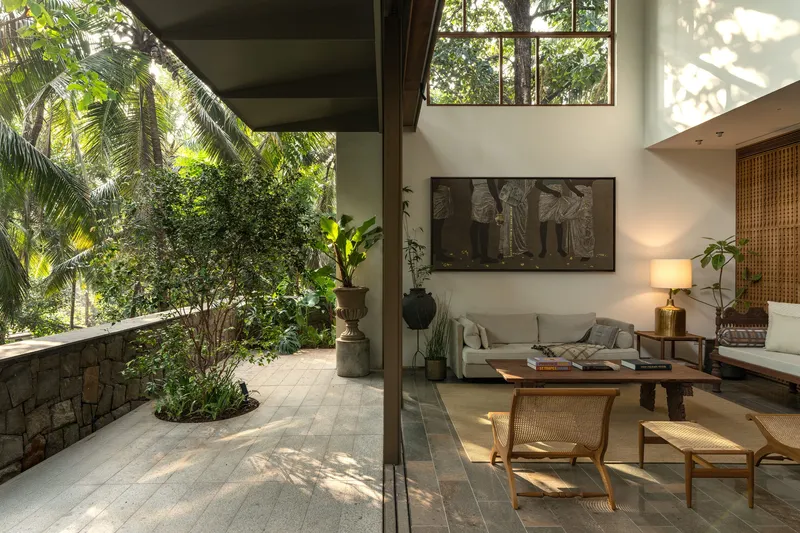
When the plot is tight, the street is narrow, and the neighboring buildings press in from every side, most architects in Kerala default to a compact box with tile cladding and call it done. Thought Parallels, led by Ar. Nikhil Mohan, took the opposite approach with Ananda House: they pushed the design energy upward, making the roof the primary event. A sweeping canopy of coconut wood beams and Mangalore clay tiles stretches beyond the walls, sheltering the house beneath deep eaves that are both thermal shield and visual signature. The name, drawn from the Sanskrit word for bliss, is more than branding. It describes the spatial payoff of walking through a compressed entry sequence into a double-height living volume flooded with filtered light.
The clients, Madhu and Mandy, live in Dallas but wanted a residence next to their ancestral home in Kerala. That duality, between global life and regional roots, is embedded in the material palette. Country brick, random rubble masonry, lime plaster, and coconut wood sit alongside exposed concrete and steel-framed glazing. The most provocative choice is the coconut wood itself: once a staple of Kerala construction, it fell out of favor when teak became fashionable. Thought Parallels harvests it only from senile palms and uses it structurally, spanning the entire roof without a false ceiling. The result is a house that performs as a climate machine, a craft argument, and a homecoming all at once.
A Roof You Read from Below
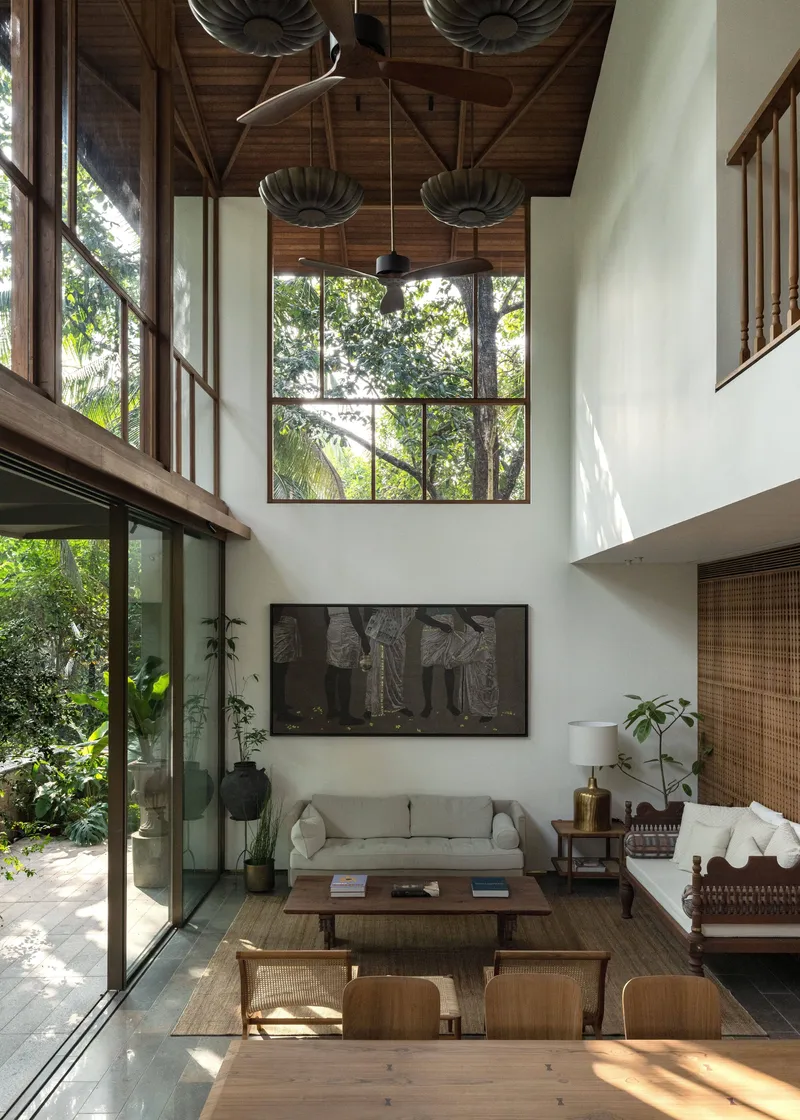
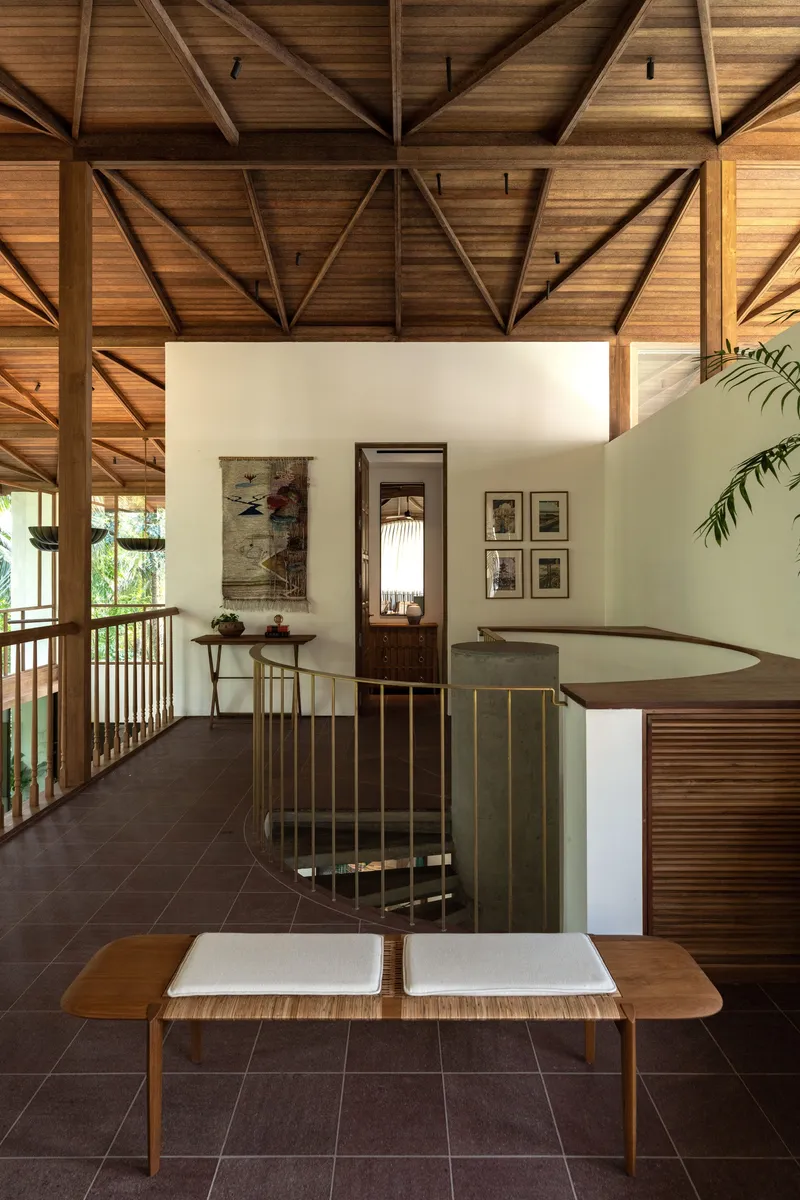

The roof is the protagonist. From inside the double-height living space, you look up into a lattice of diagonal coconut wood beams that cross and re-cross overhead, their warm grain catching afternoon light from the fully glazed northern wall. There is no false ceiling, no plasterboard to smooth over the structure. What you see is what holds the house together. The diagonal bracing pattern creates an almost textile quality, a woven canopy that recalls the coir and rattan traditions of the region without imitating them.
Outside, the roof extends well beyond the building envelope, throwing deep shadows across the brick facades. These overhangs are not decorative. In Kerala's tropical climate, with heavy monsoon rains and relentless solar gain, a generous eave is the most effective passive strategy available. Thought Parallels uses a composite roof structure that manages both thermal and waterproofing performance, but the visible layer is all about warmth and grain: coconut wood doing what it did for generations before teak displaced it.
Dense Fabric, Vertical Escape
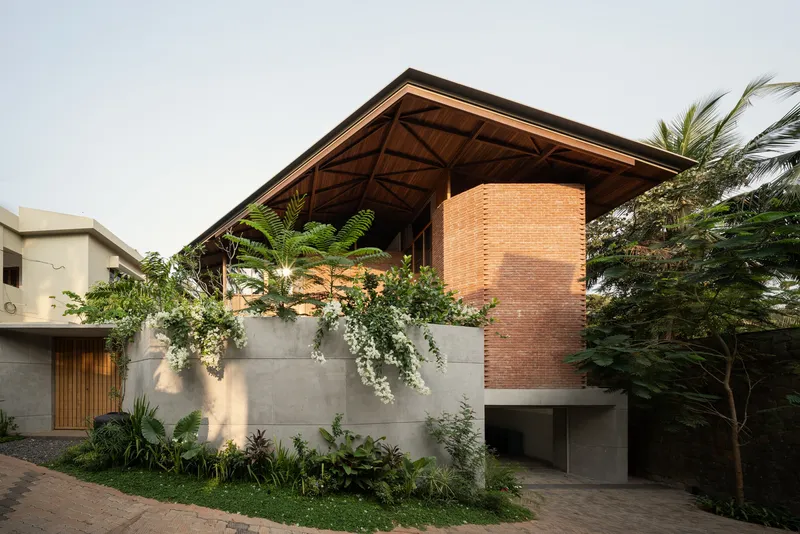
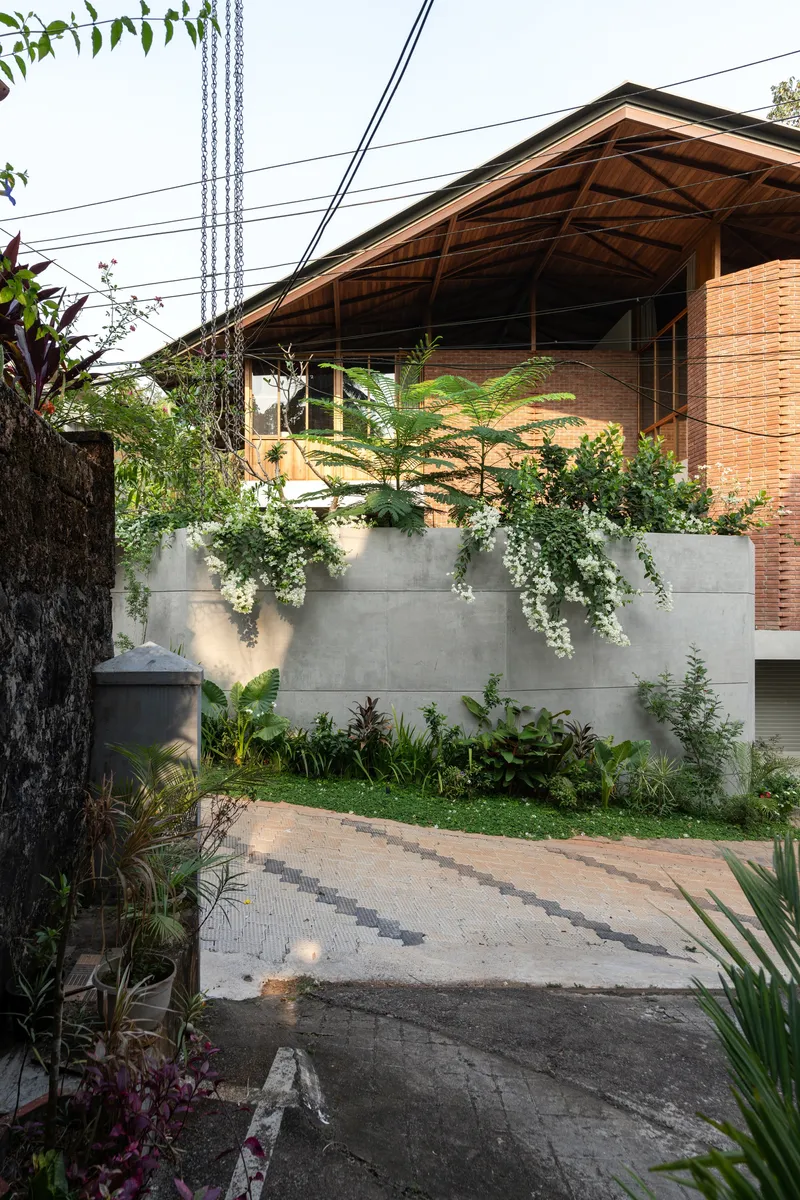

From the street, Ananda House does not announce itself with a grand elevation. It cannot. The site sits in a dense urban fabric accessible only through a narrow thoroughfare, which means conventional facade strategies are largely wasted. Thought Parallels responds by making the street presence almost fortified: a weathered compound wall, concrete planters, coconut palms, and the brick volume set back behind layers of vegetation. The building only reveals its ambitions once you cross the threshold.
The sloping topography is turned into an organizational asset. Vehicles enter at the lowest level, where a garage and storage rooms occupy the basement. Pedestrians approach from the higher side, walking through a paved front garden before entering the main living volume. Three floors stack along the slope, connected by a concrete spiral staircase that functions as both circulation and spatial anchor. The effect is a procession that moves you from constraint to openness, from the tight street to the airy double-height interior.
Brick, Concrete, and the Gaps Between

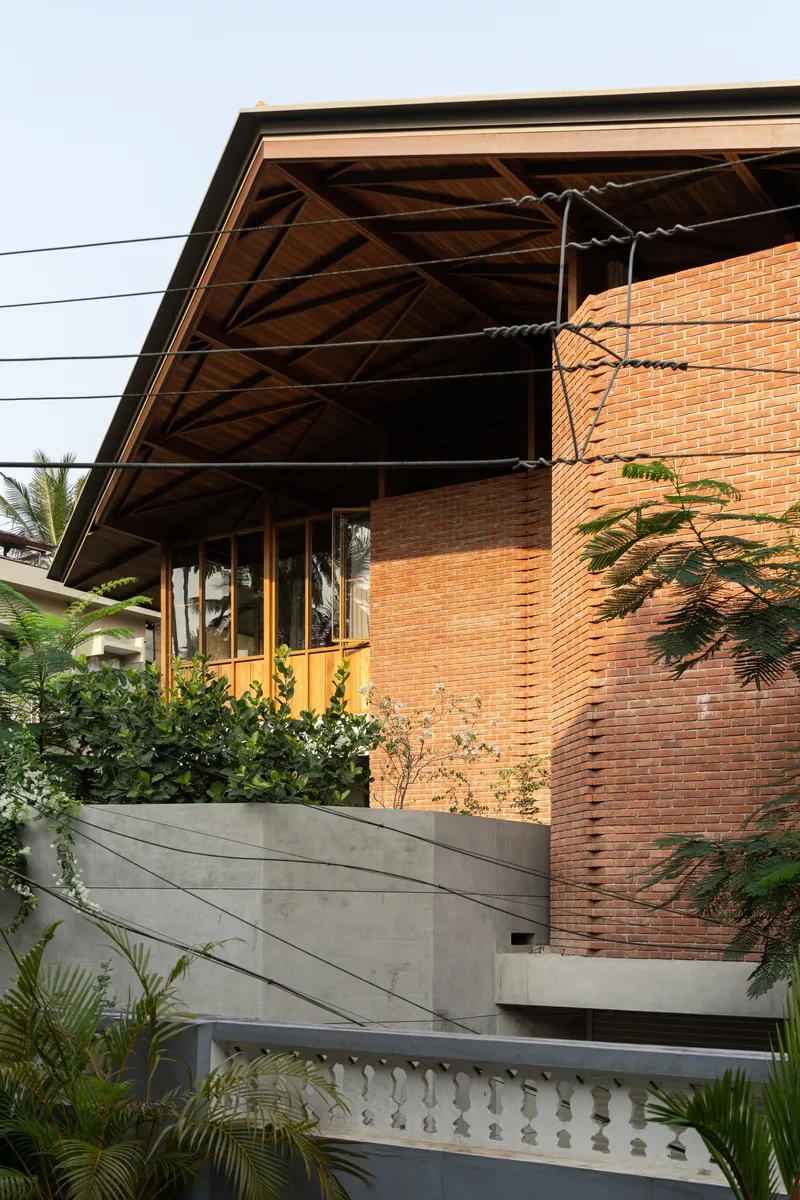
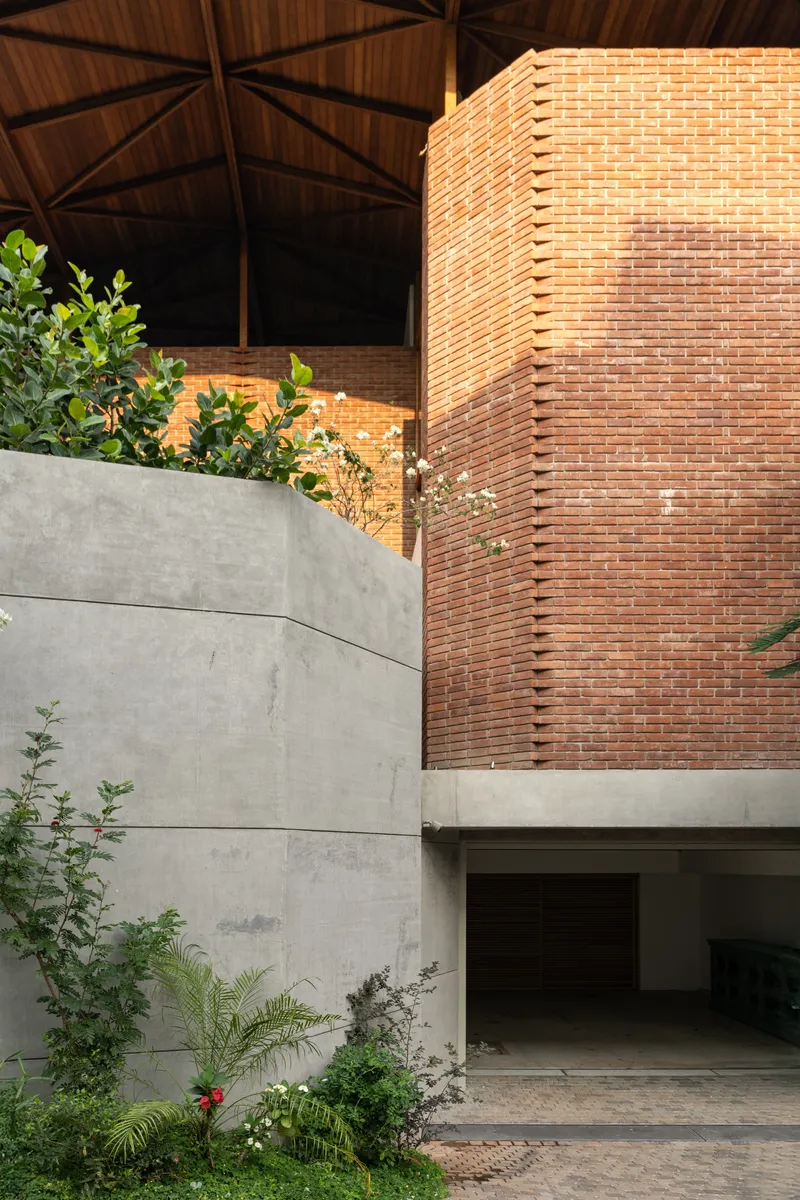
The material language is deliberately heterogeneous but disciplined. Red country brick forms the primary wall surface, its color deepening against the grey of exposed concrete planters and retaining walls. A distinctive corner detail, where gaps are left at the meeting points of brick courses, gives the masonry a perforated, breathing quality. It is a small move that signals care and intentionality without descending into ornamentation.
The cylindrical brick volume visible from the side elevation houses the spiral staircase. Its curved geometry contrasts with the rectilinear massing of the main house and reads as a separate element, almost a tower, that pins the composition together. Concrete, brick, and timber each have their zone of authority, and the transitions between them are left legible rather than smoothed over. You always know what is bearing load, what is enclosing, and what is screening.
The Spiral Staircase as Organizing Core


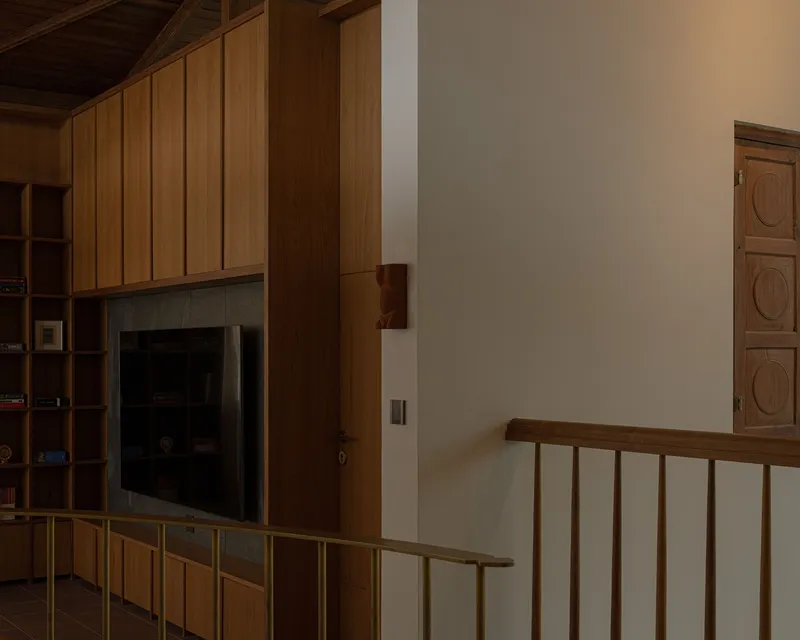
A concrete spiral staircase occupies the center of the plan, and it does far more than move people between floors. Its cylindrical form generates the curved wall that anchors the living space, creates a visual event visible from the double-height volume, and organizes the relationship between public and private zones on each level. A brass railing traces its ascent, catching warm light and introducing a material note that counters the coolness of polished concrete.
At the upper-level landing, the stair delivers you into the exposed timber ceiling structure, placing you closer to the roof and its diagonal geometry. The progression from the dark tile flooring of the ground level through the compressed stair tube and into the timber canopy above is one of the most effective spatial sequences in the house.
Screening Light, Inviting Air
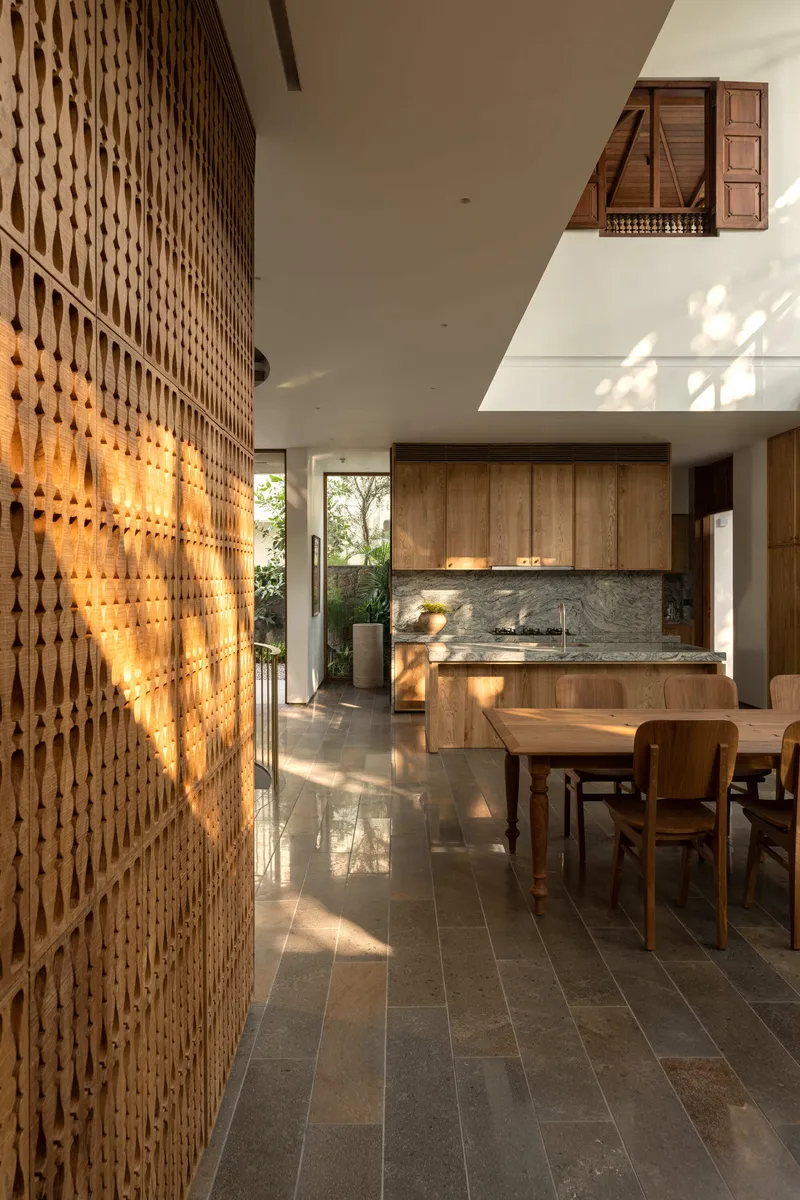
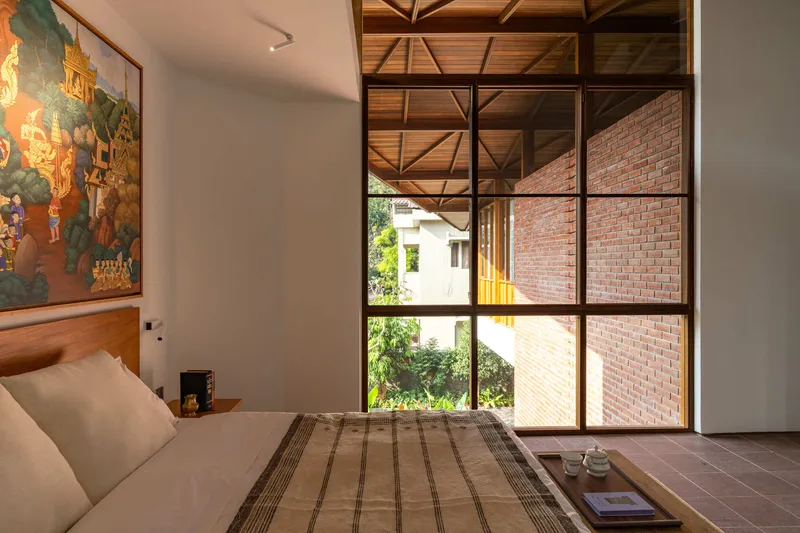
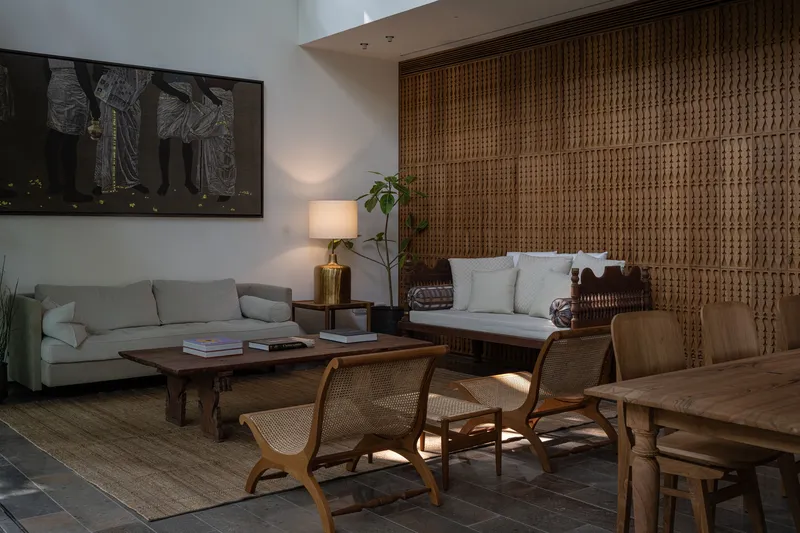
Climate strategy is woven into every surface. Narrow timber slat screens line the southern bedrooms, filtering harsh sunlight into soft bands that shift across polished stone floors through the day. Behind these screens, sliding windows open for cross-ventilation. On the northern side, fully glazed walls with sliding doors connect the living space to a garden terrace, capitalizing on indirect light and cooler breezes. Woven rattan panels and perforated timber screens appear in the interior, diffusing light and creating visual depth.
The bedrooms benefit from a layered envelope: timber screen, air gap, operable glass, interior. Each layer does something different, and the occupant can tune the combination to suit the time of day and season. It is a passive approach that avoids dependence on mechanical cooling, which is especially relevant in Kerala's humid tropical climate where air movement matters as much as shade.
Entry as Ritual

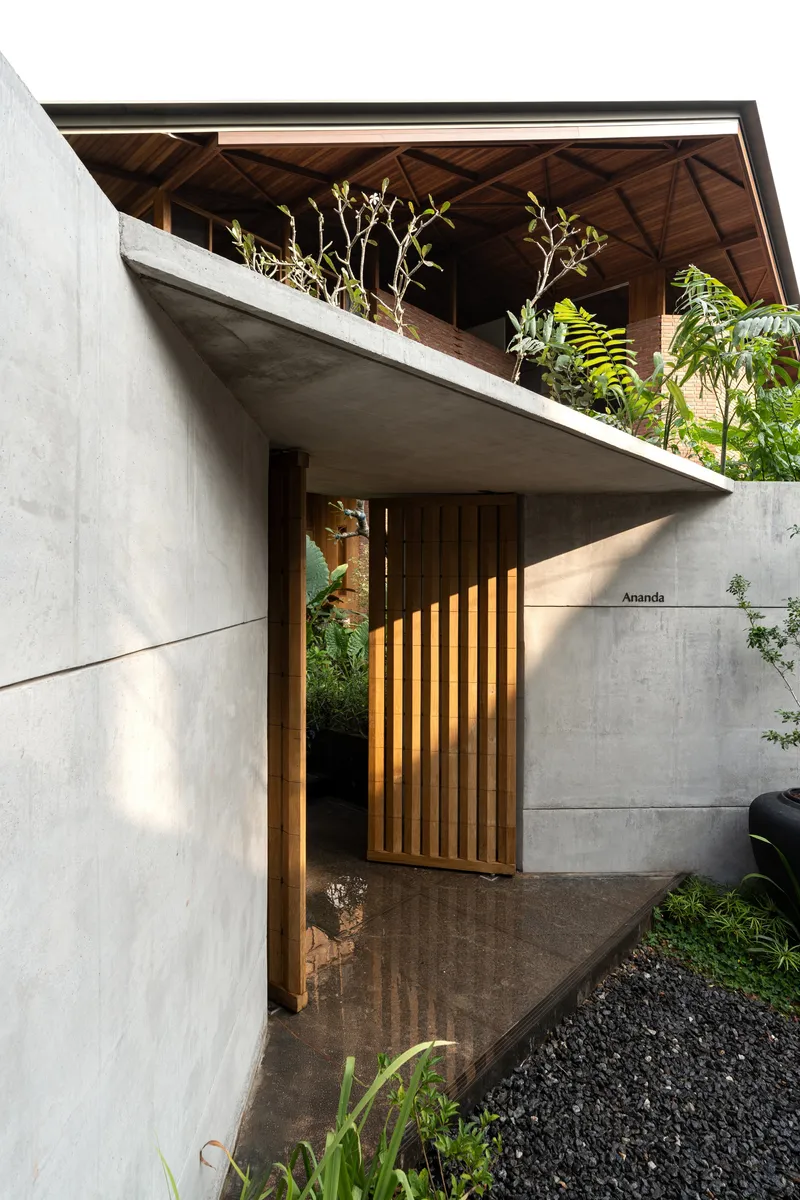

The approach to the house is orchestrated with unusual precision. Concrete panel walls rise on either side, framing vertical timber slat doors that feel more like temple gates than front doors. Flowering vines cascade from planted terraces above, softening the concrete and marking the seasons. Ferns colonize the upper edges, blurring the boundary between built and grown. The entry compresses your sightline before releasing you into the double-height living space, a technique as old as Kerala architecture itself but executed here with contemporary restraint.
After Dark


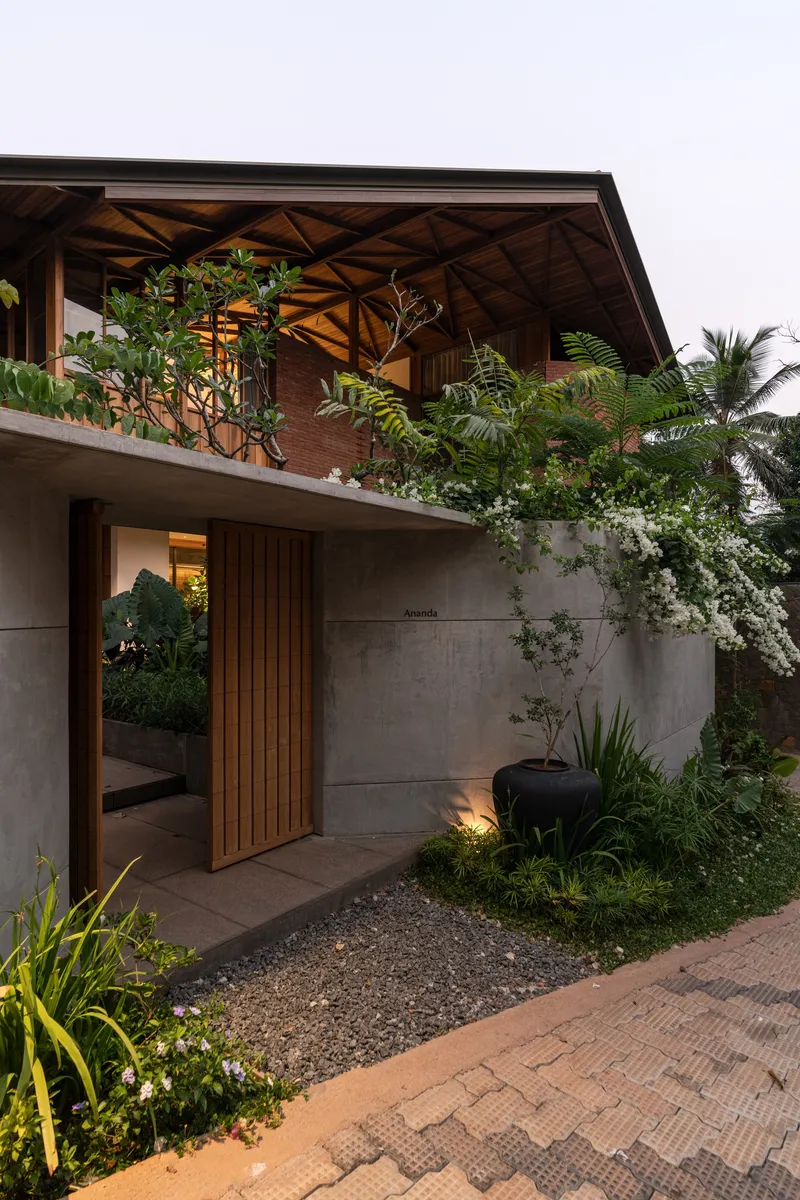
At dusk, the house reverses its daytime character. The timber frame structure glows from within, its diagonal beams silhouetted against warm interior light. The frangipani tree in the front garden becomes a foreground element, its branches tracing patterns against the illuminated facade. The brick volumes recede into shadow while the timber and glass surfaces come forward, revealing the layered construction in a way that daylight conceals. It is a house that has two faces, one for each half of the Kerala day.
Plans and Drawings
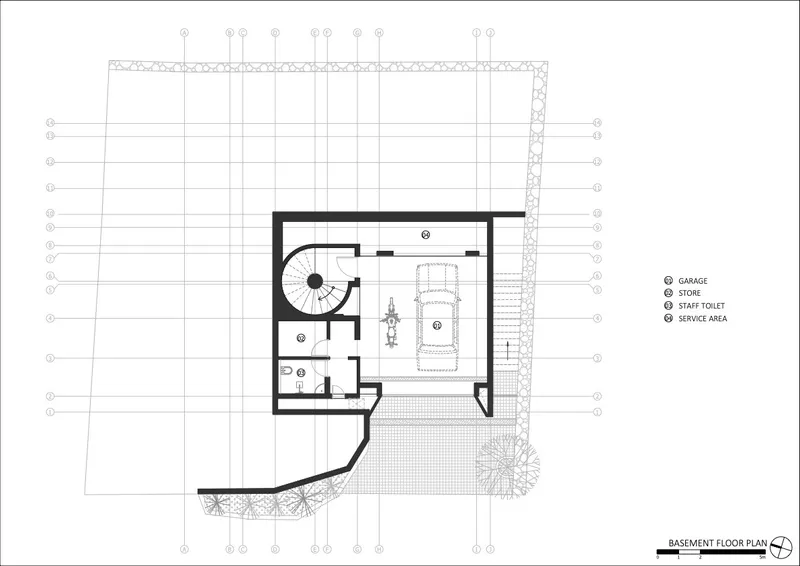
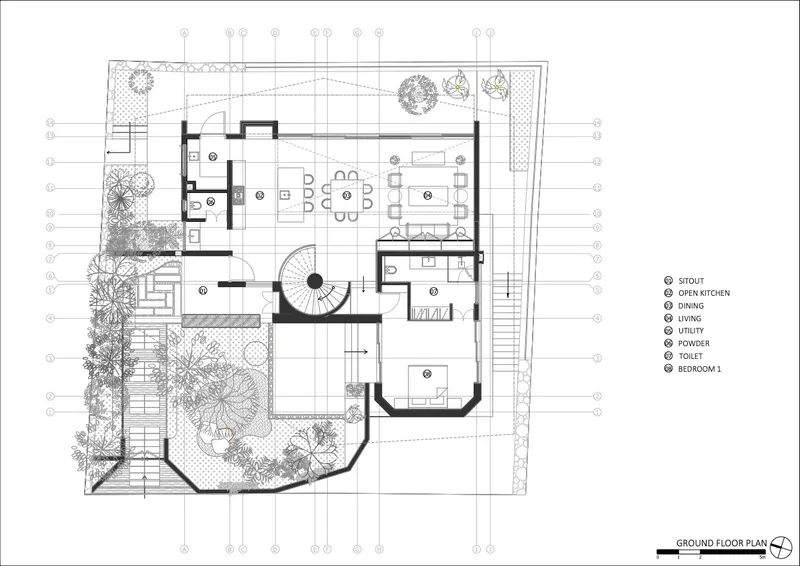
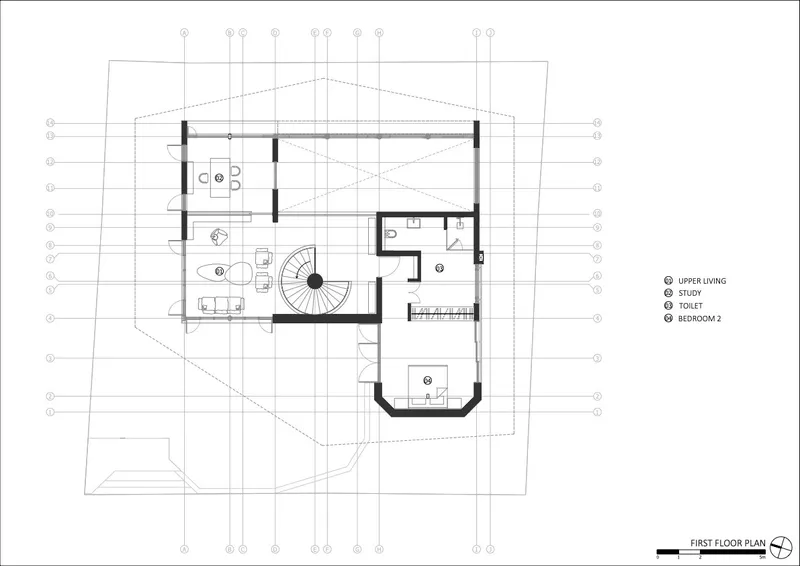
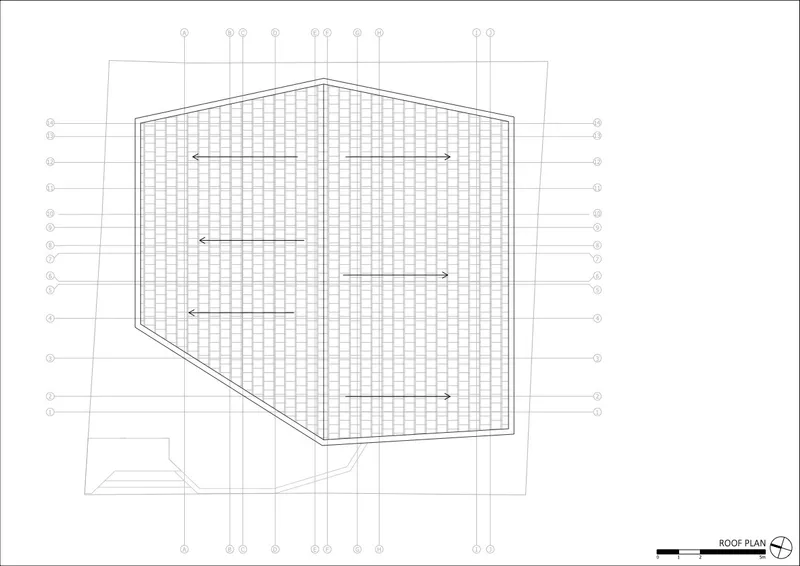
The floor plans reveal how the spiral staircase anchors every level. At the basement, it sits adjacent to the garage and storage rooms. At the ground floor, it mediates between the open kitchen-dining zone and a courtyard threaded with trees. The first floor organizes bedroom, study, and upper living area around the same central core. The roof plan shows a hexagonal outline clad in Mangalore tiles, confirming that the expansive canopy visible from below is a deliberate formal gesture, not an afterthought. The double-height section, glimpsed through the living space view opening onto the planted terrace, makes clear how the roof floats above and beyond the wall plane.
Why This Project Matters
Ananda House is a quiet provocation. In a region where coconut wood was sidelined by the prestige economy of teak, Thought Parallels makes a structural and aesthetic case for its return, sourcing it sustainably from senile palms and using it to span the entire roof without concealment. That decision is simultaneously ecological, economic, and cultural. It says that the best material for the job was here all along, waiting for someone to take it seriously again.
More broadly, the house demonstrates what is possible on a constrained urban site when the architect refuses to treat limitation as defeat. The narrow access, the dense fabric, the sloping topography: each of these constraints generates a design response that makes the house more specific, more rooted, and more interesting than a freestanding villa on an open plot could ever be. At 3000 square feet, Ananda House proves that density and delight can coexist if you build with the climate, the culture, and the grain of the wood.
Ananda House by Thought Parallels (Ar. Nikhil Mohan), Kerala, India. 3000 sq. ft. Completed 2026. Photography by Syam Sreesylam.
About the Studio
Share Your Own Work on uni.xyz
If projects like this are the kind of work you want to make, uni.xyz is a place to publish your own, find collaborators, and enter design competitions.


Popular Articles
Popular articles from the community


Architekt Andreas Gruber Scatters 23 Dark Timber Chalets Across a South Tyrolean Forest Edge
In Molini di Tures, Amonti Chalets breaks a resort into a hamlet of gabled timber houses, with parking, storage and services pushed into the slope.

Cube Design Draws an Ecological Corridor Between Two Shenzhen Hills with the Nankai Building
Beside Shenzhen's container docks, the Nankai Building pairs stacked balconies with a climbing green screen to connect two hillsides across its height.

GROUP A Strips a 1969 Rotterdam Harbor Headquarters to Its Frame and Wraps It in Timber Louvers
In Rotterdam's M4H harbor district, Ferro Offices reuses a 1969 frame, adds one timber storey and reaches BREEAM-NL Outstanding.

LT2A and OPEN Architectes Thread a Brick and Glass High School Through a Wooded Belgian Campus
In Braine-l'Alleud, a 3,000 m² wing for Collège Cardinal Mercier pairs pale brick with a glazed colonnade, deferring to a small chapel and a dense wood.

Similar Reads
You might also enjoy these articles


LAVA Architecten Gives Vocational Education a Sawtooth-Roofed Face on a Mechelen School Campus
In Mechelen, Belgium, a 2,053 m² STEM school on a 6×6 m grid turns workshops and classrooms into rooms that can be rearranged as teaching changes.

KEMA Studio Turns a Derelict Marvila Attic into a 60 m² Lighthouse Apartment Above Lisbon
In Lisbon's Marvila district, a rebuilt roof, four skylights and two plywood volumes turn an unlivable attic into a bright home facing the Tagus.

Pixel Gardens: One Repeated Module Stacked Into a Terraced Social Housing Tower for Famagusta
Salem Bader's shortlisted housing tower builds a vertical neighbourhood from one repeated module, offsetting units to carve terraces, light and air.

Bao Huynh Watercolor Atelier: A Serene Art Retreat in Hội An
Bao Huynh Watercolor Atelier in Hội An blends multifunctional art spaces, sustainable design, local materials, and family-friendly living in a serene environment.

Explore Elephant House Competitions
Discover active competitions in this discipline

Comments (0)
Please login or sign up to add comments
No comments yet. Be the first to comment!