
Corpo Atelier Dissolves Concrete Walls into Air Across Three Courtyard Façades in Faro
A renovation on Rua do Alportel preserves a 1934 street front while three new rear façades shift from stone to metal grid to open sky.


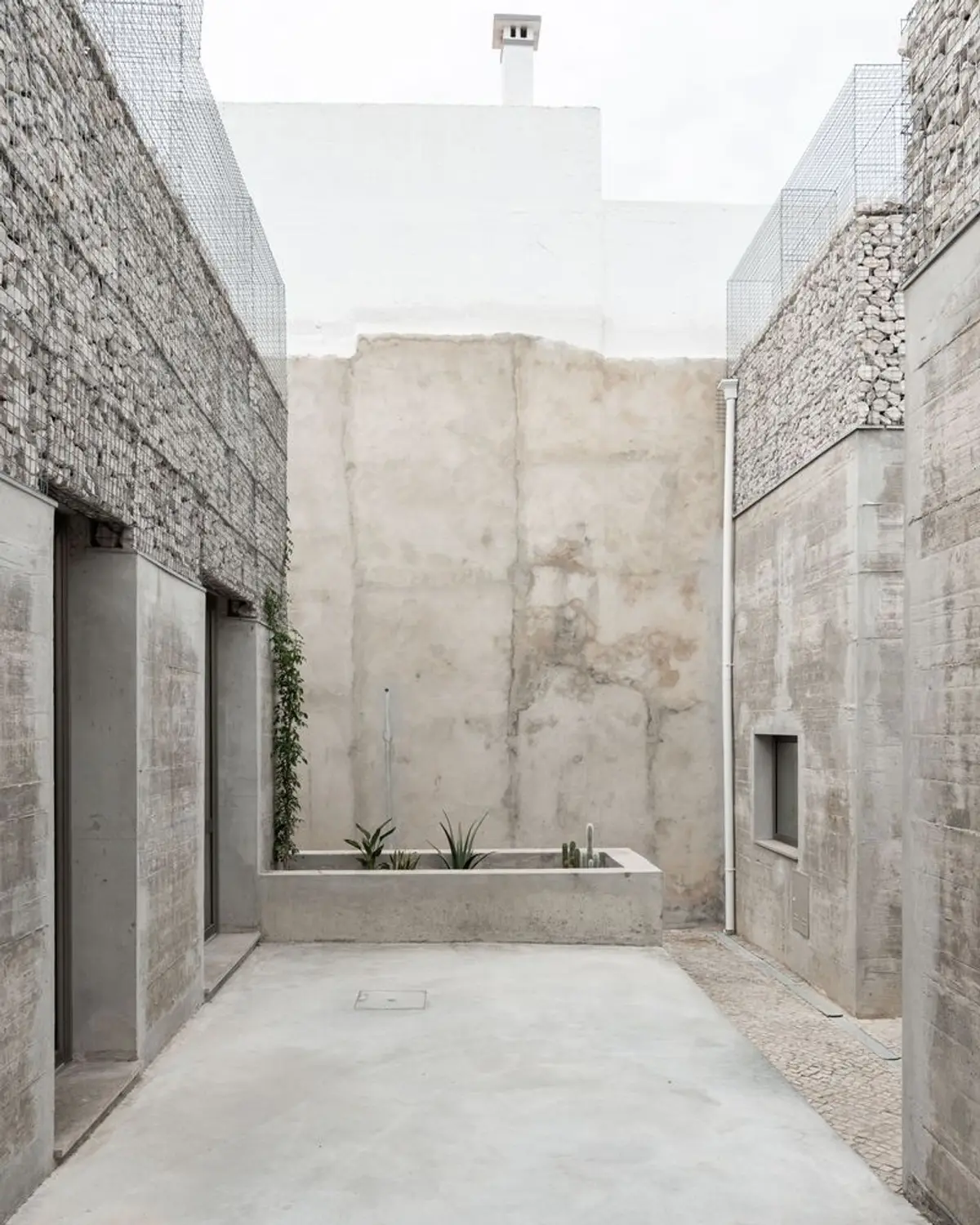
Renovation projects often split into two camps: those that erase history and those that embalm it. Corpo Atelier's intervention on Rua do Alportel in Faro, Portugal, does neither. The 1934 street façade, with its arched parapets and ornamental window surrounds, stays exactly as it was. Walk through, though, and you encounter three new exposed concrete façades organized around a central courtyard, each one built on a single constructive idea that the studio pursues to its logical conclusion: a reinforced concrete wall rises from the ground, gives way to a metal grid packed with locally sourced stones, and then, as the grid climbs higher, the stones disappear until the cage holds nothing but air.
The concept is deceptively simple, but the execution touches every layer of the project, from structure to ornament to memory. Inside the main house, four demolished walls are registered on the polished concrete floor by pine wood lines, and replica doorframes stand in the exact positions of the originals. Corpo Atelier describes the building's elements as "architectural anatomy," treating walls, windows, and doors as bones, skin, eyes, and mouths. It is a metaphor that could feel overwrought, but the built result is restrained and specific: each mark left behind has a purpose, and the courtyard at the center gives every gesture room to breathe.
Keeping the 1934 Face
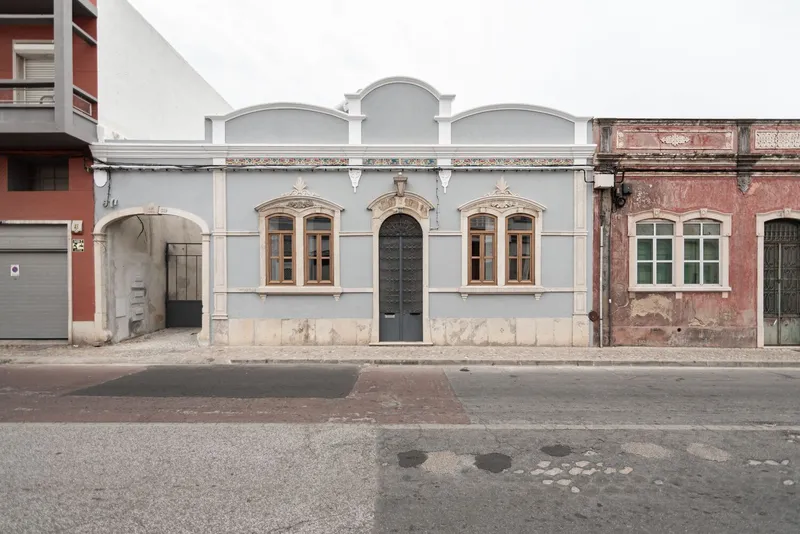
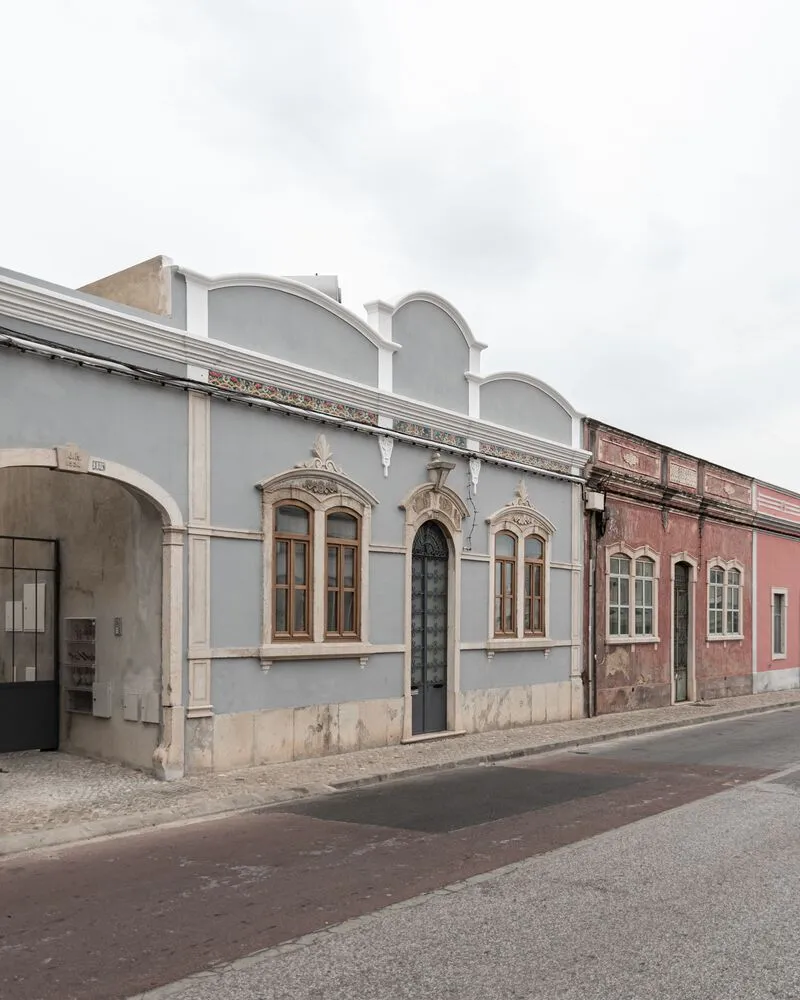
From Rua do Alportel, the building reads as part of its row. The primary façade, designed in 1934, is a pale blue composition of arched parapets and symmetrical window surrounds that the architects chose not to alter. That decision is the first, and arguably most important, design move. Leaving the street face intact is not preservation for preservation's sake; it is a statement about where the intervention belongs. The new architecture happens behind this mask, in the spaces that the public eye does not reach unless invited.
Viewed at an angle against its weathered red neighbor, the restored façade holds a quiet tension. It is visibly maintained, freshly painted, yet its proportions and detailing remain period-accurate. The contrast with what lies behind it only amplifies the surprise of the courtyard.
The Courtyard as Connective Tissue
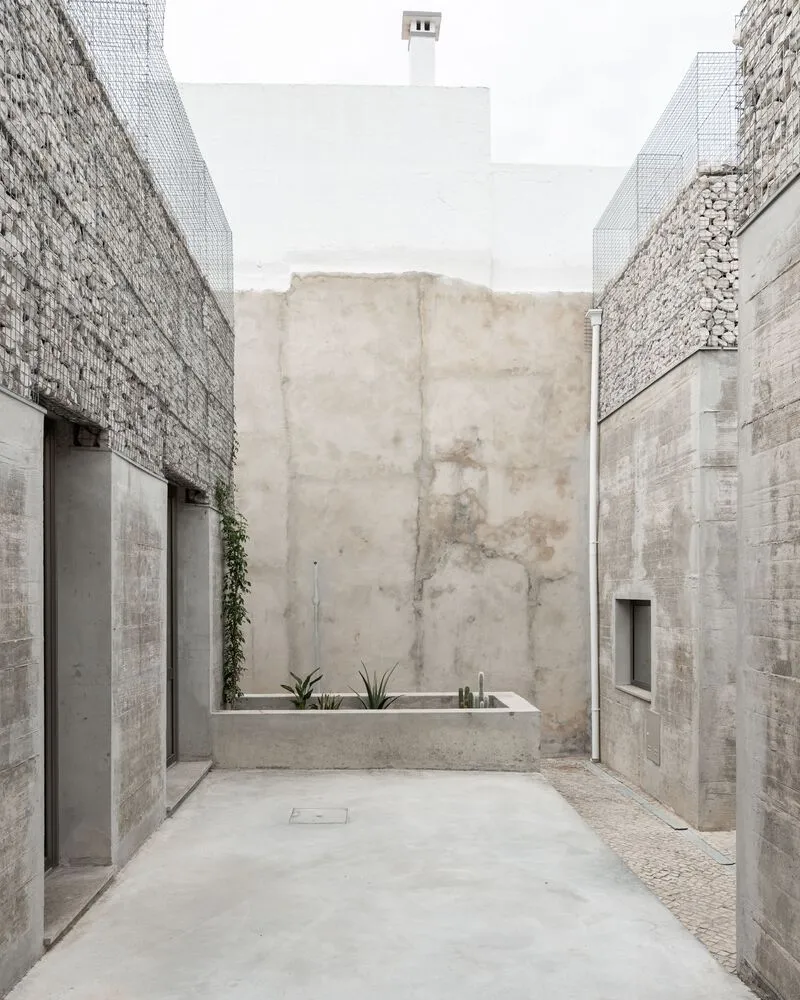
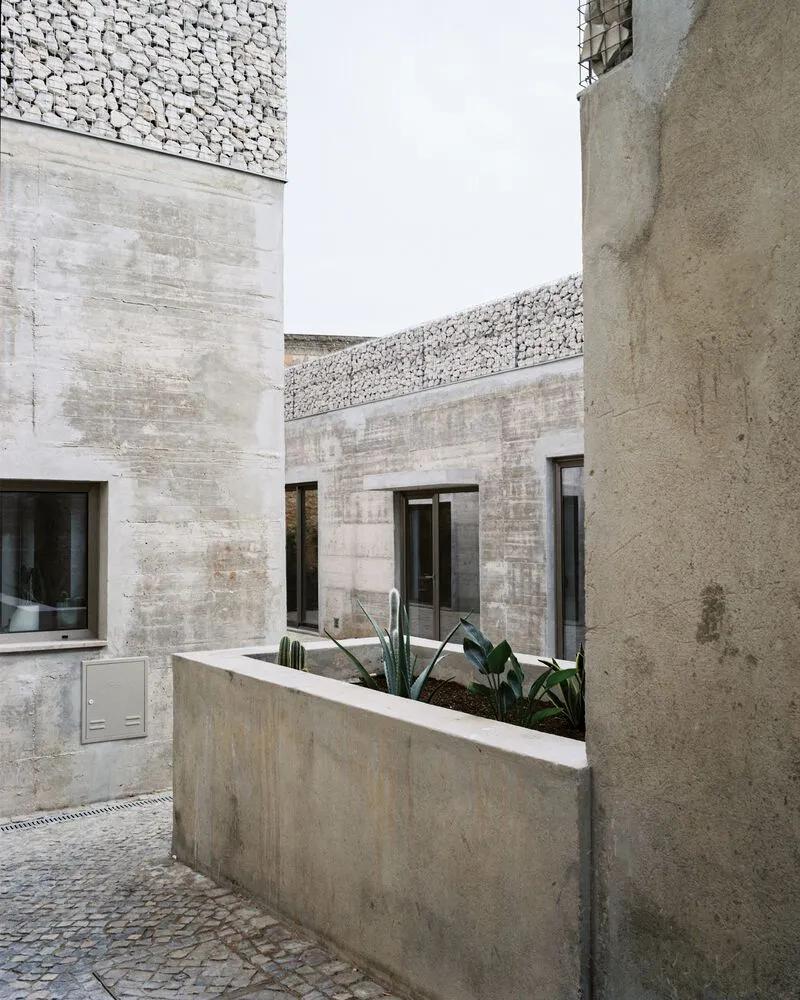
The three houses are arranged around a shared courtyard that acts as the project's organizing spine. On either side, board-formed concrete walls rise cleanly from the ground, their surfaces still carrying the grain of the formwork. Above the solid mass, metal grids emerge, filled with stacked local stones that form a kind of gabion wall. The stones are rough and varied, a deliberate contrast to the precision of the concrete below. Further up, the grid cages thin out and hold nothing at all, allowing sky and light to penetrate the enclosure.
A planted bed runs along the courtyard floor, introducing tropical vegetation that softens the mineral palette. The planting is minimal, almost surgical, framed by the concrete walls on both sides. It avoids the trap of turning the courtyard into a garden; instead, the greenery reads as one more material in the composition, positioned with the same care as the stone and steel. The effect is of a space that is simultaneously enclosed and exposed, solid at its base and dissolving at the sky.
From Concrete to Stone to Nothing
The single constructive principle that unifies the three façades is worth examining closely because it is not merely decorative. The transition from solid concrete to stone-filled grid to empty grid is a gradient of enclosure. At ground level, the wall is load-bearing, structural, opaque. As it rises, it becomes a screen, filtering light through the gaps between stones. At the top, it is pure framework, a skeleton without flesh. Corpo Atelier's "architectural anatomy" metaphor lands here: you can literally see the structure shed its skin.
Each of the three façades interprets this gradient differently, preventing the courtyard from feeling repetitive. The variation is subtle, more about proportion and stone density than formal gymnastics, which keeps the composition coherent. The use of locally sourced stone is also significant. In a region where vernacular construction relied heavily on regional materials, the gabion infill nods to that tradition while reframing it within a contemporary structural logic.
Ghosts of Removed Walls
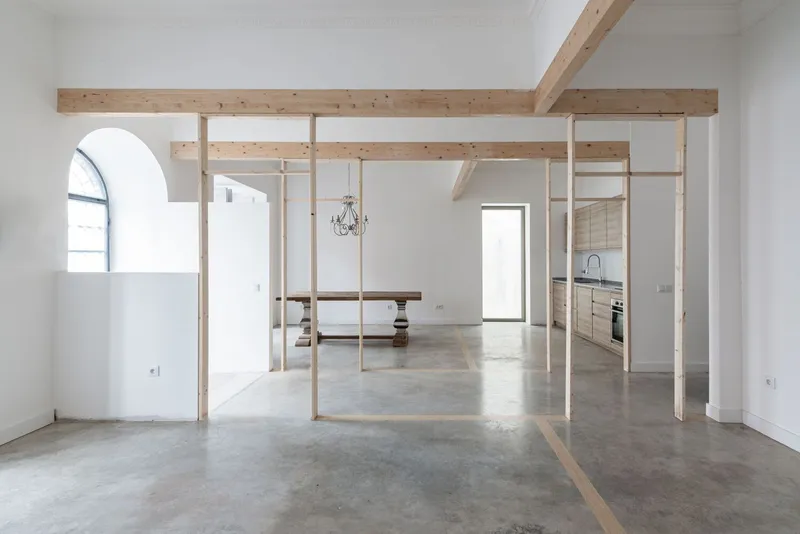
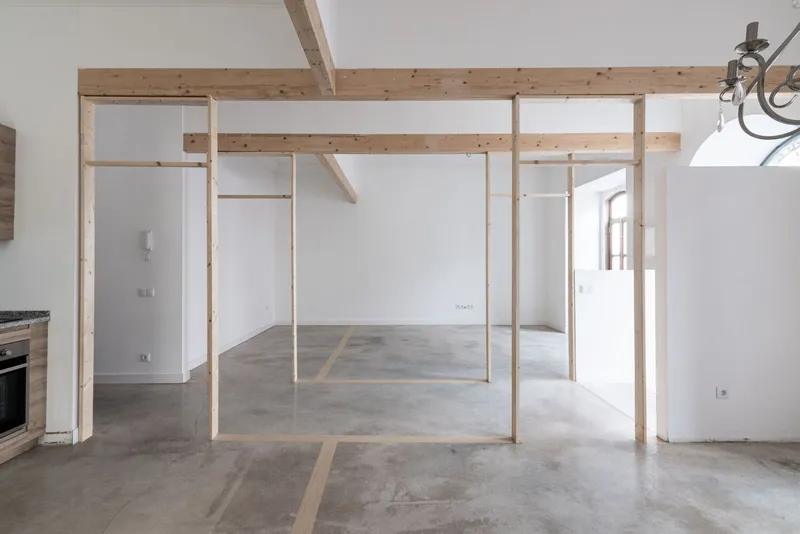
Inside the main house, the architects removed four interior walls to open up the plan, but they refused to let those walls vanish without a trace. Pine wood lines are embedded in the polished concrete floor along the exact footprints of the demolished partitions. Replica timber doorframes stand in their original positions, framing nothing. The result is a set of spatial markers that acknowledge the building's former layout without physically constraining the new one.
The interiors are spare. Polished concrete floors run wall to wall, and exposed ceiling beams reinforce the material honesty that defines the project. Light timber frame partitions divide zones without sealing them off, and an arched window on the street side lets in diffused daylight that travels deep into the plan. There is a discipline at work here that resists the urge to furnish or finish the spaces into comfort. The architecture carries the room.
What makes these ghost walls effective is their legibility. A visitor who has never seen the original floor plan can still read where the rooms used to be. The pine lines on concrete are thin enough to avoid tripping hazards but visible enough to register as intentional. The doorframes, standing free of any wall, become small monuments to the domestic rituals that once passed through them. It is a form of remembrance that stays architectural rather than sentimental.
Why This Project Matters
Three Exposed Concrete Façades succeeds because it treats renovation as a problem of legibility, not style. The 1934 front stays; the courtyard façades introduce a new tectonic logic; the interior records what was lost. Each decision reinforces a consistent attitude toward time: the past is neither hidden nor fetishized, but registered in the material language of the present. That kind of clarity is rare in adaptive reuse, where the temptation to overdesign the junction between old and new leads many projects into visual incoherence.
Corpo Atelier's anatomical metaphor also offers a useful framework for thinking about what walls actually do. Walls bear loads, enclose space, filter light, and communicate history. By separating those functions and assigning each to a different material or gesture, the project makes visible the layered work that architecture performs every day, mostly unnoticed. In a mid-size Portuguese city where historic fabric is under constant pressure from tourism and neglect alike, that visibility feels like a form of advocacy.
Three Exposed Concrete Façades, Rua do Alportel, Faro, Portugal. Architect: Corpo Atelier. Project team: Filipe Paixão, Laura Correia, Laura Bação, Diogo Silva, Pietro Pucci. Year: 2022. Photography by Frederico Martinho.
About the Studio
Share Your Own Work on uni.xyz
If projects like this are the kind of work you want to make, uni.xyz is a place to publish your own, find collaborators, and enter design competitions.


Popular Articles
Popular articles from the community


Singing Woman: An Opera House That Performs Before the Curtain Rises
Ovidiu Cristian Pavel's conceptual opera house translates Estonia's choral identity into a sculpted waterfront landmark facing the Baltic Sea.

Opera on the Sea: Driftwood Logic Shapes a Timber Opera House on Estonia's Coast
Trevor Orgill's opera house translates the entangled drift of floating timber into a civic building where wood, water, and music converge.


ETEH Reworks the Shared Spaces of São Domingos School in Brazil Around Timber, Color and Hanging Plants
At São Domingos School in Brazil, 436 m² of hall, refectory and library are recast with timber joinery, a yellow and blue code and trailing greenery.

Cube Design Draws an Ecological Corridor Between Two Shenzhen Hills with the Nankai Building
Beside Shenzhen's container docks, the Nankai Building pairs stacked balconies with a climbing green screen to connect two hillsides across its height.

Similar Reads
You might also enjoy these articles


Hodi-Mandai Geram
Project Function: Preservation and revitalization of the Intangible heritage and socio-spatial identity of the Hodi by Housing, Cultural Memory Center, Sacred Grove, landscape, local tourism economy


Olio Towers: A Mid-Rise for Performers That Fuses Housing, Rehearsal, and Stage
Located blocks from Houston's Theater District, this modular tower stacks living units around a central performance atrium.

Oasis: Modular Green Housing Carved into Dhaka's Urban Fabric
A shortlisted Plugin Housing entry reclaims unauthorized settlements in Dhaka with stepped concrete volumes, green roofs, and ventilation-driven design.

Black Hole: A Floating Megastructure for the Post-Physical Era
Emiliano Mazzarotto envisions a spherical, self-scaling arena where e-sports, digital hotels, and holographic stadiums replace traditional public space.

Explore Digital Façade Competitions
Discover active competitions in this discipline

Challenge to reimagine the Iron Throne

Photograph architecture without architects

Illustrate the lost glory of Angkor Wat - Render Challenge

Design challenge to reuse E-waste
Comments (0)
Please login or sign up to add comments
No comments yet. Be the first to comment!