
Ballistic Architecture Machine Builds a Park Over an Erased Chinese Town in Tianjin
A 42,000 square meter sports park layers mazes, geothermal chimneys, and interactive hydrology over the ghostly grid of ancient Yixing.


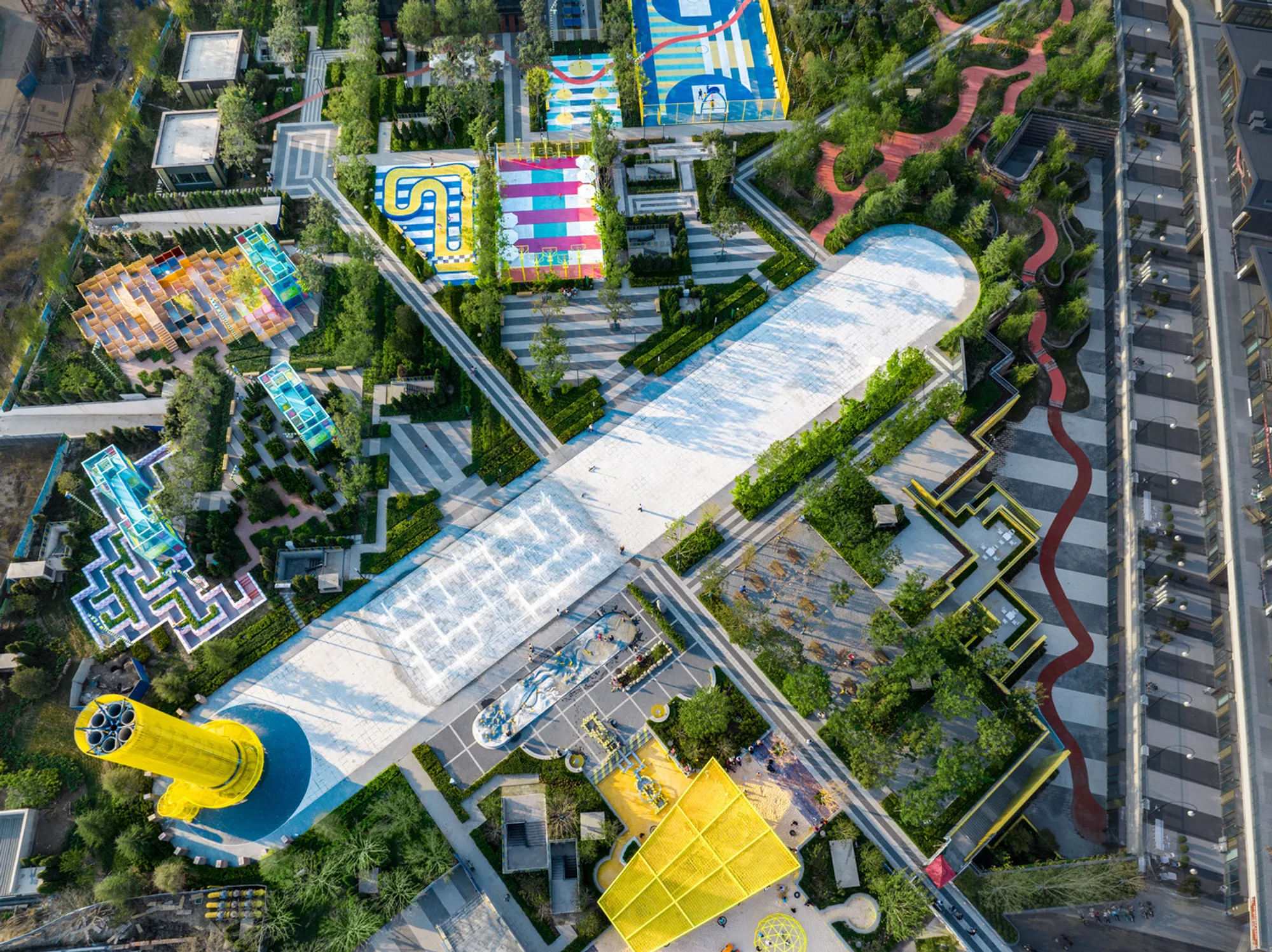
Cities consume their predecessors. In Tianjin, a mega port city in northern China, a town called Yixing once existed, organized around a central temple and a street called Teacher's Street. Centuries ago, when the Grand Canal arrived, residents of the original Yixing in Jiangsu province had relocated their entire settlement northward, reconstructing a facsimile of their hometown. That copy is now gone too, buried under decades of development. Ballistic Architecture Machine (BAM) took the ghost of that erased town as the organizing logic for a 42,000 square meter sports park, using the old street plan as a palimpsest beneath a landscape of mazes, courts, fountains, and geothermal infrastructure.
What makes the Tianjin 4A Sports Park unusual is not simply its color palette or its programmatic density, though both are aggressive. It is the insistence that a public park should teach something about the ground it sits on and the systems running beneath it: heated water drawn from the earth, rainfall collected and channeled, an interactive water feature that miniaturizes the entire Yangtze River delta. This is landscape architecture as compressed pedagogy, built for a client (Sino Ocean) over a twelve-year arc from 2010 to 2022, and designed to pack maximum ecological and social function into a site that is, by the standards of Chinese urban development, genuinely small.
Four Quadrants, One Palimpsest
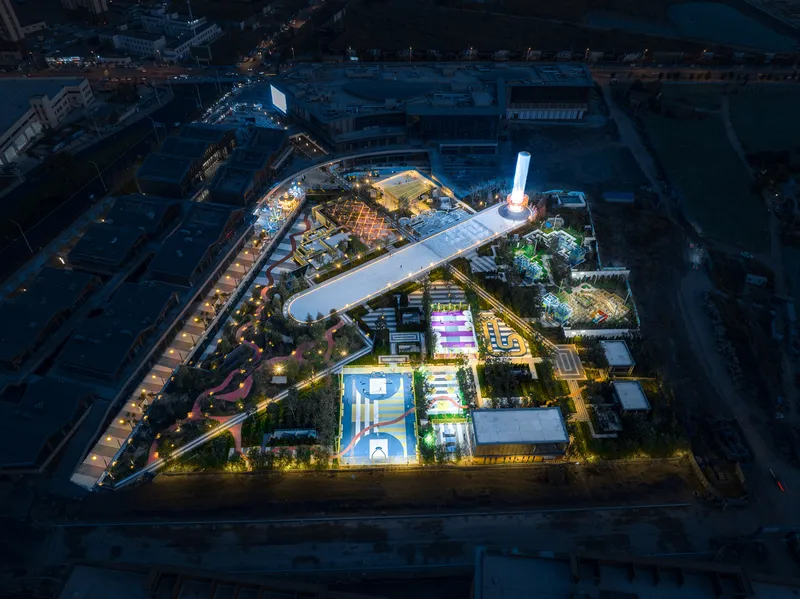
BAM divided the site into four overlapping quadrants, each with a distinct program: sports to the north, food to the east, play to the south, and mazes to the west. A central axis runs northwest to southeast, stitching a residential district through a mall to a metro station. A second axis, perpendicular, opens into a large central plaza designed to host events and absorb crowds. The layout echoes the meandering streets of the original Yixing settlement, but the overlay is selective and abstracted rather than literal. You would not walk through the park and recognize the old town. You would, however, feel the density and intricacy of a place shaped by something older than its materials.
The night aerial reveals how tightly the park is woven into its surrounding urban blocks. It is not a green buffer or a polite setback. It is a piece of infrastructure as hardworking as the residential towers flanking it, distinguished by the intensity of its programming rather than by empty lawn.
Courts as Graphic Language
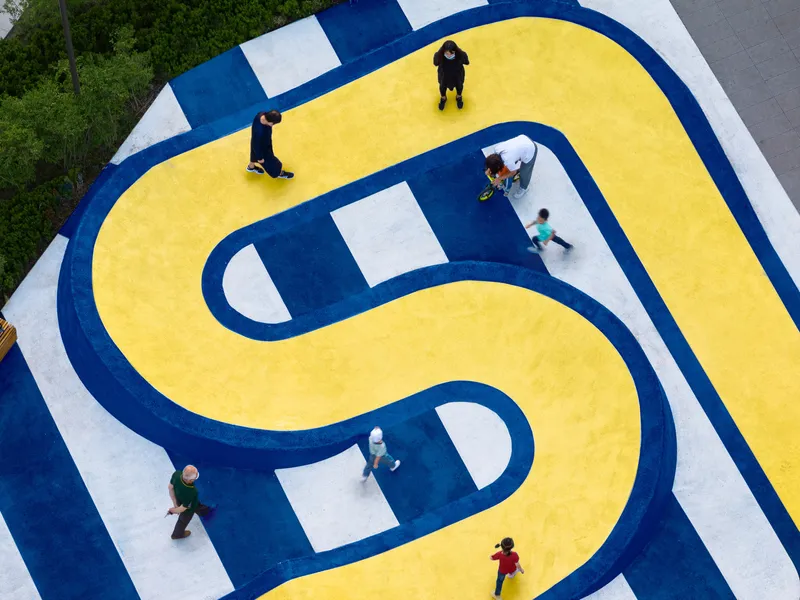
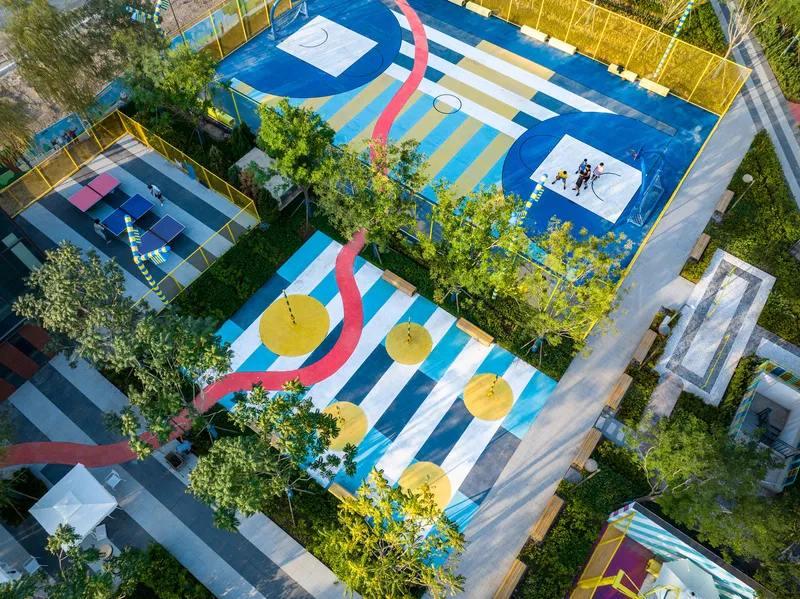
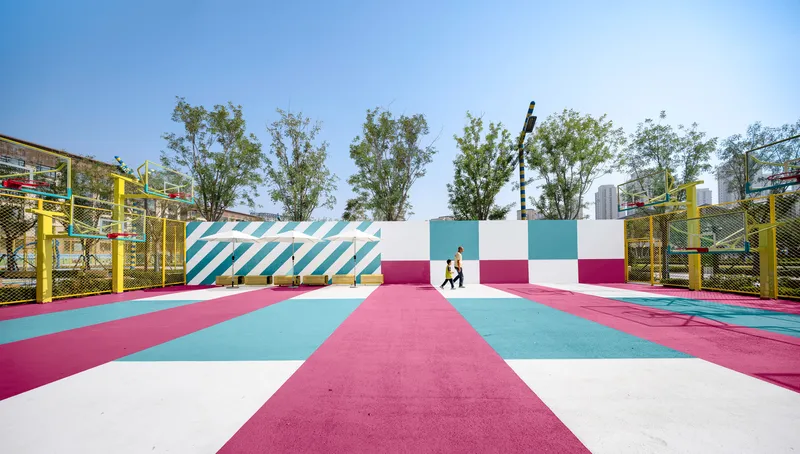
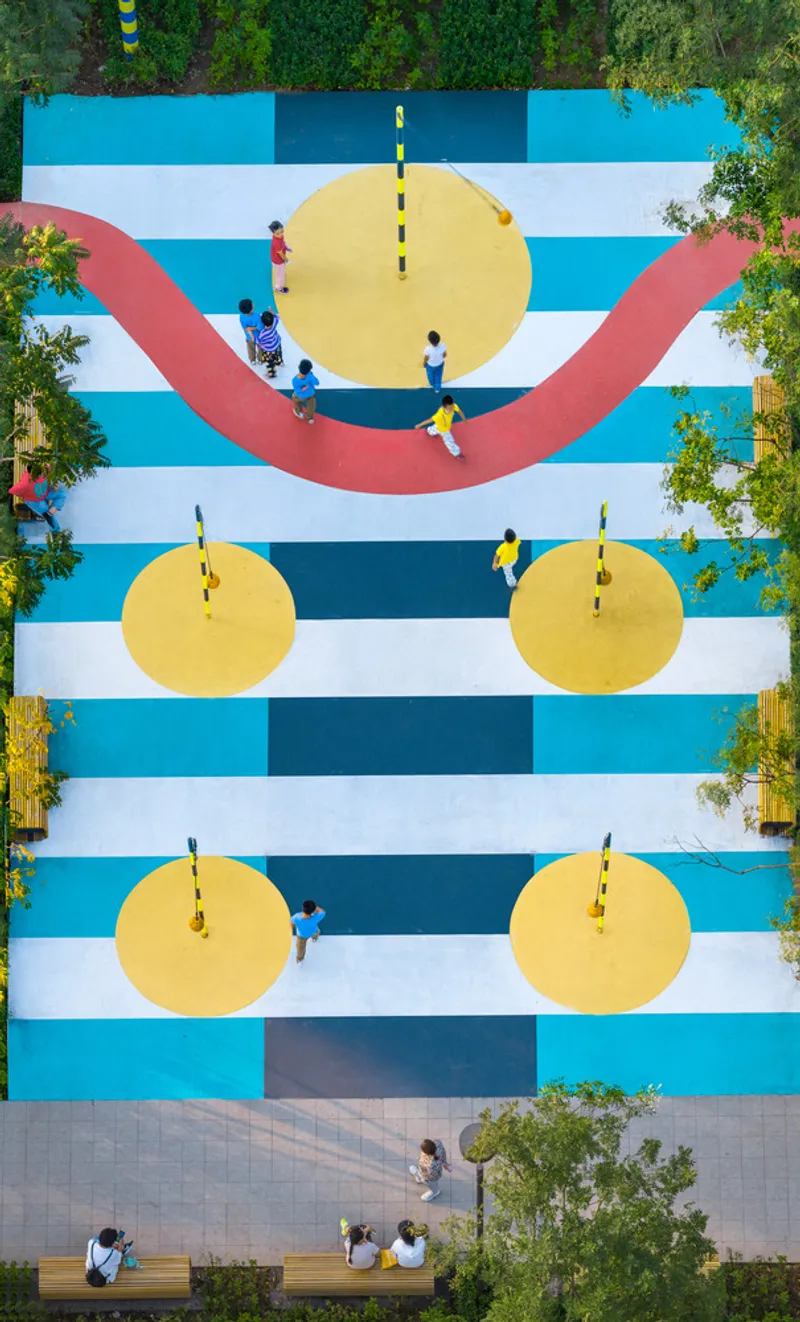
The sports quadrant, connected directly to the residential district to the north, includes basketball courts, tennis courts, tetherball areas, a small bike track, and three pitches of various sizes. BAM treats these surfaces not as neutral functional zones but as the primary graphic language of the entire park. Courts are painted in saturated blocks of yellow, turquoise, pink, and blue. Striped markings extend beyond the boundaries of play, bleeding into pathways and seating areas. The sports court becomes a public artwork that also happens to host a pickup game.
Yellow umbrella canopies punctuate the basketball courts, providing shade while reinforcing the color coding that runs through the whole site. Stripes, circles, and arcs mark activity zones as legibly as wayfinding signage, but without the deadening effect of signage. The patterning is bold enough to read from a drone and specific enough to guide a six-year-old on a bicycle.
The Play Quadrant and Its Yellow Canopy
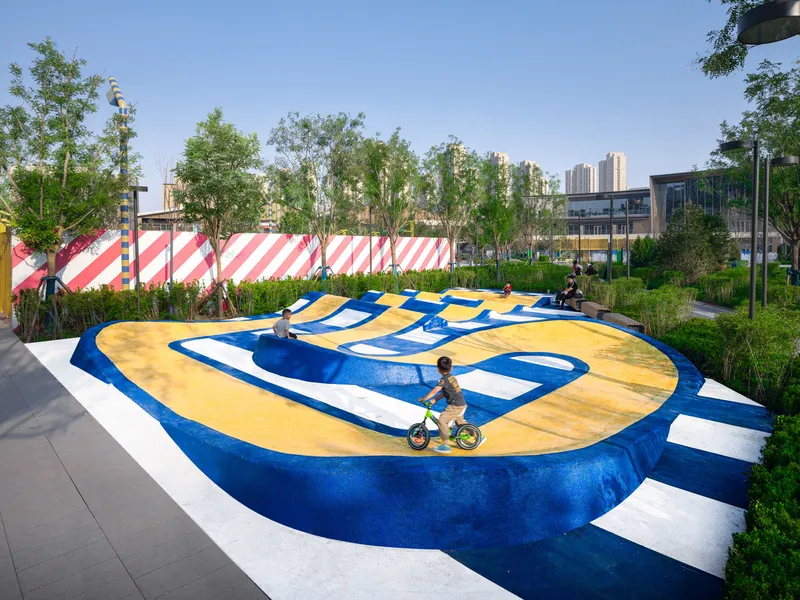
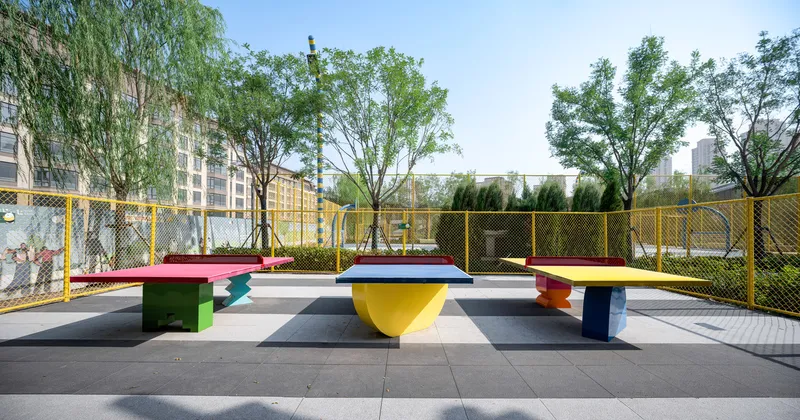
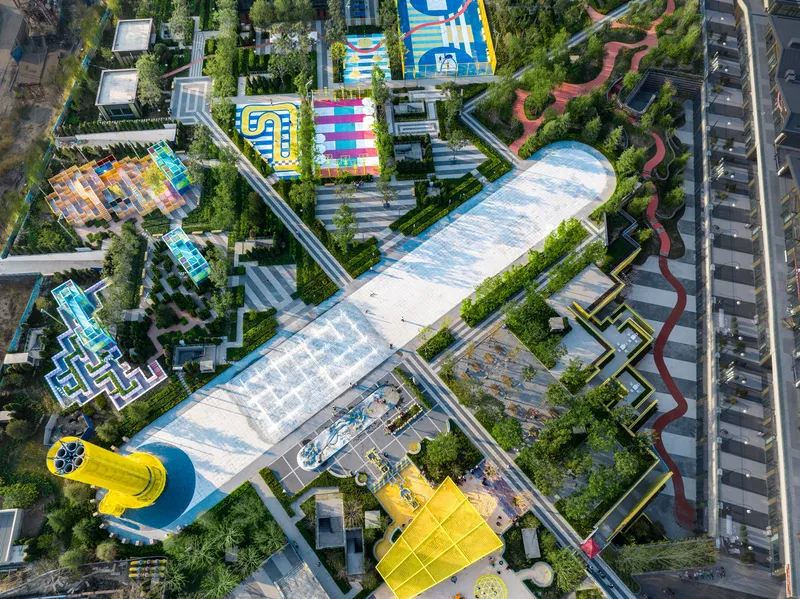
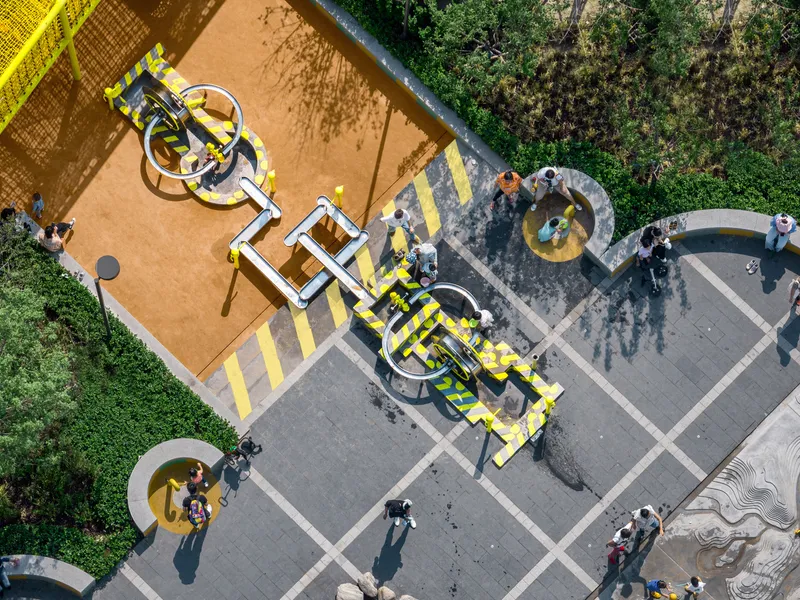
The southern play quadrant gathers sandpits, fountains, contoured play surfaces, and climbing equipment under and around a bright yellow canopy structure that operates as both shade device and visual anchor. Painted benches in green, blue, and yellow sit on grey paving, arrayed with the deliberate casualness of outdoor furniture that has been precisely positioned. The yellow and blue patterned play surface reads like a graphic textile stretched across the ground, its striped perimeter fence reinforcing the sense of a contained world within the larger park.
BAM's Play 'n Learn concept is visible here at its most direct. Every surface is an opportunity for engagement. The canopy path, visible in the aerial, connects play zones like a bright thread, drawing children (and their trailing parents) through a sequence of environments that alternate between open and enclosed, wet and dry, loud and quiet.
Mazes as Memory
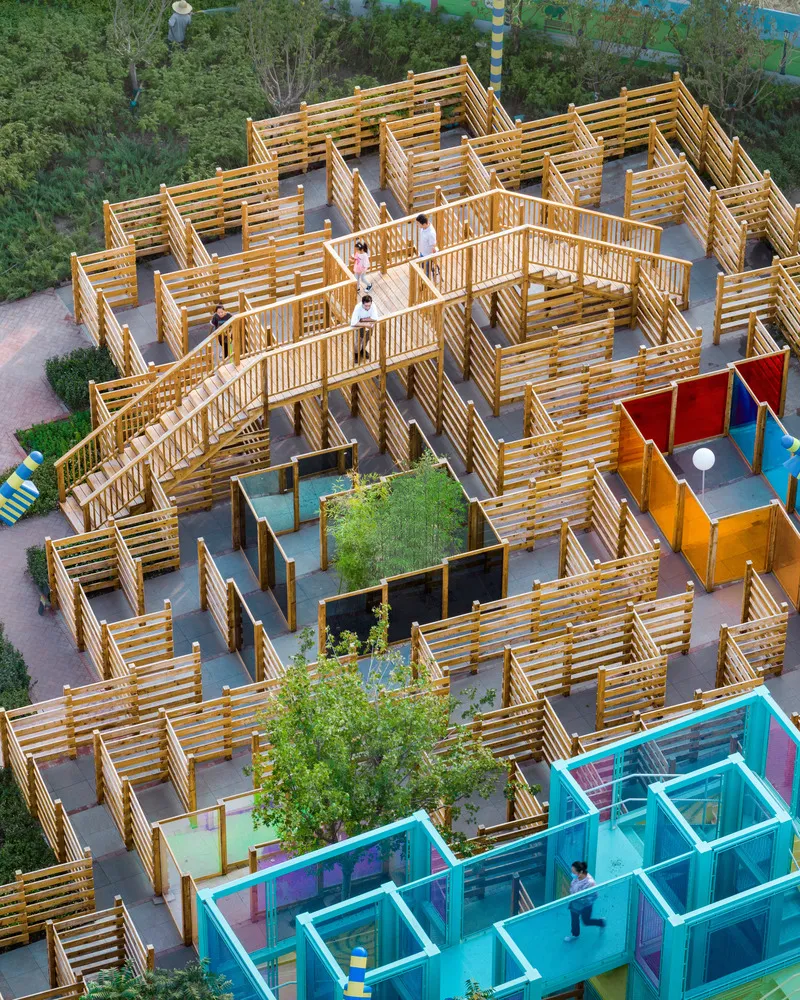
The western maze quadrant contains four interconnected mazes: hedge, earth, wood, and water. BAM positions these as analogies for the learning process itself, but they also echo the winding street pattern of the original Yixing town. The wooden slatted maze, with its elevated walkways above colored cube pavilions, offers adults a supervisory vantage while children navigate below. It is a clever inversion: the maze rewards the person inside with discovery, and the person above with a legible diagram of someone else's confusion.
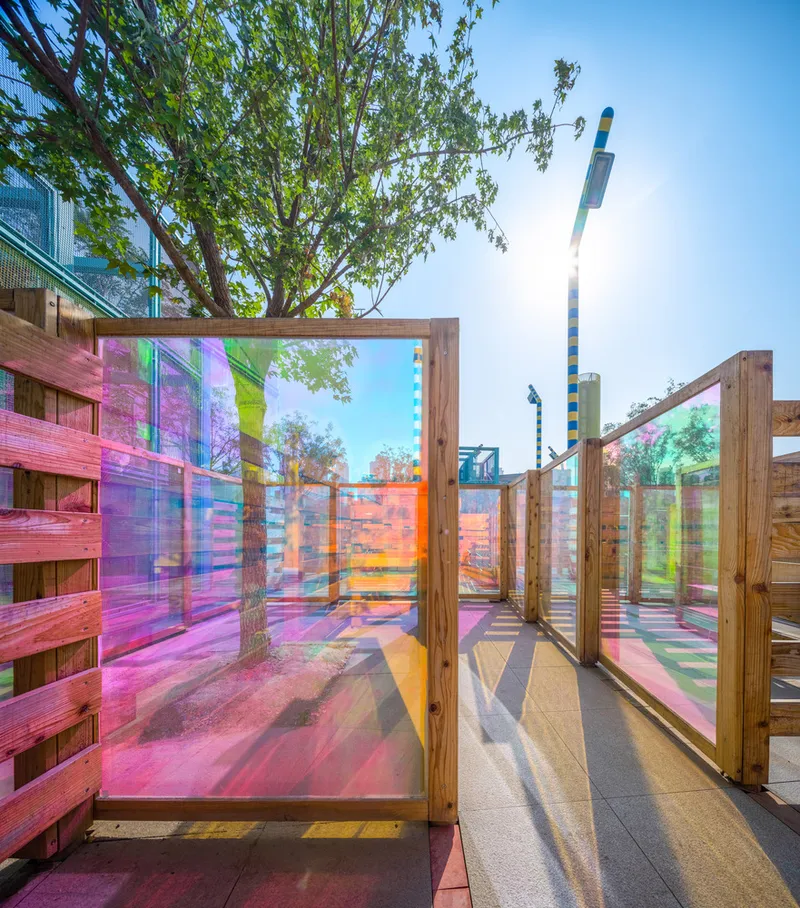
Dichroic glass panels set in timber frames cast rainbow reflections across the pathways, turning a structural material into a sensory event. The effect is calibrated to sunlight angle, which means the maze changes color throughout the day. Each maze type deploys a different material vocabulary, but all four share ample onlooking space at their perimeters, recognizing that watching someone solve a maze is nearly as satisfying as solving one yourself.
Water Mountain: Hydrology You Can Touch
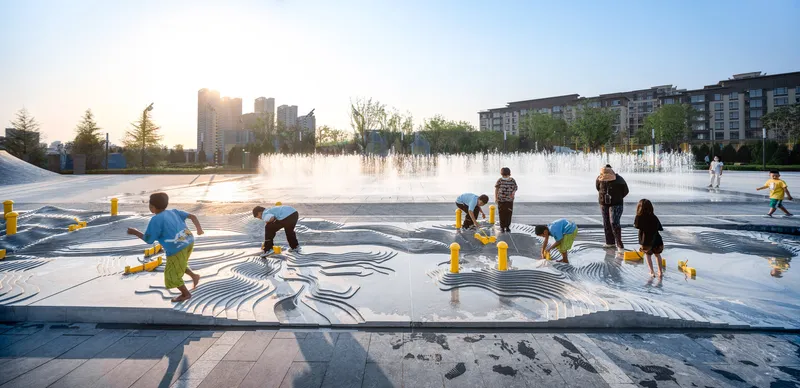
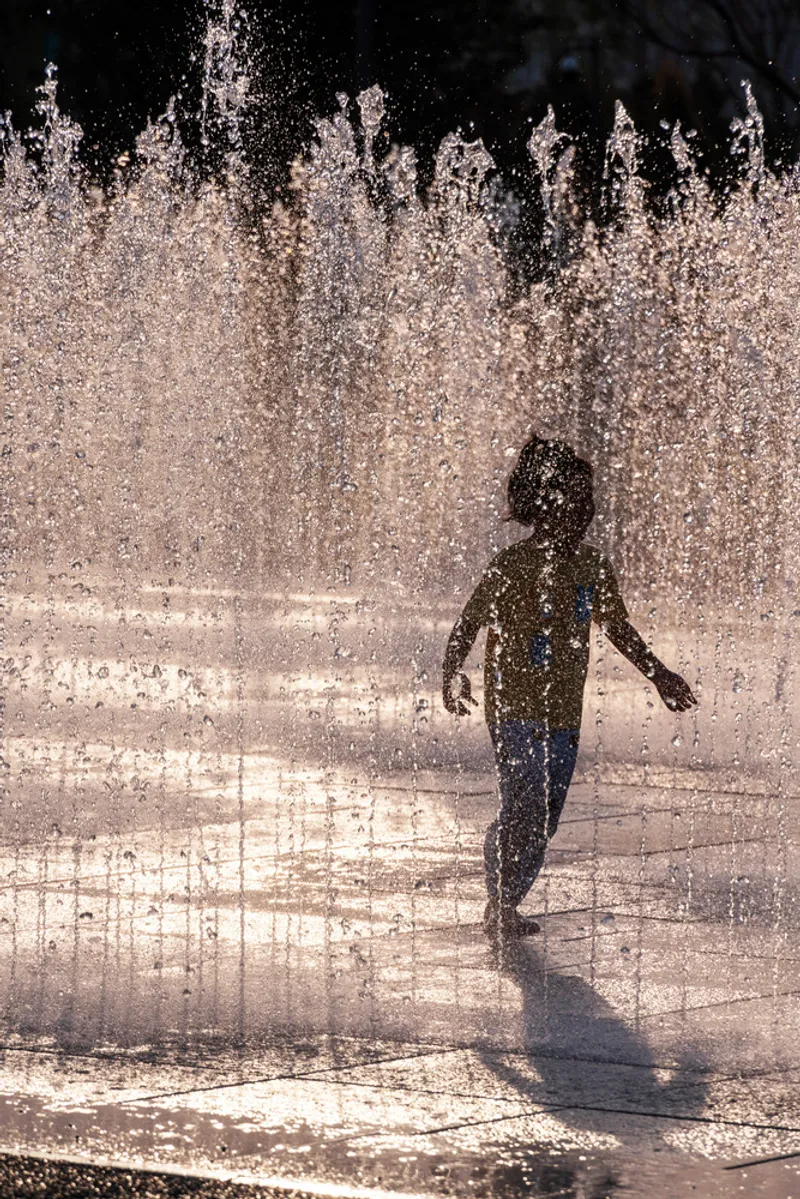
The park's most conceptually ambitious element is the Water Mountain, an interactive hydrology model that miniaturizes the Yangtze River delta landscape, the Three Gorges Reservoir, and the ancient Dujiangyan irrigation system. Water springs from sculpted mountains, moves through a valley, and flows into deltas. Children can activate water sources and build dams to create reservoirs, observing how flow patterns change in real time. The feature was built for 450,000 Chinese Yuan, a modest budget that reflects its reliance on topographic shaping and simple mechanical valves rather than expensive technology.
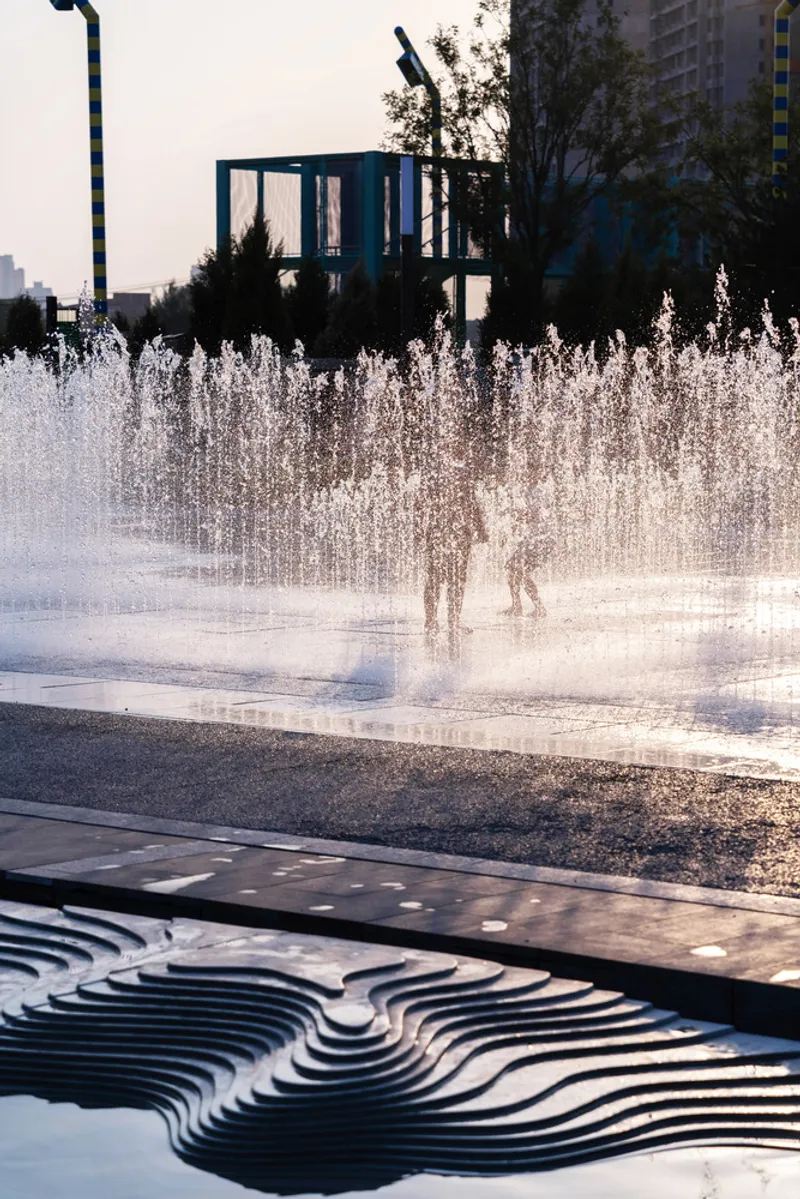
At dusk, the fountain jets along the adjacent plaza catch backlight and turn the space into something closer to a stage set. A sculptural metal bench sits at the edge, framing views through spray toward the surrounding buildings. The water features serve double duty as rainwater collection and flood management infrastructure, tying the park's playful surface to a serious climate strategy beneath it. A geothermal chimney, the park's tallest vertical element, exhausts steam from naturally occurring heated water in the region, making the site's invisible energy resources visible and legible.
Plans and Drawings
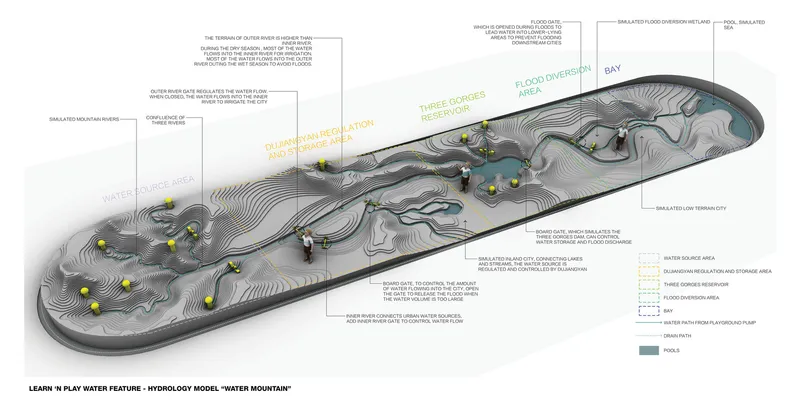
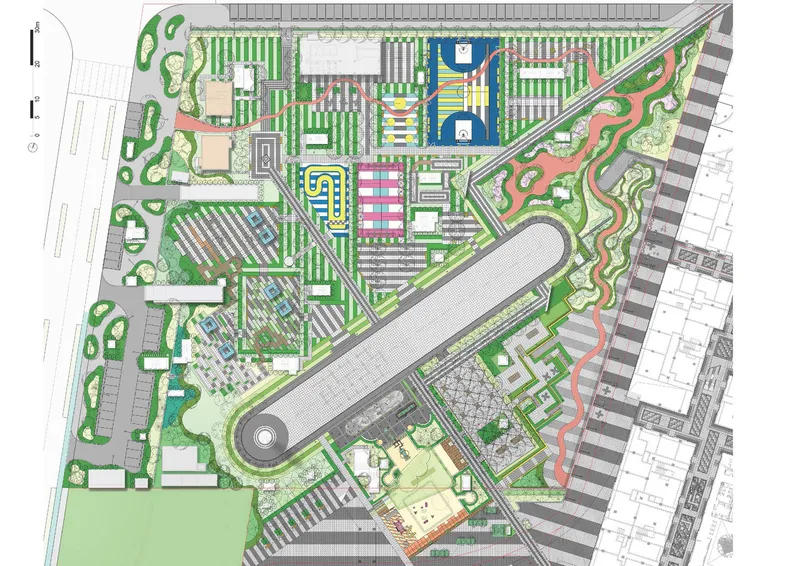
The axonometric drawing of the Water Mountain reveals the topographic terracing and labeled zones that organize the hydrology model, showing how water is routed from source to delta across a compressed landscape. The site plan shows the elongated plaza stretching between water features and planted areas, with the surrounding building footprints pressing in on all sides. Together, the drawings make clear just how tightly the park's program is packed: there is almost no leftover space, no decorative buffer. Every square meter has a job.
Why This Project Matters
Most urban parks in Chinese megacities default to one of two modes: vast ornamental green space that discourages active use, or privatized recreation zones behind fences and fees. BAM's Tianjin 4A Sports Park refuses both options. It is aggressively public, programmatically dense, and unafraid of color, noise, and mess. Its ecological ambitions are embedded in features people actually touch, not confined to a sustainability report. The geothermal chimney, the interactive hydrology model, and the rainwater management system are all visible, all part of the experience of being in the park rather than hidden below grade.
The twelve-year timeline from commission to completion is telling. Projects this layered, built over sites this historically loaded, require patience that most development cycles do not permit. That BAM sustained a coherent vision across that span, delivering a park that reads as a single, intentional composition rather than a patchwork of phased compromises, is the quieter achievement here. The louder one is that thousands of children now learn about river deltas and irrigation systems by getting wet, which is exactly how those things should be learned.
Tianjin 4A Sports Park by Ballistic Architecture Machine, Tianjin, China. 42,000 m². 2010–2022. Photography by Qingshan Wu.
About the Studio
Share Your Own Work on uni.xyz
If projects like this are the kind of work you want to make, uni.xyz is a place to publish your own, find collaborators, and enter design competitions.



Popular Articles
Popular articles from the community


Hill & Cross Opera: Sculptural Opera House Architecture Shaped by Tallinn’s Landscape and Identity
Hill & Cross Opera reimagines opera house architecture in Tallinn through its sculptural hill, civic plaza, glass wave and a luminous cross.

Co-life: Sustainable Architecture for Age-Friendly Community Living
Co-life reimagines sustainable architecture for seniors through courtyards, rammed earth, shared gardens, and spaces designed for belonging.

Conexión: Biophilic Design Reimagines High-Rise Living in Hong Kong
Conexión reimagines high-rise living in Hong Kong through biophilic design, green facades, shared spaces, daylight, water and nature within.

Co-Life: Senior Housing Design That Reconnects Older Adults With the City
Co-Life reimagines senior housing design through healing gardens, shared streets, workshops, and a sustainable community across generations.


Similar Reads
You might also enjoy these articles


Hodi-Mandai Geram
Project Function: Preservation and revitalization of the Intangible heritage and socio-spatial identity of the Hodi by Housing, Cultural Memory Center, Sacred Grove, landscape, local tourism economy


Olio Towers: A Mid-Rise for Performers That Fuses Housing, Rehearsal, and Stage
Located blocks from Houston's Theater District, this modular tower stacks living units around a central performance atrium.

Oasis: Modular Green Housing Carved into Dhaka's Urban Fabric
A shortlisted Plugin Housing entry reclaims unauthorized settlements in Dhaka with stepped concrete volumes, green roofs, and ventilation-driven design.

Black Hole: A Floating Megastructure for the Post-Physical Era
Emiliano Mazzarotto envisions a spherical, self-scaling arena where e-sports, digital hotels, and holographic stadiums replace traditional public space.


Explore City Park Competitions
Discover active competitions in this discipline



Challenge to reimagine the Iron Throne


Photograph architecture without architects


Illustrate the lost glory of Angkor Wat - Render Challenge


Design challenge to reuse E-waste
Comments (0)
Please login or sign up to add comments
No comments yet. Be the first to comment!