
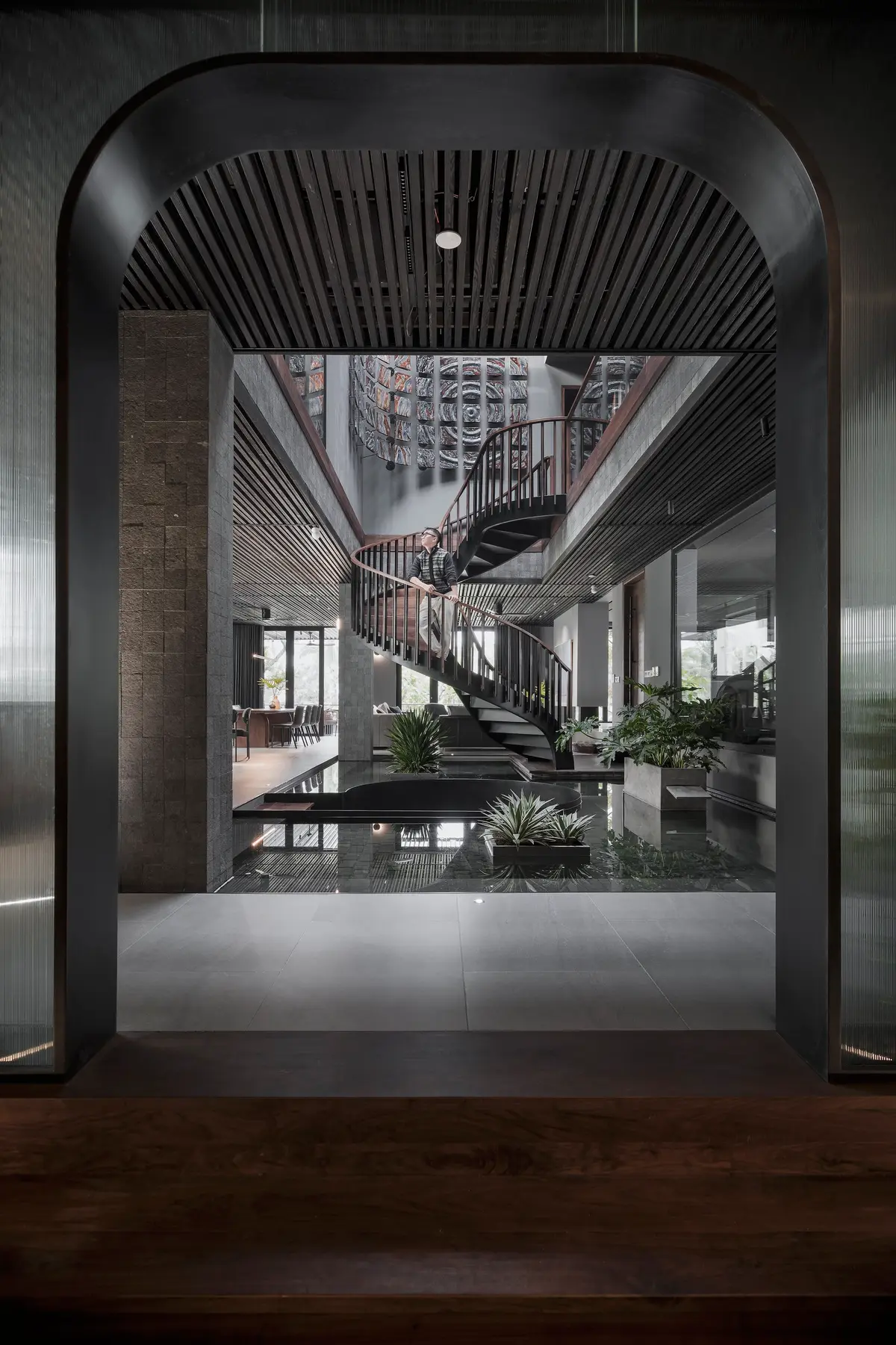
TOAM Studio Builds an Indochine Gallery House to Hold a Family's Memories in Ecopark
A 640 square meter residence in Vietnam's Ecopark township turns domestic space into a curated gallery of family stories and nature.


When four children leave home to study abroad, a house stops functioning as a daily container and starts acting as an archive. That is the premise behind TI60, a 640 square meter residence in Ecopark, Xuân Quan, designed by TOAM Studio for a mother who wanted every room to hold the residue of family life. Lead architect Nguyen Xuan Tung, working alongside Thai Nguyen and Quyen Bui, organized the house around two conceptual keywords: "Gallery" and "Indochine." The result is a home that doubles as a narrative space, where corridors frame views like exhibition halls and domestic rituals are given the weight of ceremony.
What makes TI60 genuinely interesting is how it rejects the common Vietnamese villa formula of maximizing floor area for rental or resale value. Instead, the architects surrendered a significant chunk of interior volume to a double-height atrium with a reflecting pool, spiral staircase, and planted interior landscape. The house is not efficient in a developer's sense. It is efficient in a mnemonic sense: every square meter is tuned to trigger recall, to make the returning child feel the continuity of a place that was built to outlast absence.
The Atrium as Emotional Core
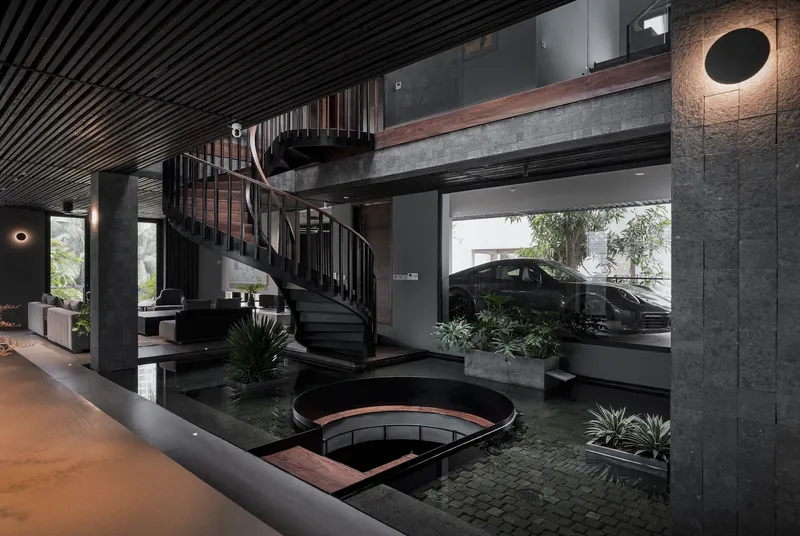
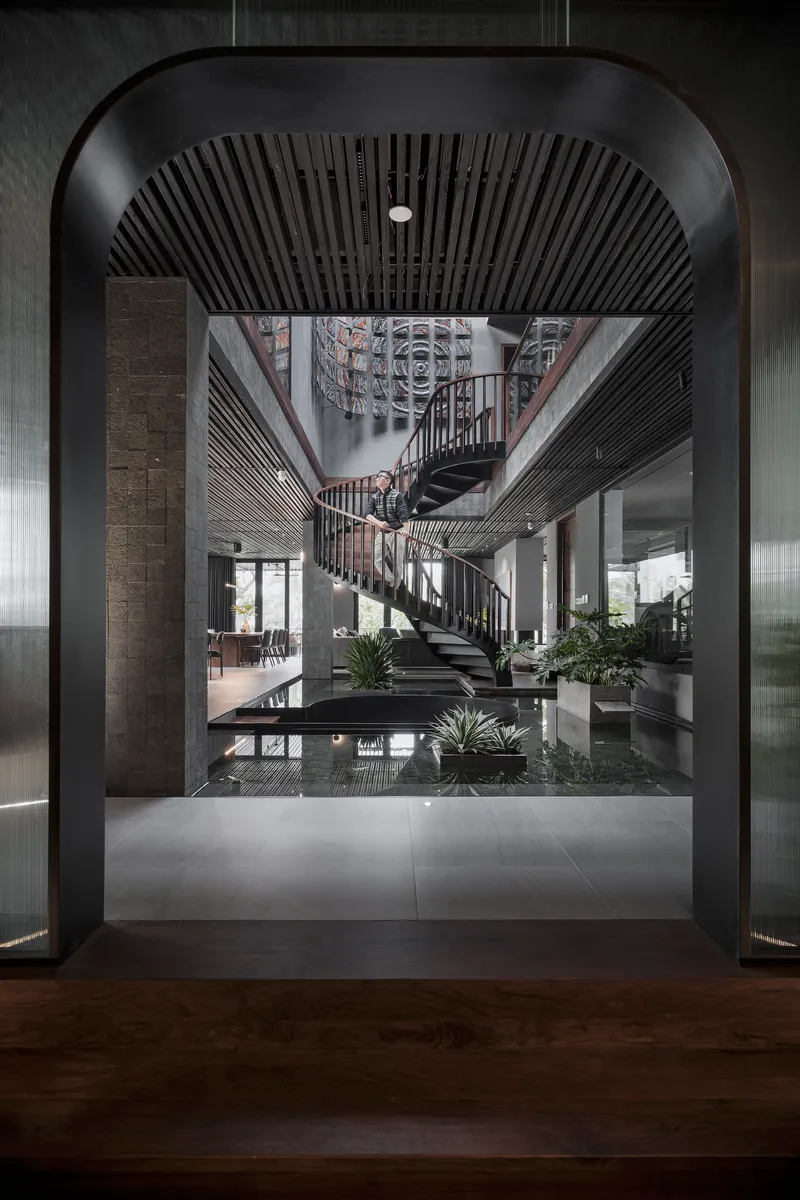
The heart of the house is a double-height void anchored by a black spiral staircase that rises above a shallow reflecting pool. Agave and ornamental grasses grow from the water's edge, introducing a controlled wildness into a space defined by precise dark steel and slatted ceilings. The effect is part courtyard, part gallery rotunda. Light enters from above and bounces off the water, animating walls and undersides of the stair treads with slow, shifting reflections.
Viewed through the arched threshold visible in the second image, the atrium reads almost as a stage set, framed by masonry walls that reference the Indochine architectural tradition of the region. The arch is not decorative nostalgia; it compresses the visual field and then releases it into the vertical volume beyond, a technique borrowed from traditional Vietnamese tube houses where sequential thresholds control the experience of depth. TOAM Studio uses this device sparingly, which is why it works: one arch, one pool, one stair, and a generous amount of air.
Indochine Without the Cliché
"Indochine" is a loaded word in Vietnamese residential design. It can easily slide into a pastiche of louvered shutters and terracotta tiles applied over concrete frames. TOAM Studio avoids that trap by abstracting the tradition into spatial relationships rather than ornamental motifs. The slatted black ceiling overhead recalls the timber rafters of colonial-era verandas, but here it is a contemporary screen that modulates light rather than a structural necessity. The natural materials and dark palette ground the house in a regionalism that feels lived-in rather than curated for Instagram.
The Indochine reference also shows up in the way the house mediates between interior and exterior. The reflecting pool inside the atrium mirrors the strategy of traditional courtyard houses that used water and planting to cool interiors and connect inhabitants to nature. In Ecopark's suburban context, surrounded by other villas and manicured landscapes, this inward-facing garden becomes a private ecosystem, a piece of nature that belongs exclusively to the family's narrative.
Program as Memory Palace
Beyond the atrium, the 640 square meters accommodate a library, a cinema room, a basement, and an elevator. These are not luxury amenities bolted onto a standard plan; they are rooms designed to anchor specific family rituals. The library stores books the children grew up with. The cinema room is where they gathered. The elevator anticipates the mother aging in place. Every programmatic decision carries a temporal dimension, planning for the house to serve across generations.
The spiral stair deserves its own mention. In a house with an elevator, a prominent staircase is a choice, not a requirement. Its sculptural presence in the atrium makes descending from the upper floors an event rather than a transition. For children returning from overseas, walking down that stair into the light-filled void with water below could function as a kind of secular homecoming ritual. The architects understood that a house meant to store stories needs spaces that generate them.
Why This Project Matters
TI60 pushes back against a trend in Vietnamese residential architecture where size and finish level are the primary measures of quality. Here, TOAM Studio argues that atmosphere and narrative coherence matter more than marble countertops or triple-height foyers. The house is generous but not ostentatious. Its most expensive gesture is empty space: the void, the water, the air above the stair. That restraint is harder to achieve than it looks in a market where clients often equate value with visible material.
For a mother whose children are scattered across the world, the house becomes an anchor point, a place that remains constant while the people who inhabit it change. TOAM Studio gave her not a showpiece but a resonant container, one where the Indochine past and the contemporary present coexist without friction, and where every return home passes through an arched threshold into a room full of light and memory.
TI60 - Ecopark Residence by TOAM Studio, led by Nguyen Xuan Tung with Thai Nguyen and Quyen Bui. Located in Ecopark, Xuân Quan, Vietnam. 640 m². Completed 2022. Photography by Abluebird Studio.
About the Studio
Share Your Own Work on uni.xyz
If projects like this are the kind of work you want to make, uni.xyz is a place to publish your own, find collaborators, and enter design competitions.


Popular Articles
Popular articles from the community


Faces of the Soviet Avant-Garde: Turning Moscow's Street Names into an Open-Air Museum
A network of sculptural installations across a Moscow residential district transforms forgotten architect names into spatial encounters with cultural memor

Cloaked Colonization: A Mobile Underwater Habitat That Moves Like a Fish
Micah Abaya's shortlisted EHC Pacific entry reimagines ocean settlement as a dispersed network of self-sustaining architectural organisms.

Temporary Home for Dogs: A Reversed Zoo Rethinks Animal Shelter Architecture
In Bucharest, a sinuous corridor and freed landscape flip the logic of containment, designing a shelter that works to make itself unnecessary.

Manzana Morphosis: Stretching Barcelona's Grid into a Living Landscape for 2050
A radical reworking of the Eixample manzana turns density into a tool for generous public space, vertical ecology, and environmental performance.

Similar Reads
You might also enjoy these articles

Pixel Gardens: One Repeated Module Stacked Into a Terraced Social Housing Tower for Famagusta
Salem Bader's shortlisted housing tower builds a vertical neighbourhood from one repeated module, offsetting units to carve terraces, light and air.

Bao Huynh Watercolor Atelier: A Serene Art Retreat in Hội An
Bao Huynh Watercolor Atelier in Hội An blends multifunctional art spaces, sustainable design, local materials, and family-friendly living in a serene environment.

Atelier Macri Concept Store Interior Design by CASE-REAL
Atelier Macri store features a "ko" counter, walnut wood details, cork displays, blending retail, gallery, and seamless customer experiences.

Manuel Vargas Izquierdo Stadium and High-Performance Sports Center: Architectural Excellence in Jalpa de Méndez
The Manuel Vargas Izquierdo Stadium blends sustainable design, inclusive sports facilities, and cultural-inspired architecture, revitalizing Jalpa de Méndez’s public spaces.

Explore Eco Building Competitions
Discover active competitions in this discipline

Challenge to design mud housing for contemporary communities

Challenge to reimagine the Iron Throne

Photograph architecture without architects

Illustrate the lost glory of Angkor Wat - Render Challenge
Comments (0)
Please login or sign up to add comments
No comments yet. Be the first to comment!