

ToBEE
Nature Flow

According to studies, approximately 90% of the plant species on Earth reproduce by pollination, and bees owe a major role in this process. They are the most important pollinators of animal origin and contribute up to 1/3 of world food production.
Human intervention leads to a change in the natural cycles of ecosystems. This threatens biodiversity, and hence our existence. Awareness of the impact of the loss of bees on humanity should change our approach towards them and towards nature in general.
The current project for the Beekeeping Center aims to design a research and production complex where problems with bee populations are solved. The main task is to promote the importance of bees and at the same time specialists to search for and find the reasons for the disappearance of bees and the possibilities for their timely rescue.
The building is situated in an out-of-town environment in a suburban park near Biltmore Estate, Asheville, North Carolina. The access to to the building is through the inner alley network of the park.
The building follows the natural contours of the eastern slope of the property in which it is located. The chosen method for compliance with the environment and emphasizing the natural resources is a prerequisite for the decision of the masterplan of the property. The masterplan is conditionally separated by the building in two parts - an eastern yard near the entrance to the property intended for visitors, and a western yard in the upper part of the property, where is the natural bee enclosure, accessible only by the staff. From bird's eye view the western yard flows organically into the green roofs of the building, where apiaries are organized. Thus, the building appears as a natural divider between the human and natural world.
The distorted E-shaped planning scheme that follows the terrain is conditioned by the search for the best possible natural sunlight of the premises, optimal functionality of the distributions and the communication connections.
The building is designed in two main volumes with a similar scale. The southern volume, where the main entrance to the building is located, houses the publicly accessible functions, and in the northern one is the production block.
The building is loaded through an enclosed space located in the basement, which is accessible via a ramp south of the building. The basement also houses a some parking lots.
There are 6 main functional zones in the project:
- Visitor center, consisting of an exhibition hall, market and shops, restaurant for 80 people and workshops for promoting community bee-keeping, which is located in the southern volume, in visual with the park environment.
- Research facility, developed as laboratory units for the creation of innovative methods and products related to the conservation of bee species, located on the last third level of the northern production volume.
- Development cell located on the second level, housing a rehabilitation center for bees and spaces for testing innovative methods and products developed at the research center as well as laboratories and study areas.
- Production area, including the necessary premises and spaces for extraction and export of honey, beeswax, royal jelly, pollen and other by-products, as well as products developed in the beekeeping center. The production is located on the first level. Two sanitary and hygienic units are provided to the production unit, as well as a dining room.
- The apiary is situated on the rooftops of the building, right next to the natural bee enclosure.
- The administrative unit of the building is located on the second level in the southern volume and is accessible through the visitor center.
The individual functional units are vertically separated, being interconnected by two stairwells with adjacent passenger elevators, as well as a freight elevator in the production unit.
The building is designed on four levels: basement (Level -3.30m), ground floor (Level ± 0.00m), first floor (Level + 5.30m), second floor (Level +9.30m), and the structural heights are in accordance with the technological requirements of the placed functional units.
The facades are formed by a microtopping coating, which has a cement finish. Through their volumetric solution and finish, the aim is to achieve monumentality, emphasizing the importance of the building. The other main component of the composition of the facades are the organic forms of the parametrically generated curtain wall. It aims to lighten the overall silhouette of the building and integrate it within the environment. Functionally, the curtain walls create soft shadows in the interior suitable for the indoor activities.
Both in the exterior and in the interior the forms are simple, devoid of unnecessary ornamentation.

Popular Articles
Popular articles from the community


The Musturak Paradise: Senior Living Architecture for a Connected Future in Temara, Morocco
The Musturak Paradise reimagines senior living architecture in Temara via private homes, social spaces, culture, community, and shared care.

Conexión: Biophilic Design Reimagines High-Rise Living in Hong Kong
Conexión reimagines high-rise living in Hong Kong through biophilic design, green facades, shared spaces, daylight, water and nature within.

ALGAL REALM: A Bio-Integrated Lunar Habitat Design for Life Beyond Earth
ALGAL REALM reimagines lunar habitat design with algae-powered life support, 3D-printed regolith, and vertical living for a lunar future.

Lunar Spiral: Space Architecture Shaped by the Mathematics of the Universe
Lunar Spiral reimagines space architecture through Fibonacci geometry, lunar regolith, levitating habitats, and self-sustaining Moon living.

Similar Reads
You might also enjoy these articles
The Rhythm of Seasons
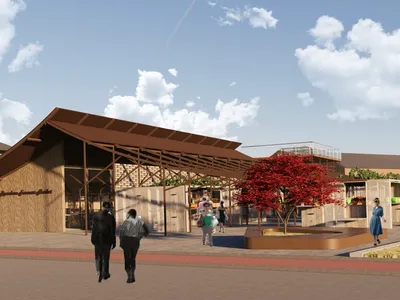
A Farmers' Market Connecting Nature and the City

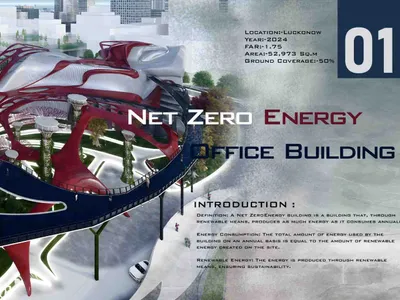
More Than a Building-Designing a Living System
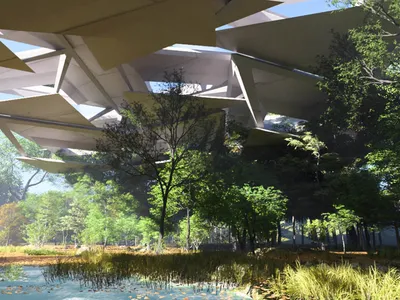
More Than a Building-Designing a Living System
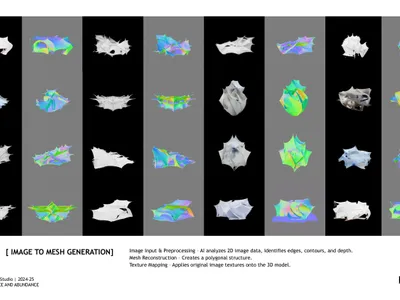
Base Beyond
DESERT COMPOUND ARID: TOURISM OF ABSENCE AND ABUNDANCE

Explore Industrial Building Competitions
Discover active competitions in this discipline


Challenge to reimagine the Iron Throne

Photograph architecture without architects

Illustrate the lost glory of Angkor Wat - Render Challenge

Design challenge to reuse E-waste
Comments (0)
Please login or sign up to add comments
No comments yet. Be the first to comment!