
Tomohiro Hata Stacks a Spiral Stairhouse into Kobe's Steep Kitano Hillside
A 116-square-meter house in Kobe, Japan, wraps four split levels around a central spiral stair that funnels light from roof to ground.


Kobe's Kitano district climbs the lower slopes of the Rokko mountain range in tight, steep blocks where houses stack shoulder to shoulder and every meter of elevation opens a new slice of harbor view. It is exactly the kind of site that punishes generic floor plans and rewards architects willing to think vertically. Tomohiro Hata Architect and Associates responded with a house that treats its four levels not as repeated floors but as a continuous spiral sequence: a 116-square-meter residence organized around a single steel helix that doubles as structural spine, light shaft, and circulation.
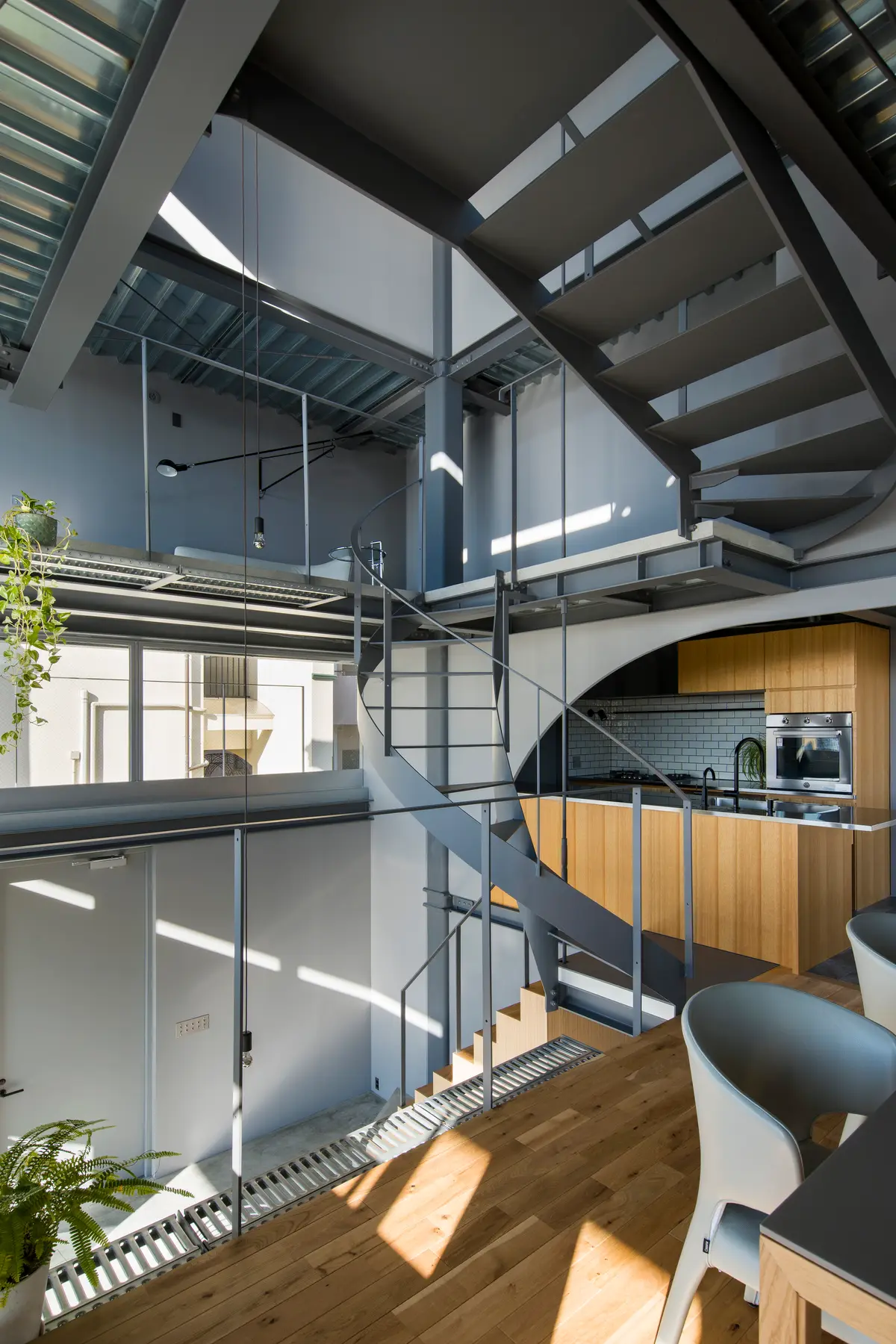
What makes this project genuinely compelling is the refusal to separate the staircase from the rooms it serves. The spiral is not tucked into a core or hidden behind a wall. It occupies the center of the plan and pulls daylight down through a slatted roof structure, so every level receives light filtered through the levels above. The result is a house where you are always aware of the whole section at once, where a meal at the dining table includes a peripheral view up through steel catwalks to the sky and down to the entry below. Vertical living here is not a compromise forced by the slope; it is the entire architectural proposition.
Concrete Volumes on a Hillside
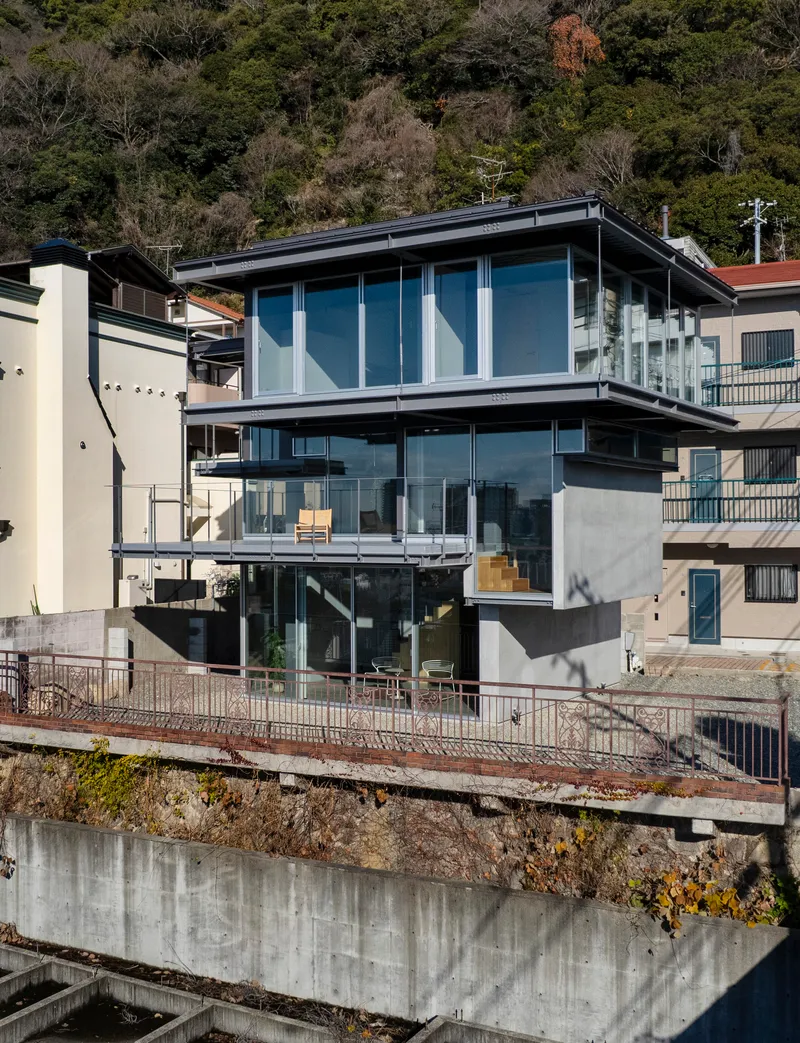
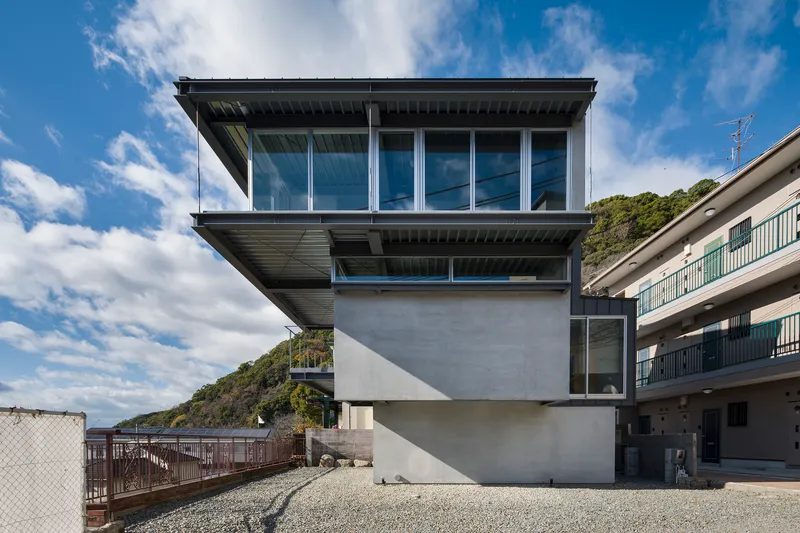
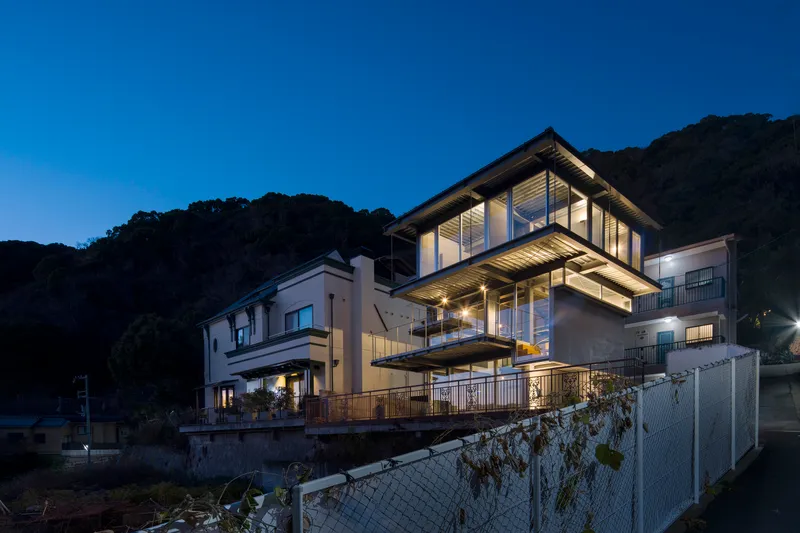
From the street, the house reads as a stack of concrete volumes, each slightly offset to follow the slope and to create cantilevered overhangs that shade the glass below. The massing is direct and unapologetic: raw concrete, large glazed openings, a gravel courtyard carved out at the base. There is no decorative facade game. The interest comes from how the volumes shift, creating terraces at each setback and letting the house step up the hillside rather than cut into it.
At dusk the steel-framed upper volume glows against the forested ridge behind, announcing its structural logic through the glazing. The house does not try to blend into the neighborhood of tiled roofs and rendered walls; it participates in the density while asserting a different tectonic language. The retaining wall at the base grounds the whole composition, acknowledging that in Kitano, architecture begins with managing gravity.
The Spiral as Spatial Engine
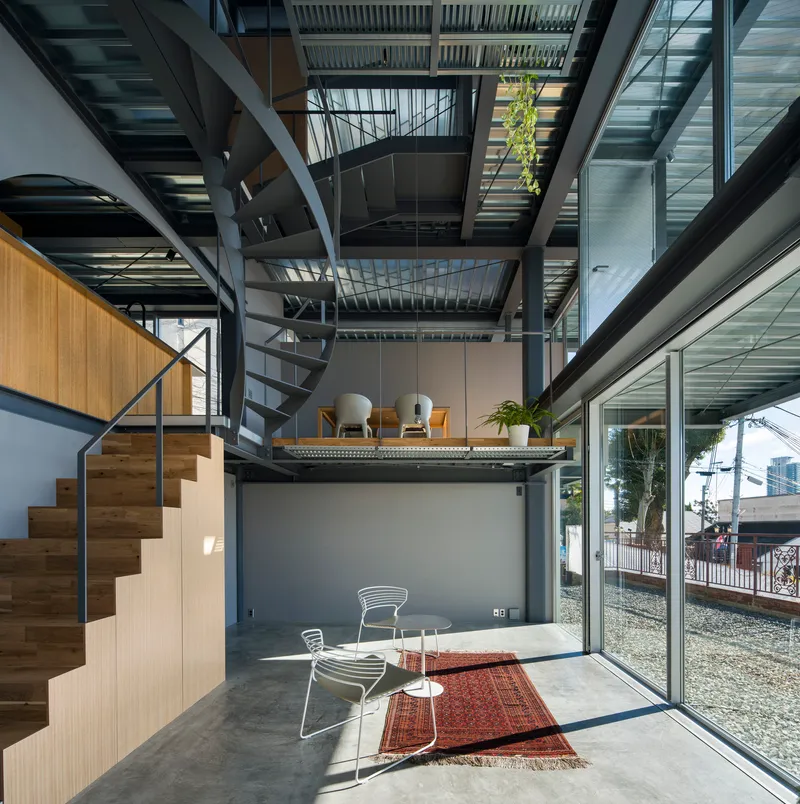
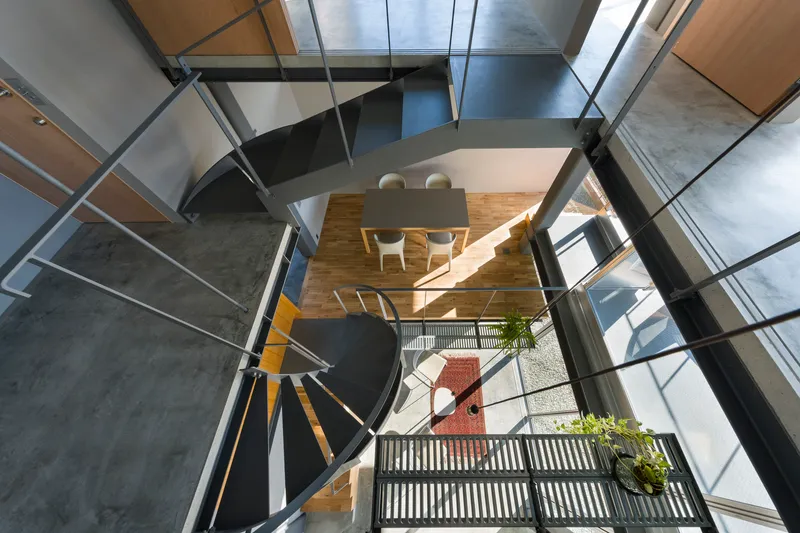
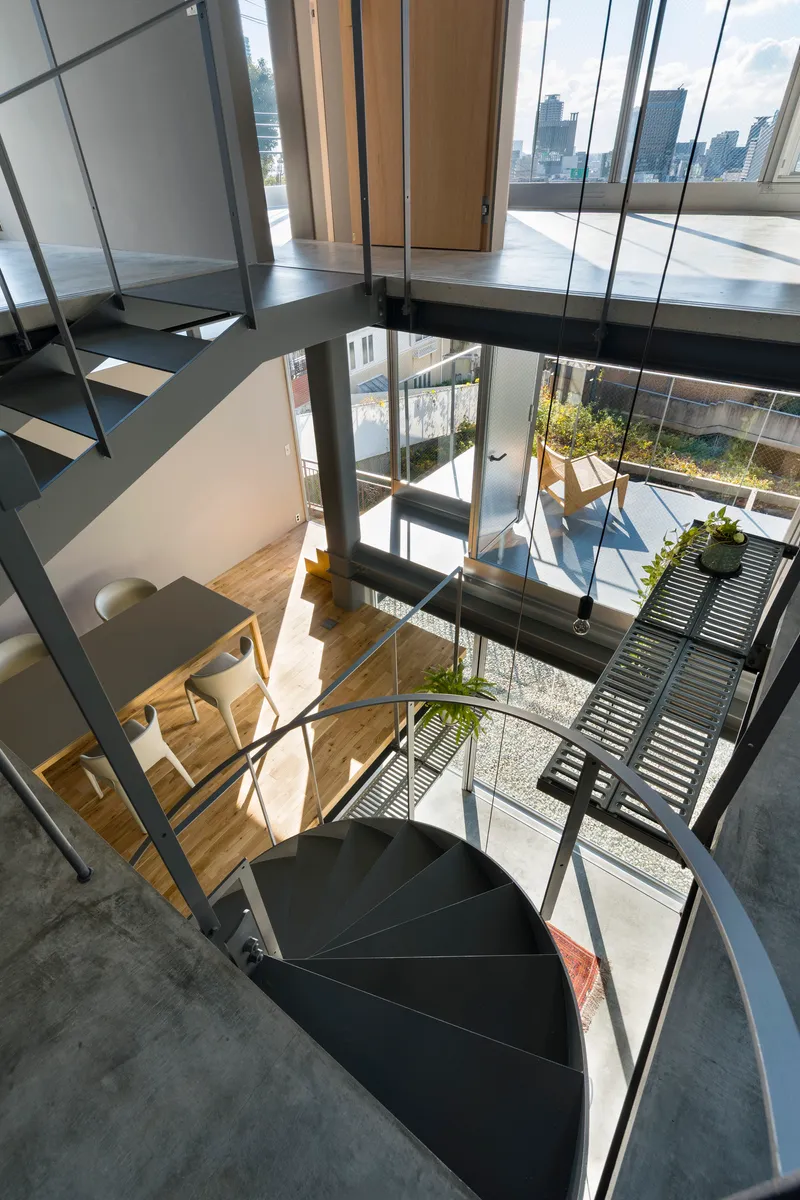
The steel spiral staircase is not just a means of moving between floors. It is the organizational logic of the entire house. Looking straight down through the stairwell reveals all four levels at once: the ground-floor entry with its glazed walls, the dining level with timber cabinetry, and the upper living platforms connected by steel catwalks. The aperture created by the stair's rotation becomes a triple-height void that behaves like an internal courtyard, pulling ventilation and daylight through the section.
Hata has calibrated the stair's diameter so that it occupies enough plan area to register as a room in itself, not merely a piece of furniture. Each landing is a moment of pause, a threshold between one domestic zone and the next. The effect is closer to navigating a series of mezzanines than climbing a conventional staircase, and it gives this small house a spatial generosity that its 116 square meters would not otherwise suggest.
Light Filtered Through Structure
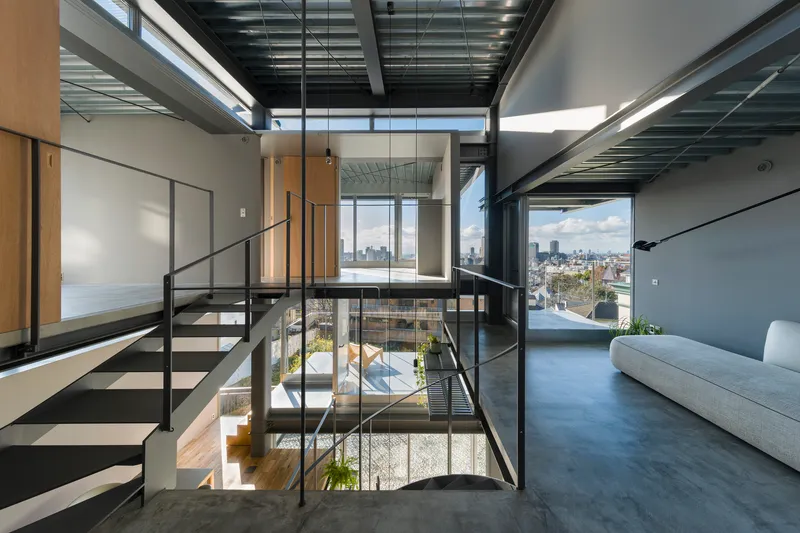
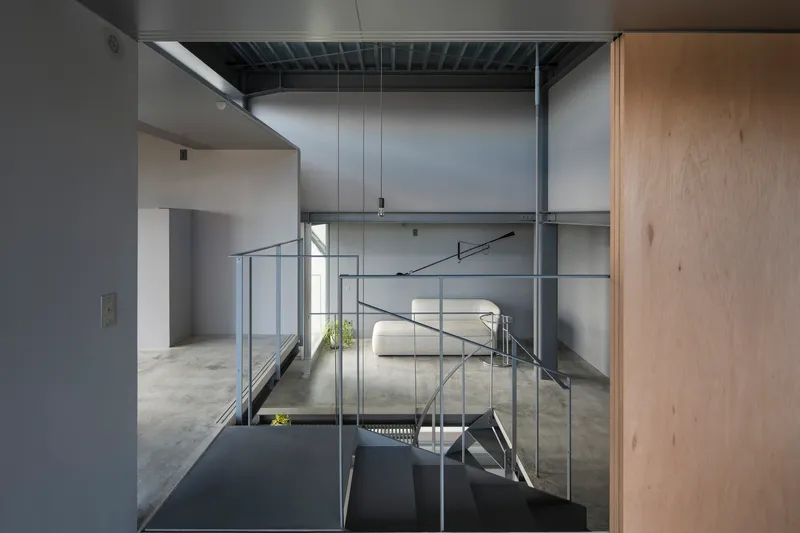
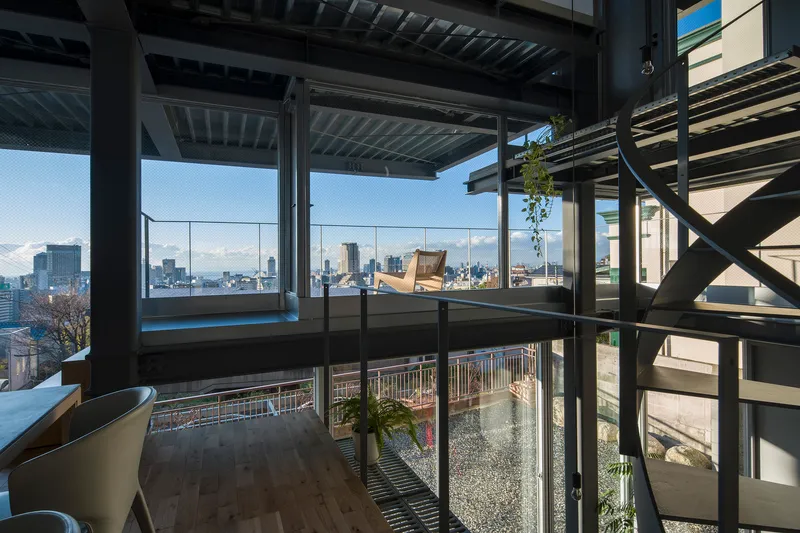
The slatted ceiling at the top of the house acts as a gridded skylight, breaking direct sun into bands that travel across the steel mesh railings and concrete walls as the day progresses. It is a carefully tuned move: enough light to illuminate the deepest floor, enough filtration to prevent the glass box from overheating. The mesh railings on the catwalks participate in this game, adding a second layer of shadow pattern that shifts with every half-level.
On the upper floors, diffused daylight arrives from both the overhead grid and the large facade glazing, so that the exposed steel ceiling joists cast long parallel shadows across the rooms. The combination of top light and side light means that no corner of the house is dark, and the structural members, far from being concealed, become the instruments through which light is modulated. There is an honest pleasure in seeing the steel do double duty: holding the house up and shaping the atmosphere inside it.
Living Between Interior and Terrace
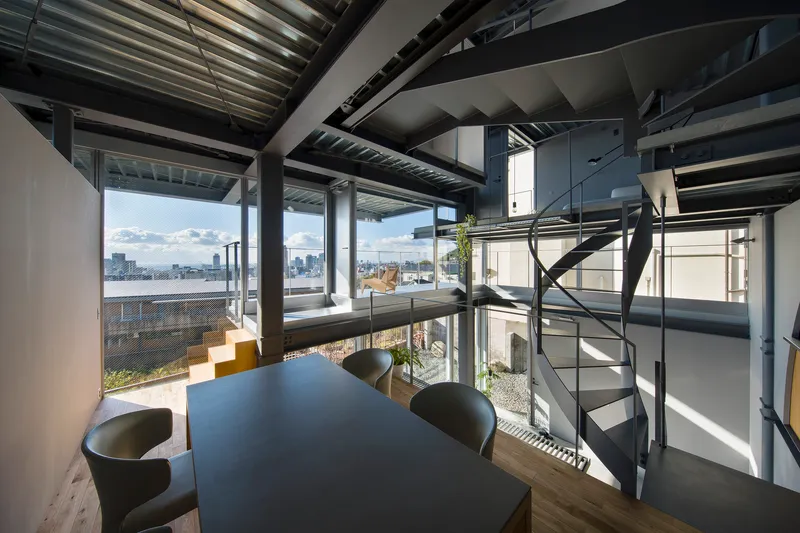
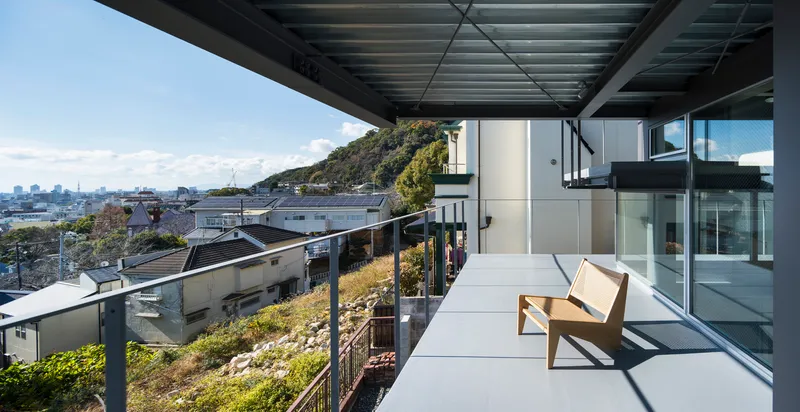

Each setback in the massing produces a terrace, and Hata uses these outdoor platforms to extend the living spaces laterally. The rooftop terrace, fitted with a steel canopy, a timber bench, and a planted green surface, functions as a fifth room with panoramic views over the hillside neighborhood. Below it, the dining level opens onto its own planted terrace, creating a layered relationship between inside and outside that compensates for the tight urban lot.
The aerial view at dusk reveals how the house's varied metal roof surfaces slot into a neighborhood of similarly scaled volumes. This is not a landed villa demanding space around itself; it is a vertical house that claims sky where it cannot claim ground. The terraces are the reward for accepting the slope, and their staggered arrangement means each one enjoys privacy from the one above. In a city defined by the gradient between mountain and sea, that layering feels entirely appropriate.
Kitchen, Cabinetry, and the Domestic Core
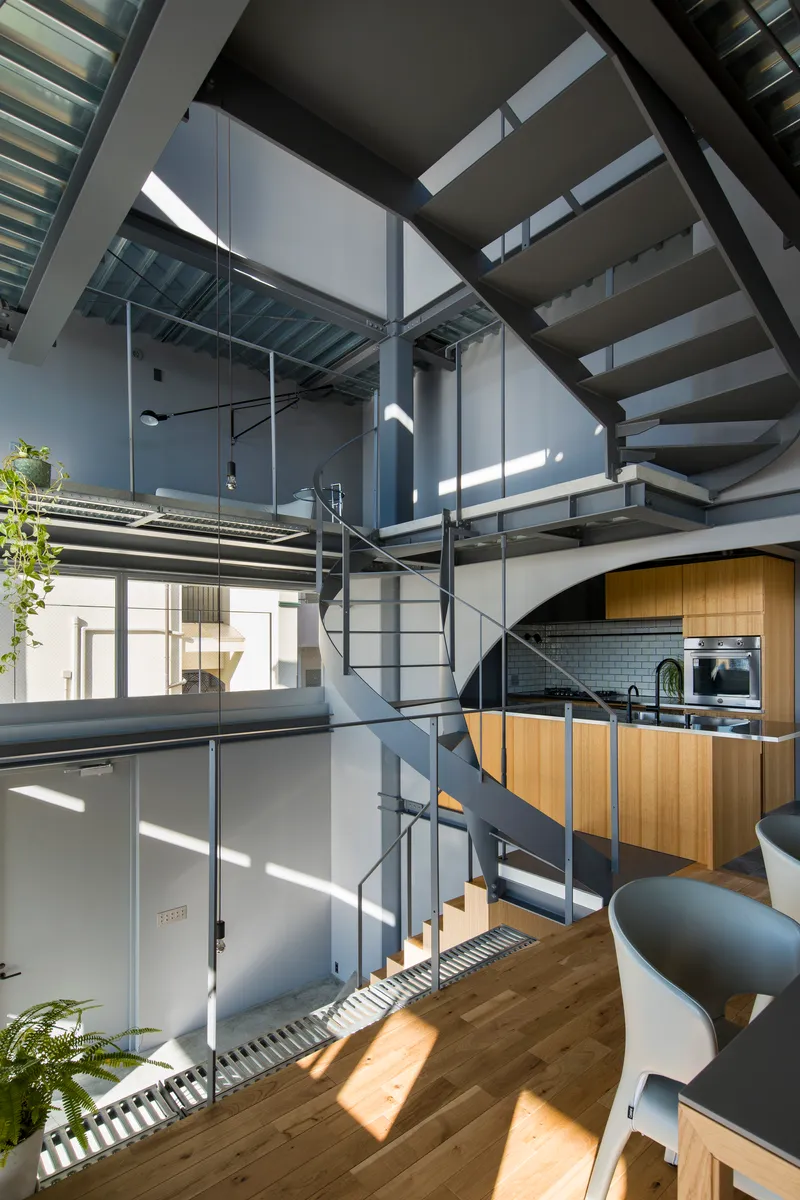
The kitchen and dining zone on the second level is where the house's two material systems meet: warm timber cabinetry wraps the cooking area while the exposed steel spiral rises immediately alongside it. The juxtaposition is deliberate. Hata lets the domestic program be soft and tactile at counter height, then shifts to industrial steel above, so that reaching for a pot and glancing up at the stairwell are experiences of fundamentally different materials.
Shafts of direct sunlight hit this level at midday, illuminating the timber grain and casting hard-edged shadows from the stair treads onto the dining surface. It is the most inhabited zone of the house, and the architect treats it as such: generous ceiling height, visual connection to the terrace through full-height glass, and the comforting presence of the stair as a kind of domestic hearth, always in motion, always pulling the eye upward.
Plans and Drawings
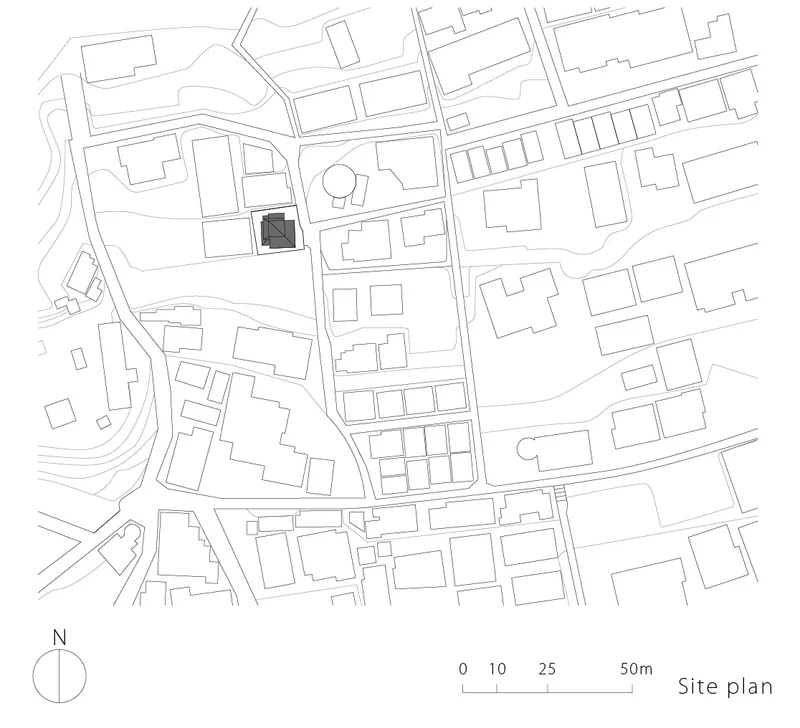
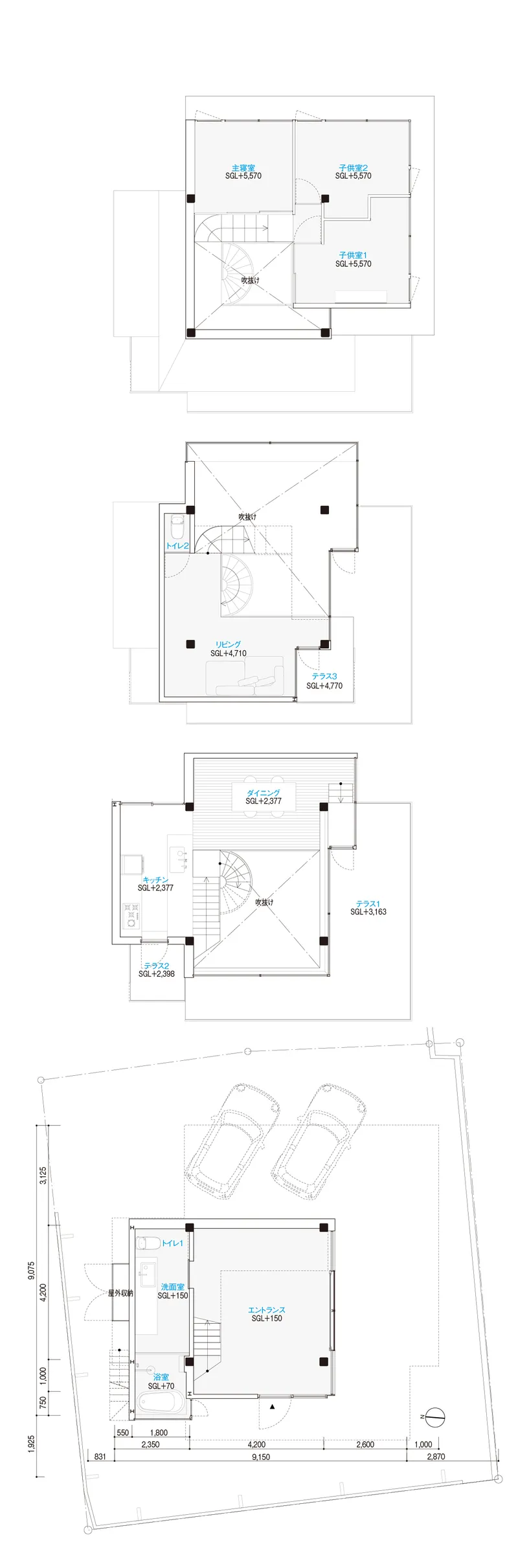
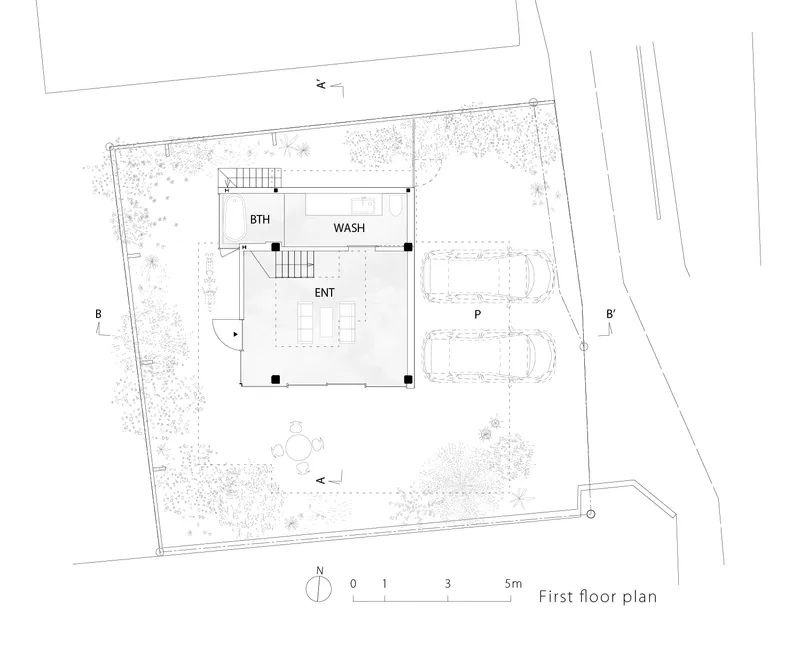
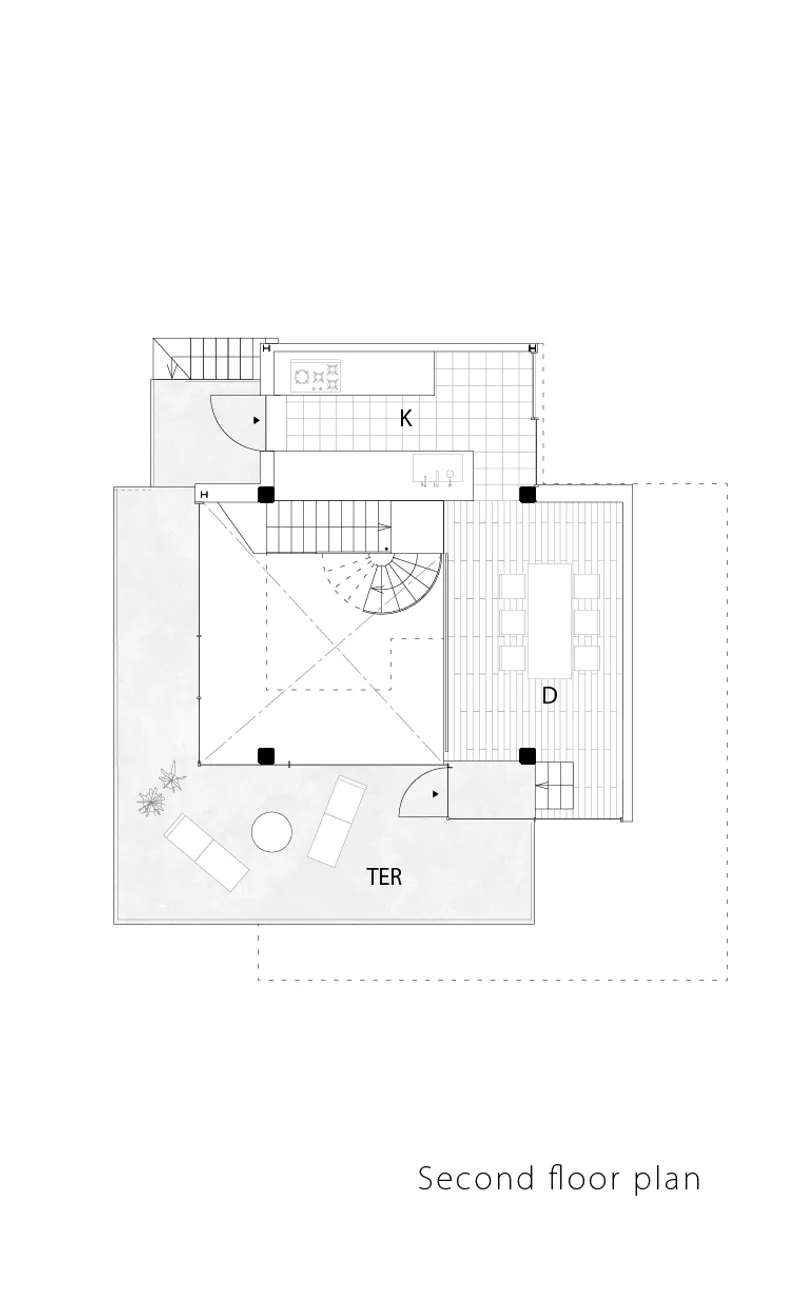
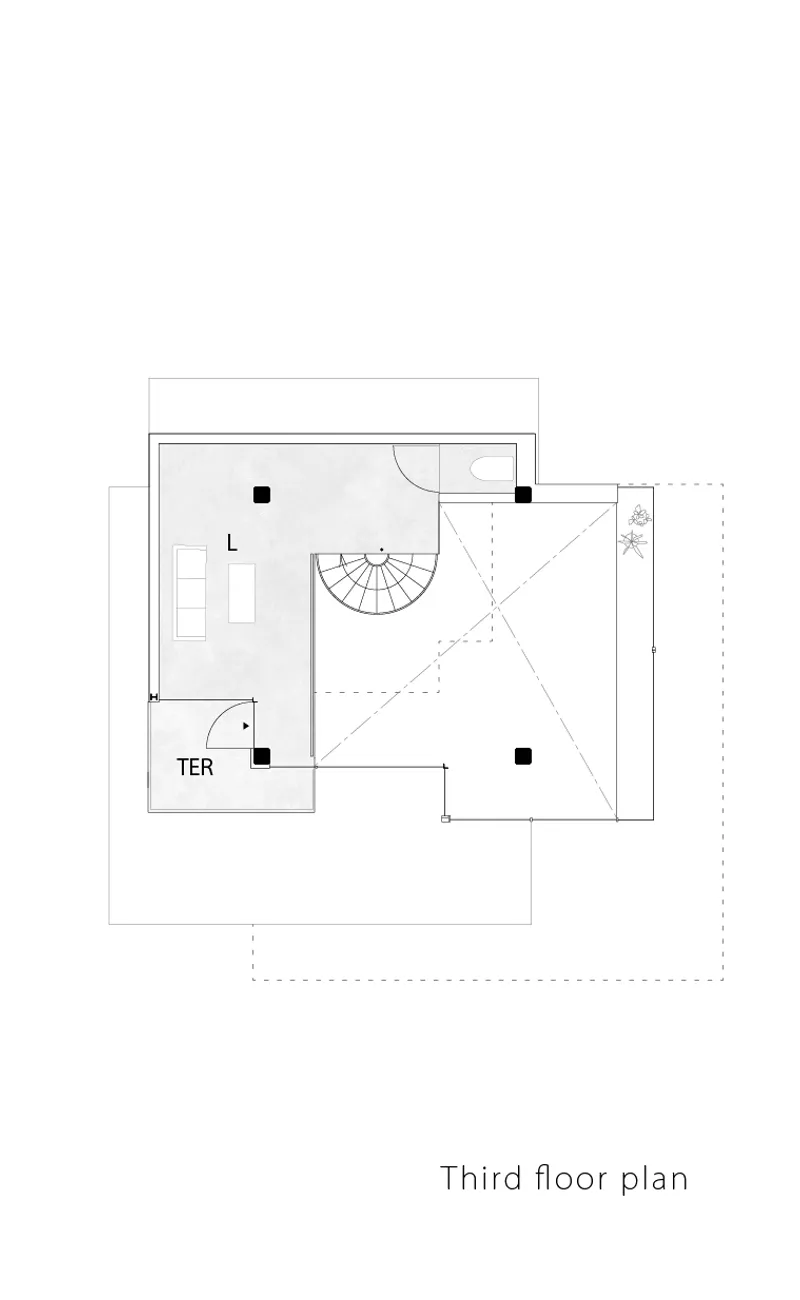
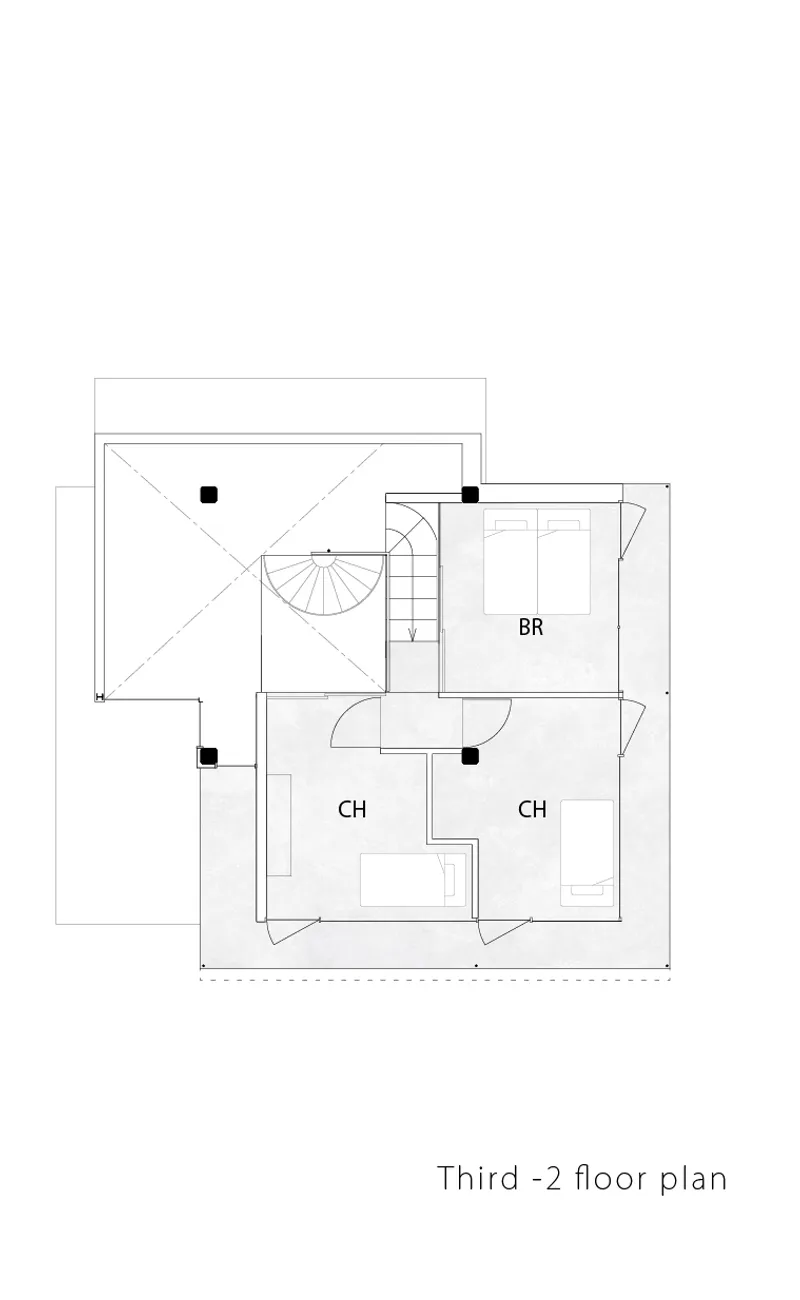
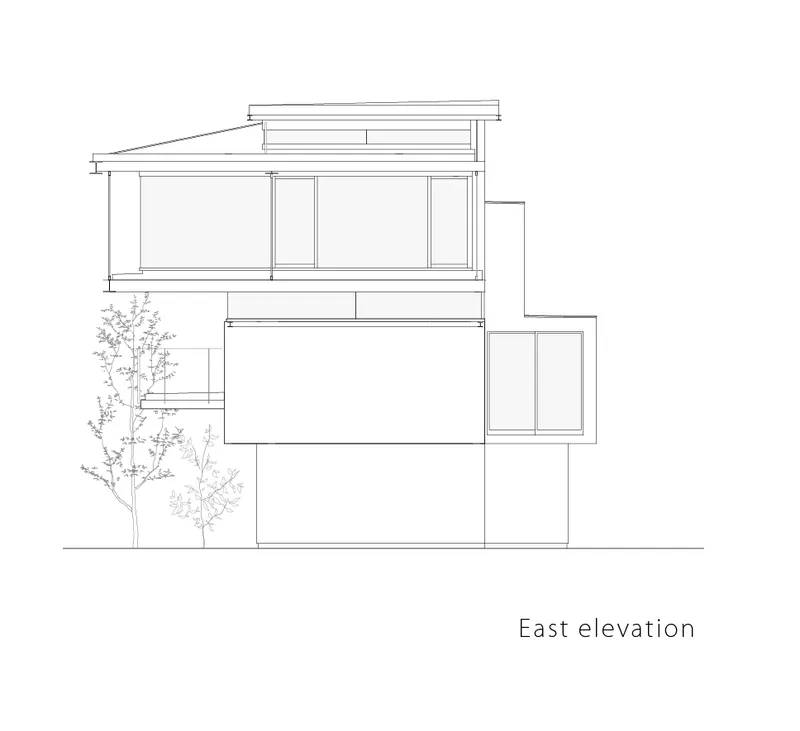
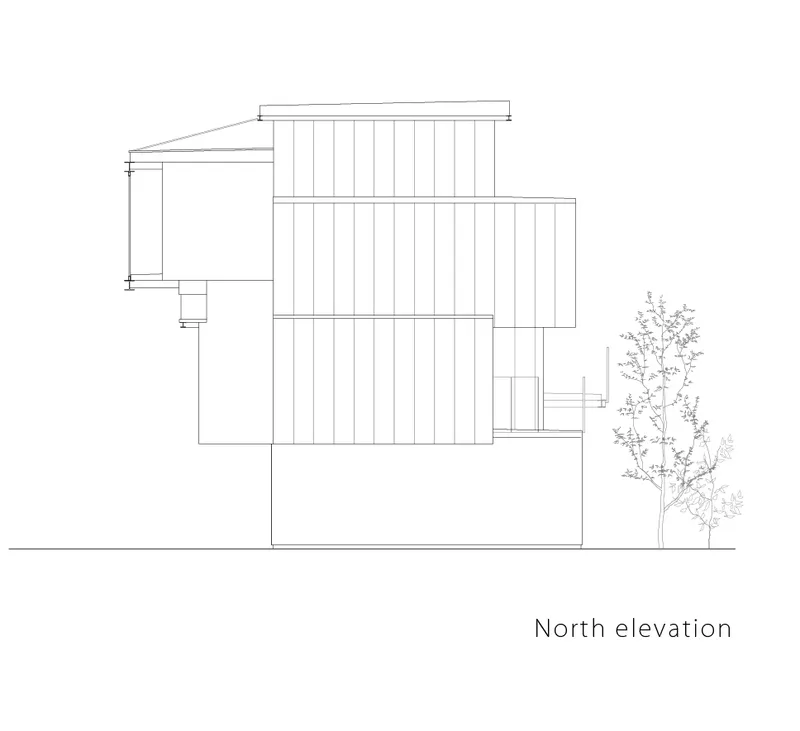
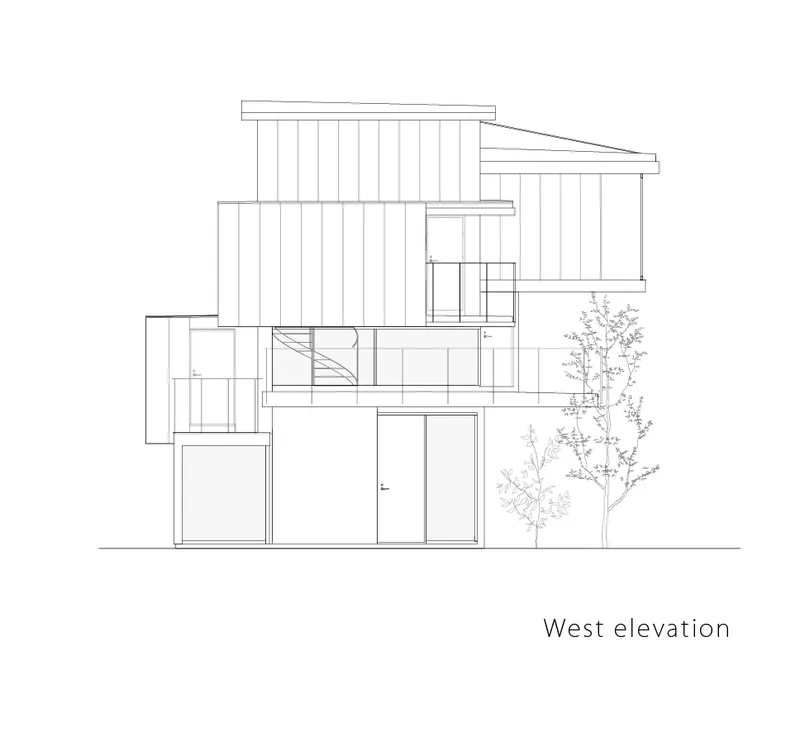
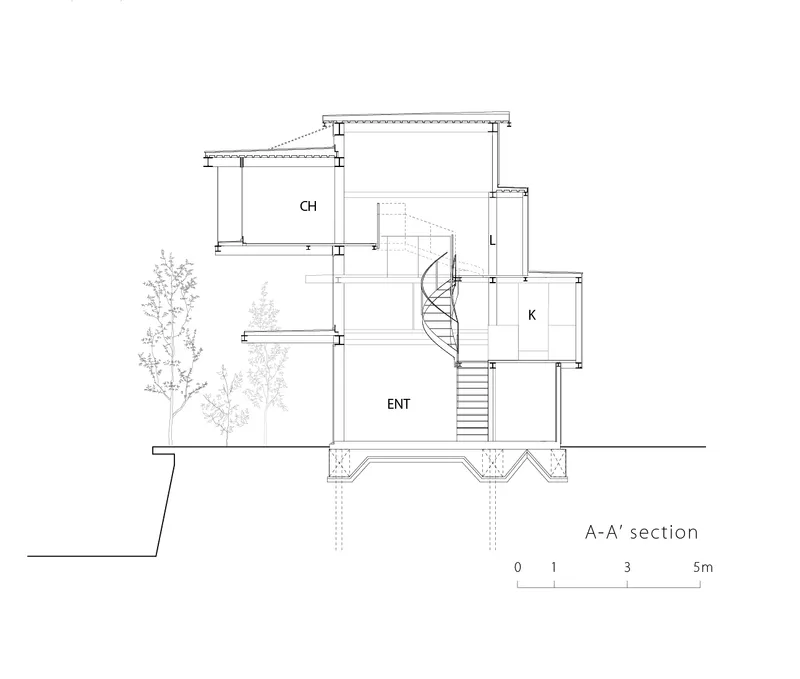
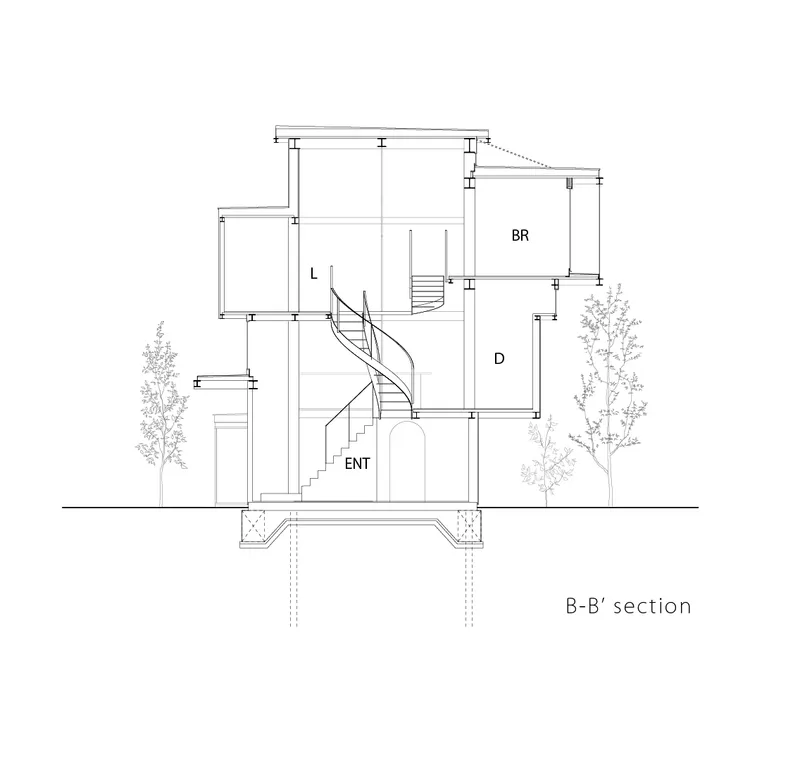
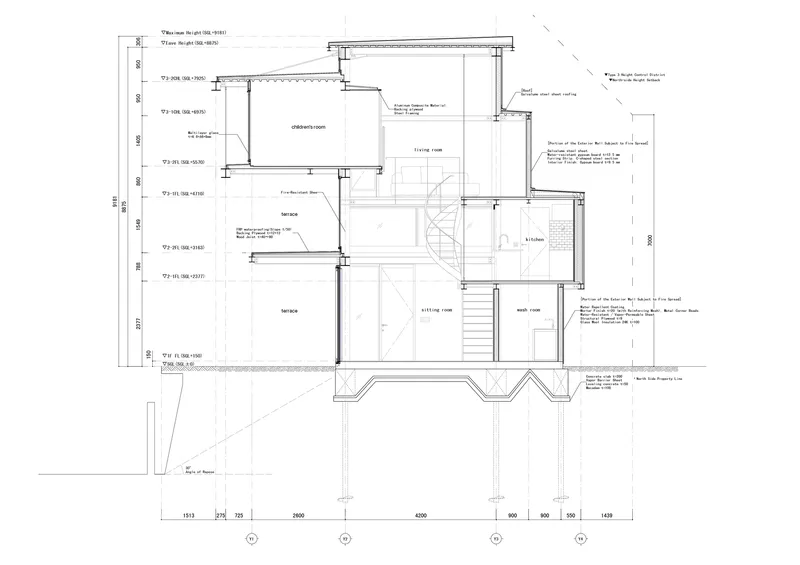
The site plan confirms just how tightly the house is packed into its urban block: surrounding structures press in on three sides, and the only real breathing room comes from the street frontage and the narrow gravel courtyard at the base. The four-level plan set reveals the spiral stair as the fixed element around which everything else rotates. Parking and entry sit at grade; kitchen and dining occupy the second level; the living room with its terrace takes the third; and bedrooms are arranged on the fourth, grouped around the staircase core.
The sections are the most revealing drawings. They show how the floor plates shift diagonally in relation to one another, creating half-level offsets that make the house feel taller than its actual height. The spiral stair is visible in every section cut, confirming its role as the single continuous element that stitches the whole building together. Foundation details and construction dimensions annotated in the final section suggest a conventional reinforced-concrete structure with steel framing at the upper levels, a hybrid approach that allows the cantilevered glazed volume at the top.
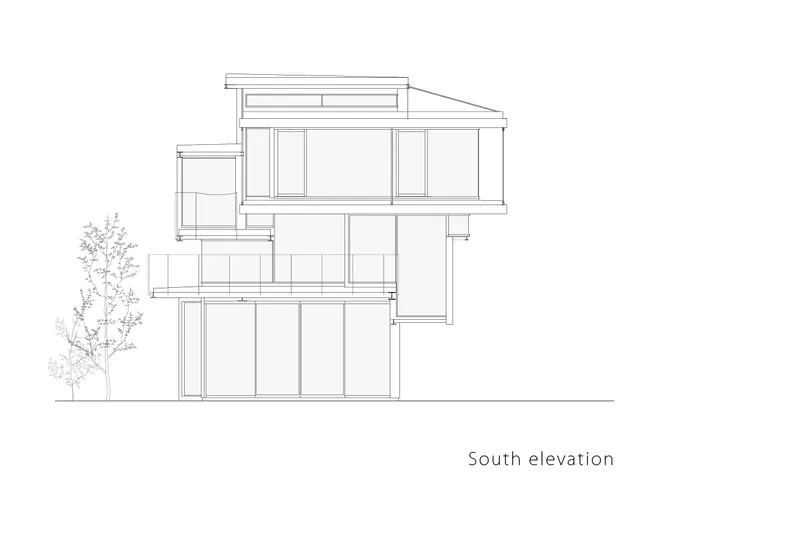
The four elevations document a house that looks different from every direction. The south facade is the most public, presenting horizontal window bands between concrete slabs. The east and west elevations reveal the offset floor plates and the spiral stair through large openings. The north elevation is the most closed, with vertical cladding and a sloped roof that negotiates the boundary with the hillside. Together, the drawings make clear that this is architecture shaped as much by the constraints of its neighbors as by the intentions of its designer.
Why This Project Matters
Small hillside houses are a staple of Japanese residential architecture, and the risk is always that they become formulaic: a concrete box, a dramatic cantilever, a view window. House in Kitano avoids that formula by making the circulation itself the primary spatial experience. The spiral stair is not a solution to a problem; it is the generative idea from which everything else follows: the light strategy, the sectional offsets, the relationship between levels, even the way the terraces cascade down the slope. That single commitment gives the house coherence without rigidity.
Tomohiro Hata demonstrates here that vertical living on a steep site does not have to mean a stack of disconnected rooms reached by a grudging staircase. It can mean a house where every level is visually and atmospherically connected, where light travels the full section, and where the act of moving through the building is itself a form of inhabitation. In 116 square meters, that is a significant achievement.
House in Kitano by Tomohiro Hata Architect and Associates, Kobe, Japan. 116 m², completed 2025. Photography by Toshiyuki Yano.
About the Studio
Share Your Own Work on uni.xyz
If projects like this are the kind of work you want to make, uni.xyz is a place to publish your own, find collaborators, and enter design competitions.


Popular Articles
Popular articles from the community


Opera on the Sea: Driftwood Logic Shapes a Timber Opera House on Estonia's Coast
Trevor Orgill's opera house translates the entangled drift of floating timber into a civic building where wood, water, and music converge.

Singing Woman: An Opera House That Performs Before the Curtain Rises
Ovidiu Cristian Pavel's conceptual opera house translates Estonia's choral identity into a sculpted waterfront landmark facing the Baltic Sea.

Extended Shell: Retrofitting Kolkata's Balconies as Living Urban Thresholds
A modular retrofit system recovers the social and environmental intelligence of Kolkata's historic verandas for contemporary Park Street residents.
Opera by the Sea Estonia: Three Shells Dissolving Architecture into Tallinn's Coastline
A winning opera house proposal replaces monumental form with interconnected shells that blur the boundary between building, park and Baltic Sea.

Similar Reads
You might also enjoy these articles

Pixel Gardens: One Repeated Module Stacked Into a Terraced Social Housing Tower for Famagusta
Salem Bader's shortlisted housing tower builds a vertical neighbourhood from one repeated module, offsetting units to carve terraces, light and air.

Bao Huynh Watercolor Atelier: A Serene Art Retreat in Hội An
Bao Huynh Watercolor Atelier in Hội An blends multifunctional art spaces, sustainable design, local materials, and family-friendly living in a serene environment.

Atelier Macri Concept Store Interior Design by CASE-REAL
Atelier Macri store features a "ko" counter, walnut wood details, cork displays, blending retail, gallery, and seamless customer experiences.

Manuel Vargas Izquierdo Stadium and High-Performance Sports Center: Architectural Excellence in Jalpa de Méndez
The Manuel Vargas Izquierdo Stadium blends sustainable design, inclusive sports facilities, and cultural-inspired architecture, revitalizing Jalpa de Méndez’s public spaces.

Comments (0)
Please login or sign up to add comments
No comments yet. Be the first to comment!