

HO Studio Carves a Multigenerational Tower from a Diagonal Sliver of Land in Vinh, Vietnam
Tram House turns a plot reshaped by urban expansion into a white sculptural tower threaded with skylights, voids, and hanging gardens.

When a city redraws its roads, the lots left behind can become architectural orphans or architectural opportunities. In Vinh, a mid-sized city in central Vietnam, HO Studio and lead architect Hồ Văn Cường chose the latter path. Their client's plot had been carved at a 40-degree angle by a new sidewalk alignment, leaving a wedge of land flanked by urban voids on three sides. The previous house, a low, enclosed single-story structure more than twenty years old, had little connection to the expansive views and breezes its location quietly offered. Tram House is the replacement: a 420-square-meter white tower that rises above its low-rise neighbors, captures cross-ventilation on every floor, and stacks living space for parents and two daughters without ever feeling stacked.
What makes Tram House genuinely interesting is how it converts constraint into spectacle. The diagonal site boundary, the narrow footprint, the need to shield the west face from heat while opening the east to light: each of these pressures produces a visible formal move. Chamfered corners, vertical light slots, stepped terraces heavy with planting, a five-meter-tall central void that pulls weather and daylight deep into the section. The result won Building of the Year at TADA 2025, and the award feels earned. Every decision reads as both pragmatic and precise.
A White Volume on a Reworked Street
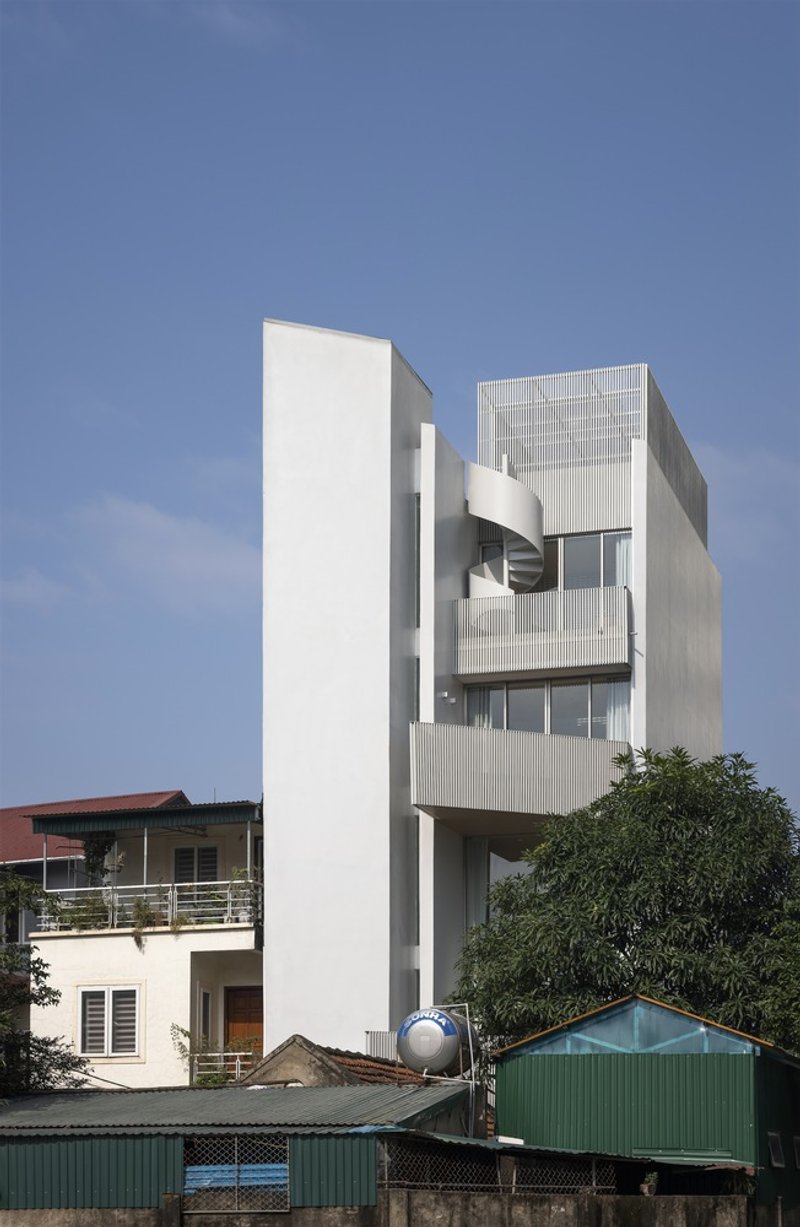
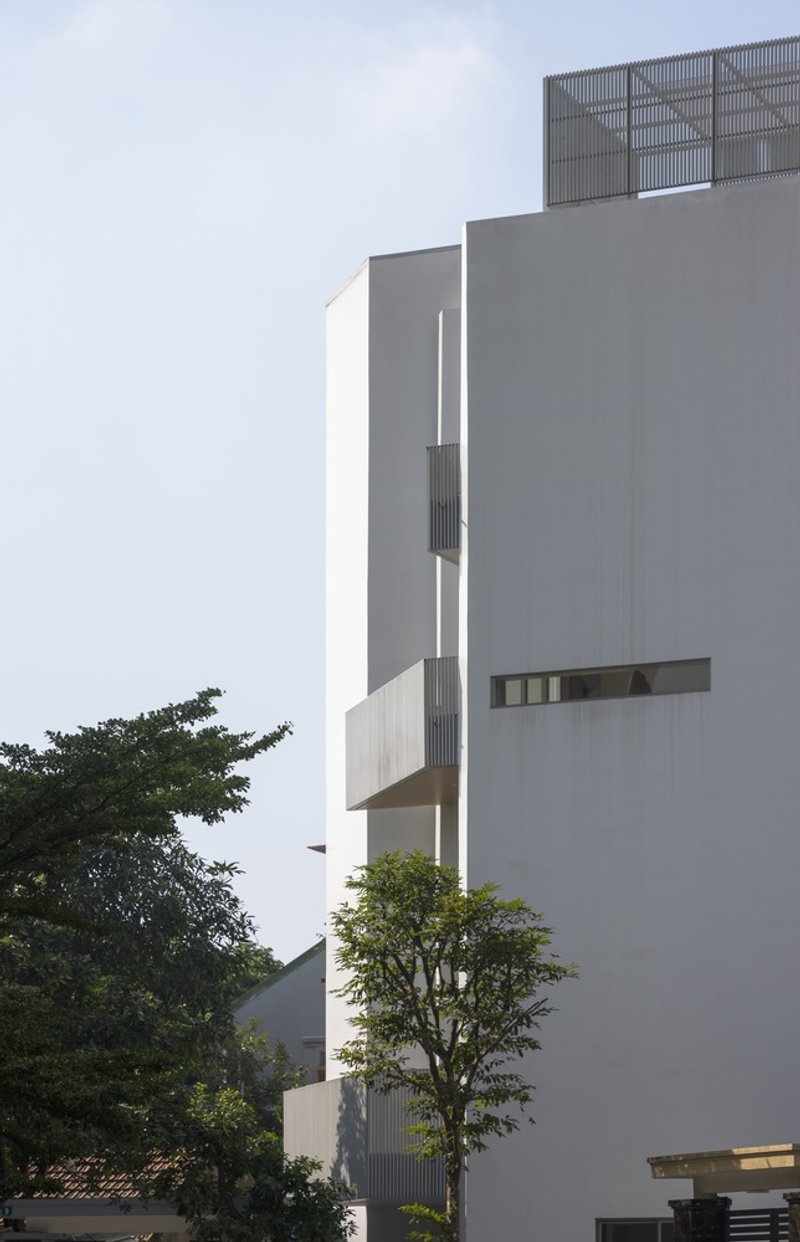
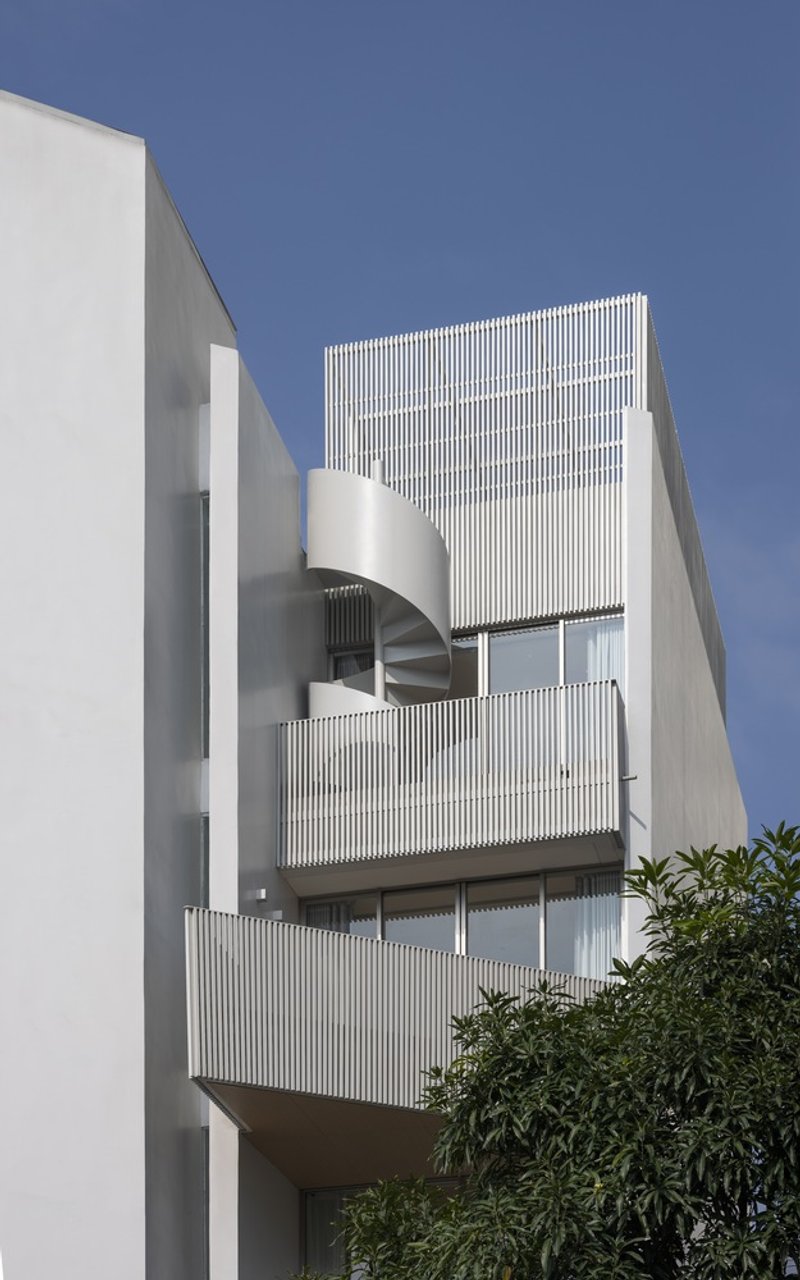
From the street, Tram House registers as a pale monolith standing a full head taller than its neighbors. The white stucco and corrugated metal cladding read cleanly against the haze of Vinh's sky, but the facade is not a blank wall. Vertical metal louvers modulate light and privacy at different levels, while a curved staircase enclosure on one flank introduces a softer geometry that breaks the orthogonal grid. A narrow vertical light slot on the side elevation works almost like a seam, hinting at the interior voids behind the surface.
The ground floor is given over to commercial use, a common arrangement in Vietnamese urban houses that keeps the family economy and the family life layered vertically. Above, four residential floors rise in a compact footprint, with all circulation, the elevator, stairs, and corridors pushed to the western wall. That wall acts as a thermal buffer, absorbing afternoon heat before it can reach the living spaces beyond.
The Double-Height Heart
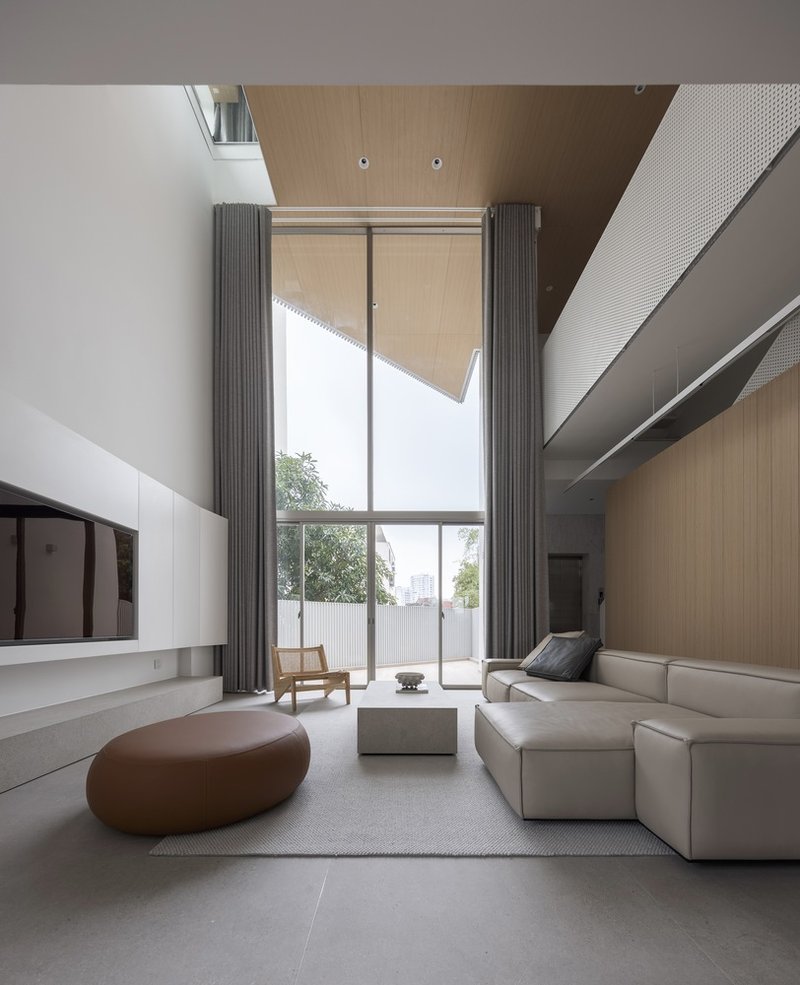
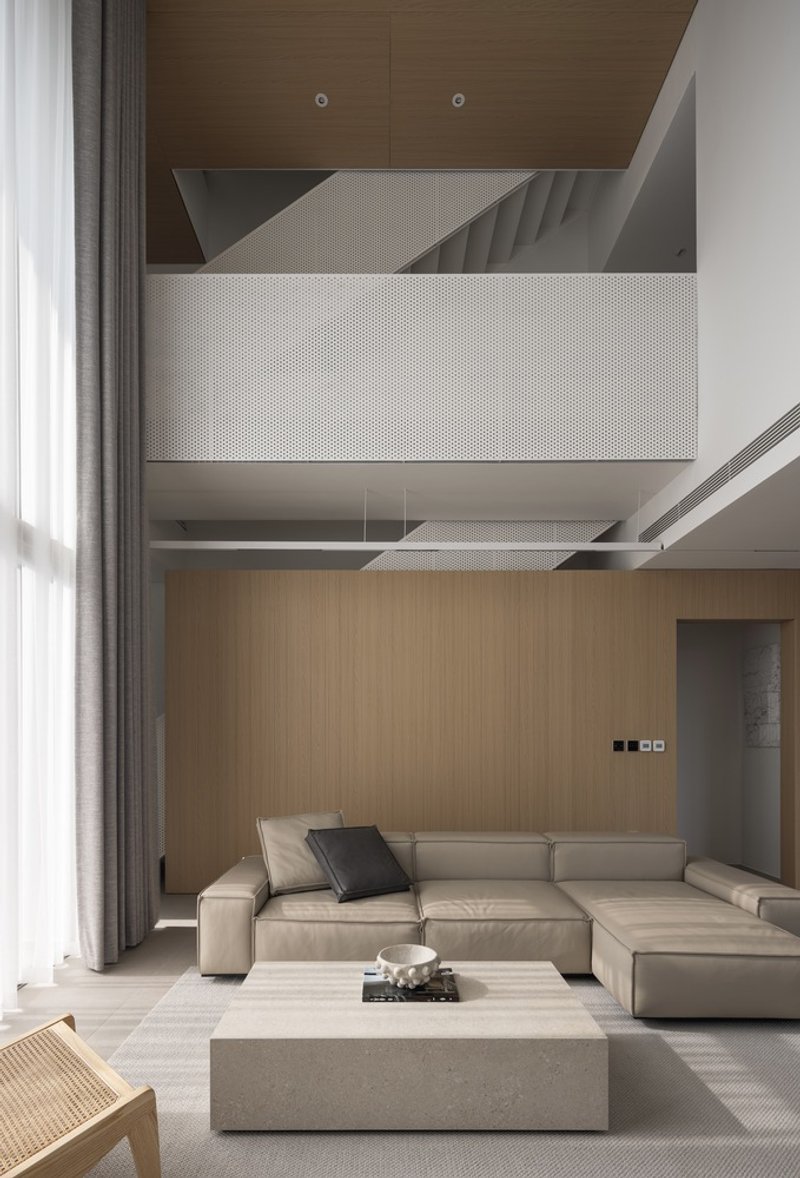
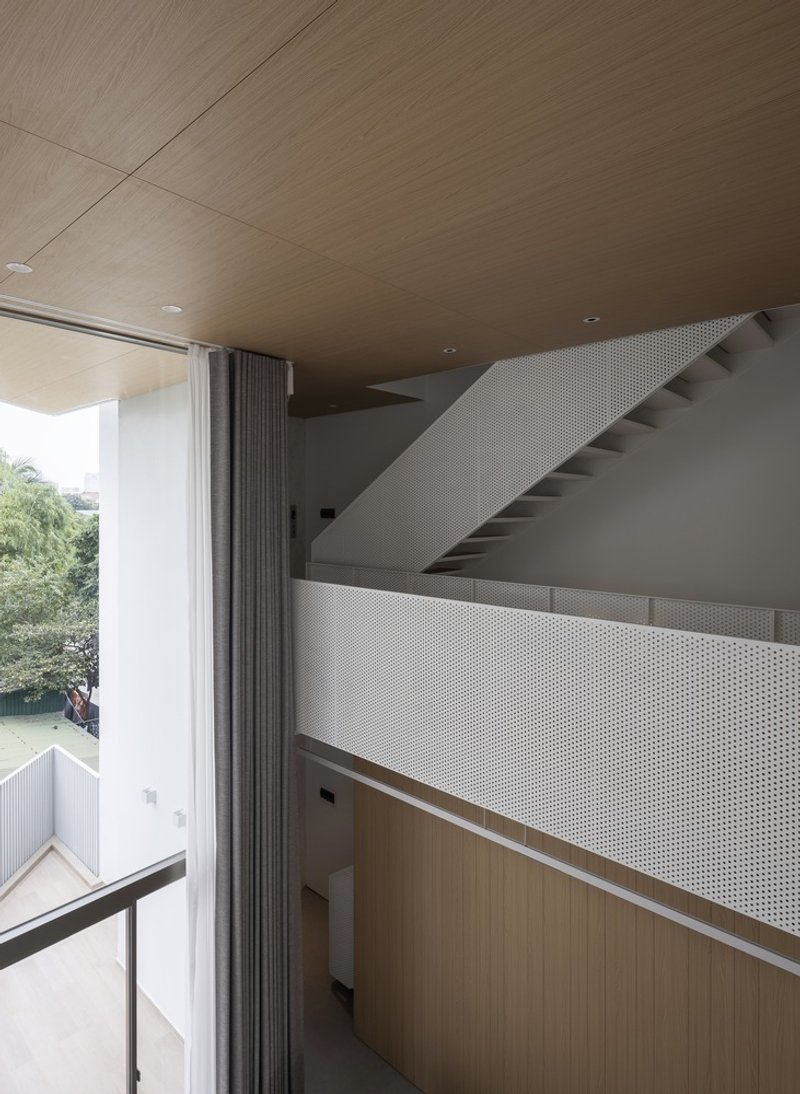
The second floor is where Tram House opens up. A central void stretches over five meters high, connecting the main living level to the floor above and pulling daylight in through skylights and tall glazed openings. The effect is immediate: you walk in from a narrow stair and the space simply exhales. Morning light rakes across angled ceiling planes and throws long shadows onto timber wall panels, creating a visual register of passing time that no artificial fixture can replicate.
Perforated metal balustrades line the mezzanine edge above, filtering views between floors rather than sealing them off. It is a smart choice for a multigenerational household. Family members on different levels remain in acoustic and visual contact without sacrificing the privacy of their own rooms. The void also functions as a thermal chimney, drawing warm air upward and out, a passive cooling strategy well suited to Vinh's hot, humid climate.
Timber, Light, and Open Plans
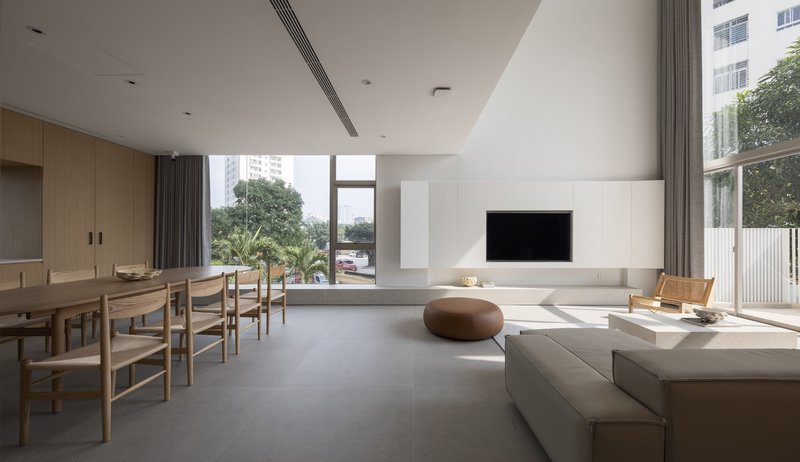
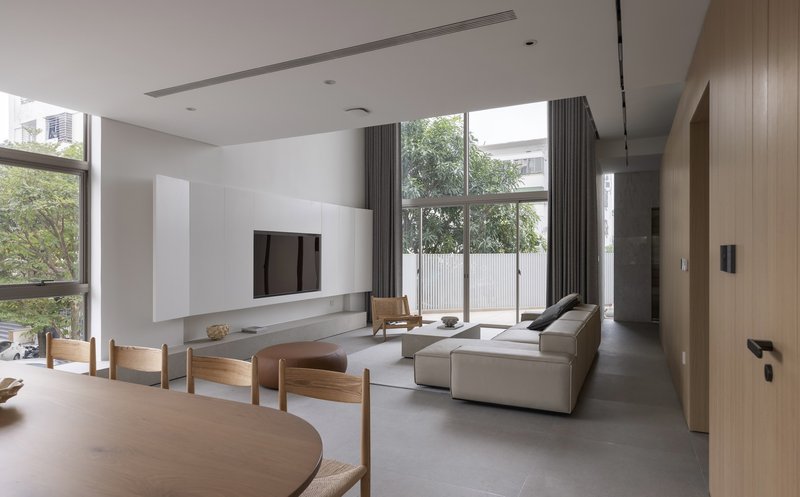
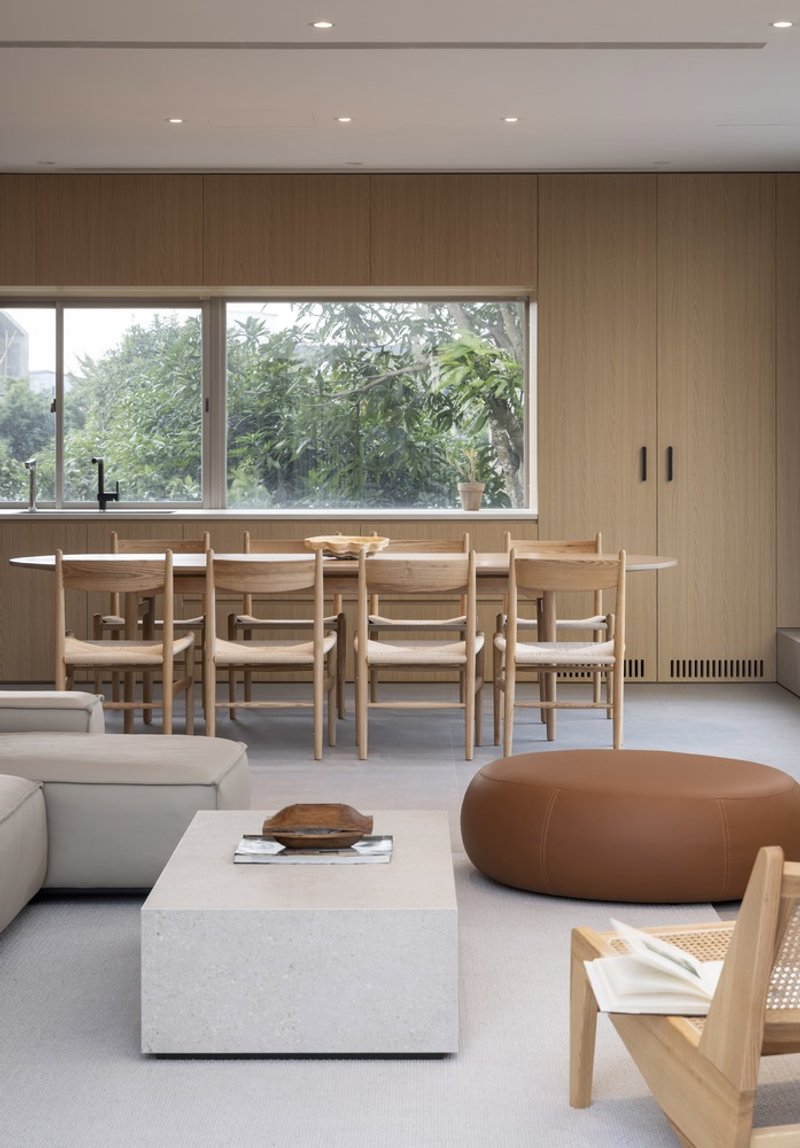
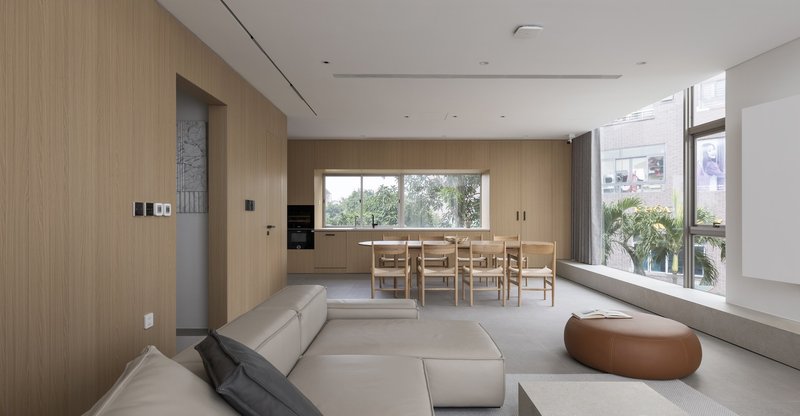
Inside, the palette is restrained: warm timber wall paneling, concrete floors, white rendered walls. The wood is deployed consistently across living, dining, and bedroom zones, giving a cohesive grain to spaces that vary in scale. Large panels conceal storage and service doors, maintaining clean surfaces that let the architecture, not the furniture, define each room.
Floor-to-ceiling glazing on the east and south faces frames the canopies of surrounding trees, an asset that HO Studio clearly identified early and designed toward. From the dining table, horizontal windows frame a band of lush greenery that reads almost as a landscape painting. The trees also provide a secondary privacy screen from neighboring buildings, a natural solution that will only improve as the planting matures.
Mezzanine and Material Interplay
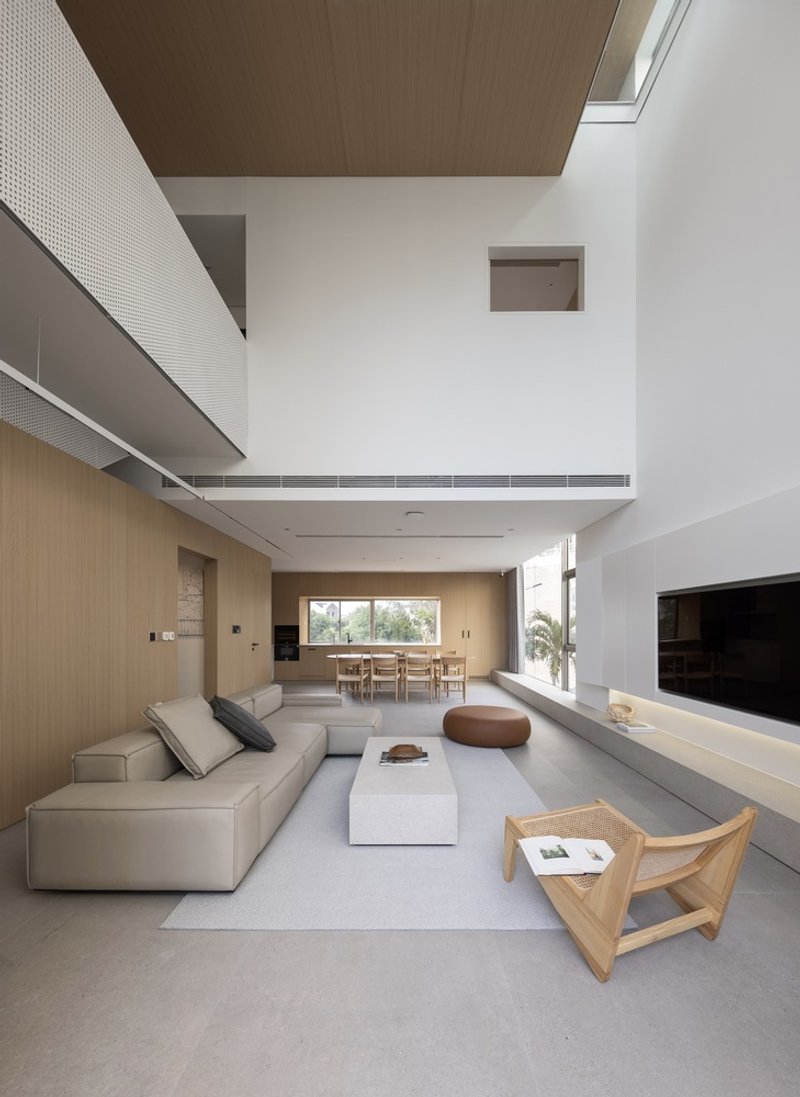
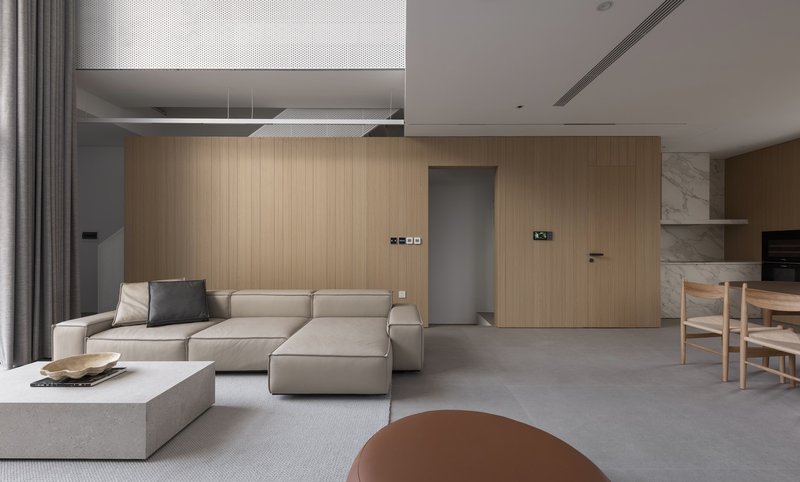
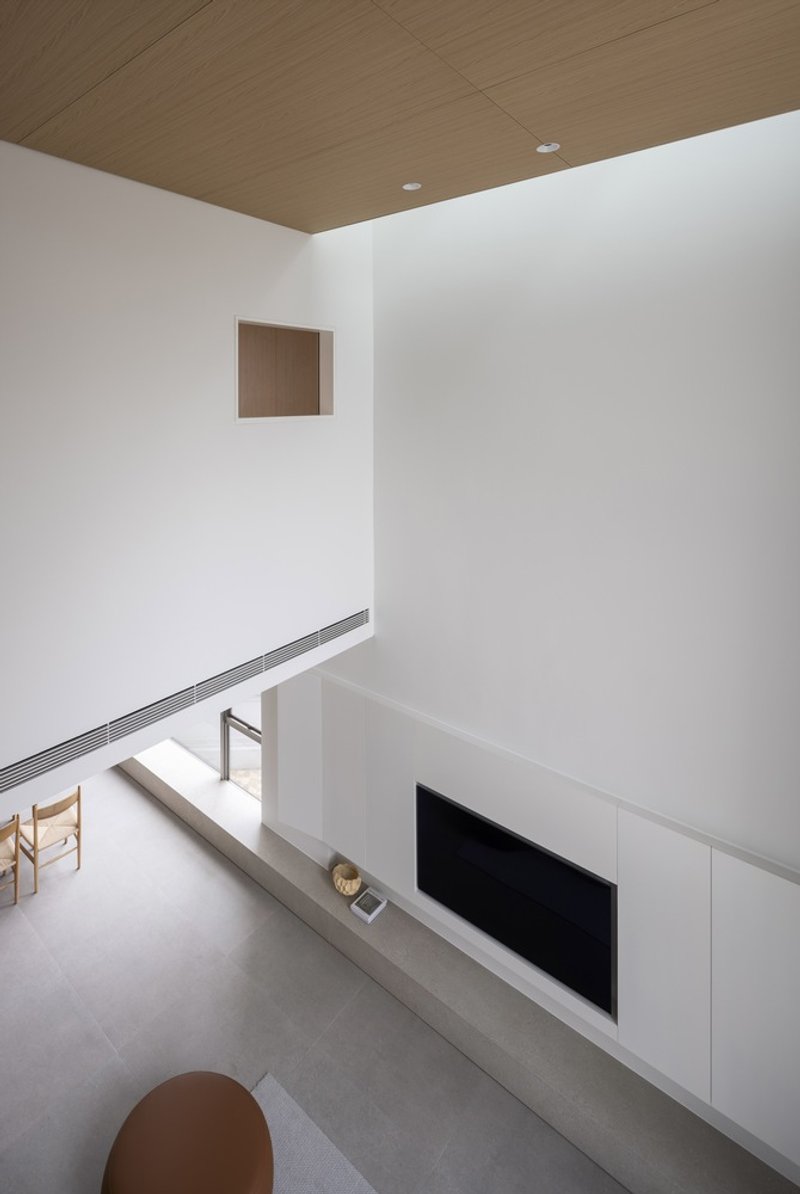
Looking up from the living area, the mezzanine level reveals a layered material composition: perforated metal panels, timber ceiling planes, and glimpses of white walls beyond. The perforations in the metal catch light and let it scatter across the lower floor, a subtle effect that changes throughout the day. A square aperture in the fireplace wall on the upper level acts as an interior window, connecting the lounge above to the volume below.
These visual links are what prevent a narrow, tall house from feeling like a stack of isolated boxes. HO Studio has been deliberate about punching through floors and walls where it counts, keeping sightlines open without compromising the structural logic of the tower.
Private Quarters and Quiet Details
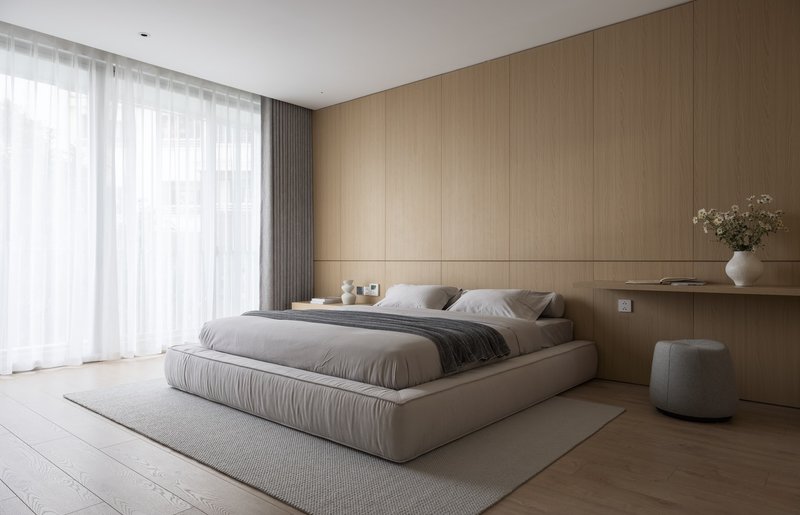
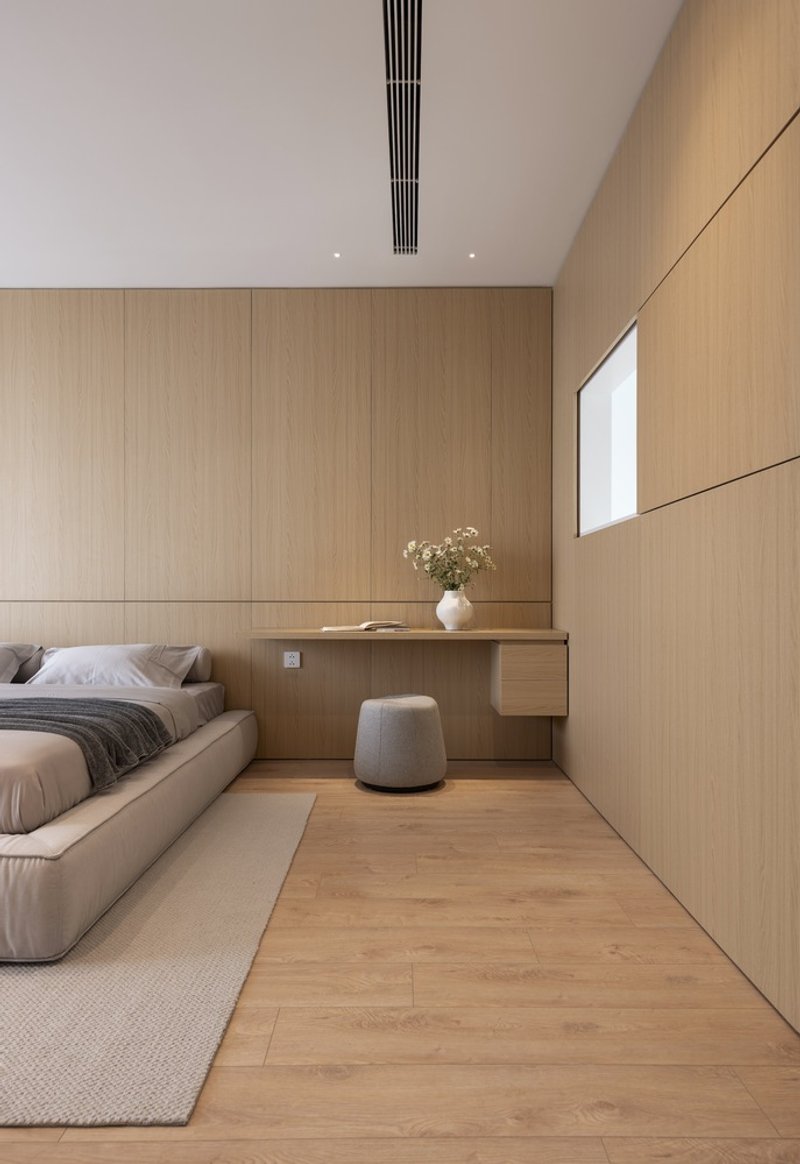
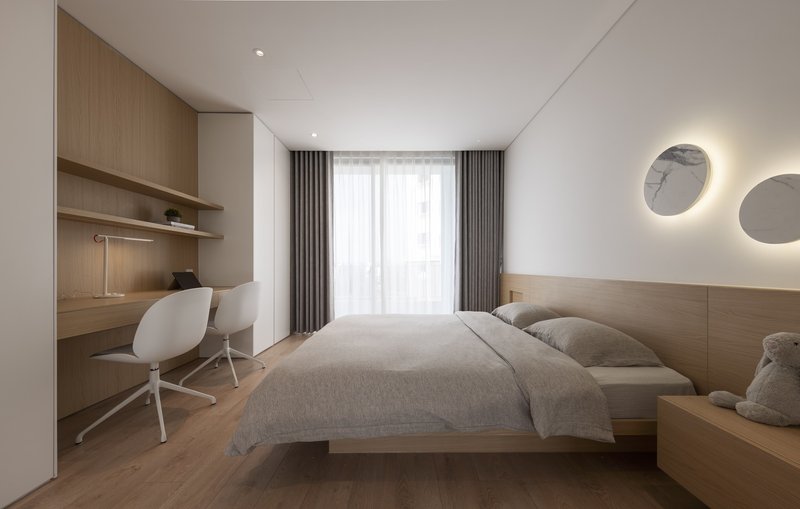
The bedrooms occupy the upper floors, where privacy increases with height. Each room follows a consistent language of integrated timber headboards, built-in desks, and high windows that admit daylight without sacrificing wall area for furniture placement. Sheer curtains soften the light, and circular backlit wall fixtures add a warm glow after dark. The rooms are compact but not cramped, a testament to careful dimensioning.
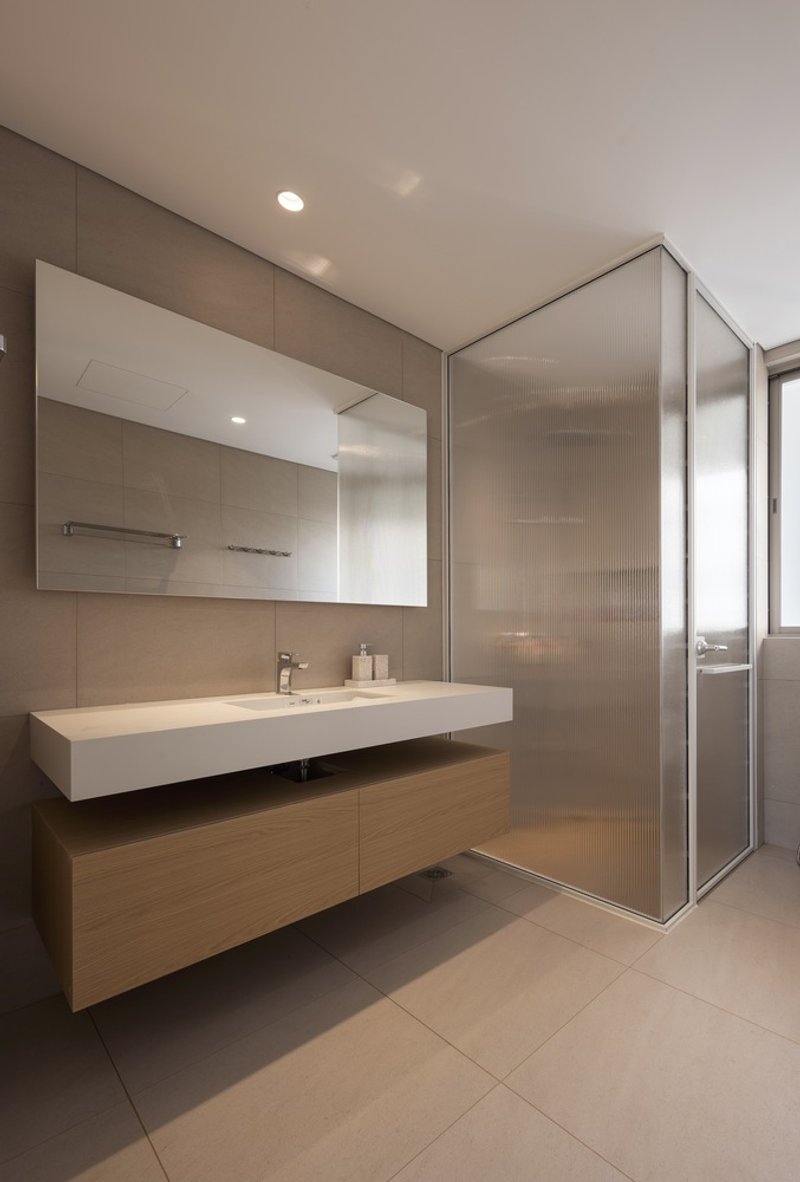
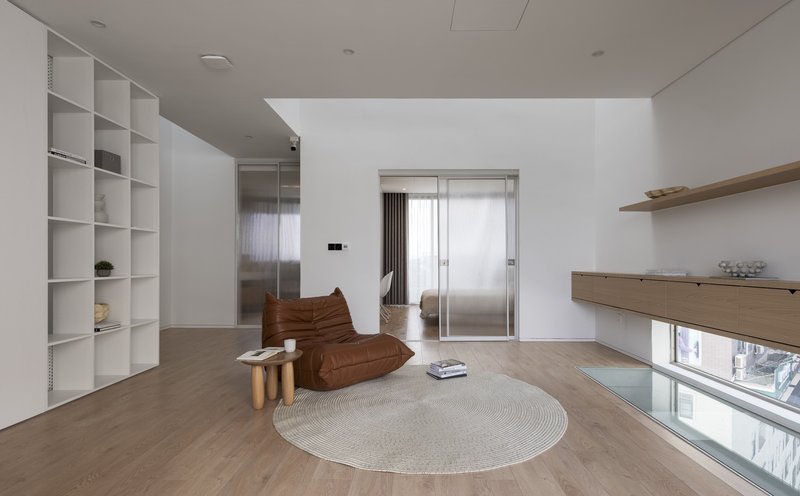
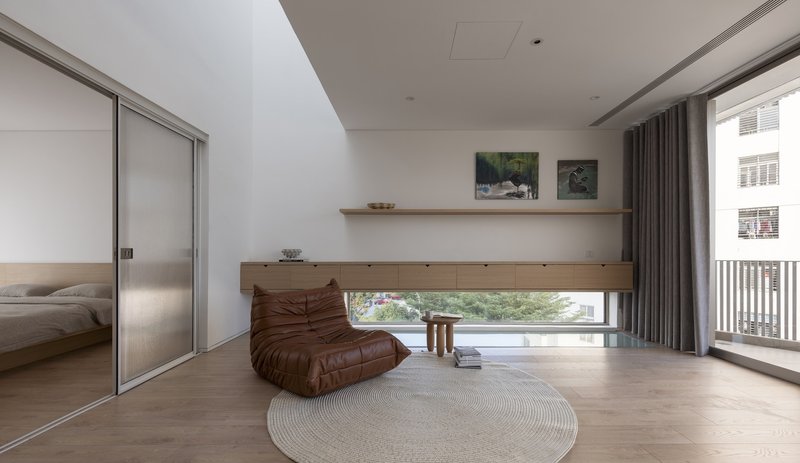
The bathroom continues the timber tone with a floating vanity unit set against a translucent glass shower enclosure. On the uppermost level, a small lounge with white shelving and a horizontal ribbon window gives the family a retreat that looks out over the street below. Grey curtains mark the threshold between interior and the planted balcony beyond, blurring the line just enough to invite you outside.
Grid Blocks and Sky
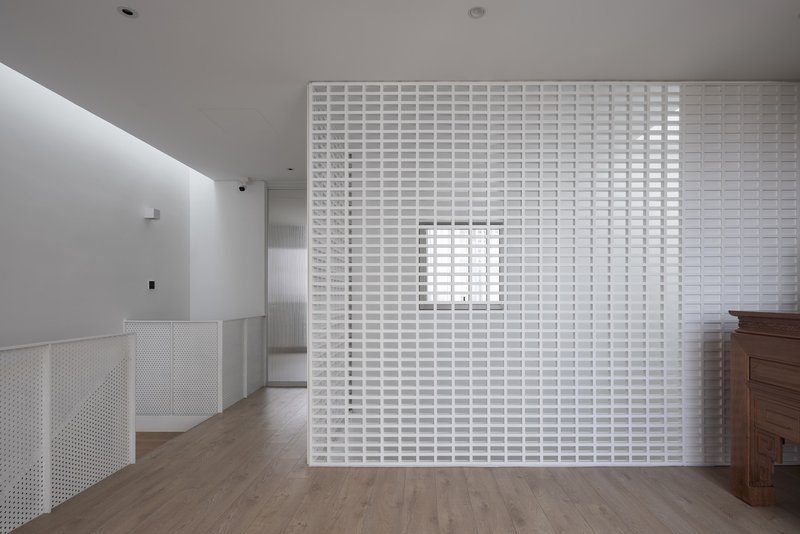
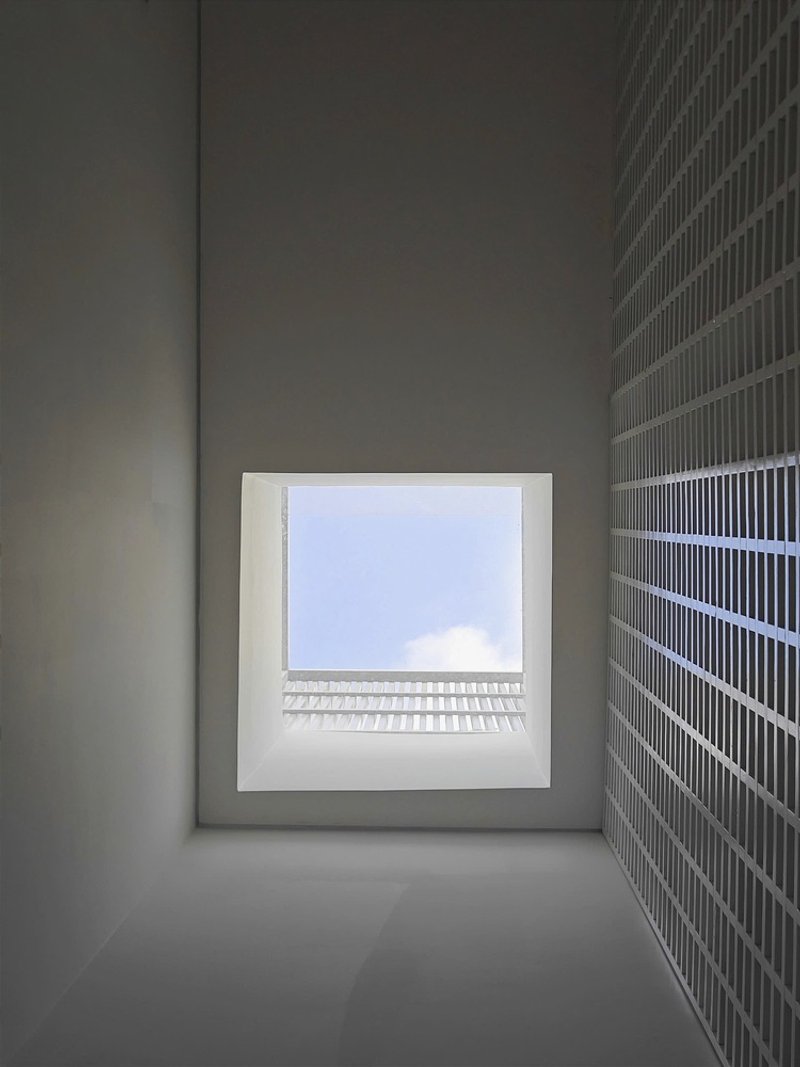
One of the most distinctive material choices in Tram House is the white grid block partition wall, a perforated screen of modular concrete units that separates zones without closing them off. The rectangular openings in the screen create a rhythm of light and shadow that shifts through the day, while also allowing air to pass freely between spaces. Above, a skylight framed by the same grid blocks opens directly to the sky, turning a service lightwell into a composition of white geometry and blue air.
These details matter because they demonstrate that the house's sustainable strategies are not applied as afterthoughts. Ventilation, daylight, and thermal regulation are embedded in the very materials that define the rooms. The grid blocks are simultaneously structural, decorative, and functional.
Plans and Drawings
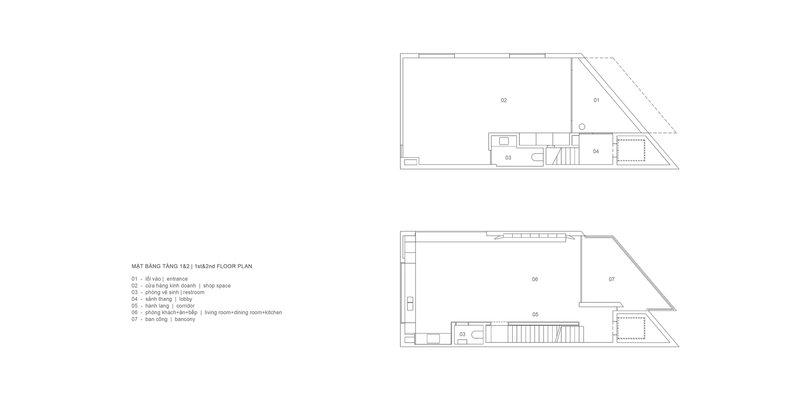
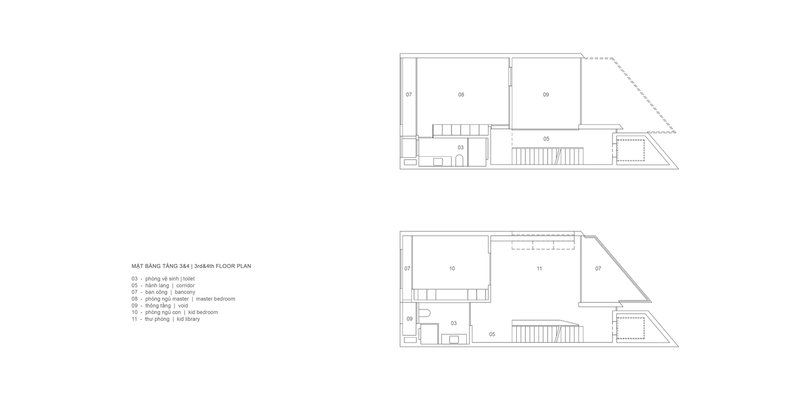
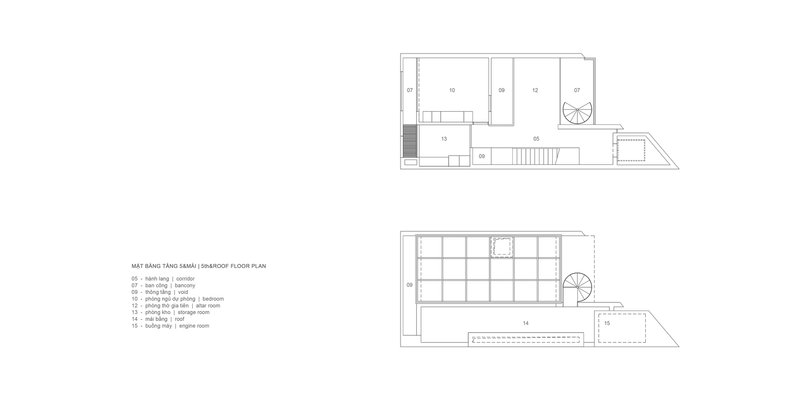
The floor plans reveal the full impact of the diagonal site boundary. The building footprint is a narrow wedge, and HO Studio has pushed all vertical circulation, stairs and elevator, against the western wall, freeing the remaining width for uninterrupted living space. Rooms read as open bands stretching from front to back, with minimal corridors. The upper levels tighten as bedrooms demand more enclosure, but the central void remains present as a constant spatial anchor.
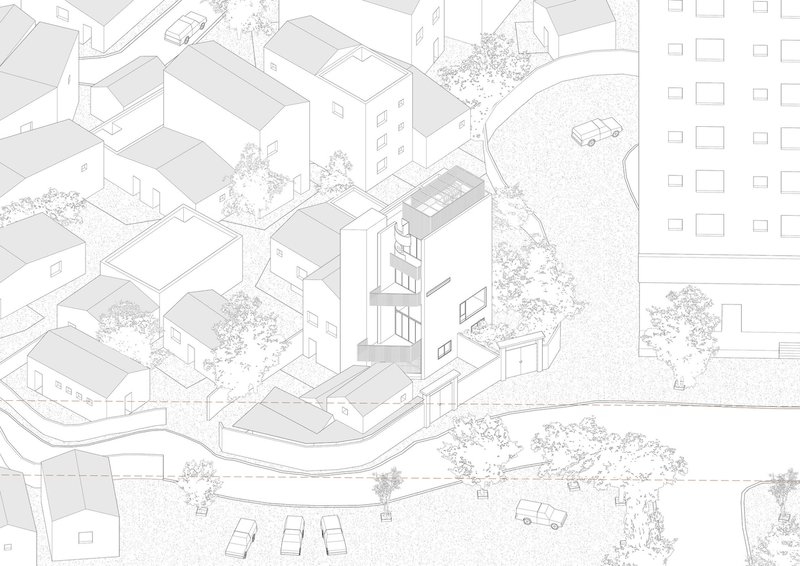
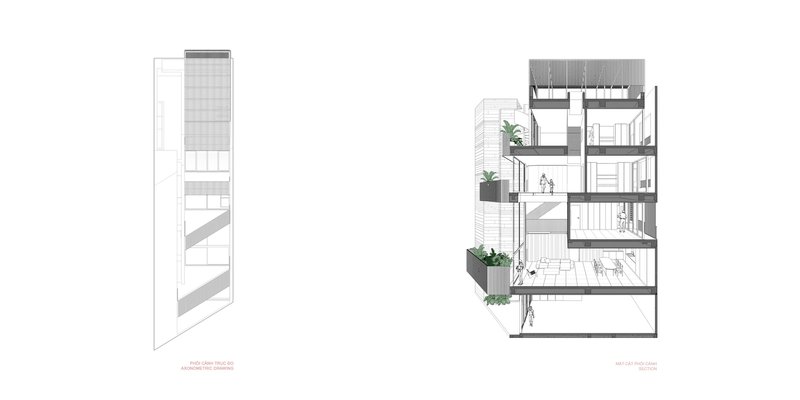
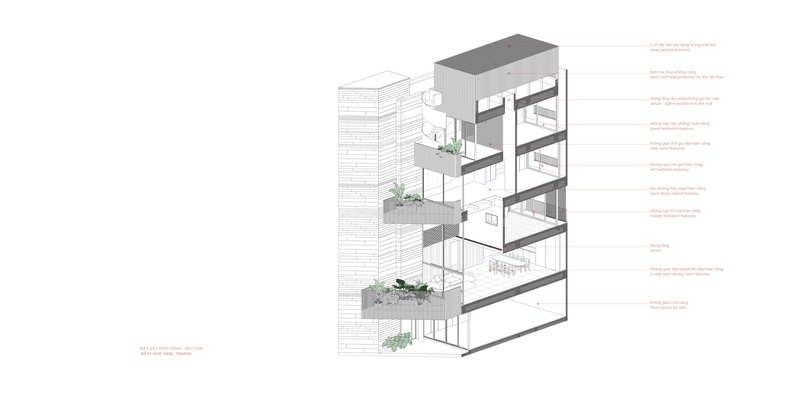
The axonometric drawings place Tram House in its dense urban block, where it reads as a white sliver rising above a tight grain of rooftops and street trees. The section is the most revealing drawing: it shows how each level steps back slightly to create planted terraces on the east face, forming a cascade of greenery that cools the facade and softens the tower's profile against the sky. The longitudinal section confirms the five-meter-high central void and the skylit circulation core, two moves that pull fresh air and daylight from top to bottom.
Why This Project Matters
Tram House is not a demonstration house or a wealthy patron's vanity project. It is a working family home built on a leftover plot in a mid-tier Vietnamese city, subject to the same economic and regulatory pressures that shape millions of tube houses across the country. What separates it is the discipline with which HO Studio turned each constraint into a design asset. The diagonal boundary becomes a sculptural facade. The narrow footprint becomes a thermal chimney. The commercial ground floor becomes a buffer that lifts the family life above the noise of the street.
Its TADA 2025 Building of the Year recognition confirms what the drawings and photographs argue on their own: that intelligent section design, passive climate strategies, and careful material choices can produce a house that is both sustainable and genuinely pleasurable to inhabit. For architects working in tropical urban contexts where land is tight and budgets are real, Tram House offers a compact case study in doing more with less, and making it look effortless.
Tram House by HO Studio, led by architect Hồ Văn Cường. Located in Vinh, Vietnam. 420 m². Completed in 2023. Photography by Nguyễn Thái Thạch.
About the Studio
Share Your Own Work on uni.xyz
If projects like this are the kind of work you want to make, uni.xyz is a place to publish your own, find collaborators, and enter design competitions.




Popular Articles
Popular articles from the community

20 Most Popular Office Building Projects of 2025
From biophilic workspaces in India to net-positive energy offices in New Delhi, 20 office building projects that defined architecture in 2025.

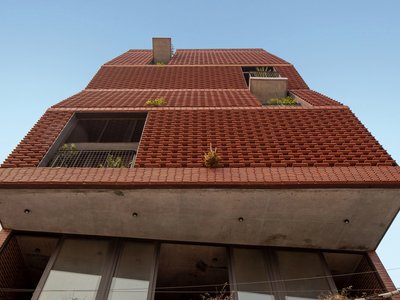
H&P Architects Stack a Vertical River of Brick and Greenery in Hanoi
A perforated terracotta tower in Dong Anh channels water, light, and air through eight staggered levels of domestic life.
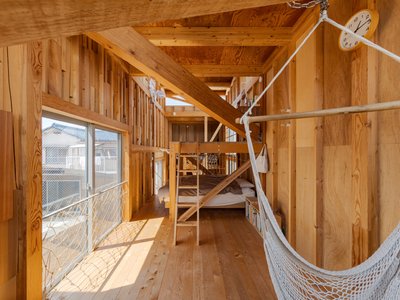
1-1 Architects Builds a Nagoya House and Office from Decades of Stockpiled Timber
A 69-square-meter tower in dense residential Nagoya transforms surplus lumber into a home and workplace for a construction company.
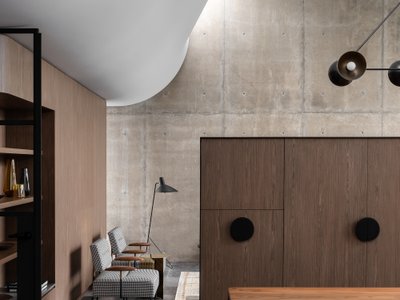
Studio Gram Unfurls a Concrete Curve Through an Adelaide Queen Anne Villa
In Rose Park, a billowing concrete threshold stitches a century-old house to a sun-chasing pavilion organized around an existing pool.


Similar Reads
You might also enjoy these articles
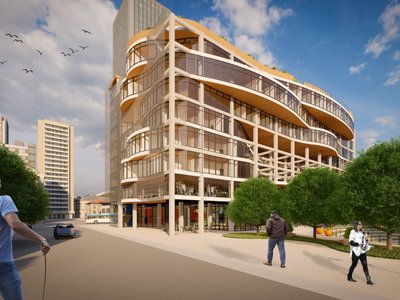
Olio Towers: A Mid-Rise for Performers That Fuses Housing, Rehearsal, and Stage
Located blocks from Houston's Theater District, this modular tower stacks living units around a central performance atrium.
Oasis: Modular Green Housing Carved into Dhaka's Urban Fabric
A shortlisted Plugin Housing entry reclaims unauthorized settlements in Dhaka with stepped concrete volumes, green roofs, and ventilation-driven design.

Black Hole: A Floating Megastructure for the Post-Physical Era
Emiliano Mazzarotto envisions a spherical, self-scaling arena where e-sports, digital hotels, and holographic stadiums replace traditional public space.
Compact & Sustainable Living in Piraeus: A Four-Level Family Home Built Around Light and Air
A narrow townhouse in one of Greece's densest port cities uses a central atrium and passive strategies to house three generations under one roof.


Explore Architecture Competitions
Discover active competitions in this discipline




The International Standard for Design Portfolios


The Global Benchmark for Architecture Dissertation Awards


The Global Benchmark for Graduation Excellence


Challenge to reimagine the Iron Throne
Comments (0)
Please login or sign up to add comments
No comments yet. Be the first to comment!