

IBUKU Weaves a Bamboo Treehouse Around Three Giant Trees on Bali's Sayan Ridge
Perched high in the jungle canopy of Ubud, this basket-like bamboo structure redefines what eco-luxury means in practice.


Most treehouses are built in a tree. This one is built around three of them. Designed by IBUKU and completed in 2020 at the Bambu Indah eco-resort in Ubud, Indonesia, the Treehouse sits high above the ground on the Sayan Ridge, where the jungle canopy opens to 180-degree views over terraced rice paddies and the Ayung River valley. The structure is entirely bamboo: floor, walls, roof, furnishings, detailing. There is no steel frame hiding behind the scenes, no concrete skeleton holding the whole thing together. Bamboo does it all.
What makes the project genuinely interesting, beyond the spectacle, is the structural logic IBUKU developed to pull it off. The floor doesn't meet the walls at a right angle. Instead, the floor surface curls upward to become the sloping enclosure, forming a continuous basket-like shell. Three ancient trees puncture the envelope and serve as natural anchors, while a lightweight roof wraps around their trunks and admits daylight through oval skylights. The architects modeled the design not with conventional blueprints but with hand-whittled bamboo stick models built to scale, a working method that treats the material's grain, flexibility, and limits as design drivers rather than afterthoughts.
The Basket Logic
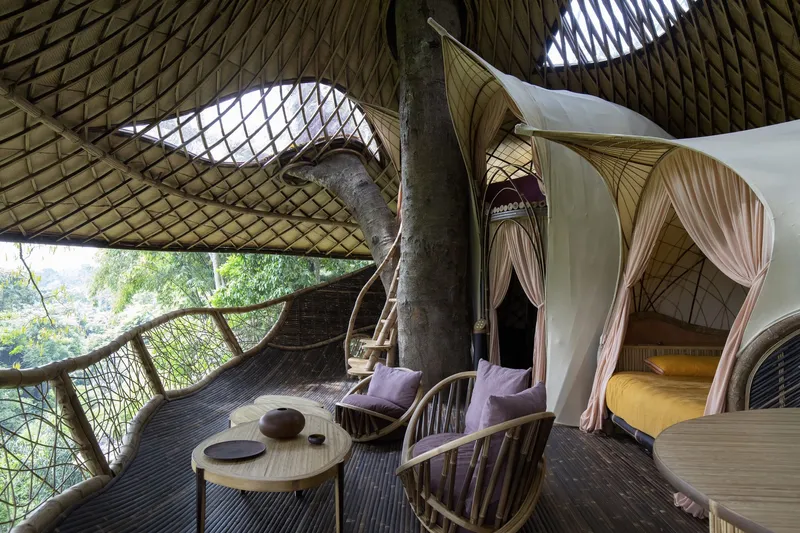
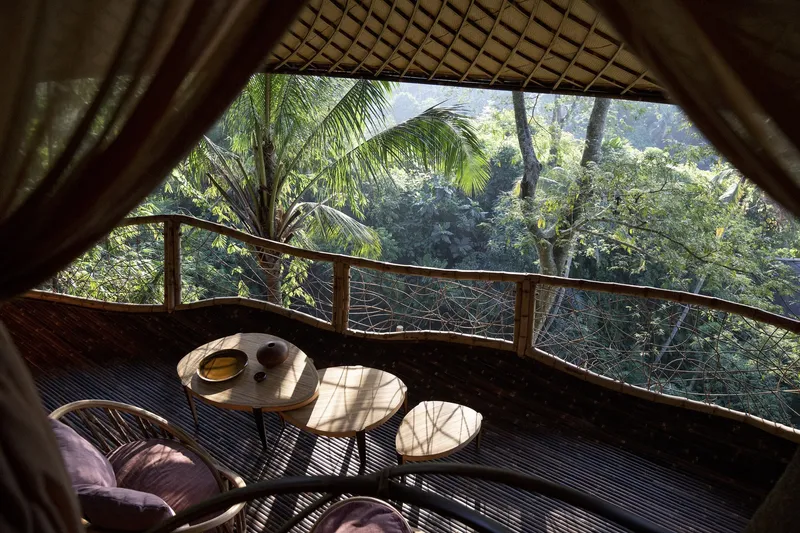
The single most legible idea in the project is the basket. From the open terrace, you can read how the woven bamboo shell arcs overhead in a continuous surface, transitioning from floor plane to curved wall to roof without interruption. The diamond-patterned weave is structural, not decorative. It distributes loads laterally across the shell while allowing the whole assembly to flex slightly in wind, exactly as a woven basket would. The openings punched through this shell are generous: wide enough to frame the surrounding jungle canopy without compromising the enclosure's integrity.
The effect from inside is of inhabiting a suspended nest. Dappled sunlight filters through the weave and the canopy beyond, and the curved edges of each opening soften the boundary between architecture and forest. There are no hard thresholds here, just gradual transitions from enclosed to semi-enclosed to open air.
Living in the Canopy
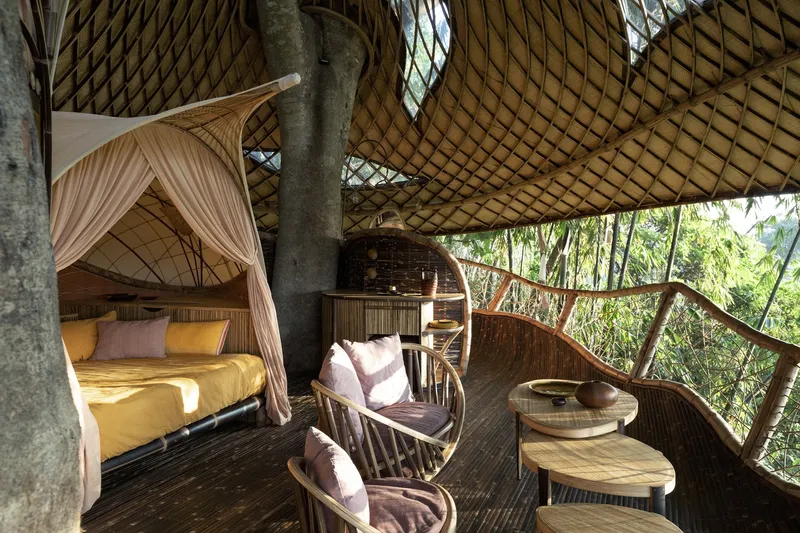
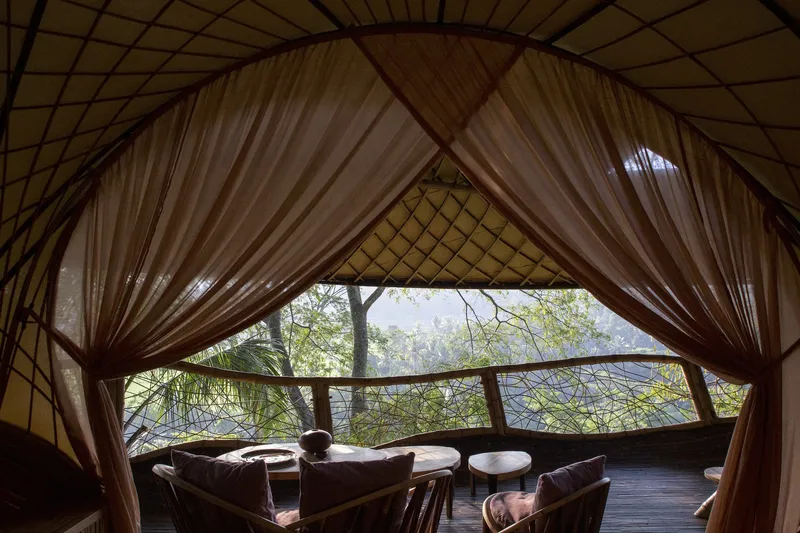
The sleeping alcove sits beneath a draped canopy of fabric that introduces a second, softer layer of enclosure within the bamboo shell. Yellow bedding and sheer curtains contrast with the raw, dark tones of the treated bamboo, a deliberate play between the handmade and the organic. The curved timber deck extends outward to create a balcony zone furnished with rattan chairs, positioning the guest at tree-crown height with nothing between them and the valley but a timber railing.
IBUKU handled the interior design after the structural work by PT Bamboo Pure was complete, and the restraint shows. Every piece of furniture responds to the curves of the architecture. The lounge area, framed by sheer curtains that billow in cross-ventilation, reads as a room within a room, its openness calibrated to the view and the breeze rather than to any rigid plan geometry.
Skylights and the Roof as Lens
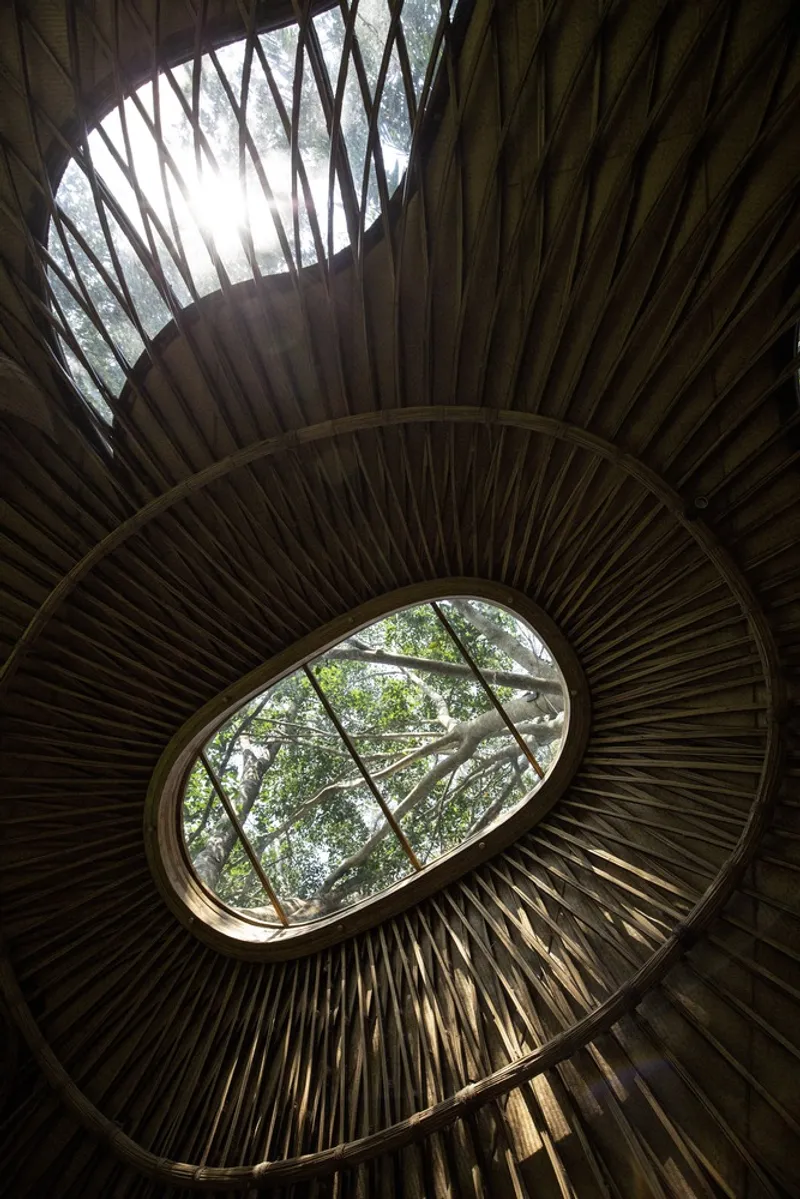

Look up inside the Treehouse and you find one of its most compelling moments. The spiraling wooden ceiling converges toward two oval skylights that frame the tree canopy above like apertures in a camera. These openings do practical work, pulling natural light deep into the interior and reducing dependence on artificial illumination, but their real contribution is atmospheric. They remind you, constantly, that you are suspended in a living ecosystem, not merely looking at one through a window.
The vertical circulation reinforces this sensation. A bamboo ladder ascends alongside one of the tree trunks, climbing past the woven wall and the diamond-paneled roof. The ascent is deliberate: you feel the structure flex underfoot, you smell the bamboo, you register the height. By the time you reach the living level, the architecture has already recalibrated your relationship with gravity and ground.
Craft Meets Computation
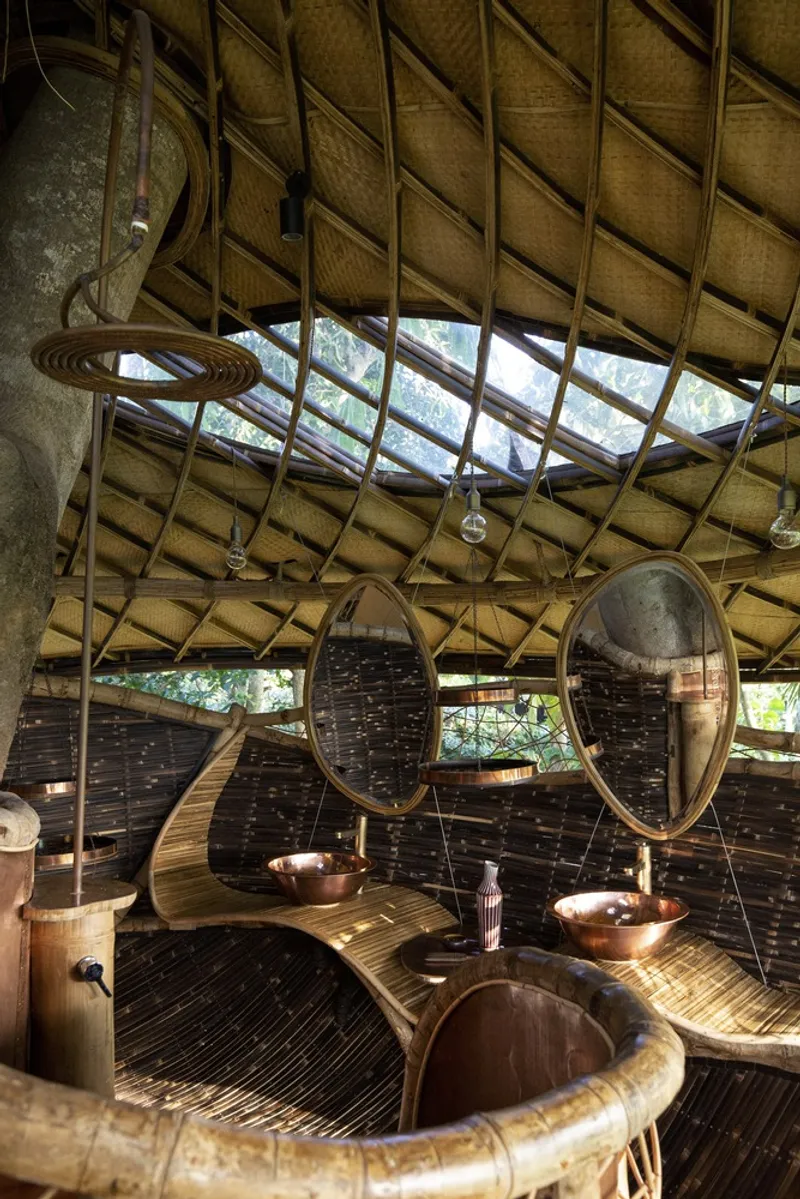
The bathroom interior reveals the level of craft embedded in the project. A woven bamboo ceiling arches overhead, its pattern tight and precise. Copper bowl sinks and oval bamboo-framed mirrors introduce small material contrasts without departing from the tonal palette. A skylight above the vanity washes the space with even, indirect light. None of this is accidental. IBUKU's design process moves between hand-whittled scale models and 3D computer modeling, using digital tools to confirm structural integrity while trusting physical prototypes to guide form and proportion.
This hybrid method matters because bamboo is not a standardized industrial material. Each culm has a different diameter, wall thickness, and curvature. The architects and engineers at IBUKU follow each project through to completion precisely because the gap between model and reality has to be negotiated on site, by craftsmen who understand the material at a tactile level. The result is a building that looks effortless but carries within it an enormous amount of embedded knowledge, from the four-year growth cycle of the raw material to the traditional Balinese building techniques that inform the joinery.
Why This Project Matters
The Treehouse at Bambu Indah is not a novelty. It is a proof of concept. Bamboo has the compressive strength of concrete and a strength-to-weight ratio rivaling steel, yet it grows from a shoot to a structural column in three years and sequesters carbon as it does so. IBUKU's work demonstrates that these properties are not just talking points for sustainability reports but can be leveraged into architecture that performs at the highest spatial and sensory level. The basket structure, the continuous floor-to-wall transition, the skylights framing the canopy: these are not compromises forced by using a "lesser" material. They are formal innovations enabled by it.
What IBUKU has built on the Sayan Ridge is also a challenge to the profession's assumptions about luxury. Luxury here is not marble, glass curtain walls, or climate-controlled perfection. It is proximity: to the canopy, to the breeze, to the sound of the Ayung River below. The architecture doesn't buffer you from its site. It suspends you inside it. That inversion, comfort defined by exposure rather than insulation, is the most radical thing about the project, and the hardest for conventional practice to absorb.
Treehouse at Bambu Indah, designed by IBUKU. Kecamatan Ubud, Bali, Indonesia. Completed 2020.
About the Studio
Share Your Own Work on uni.xyz
If projects like this are the kind of work you want to make, uni.xyz is a place to publish your own, find collaborators, and enter design competitions.


Popular Articles
Popular articles from the community

Extended Shell: Retrofitting Kolkata's Balconies as Living Urban Thresholds
A modular retrofit system recovers the social and environmental intelligence of Kolkata's historic verandas for contemporary Park Street residents.

Tsunami Convergenics: Turning Catastrophic Ocean Forces into Underwater Housing Infrastructure
A speculative underwater settlement off the coast of Onagawa, Japan, treats tsunamis and typhoons as energy sources rather than threats.

Manzana Morphosis: Stretching Barcelona's Grid into a Living Landscape for 2050
A radical reworking of the Eixample manzana turns density into a tool for generous public space, vertical ecology, and environmental performance.

Cloaked Colonization: A Mobile Underwater Habitat That Moves Like a Fish
Micah Abaya's shortlisted EHC Pacific entry reimagines ocean settlement as a dispersed network of self-sustaining architectural organisms.

Similar Reads
You might also enjoy these articles


Hodi-Mandai Geram
Project Function: Preservation and revitalization of the Intangible heritage and socio-spatial identity of the Hodi by Housing, Cultural Memory Center, Sacred Grove, landscape, local tourism economy


Olio Towers: A Mid-Rise for Performers That Fuses Housing, Rehearsal, and Stage
Located blocks from Houston's Theater District, this modular tower stacks living units around a central performance atrium.

Oasis: Modular Green Housing Carved into Dhaka's Urban Fabric
A shortlisted Plugin Housing entry reclaims unauthorized settlements in Dhaka with stepped concrete volumes, green roofs, and ventilation-driven design.

Black Hole: A Floating Megastructure for the Post-Physical Era
Emiliano Mazzarotto envisions a spherical, self-scaling arena where e-sports, digital hotels, and holographic stadiums replace traditional public space.

Explore Bamboo Construction Competitions
Discover active competitions in this discipline

Challenge to reimagine the Iron Throne

Photograph architecture without architects

Illustrate the lost glory of Angkor Wat - Render Challenge

Design challenge to reuse E-waste
Comments (0)
Please login or sign up to add comments
No comments yet. Be the first to comment!