
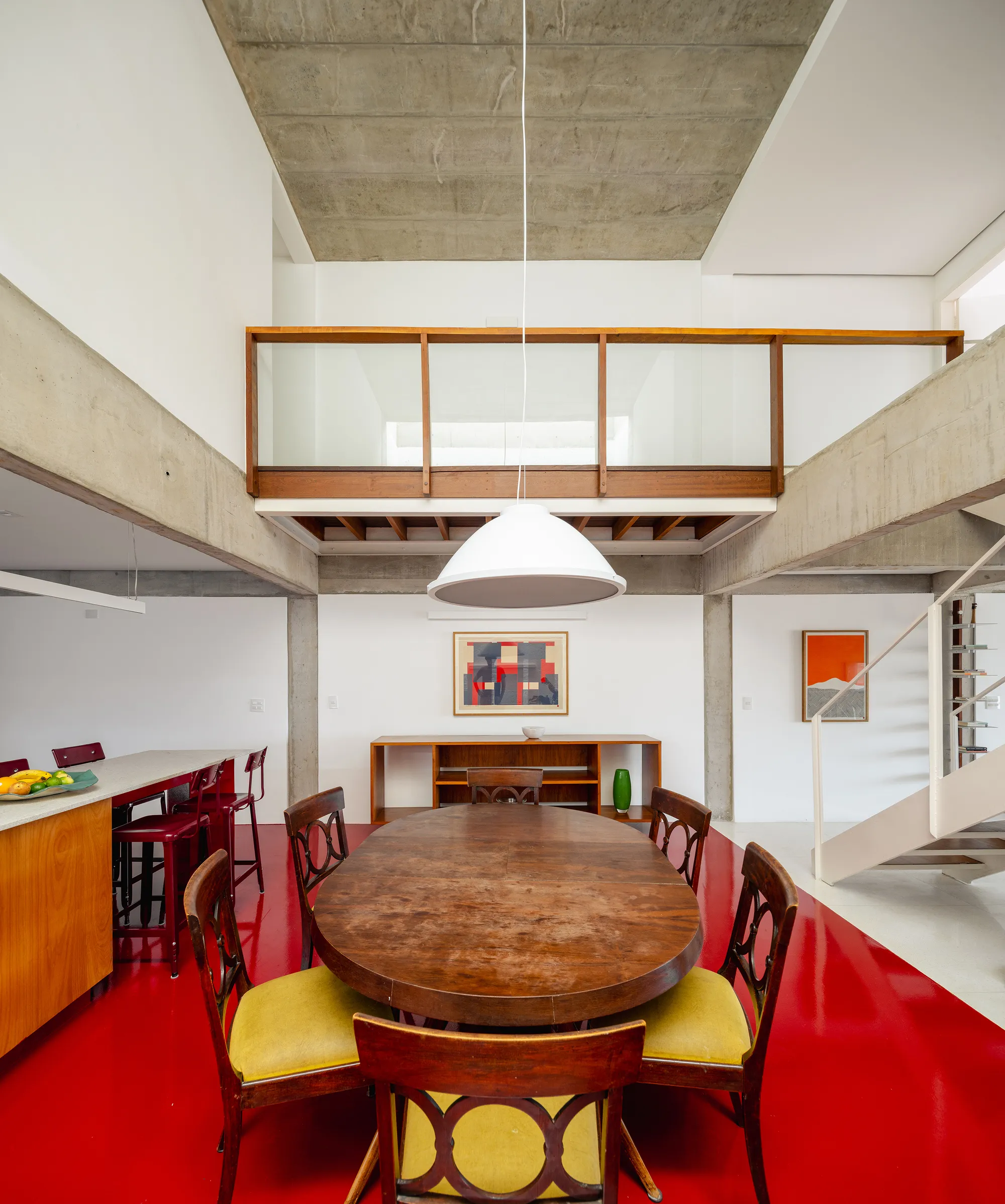
Trema Arquitetura and Gabriel Sepe Pour Red Resin Through a Brutalist São Paulo Hillside House
A four-level renovation in Sumaré wraps exposed concrete, brick, and a vivid red floor around panoramic views of Pico do Jaraguá.


Renovating a brutalist house is a tricky act. You want to honor the raw honesty of the original concrete and brick while making the place livable for someone who wasn't alive when the structure was poured. In Sumaré, a hilly residential neighborhood on São Paulo's western ridge, Trema Arquitetura and Gabriel Sepe have threaded that needle by keeping the bones exposed and injecting a single, unmissable intervention: a bright red epoxy and resin floor that runs through nearly every level of the 300 square meter house.
Led by architects Raphael Souza and Gabriel Sepe, the project takes a steep lot that drops across four staggered levels and uses the topography as the primary organizing device. Each half-level shift opens a new relationship with light, air, and the distant silhouette of Pico do Jaraguá. The concrete ceiling beams, the monolithic granilite, the exposed brick: none of it has been concealed. Instead, the renovation treats the existing structure as a geological layer onto which a contemporary domestic life can be grafted, floor by vivid floor.
The Orange Signal on the Street
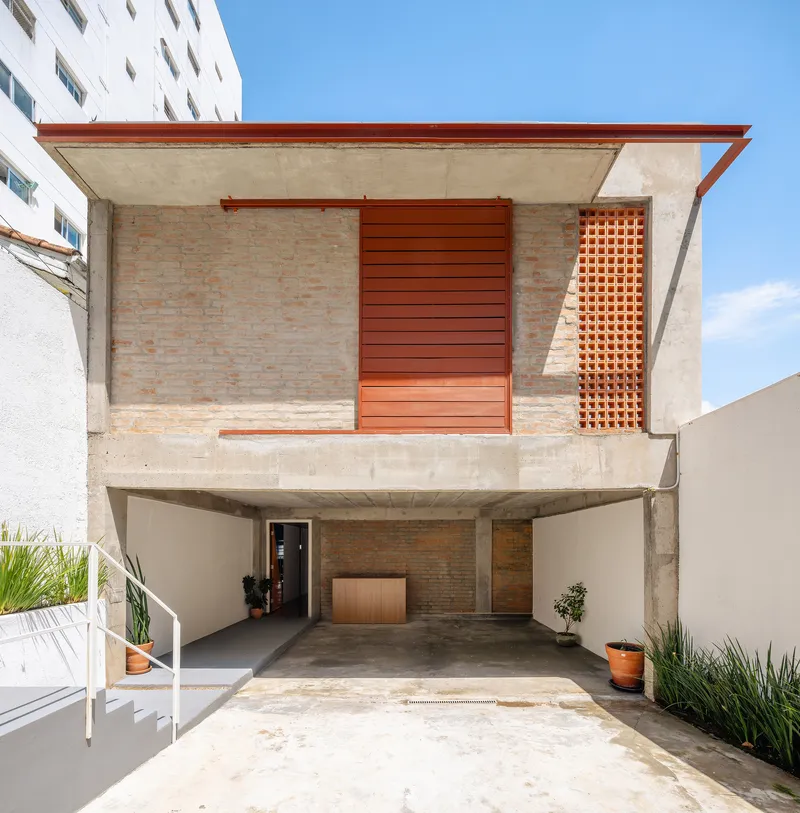


From the sidewalk, the house reads as a composition of weight and warmth. Exposed concrete frames sit alongside weathered plaster and terracotta brick screens, while sliding orange timber panels at the carport level announce that something other than austere minimalism lives inside. The lattice brickwork at the upper levels filters light without surrendering privacy, a move that gives the facade a textile quality against the hard concrete planes.
The garage door, also in orange-stained timber, repeats the signal at ground level. It is a small gesture that does a lot of work: it tells you the renovation respects the original mass of the building but refuses to be somber about it. Tree shadows on the pavement complete a street elevation that feels rooted in its context without trying to disappear.
Living Between Concrete and Canopy


The living areas occupy the intermediate levels, where the stagger of the site allows rooms to borrow daylight from two sides. Folding glass doors at one end open directly onto a timber deck that floats above the neighborhood's dense tree cover, collapsing the boundary between interior and landscape. The exposed concrete beams overhead are left as they were: heavy, directional, and structurally legible.
A view through the living room toward a daylit workspace reveals how the architects sequence space along the section. Each room is not simply adjacent to the next; it sits a few steps above or below, so the eye always moves both horizontally and vertically. A white staircase at the far end becomes a marker of orientation, its lightness a deliberate counterpoint to the gray mass above.
That Red Floor
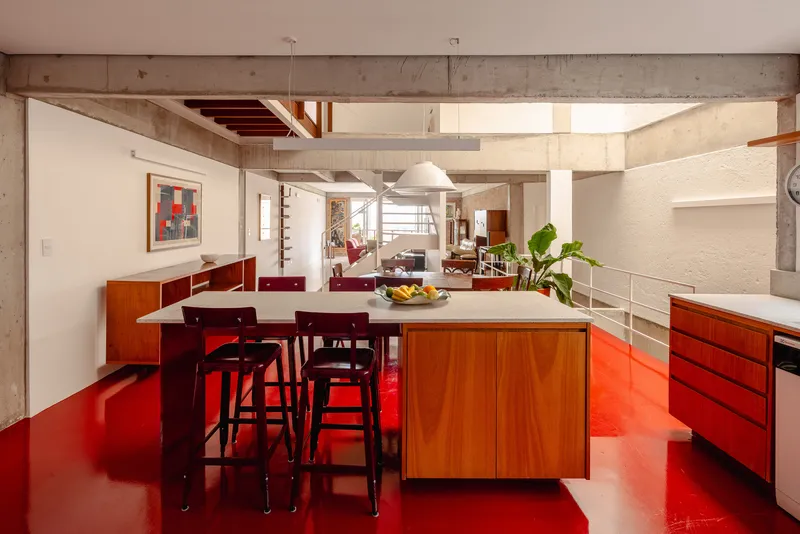


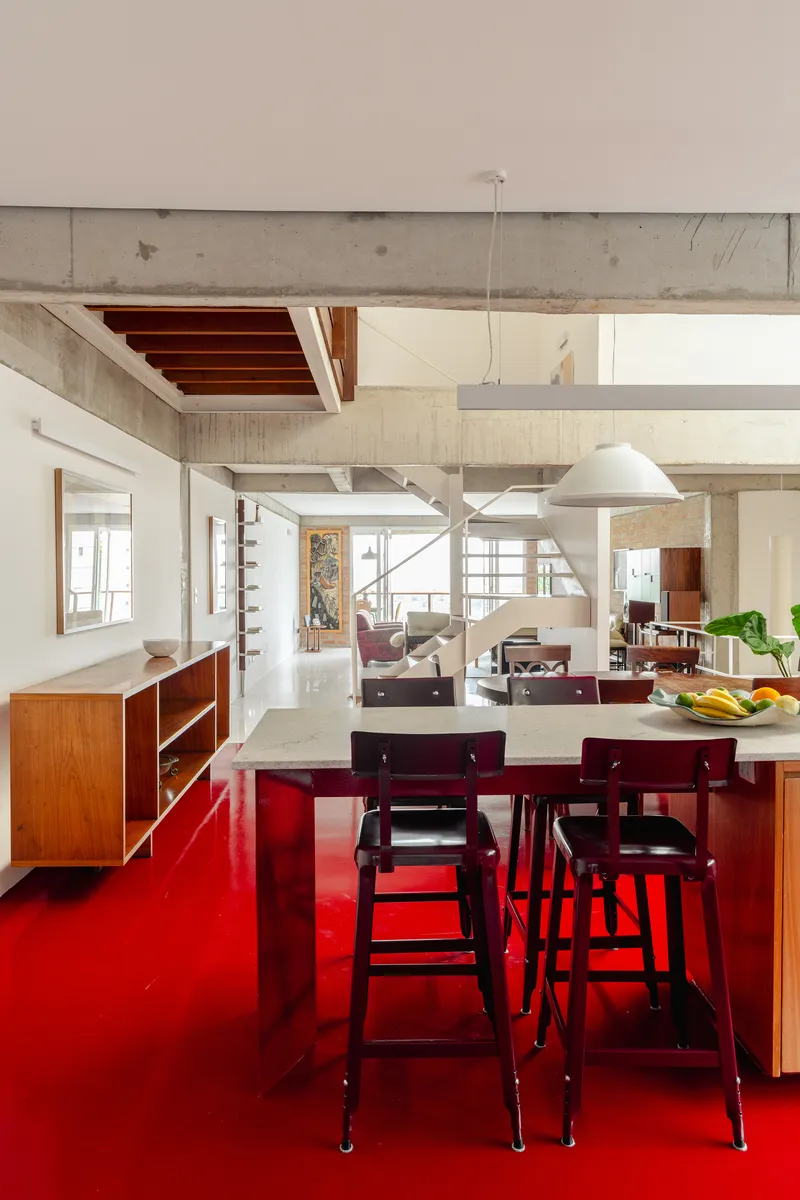
Let's talk about the floor. A glossy, saturated red resin runs from the kitchen through the dining room, up to the mezzanine, and out onto balconies and the rooftop terrace. It is the single most assertive design decision in the house, and it succeeds because it is total. There is no room where the red appears and then stops awkwardly at a threshold. It flows like lava through the section, binding levels that the staggered plan would otherwise read as disconnected.
Against the wood cabinetry in the kitchen, the red becomes warm. Against exposed concrete beams, it becomes electric. Against the ribbed glass cabinet doors and stainless steel appliances, it reads almost pop-art. The architects understood that a neutral floor in this house would have made it feel like a preserved ruin. The red makes it unmistakably inhabited.
The Double-Height Dining Room


The heart of the house is a double-height dining space where the red floor, the concrete ceiling, and a timber-framed mezzanine balcony all converge. A single pendant light drops from the full height, drawing the eye upward to a clerestory window that washes the concrete with indirect daylight. A potted banana plant in the corner provides scale and a jolt of green against the warm reds and grays.
The mezzanine railing, a simple white steel guardrail, reads as a horizontal line cutting across the vertical volume. It is not a grand balcony; it is closer to a ship's rail, something you lean on to look down at the table below. That casualness is essential. The space has the proportions of something monumental, but the detailing keeps it domestic.
Courtyard, Pergola, and the Frangipani Tree


An open-air courtyard punches through the middle of the plan, bringing light and ventilation deep into the section. A flowering frangipani tree rises through the void, its branches casting dappled shadows across the red resin floor below. A timber pergola shelters an outdoor kitchen at one edge, creating a threshold space that is neither inside nor outside.
Above, the dining terrace extends the social life of the house outward. Timber decking and a slender metal railing frame a panoramic view of São Paulo's green western ridge, with apartment towers visible in the middle distance. It is a reminder that this house sits on a steep slope in a dense city, a condition the architects have exploited rather than resisted.
Mezzanine and Rooftop: Life at the Top
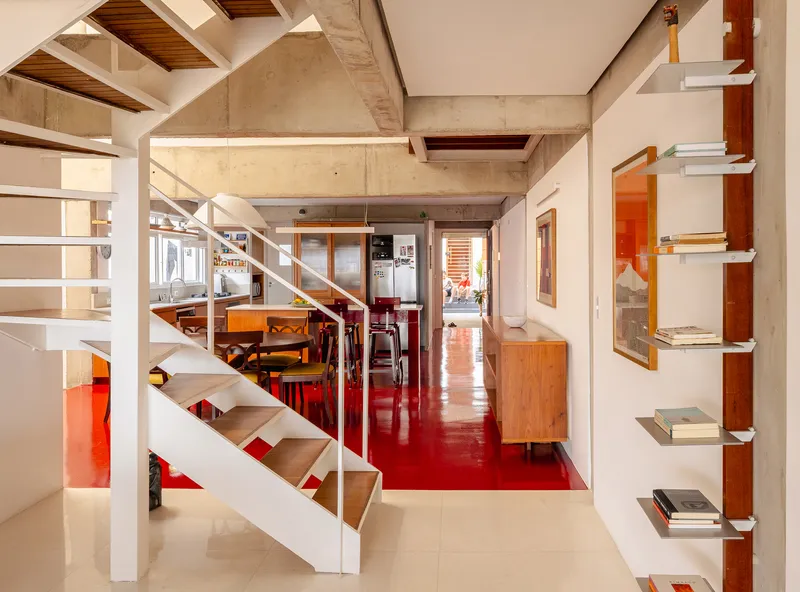
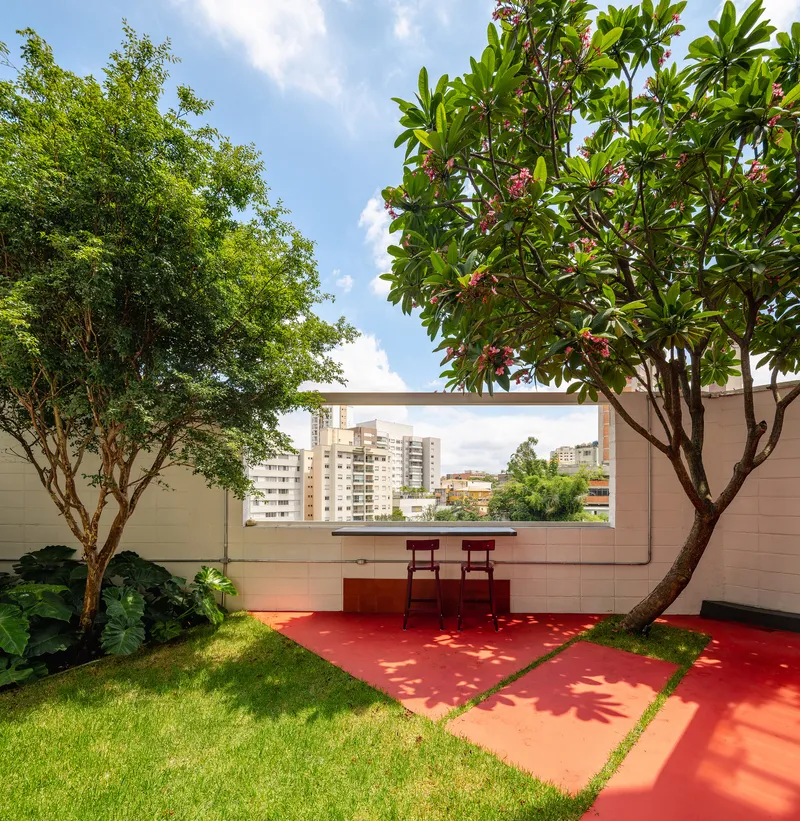

The upper levels are where the red floor meets the sky. At the mezzanine, a white steel staircase rises against exposed concrete ceilings inset with timber panels, a detail that softens the overhead plane without concealing the structure. The red flooring continues unbroken, anchoring the upper rooms to the same palette as the levels below.
On the rooftop terrace, planted trees and a horizontal window frame the urban skyline beyond. It is the payoff for the steep site: from here you can see Pico do Jaraguá, São Paulo's highest point, rising above the low sprawl. A small balcony off one of the bedrooms, with its exposed brick wall and sliding glass door, offers a more intimate version of the same outward gaze.
Material Dialogues: Brick, Concrete, and Wood
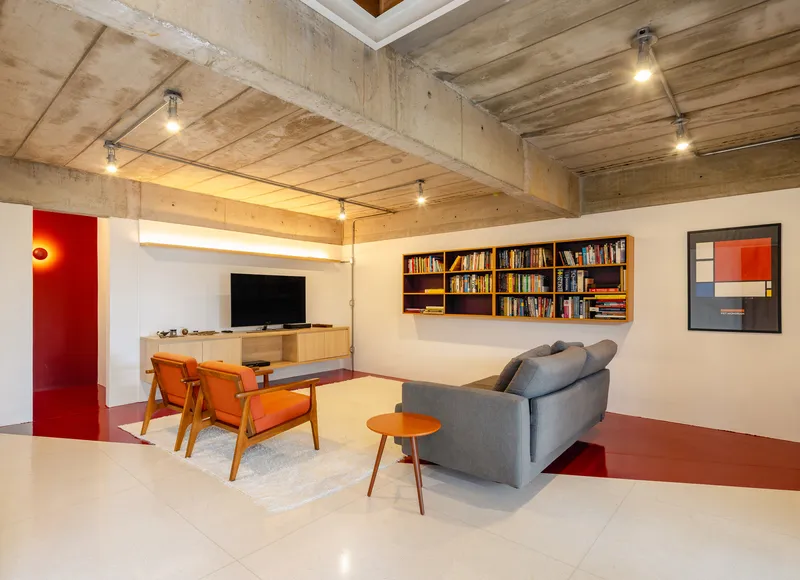
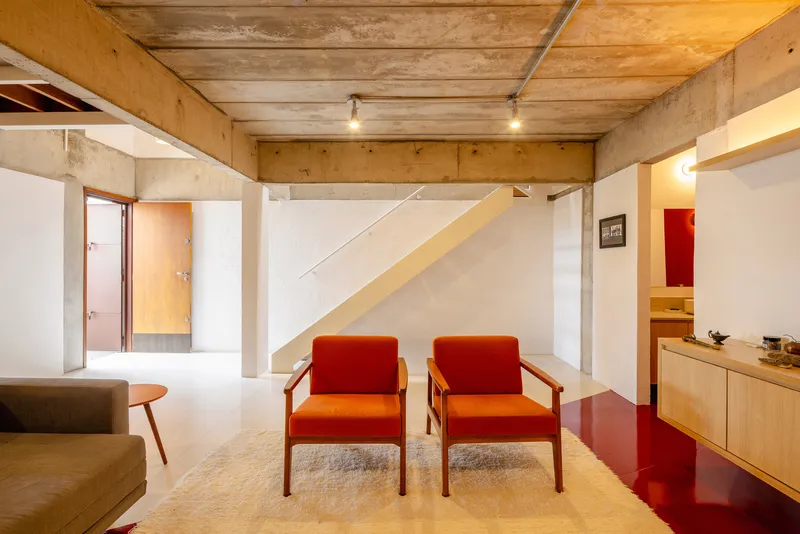

Throughout the house, three materials do most of the talking. Exposed brick walls provide texture and thermal mass. Exposed concrete beams and ceilings give the rooms their structural rhythm. And wood, in the form of veneer cabinet panels, plywood wall linings, and deck boards, warms every surface it touches. The architects have not introduced any new structural material; they have simply curated what was already there.
Wall-mounted bookshelves in the living room and plywood panels above white volumes in the double-height space show a willingness to let the renovation layer onto the original without pretending to be seamless. The old house and the new intervention are legible as distinct episodes, which is the correct approach when the original has this much character.
Plans and Drawings


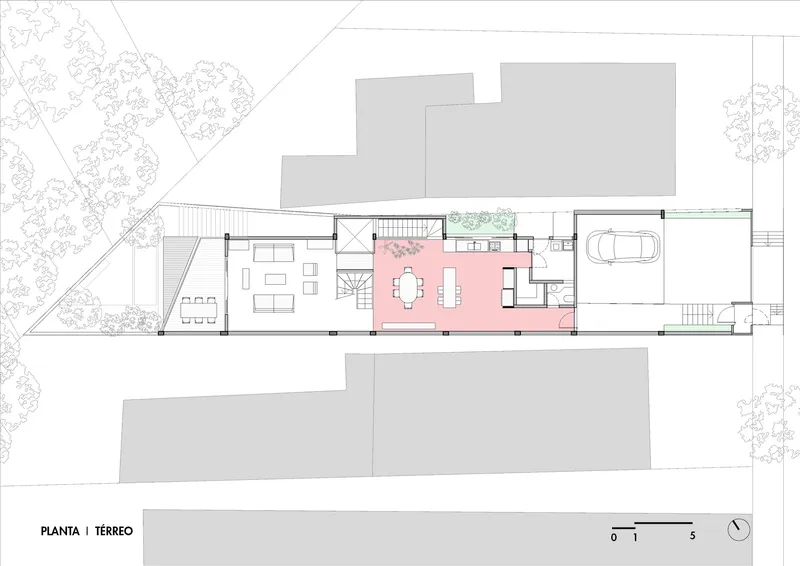


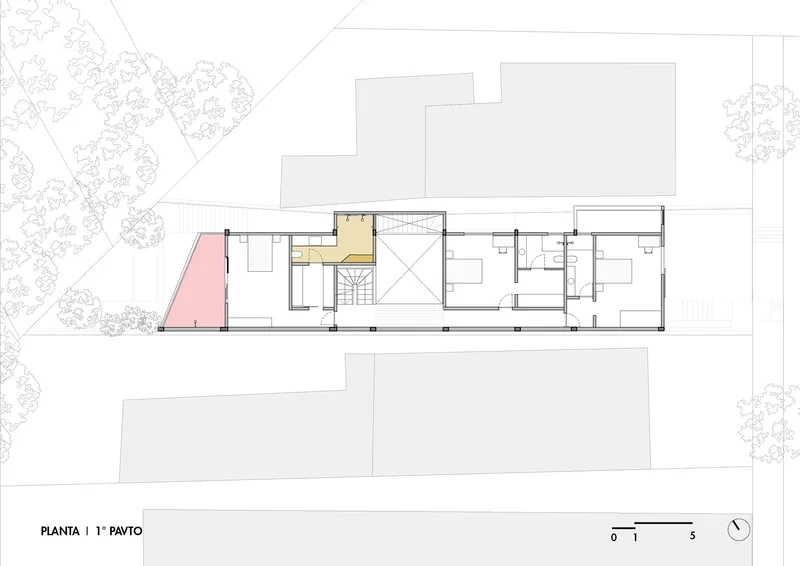


The floor plans reveal a narrow rectangular volume pinched between adjacent buildings, with the courtyard acting as the primary light well. The section drawing is the most revealing document: it shows how the four levels step down the slope, each half-level creating a distinct zone while remaining connected by the central staircase. Color-coded zones in the first floor plan distinguish new walls from demolished ones, making the surgical nature of the renovation legible at a glance.
The demolition plan is worth studying. It shows how little of the original structure was actually removed. The staircase was repositioned and walls were opened, but the concrete frame stands largely as it was built. The architects worked within the cage rather than against it, which explains why the finished house feels so structurally confident.
Why This Project Matters
Brutalist houses in São Paulo are plentiful, and many are at risk of being gutted and whitewashed into something generic. What Trema Arquitetura and Gabriel Sepe have done in Sumaré is demonstrate that you can renovate a heavy concrete house without neutralizing it. The red floor is not decoration; it is a strategy. It gives the house a continuous interior landscape that unifies four levels, multiple courtyards, and a rooftop into a single domestic experience.
More broadly, the project argues that renovation does not require subtlety. When the existing building has the confidence of exposed concrete and monolithic brick, the new intervention can be equally bold. The red resin floor meets the gray concrete on equal terms, and neither blinks. That kind of material conviction, applied to a 300 square meter hillside house with panoramic views, produces something rare: a renovation that feels as committed as the original.
Residence in Sumaré, São Paulo, Brazil. Architects: Trema Arquitetura and Gabriel Sepe. Lead architects: Raphael Souza, Gabriel Sepe. Area: 300 m². Year: 2025. Photography: Manuel Sá.
About the Studio
Share Your Own Work on uni.xyz
If projects like this are the kind of work you want to make, uni.xyz is a place to publish your own, find collaborators, and enter design competitions.



Popular Articles
Popular articles from the community


Hill & Cross Opera: Sculptural Opera House Architecture Shaped by Tallinn’s Landscape and Identity
Hill & Cross Opera reimagines opera house architecture in Tallinn through its sculptural hill, civic plaza, glass wave and a luminous cross.

The Musturak Paradise: Senior Living Architecture for a Connected Future in Temara, Morocco
The Musturak Paradise reimagines senior living architecture in Temara via private homes, social spaces, culture, community, and shared care.

The Earth Pod: 3D Printed Homes for Resilient Refugee Communities
The Earth Pod reimagines refugee housing through 3D printed homes made from clay, combining resilience, self-sufficiency, and rapid shelter.

The Ocean Hive: Sustainable Architecture for a Self-Sufficient Civilization at Sea
The Ocean Hive imagines sustainable architecture at sea, where modular habitats, algae, wave power and ocean waste sustain a growing colony.
Similar Reads
You might also enjoy these articles

Bao Huynh Watercolor Atelier: A Serene Art Retreat in Hội An
Bao Huynh Watercolor Atelier in Hội An blends multifunctional art spaces, sustainable design, local materials, and family-friendly living in a serene environment.

Atelier Macri Concept Store Interior Design by CASE-REAL
Atelier Macri store features a "ko" counter, walnut wood details, cork displays, blending retail, gallery, and seamless customer experiences.

Manuel Vargas Izquierdo Stadium and High-Performance Sports Center: Architectural Excellence in Jalpa de Méndez
The Manuel Vargas Izquierdo Stadium blends sustainable design, inclusive sports facilities, and cultural-inspired architecture, revitalizing Jalpa de Méndez’s public spaces.

KAKR Buluh Awar Hall: Revitalizing Community and Ecology Through Bamboo Architecture
Community built bamboo hall revitalizes Buluh Awar village, empowering youth, restoring ecology, celebrating vernacular craftsmanship through sustainable architecture and culture.


Explore Residence Competitions
Discover active competitions in this discipline


Challenge to design mud housing for contemporary communities


Challenge to reimagine the Iron Throne


Photograph architecture without architects


Illustrate the lost glory of Angkor Wat - Render Challenge
Comments (0)
Please login or sign up to add comments
No comments yet. Be the first to comment!