
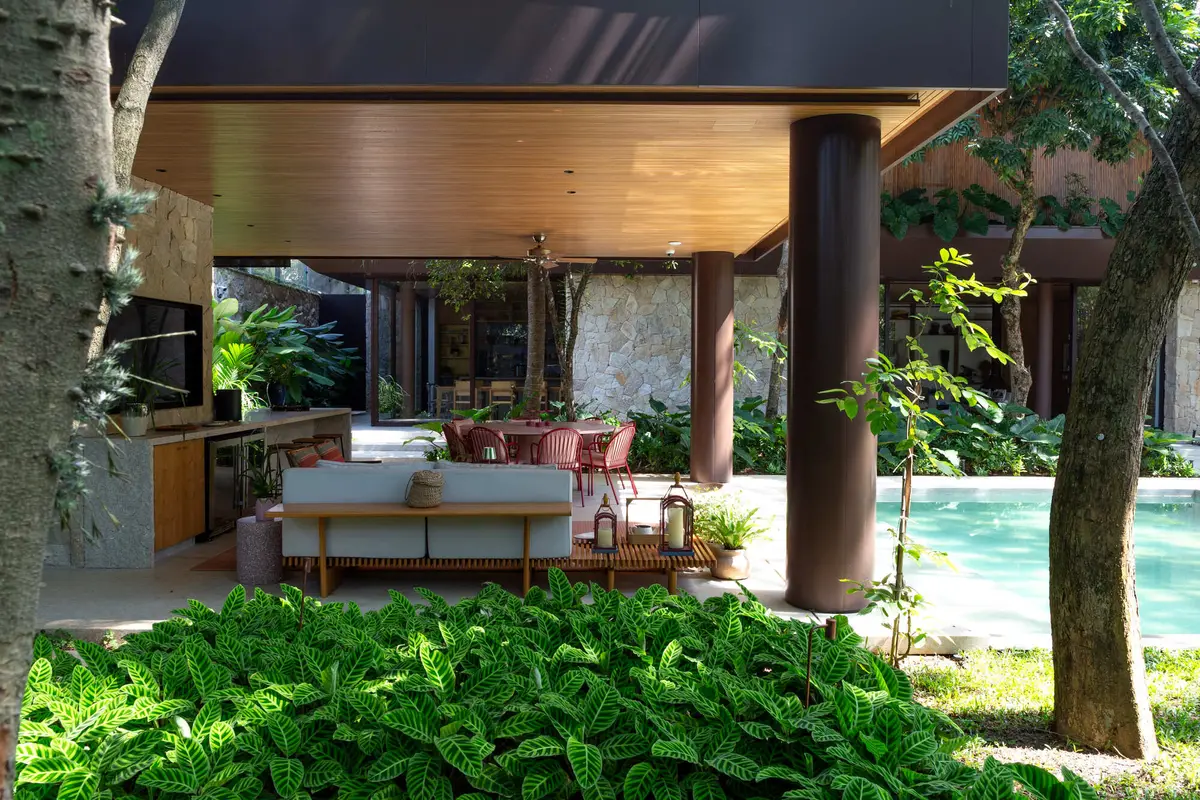
Triplex Arquitetura Shapes a São Paulo House Around the Trees That Were Already There
In the wooded Jardim Paulistano neighborhood, Casa MKN treats existing vegetation as the primary design constraint.


Most residential projects in São Paulo begin with a cleared lot. Casa MKN, designed by Triplex Arquitetura under the direction of lead architect Cristiano Terrone, began with a different premise: the trees stay, and the house figures itself out around them. On a wooded site in the Jardim Paulistano neighborhood, the 900 m² residence defers to mature canopy trees at nearly every decision point, from the positioning of its two main volumes to the orientation of its facades, the depth of its eaves, and even the placement of its pool.
What makes this worth paying attention to is not the ecological sentiment, which is common enough in contemporary practice, but the formal discipline it produces. The house is relentlessly horizontal, governed by straight lines and continuous planes that read as a deliberate counterpoint to the organic tangle of trunks and canopy above. Granite with a rustic finish anchors the base; aluminum slats painted in a wood finish wrap the upper volume, lending warmth without the maintenance liability. The result is a house that looks both grounded and lightweight, solid at the base and permeable at the top.
Arriving Through Dappled Light
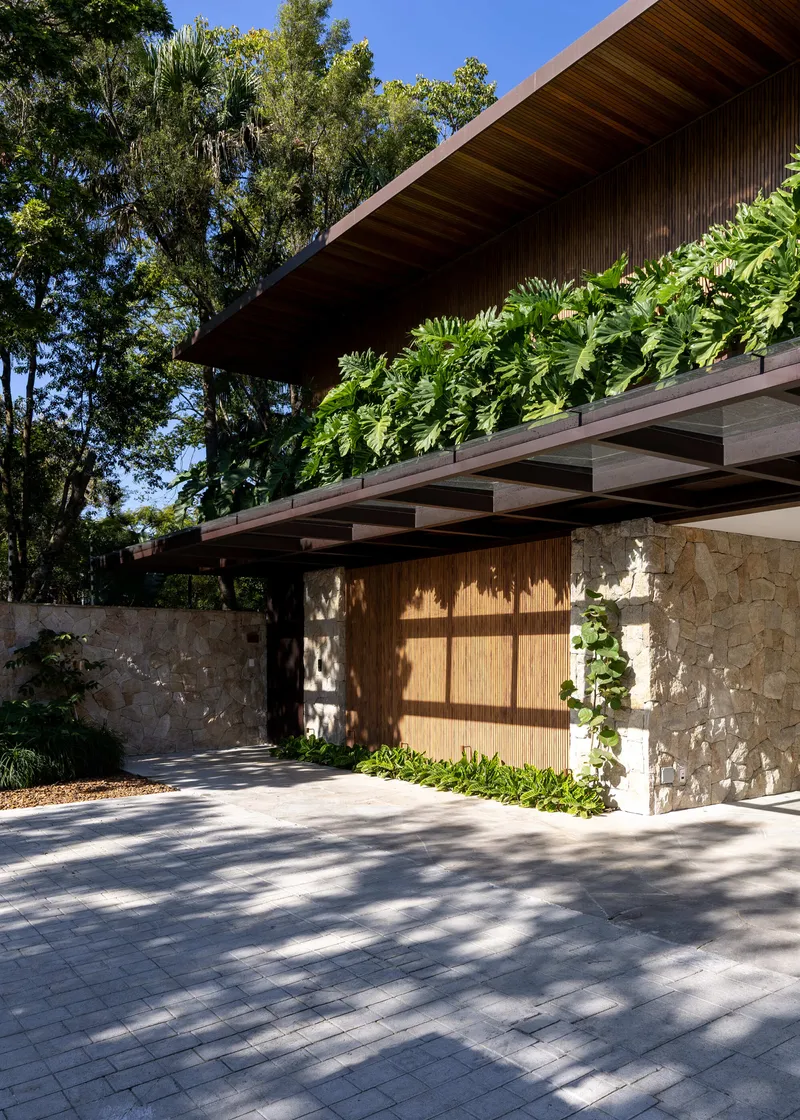
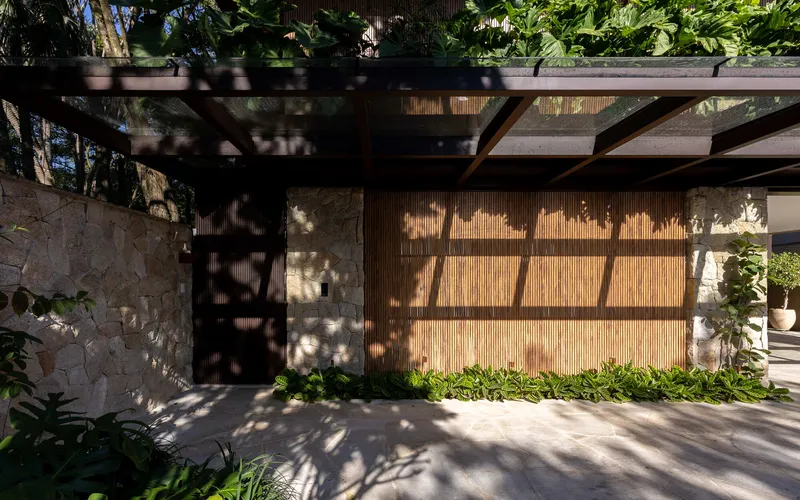
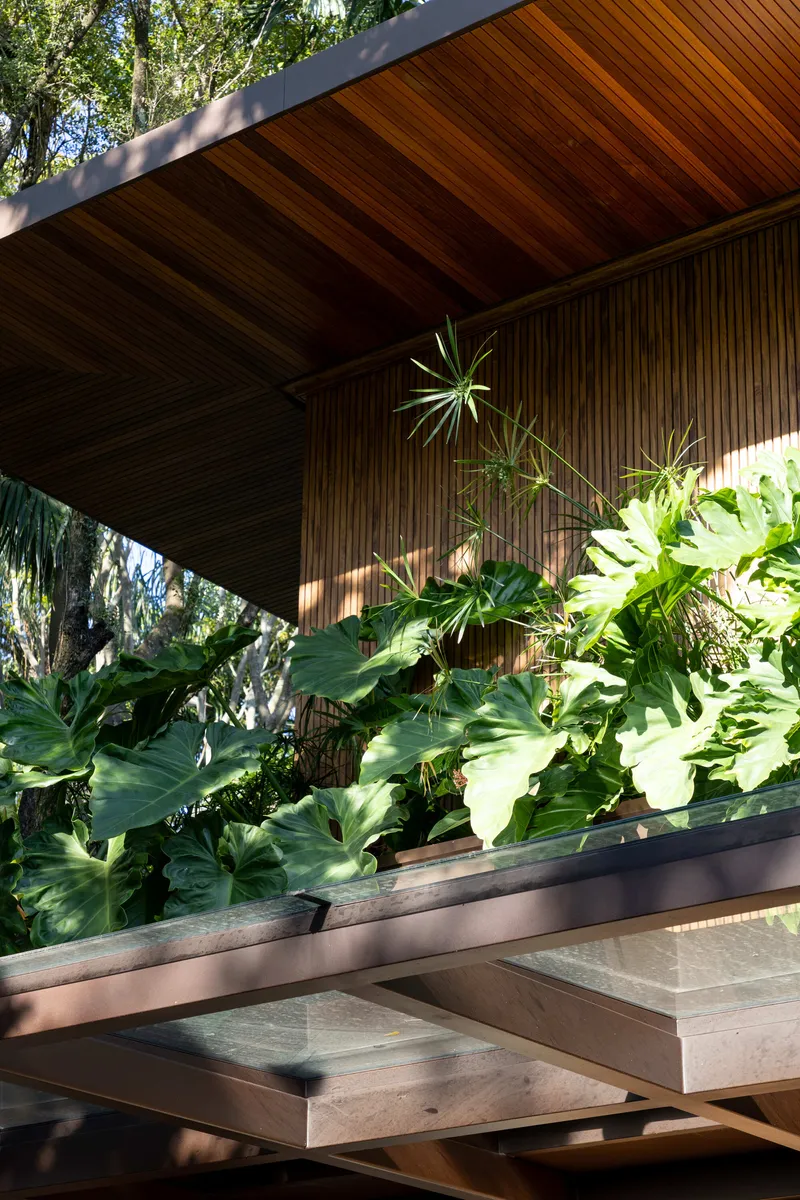
The entrance sequence sets the tone. A deep overhang with exposed beams shelters a path flanked by rough stone walls and a timber slat screen that filters light into soft, shifting patterns on the ground. Ferns hang from the soffit, and a planted green roof above the pergola blurs the line between built form and landscape. It is a slow, deliberate arrival, one that asks you to adjust your eyes before stepping inside.
The vertical timber slats recur throughout the project as a screening device, modulating privacy and solar exposure while maintaining visual continuity with the surrounding foliage. The interplay of shadow on these surfaces changes throughout the day, creating an architecture that performs differently at noon than it does at four o'clock.
Stone, Aluminum, and the Logic of Stacking
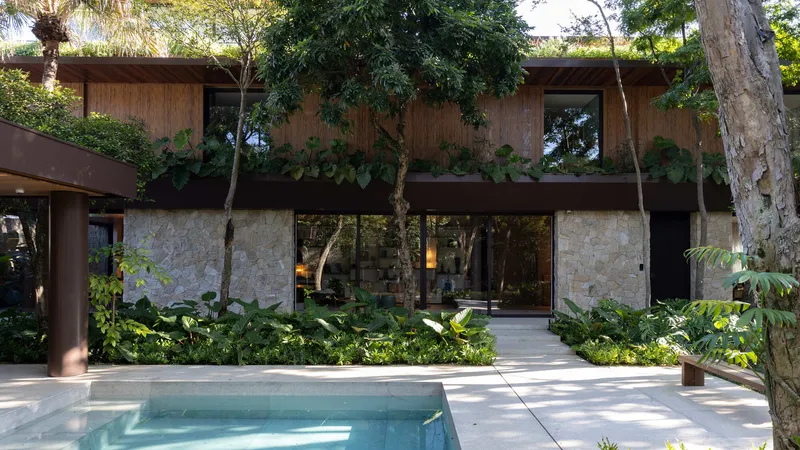
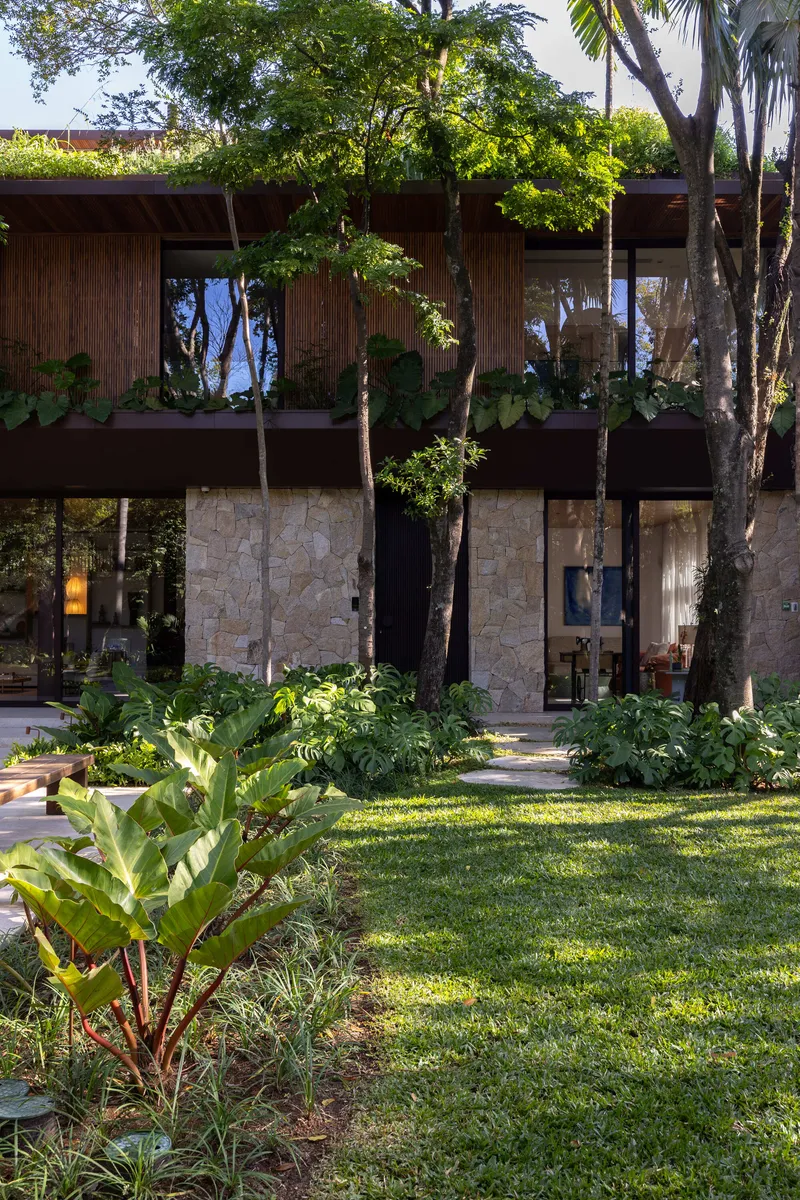
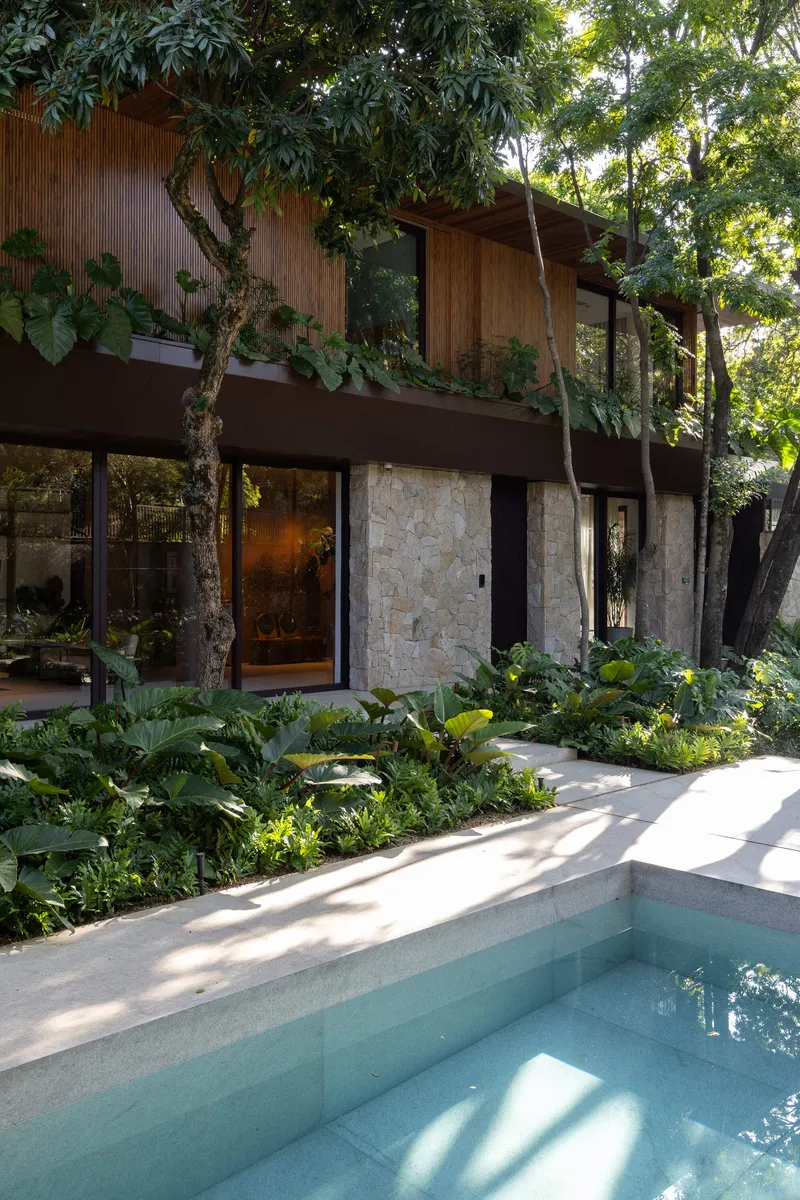
The two-storey facade facing the pool presents the material strategy most clearly. The rustic granite base reads as a geological datum, something that belongs to the ground. Above it, the aluminum-slat upper volume floats with a lighter visual weight, its wood-tone finish keeping it in dialogue with the canopy rather than competing with it. The two materials meet without a fussy transition, separated only by a recessed shadow line.
Seen from various angles through the trees, the house registers less as a singular object and more as a series of horizontal planes layered into the landscape. Wide eaves extend the roof planes outward, providing shade and rain protection while reinforcing the sense that the building is reaching into the garden rather than walling itself off from it.
The Pool as Social Connector
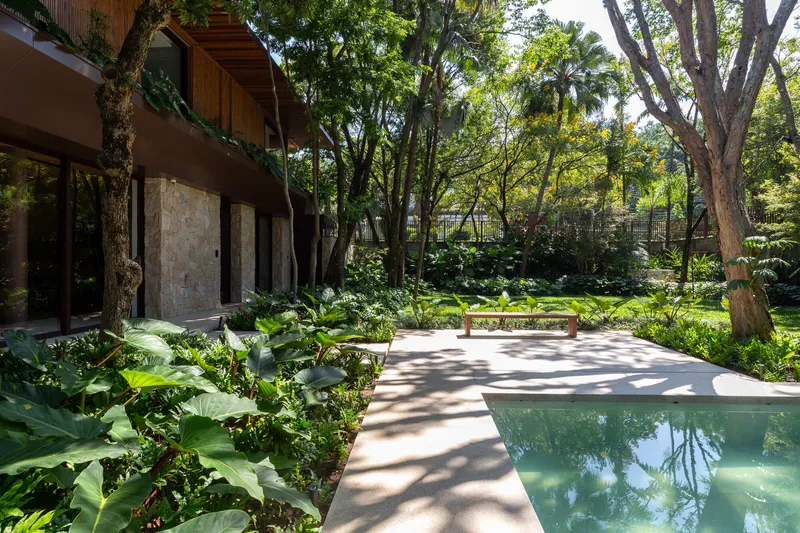
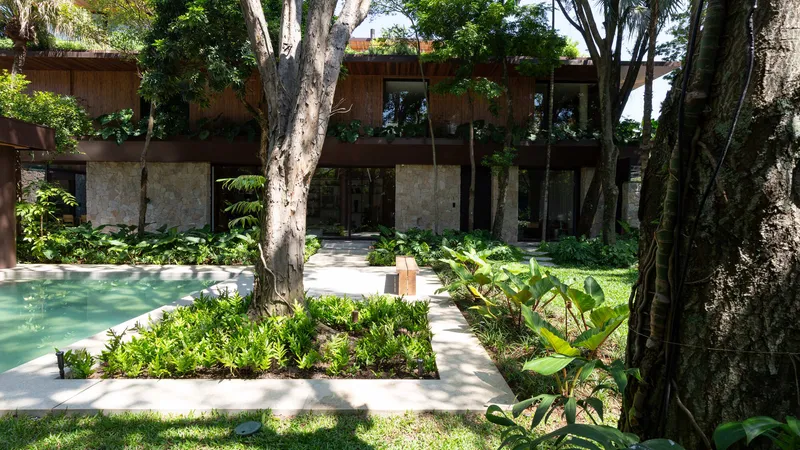
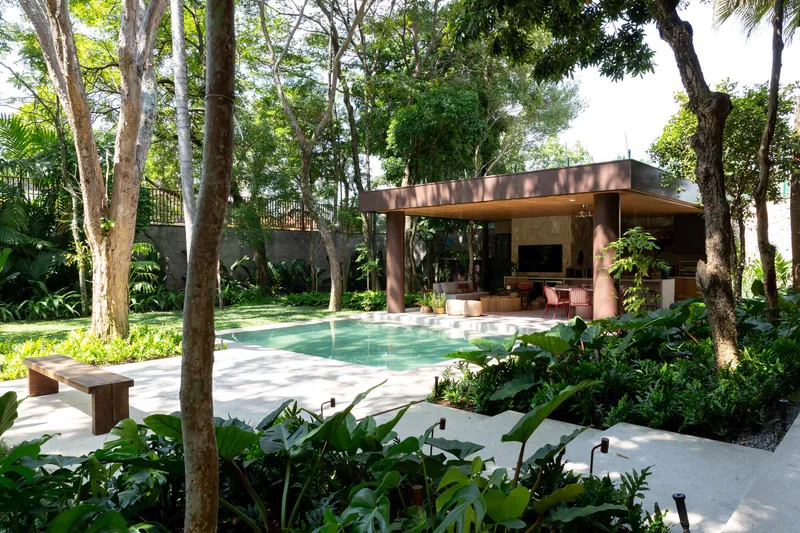
The swimming pool occupies the space between the residence and the densest area of preserved vegetation, and it functions less as a recreational amenity than as the social center of the plan. Concrete pathways wind between existing trees and planted beds to reach its edges. A covered gourmet area opens directly onto the pool deck, creating a single continuous zone for gathering that is simultaneously indoors and outdoors.
What Flávia Tiraboschi's landscape design achieves here is a kind of curated wildness. The planted beds around the pool are lush with tropical understory species, but the canopy trees are the originals, their trunks sometimes standing within arm's reach of the house's walls. The pool terrace does not feel carved out of the forest; it feels negotiated with it.
Living Under the Canopy
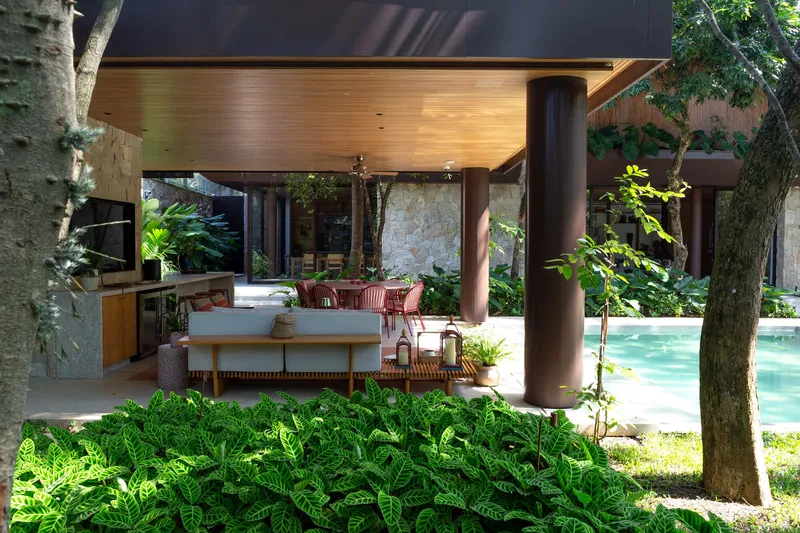
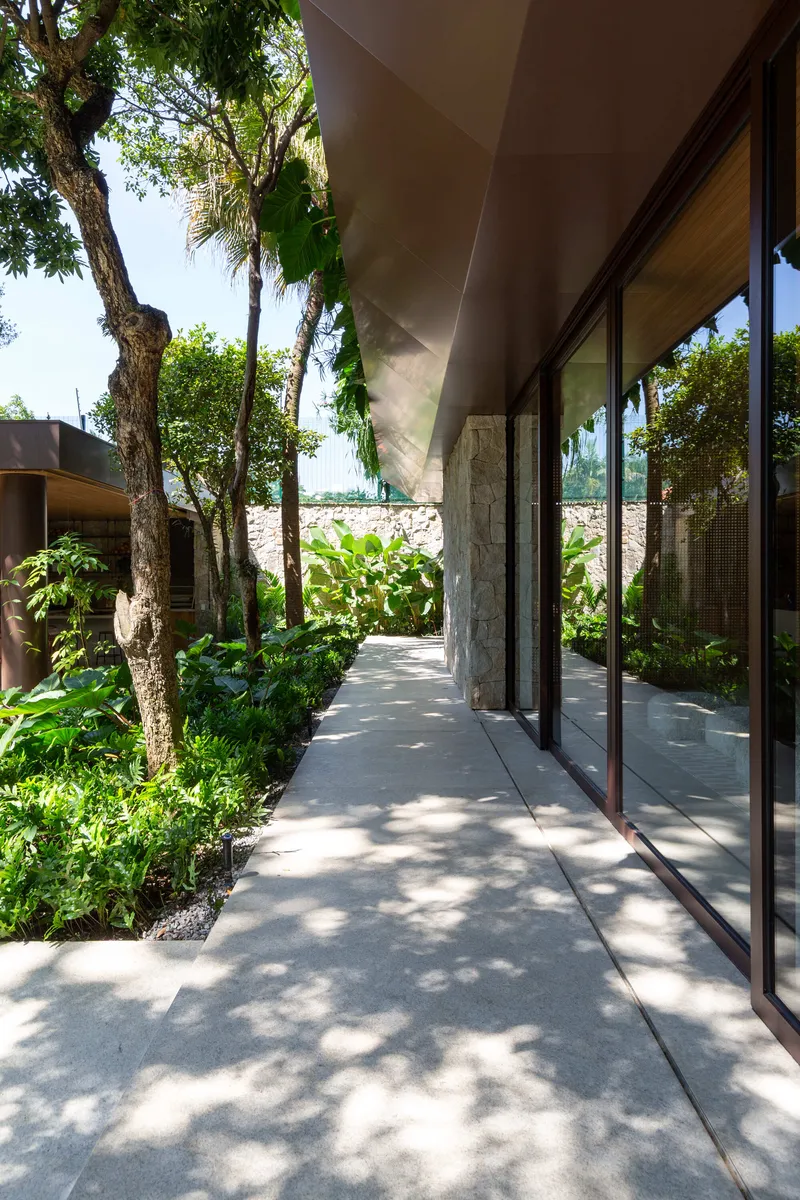
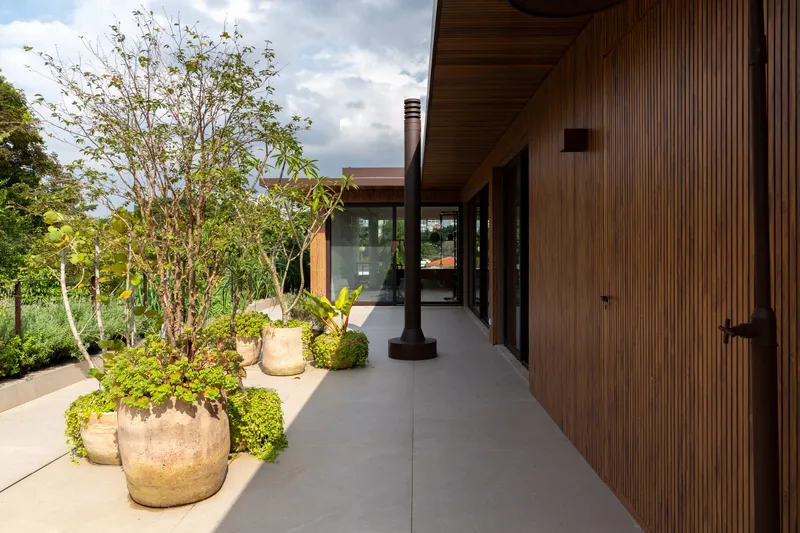
The open living pavilion is the project's most generous space, a room defined by a timber ceiling, cylindrical columns, and full-height openings to the pool and garden. Trees pass through the covered area at several points, their trunks treated as found columns that the architecture simply acknowledges. Interior designer Marina Linhares kept the furnishings low and warm-toned, letting the ceiling and the view do the heavy lifting.
Covered walkways along the ground floor use sliding glass doors to dissolve the boundary between circulation space and garden. Preserved trees stand inches from the glass, their shadows moving across the interior floors throughout the day. The lighting design by Studio 220V reinforces this quality after dark, washing the timber soffits with warm light that extends the sense of shelter outward into the planted beds.
Interior Thresholds
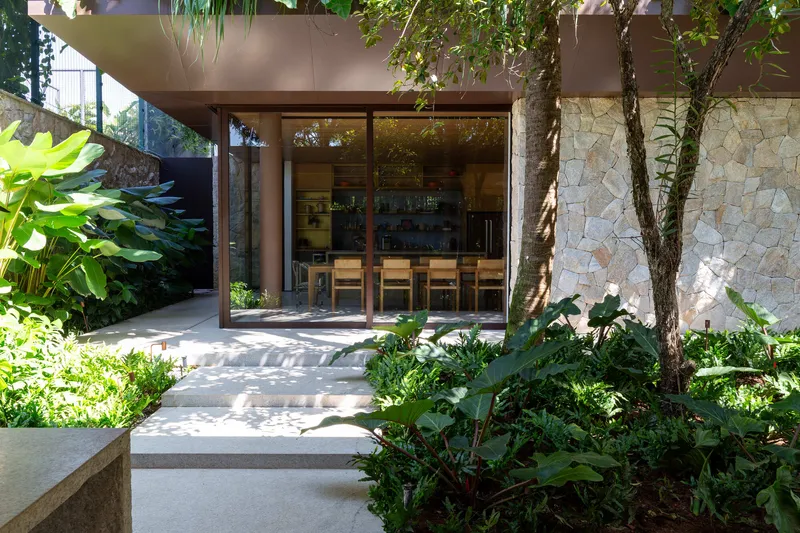
Looking into the dining area through fully opened glass doors, the stone wall behind the table anchors the composition while a mature tree trunk stands just outside the threshold, framed like a piece of sculpture. The deliberate blurring of interior and exterior extends to the large planters on the covered terrace, where trees grow in containers positioned alongside cylindrical structural columns. The distinction between what is planted and what is built becomes productively ambiguous.
Plans and Drawings
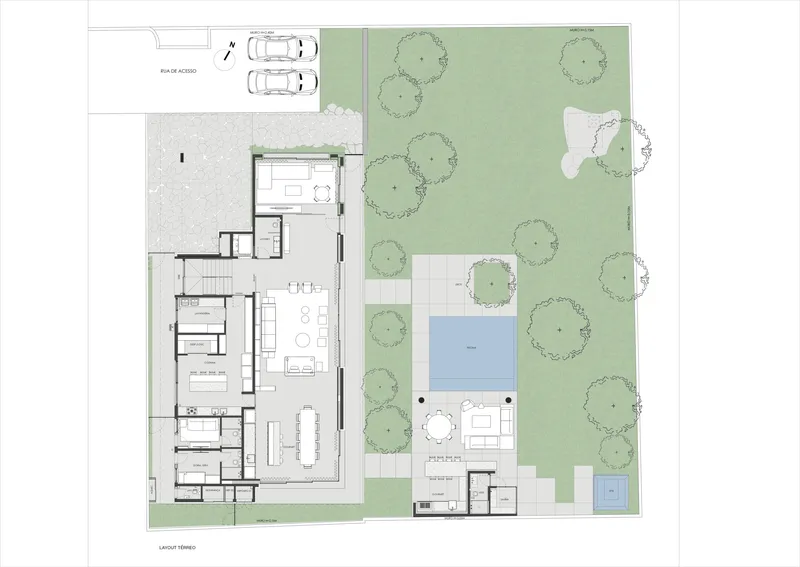
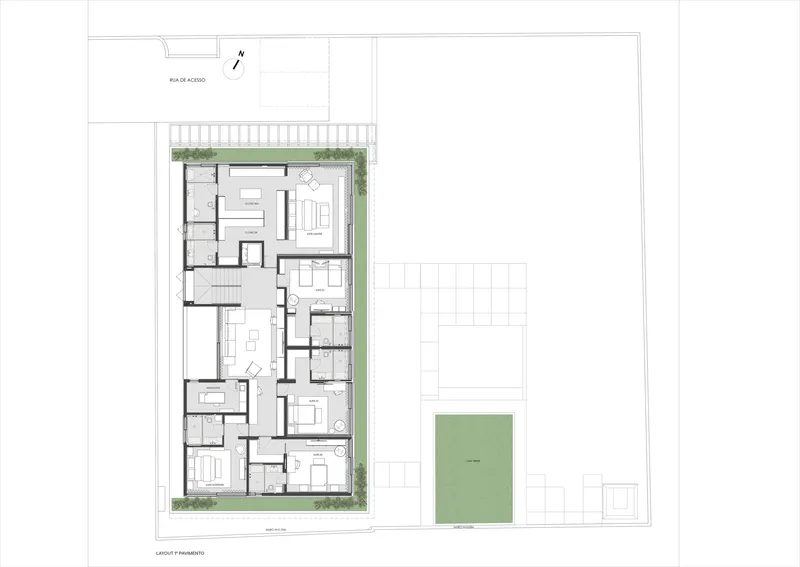
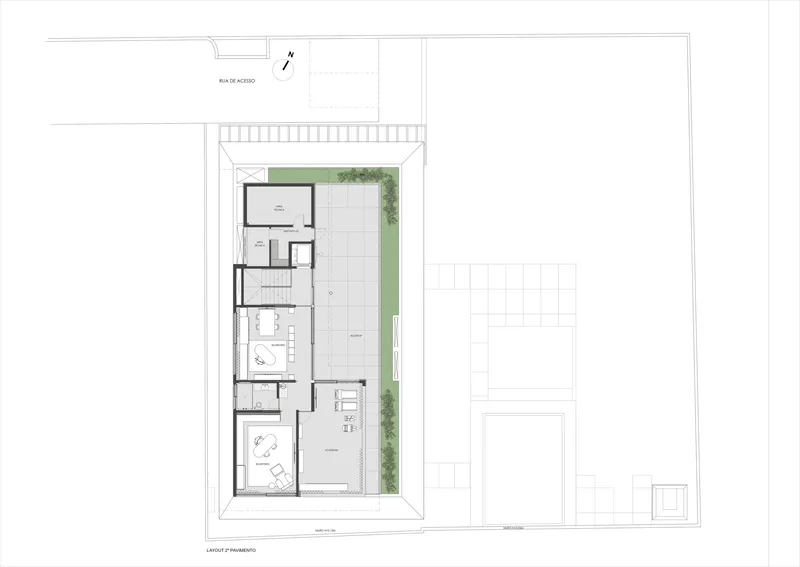
The site plan confirms what the photographs suggest: the two residential volumes are positioned to avoid the largest existing trees, creating a pinched central zone where the pool and garden sit. The ground floor plan reveals a linear organization with rooms opening to landscaped edges on both sides, ensuring cross-ventilation and visual access to greenery from nearly every space. The first floor is narrower, pulling back from the canopy and retaining a lateral garden strip that brings light and air to the upper rooms.
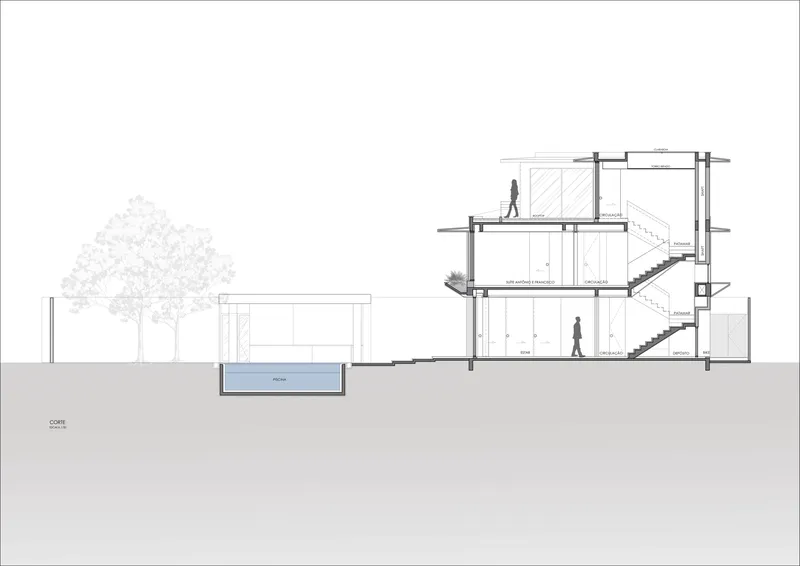
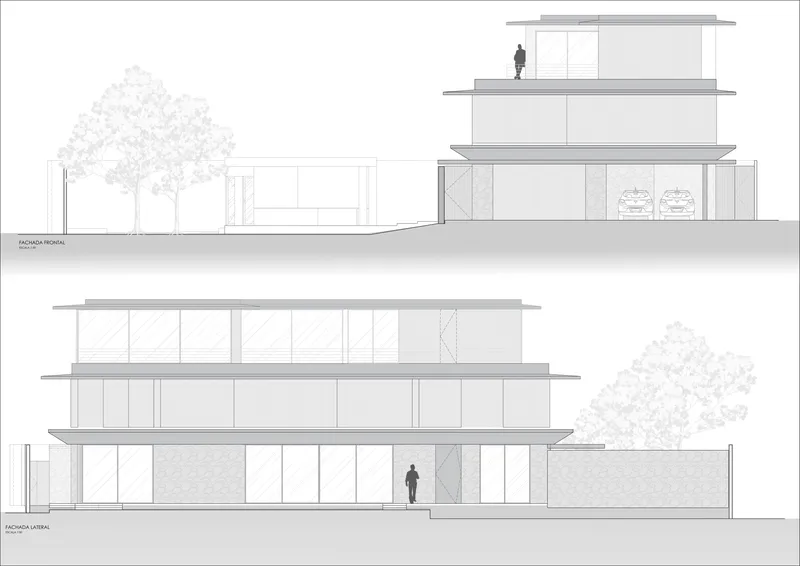
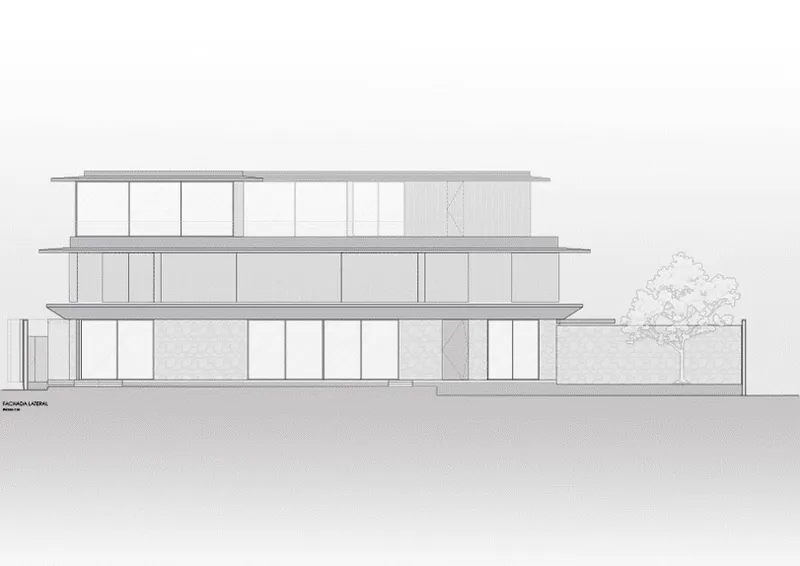
The section drawing is particularly revealing. It shows the relationship between the pool, the multi-level interior, and a preserved tree in the landscape, clarifying the vertical distances that the wide eaves and horizontal planes are working to mediate. The elevation drawings depict the stacked three-level volume with its glazed facades and horizontal slabs, and the inclusion of tree outlines in these drawings is not decorative. It is an honest representation of the design constraint that shaped every decision.
Why This Project Matters
The idea of designing around existing trees is hardly new, but Casa MKN demonstrates what happens when that constraint is taken seriously at every scale, from the master plan down to the position of a column. The result is not a house that looks like it was dropped into a forest clearing. It is a house that could not have been designed for any other site. Its volumes, its overhangs, its material palette, and its spatial sequences all derive from a specific set of trees that happened to be growing in Jardim Paulistano before the architects arrived.
Triplex Arquitetura, working with a strong collaborative team spanning landscape, interiors, and lighting, has produced a residence that is formally rigorous and experientially generous. The horizontal discipline gives the house clarity; the preserved canopy gives it soul. In a city where residential lots are routinely stripped bare before construction begins, that reversal of priority is the most significant thing about the project.
MKN House by Triplex Arquitetura, led by Cristiano Terrone. São Paulo, Brazil. 900 m². Completed 2023. Landscape architecture by Flávia Tiraboschi. Interior design by Marina Linhares. Lighting by Studio 220V. Construction by LAR Construtora. Photography by Dândara Nunes Bettini.
About the Studio
Share Your Own Work on uni.xyz
If projects like this are the kind of work you want to make, uni.xyz is a place to publish your own, find collaborators, and enter design competitions.


Popular Articles
Popular articles from the community

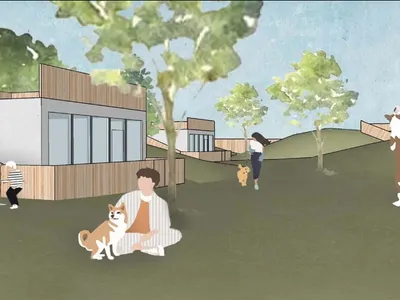
Temporary Home for Dogs: A Reversed Zoo Rethinks Animal Shelter Architecture
In Bucharest, a sinuous corridor and freed landscape flip the logic of containment, designing a shelter that works to make itself unnecessary.

Manzana Morphosis: Stretching Barcelona's Grid into a Living Landscape for 2050
A radical reworking of the Eixample manzana turns density into a tool for generous public space, vertical ecology, and environmental performance.

Extended Shell: Retrofitting Kolkata's Balconies as Living Urban Thresholds
A modular retrofit system recovers the social and environmental intelligence of Kolkata's historic verandas for contemporary Park Street residents.

Opera by the Sea Estonia: Three Shells Dissolving Architecture into Tallinn's Coastline
A winning opera house proposal replaces monumental form with interconnected shells that blur the boundary between building, park and Baltic Sea.

Similar Reads
You might also enjoy these articles

Pixel Gardens: One Repeated Module Stacked Into a Terraced Social Housing Tower for Famagusta
Salem Bader's shortlisted housing tower builds a vertical neighbourhood from one repeated module, offsetting units to carve terraces, light and air.

Bao Huynh Watercolor Atelier: A Serene Art Retreat in Hội An
Bao Huynh Watercolor Atelier in Hội An blends multifunctional art spaces, sustainable design, local materials, and family-friendly living in a serene environment.

Atelier Macri Concept Store Interior Design by CASE-REAL
Atelier Macri store features a "ko" counter, walnut wood details, cork displays, blending retail, gallery, and seamless customer experiences.

Manuel Vargas Izquierdo Stadium and High-Performance Sports Center: Architectural Excellence in Jalpa de Méndez
The Manuel Vargas Izquierdo Stadium blends sustainable design, inclusive sports facilities, and cultural-inspired architecture, revitalizing Jalpa de Méndez’s public spaces.


Comments (0)
Please login or sign up to add comments
No comments yet. Be the first to comment!