
Attmo Arquitetos Scatters Four Timber Pavilions Across a Bahian Coastal Plot for GS House
A glued laminated timber residence in Trancoso, Brazil, links private and social modules through a landscape of walkways and water mirrors.


Most houses that claim to dissolve into nature do so with a single sweeping gesture: a long glass wall, an oversized sliding door, a cantilevered deck. GS House, designed by Attmo Arquitetos in Trancoso on Bahia's south coast, takes a less theatrical approach. Instead of one pavilion performing openness, four distinct modules are distributed across an elongated 3,267 square meter plot, connected by a wooden walkway that threads through landscape, water features, and planted courtyards. The strategy is closer to a small village than a villa.
What makes the project genuinely interesting is the structural commitment behind the idea. The entire house is built in glued laminated timber, with concrete bases reserved only for the two-story module where the span demands it. That hybrid logic, wood where lightness works and concrete where gravity insists, keeps the 1,351 square meter residence from feeling heavy despite its considerable size. The modular plan also solves a common problem in tropical houses: it separates private bedrooms from social and leisure zones without needing corridors, using the landscape itself as circulation.
A Campus of Rooms
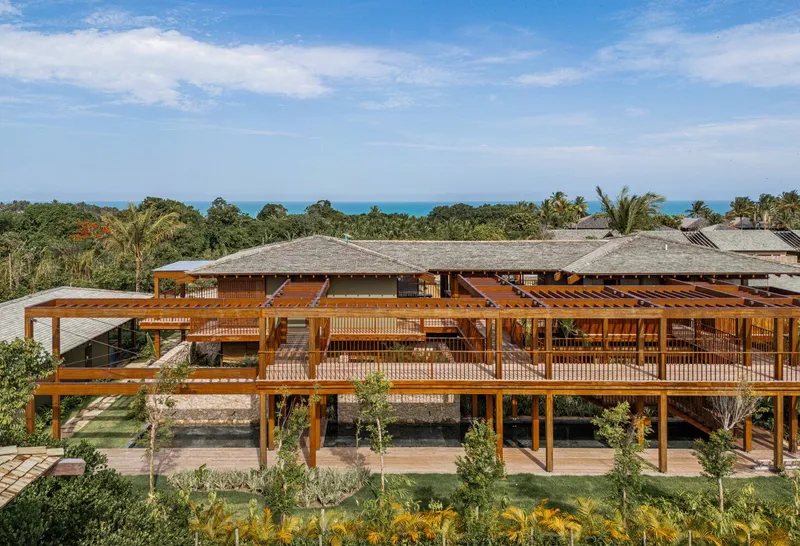
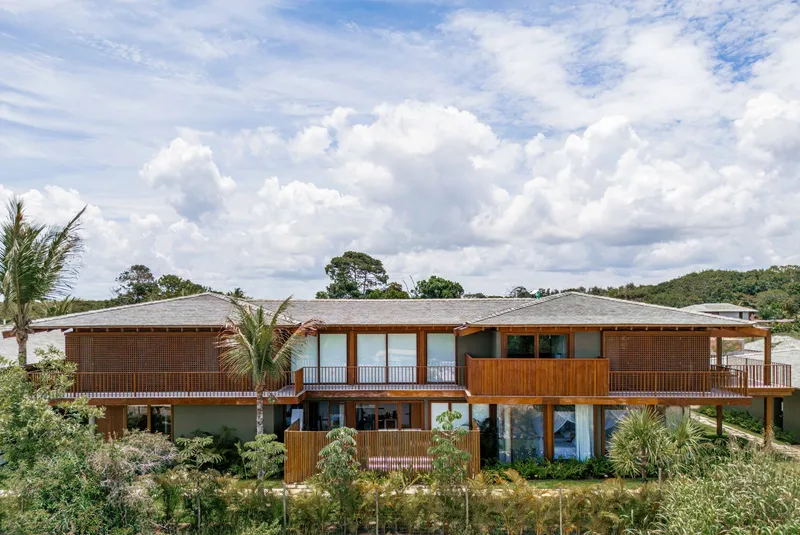
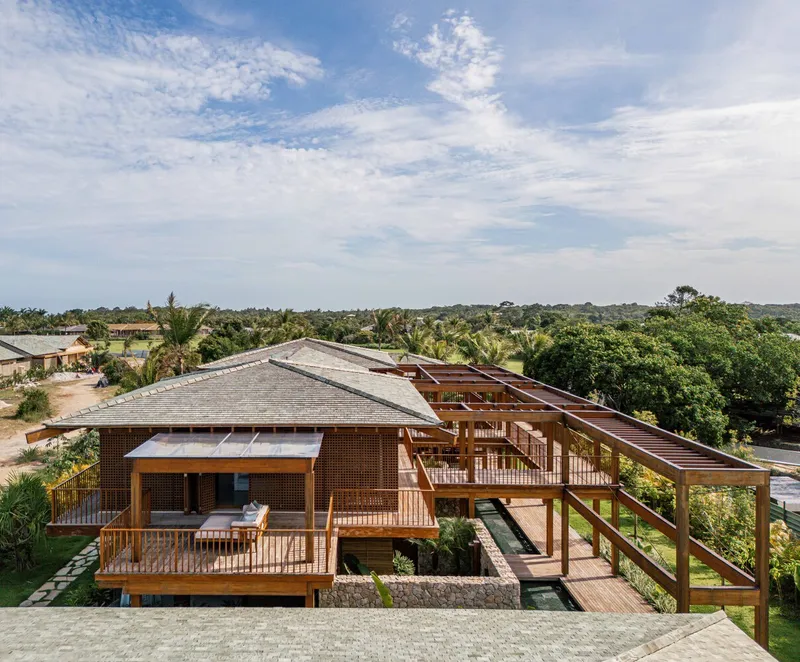
Seen from a distance, GS House reads as a cluster of hipped and gabled timber roofs floating above the tropical canopy. The two front modules handle pragmatics: parking, gym, guest suites, service areas, and a two-story family wing with children's rooms, a master suite, and a small office above. The two rear modules open up dramatically, housing the living and dining areas, a gourmet kitchen, and a covered balcony that faces the condominium's shared green expanse.
The decision to break the program into four volumes rather than one consolidated mass creates a powerful thermal advantage. Cross-ventilation occurs not just within rooms but between buildings, as breezes sweep through the gaps. Double-height ceilings in the social module push hot air upward and out through clerestory windows, a move that in this coastal climate reduces reliance on mechanical cooling to a minimum.
Timber Structure as Identity
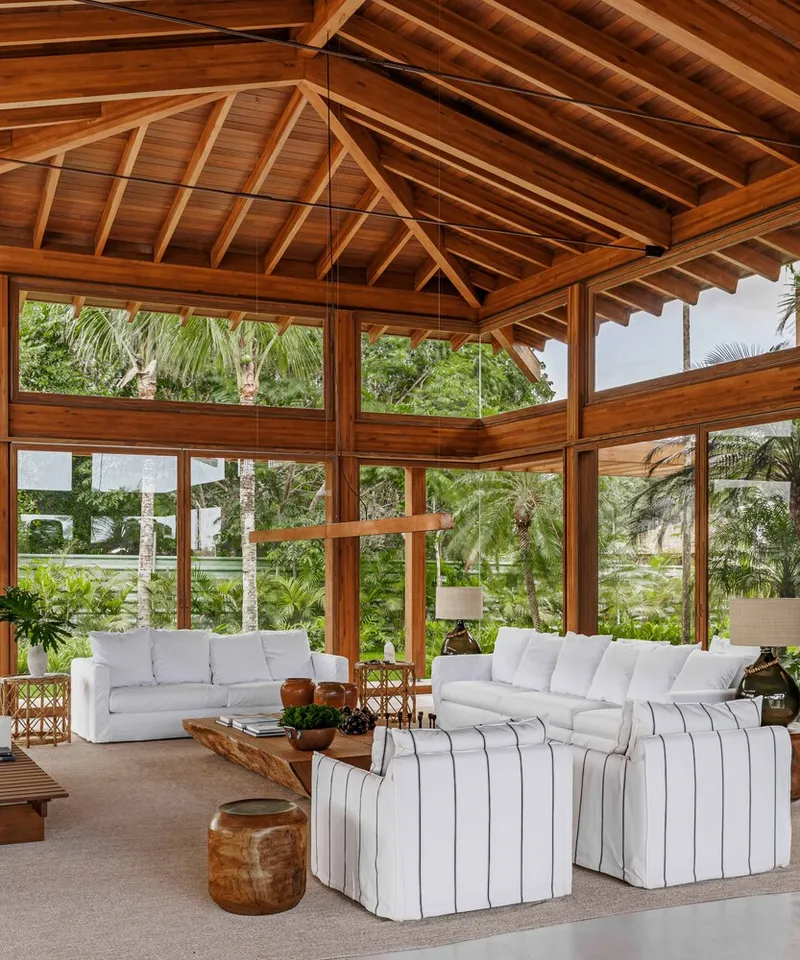
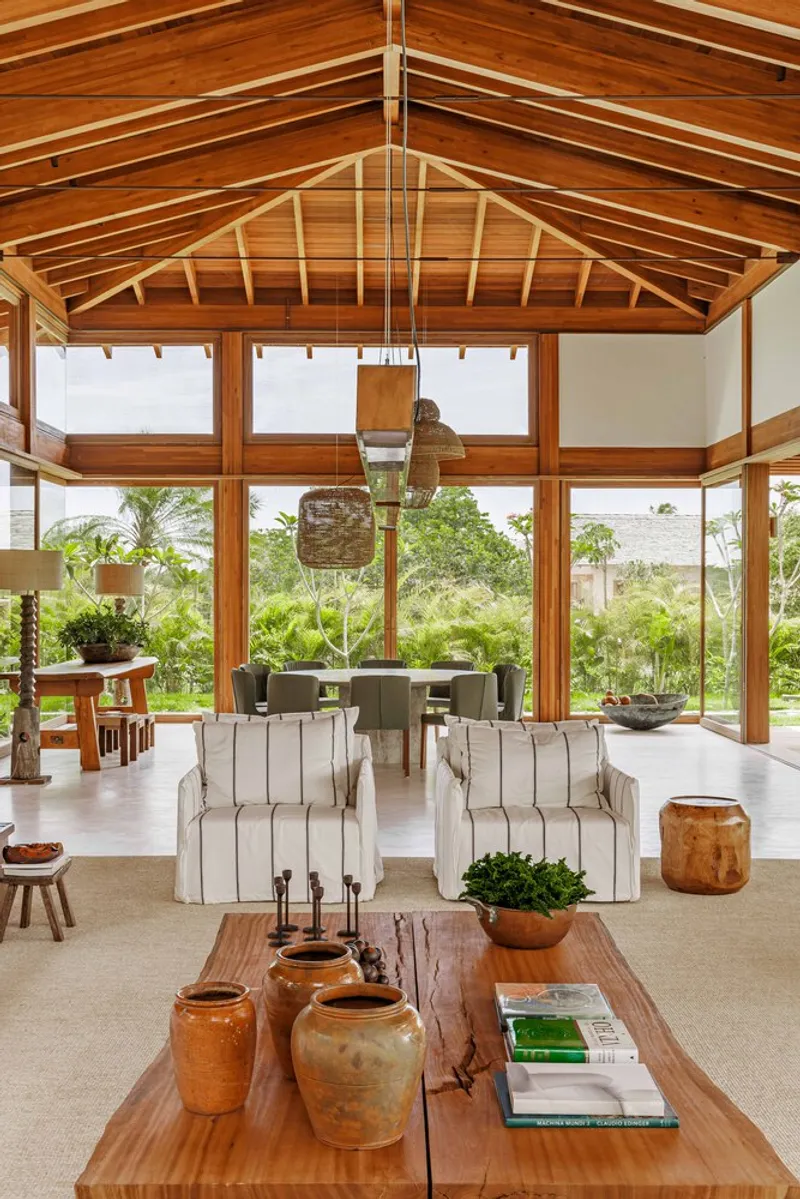
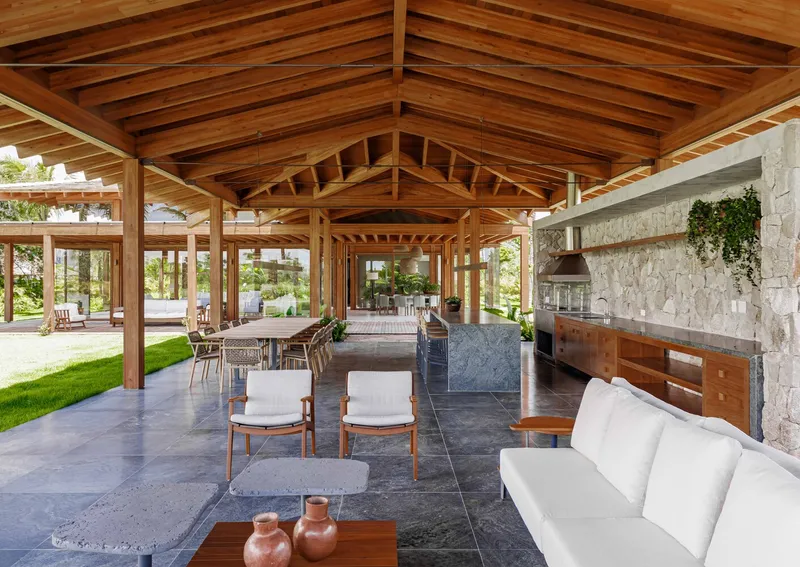
The glued laminated timber framing is not hidden. It is the architecture. Exposed rafters, columns, and trusses establish the visual rhythm of every room. In the double-height social pavilion, the gabled ceiling structure becomes the dominant spatial experience, its geometry repeated and visible through continuous clerestory glazing that wraps the upper walls. The timber is slender because laminated wood allows longer spans with smaller sections than solid sawn timber, and the architects exploit this: the result is an airy, almost skeletal framework that feels more like a well-crafted boat than a building.
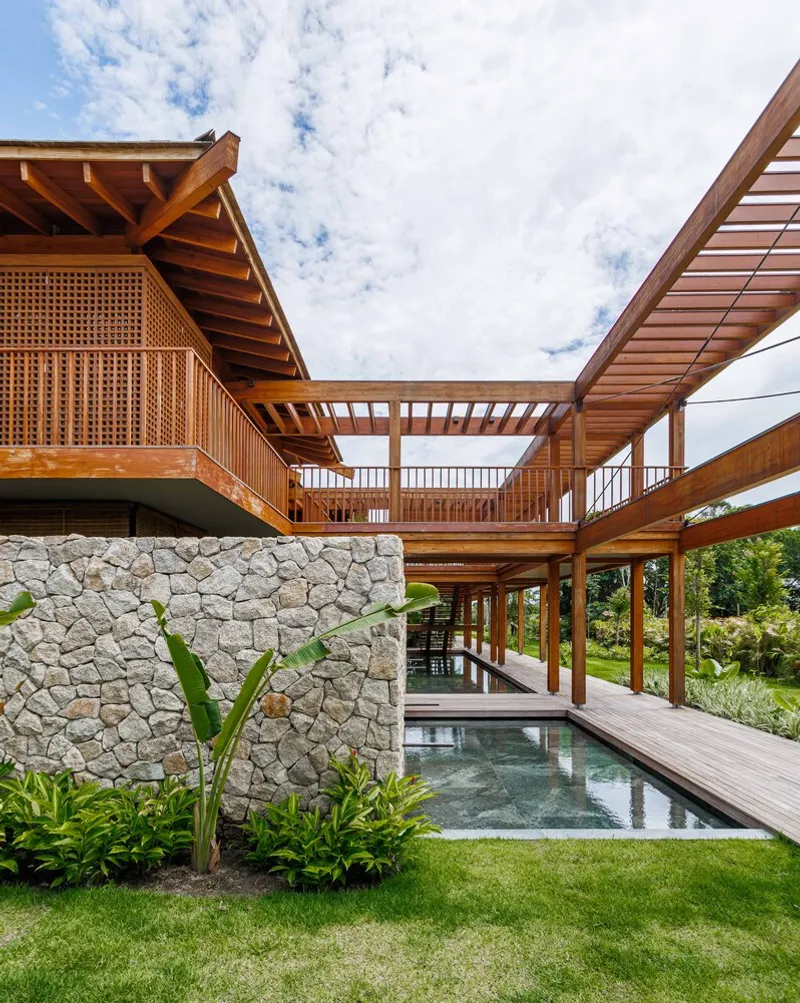
Where concrete appears, at the base of the two-story module, it is handled plainly and honestly. Moledo stone garden walls provide the visual weight that the timber deliberately avoids, grounding the composition without competing with it.
The Walkway as Architecture
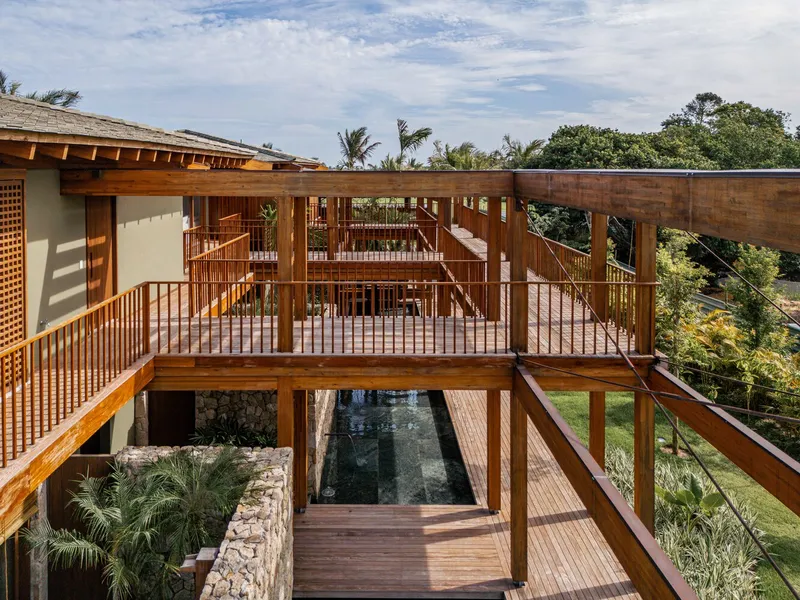
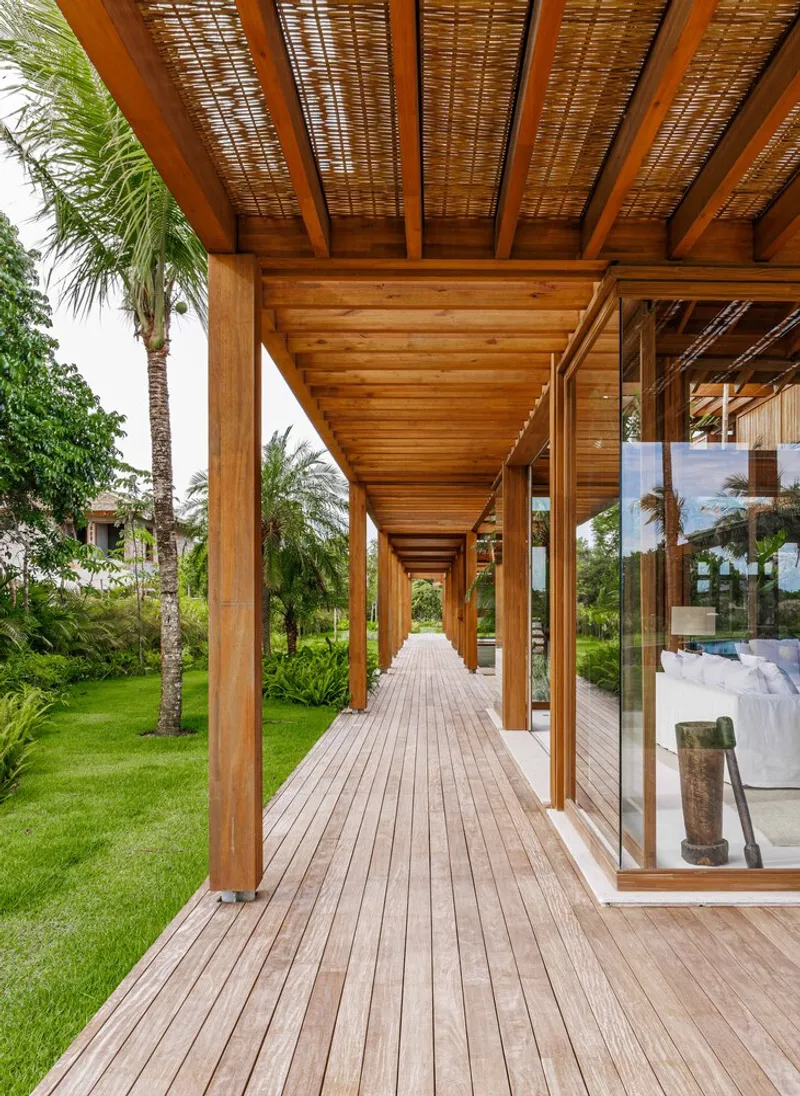
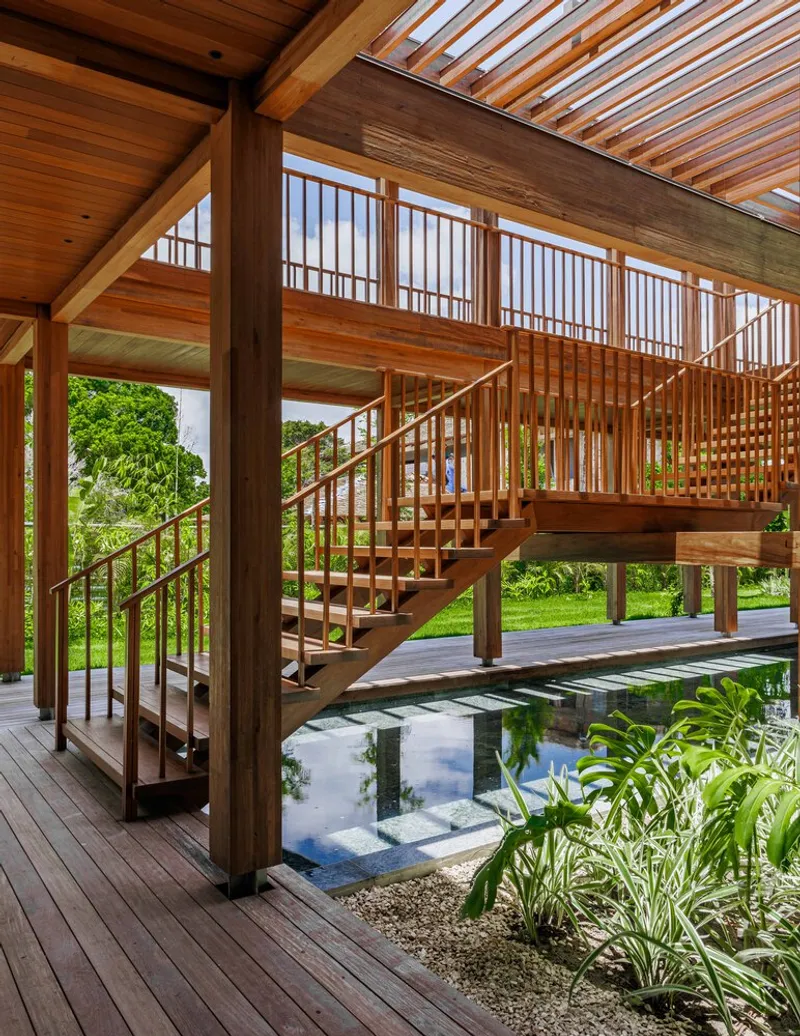
The cumaru wood walkway connecting the four modules is more than a path. It bridges over reflecting pools, passes beneath slatted pergolas, and opens into planted courtyards, turning daily movement through the house into a sensory sequence. Water mirrors sit beneath timber bridges, amplifying the sound of footsteps and reflecting the underside of the structure. It is a deliberate slowing down: you cannot rush between the kitchen and the pool without noticing the palms, the sky, the water.
The reflecting pools also serve a passive cooling function, drawing heat from the air through evaporation. In a region where humidity is already high, this is a subtle play: the water features work less as evaporative coolers in the traditional sense and more as thermal mass elements that stabilize microclimatic conditions around the walkways.
Living Spaces Open on All Sides
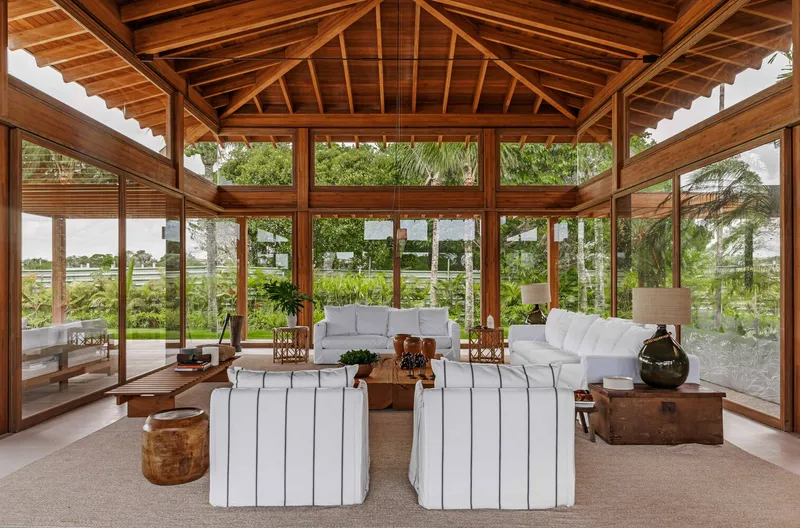
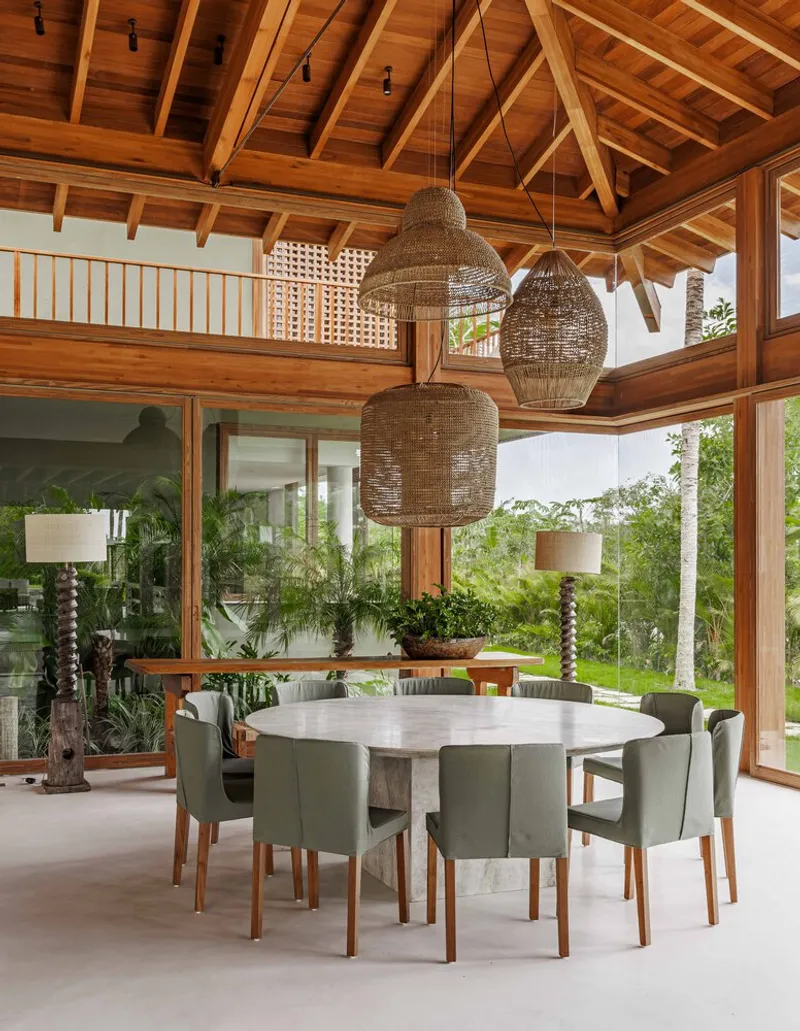
The social pavilion is the centerpiece. Glazed on all sides and topped with a pitched timber roof, it functions less as a room and more as a covered clearing. Woven pendant light fixtures hang from the exposed structure, and a stone fireplace wall anchors one end of the axial sequence. The dining area sits beneath this volume with a round table, reinforcing the informality the architects were after: no head of the table, no formal procession.
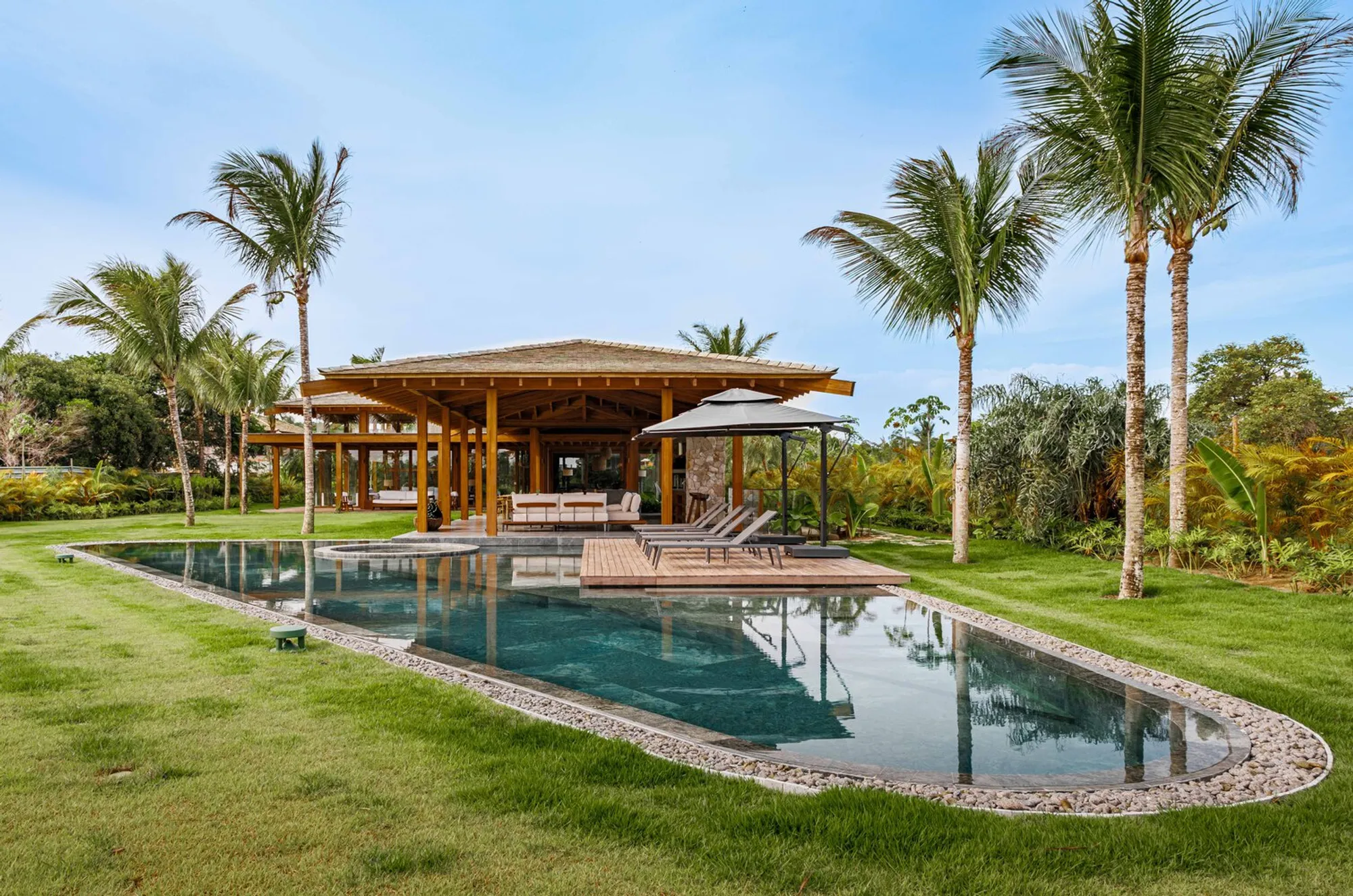
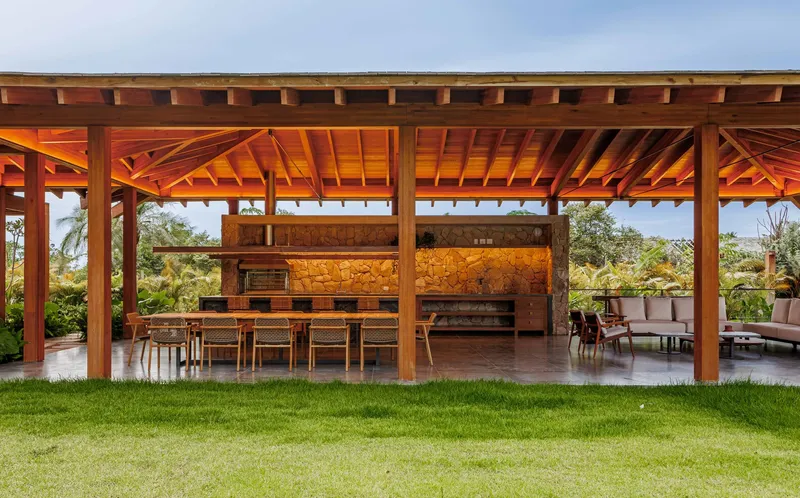
Module four, the gourmet area, extends this openness further. A stone grill wall and timber shelving form a functional outdoor kitchen shielded by the deep eaves of the roof. The space looks directly onto the triangular swimming pool, which follows the plot's geometry and includes a sundeck, hydrotherapy section, shallow beach area, and swimming lane packed into its unusual footprint.
Private Rooms with Their Own Gardens
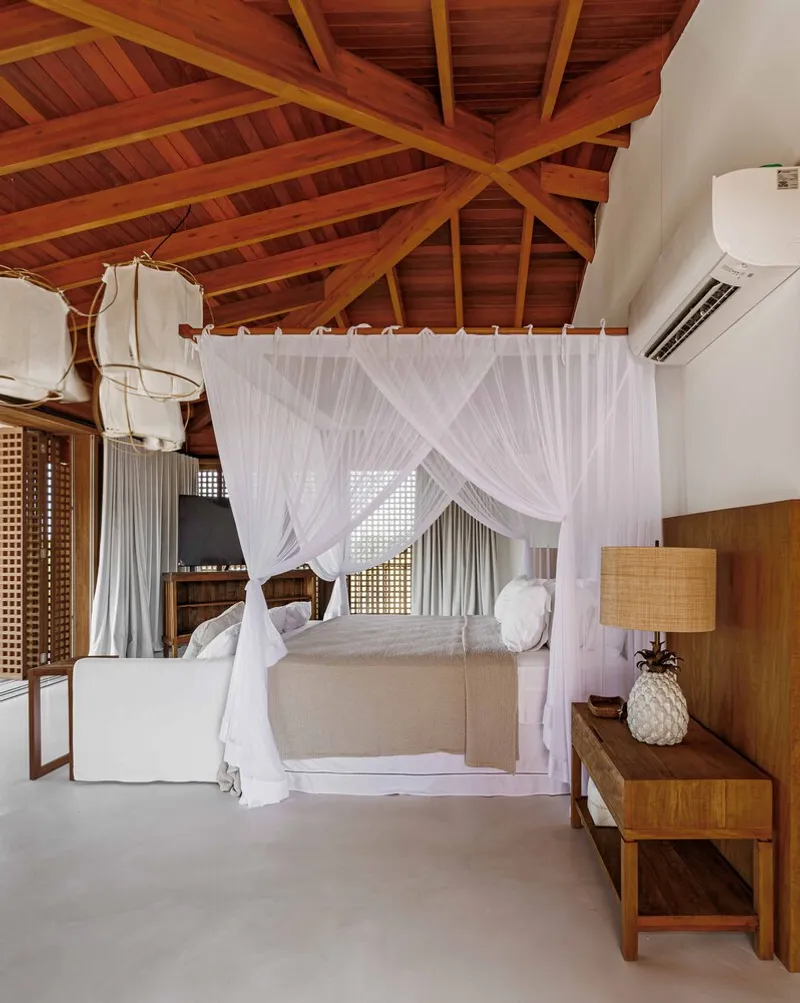
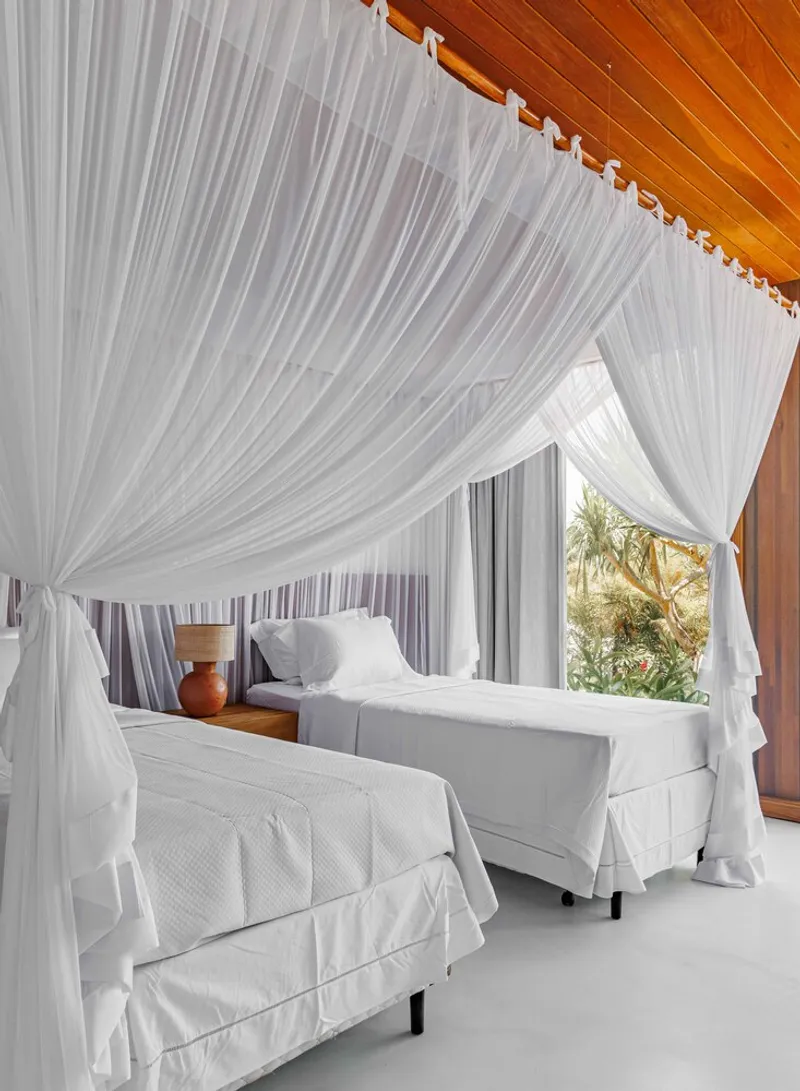
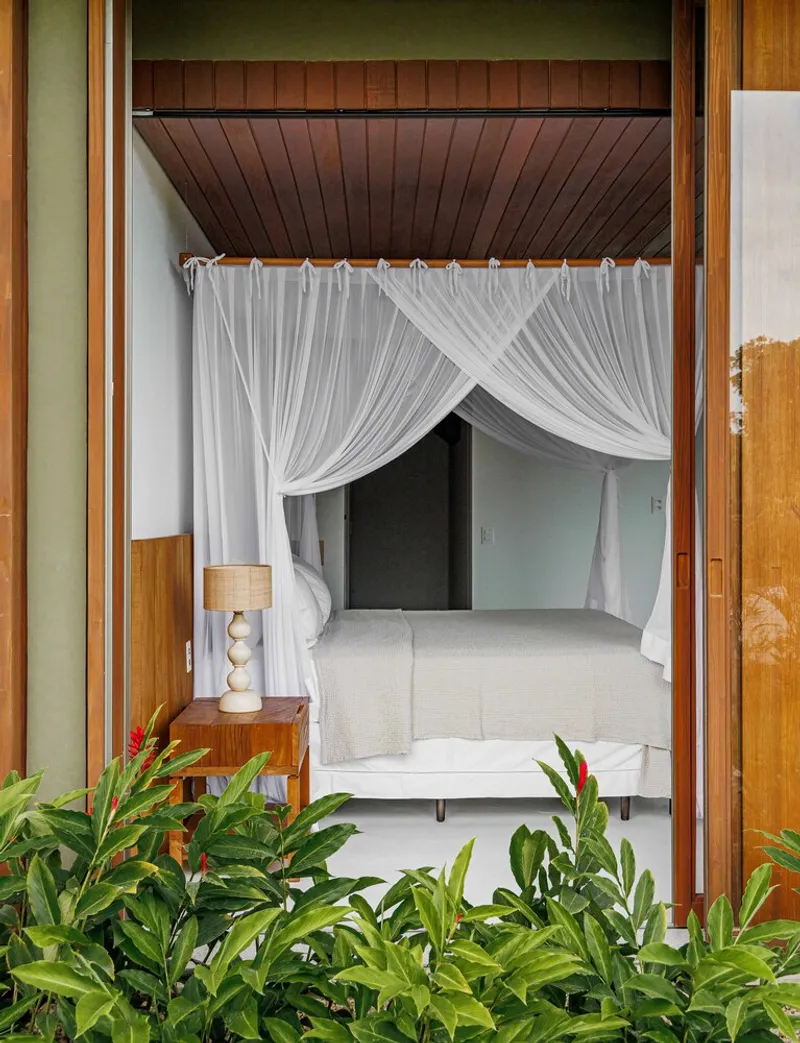
The bedrooms continue the house's refusal to separate inside from outside. Each suite includes its own private courtyard or garden, visible from the bed and accessible from the bathroom. White canopy beds, fabric pendant lights, and locally crafted straw ceiling finishes give the rooms a soft, regional character without descending into resort cliché. The master suite occupies the upper floor of the two-story module, oriented east to catch morning light and shielded by timber muxarabi screens that filter glare while allowing air to pass.
Children's rooms use mosquito netting draped over twin beds beneath curved timber soffits, a practical solution that doubles as spatial definition. The overall material strategy in the private zones is restrained: light-colored canvas, twill fabrics, and the warm tone of the timber structure do most of the work.
Bathrooms as Courtyards
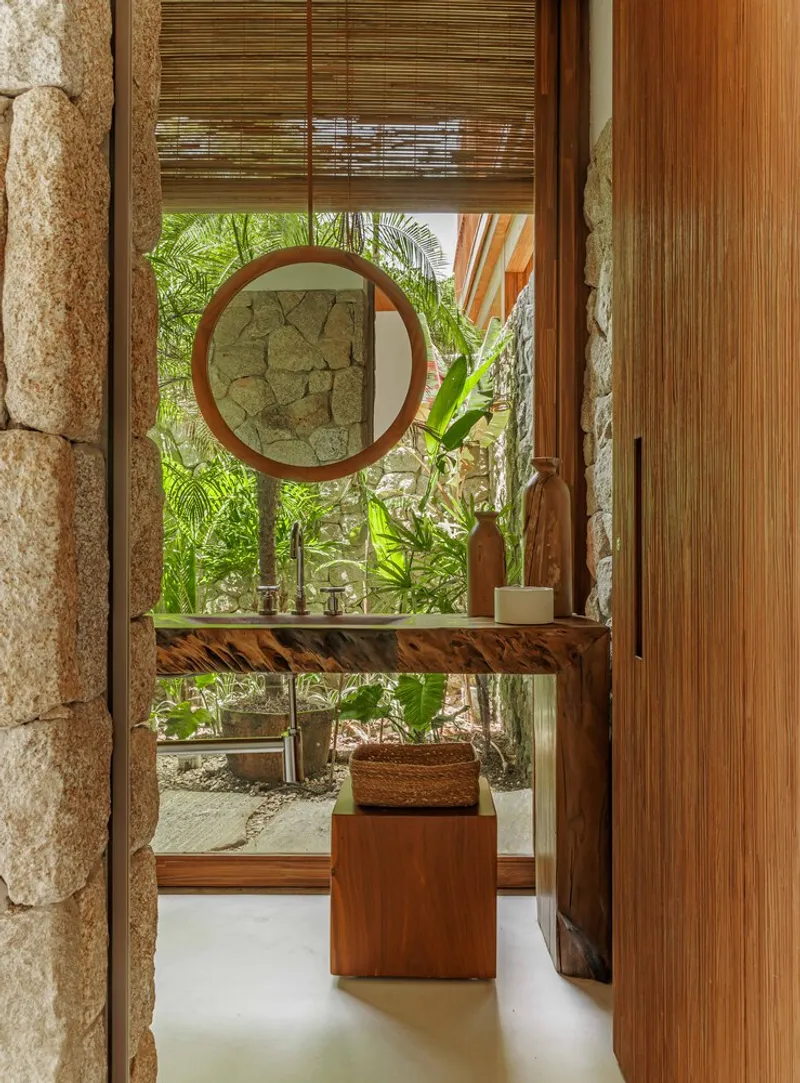
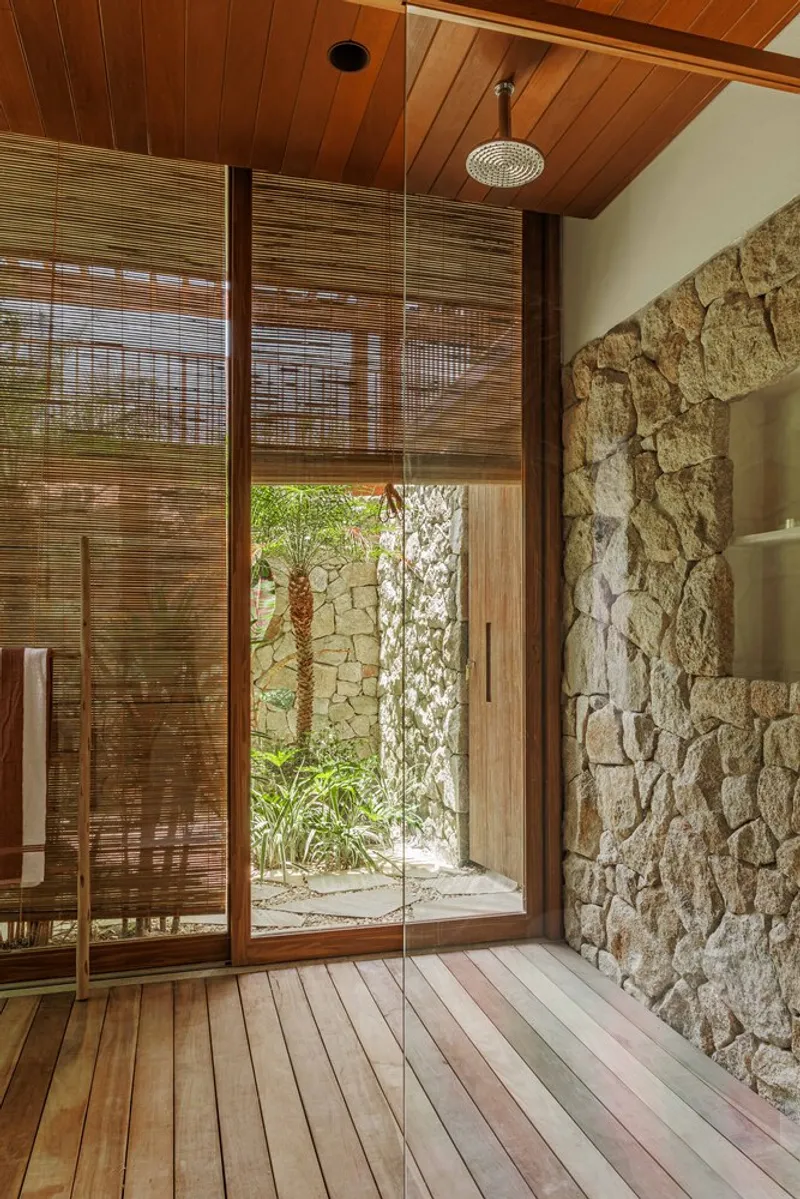
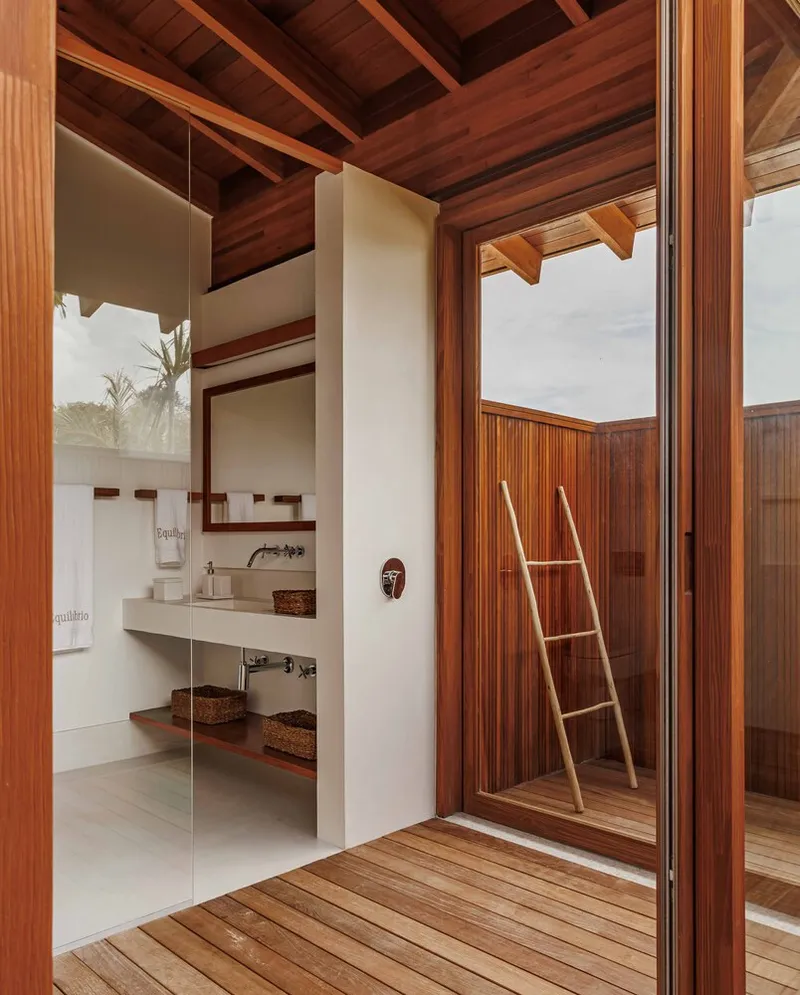
The bathrooms deserve their own mention because they are among the most resolved spaces in the project. Each one opens onto a screened courtyard with planting, effectively turning a utilitarian room into a semi-outdoor experience. Stone walls, bamboo screens, and floating concrete vanities keep the palette grounded. One shower enclosure uses rough stone and bamboo in combination, a pairing that could easily feel forced but here reads as natural because the material logic is consistent with the rest of the house.
Details like repurposed mill screws transformed into copper light fixtures and antique trunks used as storage speak to an approach that values specificity over catalog specification. These are not gestures toward sustainability branding; they are choices rooted in the regional craft tradition of southern Bahia.
Pool and Landscape as Extension
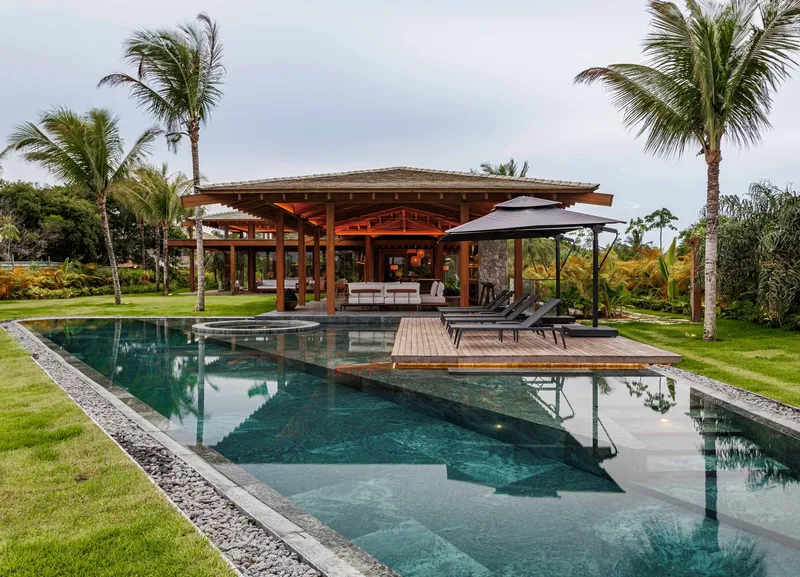
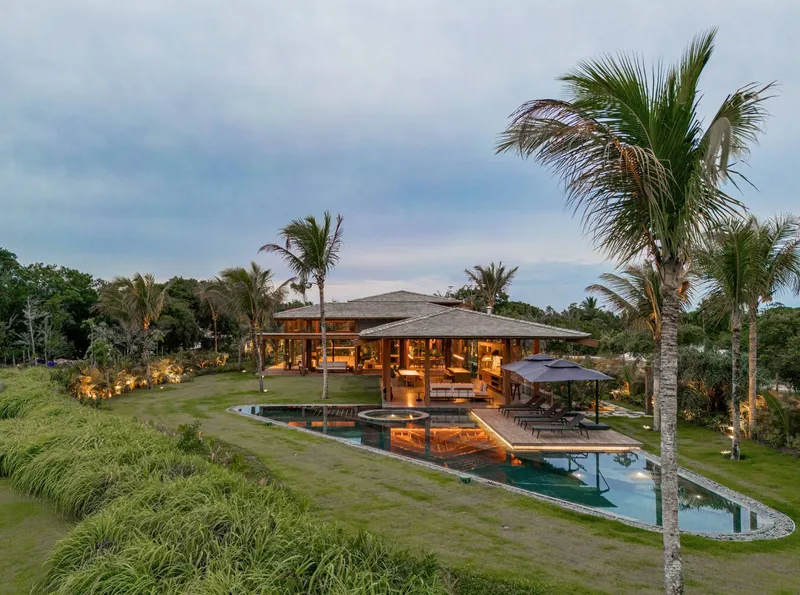
The triangular pool, clad in green candeias granite, mirrors the property's contour and becomes the social anchor of the rear garden. Timber deck islands punctuate the pool terrace, creating distinct zones for lounging without walls or partitions. At evening, the lit pavilions and their reflections in the pool water create a composition that reads as a small settlement rather than a single house, which is entirely the point.
Beyond the pool, the landscape design blurs the boundary between the private plot and the condominium's communal green space, creating a visual continuity that makes the property feel far larger than its actual footprint. Only 700 meters from the beach and 4.5 kilometers from Trancoso's historic Quadrado, the house occupies a site that is simultaneously remote in feeling and close to the social life of the village.
Plans and Drawings
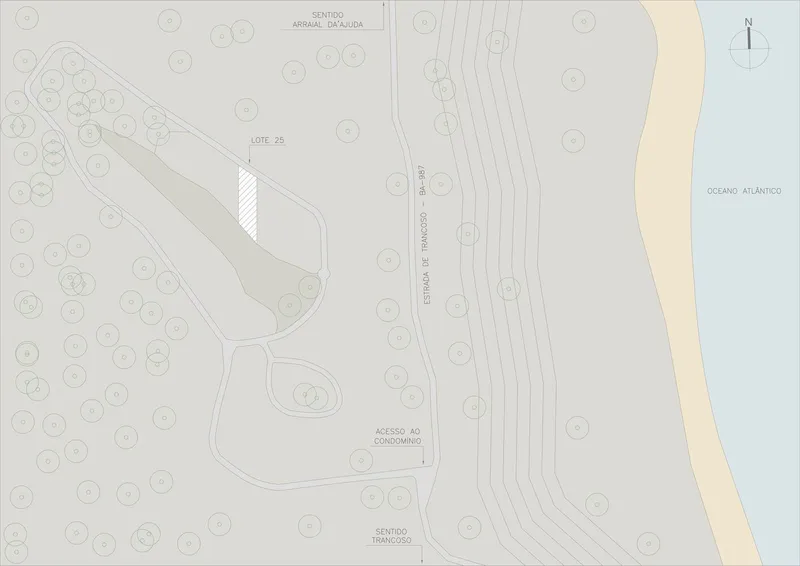
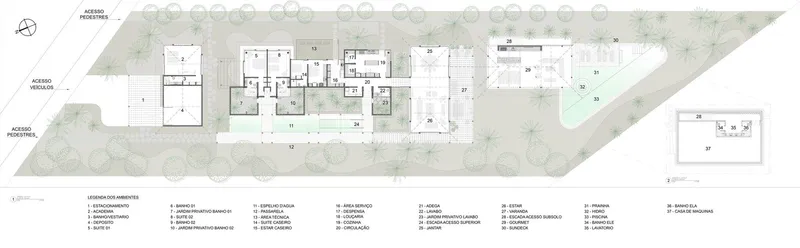
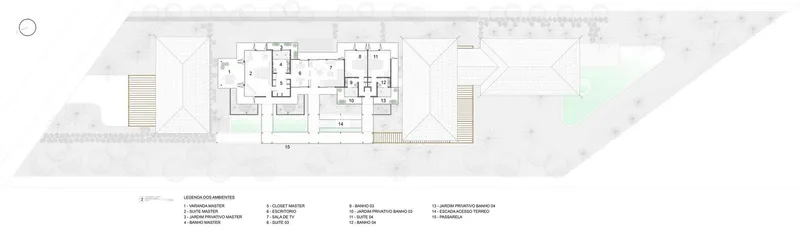
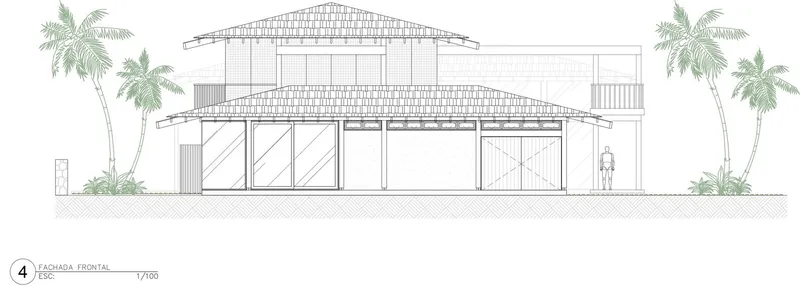


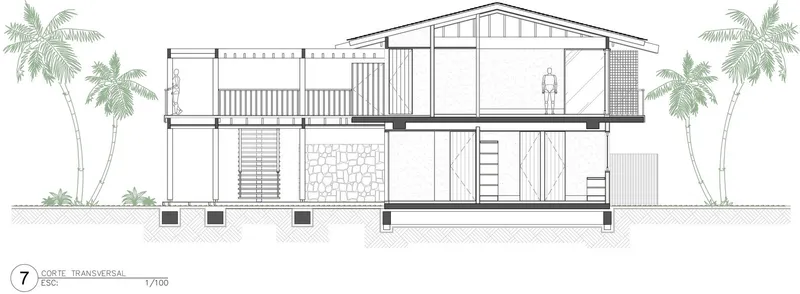
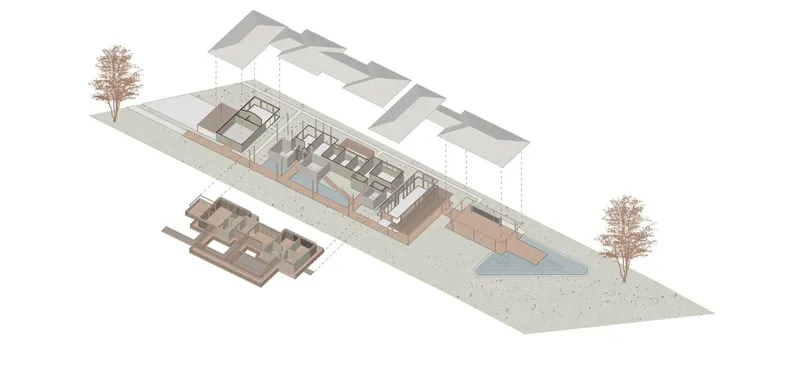
The site plan reveals the full strategy: four volumes arranged along the plot's long axis with landscape filling every gap. Floor plans confirm the separation of private modules (front) from social modules (rear), with the walkway as the organizing spine. Sections through the double-height social pavilion show how the gabled roof lifts away from the walls at clerestory level, and the axonometric cutaway makes legible what photographs can only suggest: that the pool, walkways, courtyards, and built volumes form a single integrated system rather than a house with a yard.
The elevations demonstrate the careful calibration of roof heights across the four modules. The two-story volume rises above the single-story pavilions, creating a skyline that varies without becoming restless. Palm trees drawn at scale confirm that the architecture never tries to compete with the landscape for height; it sits comfortably beneath the canopy.
Why This Project Matters
GS House is significant because it demonstrates that large-scale residential timber construction in tropical climates does not have to compromise on spatial ambition. The glued laminated wood structure enables spans and lightness that would be difficult with conventional solid timber, and the concrete-only-where-needed approach shows a clear-headed understanding of material performance rather than ideological purism. The modular plan, meanwhile, offers a genuine alternative to the open-plan mega-house: by separating functions into distinct pavilions, the architects create privacy, ventilation, and landscape integration simultaneously.
For architects working in similar coastal and tropical contexts, the lesson here is organizational. Breaking a program into parts connected by landscape is not a new idea, but doing it with this level of structural clarity and material consistency is rare. The house does not wear its sustainability on its sleeve, yet its passive ventilation, local material sourcing, and water-based cooling strategies are built into the logic of the plan from the first line drawn. That kind of integration, where performance and design intent are indistinguishable, is the hardest thing to achieve and the most worth studying.
GS House by Attmo Arquitetos. Trancoso, Bahia, Brazil. 1,351 m². Completed project.
About the Studio
Share Your Own Work on uni.xyz
If projects like this are the kind of work you want to make, uni.xyz is a place to publish your own, find collaborators, and enter design competitions.




Popular Articles
Popular articles from the community


The Musturak Paradise: Senior Living Architecture for a Connected Future in Temara, Morocco
The Musturak Paradise reimagines senior living architecture in Temara via private homes, social spaces, culture, community, and shared care.

Riyadh For All: Intergenerational Urban Design for Active Aging in Rabat
Riyadh For All reimagines urban design in Rabat with intergenerational co-living, adaptive courtyards, and Moroccan cultural exchange today.

Conexión: Biophilic Design Reimagines High-Rise Living in Hong Kong
Conexión reimagines high-rise living in Hong Kong through biophilic design, green facades, shared spaces, daylight, water and nature within.

Hill & Cross Opera: Sculptural Opera House Architecture Shaped by Tallinn’s Landscape and Identity
Hill & Cross Opera reimagines opera house architecture in Tallinn through its sculptural hill, civic plaza, glass wave and a luminous cross.

Similar Reads
You might also enjoy these articles

Bamboo Housing Challenge 2026: Design Affordable, Sustainable Homes Using Bamboo
An international design competition by Bamboo U and IBUKU inviting architects and designers to reimagine affordable housing using bamboo — with the winning design built full-scale in Bali.

Computational Design & Education: Beegraphy Design Awards Introduces 7th Category (Featuring Jiyun's Innovative Approach)
Dive into Beegraphy’s 7th Design Awards category, where computational design meets education to create immersive, interactive learning tools, inspired by Jiyun’s work.

From Parametric Lighting to Urban Furniture: Join the 2nd Workshop in Beegraphy’s Computational Design Series
Dive into Cutting-Edge Design Techniques and Practical Applications with Industry Experts

Last Call: Unleash Your Architectural Genius in SHAK's Kindergarten Design Competition
Urgent call for architects to join SHAK's kindergarten design competition before the looming deadline


Explore Architecture Competitions
Discover active competitions in this discipline



Challenge to reimagine the Iron Throne


Photograph architecture without architects


Illustrate the lost glory of Angkor Wat - Render Challenge


Design challenge to reuse E-waste
Comments (0)
Please login or sign up to add comments
No comments yet. Be the first to comment!