

Barkow Leibinger Wraps a Black Forest Tech Campus in Timber Frames and Stacked White Volumes
The Trumpf Schramberg Tech Center clusters layered volumes across a sloped site in southwestern Germany, balancing industrial precision with warmth.


Schramberg sits in a narrow valley in Baden-Württemberg, a town whose economy has long been shaped by precision manufacturing. When Trumpf, the laser and machine-tool giant, needed a new technology center there, Barkow Leibinger responded not with a single monolithic block but with a constellation of stacked white volumes that step across the sloped terrain. The result is a campus that reads from the street as a series of horizontal bands, timber-framed windows, and planted terraces, more village than factory.
What makes the project genuinely interesting is the way it negotiates two competing demands. On one hand, Trumpf requires highly serviced, column-free floor plates for research and manufacturing. On the other, the firm wanted something that belongs to Schramberg, a building that engages the landscape rather than flattening it. Barkow Leibinger solve this by clustering volumes around courtyards and atriums, creating an internal world of diagonal timber structures, coffered ceilings, and sightlines that pull the surrounding hillside into every corridor.
Terraced Volumes on a Sloped Site
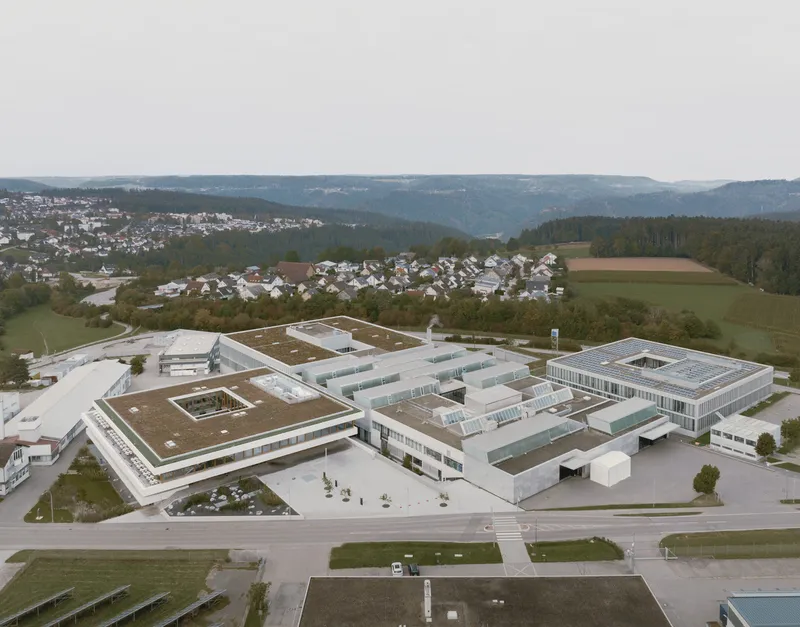
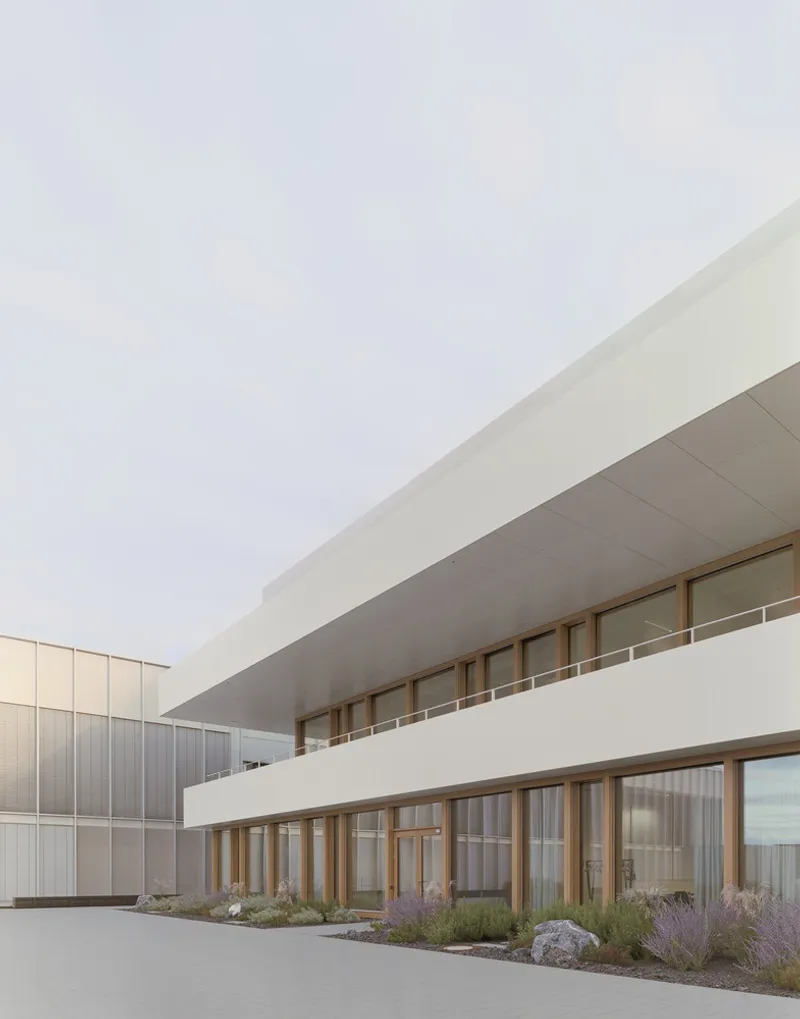
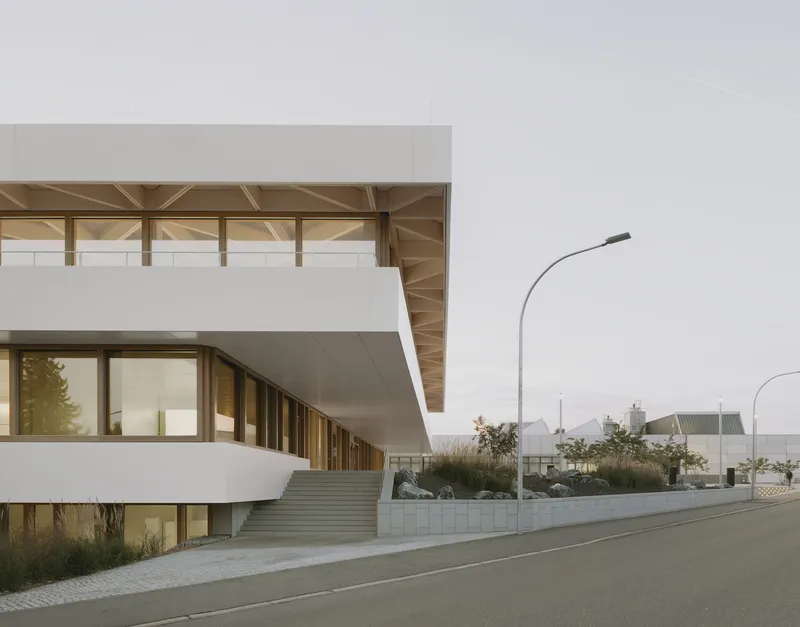
Seen from above, the campus reveals its organizing logic. Green roofs soften the massing, and each volume is offset just enough from its neighbor to create courtyards, gaps, and planted terraces between them. The aerial view makes clear that the building is not one object but a family of related pieces, each scaled to the valley's existing grain of small workshops and residential blocks.
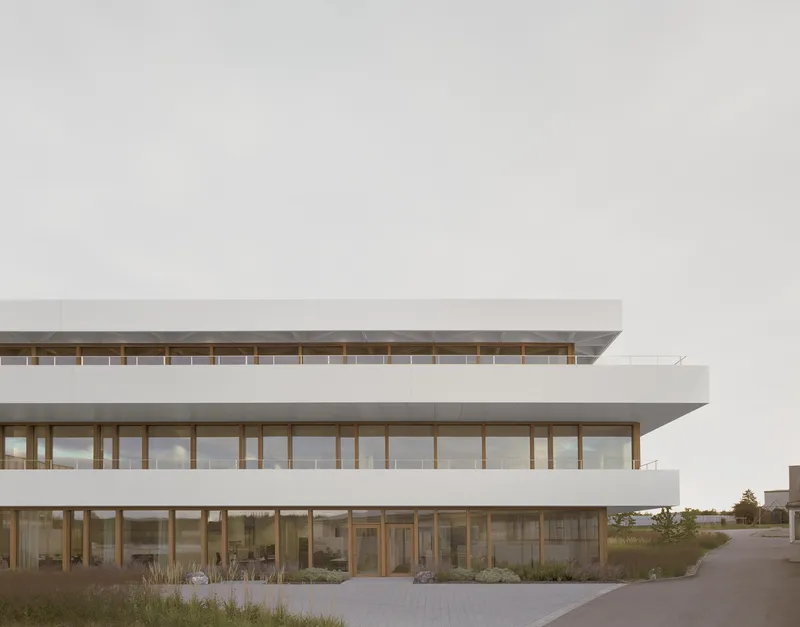
At street level, the stacking reads differently. Three-story facades present continuous horizontal white bands punctuated by recessed timber-framed glazing. The effect is orderly without being rigid. Planted berms and retaining walls mediate between the public sidewalk and the building's ground floor, keeping the campus grounded in its topography rather than floating above it on a podium.
Timber Structure as Architectural Identity
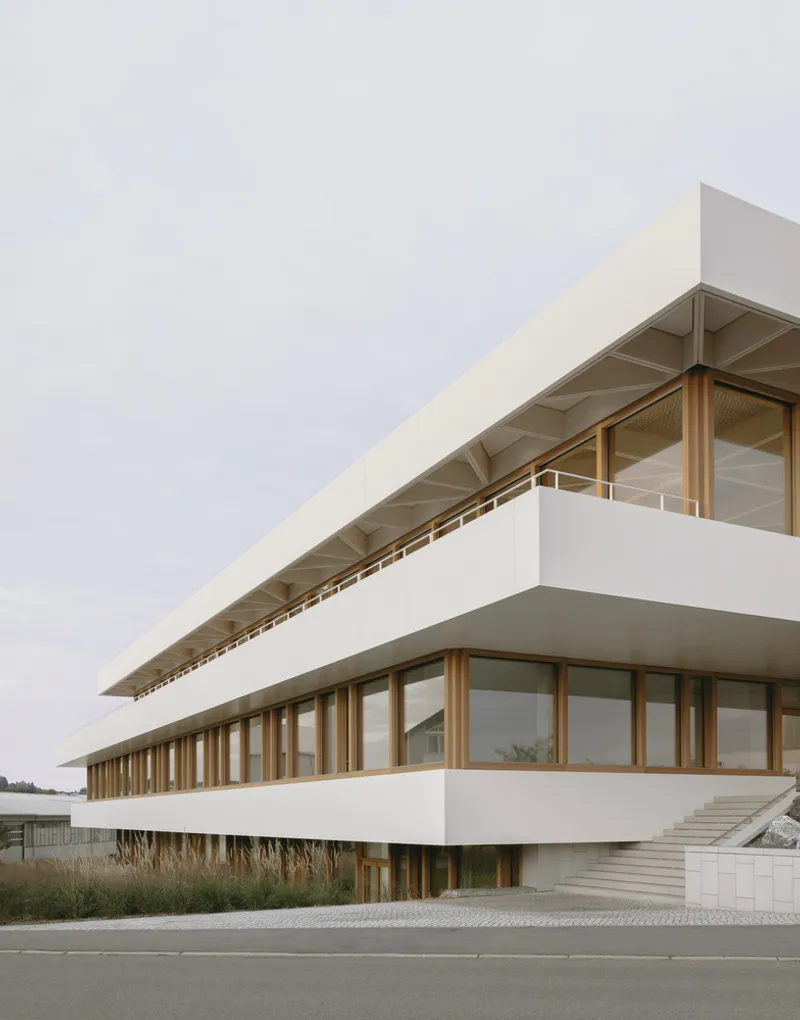
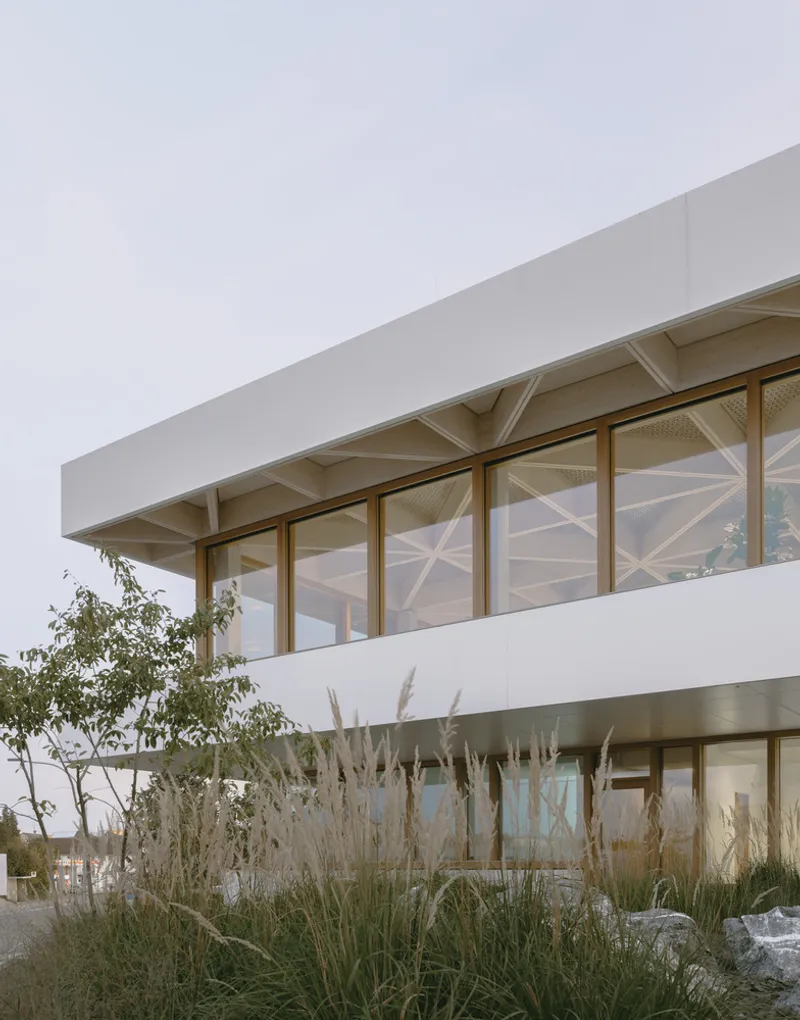
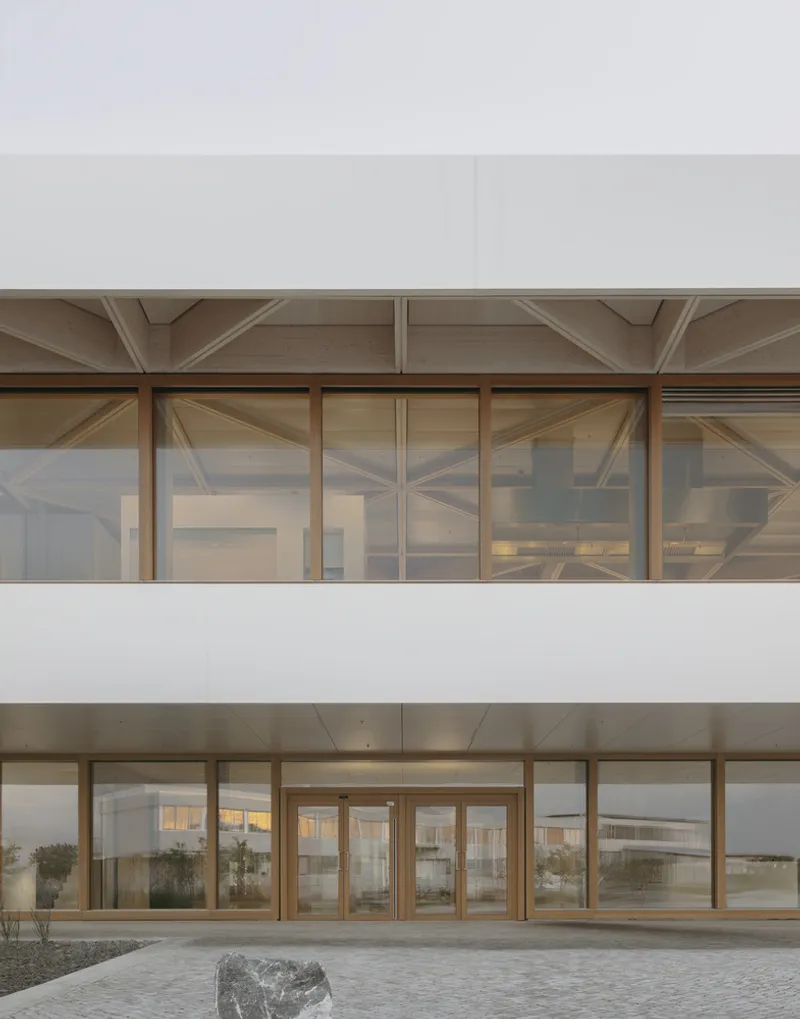
Timber does serious structural work here, but it also carries the building's entire aesthetic personality. Beneath the white parapets, cantilevered floor plates reveal exposed timber columns and beams, giving depth to what could otherwise be flat facade bands. The close-up views show how the grain and warmth of the wood register against the precision of the white cladding, a pairing that nods to Trumpf's own ethos of high-tech craft.
The timber frames continue into the glazing systems, where they organize floor-to-ceiling windows into a rhythm of verticals and horizontals. Reflected in the glass at certain angles, the exposed ceiling beams create a layered double image: structure visible both inside and out. It is a straightforward move, but it keeps the building from ever feeling sealed off or opaque.
The Central Atrium and Spiral Stair
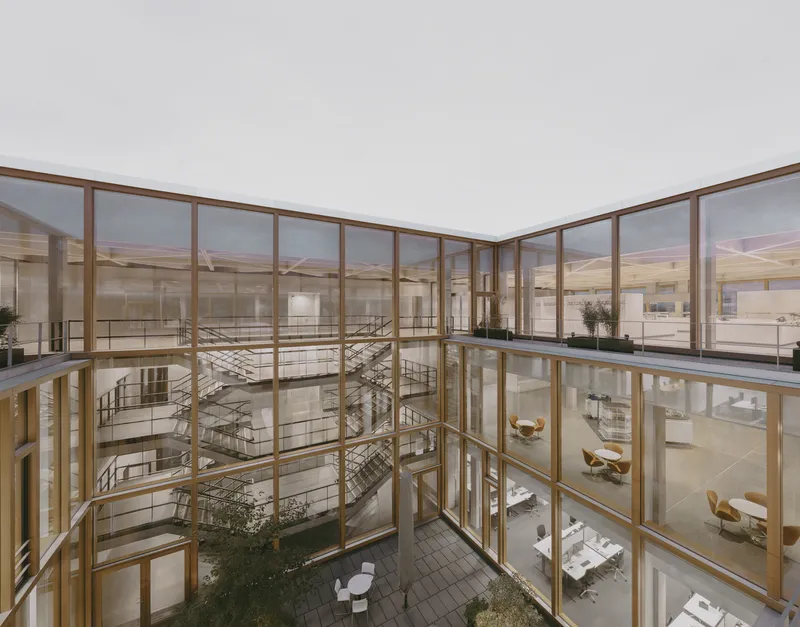
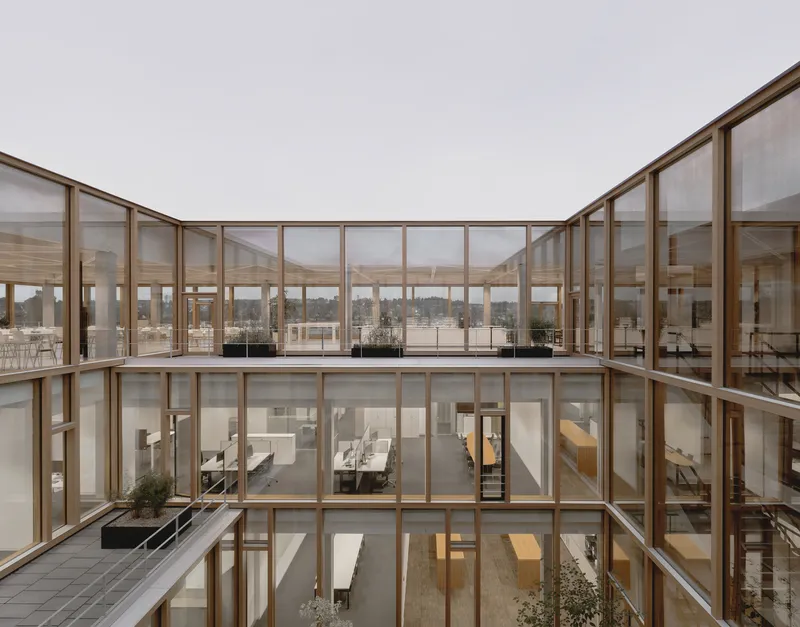
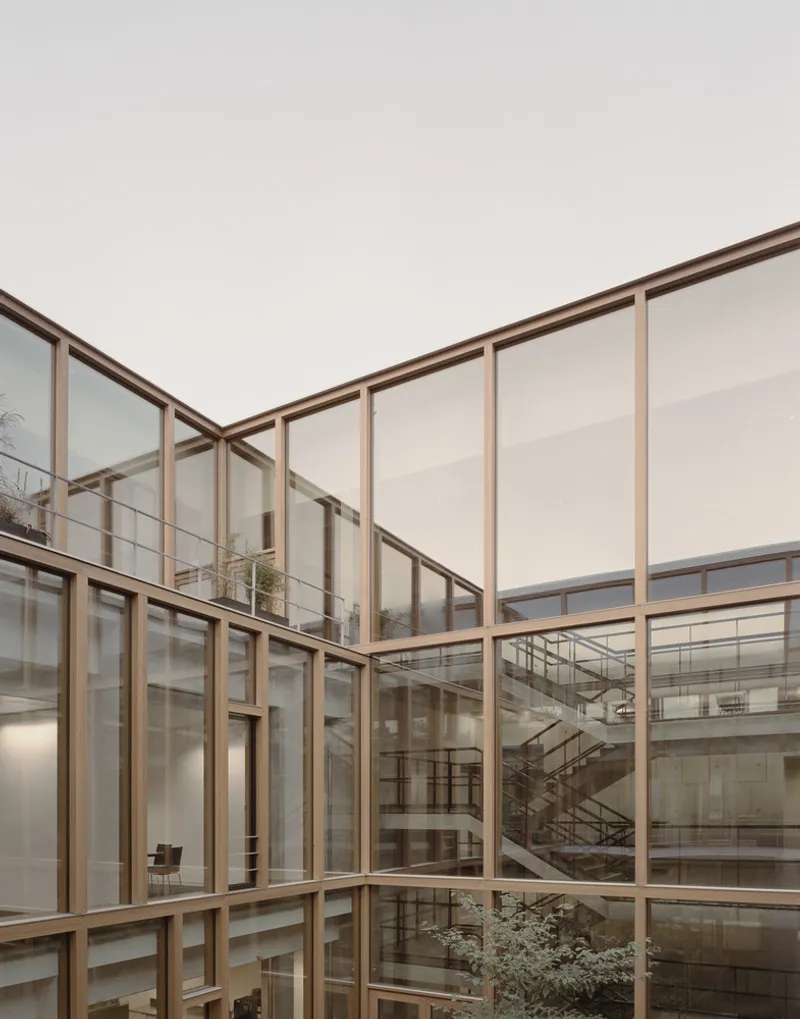
The glazed atrium is the social spine of the complex. Rising through three stories, it connects office floors, circulation galleries, and communal spaces around a spiral stair that becomes the building's most visible interior gesture. At twilight, the atrium glows outward, its timber framing silhouetted against interior lighting, turning the corner into a lantern for the street.
From inside, the atrium offers something more restrained: framed views down into a landscaped courtyard, metal staircases visible through layers of glass, and a vertical openness that counterbalances the long horizontal floor plates. The symmetry of the timber-framed windows looking into the courtyard gives these moments a calm, almost domestic quality, even at this scale.
Courtyards and Landscape as Infrastructure
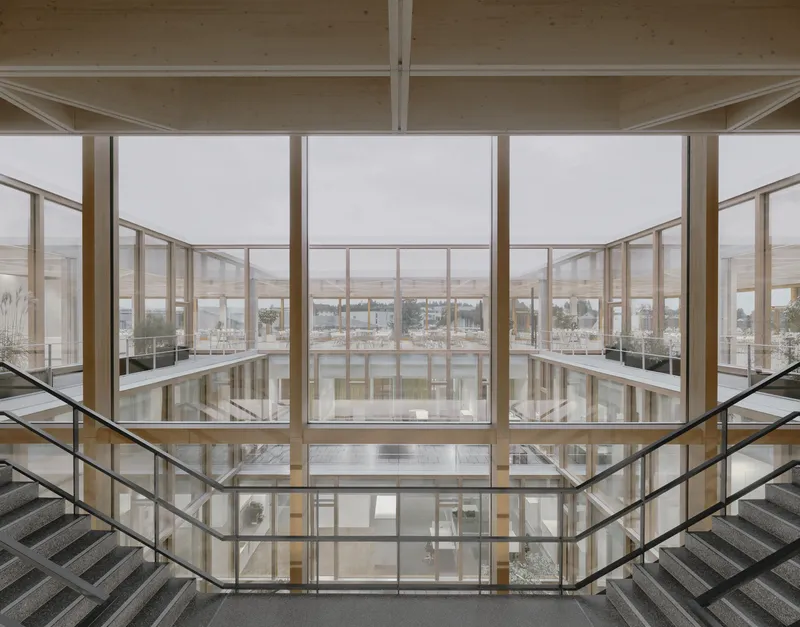
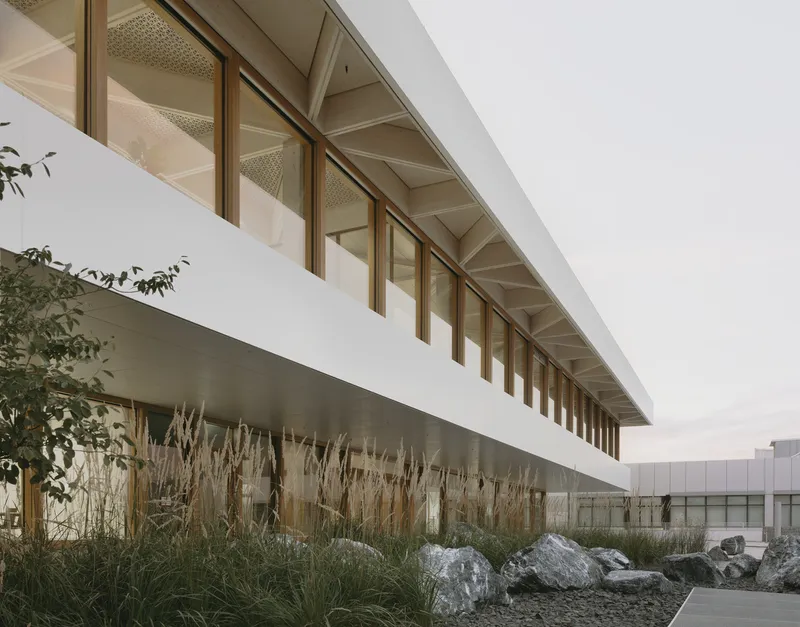
Between the stacked volumes, landscape beds of native grasses, boulders, and dried plantings create micro-environments that bring daylight and views into the center of the campus. An elevated walkway spans above one of these beds, its timber-framed windows turning a simple corridor into a bridge over a small ecosystem. At dusk, the planted terraces glow beneath the glass walls, blurring the line between architecture and terrain.
These are not leftover spaces. The courtyards are working elements of the building's environmental strategy, channeling air and light into deep floor plates while giving employees daily contact with planting and sky. The boulders and grasses read as fragments of the Black Forest valley brought into the building's core.
Ceilings That Do the Heavy Lifting
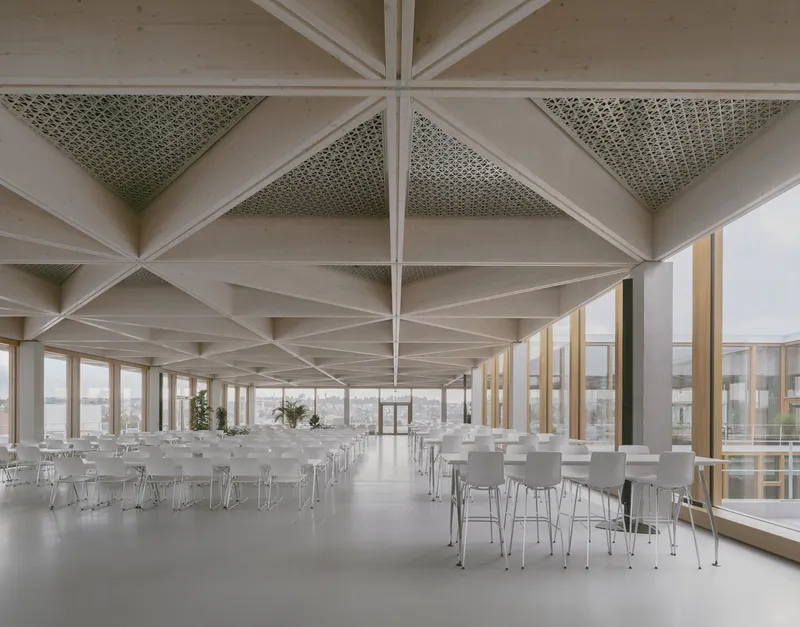
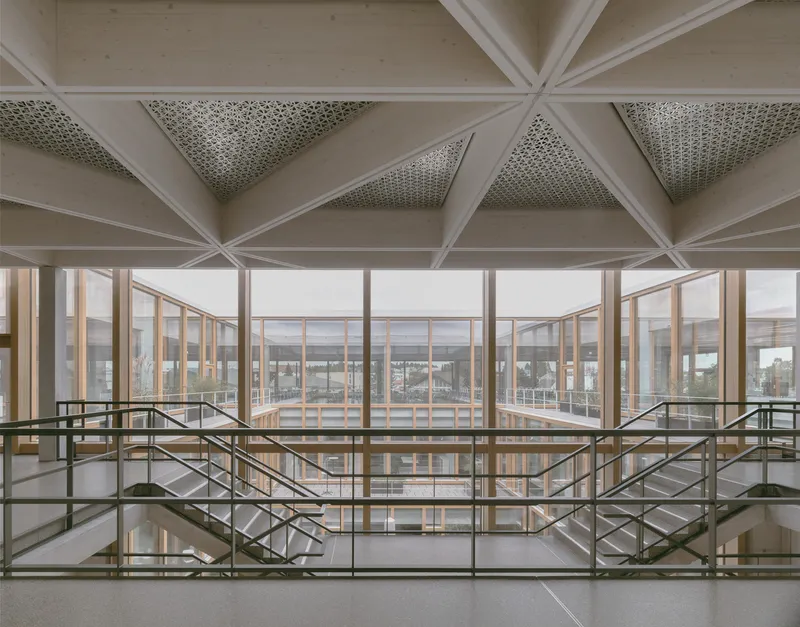
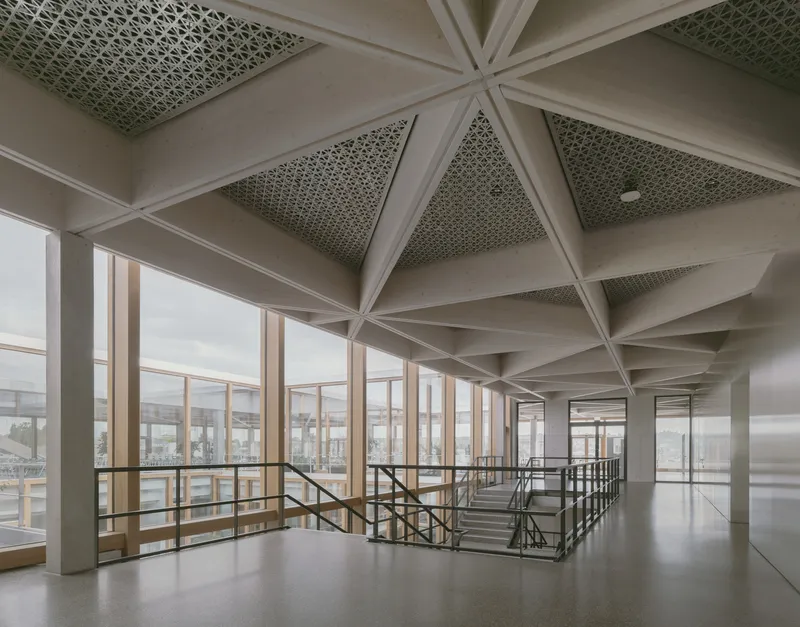
Interior ceiling design is often an afterthought. Here it is the dominant interior experience. The dining hall features triangulated timber beams with perforated acoustic panels fitted between the rafters, creating a geometric canopy that gives scale and character to what is essentially a large open room. Elsewhere, coffered ceilings with perforated panels manage acoustics while casting soft patterned shadows across mezzanine balustrades.
The vaulted ceiling in the circulation spaces takes a different tack: green perforated acoustic panels curve between exposed structure, adding color and directing attention upward as you move through the building. It is a detail that rewards attention without demanding it, keeping the spaces legible and varied across what could easily become a monotonous sequence of corridors.
Communal Spaces and Material Warmth
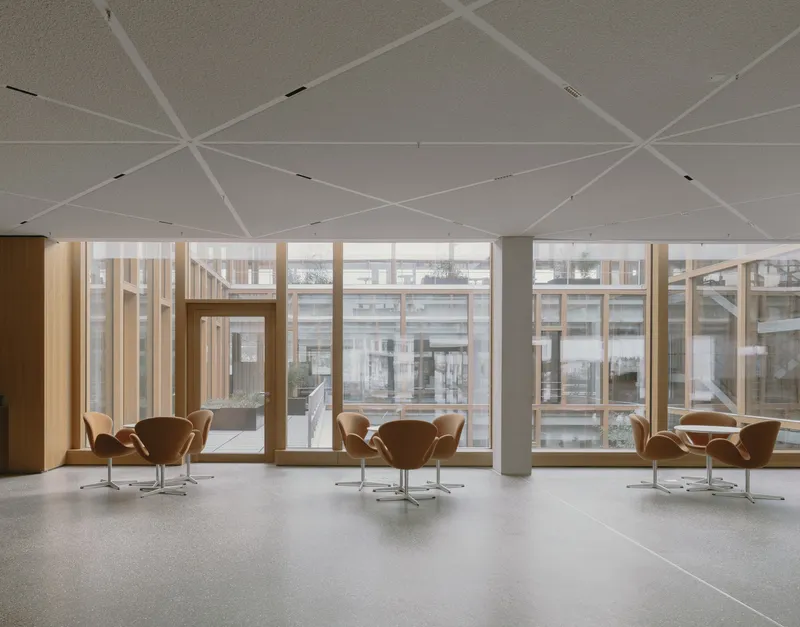
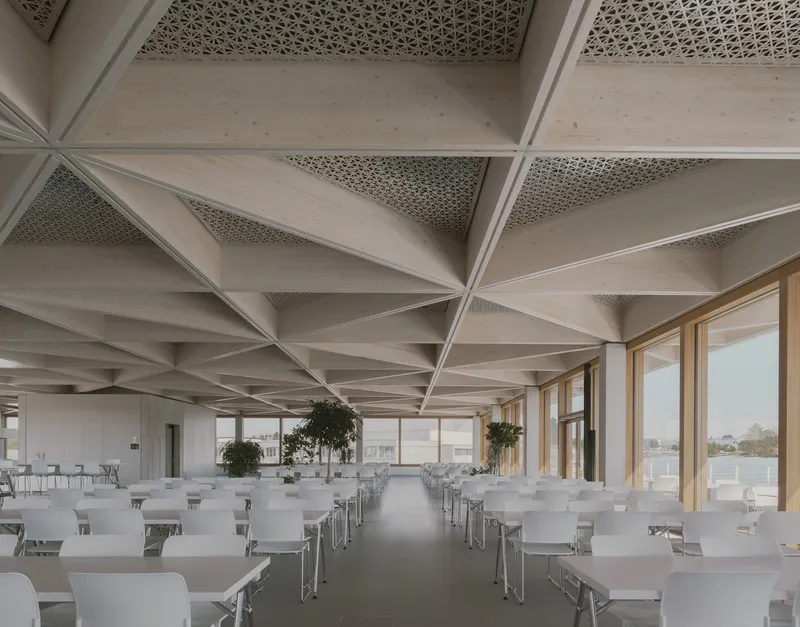
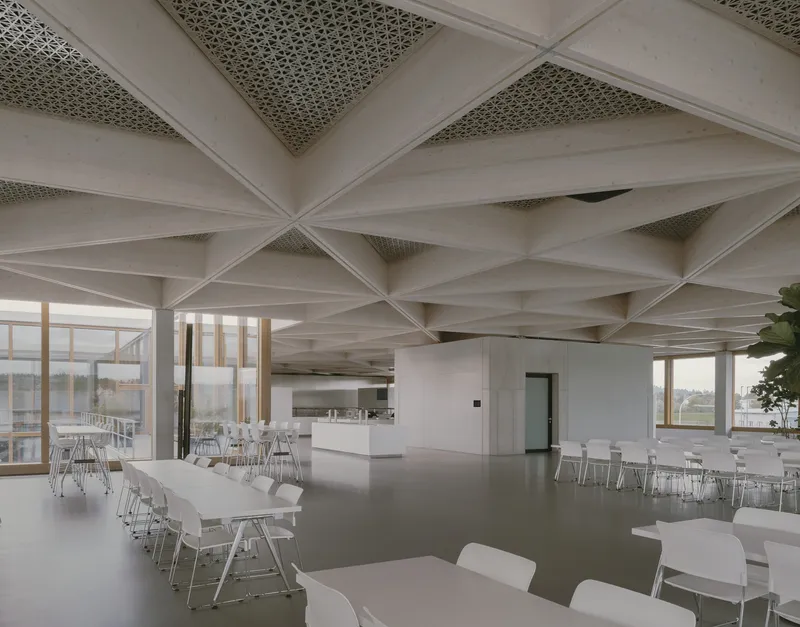
The lounges and dining halls share a material palette that combines tan leather, white surfaces, and timber framing to create spaces that feel inviting without trying too hard. The lounge, with its faceted white ceiling and courtyard-facing windows, reads as a calm break room rather than a showpiece. The dining halls seat large numbers beneath coffered ceilings and geometric grids, but the warmth of the timber keeps them from tipping into institutional anonymity.
These are spaces designed for a workforce that spends long hours in a building. The careful acoustic treatment, the natural light from multiple orientations, and the recurring presence of courtyard views all add up to an interior that sustains comfort across a full workday. It is unglamorous, considered design.
Street Presence and Civic Generosity
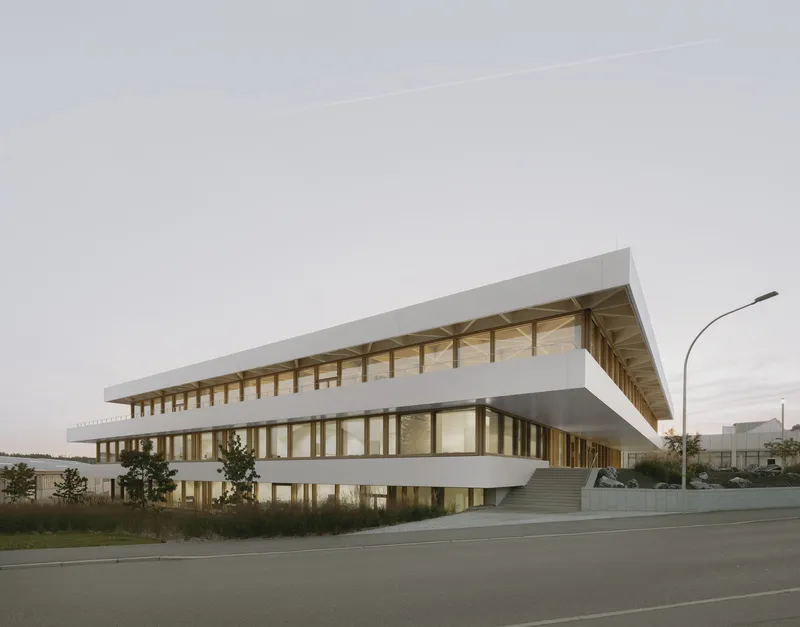
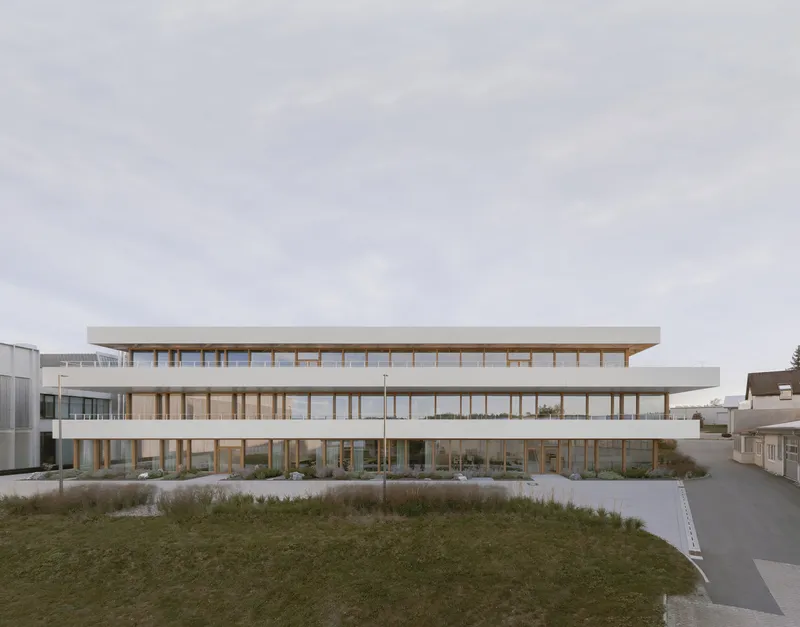
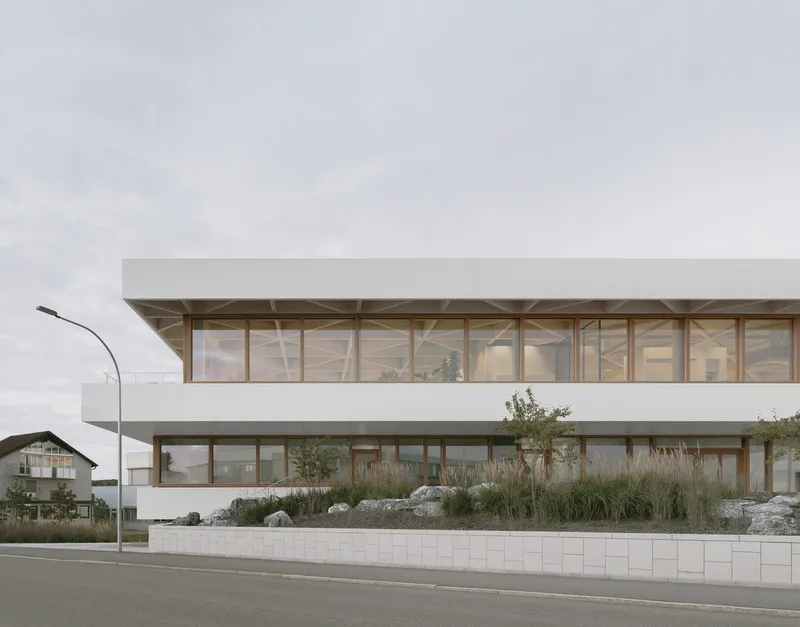
The building's relationship to its immediate neighborhood is where the design's ambition is clearest. Rather than presenting a blank wall or a gated perimeter, the campus meets the street with glazed facades, visible interiors, and planted berms that soften the transition from sidewalk to building. In winter, stripped of foliage, the horizontal bands and vertical timber frames read with graphic clarity against the grey sky.
For a corporate tech center, this level of civic generosity is notable. The building does not retreat from Schramberg; it participates in the town. The three-story facades maintain the scale of the surrounding neighborhood while the setbacks and terraces prevent the mass from overwhelming the narrow valley.
Plans and Drawings
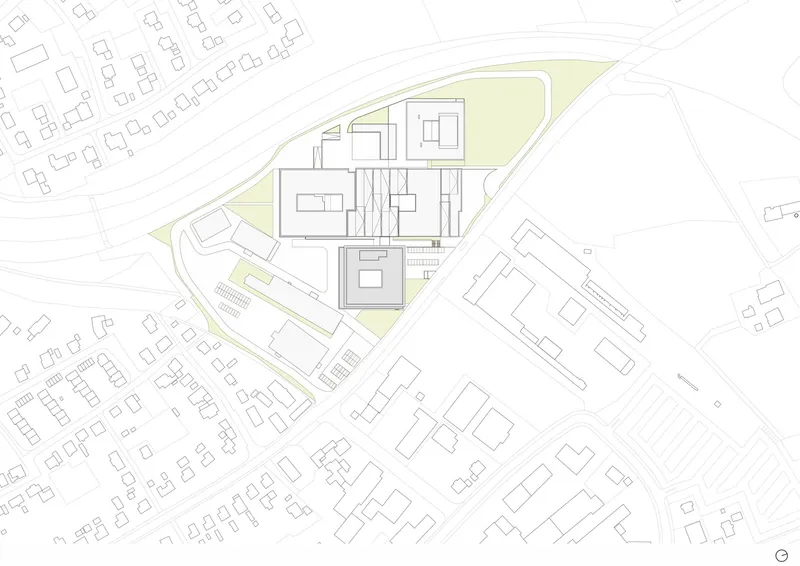
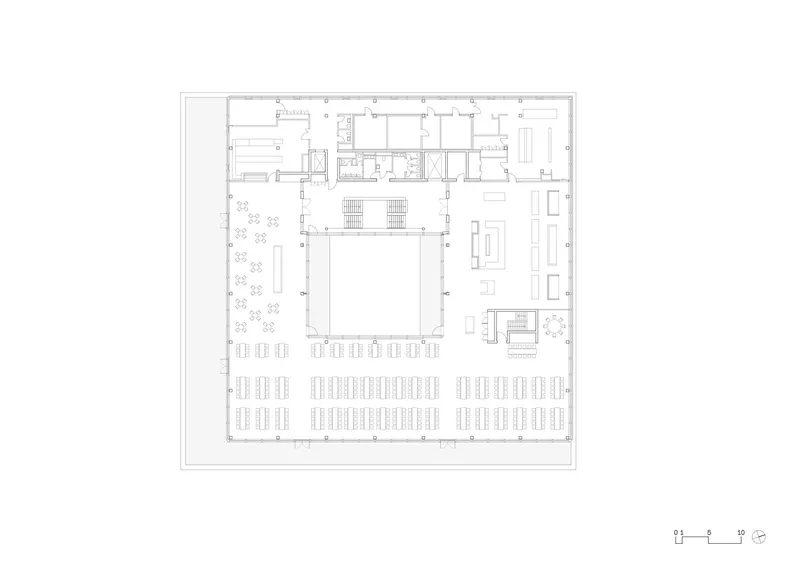
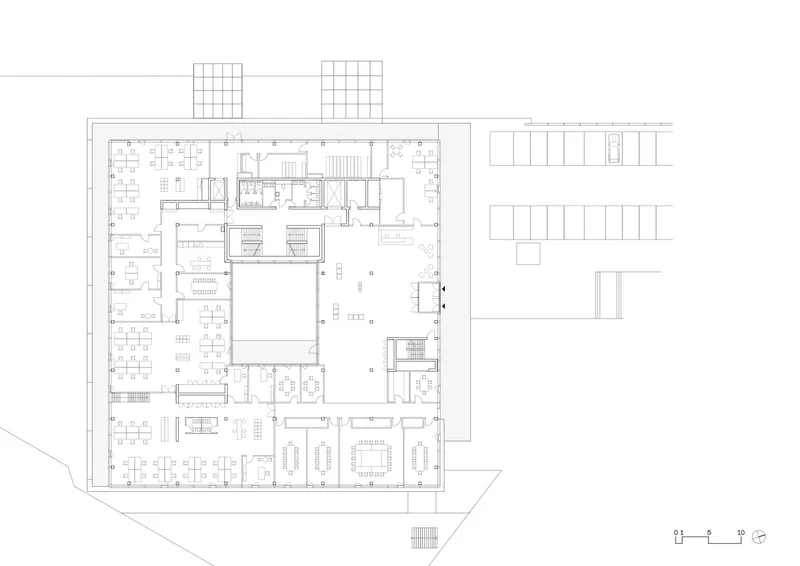
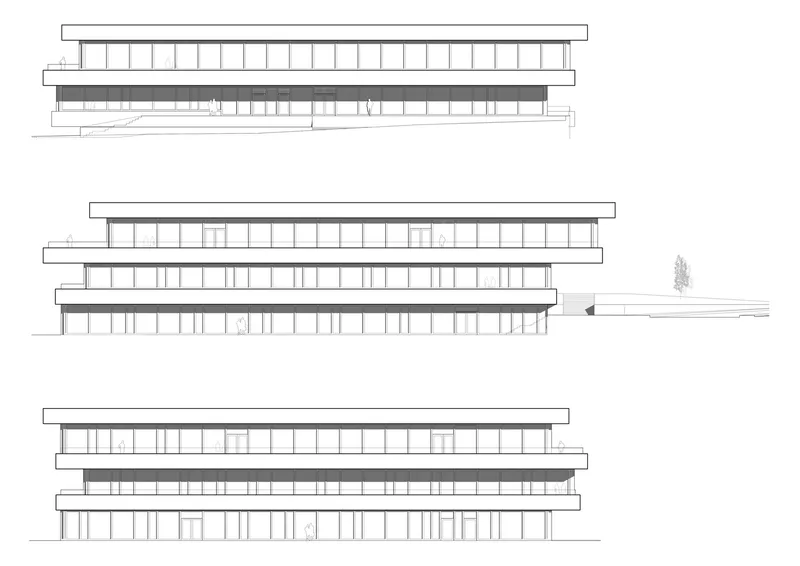
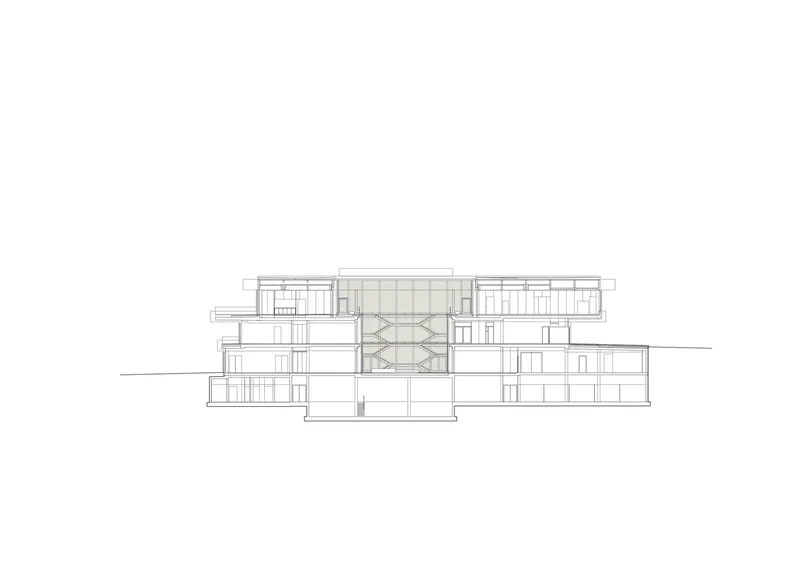
The site plan confirms the reading from the aerial photographs: a cluster of interconnected volumes set within a green perimeter, knitted into the neighborhood fabric rather than isolated from it. The floor plans reveal a square layout organized around a central courtyard void, with office spaces wrapping the perimeter and seating areas gathered below. The section through the central atrium shows how diagonal structural members crisscross between flanking wings, creating a spatial drama that the plans alone cannot communicate. The elevations document the three-story horizontal banding and cantilevered floor plates that define the street-facing facades.
Why This Project Matters
Corporate campuses built outside major cities tend toward two extremes: bland business parks that could be anywhere, or attention-seeking sculptures that ignore their context. Barkow Leibinger find a third path at Schramberg. By breaking the program into clustered volumes, stepping them across the slope, and investing in a timber structure that gives the building warmth and legibility, they produce a campus that is specific to its site and ambitious in its spatial invention.
The project also demonstrates that timber construction at this scale can carry both structural and expressive weight without becoming a fetish object. The material is everywhere, from the facade columns to the ceiling beams to the window frames, yet it never reads as self-conscious. It is simply the right choice for a building that wants to be precise, warm, and rooted in a Black Forest valley. That combination of pragmatism and care is what makes the Trumpf Tech Center worth studying.
Trumpf Schramberg Tech Center by Barkow Leibinger, Schramberg, Baden-Württemberg, Germany. Photography by Simon Menges.
About the Studio
Share Your Own Work on uni.xyz
If projects like this are the kind of work you want to make, uni.xyz is a place to publish your own, find collaborators, and enter design competitions.


Popular Articles
Popular articles from the community


Jaramillo Van Sluys Arquitectura and Urbanismo Turn a Demolished Registry Lot in Quito into an Orchard Plaza
In Quito's Centro Histórico, a 2,800 m² plaza exposes the San Agustín convent wall and redraws its lost Augustinian orchard in volcanic stone.

David Ortega Stacks a Two-Story Mexico City Penthouse Around a Steel Stair and a Pergola-Shaded Roof Terrace
In Colonia Roma, a 300 m² penthouse uses oak joinery, a planted steel stair and a slatted roof pergola to make a new-build apartment feel like a house.

Juan García Correa, John González and Claudia Rueda Sink a Circular Amphitheater into a Manizales Engineering Building
On the La Nubia campus in Manizales, Colombia, the S1 Building folds labs and offices into a hillside of ramped lawns that double as a campus route.

LT2A and OPEN Architectes Thread a Brick and Glass High School Through a Wooded Belgian Campus
In Braine-l'Alleud, a 3,000 m² wing for Collège Cardinal Mercier pairs pale brick with a glazed colonnade, deferring to a small chapel and a dense wood.

Similar Reads
You might also enjoy these articles


Hodi-Mandai Geram
Project Function: Preservation and revitalization of the Intangible heritage and socio-spatial identity of the Hodi by Housing, Cultural Memory Center, Sacred Grove, landscape, local tourism economy


Olio Towers: A Mid-Rise for Performers That Fuses Housing, Rehearsal, and Stage
Located blocks from Houston's Theater District, this modular tower stacks living units around a central performance atrium.

Oasis: Modular Green Housing Carved into Dhaka's Urban Fabric
A shortlisted Plugin Housing entry reclaims unauthorized settlements in Dhaka with stepped concrete volumes, green roofs, and ventilation-driven design.

Black Hole: A Floating Megastructure for the Post-Physical Era
Emiliano Mazzarotto envisions a spherical, self-scaling arena where e-sports, digital hotels, and holographic stadiums replace traditional public space.

Explore Architecture Competitions
Discover active competitions in this discipline

Challenge to reimagine the Iron Throne

Photograph architecture without architects

Illustrate the lost glory of Angkor Wat - Render Challenge

Design challenge to reuse E-waste
Comments (0)
Please login or sign up to add comments
No comments yet. Be the first to comment!