
XDGA Pairs a 70-Meter Prismatic Tower with a 140-Meter Bar Building on a Former Brewery Site in Leuven
Tweewater Housing redefines a historic beer production park between Vaartkom and the River Dijle with 28,000 square meters of transparent living.


Beer has shaped Leuven for centuries, but the city's relationship with its brewing infrastructure is evolving. On a park site once occupied by a major beer production complex, wedged between the Vaartkom canal basin and the River Dijle, XDGA – Xaveer De Geyter Architects has erected two volumes that could not be more different in posture yet read as one project. A 70-meter tower of 65 apartments and a 140-meter bar building containing 89 apartments plus 55 assisted living units together deliver 28,000 square meters of housing and ground-floor commercial space. The pair completed in 2022.
What makes Tweewater genuinely interesting is the refusal to treat tower and slab as separate typologies that happen to share an address. Both buildings push transparency to an extreme, wrapping nearly every face in glass and aluminum profiles. Both use the loggia as a primary spatial device, giving every apartment direct outdoor access. And both manipulate massing through fracture: the tower through offset prisms, the bar through floor-by-floor volumetric shifts. The result is a residential complex that reads as landscape-scaled composition rather than two buildings dropped onto a site plan.
Two Volumes, One Conversation
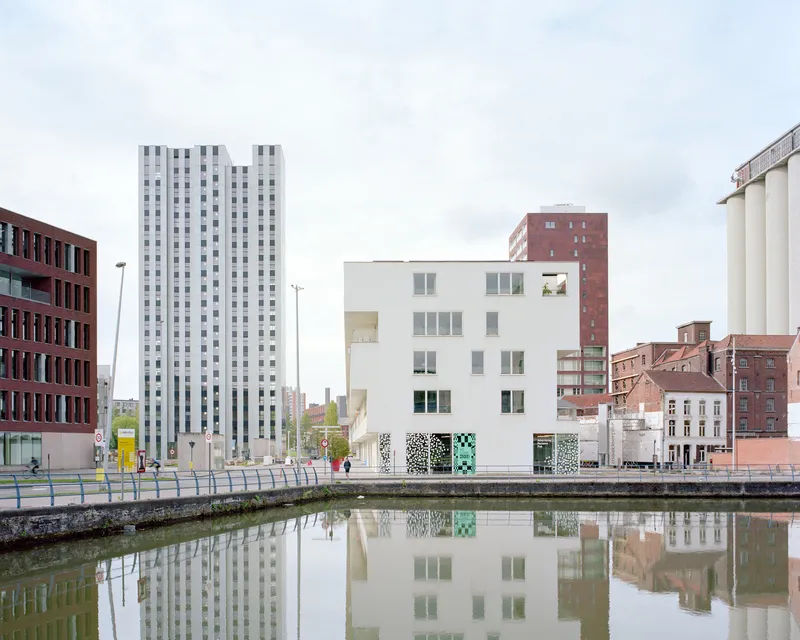
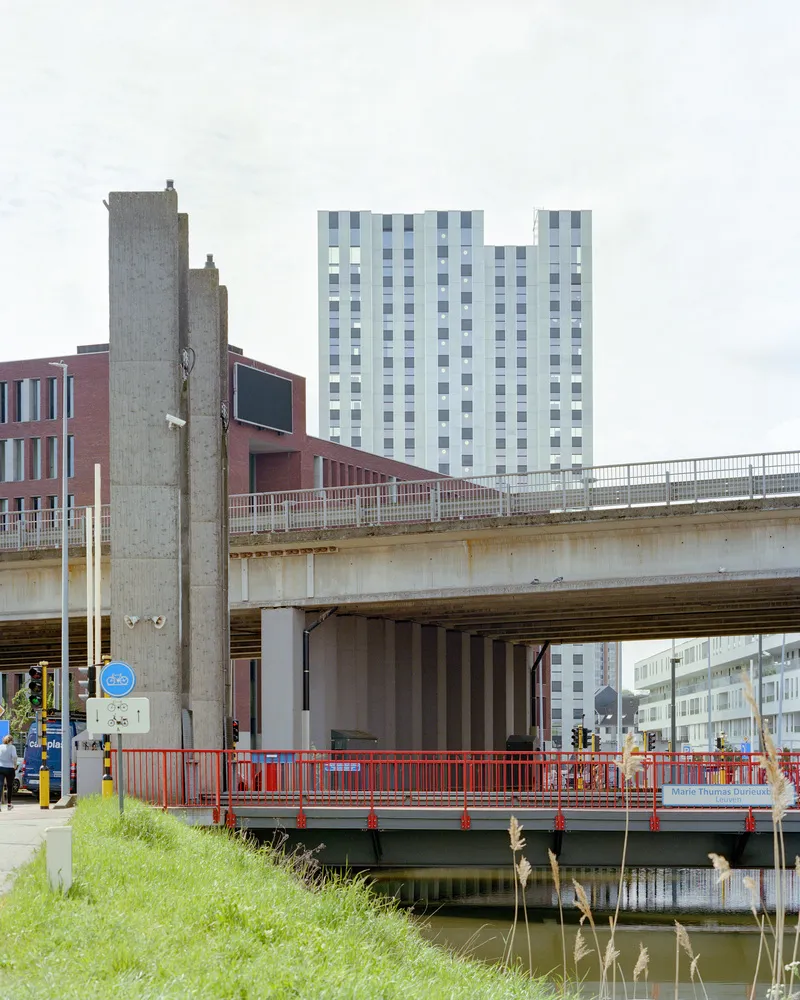
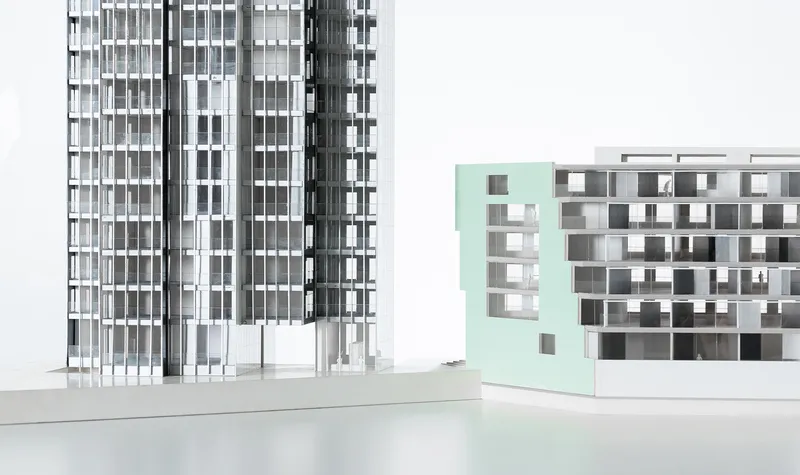
Seen from the canal, the tower and bar stage a deliberate contrast of orientation. The tower, called Lucid, is vertical and sculptural, its silhouette shifting depending on the angle of approach. The bar, called Vivid, is resolutely horizontal, stretching along the park edge at six stories. Neither building dominates: the tower marks the site on the skyline while the bar holds the ground plane. A physical model of the scheme reveals just how clearly this compositional logic was established from the start, with the slender tower pinned to one end and the perforated bar extending outward.
The canal reflection in image zero is no accident. XDGA positioned the bar so that its white mass doubles in the water, turning infrastructure into scenography. Meanwhile, the highway overpass slicing across the canal in front of the tower is a reminder that this is not a pastoral site. It is contested urban territory, and the architecture engages that friction rather than hiding from it.
The Tower as Fractured Prism
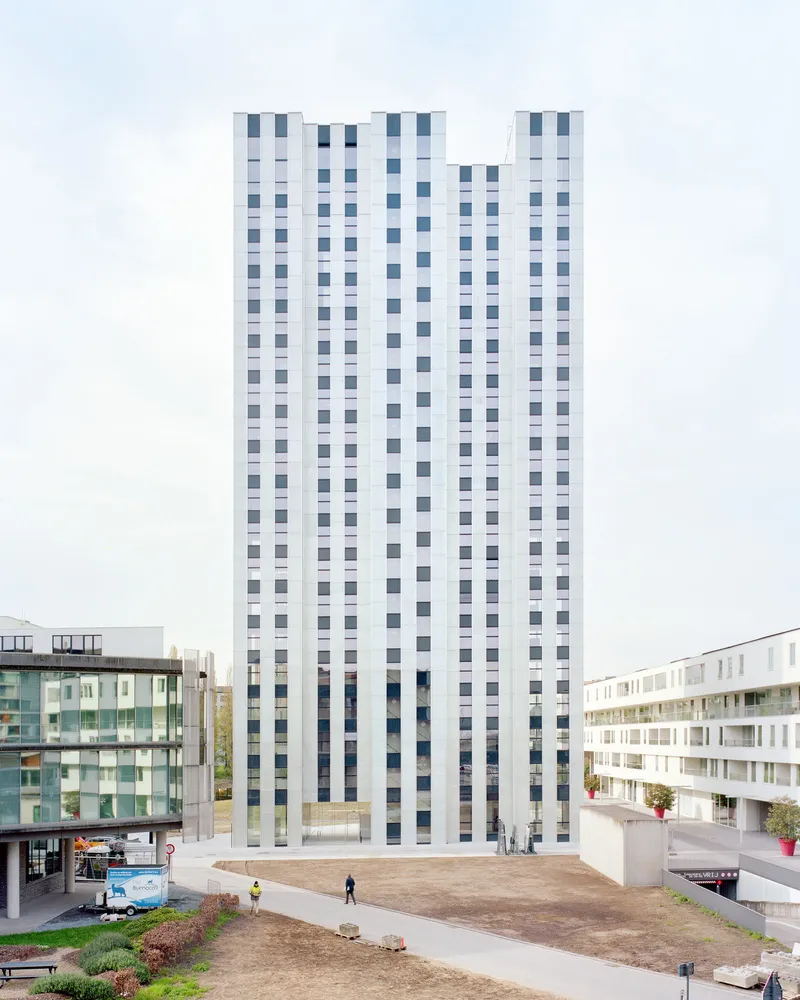
Lucid rises 20 levels, and its most distinctive move is the juxtaposition and offset of prismatic volumes that break the tower's profile into something less predictable than a simple extrusion. Viewed from the plaza, vertical bands of white and grey cladding reinforce the reading of separate volumes stacked and shifted. The effect is a tower that appears to rotate as you walk around it, offering ample and diversified views toward Leuven's historic center and surrounding landscape.
The southern facade is given over entirely to loggias, meaning every apartment on that face opens onto a sheltered outdoor room. It is a straightforward climate strategy: south-facing balconies capture winter sun while providing summer shading through their recessed depth. At 9,000 square meters of apartments across 65 units, the tower achieves a generous average unit size, unusual for speculative high-rise housing.
Loggia as Living Room Extension
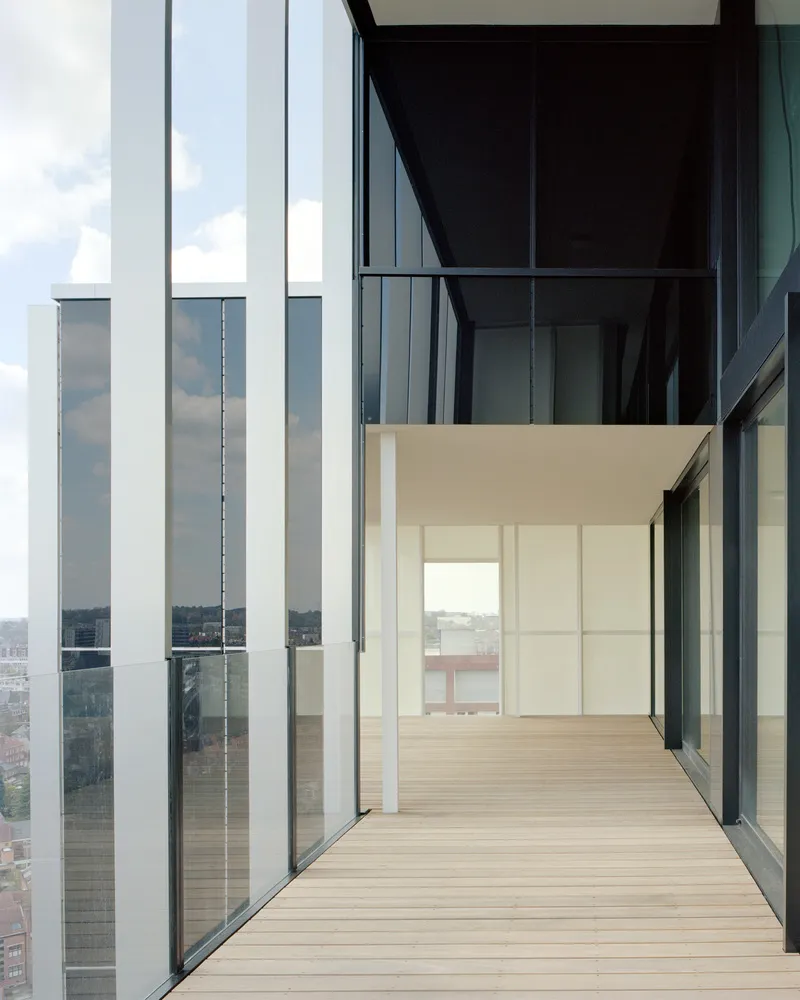
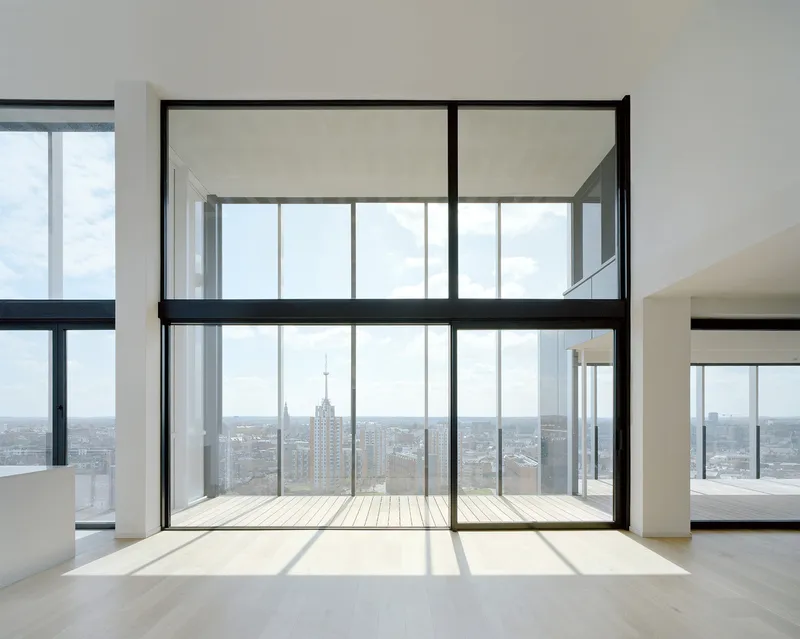
The timber-decked loggias are the project's strongest spatial idea. Framed by vertical white fins and floor-to-ceiling glass, they function as intermediate rooms: neither fully inside nor fully outside. From within, the fins create a rhythmic frame for city views. From outside, they give the facade a layered depth that prevents the all-glass envelope from reading as flat.
A double-height interior condition, visible in image four, connects an upper living space to a loggia that looks back toward the tower itself. The architects clearly understood that the two buildings would become each other's primary view, and they designed the loggias to frame that visual exchange. It is a subtle but important decision: the project is its own context.
The Bar Building and Its Ground Plane
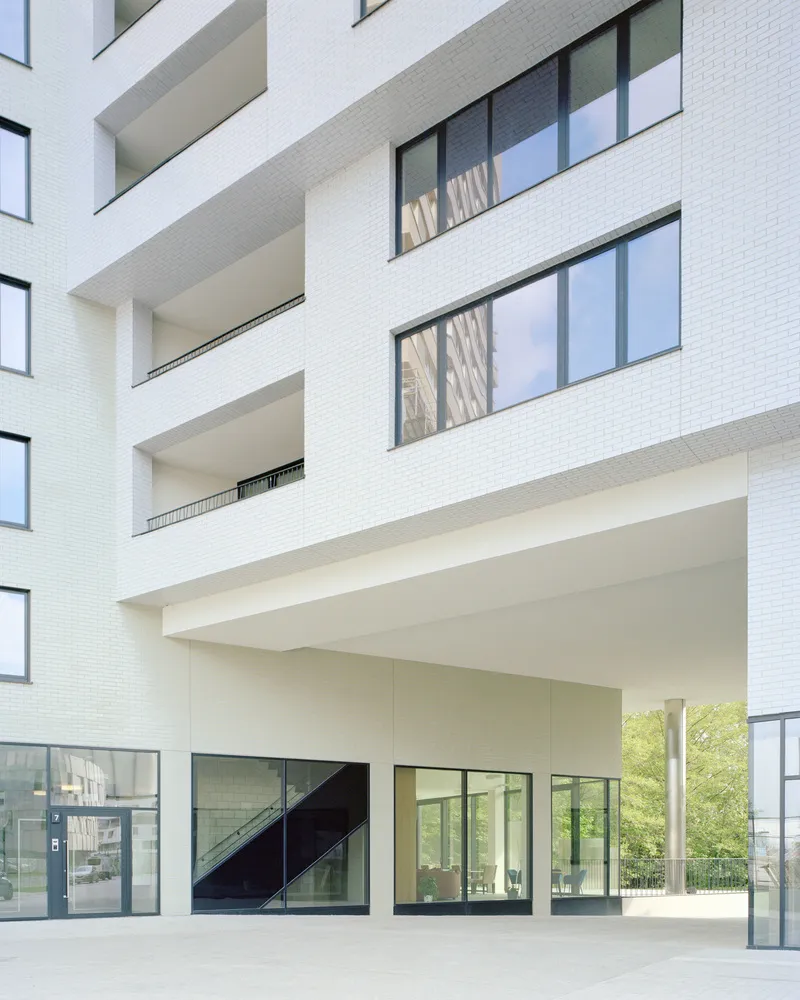
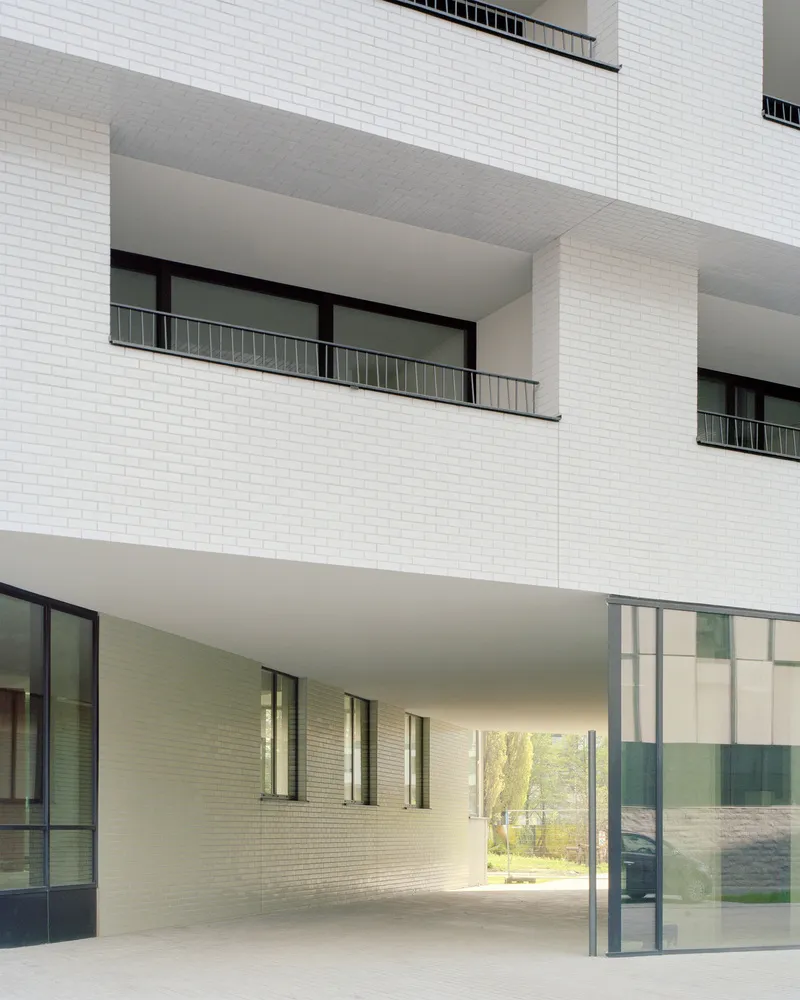
Vivid operates on entirely different terms. At 140 meters long and six stories, it is conceived as a horizontal object in direct dialogue with the park. The ground level opens through a covered entry loggia with deep cantilevered balconies overhead, creating a generous sheltered zone between the building and the landscape. White brick walls at the base give the bar a material weight that the tower's aluminum-and-glass skin does not share.
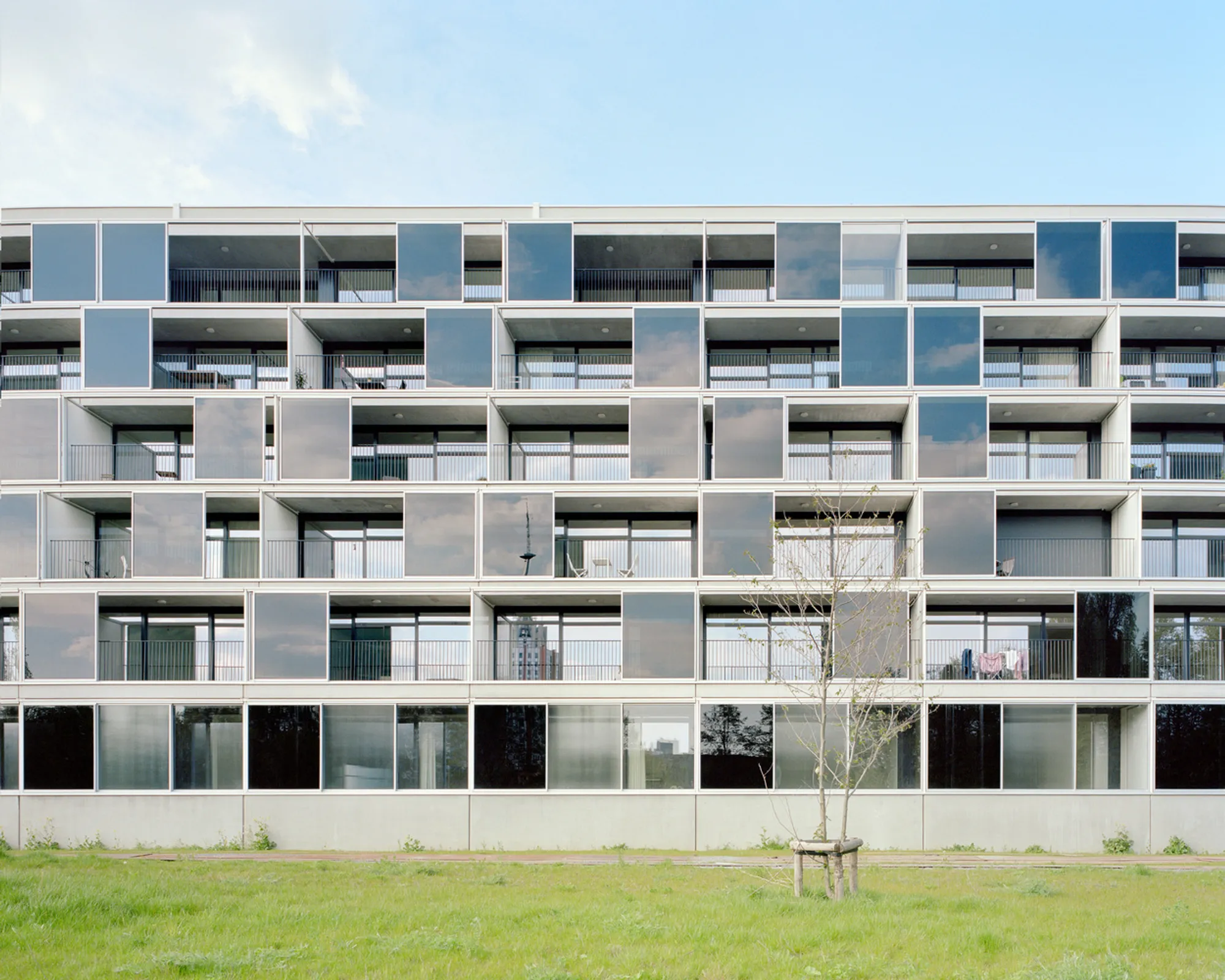
The fractional volumetry is visible in the way the facade steps and recesses at each floor, avoiding the deadening repetition that plagues linear residential blocks. Lobbies, communal activity spaces, and terraces are all oriented south toward the park, activating the ground floor as a social threshold rather than a service corridor. With 89 standard apartments and 55 assisted living units, the bar also carries the project's programmatic diversity, mixing demographics in a way the tower does not.
Facade Depth and Material Strategy
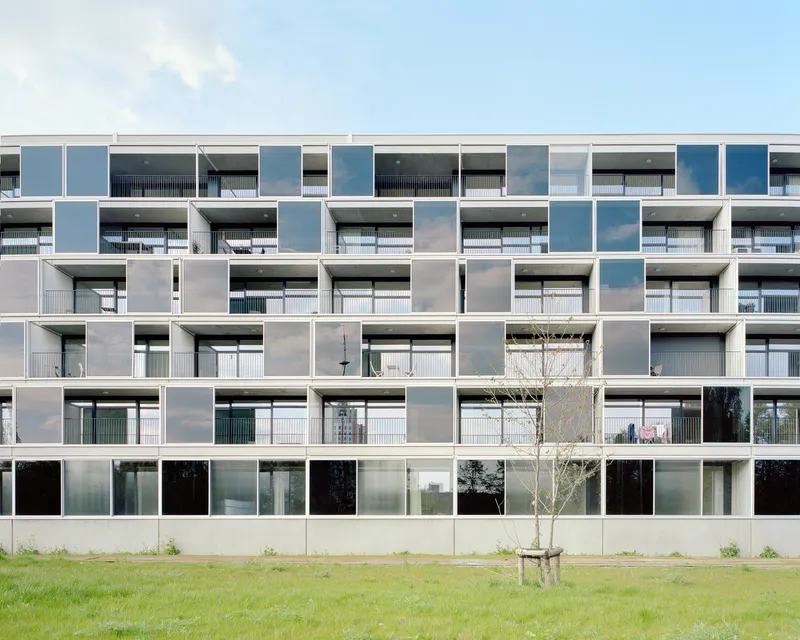
Seen head-on from the lawn, the bar's facade resolves into a rigorous grid of recessed balconies, sliding glass panels, and opaque infill. The depth of each bay is significant: it creates shadow lines that change throughout the day, giving the facade a kinetic quality that photographs only partially capture. Aluminum profiles run vertically, establishing the rhythm, while the glass and opaque panels alternate to signal different room functions behind.
The near-total transparency that XDGA pursued across both buildings is not merely aesthetic. With loggias on every south-facing apartment and generous glazing on all other orientations, the design maximizes daylight penetration deep into floor plates. Two underground parking levels remove cars from the site surface entirely, freeing the ground for landscape, bicycle storage, and pedestrian circulation. Landscape architects ARA and Bureau Bas Smets handled the parkland, ensuring the green buffer between bar and canal reads as continuous public space.
Plans and Drawings
The physical model clarifies decisions that photographs obscure. The tower's prismatic offsets are legible as distinct volumes rather than surface decoration. The bar's perforated facade openings register as a systematic pattern of voids that correspond to the loggia grid. And the relationship between the two buildings, separated but aligned along the park edge, confirms that this is a site-scaled composition planned as a single gesture.
Why This Project Matters
Tweewater matters because it demonstrates that large-scale residential development on post-industrial land does not have to default to generic slabs or isolated towers. XDGA treated the 28,000-square-meter program as an opportunity to create two buildings that argue with each other, one vertical, one horizontal, yet share a commitment to transparency, loggia living, and fractured massing. The mixed demographic programming, pairing luxury apartments with assisted living, is also notable in a market where such combinations rarely survive the developer's spreadsheet.
For Leuven, the project reclaims a site that sat between infrastructure and heritage, giving it a new public identity while acknowledging its industrial past through sheer scale. The 70-meter tower does not apologize for its height; the 140-meter bar does not apologize for its length. Together they propose that ambition and livability are not opposites, a proposition that more European housing projects would benefit from testing.
Tweewater Housing by XDGA – Xaveer De Geyter Architects, Leuven, Belgium. 28,000 m². Completed 2022. Photography by Maxime Delvaux.
About the Studio
Share Your Own Work on uni.xyz
If projects like this are the kind of work you want to make, uni.xyz is a place to publish your own, find collaborators, and enter design competitions.


Popular Articles
Popular articles from the community


Riyadh For All: Intergenerational Urban Design for Active Aging in Rabat
Riyadh For All reimagines urban design in Rabat with intergenerational co-living, adaptive courtyards, and Moroccan cultural exchange today.

The Musturak Paradise: Senior Living Architecture for a Connected Future in Temara, Morocco
The Musturak Paradise reimagines senior living architecture in Temara via private homes, social spaces, culture, community, and shared care.

Lunar Spiral: Space Architecture Shaped by the Mathematics of the Universe
Lunar Spiral reimagines space architecture through Fibonacci geometry, lunar regolith, levitating habitats, and self-sustaining Moon living.

Hill & Cross Opera: Sculptural Opera House Architecture Shaped by Tallinn’s Landscape and Identity
Hill & Cross Opera reimagines opera house architecture in Tallinn through its sculptural hill, civic plaza, glass wave and a luminous cross.
Similar Reads
You might also enjoy these articles


Hodi-Mandai Geram
Project Function: Preservation and revitalization of the Intangible heritage and socio-spatial identity of the Hodi by Housing, Cultural Memory Center, Sacred Grove, landscape, local tourism economy


Olio Towers: A Mid-Rise for Performers That Fuses Housing, Rehearsal, and Stage
Located blocks from Houston's Theater District, this modular tower stacks living units around a central performance atrium.

Oasis: Modular Green Housing Carved into Dhaka's Urban Fabric
A shortlisted Plugin Housing entry reclaims unauthorized settlements in Dhaka with stepped concrete volumes, green roofs, and ventilation-driven design.

Black Hole: A Floating Megastructure for the Post-Physical Era
Emiliano Mazzarotto envisions a spherical, self-scaling arena where e-sports, digital hotels, and holographic stadiums replace traditional public space.
Explore 2X1 Architects Competitions
Discover active competitions in this discipline



Challenge to reimagine the Iron Throne


Photograph architecture without architects


Illustrate the lost glory of Angkor Wat - Render Challenge


Design challenge to reuse E-waste
Comments (0)
Please login or sign up to add comments
No comments yet. Be the first to comment!