
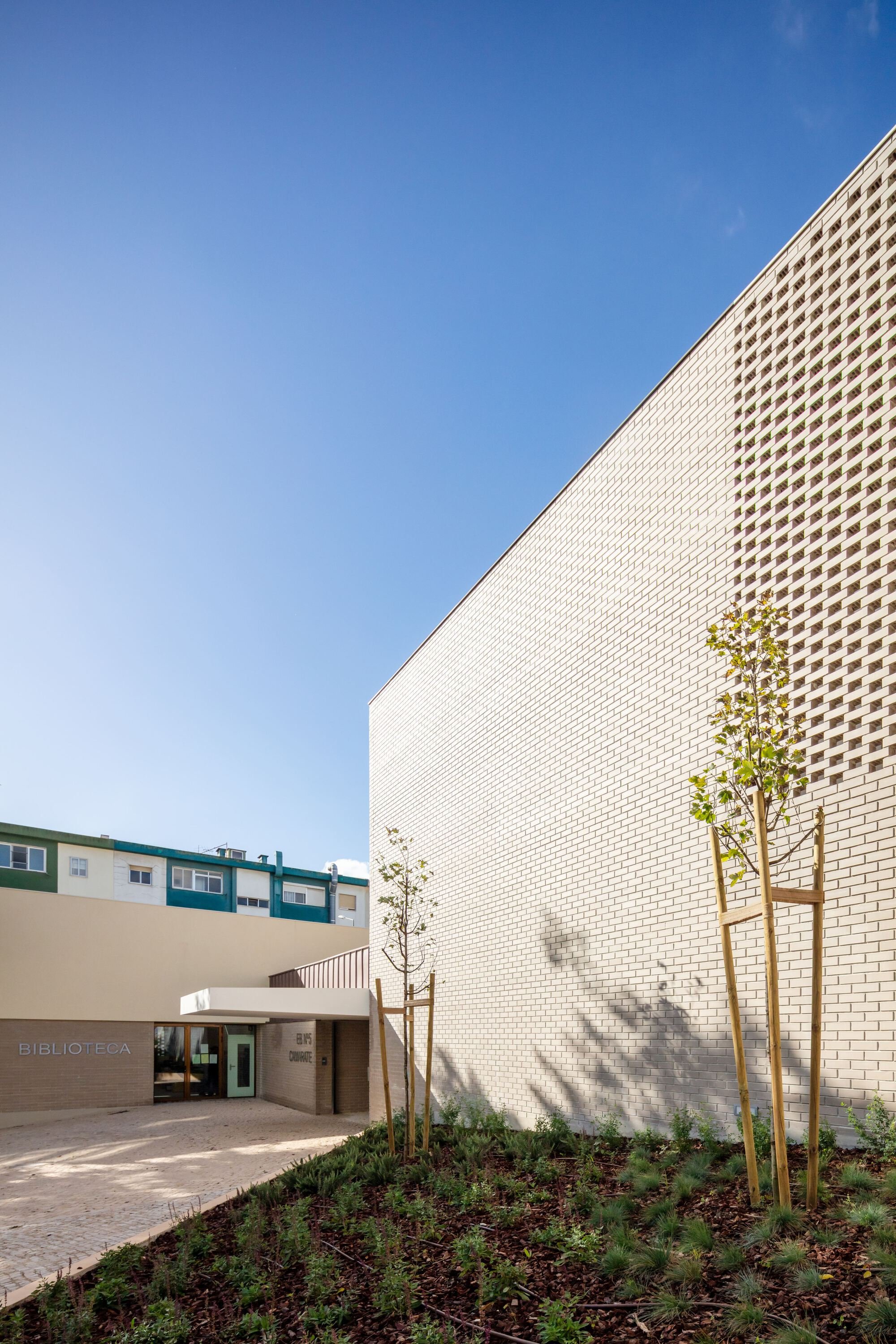
UMA Collective Wraps a Camarate School Around a Courtyard of Perforated Brick and Play
A new elementary school in Loures, Portugal, doubles as a neighborhood anchor with a public library and generous outdoor rooms.

Public schools rarely get to be civic architecture. Budget constraints, tight timelines, and the sheer repetition of program rooms tend to flatten ambition into corridor-and-classroom slabs. So when a new elementary school manages to feel like a genuine place, one worth walking past even if you have no children enrolled, it deserves attention. UMA Collective's Camarate Elementary School No. 5, completed in 2026 in the São Francisco neighborhood of Loures, Portugal, is that kind of building: a 1,731-square-meter facility for young students and kindergarteners that treats its courtyard, its brick skin, and its public-facing library as design problems of equal seriousness.
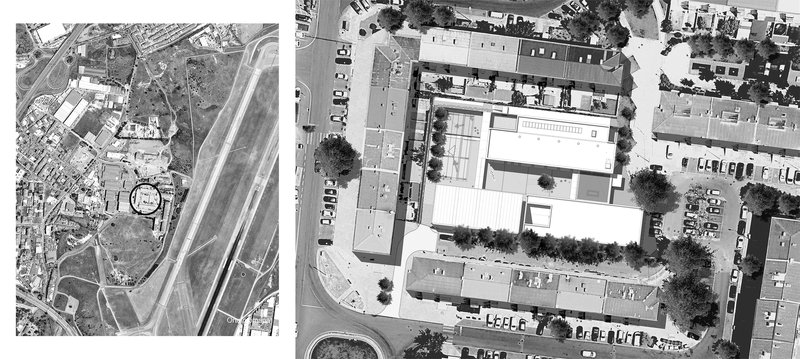
The most striking decision, visible from the air and on the ground, is the circular footprint that organizes classrooms, dining hall, and library around a central courtyard. Led by architect Rui Cruz, the design rejects the standard bar-building typology in favor of volumes that curve inward, creating sheltered outdoor space at the heart of the plan. Every corridor terminates in a view of sky and trees. Every classroom sits a few steps from open air. For a neighborhood that needed urban regeneration as much as it needed school seats, the building delivers both: a courtyard for children during the day, a library for the community at all hours.
Brick as Both Skin and Screen
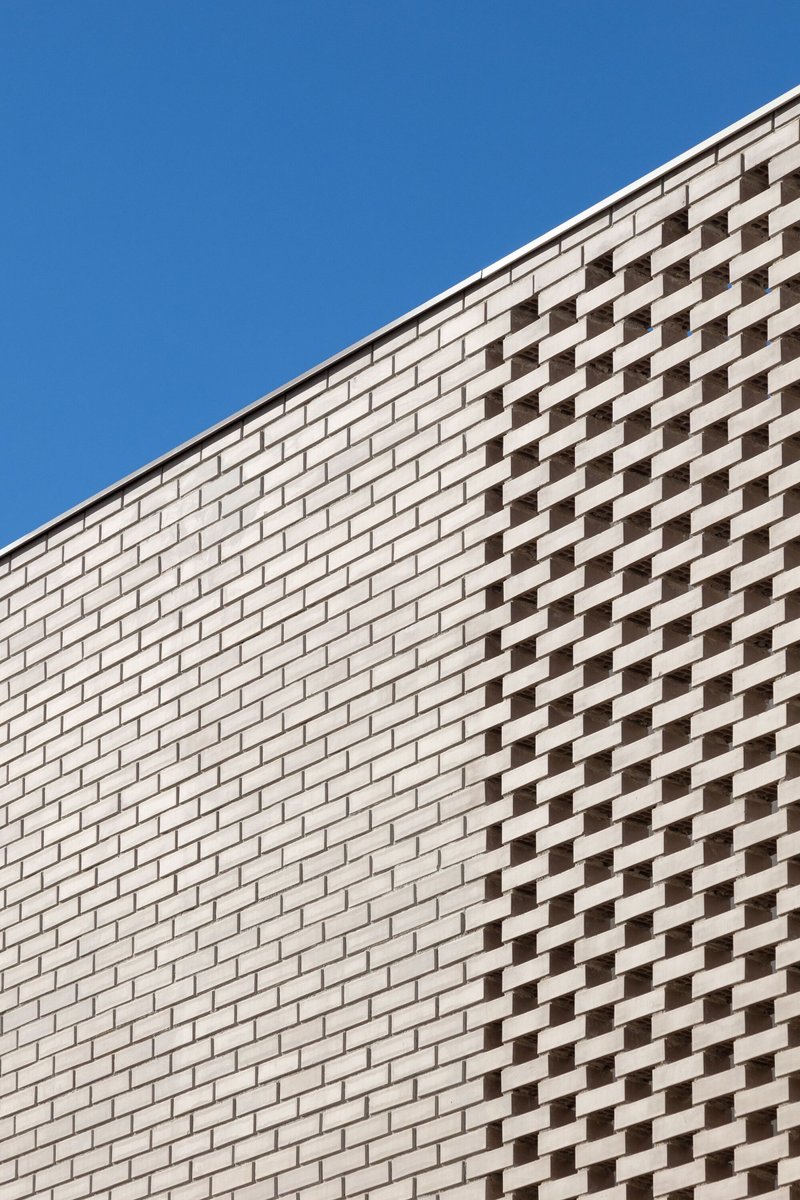
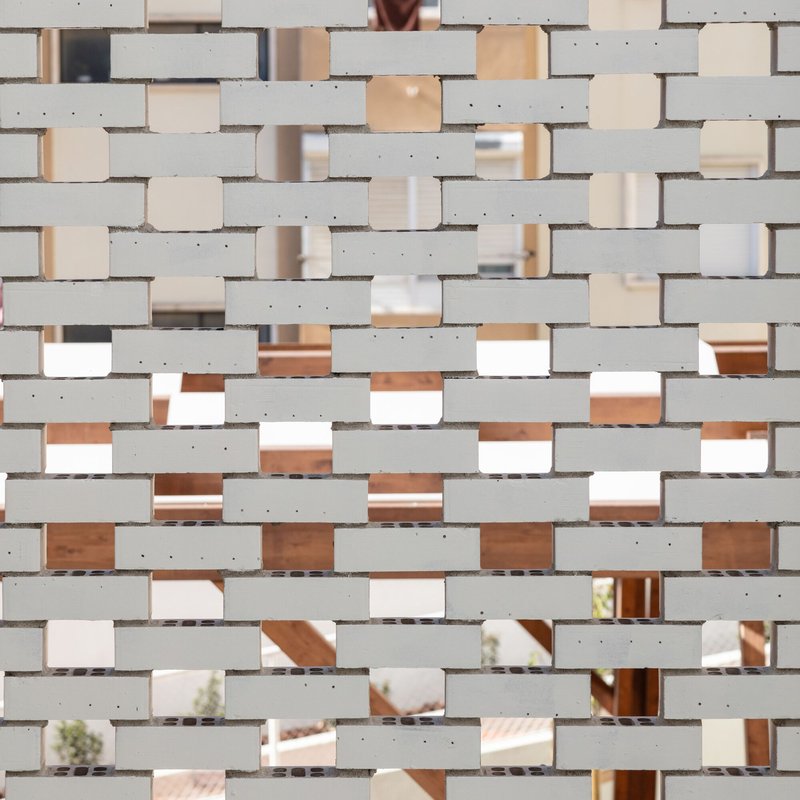
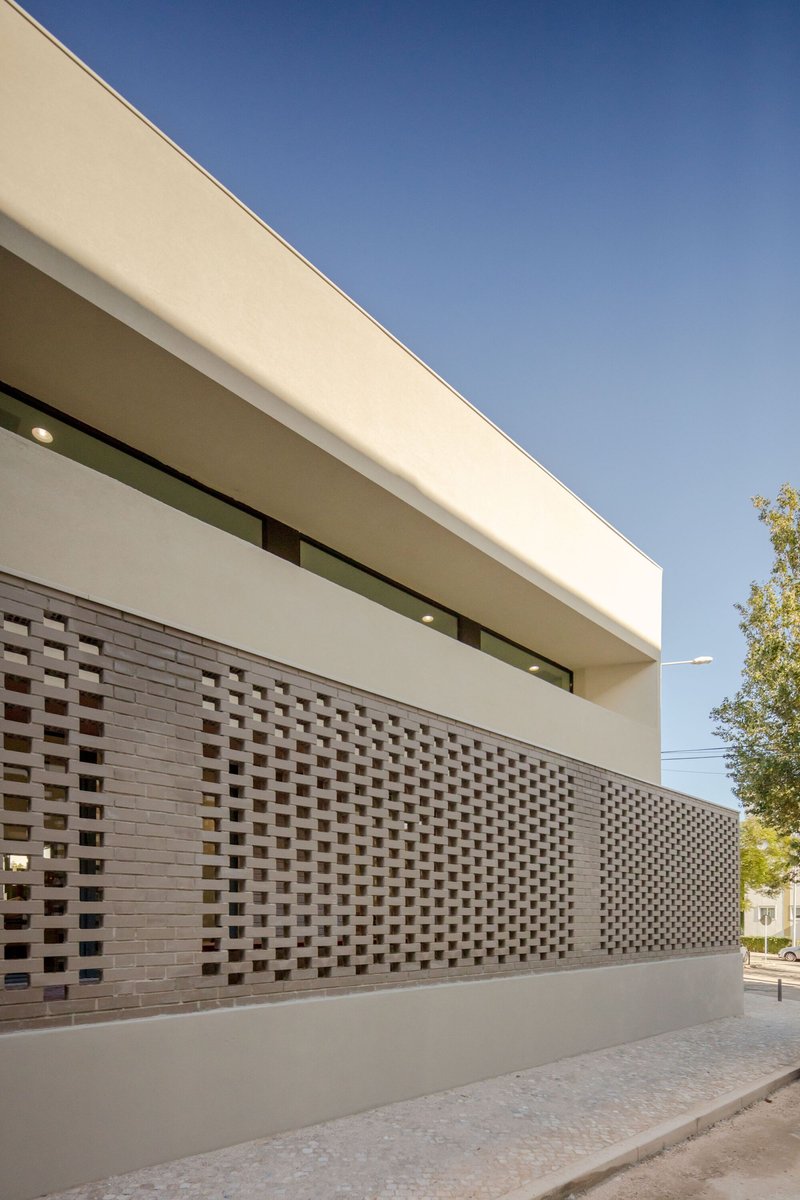
The buff brick that wraps the school does at least three jobs. In its solid stretches it gives the building a warm, tactile presence on the street. Where it shifts into a stepped checkerboard pattern, it becomes a perforated screen that filters light into covered walkways and terraces without blocking air movement. And where mirrored glass is set into the openings, the screen turns semi-translucent, reflecting foliage and sky back at passers-by while softening the visual boundary between inside and outside.
UMA Collective has built a reputation around energy-efficient refurbishments and Passive House standards, and the brick screens here feel like an extension of that thinking. Rather than relying solely on mechanical systems to manage solar gain, the architects let the envelope do the work. The perforated panels shade glazing during peak hours, reduce glare in classrooms, and introduce a rhythm of light and shadow that changes through the day. It is a climate strategy that also happens to be the building's most memorable image.
The Courtyard as Classroom
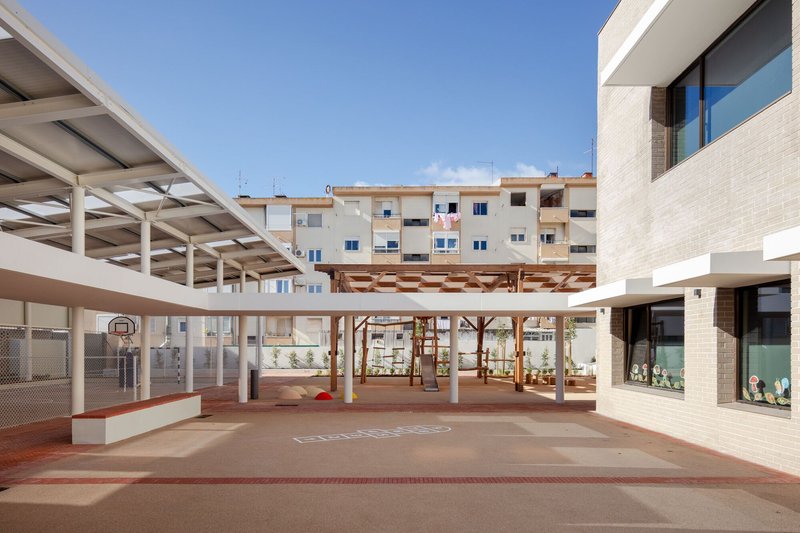
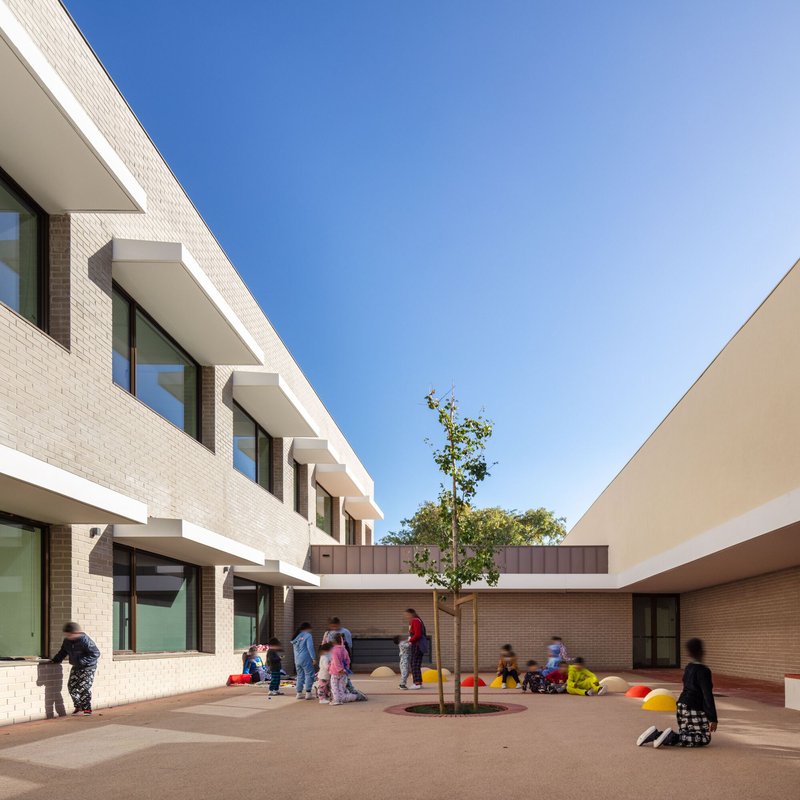
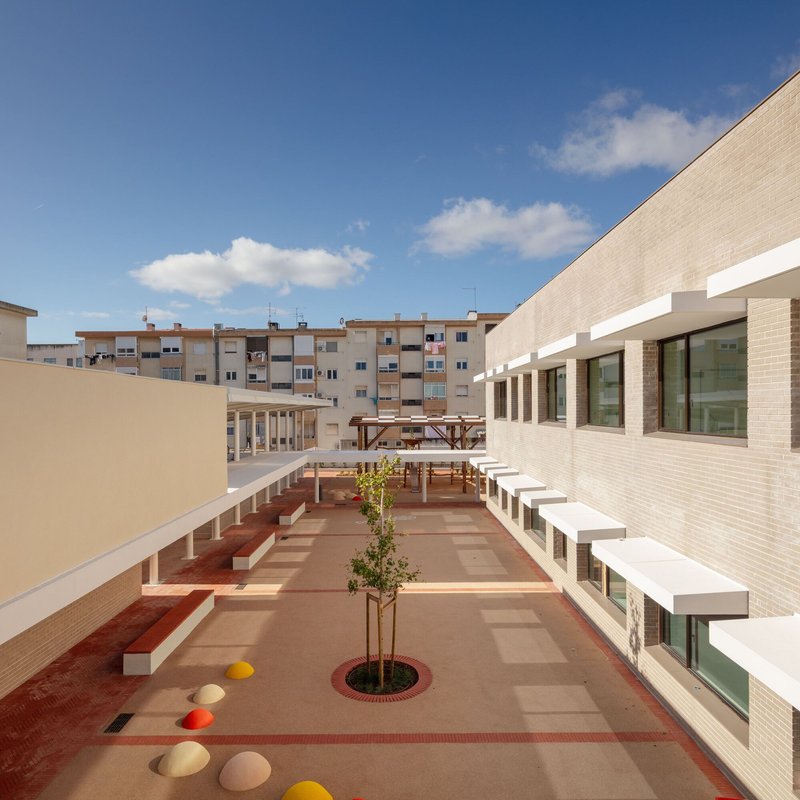
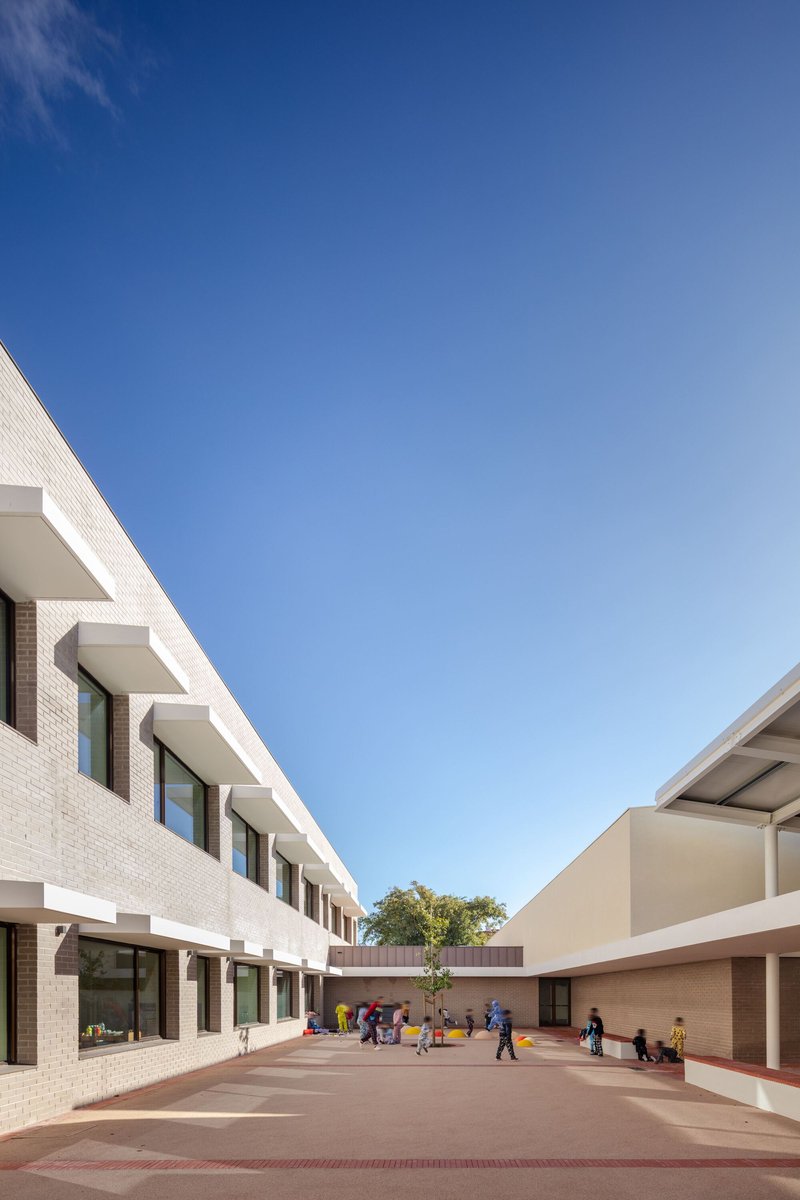
Central courtyards in schools can easily become dead zones: too hot in summer, too windswept in winter, too undefined to invite real use. UMA Collective avoids that trap by breaking the courtyard into distinct zones. A timber pergola structure creates a shaded corridor connecting the surrounding volumes, while planted tree beds and a circular planter with colored play spheres give younger children scaled-down territories to claim. The paving shifts between earth tones and bolder reds, marking zones without hard barriers.
The decision to plant young saplings rather than truck in mature trees is worth noting. It means the courtyard will mature with the students who use it, gaining shade and canopy cover over the coming decades. For now, the pergola and projecting canopies do the heavy lifting, but the long-term bet is on a green heart that grows denser each year.
Canopies, Arcades, and the In-Between
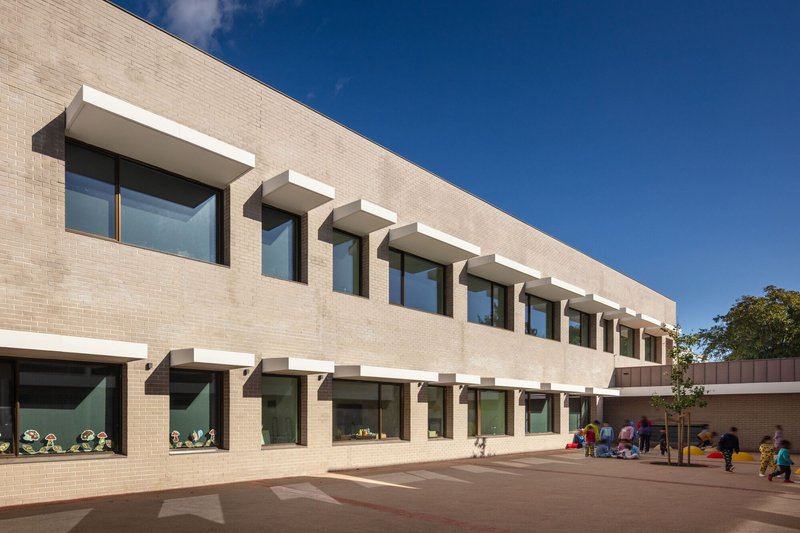
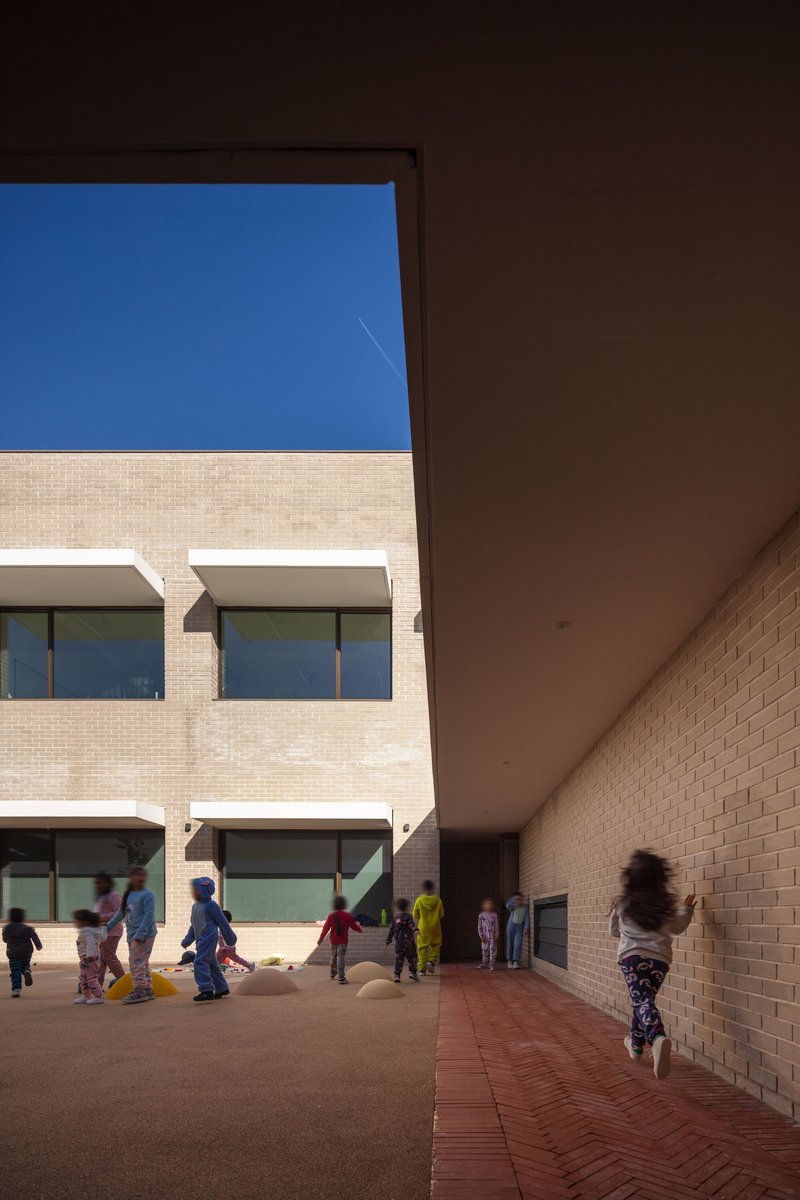
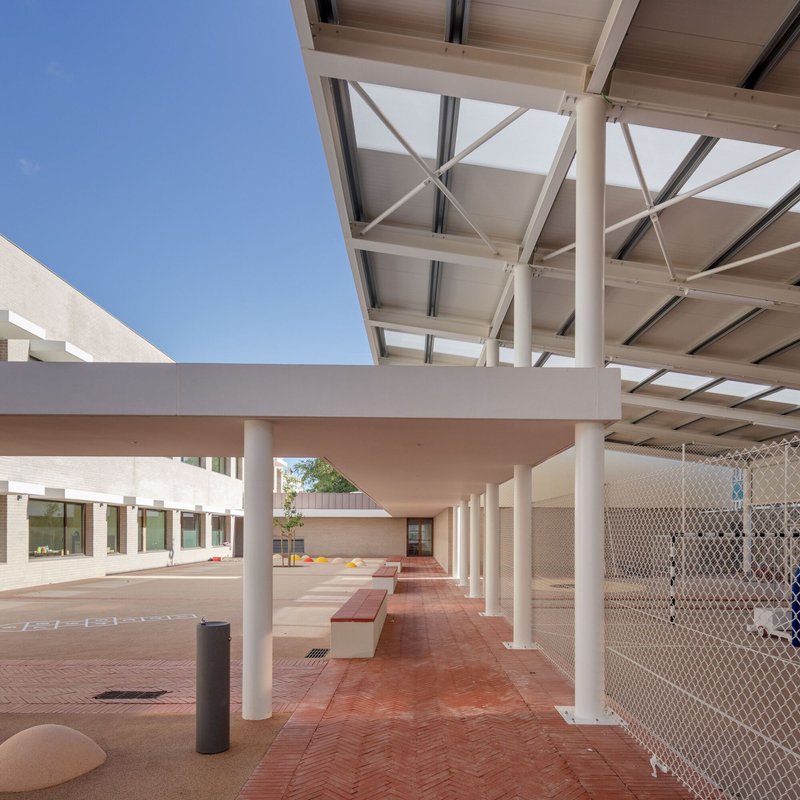
Some of the best space in this school is neither inside nor outside. Covered walkways with white cylindrical columns and cross-braced canopies wrap the courtyard edge, giving children a place to gather in rain or shade without retreating indoors. Herringbone terracotta paving underfoot distinguishes these arcades from the courtyard proper and lends them an almost domestic quality, closer to a Portuguese loggia than a school corridor.
The repeating canopy shades that project over glazed classroom openings on the courtyard facades serve a dual purpose. They cut direct sun before it hits the glass, and they give each opening a deep, shadowed reveal that reads as a kind of brow, lending the facade a layered depth that flat curtain walls never achieve. Children running beneath them inhabit a threshold zone, half sheltered, half exposed, that feels genuinely generous for a public school.
Street Presence and Community Access
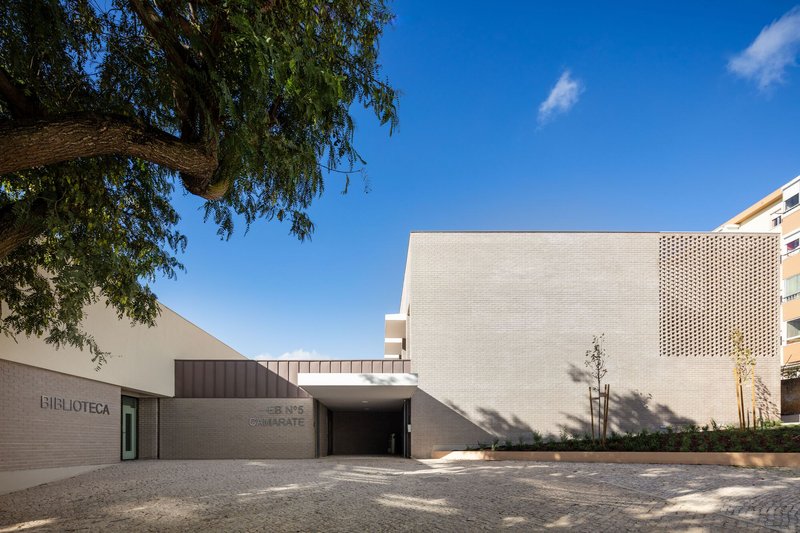
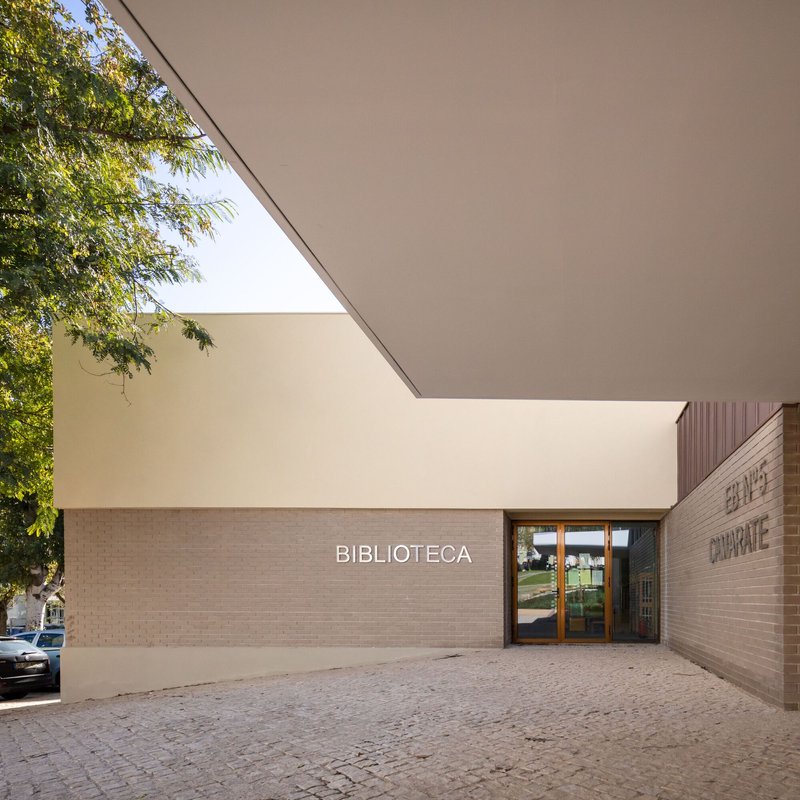
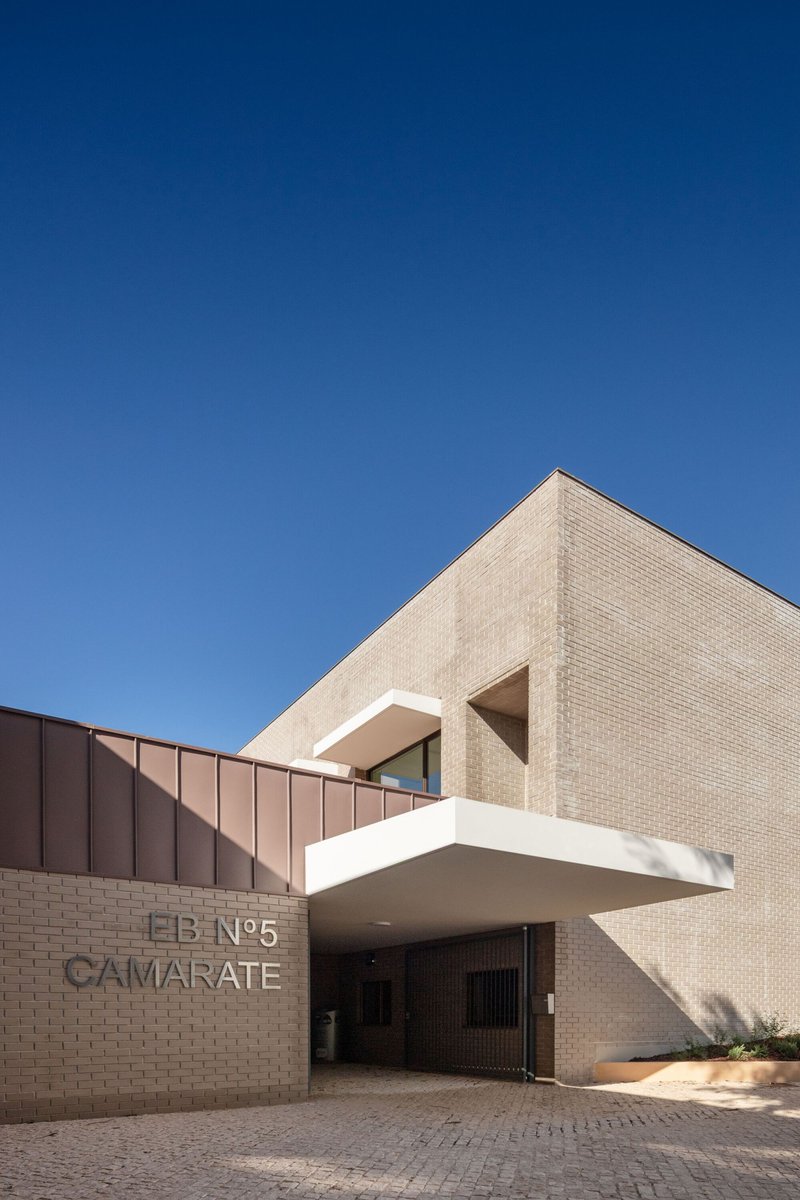
Schools in dense neighborhoods face a tension between security and openness. The building needs to feel welcoming without being porous. UMA Collective handles this by differentiating the street-facing facades from the courtyard-facing ones. On the street side, the buff brick is more solid, punctuated by raised white lettering that identifies the school and glass doors that sit beneath a cantilevered white canopy. The library entrance, marked by the perforated brick panels visible through overhanging tree branches, announces itself as the public face of the building, distinct from the student entrances.
Including a publicly accessible school library was a deliberate move to blur the line between educational facility and neighborhood institution. In São Francisco, where the project was conceived partly as an urban regeneration catalyst, this matters. The library gives residents a reason to engage with the school even if they have no direct connection to it, turning the building into shared infrastructure rather than a walled compound.
Interior Light and Material Restraint
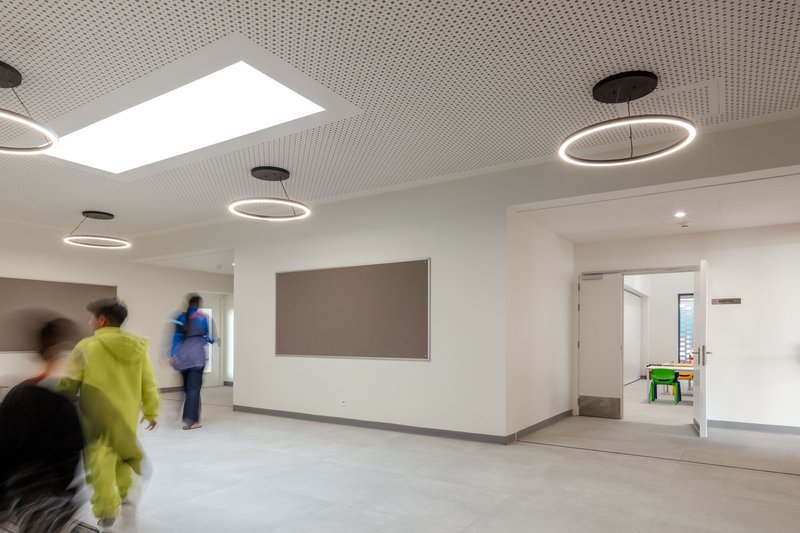
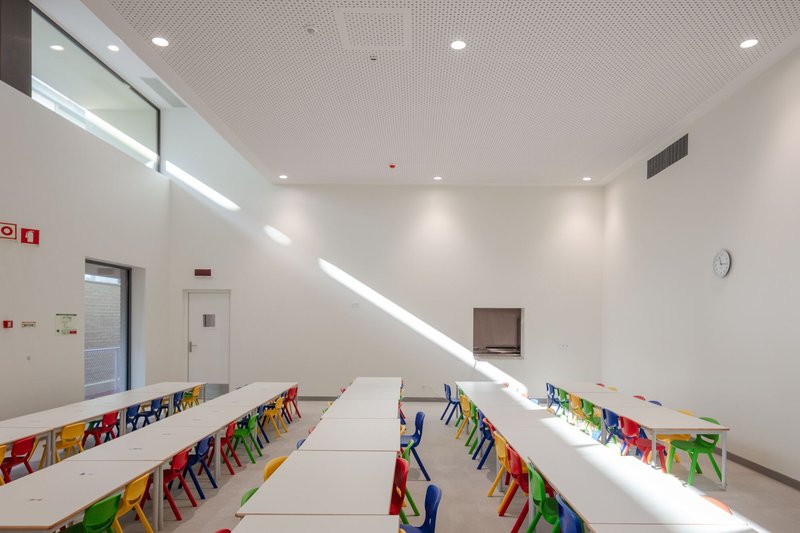
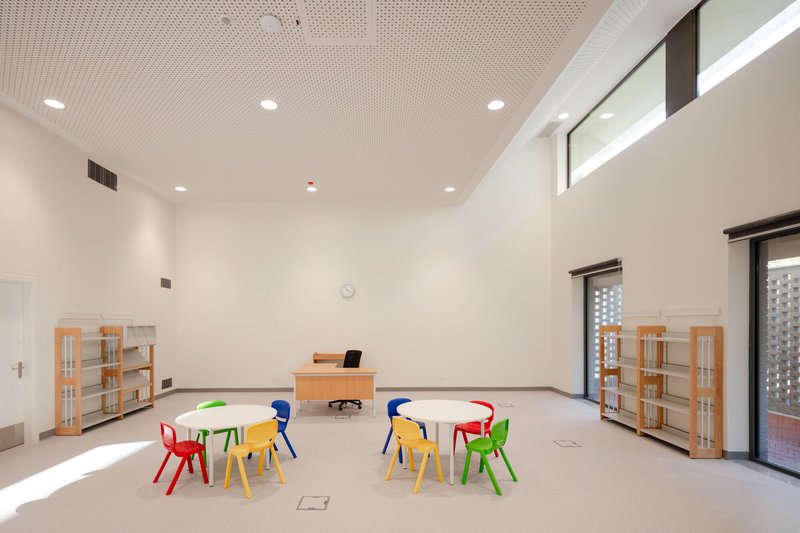
Inside, the palette is deliberately restrained: white walls, terrazzo flooring, pale wood paneling on stairs, and perforated acoustic ceilings in classrooms. The restraint is strategic. In a building for young children, the furniture, art, and daily clutter supply all the color you need. Neutral backgrounds let those elements breathe. Circular pendant lights in corridors and clerestory windows in the dining hall ensure natural daylight reaches deep into the plan, reducing dependence on artificial lighting during school hours.
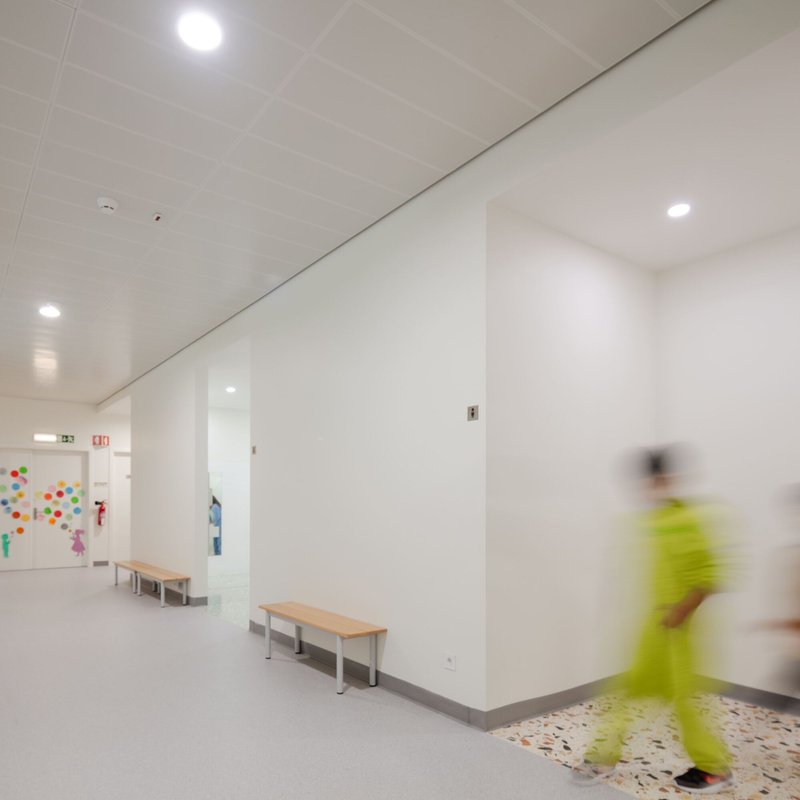
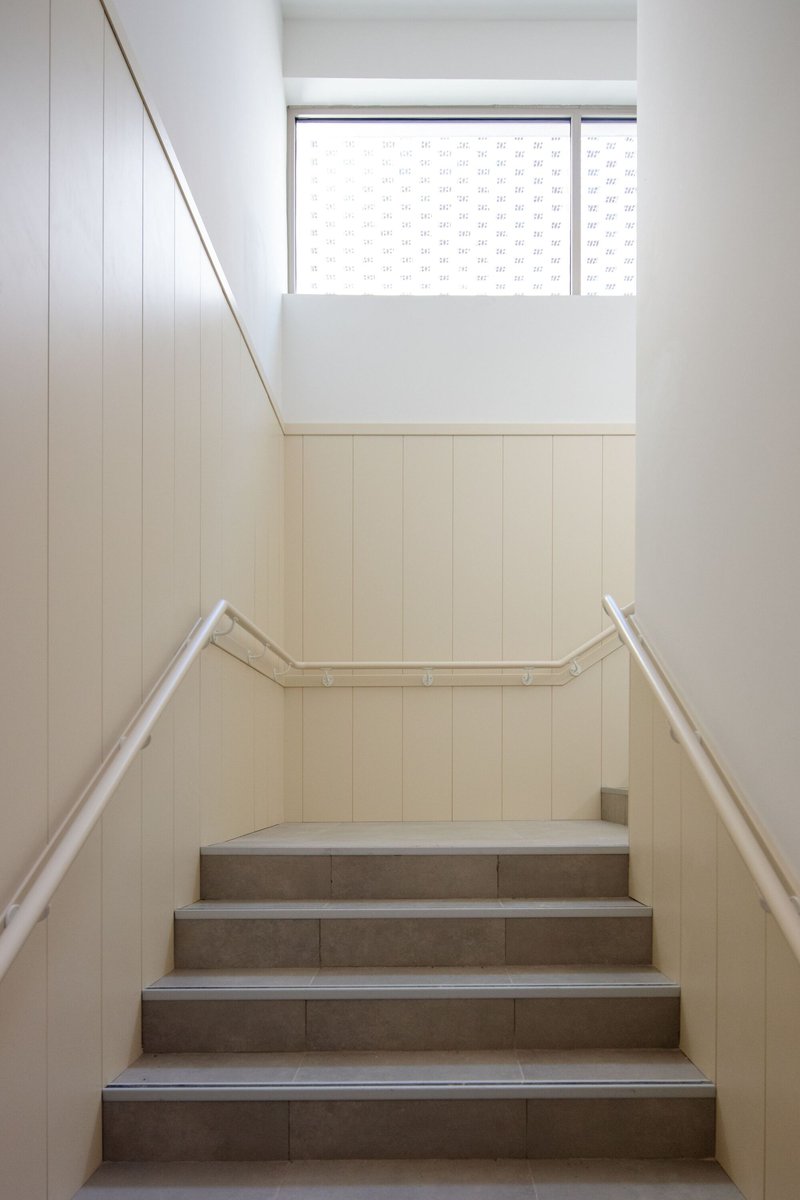
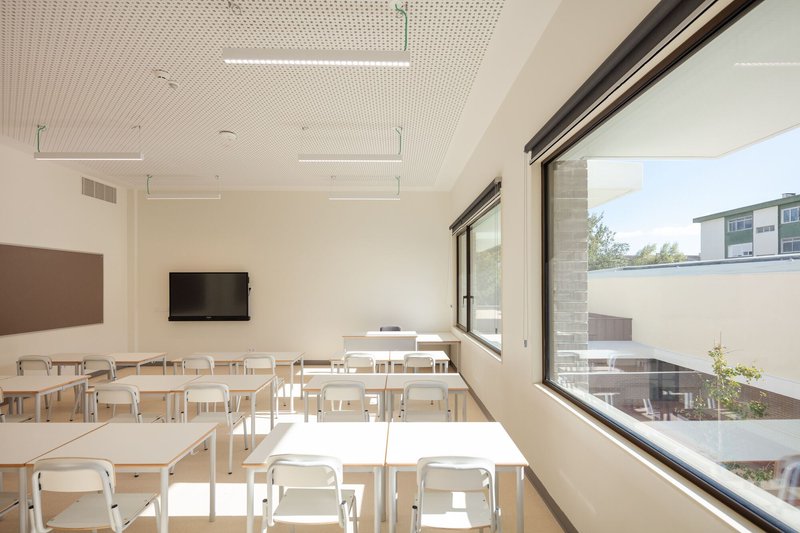
The classrooms themselves are compact but well-proportioned, with corner windows that pull in light from two directions and perforated acoustic ceilings that tame the inevitable noise of a room full of small children. Timber benches in hallways offer rest points that double as informal gathering spots, acknowledging that learning happens outside the classroom as much as within it.
Outdoor Rooms and Edges
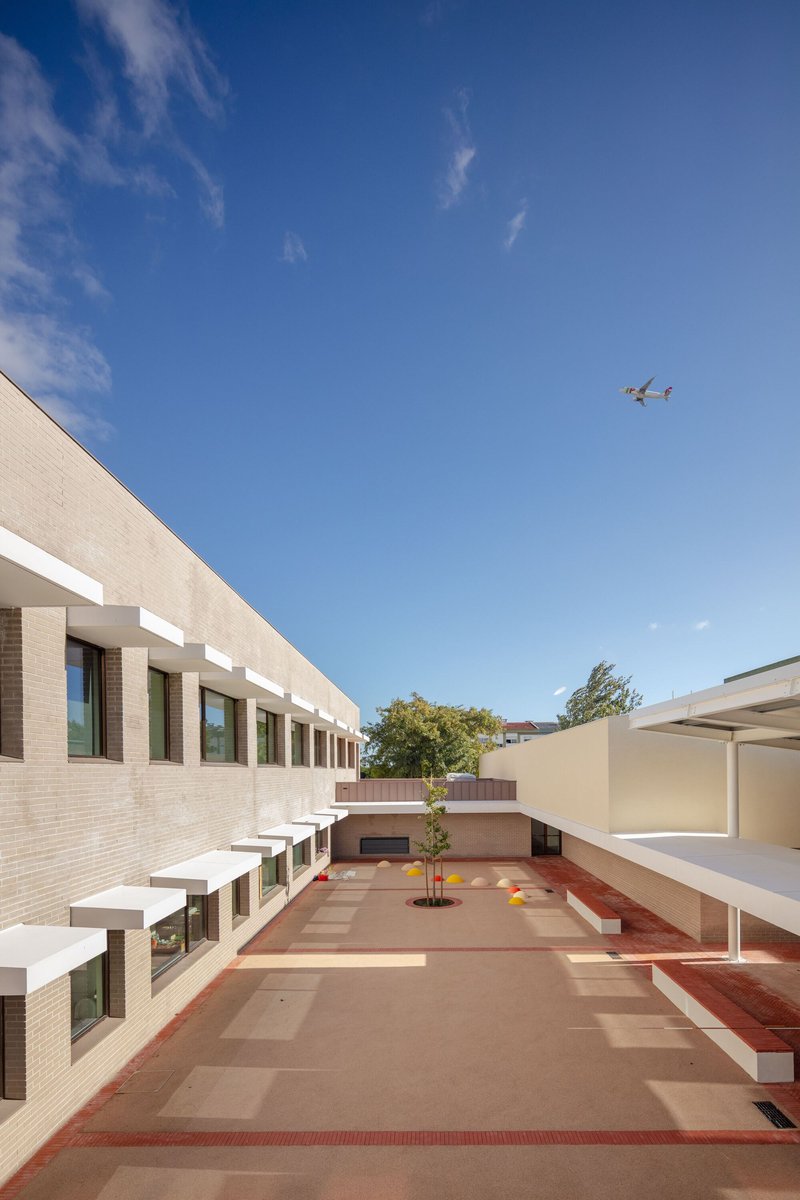
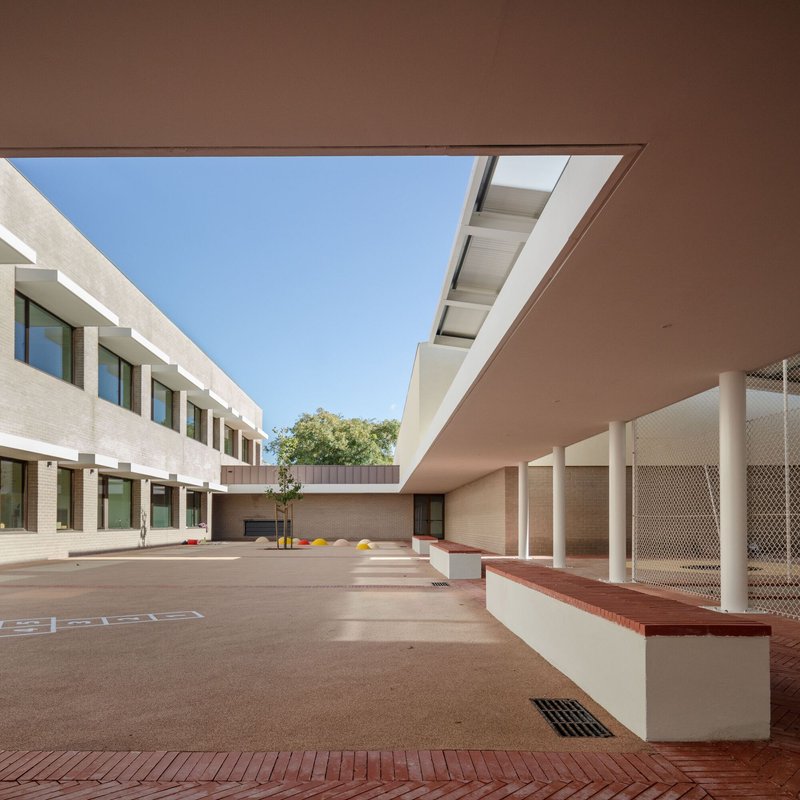
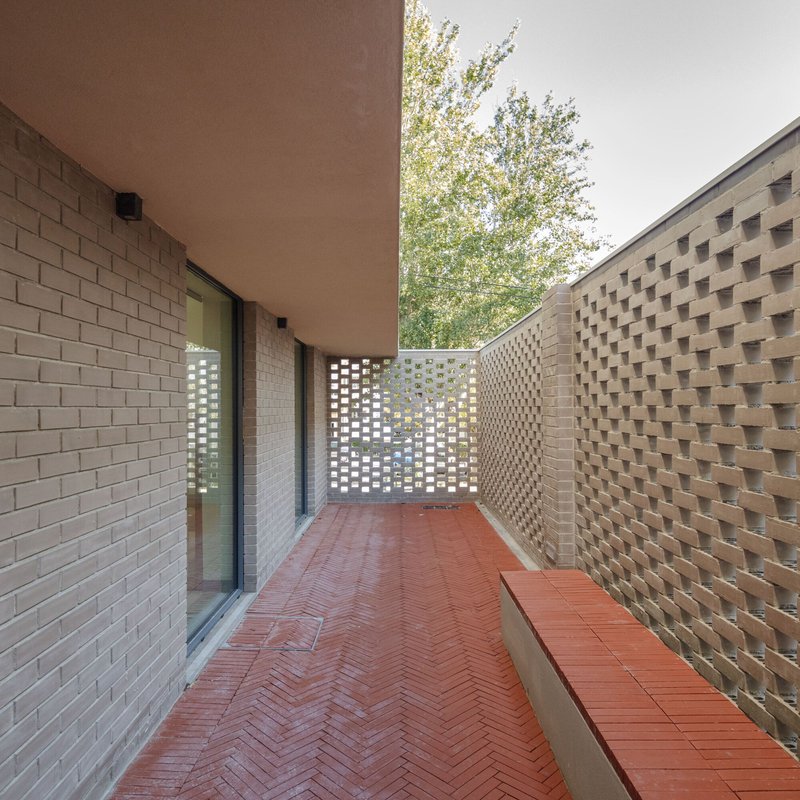
Beyond the central courtyard, secondary outdoor spaces extend the school's vocabulary of sheltered ground. Terraces with herringbone tile floors are framed by perforated brick screen walls, creating outdoor rooms that feel enclosed without being closed. Red-capped benches line the arcade edges, providing seating scaled to adults and older children alike. The tiled paving in earth tones ties these peripheral spaces back to the warmer palette of the brick, ensuring a visual coherence across the entire site.
Volumes in Composition
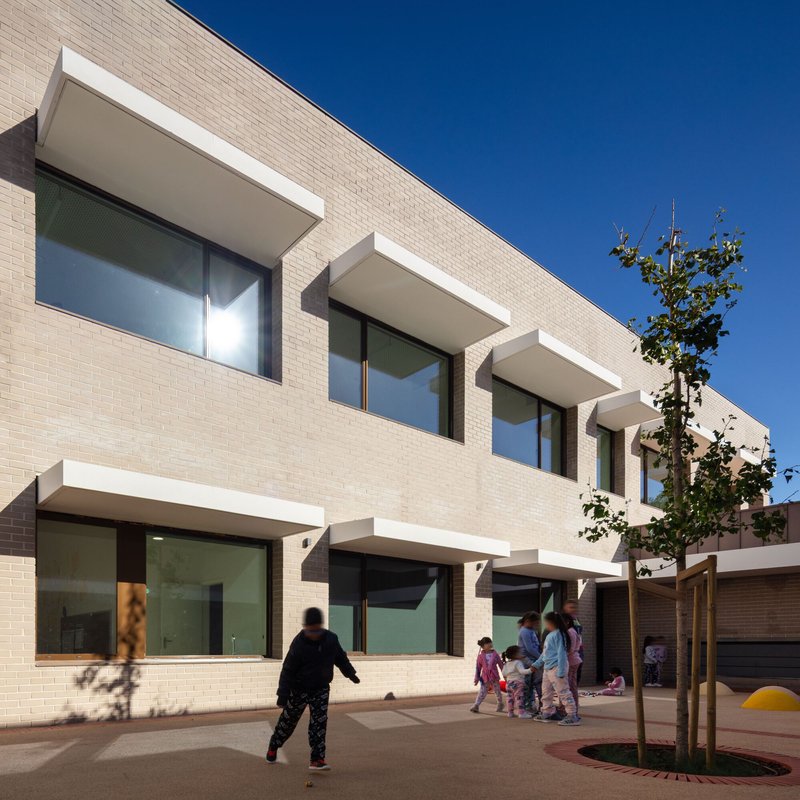
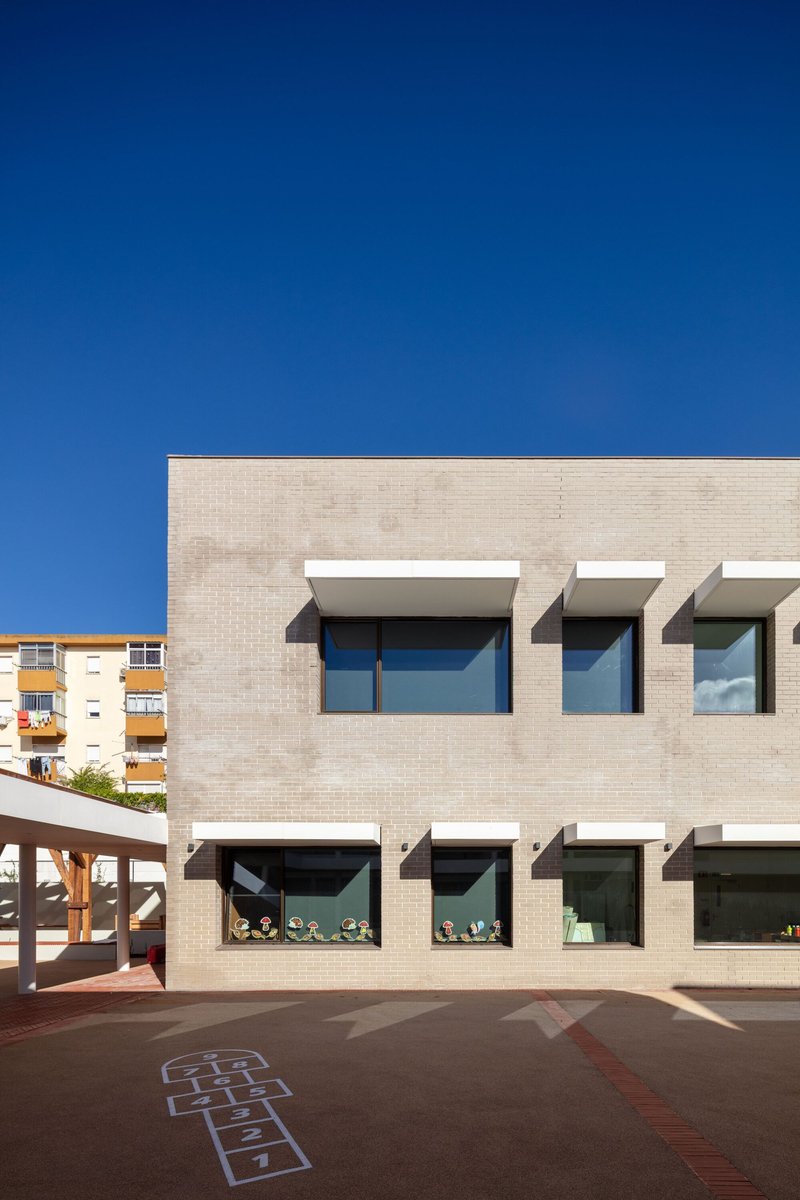
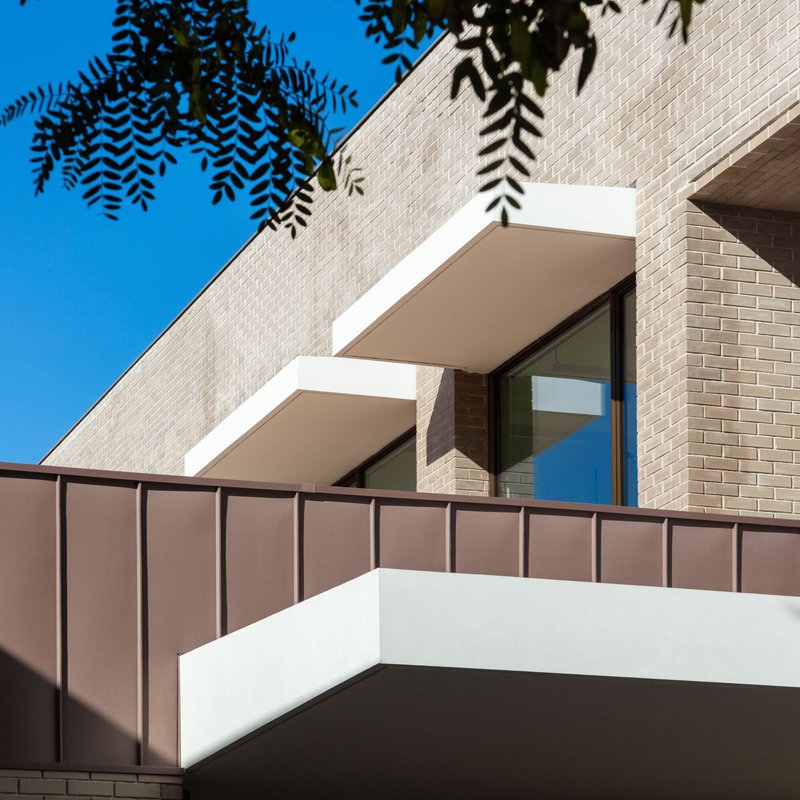
From the courtyard, the school reads as a composition of two-story brick volumes connected by lower links. Projecting sun shades, vertical metal cladding at corners, and a copper standing-seam roof give each volume its own identity while the shared material language holds the ensemble together. The stacking of canopies on the corner detail is particularly effective: it introduces a vertical rhythm that counters the predominantly horizontal lines of the ribbon windows and arcade.
The aerial view reveals how tightly the circular plan sits within its urban block, surrounded by parking and adjacent buildings. The compact footprint maximizes usable outdoor space within the site boundary, leaving the perimeter for access and services while concentrating the social life of the school at its center. It is an efficient diagram that never feels diagrammatic at ground level.
Plans and Drawings
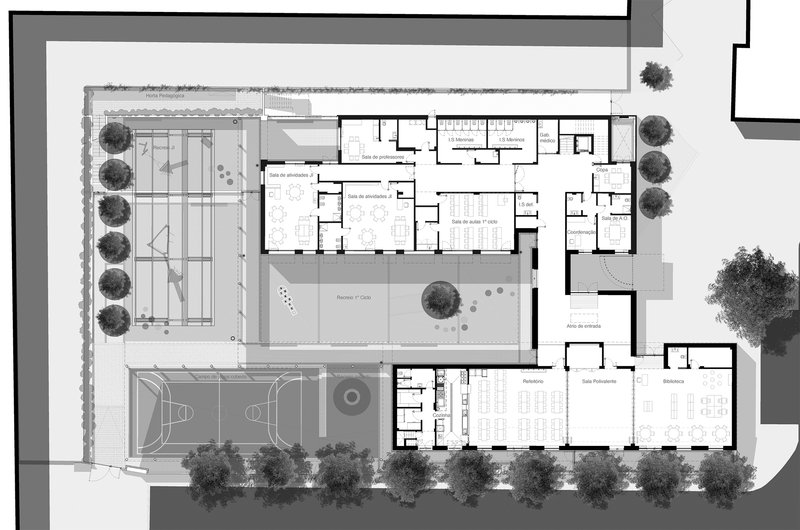
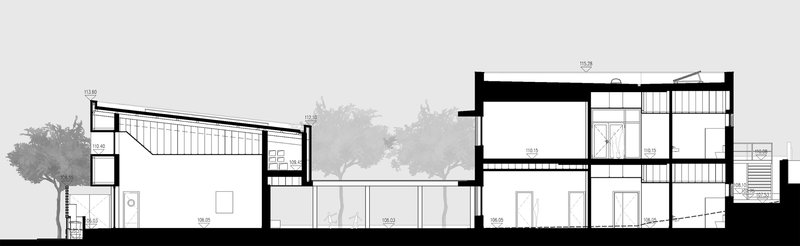

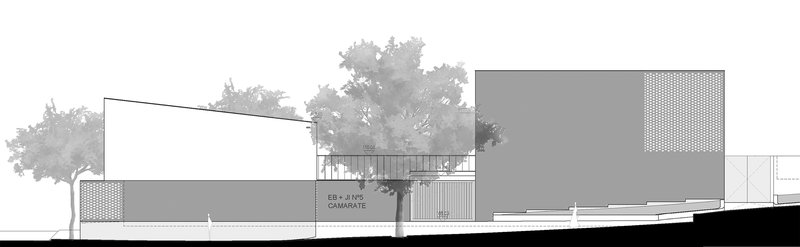
The site plan confirms the courtyard-centric organization, with classroom wings radiating around a central open space that includes a basketball court and landscaped edges. The sections show how the sloped roof volumes connect low and high wings, creating varied ceiling heights inside while maintaining a cohesive profile from the street. Elevation drawings reveal the horizontal canopy structure in full, illustrating how the row of trees planted along the facade will eventually form a secondary screen that mediates between the building and its neighborhood.
Why This Project Matters
Camarate Elementary School No. 5 matters because it refuses the false choice between efficiency and atmosphere. Every square meter of its 1,731-square-meter footprint is accounted for in programmatic terms, classrooms, dining hall, library, circulation, yet the building feels generous. That generosity comes from the in-between spaces: the arcades, the terraces, the perforated screens that turn a wall into a veil. These are not leftover areas. They are the most designed parts of the project, and they are the parts children will remember decades from now.
For UMA Collective, the project is also a proof of concept for the idea that a public school can anchor a neighborhood. The publicly accessible library, the carefully scaled street facades, and the courtyard visible through gaps in the brick screen all signal that this building belongs to more than its enrolled students. In a country where school construction too often defaults to prefabricated pragmatism, this is a building that argues, convincingly, that civic investment in young children deserves civic architecture in return.
Camarate Elementary School No. 5 by UMA Collective, lead architect Rui Cruz. Located in Camarate, Loures, Portugal. 1,731 m². Completed 2026. Photography by João Morgado.
About the Studio
Share Your Own Work on uni.xyz
If projects like this are the kind of work you want to make, uni.xyz is a place to publish your own, find collaborators, and enter design competitions.


Popular Articles
Popular articles from the community

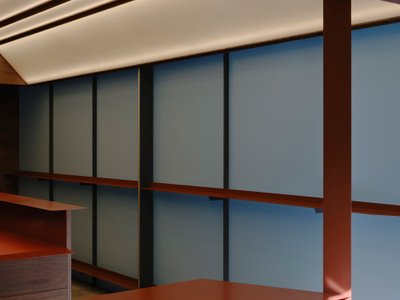
Kerry Kounnapis Packs 800 Daily Coffees into a 43-Square-Metre Melbourne Laneway Bar
Palace Coffee channels Pellegrini's and European standing bars through oxide-red steel and spotted gum timber in a Ridgway Place sliver.
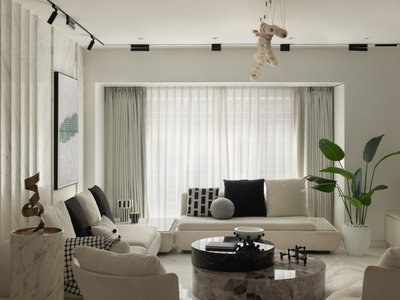
Inside a Timeless Mumbai Residence by Aether Studio
Aether Studio's 2,250 sq ft apartment in Malad, Mumbai uses marble, brass, boucle, and disciplined restraint to build a quiet retreat from the city.

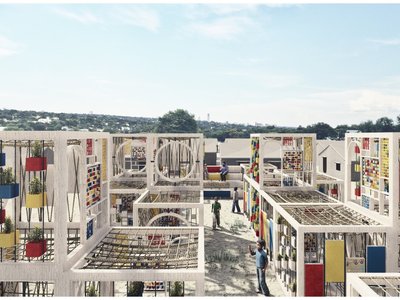
The Faith: Modular Architecture for Play, Learning, and Hope in Kutupalong Refugee Camp
A modular playground architecture project in Bangladesh where play, learning, safety, and hope rebuild childhood inside a refugee camp anew.
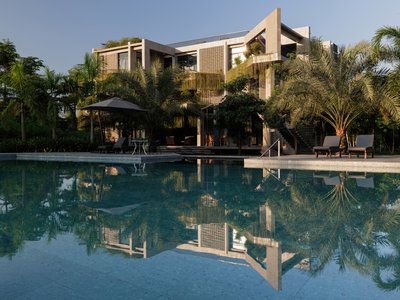
Reincarnation Weaves a Three-Story Retreat into the Green Landscape of Rural Bangladesh
Ara Manor in Narsingdi dissolves the line between domestic architecture and its lush surroundings through screens, courtyards, and planted rooftops.


Similar Reads
You might also enjoy these articles
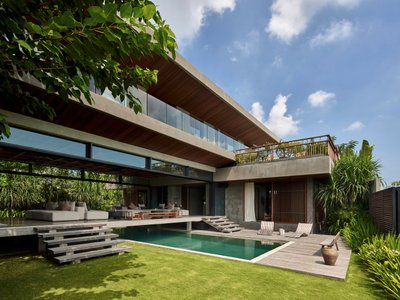
Freebird Residence by Alexis Dornier: A Tropical Modernist Sanctuary in Bali
Floating living pavilion above pool anchors H-shaped tropical villa, blending Japanese minimalism, sustainable strategies, lush landscape, and sculptural interiors.
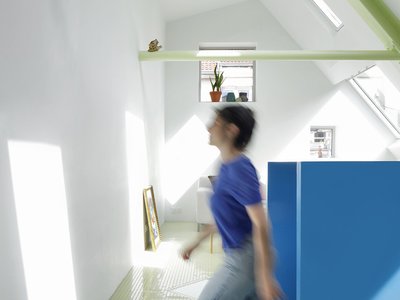
127af Flips a Tiny Bagnolet Rowhouse Upside Down with a Handcrafted Roof Extension
A 55-square-meter terraced house on the edge of Paris gains a luminous upper living floor through lightweight timber and steel.
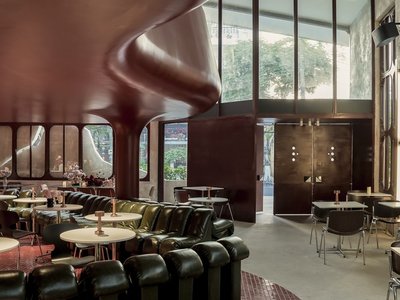
1.61 Design Workshop Wraps a 600-Square-Meter Café in Vietnam in Sculptural Burgundy Drama
Reden Café & Bistro pairs a helical staircase, mosaic floors, and deep red interiors to rethink Vietnamese hospitality space.

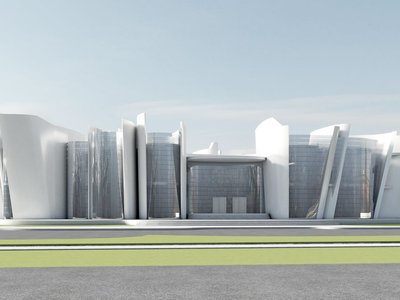
The Unbound Brain: A School Shaped by Cognitive Architecture
Cylindrical learning pods radiate like neurons from a central cortex, turning the floor plan into a spatial model of human thought.


Explore Commercial Buildings Competitions
Discover active competitions in this discipline




The Global Benchmark for Architecture Dissertation Awards


Challenge to design public laboratory
Comments (0)
Please login or sign up to add comments
No comments yet. Be the first to comment!