

UNBLACK: A Transparent Sphere That Turns Pollution Into Ink to Defend the Taj Mahal
Kirti Bali's spherical pavilion collects carbon dust from Agra's air and channels it into darkening lattice screens, making decay visible.


What if a building could ingest pollution and wear it on its skin? UNBLACK proposes a transparent spherical pavilion near the Taj Mahal that does exactly that. The structure captures airborne carbon particles, converts them into ink, and feeds that ink into latticed screens forming the sphere's outer shell. Over months and years the pavilion darkens, turning visually black as Agra's air quality worsens. The result is a real-time environmental gauge and a poetic inversion: as the Taj Mahal yellows under pollution, its architectural twin absorbs the evidence.
Designed by Kirti Bali, the project received an Honorable Mention in The Black Taj competition, which asked designers to reimagine the legend of Shah Jahan's unbuilt black marble mausoleum across the Yamuna River. Rather than reconstruct a myth, Bali reframes the "black Taj" as an environmental condition already in progress, one that architecture can make legible and ultimately resist.
A Sphere of Glass and Guilt
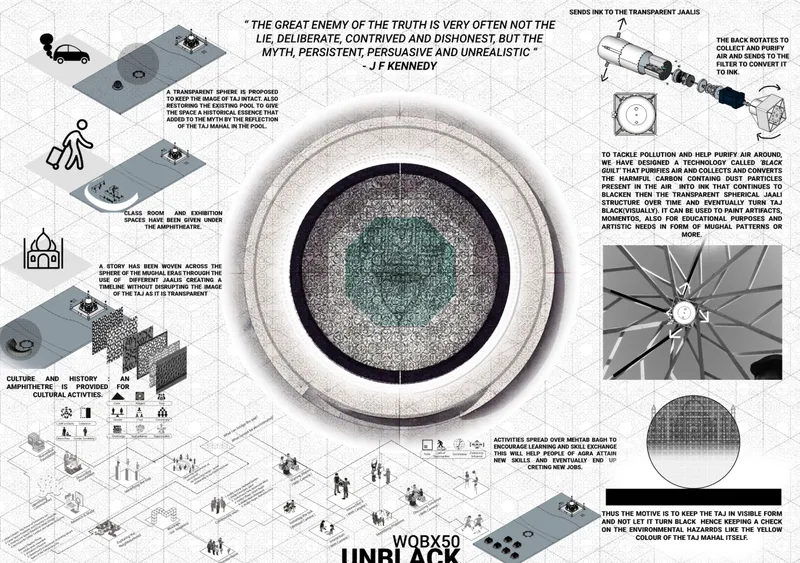
The project board lays out the full ambition: a transparent sphere positioned to hold the image of the Taj Mahal within its volume, preserving a pristine visual echo of the monument even as the original structure deteriorates. Axonometric diagrams and section drawings reveal a circular exhibition structure anchored by an amphitheater, with the sphere rising above as both skyline gesture and environmental machine. The transparency is not decorative. It represents, in Bali's framing, truth and purity, while the gradual darkening of the jaali lattice screens literalizes a concept the designer calls "Black Guilt," the collective environmental debt owed to heritage sites choked by industrial emissions.
The mechanism is straightforward in principle: air is drawn through filters that collect carbon dust, the dust is processed into ink, and the ink is channeled into the transparent jaali panels that compose the sphere's outer skin. As the jaalis fill, the pavilion shifts from clear to opaque black, transforming pollution into a visible, almost accusatory artifact. That ink is not wasted after extraction either. Bali proposes it can be repurposed for creating patterns, artifacts, and educational exhibits, linking environmental remediation to artistic production.
Radial Structure as Directional Logic
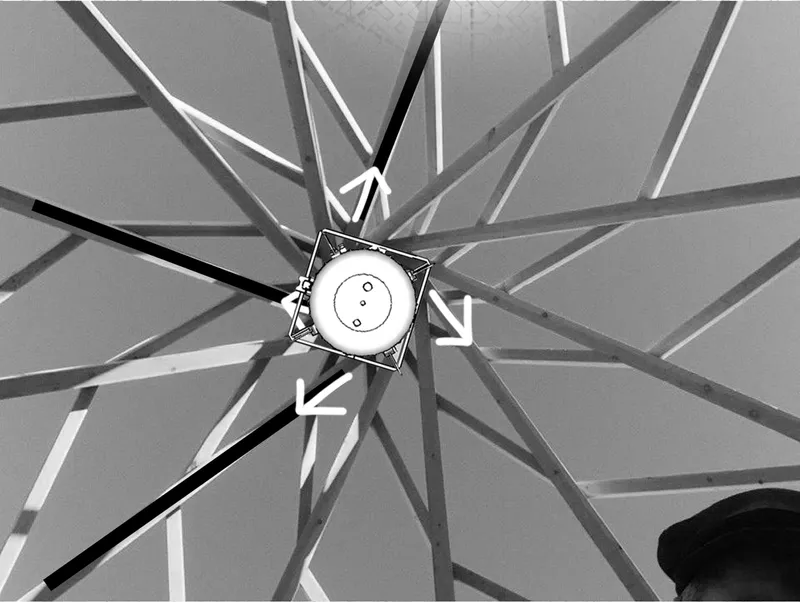
Seen from below, the structural system reads as a sunburst of radial beams converging at a central hub, with arrows indicating directional flow of both visitors and air. The geometry is more than formal preference. It organizes the building's environmental systems and its spatial hierarchy simultaneously, pulling air inward for filtration while guiding foot traffic outward toward programmatic zones. There is a discipline here that serves the concept well: the structure itself diagrams the building's purpose, making the act of purification architecturally legible.
Amphitheater Below, Monument Above
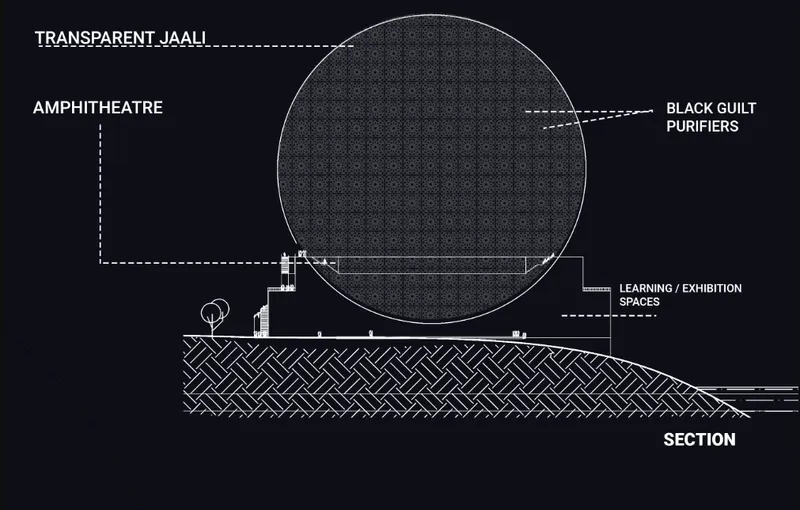
The section drawing reveals how the program stacks. A transparent roof caps the circular volume while an amphitheater carved into the lower levels provides seating adjacent to exhibition spaces. This below-grade strategy keeps the pavilion's footprint modest at ground level, deferring to the Taj Mahal's dominance in the landscape while creating generous interior volume for cultural programming. The amphitheater is designed for workshops, cultural exchange events, and skill-development activities centered on environmental stewardship and Mughal architectural history. It turns the site into what Bali describes as a living museum: part monument to the past, part laboratory for sustainable heritage conservation.
Circulation as Cultural Chronology
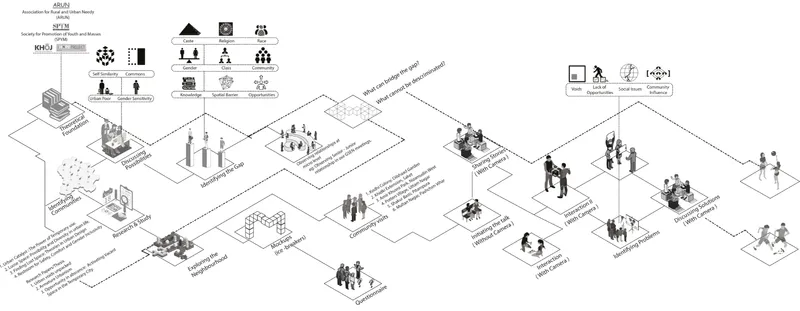
The axonometric circulation diagram maps visitor paths through interconnected programmatic zones, populated with figure silhouettes that give the spaces a sense of inhabitation and scale. Different types of jaali patterns encountered along the route narrate the evolution of Mughal eras, forming a chronological timeline woven into the architecture itself. Bali balances cultural storytelling with architectural restraint here, honoring the Mughal mastery of ornamentation without overwhelming the sphere's primary role as an environmental instrument. The path becomes a walk through both history and ecological consequence.
Why This Project Matters
UNBLACK succeeds because it refuses to treat heritage preservation and environmental activism as separate problems. Most proposals for endangered monuments default to either restoration or commemoration. Bali's design does something rarer: it makes the threat itself into the medium. Pollution becomes ink, ink becomes pattern, and the building's appearance becomes an evolving public record of environmental harm. That feedback loop, where architecture registers the very forces degrading its neighbor, is a genuinely inventive proposition.
The project also challenges the competition's mythological premise with a dose of realism. The legendary black Taj was never built. But a black Taj is being built right now, particle by particle, on the surface of the white one. By naming this process and making it spatially tangible, Bali reframes the design challenge from romantic speculation to urgent advocacy. The sphere does not replace the Taj Mahal. It watches the Taj darken, absorbs the same air that is doing the damage, and wears the evidence for everyone to see.
View the Full Project
About the Designers
Designer: Kirti Bali
Enter a Design Competition on uni.xyz
uni.xyz runs architecture and design competitions year-round that reward proposals with spatial conviction and real site intelligence.
Project credits: The Black TAJ UNBLACK by Kirti Bali The Black Taj (uni.xyz).




Popular Articles
Popular articles from the community

AL-JANNAH: Sustainable Architecture and Permaculture for Afghan Widows
AL-JANNAH uses sustainable architecture and permaculture to create resilient oasis of housing, learning, work and renewal for Afghan widows.

Conexión: Biophilic Design Reimagines High-Rise Living in Hong Kong
Conexión reimagines high-rise living in Hong Kong through biophilic design, green facades, shared spaces, daylight, water and nature within.

Co-life: Sustainable Architecture for Age-Friendly Community Living
Co-life reimagines sustainable architecture for seniors through courtyards, rammed earth, shared gardens, and spaces designed for belonging.

The Ocean Hive: Sustainable Architecture for a Self-Sufficient Civilization at Sea
The Ocean Hive imagines sustainable architecture at sea, where modular habitats, algae, wave power and ocean waste sustain a growing colony.


Similar Reads
You might also enjoy these articles

The Musturak Paradise: Senior Living Architecture for a Connected Future in Temara, Morocco
The Musturak Paradise reimagines senior living architecture in Temara via private homes, social spaces, culture, community, and shared care.

The Leaf Center: Cultural Center Architecture for Social Integration in Amsterdam
Cultural center architecture becomes a bridge at The Leaf Center, connecting international students with Amsterdam through art and exchange.
Conexión: Biophilic Design Reimagines High-Rise Living in Hong Kong
Conexión reimagines high-rise living in Hong Kong through biophilic design, green facades, shared spaces, daylight, water and nature within.

Wander to Wonder: Modular Playground Design for Children in Kutupalong Refugee Camp
Wander to Wonder uses modular playground design to create flexible, imaginative play spaces for children in Kutupalong refugee camp.

Explore The Black Taj Competitions
Discover active competitions in this discipline



Challenge to reimagine the Iron Throne


Photograph architecture without architects


Illustrate the lost glory of Angkor Wat - Render Challenge


Bring back Drive In's
Comments (0)
Please login or sign up to add comments
No comments yet. Be the first to comment!