

Under The Skin: Architecture That Plays Music When You Walk
An interactive installation in Toronto transforms footsteps into a cappella harmonies through sensor-driven floors and magnetically responsive ceilings.


What if a building could sing back to you? Under The Skin proposes exactly that: a public installation where every footstep triggers a vocal note, every movement reshapes the ceiling above, and the boundary between architecture and instrument dissolves entirely. The project treats the city sidewalk as a keyboard, the pedestrian as a performer, and the structure itself as a living, breathing collaborator.
Designed by Rachel Sau, Under The Skin won the Elevate 2019 competition. Proposed for the intersection of King Street and Portland Street in Toronto, Ontario, the installation occupies a charged urban corner and extends into an adjacent alleyway, creating a sequence of spatial zones that pull pedestrians from the street into an immersive, sound-driven environment.
A Canopy That Invites You In
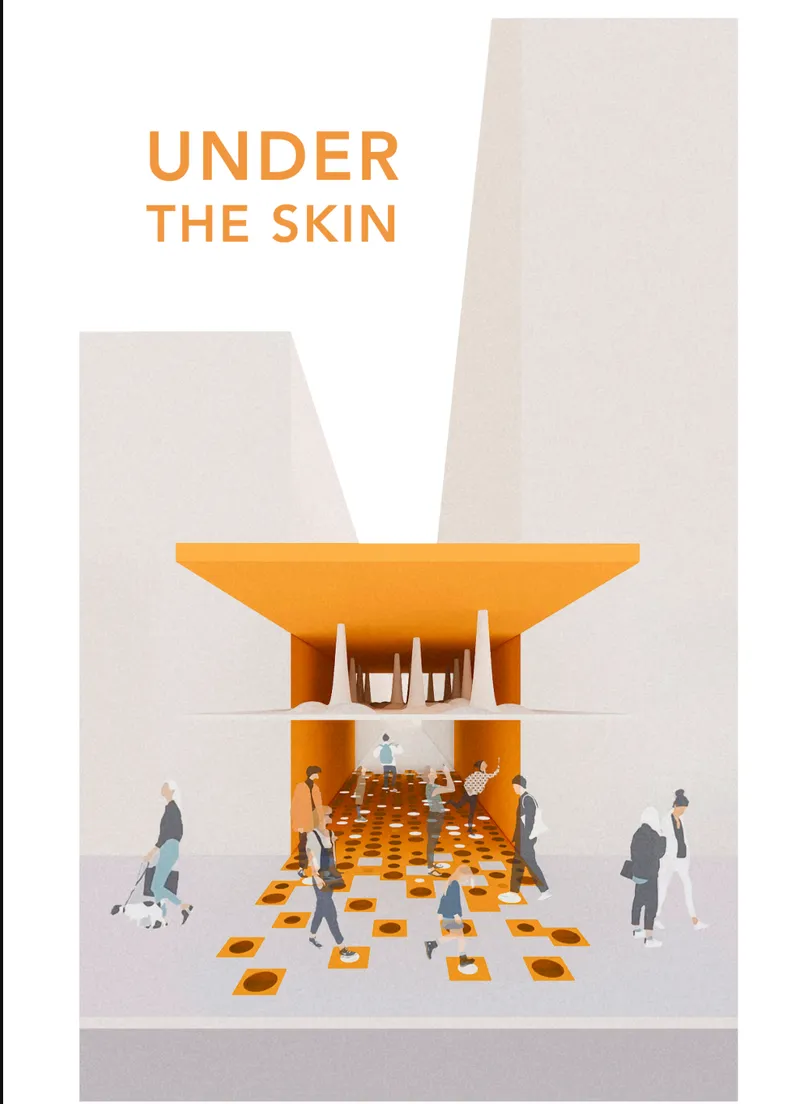
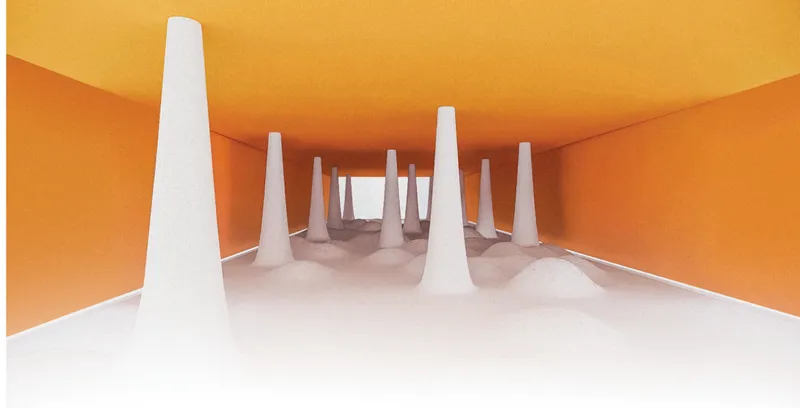
The installation reads as a cantilevered canopy hovering over a public plaza, its orange patterned floor acting as both surface and signal. That vivid ground plane is the first lure: street-facing modules remain fully illuminated to catch the attention of passing pedestrians, drawing them toward the entry and exit zone that functions as an inviting threshold. Once inside, white conical columns define a perspective corridor beneath an orange ceiling, compressing and directing movement deeper into the installation.
The spatial sequence is deliberate. Three distinct zones organize the experience: the entry/exit zone at the street edge, a main play area at the center where the full interactive system activates, and a semi-enclosed alleyway extension that heightens immersion by narrowing the space around visitors. The architecture doesn't just house an experience; it choreographs one.
Solenoids, Magnetic Fields, and a Ceiling That Breathes
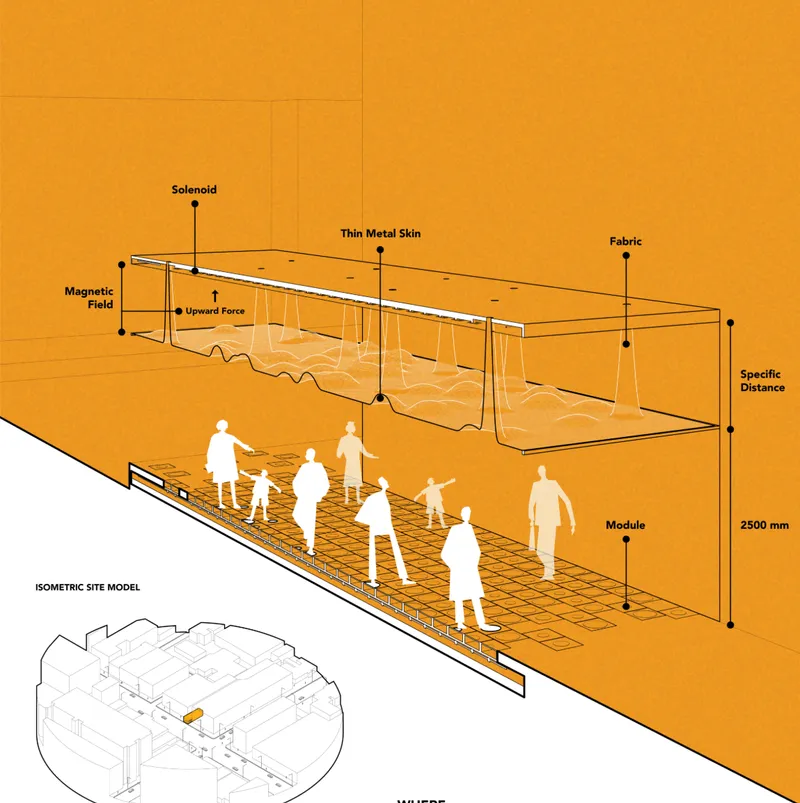
The real invention sits overhead. The ceiling structure consists of two layers: a thin metal skin manipulated through magnetic force, and a fabric layer that reacts to movement by forming organic deformations. Solenoid mechanisms embedded within the ceiling modules generate magnetic fields that elevate sections in real time, so the canopy above a visitor literally rises and shifts as they walk beneath it. The isometric diagram reveals the system's logic clearly, showing how solenoid coils, the metal skin, and the fabric membrane work in concert.
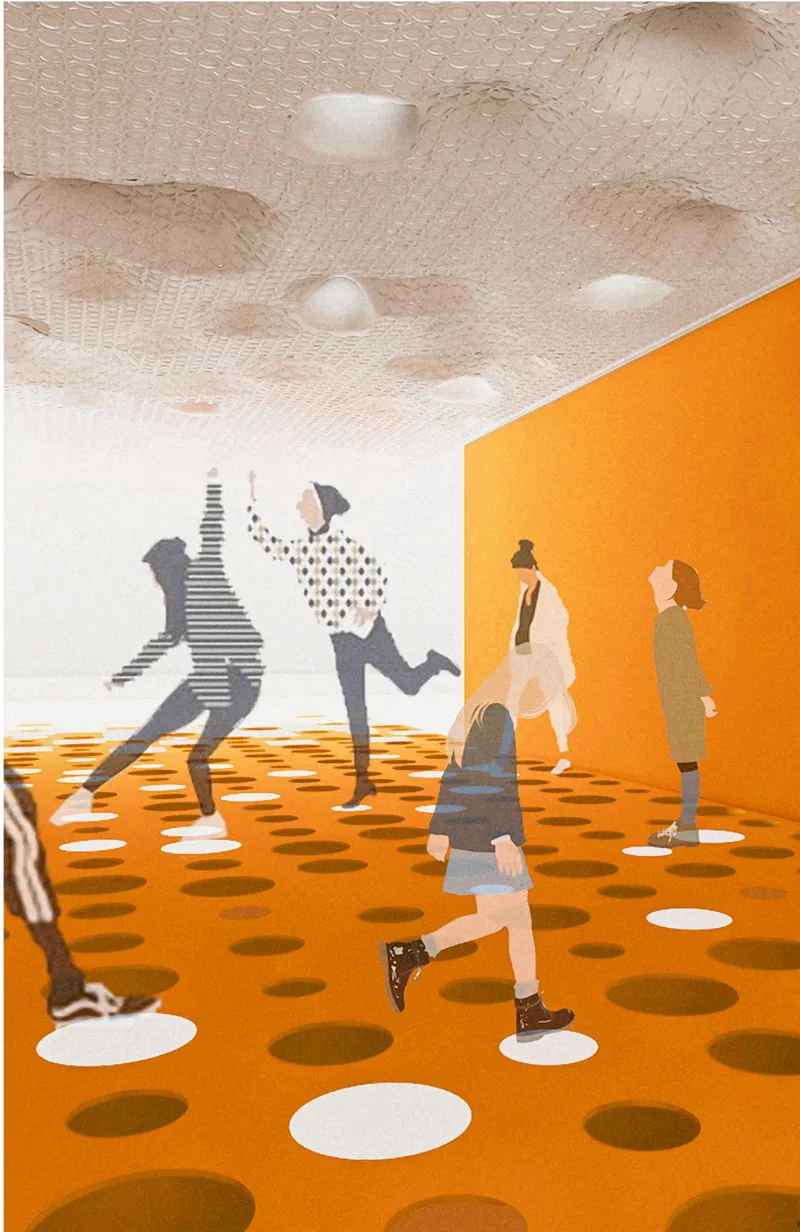
The interior rendering captures the result: visitors move across a dotted orange and white floor while the fabric ceiling above them ripples and deforms in response. The effect is less mechanical spectacle and more biological rhythm, as if the building is inhaling and exhaling with each step. It transforms architecture from a static shell into something closer to a responsive organism.
Layers of Construction, from Recycled Tiles to Junction Boxes
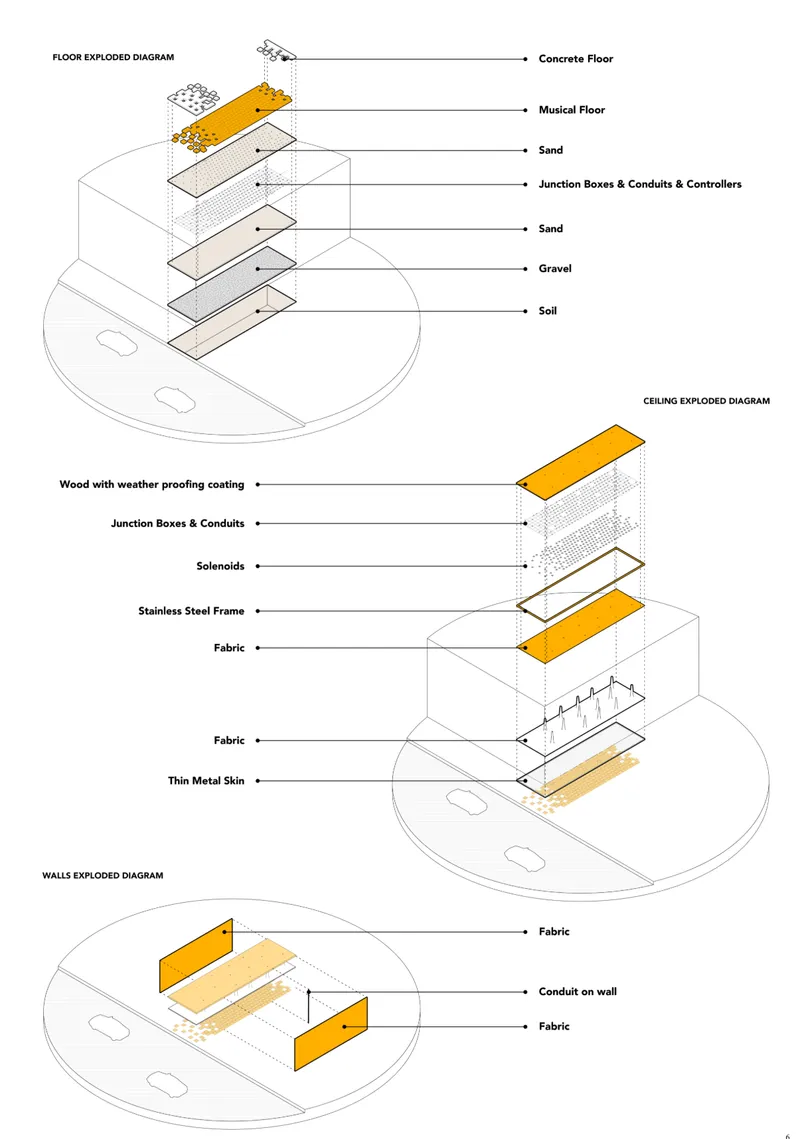
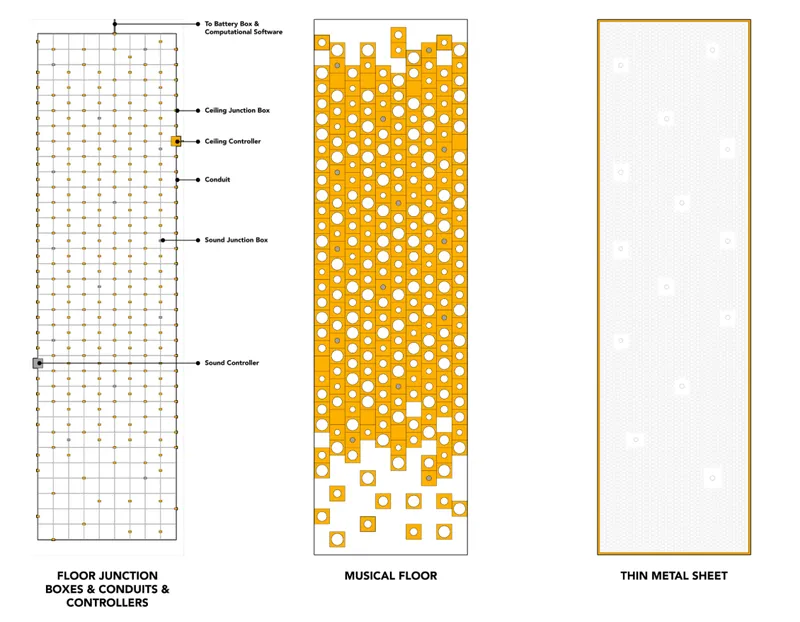
The exploded axonometric diagrams pull the installation apart to reveal its material intelligence. The floor assembly layers concrete flooring, sand insulation, recycled tile bases, and junction boxes that control electrical connections beneath translucent glass tiles embedded with LED lights and weight sensors. Every module is a self-contained unit capable of detecting a footstep, triggering a sound, and sending a signal to the ceiling above.
The plan drawings reinforce the system's precision, mapping floor junction box locations, the musical floor pattern, and the thin metal sheet components overhead. What could have been a loose conceptual gesture is instead a tightly resolved technical proposition. The wall, floor, and ceiling assemblies are each documented with labeled material callouts, showing that Sau treated buildability as seriously as spectacle.
Six Voices, One Collaborative Instrument
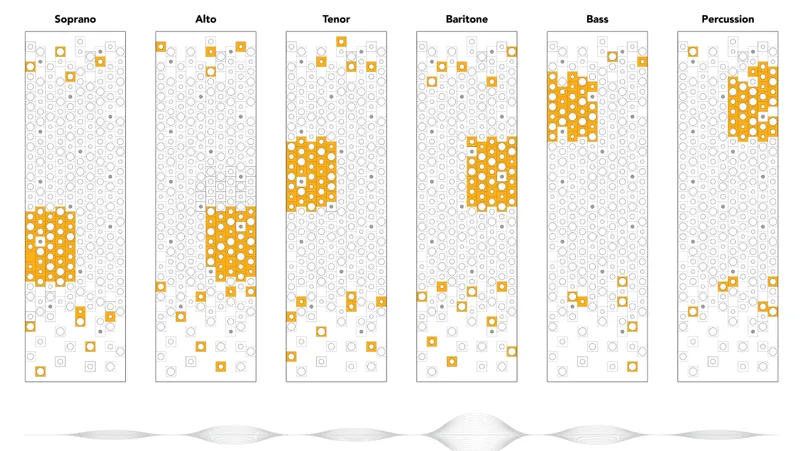
The musical system is the project's conceptual spine. The floor is programmed to play six distinct a cappella vocal parts: soprano, alto, tenor, baritone, bass, and percussion. The diagram maps orange circular markers across six vertical columns, each labeled for a different voice range. Participants can play individually, generating single melodic lines, or collaboratively, layering multiple vocal parts into spontaneous compositions as groups move through the space together.
The choice of a cappella over electronic tones is significant. Human voices carry warmth and familiarity that synthesized sounds cannot replicate. By grounding the interactive system in vocal harmonics, Sau ensures the installation feels intimate rather than clinical, turning a technological platform into something that resonates on a deeply human register.
Why This Project Matters
Under The Skin succeeds because it refuses to separate technology from bodily experience. In an era where interactive installations often mean staring at a screen, this project insists on full-body participation: walking, stepping, listening, looking up. The weight sensors, solenoid mechanisms, LED modules, and a cappella sound system are all calibrated to reward physical presence rather than passive observation. The architecture doesn't perform for you; it performs with you.
Rachel Sau's winning entry for Elevate 2019 also makes a compelling case for how public infrastructure can double as collective play. By siting the installation at a busy Toronto intersection and extending it into an alleyway, the project hijacks the routines of urban commuting and replaces them, even briefly, with spontaneous collaboration. It is a reminder that the most powerful architecture is not always the most permanent, but the most participatory.
View the Full Project
About the Designers
Designer: Rachel Sau
Enter a Design Competition on uni.xyz
uni.xyz runs architecture and design competitions year-round that reward proposals with spatial conviction and real site intelligence.
Project credits: Under The Skin by Rachel Sau Elevate 2019 (uni.xyz).


Popular Articles
Popular articles from the community


Opera on the Sea: Driftwood Logic Shapes a Timber Opera House on Estonia's Coast
Trevor Orgill's opera house translates the entangled drift of floating timber into a civic building where wood, water, and music converge.

Singing Woman: An Opera House That Performs Before the Curtain Rises
Ovidiu Cristian Pavel's conceptual opera house translates Estonia's choral identity into a sculpted waterfront landmark facing the Baltic Sea.

Manzana Morphosis: Stretching Barcelona's Grid into a Living Landscape for 2050
A radical reworking of the Eixample manzana turns density into a tool for generous public space, vertical ecology, and environmental performance.


FCC Arquitectura Expands a Portuguese Granite House with a Board-Marked Concrete Wing
In Portugal, JV House pairs a cleaned-up whitewashed and granite dwelling with a timber-shuttered concrete extension, courtyards and a garden pool.

Similar Reads
You might also enjoy these articles

Vereda Arquitetos Renovates a 40-Square-Meter Apartment Inside Niemeyer's Copan Building
A compact unit in São Paulo's most iconic residential tower gets a material overhaul that pairs exposed concrete with bold blue Formica.

Shakur's House: Exposed Brick as an Interior Organiser in a 168 m² Mashhad Residence
Brick moves indoors in this Mashhad residence, where masonry walls, glass partitions and teal planes sequence a compact home without closing it off.

Day and Night Park: A Time-Based Urban Newsstand in Beijing
A temporary urban newsstand in Beijing blending travel, light, and reading through poetic colors, compact form, and community-focused design.

Modernist Patio Renovation in El Masnou, Barcelona by Oliver Segura Arquitectura + Cebrià Arquitectura
Modernist patio renovation blending tradition and innovation with a movable pool, leveled floors, and Catalan materials in El Masnou.

Explore Interactive Architecture Competitions
Discover active competitions in this discipline

Challenge to design locus for the upliftment of human rights

Design challenge to reuse E-waste
Comments (0)
Please login or sign up to add comments
No comments yet. Be the first to comment!