

Davidsson Tarkela Carves a 13,780 m² Sports and Events Center into Finnish Bedrock
The Luola Centre in Kuopio transforms a Cold War military depot beneath Neulamäki Hill into a civic arena for 2,500 spectators.


Beneath Neulamäki Hill in the developing Savilahti district of Kuopio, Finland, a former Defense Forces depot has been hollowed out, expanded, and relined into a 13,780 m² sports and events complex. Davidsson Tarkela took on the unusual brief of turning tunnels blasted into rock during a different era into a continuous public interior: two major halls, three fitness studios, a gym, changing rooms on three levels, and a 550 m² entrance pavilion that is the only piece of the project visible above grade. The name tells the story plainly. "Luola" is Finnish for "cave," and the architects leaned into that etymology, treating the underground condition not as a constraint to overcome but as the very premise of the building's identity.
What makes the project genuinely interesting is how it negotiates the threshold between daylight and deep rock. The entrance building, sheathed in perforated and ribbed aluminium panels, sits against a sheer excavated cliff face studded with circular light elements that read almost like land art. Step inside and you descend through corridors that shift from polished blue resin floors to raw concrete to exposed bedrock. Color becomes the primary orienting device: vivid blues, teals, and yellows mark communal zones, while utilitarian back-of-house areas stay in grey formwork. The spatial hierarchy is legible without signage. And beneath all of it runs a civic mandate that is hard to ignore: this same volume doubles as an emergency shelter for 6,790 people.
A Pavilion Against the Cliff
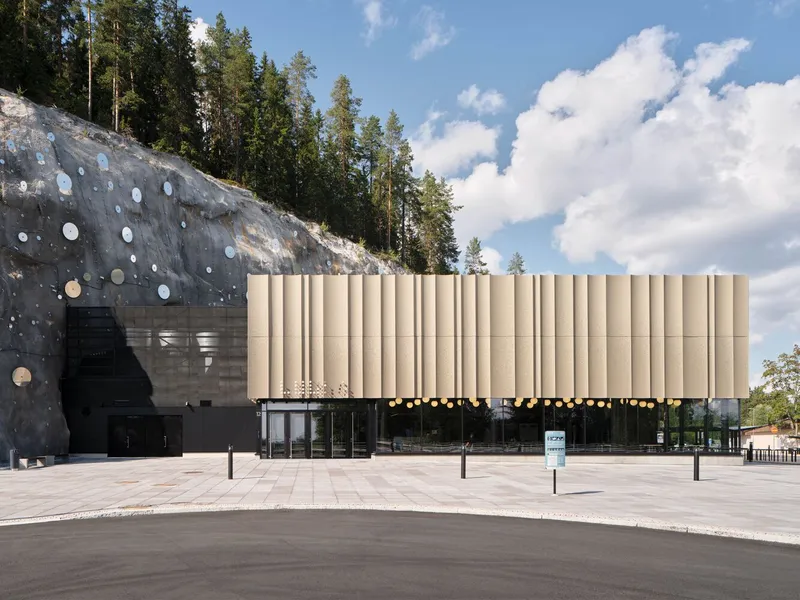
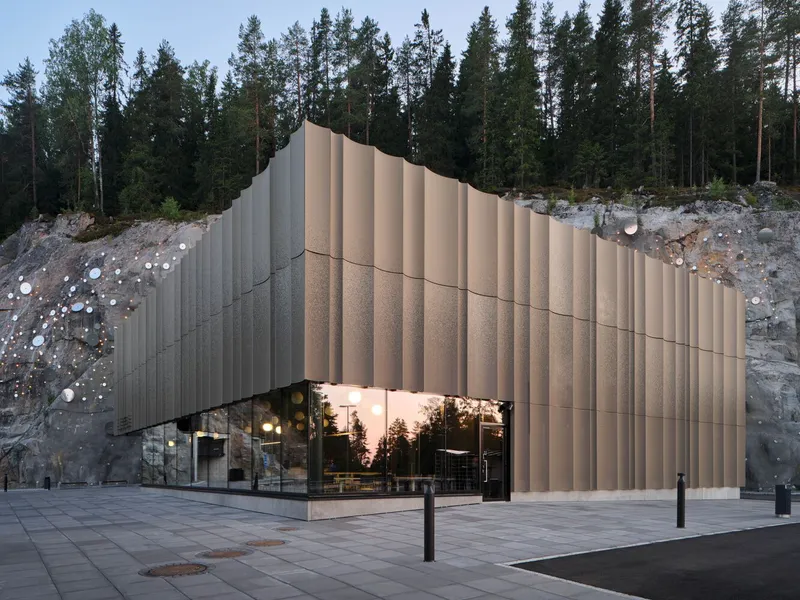
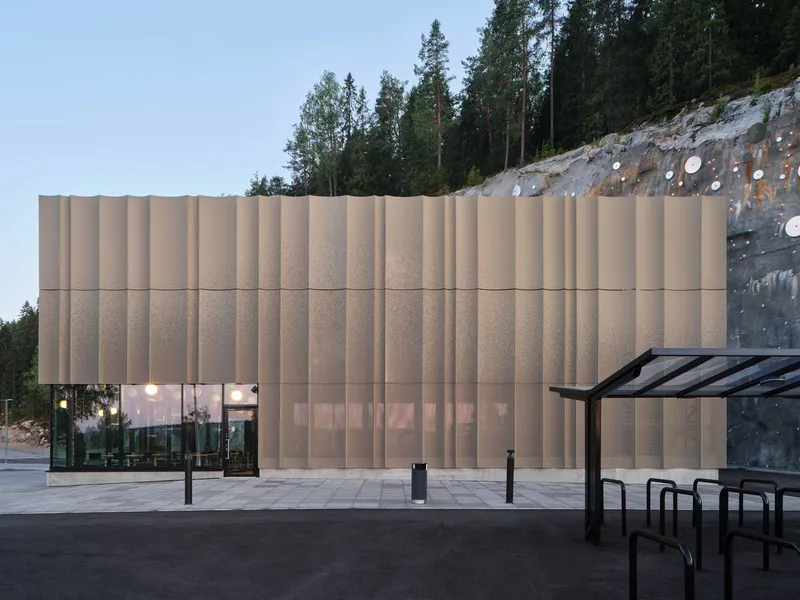
The entrance building punches well above its modest 550 m² footprint. Ribbed facade panels in earthy aluminium tones cantilever above a fully glazed ground level, giving the pavilion a lantern-like presence at dusk. The materiality is precise: vertical ribs catch raking light and cast fine shadow lines that echo the striations of the quarried rock face behind. Rather than competing with the cliff, the architecture establishes a taut, deliberate contrast, something refined set against something geological.
Reception, a cafeteria, and offices occupy this above-ground volume, but the pavilion also conceals escape routes and ventilation infrastructure for the underground halls below. It functions, in other words, as the lungs and mouth of the cave. The collaborative artwork "Pulssi" by Pasi Rauhala and Jaakko Niemelä, executed directly on the surrounding rockface, extends the building's visual field into the landscape, treating the excavation scar as a canvas rather than a wound.
The Rock Face as Architecture
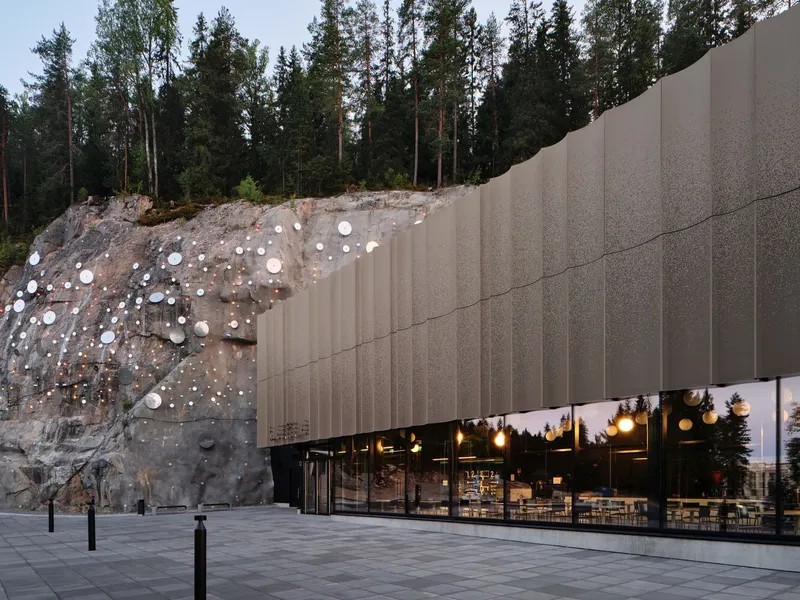
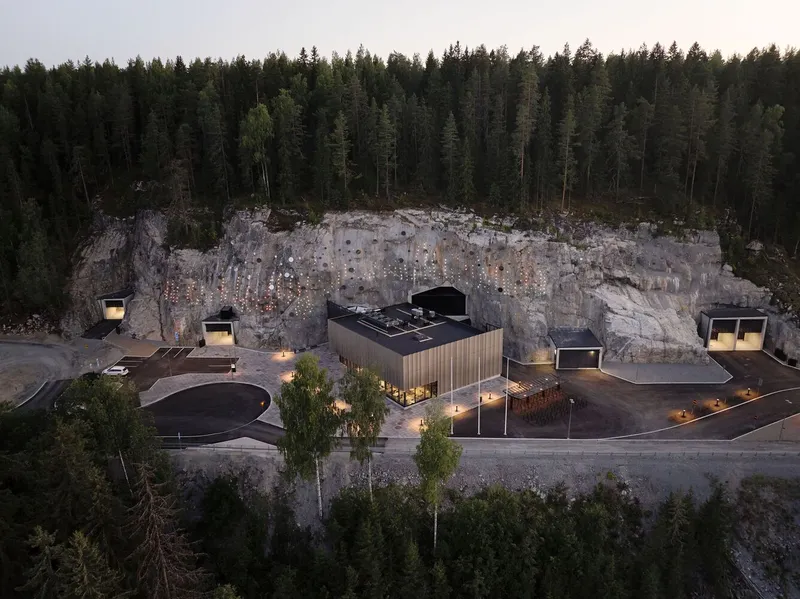
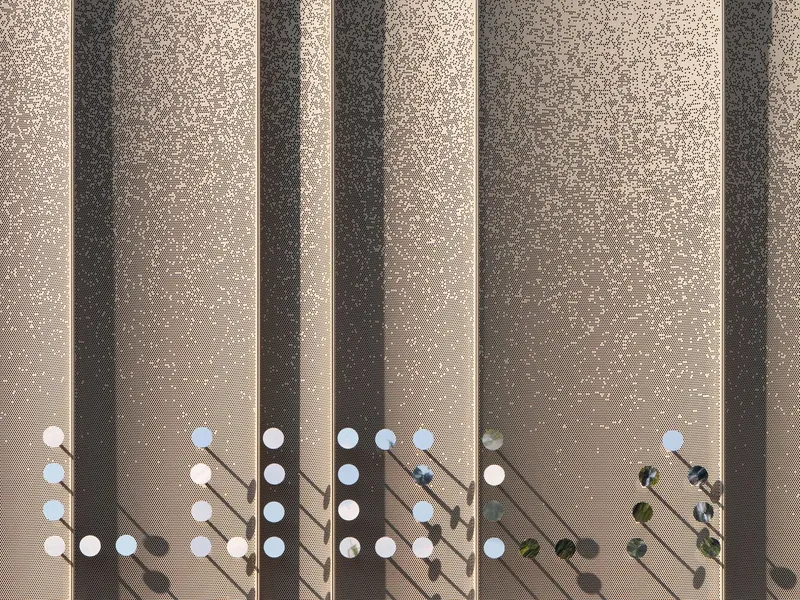
Seen from the air at dusk, the full scale of the intervention becomes clear. The complex occupies the footprint of a former quarry, its glass and metal surfaces set into a cliff that drops away sharply. Circular inset lighting elements punctuate the exposed rock, transforming what could be a brutal retaining wall into something more ambiguous, part infrastructure, part installation. The textured pavement above, with its striped bands and shadow-casting fixtures, reads as a designed ground plane rather than leftover terrain.
The site strategy positions the centre as a gateway between a new residential area and the district's park and amenities. Arriving at the entrance means confronting the cliff face head-on, which makes the act of entering the building feel deliberate and slightly cinematic. You do not stumble into Luola; you descend into it.
Descending Into Color
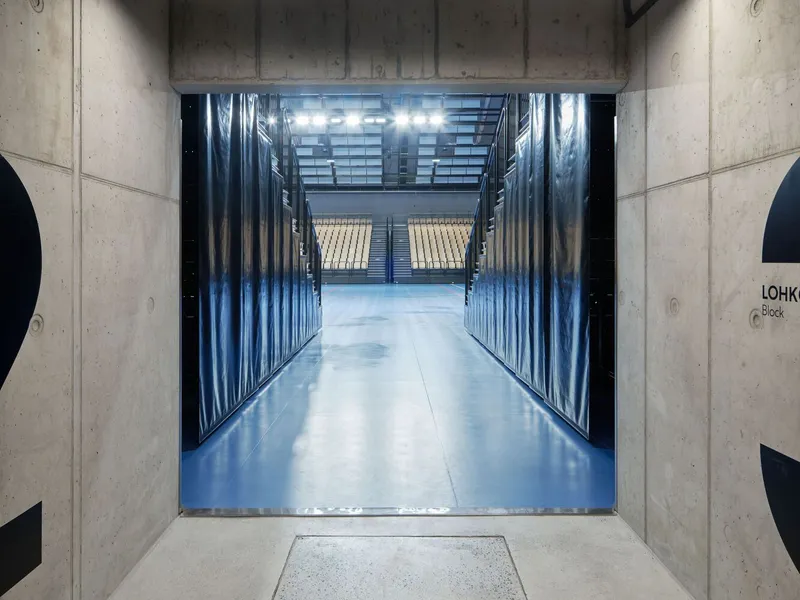
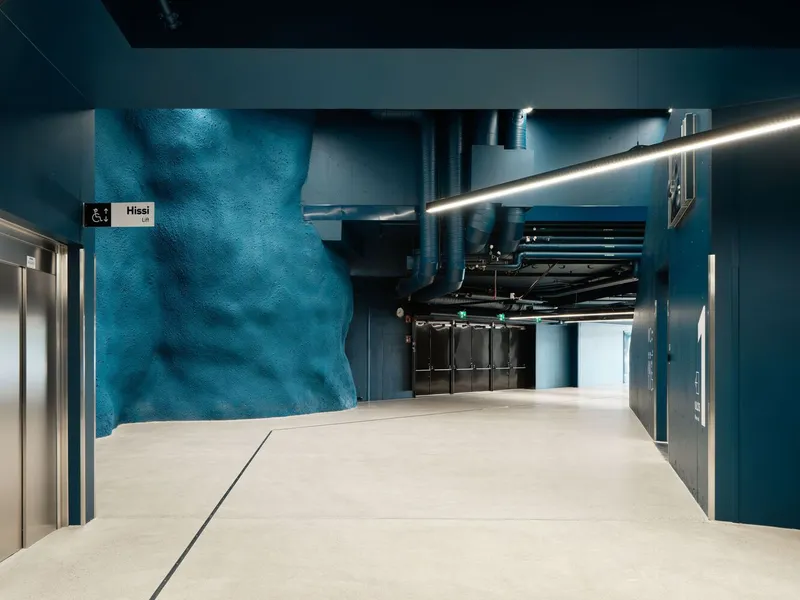
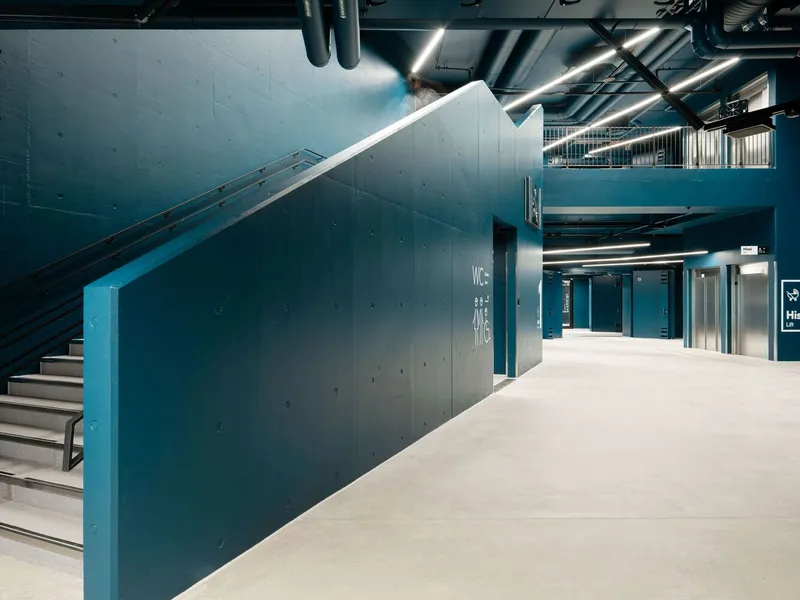
The transition sequence from surface to subterranean is the project's strongest architectural move. A concrete threshold opens onto a polished blue resin corridor flanked by corrugated metal walls. Deeper in, painted rock surfaces in saturated blue and teal give the passages an almost aquatic quality, while linear lighting and exposed ceiling services maintain a legible, industrial clarity. The escalator and stairwell lobby, wrapped in teal concrete, is the hinge point where visitors orient themselves before splitting toward Hall 1 to the north or Hall 2 to the south.
The color strategy is more than decorative. In an environment where natural wayfinding cues like windows, sky, and horizon are absent, hue becomes the substitute. Vibrant public zones stand apart from grey support corridors so clearly that the spatial logic is almost chromatic. It is a pragmatic decision dressed as a bold aesthetic one.
Hall 1: The Arena in the Rock
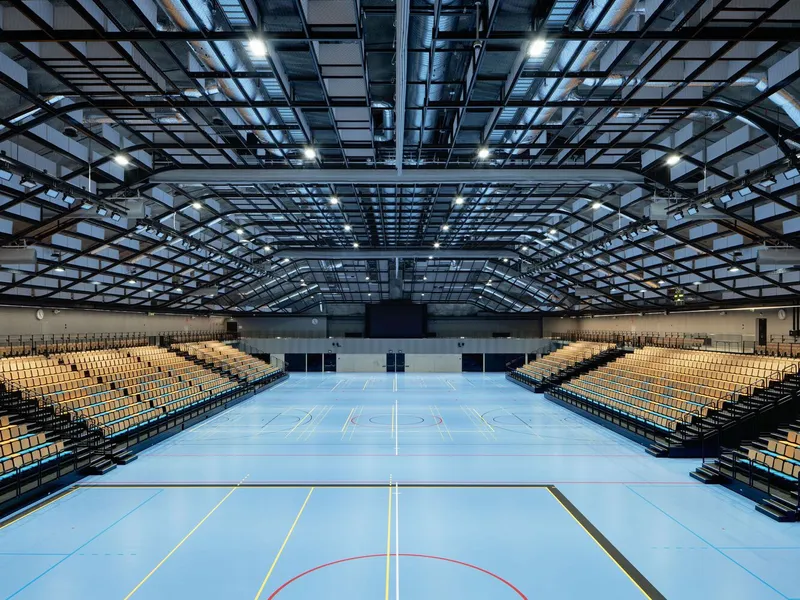
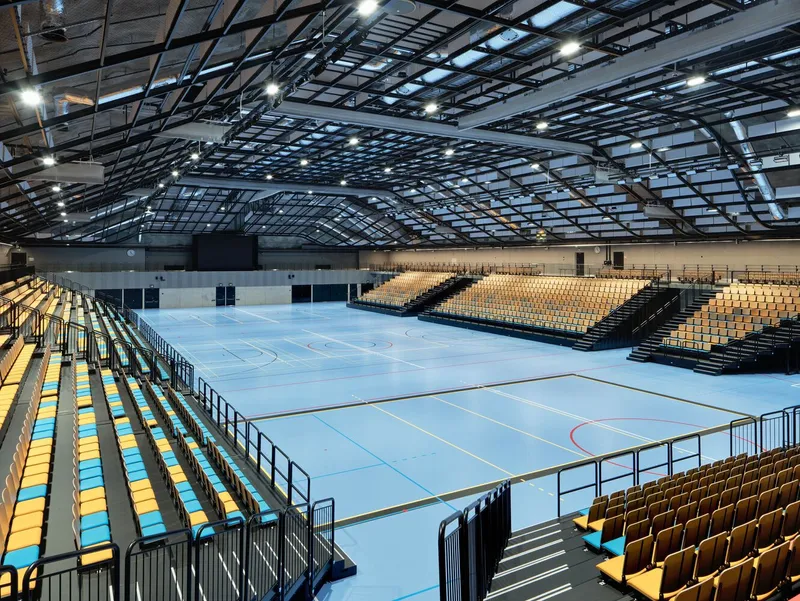
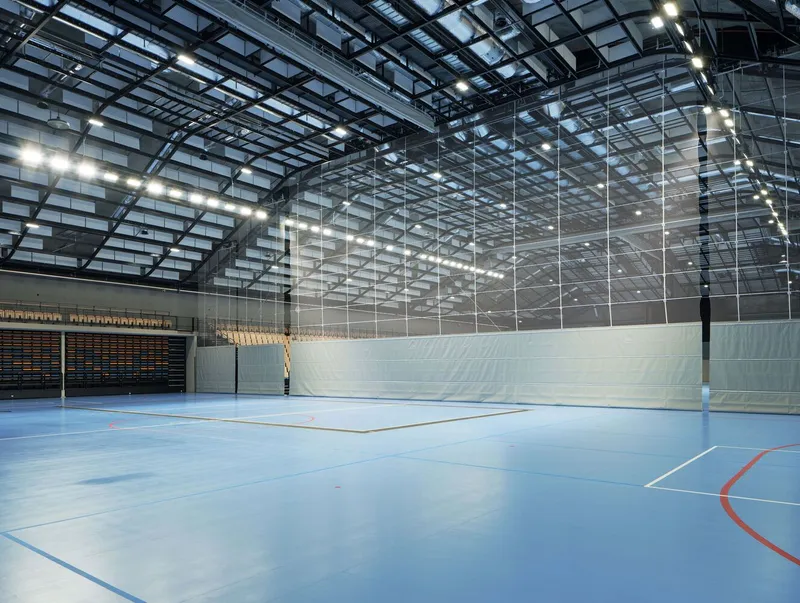
Hall 1 is the centrepiece, a 50-meter-wide rock chamber spanned by an undulating steel truss roof and fitted with tiered seating for up to 2,500 spectators. The curved steel and glass roof structure admits no daylight, of course, but its geometry reads as vaulted, almost ecclesiastical. Blue court markings on the floor anchor the space visually, and retractable net dividers allow the hall to shift between configurations for volleyball, handball, or flat-floor events like concerts and trade fairs.
Designing a 50-meter span inside bedrock is not a trivial engineering problem. The architects used 3D modeling to coordinate the roof geometry with the irregular rock profile, and the project's cooperative target price contract (TARU) helped manage the risk that unpredictable rock fractures introduced during construction. The result feels effortless, which is precisely the point: the difficulty should be invisible.
Fitness, Studios, and the Everyday Underground
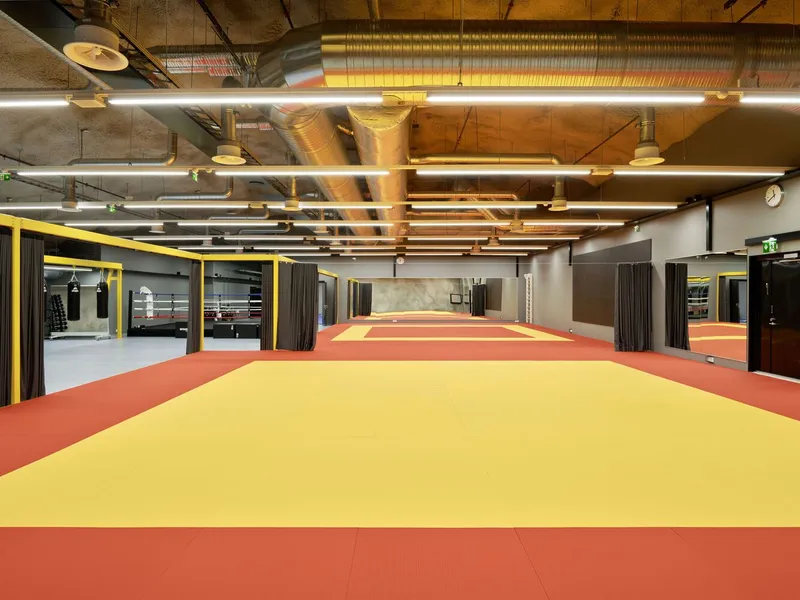
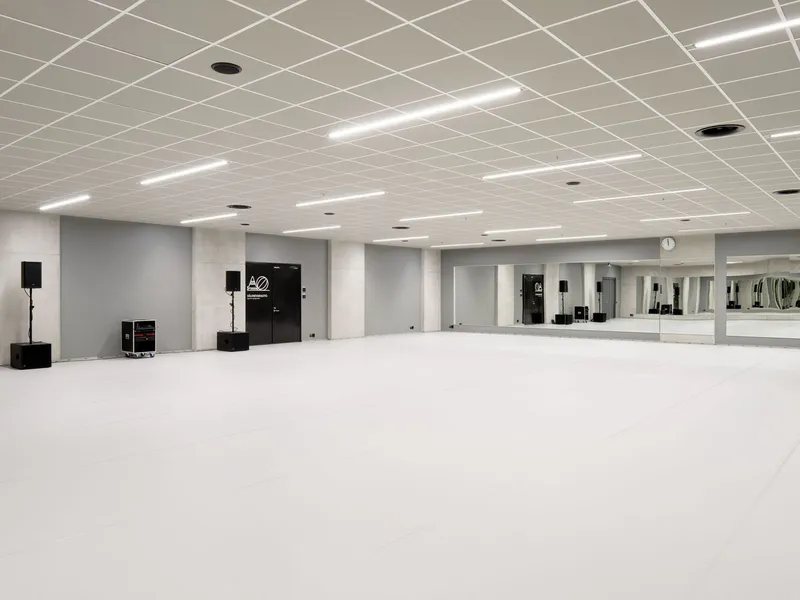
Hall 2 at the south end houses three fitness studios and a gym across two floors, and these rooms reveal the project's more intimate register. A training room with yellow and red mat flooring sits beneath an exposed timber ceiling, warm and slightly domestic in feeling. Next door, a white dance studio with full-height mirrors and an acoustic tile grid ceiling could belong to any above-ground facility. The point is that underground does not have to mean oppressive. Good lighting, considered materials, and generous ceiling heights make these rooms genuinely pleasant to occupy.
The programme is intentionally broad: schoolchildren, university students, sports clubs, individual citizens. Luola is not an elite training centre but a shared civic resource, and the variety of its interior environments, from the cavernous arena to the compact studio, reflects that range of users.
Concrete, Mesh, and the Honest Back-of-House
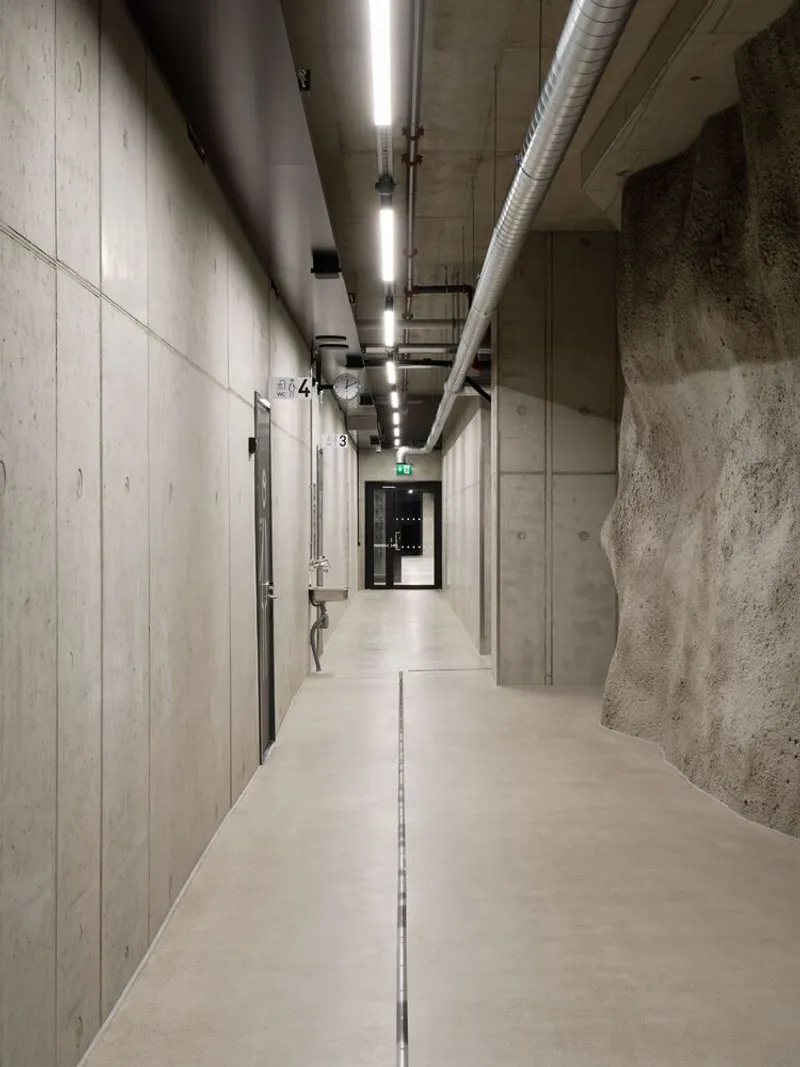
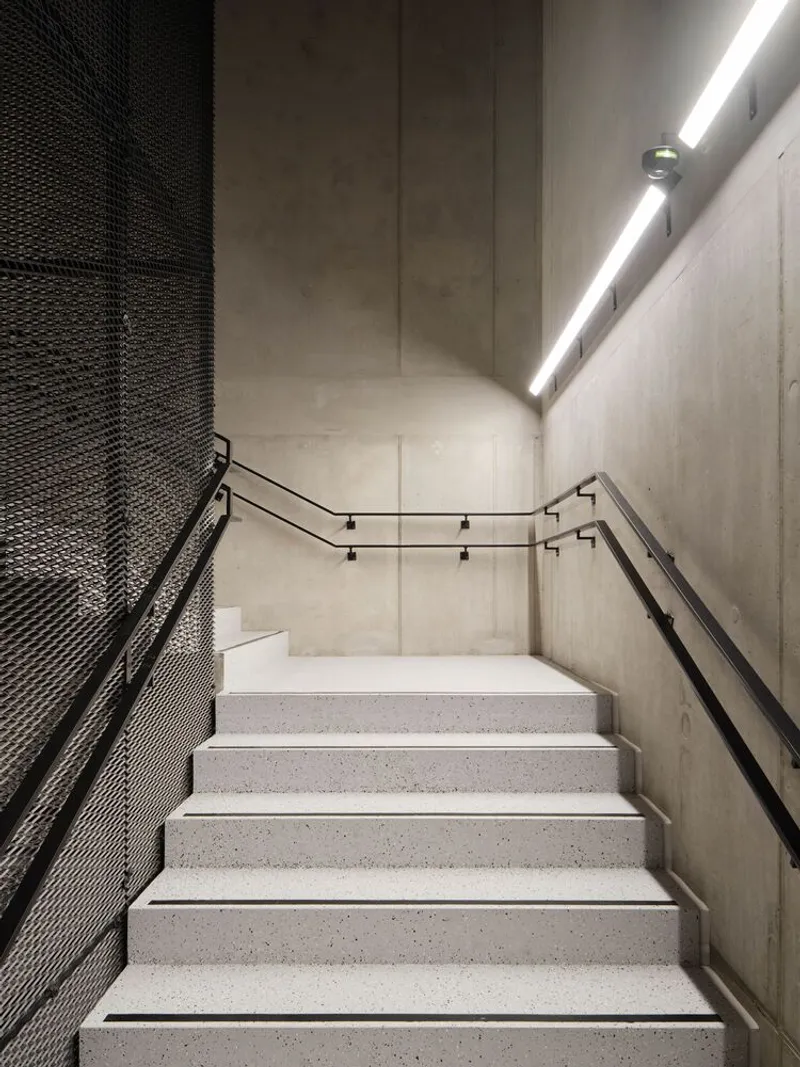
Support corridors and stairwells get no color treatment. Raw concrete, exposed ductwork, formwork panels, and metal mesh balustrades are left unadorned, their surfaces registering every pour line and bolt head. This is not neglect but strategy: the contrast between the treated public zones and the stripped-back service areas reinforces legibility throughout the complex. You always know whether you are in the building's front or back.
The honesty extends to the rock itself. In several corridors, the blasted bedrock wall is left exposed alongside the concrete structure, a direct reminder that this space was carved, not built. It is a compelling juxtaposition: the precision of cast concrete against the irregular grain of Finnish granite.
Plans and Drawings
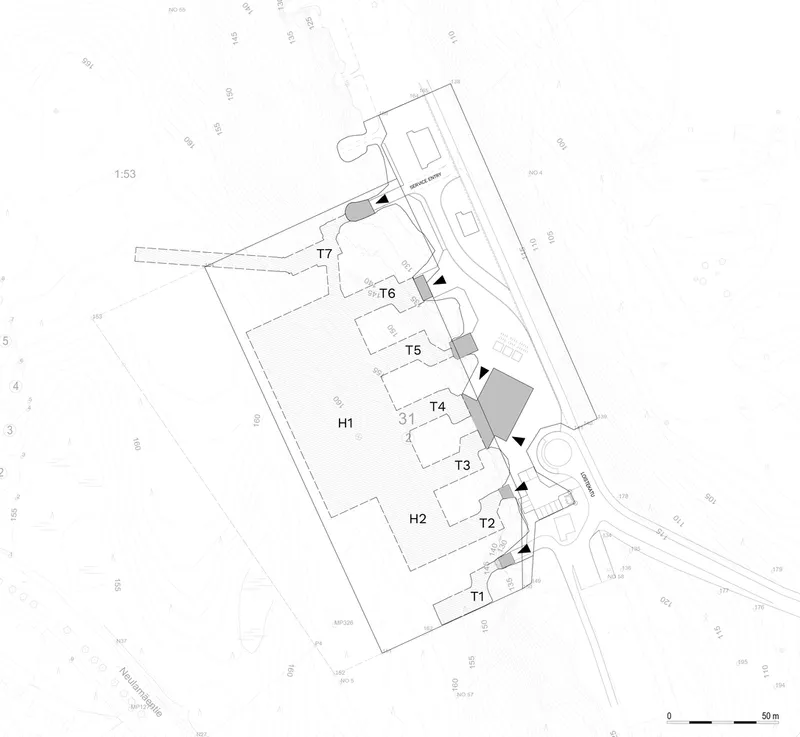
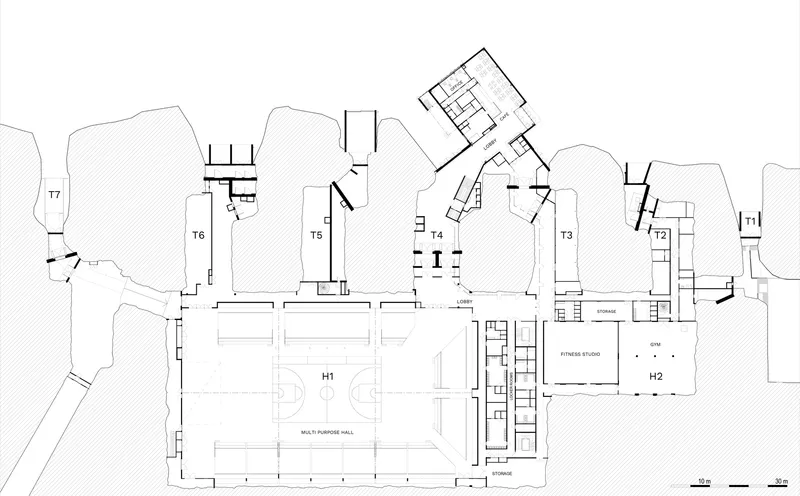
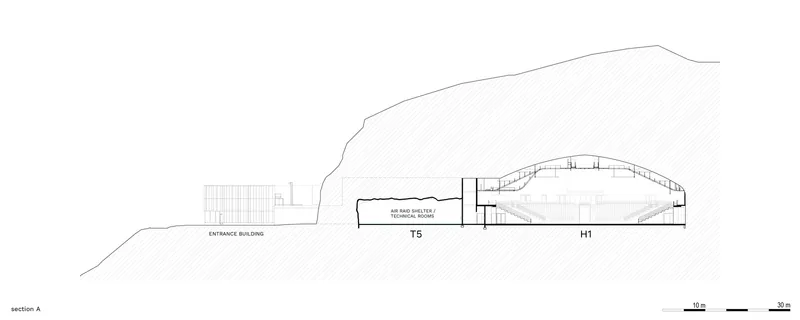
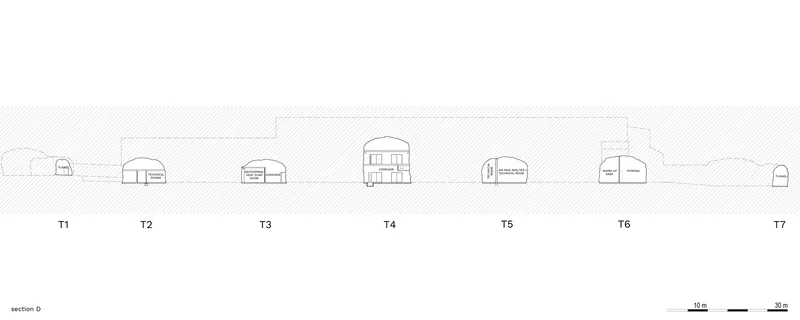
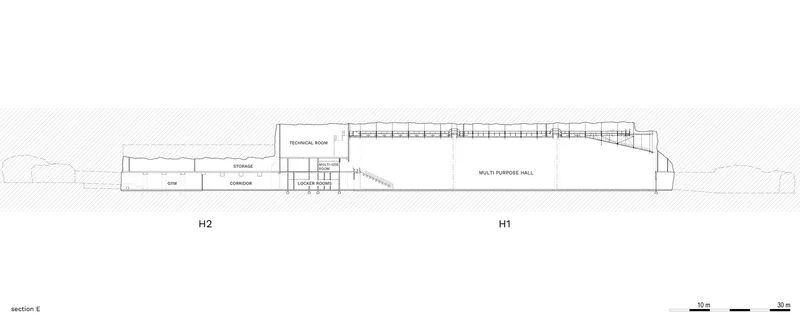
The site plan reveals how the complex is threaded along a diagonal access route, linking residential fabric to the park edge. The floor plan confirms the bilateral organization: Hall 1 to the north, Hall 2 to the south, with centralized changing rooms and services mediating between them. Section drawings are where the project's ambition becomes most legible. A sequence of barrel-vaulted chambers of varying size sits embedded in the hillside, their profiles dictated by the rock's structural capacity as much as by programmatic need.
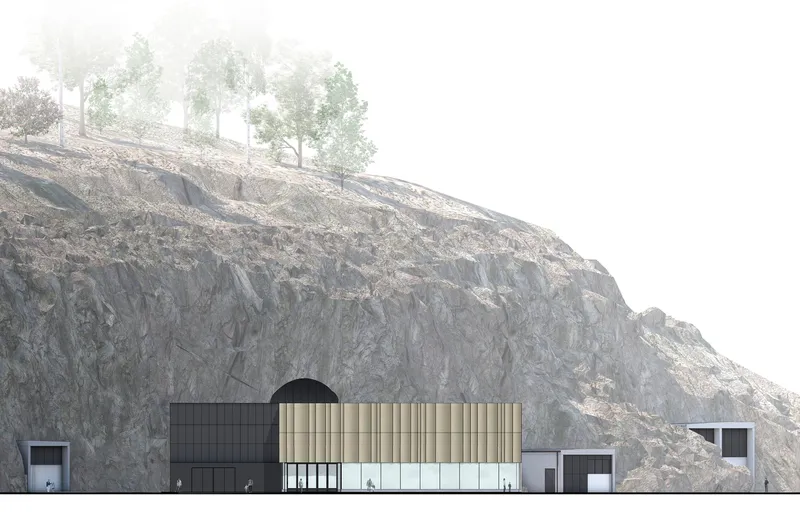
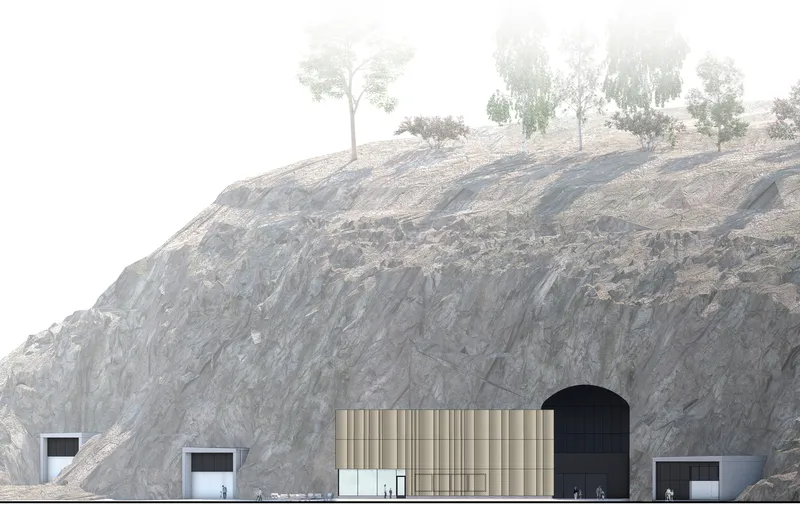
The elevation renderings show the entrance pavilion's timber-clad volumes and black arched portal set against the striated rock face, a composition that oscillates between vernacular and geological. It is telling that the architects chose to render these views with trees and sky: above ground, Luola wants to disappear. Below ground, it wants to be monumental.
Why This Project Matters
Underground architecture tends to fall into two camps: utilitarian bunkers that accept their subterranean condition as punishment, or overdesigned spectacles that try to make you forget you are below grade. Luola does neither. It uses color, material hierarchy, and deliberate spatial sequencing to make the underground condition legible, interesting, and even enjoyable, without pretending it is something else. The exposed rock walls are the project's most honest gesture: you are inside a hill, and that fact is worth celebrating rather than concealing.
The dual-use mandate, sports centre by day, emergency shelter for nearly 7,000 people when needed, also raises a question that more cities will face in coming years: how to justify the cost of large-scale underground construction. Kuopio's answer is to make the space serve as many publics as possible, from schoolchildren to concert-goers to professional athletes. Davidsson Tarkela has delivered a building that is genuinely civic in the fullest sense of the word, a commons carved into stone.
Luola Sports and Events Centre, Savilahti, Kuopio, Finland. Architect: Davidsson Tarkela. Area: 13,780 m². Completed: 2024. Photography: Tuomas Uusheimo.
About the Studio
Share Your Own Work on uni.xyz
If projects like this are the kind of work you want to make, uni.xyz is a place to publish your own, find collaborators, and enter design competitions.


Popular Articles
Popular articles from the community


David Ortega Stacks a Two-Story Mexico City Penthouse Around a Steel Stair and a Pergola-Shaded Roof Terrace
In Colonia Roma, a 300 m² penthouse uses oak joinery, a planted steel stair and a slatted roof pergola to make a new-build apartment feel like a house.

Juan García Correa, John González and Claudia Rueda Sink a Circular Amphitheater into a Manizales Engineering Building
On the La Nubia campus in Manizales, Colombia, the S1 Building folds labs and offices into a hillside of ramped lawns that double as a campus route.

U.GA Architects Wraps an Oval Rooftop Pool in Curved Board-Formed Concrete on Busan's Jeollidan-gil
In Busan's Jeonpo-dong, a 454 m² mixed-use block stacks a neighborhood facility, guest rooms and an oval rooftop pool inside spiraling concrete walls.

Cube Design Draws an Ecological Corridor Between Two Shenzhen Hills with the Nankai Building
Beside Shenzhen's container docks, the Nankai Building pairs stacked balconies with a climbing green screen to connect two hillsides across its height.

Similar Reads
You might also enjoy these articles


Hodi-Mandai Geram
Project Function: Preservation and revitalization of the Intangible heritage and socio-spatial identity of the Hodi by Housing, Cultural Memory Center, Sacred Grove, landscape, local tourism economy


Olio Towers: A Mid-Rise for Performers That Fuses Housing, Rehearsal, and Stage
Located blocks from Houston's Theater District, this modular tower stacks living units around a central performance atrium.

Oasis: Modular Green Housing Carved into Dhaka's Urban Fabric
A shortlisted Plugin Housing entry reclaims unauthorized settlements in Dhaka with stepped concrete volumes, green roofs, and ventilation-driven design.

Black Hole: A Floating Megastructure for the Post-Physical Era
Emiliano Mazzarotto envisions a spherical, self-scaling arena where e-sports, digital hotels, and holographic stadiums replace traditional public space.

Explore Architecture Competitions
Discover active competitions in this discipline

Challenge to reimagine the Iron Throne

Photograph architecture without architects

Illustrate the lost glory of Angkor Wat - Render Challenge

Design challenge to reuse E-waste
Comments (0)
Please login or sign up to add comments
No comments yet. Be the first to comment!