
UNderNature: A Cemetery That Refuses to Be Left for Dead
In Shanghai's Hongkou District, a hybrid cemetery buries the dead underground and gives the surface back to the living city.


What if a cemetery were the most alive place in a neighborhood? Not in some macabre sense, but as a genuine civic anchor: a library, a park, a community center, and a garden that happens to house the dead beneath its green rooftops. UNderNature takes the urban cemetery, a building type most cities have banished to their peripheries, and drops it squarely into the dense fabric of Shanghai. The dead go underground. The living get everything above.
Designed by Tao Hung Su and 賢 陳, the project was recognized as an Editor's Choice entry in the Circle of Life competition. Sited in Shanghai's Hongkou District, one of the city's most spatially constrained neighborhoods, the proposal confronts the reality that traditional suburban cemeteries are becoming unsustainable in terms of both land consumption and accessibility. UNderNature responds with a scalable, multifunctional alternative that treats death not as something to be hidden but as something woven into daily life.
An Arched Threshold Between Ritual and Everyday Life
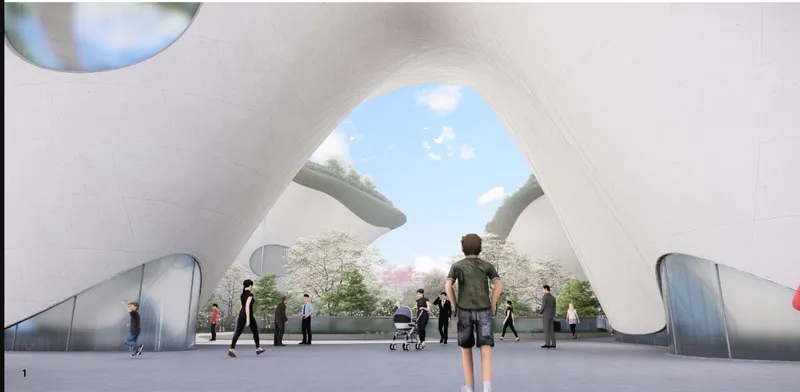
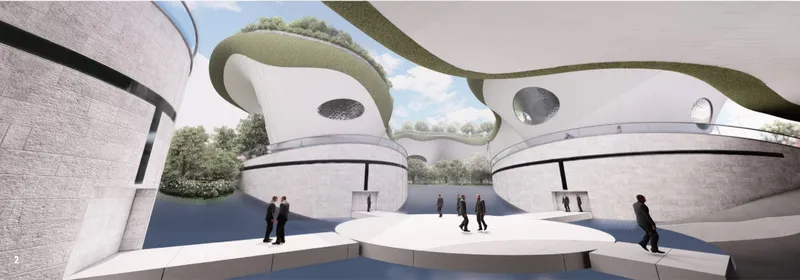
The interior view through a monumental arched opening captures the project's central ambition: to dissolve the hard boundary between funerary space and public realm. Visitors pass through this threshold into landscaped gardens under open sky, and it is genuinely unclear whether they are entering a cemetery or a park. That ambiguity is the point. The courtyard beyond, ringed by curved stone walls and green roofs, creates organic enclosures that allow mourners, students, families, and commuters to coexist without collision. Undulating paths and water features serve as spatial buffers, gently redirecting different groups so that a child playing near a reading zone never disrupts a family in mourning.
The designers describe this coexistence through three experiential stages: visit, transact, and retrospect. By abstracting the rituals of grief into these phases rather than prescribing specific religious or cultural choreographies, the architecture becomes adaptable across belief systems. It is inclusive design not as a marketing label, but as a structural logic that shapes how rooms connect and how people move.
Below Ground: Intelligent Columbaria and Private Worship
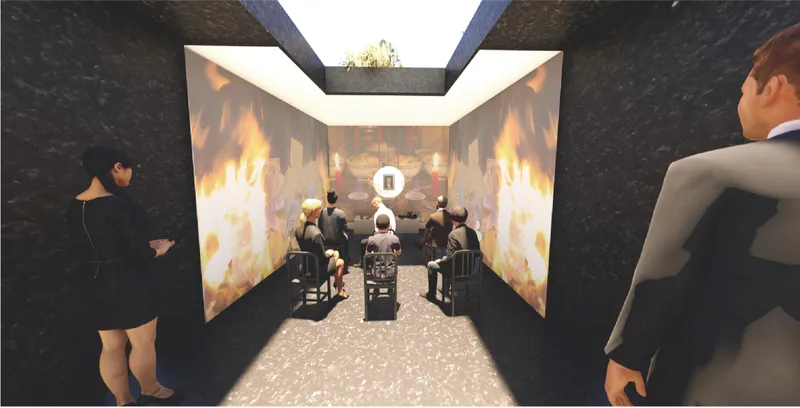
The ceremonial interior is striking in its restraint. Dark walls carry projected flame imagery, casting a warm, shifting glow across seated visitors facing an altar. Ashes are housed in intelligent columbarium chambers within climate-controlled underground spaces, each connected to private worship rooms accessible through app-based reservations. The system enables a time-sharing approach: descendants book visits in advance, so multiple ceremonies can take place within the same spatial framework without congestion. Capacity increases without the footprint growing by a single square meter.
This is cemetery infrastructure reimagined as a service layer. The app-driven booking is not a gimmick; it is a direct response to the spatial economics of a city where land is precious and the population of the deceased only grows. By stacking ritual below grade and civic program above, the project turns a zero-sum equation into a generative one.
Green Rooftops as Natural Burial Gardens
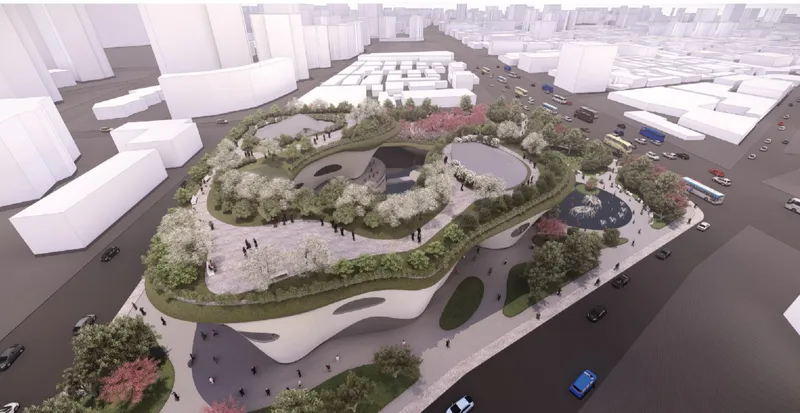
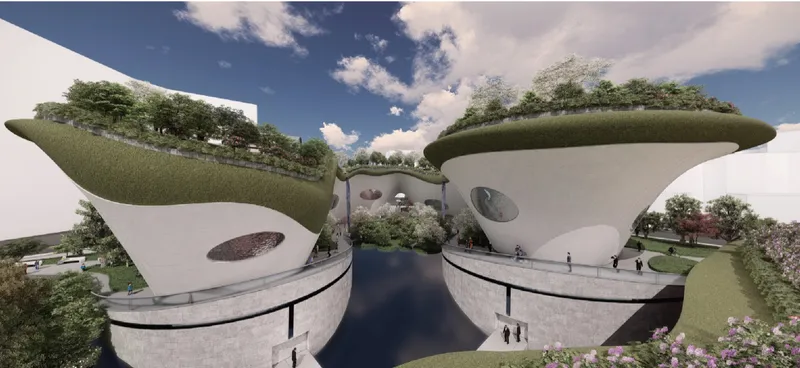
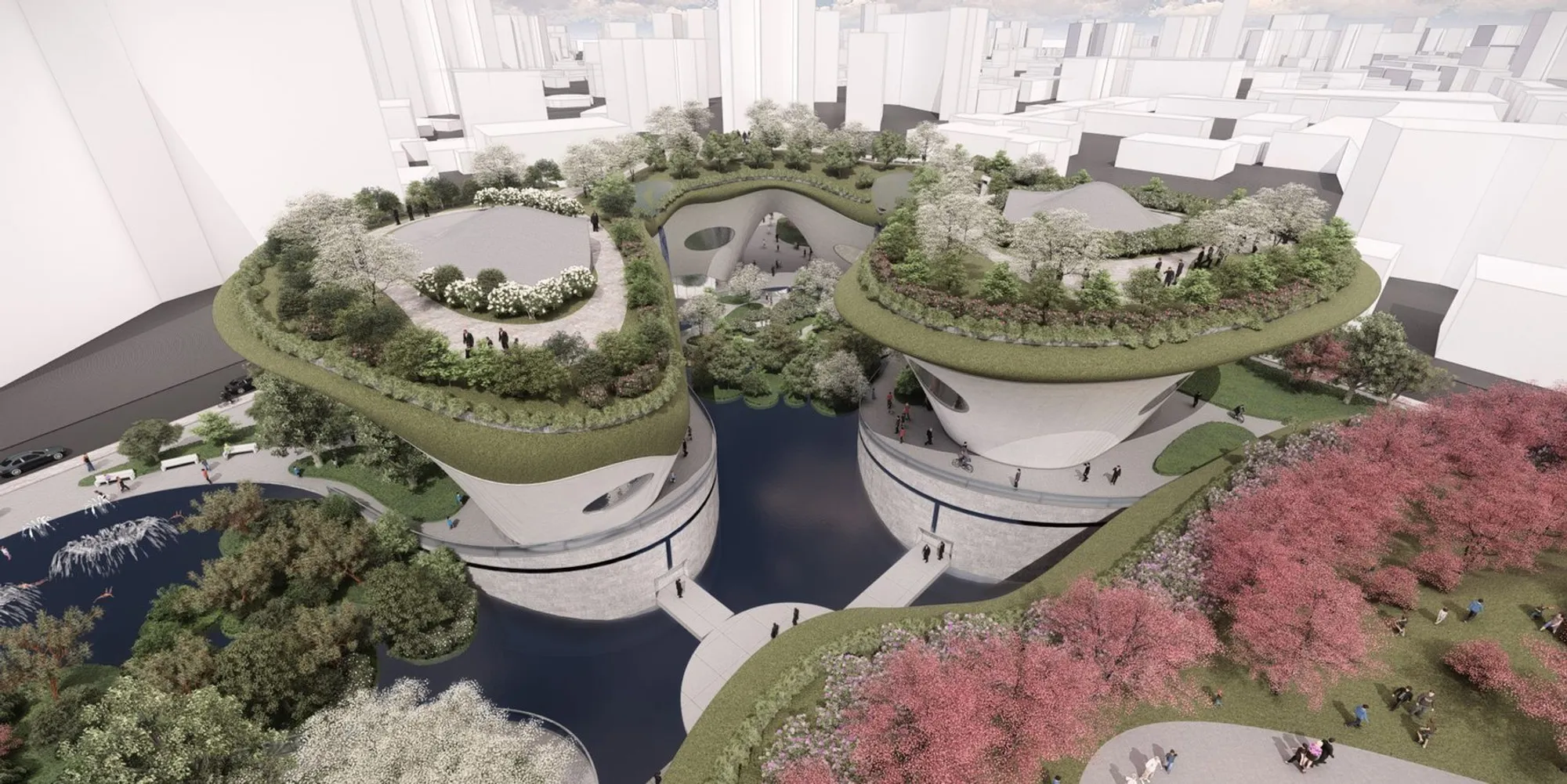
From the air, UNderNature reads as a series of curved, planted landforms rather than a building. The aerial rendering reveals green roofs thick with trees and grass atop white curved volumes, a water feature threading between them, all surrounded by the relentless grid of urban blocks and streets. A natural burial zone occupies the rooftop, transforming grief into a literal act of ecological renewal: bodies return to the earth, and the earth, in turn, sustains a living canopy that improves urban biodiversity.
The biophilic strategy is total. Vegetation covers every available surface, from rooftop burial gardens to interior courtyards and tree-lined paths. Water, used as streams, ponds, and fountains, functions simultaneously as a spatial organizer, a sensory element, and a ritual medium. The result is a microclimate that is measurably cooler, quieter, and richer in species than the surrounding district. For a neighborhood that likely has too few parks, the cemetery becomes the park.
A Civic Presence on the Street
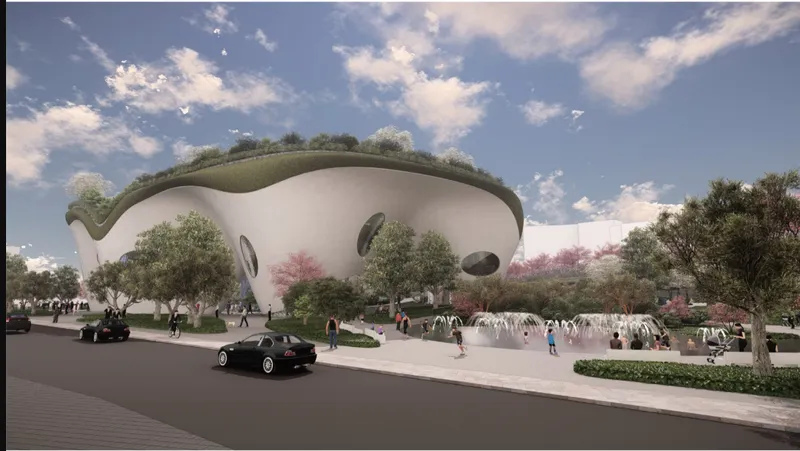
At street level, the building presents itself as a series of white curved volumes crowned with greenery, flanked by spring trees and open to pedestrian life. Nothing about this elevation announces "cemetery." The ground floor accommodates libraries, reading areas, study centers, playgrounds, and community facilities alongside parking infrastructure. Locals can use these spaces daily without ever encountering the funerary program below. The design breaks the taboo surrounding death not through confrontation, but through proximity: death simply becomes another layer in the stack of urban functions, no more remarkable than a parking garage or a reading room.
Why This Project Matters
UNderNature makes a compelling case that the cemetery is not a problem to be pushed to the urban fringe but an opportunity to reclaim civic ground. By combining underground columbaria with surface-level public programming and rooftop burial gardens, the project demonstrates that density and dignity are not mutually exclusive. It proposes a scalable model: if one Hongkou District site can absorb this hybrid, so can dozens of other land-starved neighborhoods across the world's growing megacities.
What resonates most is the refusal to treat death as architecturally exceptional. The strongest design moves here, the app-based booking system, the three-stage ritual abstraction, the civic program layered above the funerary one, all stem from the same conviction: that integrating the dead into the fabric of daily life is healthier, more sustainable, and more honest than walling them off. Tao Hung Su and 賢 陳 have designed a building that asks a city to grow up, in every sense, by building down.
View the Full Project
About the Designers
Designers: Tao Hung Su, 賢 陳
Enter a Design Competition on uni.xyz
uni.xyz runs architecture and design competitions year-round that reward proposals with spatial conviction and real site intelligence.
Project credits: UNderNature by Tao Hung Su, 賢 陳 Circle of Life (uni.xyz).



Popular Articles
Popular articles from the community


Play: Fragments of Their World
Familiar architecture becomes modular playground design, creating safe spaces where displaced children can learn, connect, imagine and play.

The Earth Pod: 3D Printed Homes for Resilient Refugee Communities
The Earth Pod reimagines refugee housing through 3D printed homes made from clay, combining resilience, self-sufficiency, and rapid shelter.

Riyadh For All: Intergenerational Urban Design for Active Aging in Rabat
Riyadh For All reimagines urban design in Rabat with intergenerational co-living, adaptive courtyards, and Moroccan cultural exchange today.

Lunar Spiral: Space Architecture Shaped by the Mathematics of the Universe
Lunar Spiral reimagines space architecture through Fibonacci geometry, lunar regolith, levitating habitats, and self-sustaining Moon living.

Similar Reads
You might also enjoy these articles

Bao Huynh Watercolor Atelier: A Serene Art Retreat in Hội An
Bao Huynh Watercolor Atelier in Hội An blends multifunctional art spaces, sustainable design, local materials, and family-friendly living in a serene environment.

Atelier Macri Concept Store Interior Design by CASE-REAL
Atelier Macri store features a "ko" counter, walnut wood details, cork displays, blending retail, gallery, and seamless customer experiences.

Manuel Vargas Izquierdo Stadium and High-Performance Sports Center: Architectural Excellence in Jalpa de Méndez
The Manuel Vargas Izquierdo Stadium blends sustainable design, inclusive sports facilities, and cultural-inspired architecture, revitalizing Jalpa de Méndez’s public spaces.

KAKR Buluh Awar Hall: Revitalizing Community and Ecology Through Bamboo Architecture
Community built bamboo hall revitalizes Buluh Awar village, empowering youth, restoring ecology, celebrating vernacular craftsmanship through sustainable architecture and culture.




Comments (0)
Please login or sign up to add comments
No comments yet. Be the first to comment!