
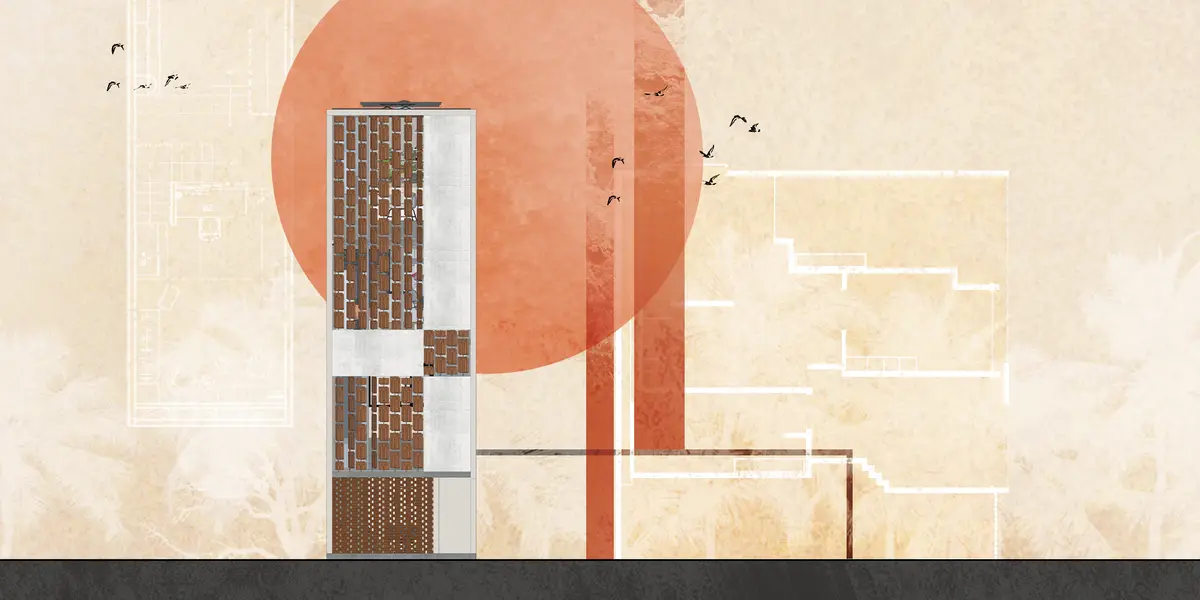
Understanding Linking Levels
A structure creating opportunities for social experiences by linking the change in height.

Site Context
Dating back to the 1700’s, the Ranwar village is an old colonial neighbourhood which sits in between Mt. Carmel road and Hill road, in Bandra, Mumbai. The village accommodates a cosmopolitan demographic with their occupations from a wide range of different backgrounds. The quaint narrow lanes of the village are predominantly lined with a series of the old bungalows with sloping mangalore tile roofing which indicate the predominance of an affluent way of lifestyle and the climate responsive architecture.
The rapidly increasing density of a metropolitan city like Mumbai, befittingly sees steep upward graphs of rising prices in real estate in the suburbs of Bandra. Another provoking factor for the high property rates of this area is its close proximity with the Bandra-Kurla complex which is a prominent business and residential area and a booming upscale commercial hub. This also leads to an observable change in the locality as it undergoes redevelopment by replacement of these old typologies of housing sitting on the expensive land. Our design is an attempt at adopting the bungalow typology of comfortable living while adapting to the decreased area of possible land usage. It also tends to cater to the rising migrant population who come to the city of dreams, Mumbai, that offers extensive options for employment and job opportunities but fails to find accommodations catered to their way of life.
Concept & Form Development
In the current virtual world, even though long distance communication has become easier and more accessible, the real life conversations of the youth with the people in their closest proximity has also seen a decline. Since our structure is housing the younger generation who will not be originally acquainted with each other, our structure will be encouraging socializing and building connections organically without having to go out of their way for it. The motive is to create opportunities for effortless social and interactive experiences. This is achieved by optimizing the usage of space in terms of having designated spaces which will be shared by all the residents. In addition to that, the integration of circulation will act as a key binding tool to encourage engagement so as to reduce restrictive or controlling factors like partitions which limit interaction.
So to achieve these, the concept is to have the tighter private spaces (individual units) open up into the spacious common spaces and manifest the difference volumetrically, by playing with heights. The form developed from this concept resulted in being a stepped form creating alternate proportionately larger and smaller spaces in sections which show the transition from shared spaces. This happens visually as well as spatially, by vertically widening out the measurements. Thus, the users’ perspective enlarges three-dimensionally and not just two-dimensionally since we have a constraint of limited carpet area.
The emphasis being on these shared spaces, circulation plays a significant part in supplementing their use. The staggered stairway runs through the common living spaces on the multitude of levels and ties them together to finally lead into their private individual units.
Natural Lighting & Ventilation
The vertical pivoted louvers of mangalore tiles in the facade, give way for ample natural lighting to light up the internal spaces while also casting shadows in interesting patterns. The interactive nature of these pivoted louvers help in controlling the influx of light and wind flow as per the user’s preference. The stairways, running through the structure, form voids that allow sunlight to enter and brighten up the interiors and also aid the ventilation by permitting air flow.
A light well takes care of both natural lighting and ventilation but it takes up too much space. Its functions can be broken down and divided. A duct at the end of the structure takes care of the ventilation and technological devices like solar tubes can be used for lighting. Solar tubes, which range from 10 to 22 inches, are pipe-like. A weather-proof dome at the top of the structure absorbs sunlight and blocks UV rays from penetrating your home. Light travels through the tube thanks to reflective surfaces. A diffuser that is mounted to the ceiling of a room generates a bright light when it reaches the bottom. They reduce your energy consumption without making dramatic changes to your home's architecture. Moreover, there is minimal heat loss or gain with solar tubes because of their smaller size.
Strategies used to make the design low cost and sustainable in your city
The use of locally available materials like terracotta mangalore roof tiles in the facade and concrete as the building material cut down on construction cost. Installation of skylights, solar tubes, a well ventilated facade and proper orientation of the structure come under passive design strategies that help in avoiding additional artificial lighting and cooling inside the structure and therefore cutting down on long term expenditure.

Popular Articles
Popular articles from the community


David Ortega Stacks a Two-Story Mexico City Penthouse Around a Steel Stair and a Pergola-Shaded Roof Terrace
In Colonia Roma, a 300 m² penthouse uses oak joinery, a planted steel stair and a slatted roof pergola to make a new-build apartment feel like a house.

David Macias Steps a Doorless Stone and Plaster House Down a Tropical Colombian Hillside
In the humid hills of Colombia, Threshold House replaces the front door with an open void and terraces its 850 m² down the slope instead of fighting it.

Juan García Correa, John González and Claudia Rueda Sink a Circular Amphitheater into a Manizales Engineering Building
On the La Nubia campus in Manizales, Colombia, the S1 Building folds labs and offices into a hillside of ramped lawns that double as a campus route.

Jaramillo Van Sluys Arquitectura and Urbanismo Turn a Demolished Registry Lot in Quito into an Orchard Plaza
In Quito's Centro Histórico, a 2,800 m² plaza exposes the San Agustín convent wall and redraws its lost Augustinian orchard in volcanic stone.

Similar Reads
You might also enjoy these articles

The Rhythm of Seasons
A Farmers' Market Connecting Nature and the City

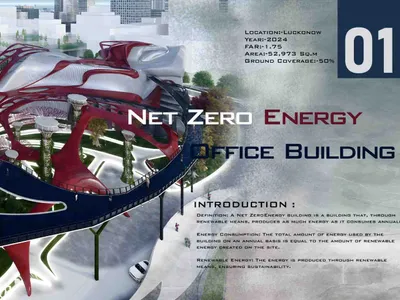
More Than a Building-Designing a Living System
More Than a Building-Designing a Living System
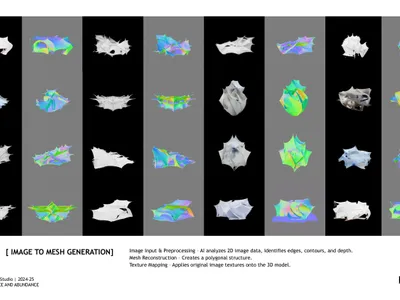
Base Beyond
DESERT COMPOUND ARID: TOURISM OF ABSENCE AND ABUNDANCE

Explore Archviz Competitions
Discover active competitions in this discipline


Challenge to visualize a collision of the future and past

Challenge to visualize future spaces of waste

Challenge to visualize slums of 2080

Challenge to illustrate the ruins of Petra
Comments (0)
Please login or sign up to add comments
No comments yet. Be the first to comment!