

Urban Agricultural Community: A Housing Thesis That Puts the Farm Inside the Neighbourhood
Aazil Abdul Jamal's B.Arch thesis threads vertical farms, community plots and production space through housing, making food security a design parameter.


Most cities eat food grown somewhere else, and the gap between field and plate keeps widening. Every added kilometre raises prices, adds carbon, and leaves urban households more exposed when supply chains falter. The Urban Agricultural Community starts from that gap and asks an architectural question rather than a policy one: what happens if housing itself becomes the farm? The answer here is a neighbourhood where vertical farms, rooftop beds, hydroponics and aeroponics sit within the same fabric as homes and shared spaces. Food production becomes part of daily routine instead of a distant rural activity.
The project is an architectural thesis by Aazil Abdul Jamal, developed for the Bachelor of Architecture program at MES School of Architecture. It is framed against a stark projection: by 2045, the world's urban population is expected to pass six billion, with the fastest growth in developing countries. Rather than treating that figure as background, the thesis uses it to build an argument. A self-sufficient community that combines housing with food production could cut food miles, create local employment, improve microclimates and give residents everyday access to fresh produce, all on limited urban land.
Mapping Population Pressure Before Drawing a Single Wall

The thesis opens with a hand-drawn mind map rather than a building. Population growth sits in a central yellow oval, with branches spreading out into causes, impacts, facts and the logic of exponential growth. It is a modest graphic, but it sets out the project's method: the architecture follows from a diagnosis. Rising urban density puts pressure on food supply, land, employment and infrastructure at the same time. The design brief therefore has to handle all four rather than offer a greenhouse as a single-issue fix.
Following the Food: From Big Box Trucks to the Landfill Heap
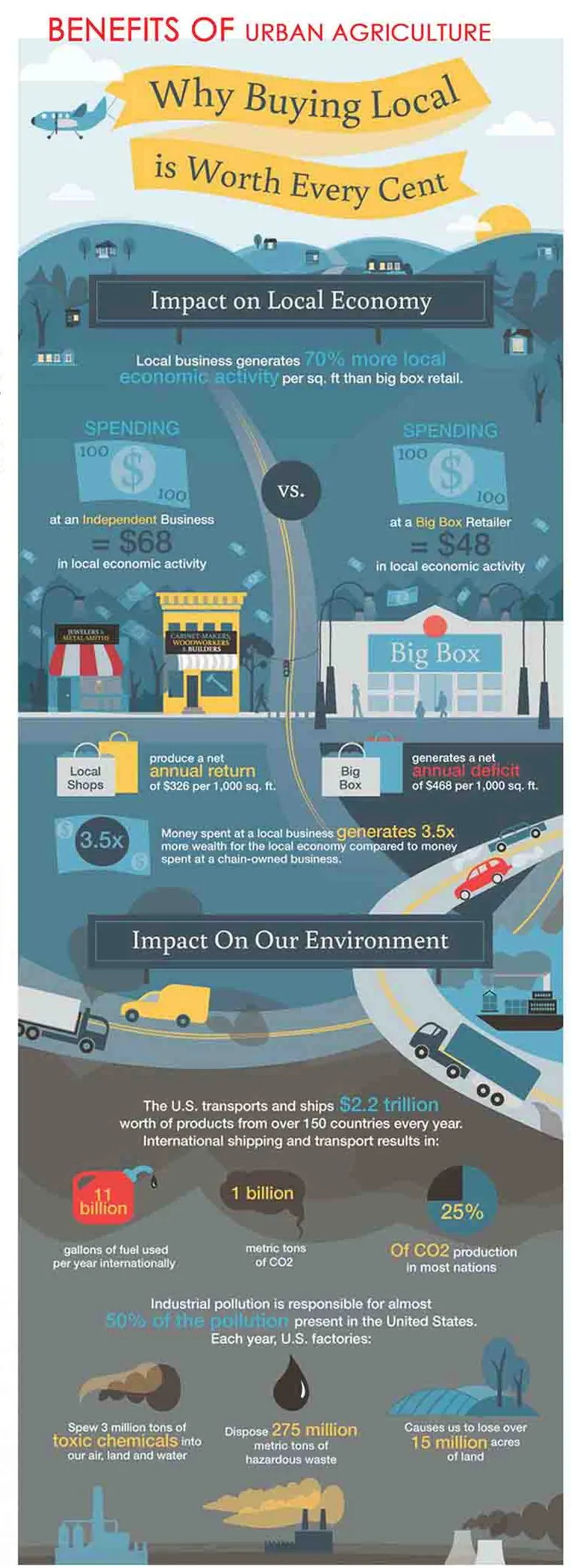
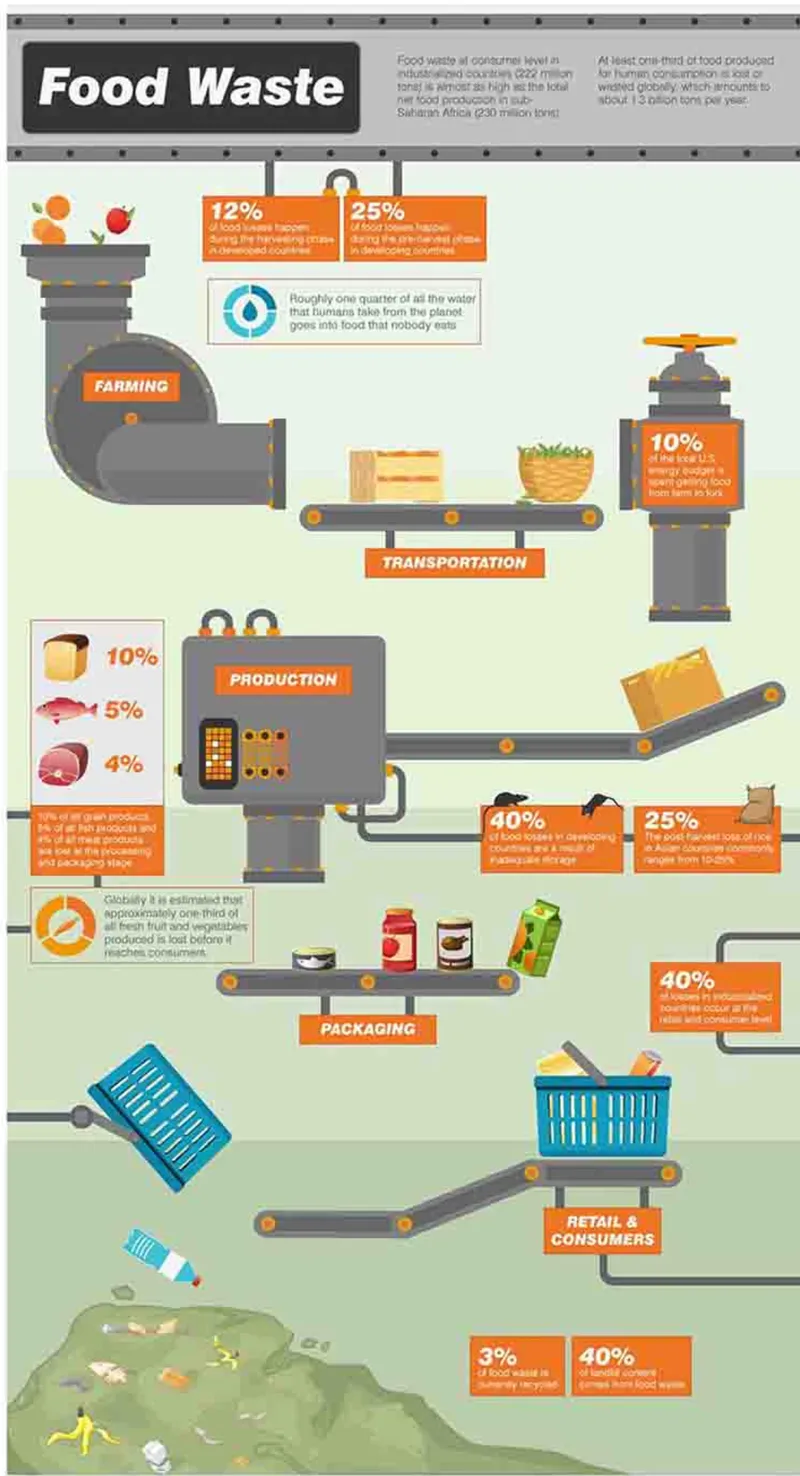
Two illustrated infographics trace where food money and food matter go. The first sets local business spending against big box retail. Shops, trucks and factories stack above figures on shipping emissions, making the carbon cost of distance visible. The second draws food waste as a conveyor belt and pipe system that runs from farming through packaging and ends in a landfill heap. Read together, they identify the problem the architecture has to address: a linear chain that loses value at every handoff.
The thesis argues that moving production closer to consumers shortens this chain directly. Less transport and storage means less spoilage, fresher and more nutritious produce, and a lower carbon footprint. It also brings resilience when supply is disrupted. These drawings make the case for proximity before any plan is shown, which is the right order for a project whose central claim is that location matters.
Villas, Towers and a Production Block Along the River

The site plan board is where the argument takes physical form. Beside a river, the scheme brings together villas, apartment towers, an events space and a dedicated production block. The housing mix is telling. Low-rise and high-rise typologies sit within the same community, which suggests that farming is meant to work across different densities and household types instead of being limited to one building model.
The production block anchors the system. The study's scope calls for shared facilities for production, processing and distribution, alongside community farming zones within housing clusters. Placing these next to homes, rather than on an industrial edge, keeps the work of growing food visible and within reach. The events space and the educational, interpretative spaces in the brief extend that visibility to the wider public, so the community also teaches people how urban food systems can work.
Macro Forces and Micro Decisions in One Diagram Grid
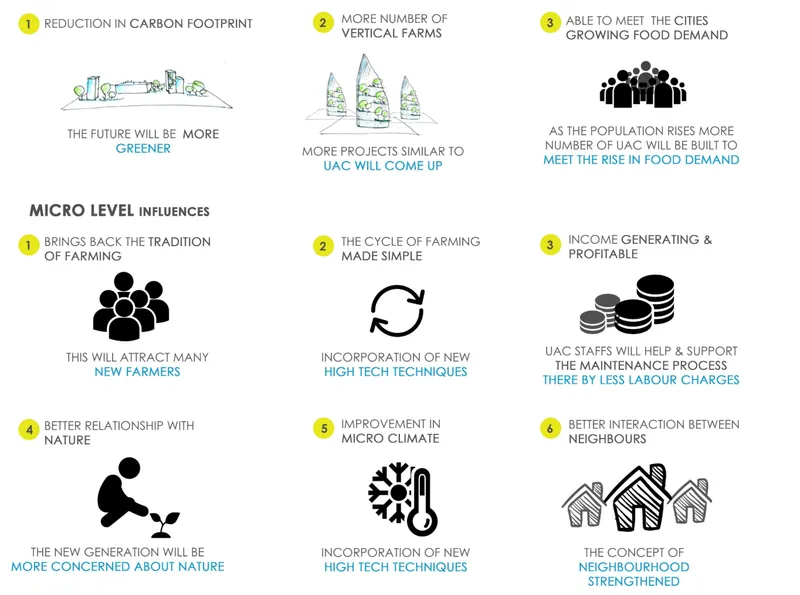
The final diagram sorts the project's influences into macro and micro levels using a grid of icons: vertical farm sketches, coins, houses and a thermometer. Each one stands for a pressure the design responds to. Vertical farming addresses land scarcity by getting higher yields from smaller parcels. Coins point to the economic side, including jobs for urban and semi-urban residents. Houses stand for the residential base of the scheme. The thermometer refers to the microclimate and biodiversity benefits of bringing planting back into dense areas. The grid shows that the thesis treats agriculture as environmental, social and economic infrastructure at the same time.
Why This Project Matters
The strongest move in the Urban Agricultural Community is to treat food security as a core design parameter rather than an added feature. Many urban farming proposals stop at a striking vertical greenhouse. This thesis instead works through the full chain: population pressure, spending patterns, waste, land use, and finally a mixed community where housing, cultivation, processing and public education share one site. Because the research comes first, the architecture can be read as a response rather than an image.
As a prototype, its value lies in being transferable. Rapidly growing cities in developing countries will face the land, employment and supply pressures this project maps, and few will have the luxury of separating where people live from where food is grown. Aazil Abdul Jamal's proposal shows how a residential development could carry part of that load, turning a neighbourhood from a point of consumption into a productive part of the city's food system.
View the Full Project
About the Designers
Designer: Aazil Abdul Jamal
Enter a Design Competition on uni.xyz
uni.xyz runs architecture and design competitions year-round that reward proposals with spatial conviction and real site intelligence.
Project credits: Urban Agricultural Community by Aazil Abdul Jamal.


Popular Articles
Popular articles from the community


Tsunami Convergenics: Turning Catastrophic Ocean Forces into Underwater Housing Infrastructure
A speculative underwater settlement off the coast of Onagawa, Japan, treats tsunamis and typhoons as energy sources rather than threats.
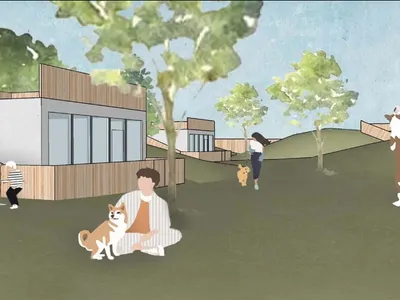
Temporary Home for Dogs: A Reversed Zoo Rethinks Animal Shelter Architecture
In Bucharest, a sinuous corridor and freed landscape flip the logic of containment, designing a shelter that works to make itself unnecessary.

Cloaked Colonization: A Mobile Underwater Habitat That Moves Like a Fish
Micah Abaya's shortlisted EHC Pacific entry reimagines ocean settlement as a dispersed network of self-sustaining architectural organisms.

Faces of the Soviet Avant-Garde: Turning Moscow's Street Names into an Open-Air Museum
A network of sculptural installations across a Moscow residential district transforms forgotten architect names into spatial encounters with cultural memor

Similar Reads
You might also enjoy these articles

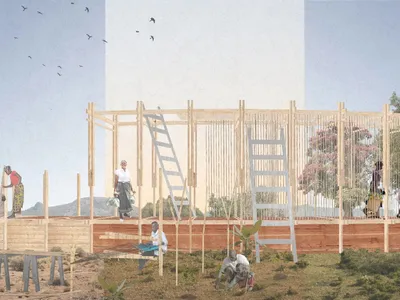
Healing Façade: A Modular Chapel System That Restores Ethiopia's Sacred Forests
Winner of the Eco-Chapel competition, this circular timber façade collects water from air to rebuild soil and reforest degraded Ethiopian landscapes.
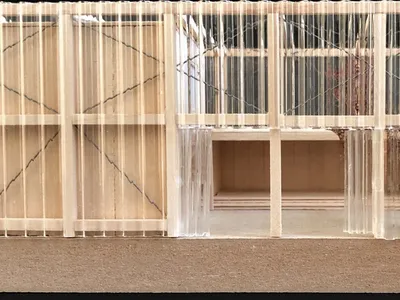
Kaffeebühnen: Where Coffee Shop Architecture Becomes a Civic Stage in Vienna
A linear sequence of timber boxes, transparent shells, and open yards turns the Viennese café tradition into a public performance space.
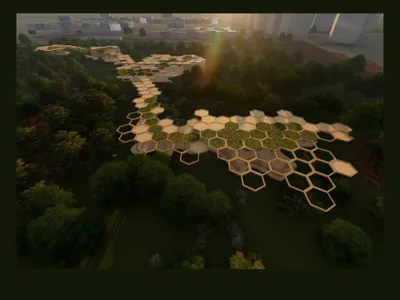
Eco Chapel: A Modular Forest Pavilion That Grows Like the Landscape It Protects
Hexagonal timber modules weave through existing trees, turning a chapel into a living system for prayer, education, and reforestation.


Urban Forest: A Vertical Ecosystem for 5,000 Workers in Singapore's Changi Business Park
Radially stacked pods and layered green decks turn a 7-acre plot into 47 acres of ecological workspace projected for 2040.

Comments (0)
Please login or sign up to add comments
No comments yet. Be the first to comment!