
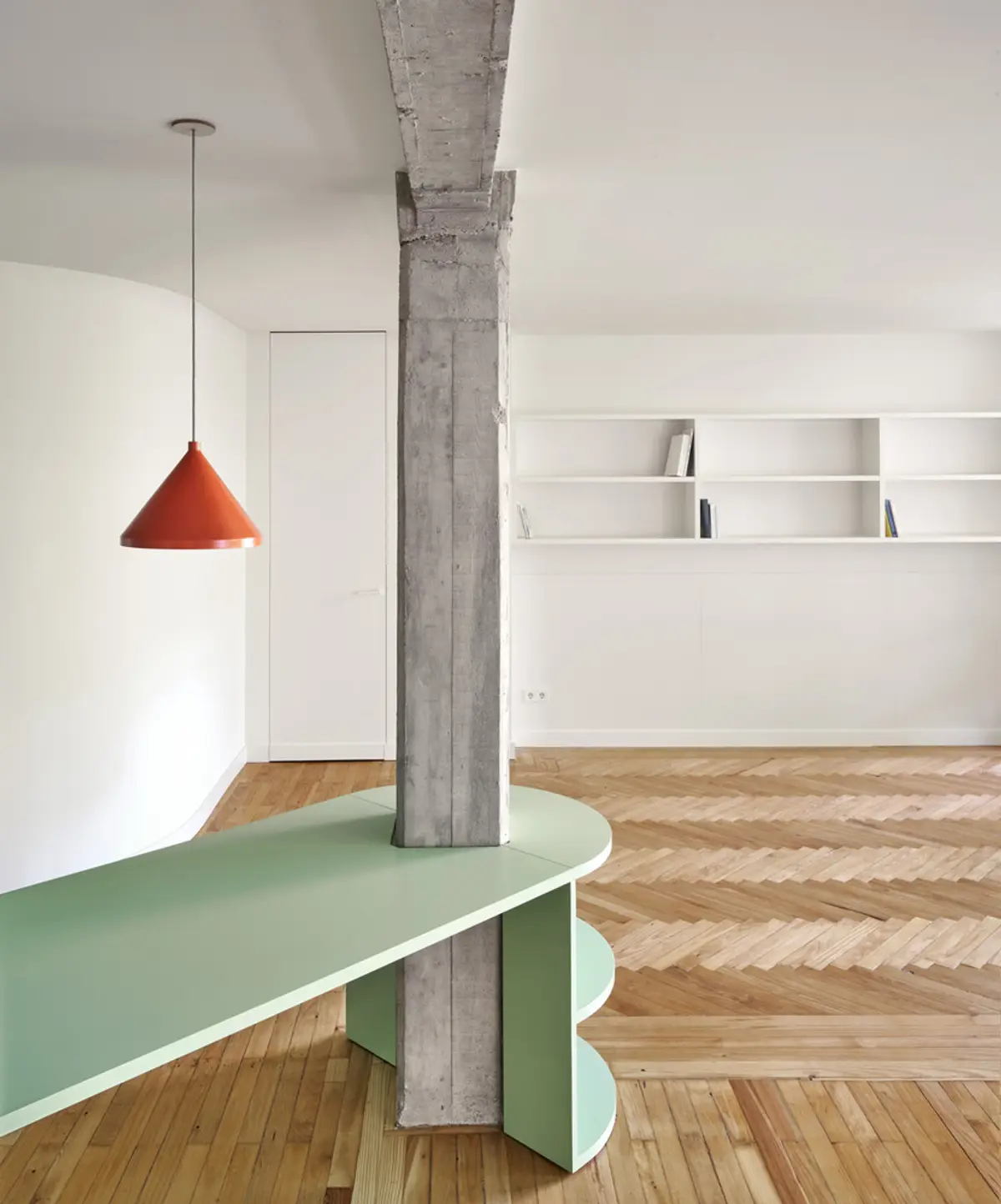
Arroyo and Villalba Wrap Furniture Around Concrete Pillars to Reopen a 1950s Madrid Apartment
The second project in the Urban Cabinets series turns structural columns into the DNA of a fluid domestic landscape in Retiro.


Most apartment renovations in historic European neighborhoods follow a predictable script: strip the partitions, polish the floors, install a kitchen island, and call it open plan. Beatriz Arroyo and Lys Villalba reject that formula. Their Urban Cabinets series treats furniture not as objects placed inside a room but as spatial devices that generate the room itself. In the second installment, set inside a 1950s open-block housing unit in Madrid's Retiro neighborhood, they remove the walls that had chopped the original plan into seven small compartments and let a pair of oversized, pillar-hugging cabinets do the work of organizing domestic life.
What makes the project genuinely interesting is the refusal to hide structure. When the partitions came down, concrete pillars and heating pipes stood exposed, the kind of raw leftovers that most renovations bury behind drywall. Arroyo and Villalba instead made each pillar the literal nucleus of a new piece of furniture, so the column is simultaneously load-bearing element and the spine of a countertop, a minibar, or a desk. The result is a single flowing domestic space where architecture and carpentry become indistinguishable.
Furnitectures That Embrace the Column
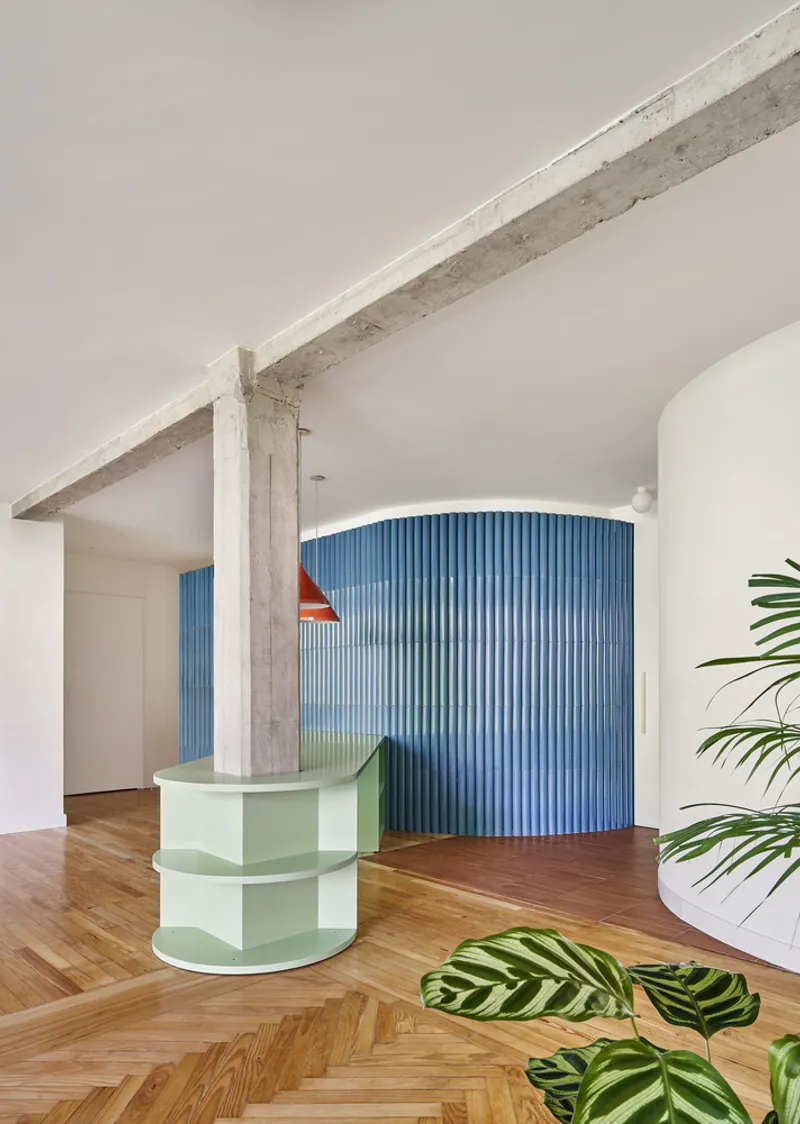
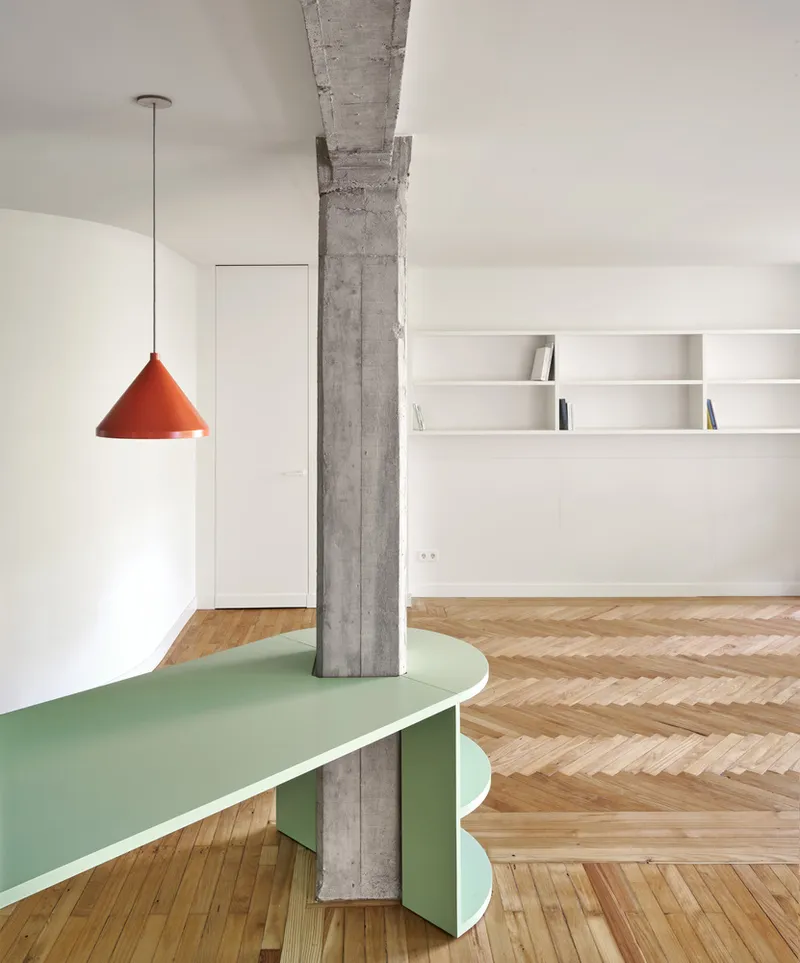
The term the architects use is "furnitectures," and it is more than branding. Each piece wraps around an existing concrete pillar with a pale green, sinuously curved skin that reads as cabinetry up close and as spatial partition from a distance. The first pillar-unit stretches four meters through the entrance hallway, bending visitors along its length before releasing them into the communal zone. It absorbs the functions of a hall table, an office desk, and a dish pantry into one continuous piece, eliminating the need for any corridor wall.
The second unit, visible in the dining area, acts as a screen between living and eating zones. One face presents a minibar; the other hides a television. What holds these two identities together is the column at the core. Rather than disguising the concrete, the joinery wraps it so tightly that the raw structural surface peeks through as a deliberate contrast, a reminder that the furniture is not decorating the architecture but literally growing out of it.
Craft Technique as Design Driver
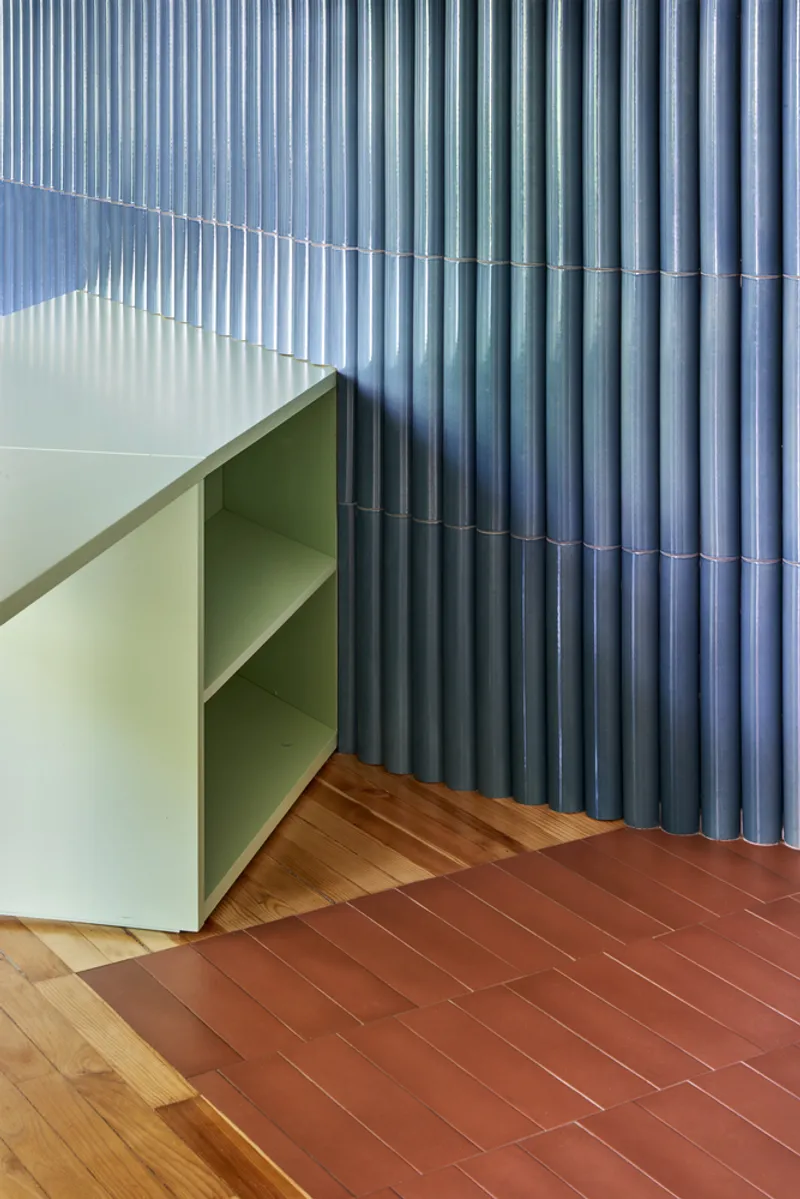
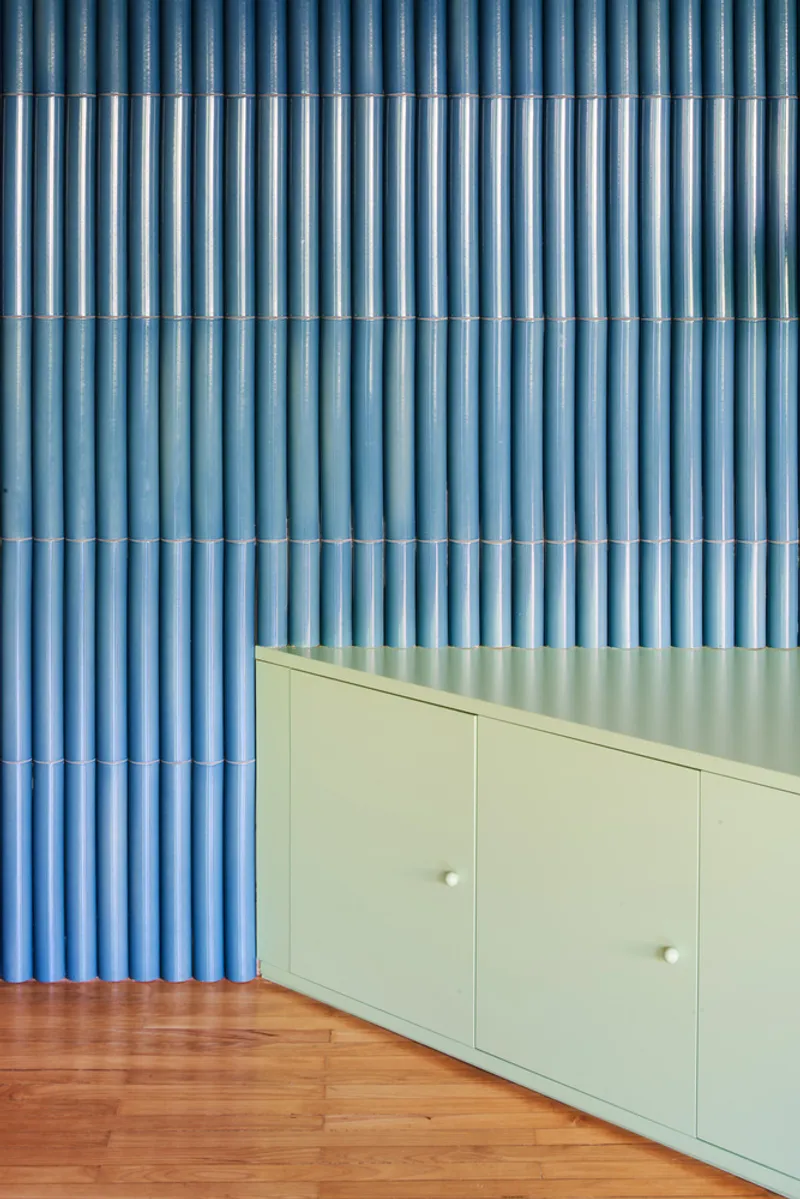
The corrugated blue wall panels that appear alongside the pale green cabinetry are not off-the-shelf cladding. They belong to a material strategy that values handmade production from small workshops. Ceràmica Cumella and Equipe Céramicas supplied the ceramic pieces that clad the curved staircase wall elsewhere in the apartment, and the same artisanal logic governs the woodwork. Cabinetmaker Emilio, working with Carpintería Castillo, adapted a tambour roller shutter technique his grandfather used in 1920s bureaus. The original mechanism rolled horizontally; here it rolls vertically, letting shutters slide sideways to reveal or conceal storage compartments.
That kind of detail matters because it anchors the design in a specific lineage of making. The project does not fetishize craft for nostalgia's sake; it deploys inherited techniques to solve contemporary spatial problems. A vertically rolling shutter is the most elegant way to open a tall, narrow cabinet without swinging doors into a circulation path. The solution is invisible until you use it, which is exactly the point.
Material Dialogue: Terracotta, Timber, and Concrete
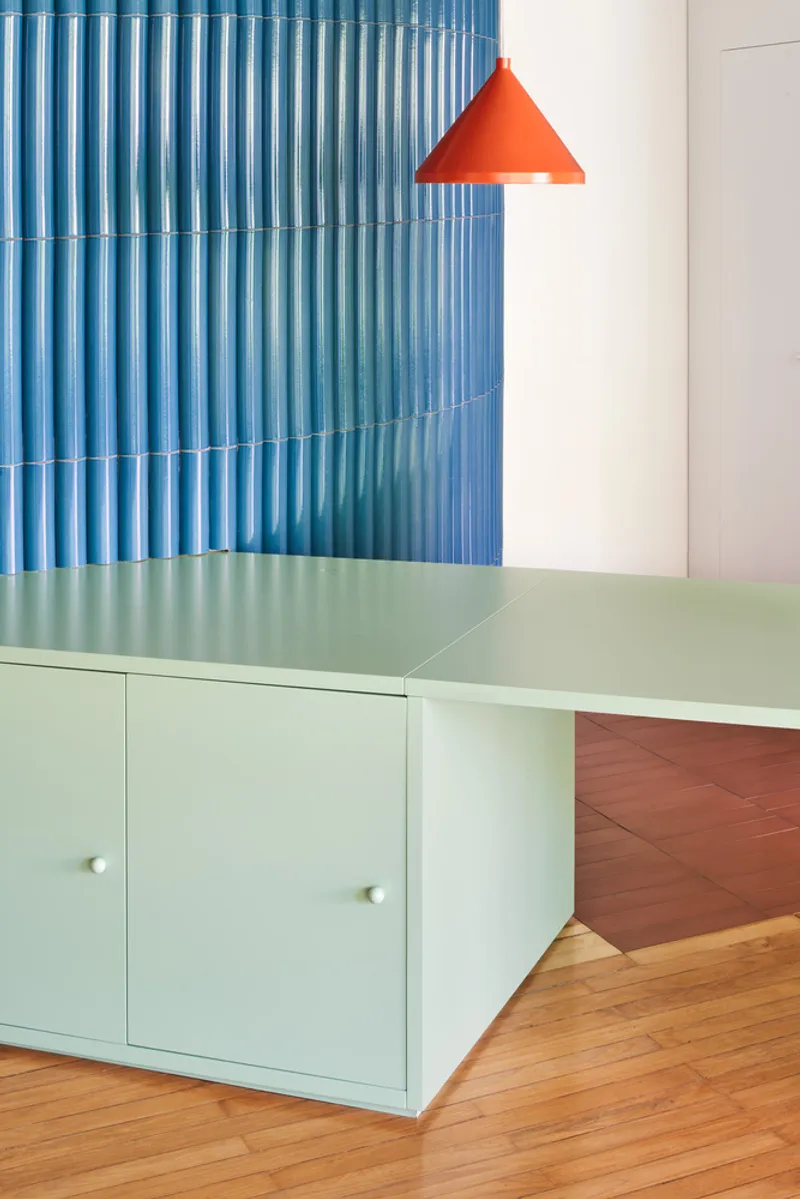
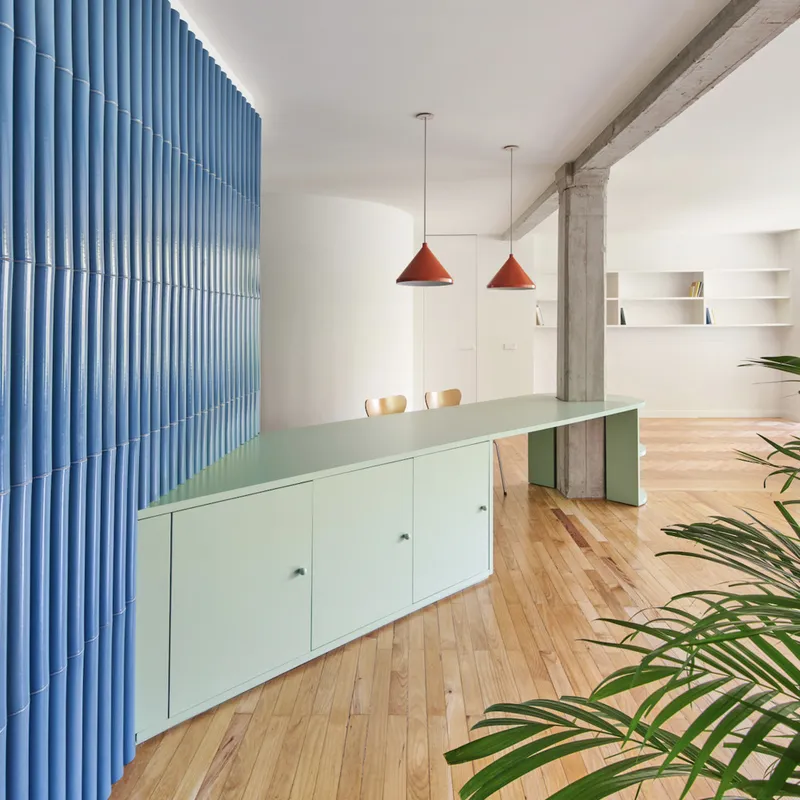
The floor tells a story the walls cannot. Herringbone timber runs through the communal living zone while terracotta tiles define the kitchen and threshold areas, and the two materials meet without a trim strip, letting the color shift do the spatial work. Overhead, exposed concrete beams reinforce the sense that this is a building with a history. The red pendant lights punctuate the neutral palette with confident warmth, echoing the terracotta below and pulling the vertical dimension of the room into the same conversation.
The pale green of the cabinetry is a deliberate mediator. Against the warm red-orange of the tiles, it cools the room; against the blue corrugated panels, it softens the industrial edge. Every material decision reads as a negotiation between the apartment's 1950s concrete bones and the new domestic program Arroyo and Villalba have layered on top.
Recovering Air, Light, and the Terrace
Before this renovation, a previous intervention had eliminated the apartment's terrace and sealed the southern facade. Arroyo and Villalba reversed that decision, recovering the terrace-balcony and reconnecting the interior with the leafy garden below. With the partitions gone, cross ventilation runs unobstructed through the full depth of the plan, and southern winter sun reaches spaces that had been dark for decades. A reversible bench, perforated by an oculus, sits at the threshold between inside and outside, functioning as a countertop on one face and a wardrobe on the other.
The environmental gains are not incidental. By exposing the structure and removing the room fragmentation, the architects created a passive climate strategy without adding mechanical systems. It is a useful reminder that in a Mediterranean climate, the most effective sustainable move is often subtraction: fewer walls, more air, direct access to exterior space.
Why This Project Matters
The Urban Cabinets series proposes something more radical than it first appears. In a discipline that still draws hard lines between architecture and interior design, Arroyo and Villalba locate the entire renovation project at the scale of furniture. The column is the hinge: it belongs to the building's structural system, yet it also belongs to the cabinet that wraps it. That dual identity collapses the hierarchy between shell and fit-out, suggesting that the real work of domestic renovation is not about choosing finishes but about reimagining which elements organize space.
For a 1950s apartment in Retiro, the stakes are modest. But the method is transferable to any mid-century housing stock where repetitive concrete frames have been subdivided into cramped rooms over decades of piecemeal renovation. Expose the structure, build around it, let craft carry the detail. It is a patient, materially precise approach that treats existing buildings not as obstacles to design but as its starting condition.
Urban Cabinets Series (2) by Beatriz Arroyo and Lys Villalba. Located in the Retiro neighborhood, Madrid, Spain. Photography by José Hevia.
About the Studio
Lys Villalba
Official website of Lys Villalba, one of the studios behind this project.
lysvillalba.netShare Your Own Work on uni.xyz
If projects like this are the kind of work you want to make, uni.xyz is a place to publish your own, find collaborators, and enter design competitions.


Popular Articles
Popular articles from the community


GROUP A Strips a 1969 Rotterdam Harbor Headquarters to Its Frame and Wraps It in Timber Louvers
In Rotterdam's M4H harbor district, Ferro Offices reuses a 1969 frame, adds one timber storey and reaches BREEAM-NL Outstanding.

U.GA Architects Wraps an Oval Rooftop Pool in Curved Board-Formed Concrete on Busan's Jeollidan-gil
In Busan's Jeonpo-dong, a 454 m² mixed-use block stacks a neighborhood facility, guest rooms and an oval rooftop pool inside spiraling concrete walls.

Juan García Correa, John González and Claudia Rueda Sink a Circular Amphitheater into a Manizales Engineering Building
On the La Nubia campus in Manizales, Colombia, the S1 Building folds labs and offices into a hillside of ramped lawns that double as a campus route.

David Ortega Stacks a Two-Story Mexico City Penthouse Around a Steel Stair and a Pergola-Shaded Roof Terrace
In Colonia Roma, a 300 m² penthouse uses oak joinery, a planted steel stair and a slatted roof pergola to make a new-build apartment feel like a house.

Similar Reads
You might also enjoy these articles


Hodi-Mandai Geram
Project Function: Preservation and revitalization of the Intangible heritage and socio-spatial identity of the Hodi by Housing, Cultural Memory Center, Sacred Grove, landscape, local tourism economy


Olio Towers: A Mid-Rise for Performers That Fuses Housing, Rehearsal, and Stage
Located blocks from Houston's Theater District, this modular tower stacks living units around a central performance atrium.

Oasis: Modular Green Housing Carved into Dhaka's Urban Fabric
A shortlisted Plugin Housing entry reclaims unauthorized settlements in Dhaka with stepped concrete volumes, green roofs, and ventilation-driven design.

Black Hole: A Floating Megastructure for the Post-Physical Era
Emiliano Mazzarotto envisions a spherical, self-scaling arena where e-sports, digital hotels, and holographic stadiums replace traditional public space.

Explore Urban Furniture Competitions
Discover active competitions in this discipline

Challenge to design mud housing for contemporary communities

Challenge to reimagine the Iron Throne

Photograph architecture without architects

Illustrate the lost glory of Angkor Wat - Render Challenge
Comments (0)
Please login or sign up to add comments
No comments yet. Be the first to comment!