
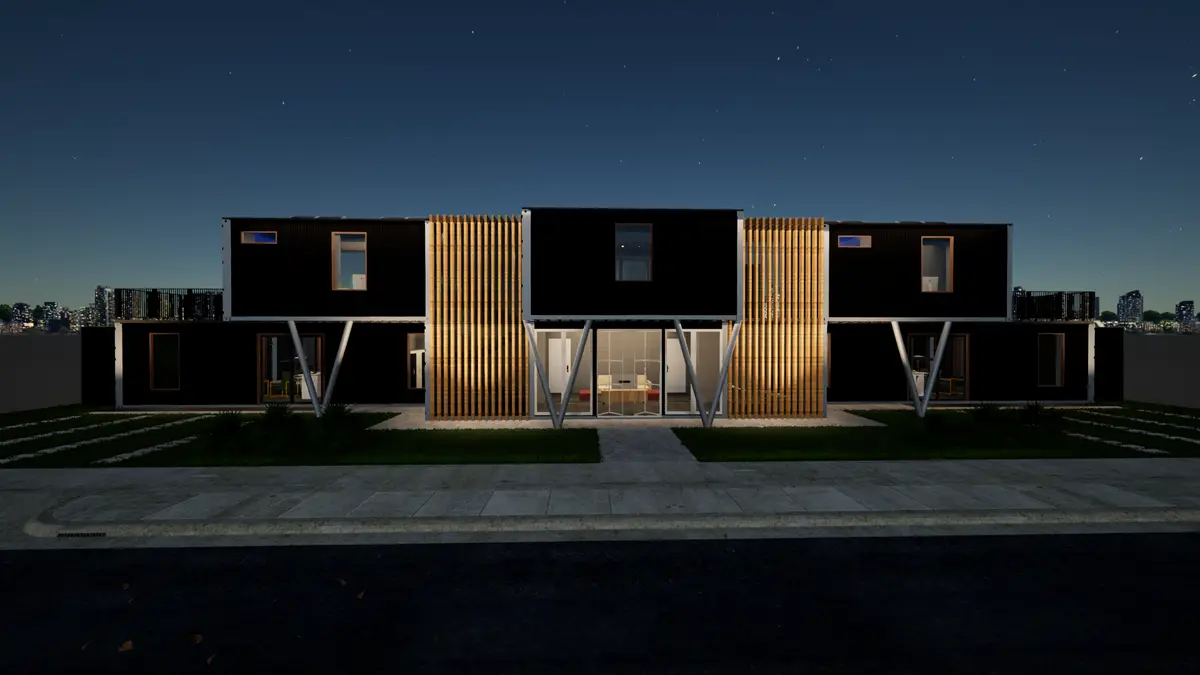
URBAN CENTER
CONTAINER CITY

KNOW US
We are four young people, fourth semester students of the Faculty of Architecture of the Benemérita Universidad Autónoma de Puebla, we are from the City of Puebla, Mexico. We are excited to participate in this contest, we have been studying it for a few months and working hard to deliver a worthy result that can represent our University that we love so much.
BACKGROUND
Puebla year after year receives students from different states of the Mexican Republic, many of them leave their family behind to look for a better future residing in a city that is not their own, many of them come to feel lonely, sad but with a lot of desire to learn day by day.
DESIGN CONCEPT
The concept behind our design is to create a smaller-scale analogy based on the main layout of the City of Puebla, more specifically the center of our city. We want the young students who live here to feel in harmony with the city.
Our intention behind the organization of the architectural elements was to better distribute the spaces so that each student felt comfortable, with privacy but accompanied by other young people who live situations similar to theirs.
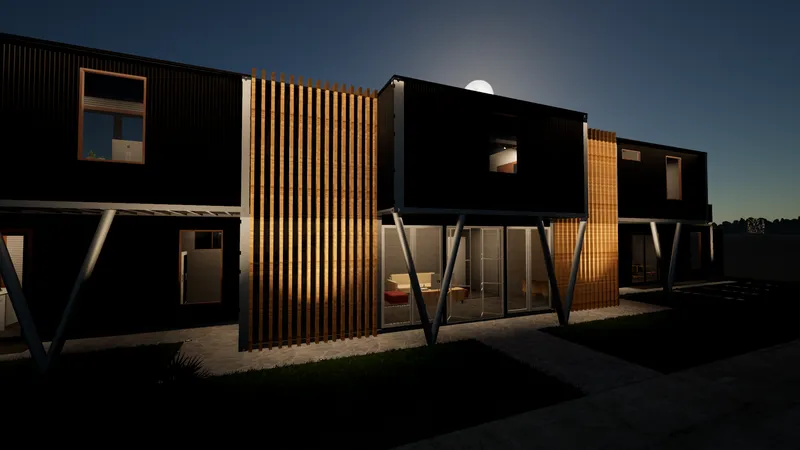 MAIN FACADE
CHOICE OF SITE
The choice of the site was the most difficult decision, looking for a location that could provide us with everything a young student needs such as: supermarkets, public transport routes, his university or high school, urban equipment and infrastructure, however, we were able to find a land with all these qualities. The chosen land is located 100 meters from the most emblematic university in Puebla. Another advantage of this land is that it is completely flat, so it does not require major excavations or fillings. And it has direct views of the University Library.
ATTEMPTS AT ITERATIONS
The iterations that we tried before reaching the final result were quite a few, we believe that they were around ten, we studied each one with its advantages and disadvantages, circulations, functionality, dimensions of spaces. We are sure that after our failed attempts we arrive at the best solution, we are satisfied with the results, this last proposal contains functional circulations, wide spaces, pleasant outdoor spaces, outdoor terraces, and common and private spaces.
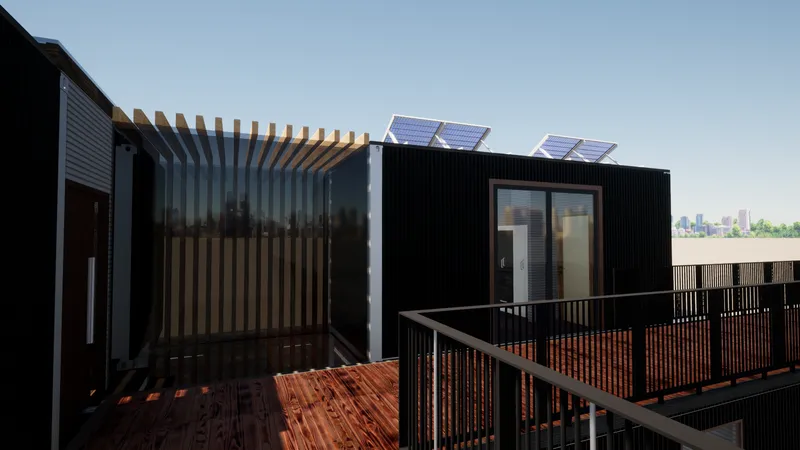 PRIVATE TERRACES
DESIGN METHOD
Our research design method was to start with a general party, with an initial idea that could receive any type of change, said general party was to draw on the proposed field ideas in the position and arrangement of the maritime containers, at the same time we were creating volumetric models for our better visualization and understanding of the design. We made quite a few ideas and we were discarding those that seemed less functional and aesthetic. When we had five possible solutions, we developed them further, carrying out a more detailed intervention in the containers such as: creation of doors and windows, furnishing, zoning, creation of an architectural program based on the needs of young people and the design of each of these proposals. Finally, when they were all finished, we opted to choose the most functional and aesthetic one.
HOW WE GOT THE PROGRAM
The way in which we obtained the final program was determining the needs of the young people by asking ourselves and fellow students what we needed to live comfortably in a housing unit like the one we were creating, privacy but at the same time coexistence with others was which dictated which spaces were extremely necessary. Spaces such as a small library to carry out work, a gym to exercise and a common kitchen are some of the spaces that we say were necessary for this housing unit.
MATERIALS
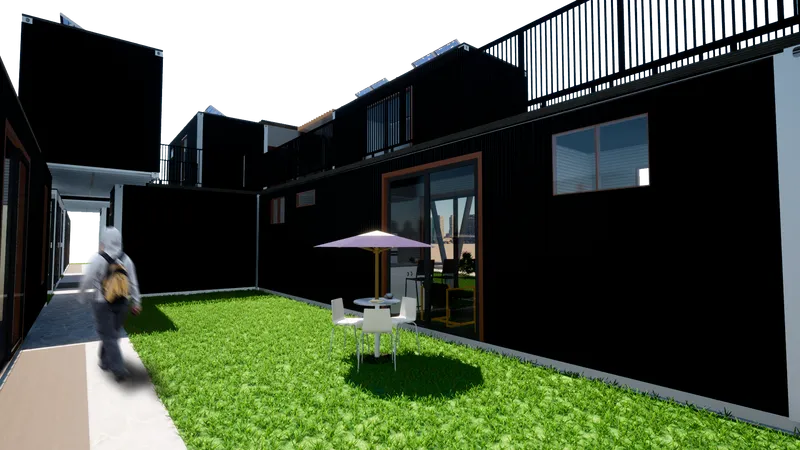
For the choice of additional materials in the project, we wanted to respect the materials that are usually used in our city, however, these materials are easy to find in any other country, such as the use of wooden pallets, metal railings, among others. We use these materials thinking of giving the project a more striking and attractive appearance so that the young residents feel comfortable living here and we firmly believe that we achieved it.
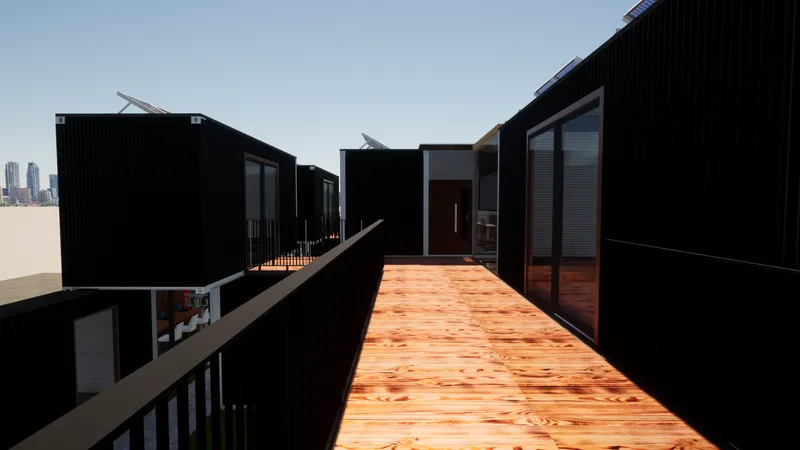 MATERIALS
OUR WORK TEAM
Our work team knows each other very well, we know what our weaknesses and our strengths are; We worked hard in the development of the project, we set pre-established goals in periods of time that we had to overcome little by little to take better control of it. We set out to design a project that would be as close to reality and would not remain a conceptual project so that it would be easier to carry it out if necessary. This was achieved by investigating how we can work with containers, professional recommendations and use of space.
PROJECT EXPANSION PLAN
The expansion plan of the project is subject to the extension of the land, our design is willing to be replicated, oriented in a different way or enlarged according to the needs of the client / user. However, it can also expand after it has been built, if young people decide to place new furniture this is possible because they have the necessary interior and exterior space.
 CIRCULATIONS
PROJECT TRANSFORMATION PLAN
We believe that the transformation of the project will be subject to the user's own modifications, however, our team knows that the architect's work goes beyond design and it is for this reason that we will be aware of the new needs of our users so that as students From the Faculty of Architecture we can give them the best solution and they are satisfied with their place of residence.
Finally, we want to add that this is the first contest we have attended and we are happy with the results we obtained, we learned a lot, we gained experience and we enjoyed the whole process. We can only thank the organization for creating this type of contest where young people like us can test how far we can go and give our best.
Thanks.

Popular Articles
Popular articles from the community


Cube Design Draws an Ecological Corridor Between Two Shenzhen Hills with the Nankai Building
Beside Shenzhen's container docks, the Nankai Building pairs stacked balconies with a climbing green screen to connect two hillsides across its height.


Aquadapt: An Underwater Habitat That Rewrites Its Rooms by the Hour
Curved modules ring the seabed while one shell shifts from breakfast room to cinema, farm and football pitch as residents' needs change.

ETEH Reworks the Shared Spaces of São Domingos School in Brazil Around Timber, Color and Hanging Plants
At São Domingos School in Brazil, 436 m² of hall, refectory and library are recast with timber joinery, a yellow and blue code and trailing greenery.

graciastudio Turns a Viewless Tijuana Lot Inward Around a Courtyard of Concrete, Timber and Trees
In Tijuana, Jorge Gracia's GA2 House stacks a timber-clad private floor over exposed concrete and replaces a missing view with a planted interior patio.

Similar Reads
You might also enjoy these articles

Vereda Arquitetos Renovates a 40-Square-Meter Apartment Inside Niemeyer's Copan Building
A compact unit in São Paulo's most iconic residential tower gets a material overhaul that pairs exposed concrete with bold blue Formica.

Shakur's House: Exposed Brick as an Interior Organiser in a 168 m² Mashhad Residence
Brick moves indoors in this Mashhad residence, where masonry walls, glass partitions and teal planes sequence a compact home without closing it off.

Day and Night Park: A Time-Based Urban Newsstand in Beijing
A temporary urban newsstand in Beijing blending travel, light, and reading through poetic colors, compact form, and community-focused design.

Modernist Patio Renovation in El Masnou, Barcelona by Oliver Segura Arquitectura + Cebrià Arquitectura
Modernist patio renovation blending tradition and innovation with a movable pool, leveled floors, and Catalan materials in El Masnou.

Comments (0)
Please login or sign up to add comments
No comments yet. Be the first to comment!