
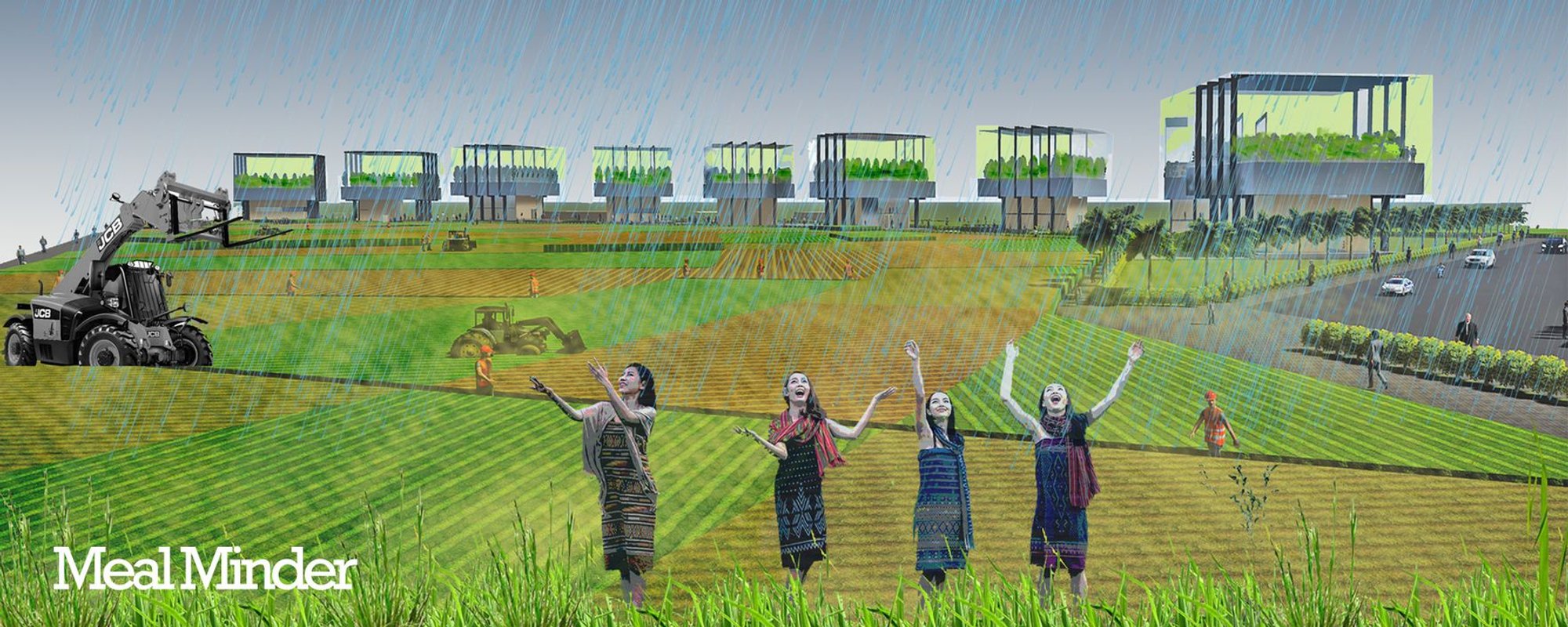
Urban Meal Minder: Architecture That Grows 75% of a Community's Food
Nine farming blocks along the Thames merge aeroponic greenhouses, seasonal festivals, and nutritional programming into a single urban ecosystem.

What if a building could grow three-quarters of the food its residents need? The Urban Meal Minder takes that question seriously, organizing nine architectural blocks around the structure of an "Eatwell guide," balancing fruits, vegetables, cereals, pulses, and proteins across distinct farming floors. The result is a hybrid typology: part greenhouse, part community center, part cultural venue, all grounded in the conviction that urban architecture should feed people, not just house them.
Designed by Harshitha and awarded the People's Choice Award in the Urban Meal Minder competition, the project is sited near the Thames and positioned alongside cultural landmarks. Its strategic master plan distributes pavilions across a triangular green space, creating a campus rather than a single monolith. The design is as much about public life as it is about crop yields, weaving fitness facilities, an information center, and social gathering areas into a framework that treats food security as inseparable from community well-being.
A Campus of Farming Blocks Along the Thames
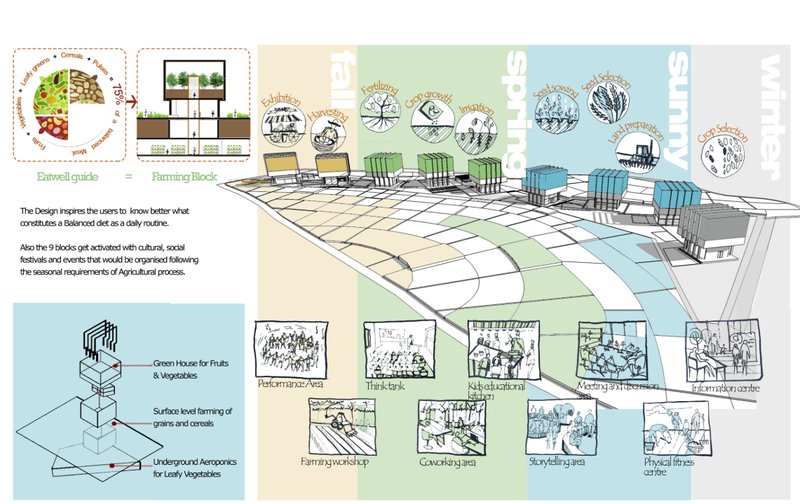
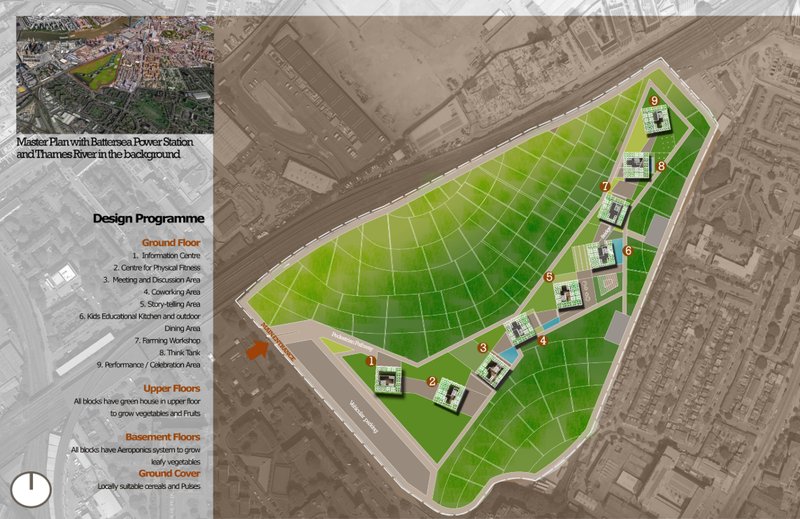
The axonometric drawing reveals how the nine blocks are organized: rooftop farming zones sit above educational program spaces and cultural areas, creating a vertical loop from food production to consumption. Below, the site plan rendering shows the campus distributed across a triangular green field, with pavilions placed to maximize open ground between structures. Rather than concentrating agriculture in a single tower, Harshitha spreads the program outward, allowing each block to specialize in different crop categories while maintaining pedestrian connectivity across the site.
The proximity to the Thames is not incidental. Positioning the project near water and established cultural landmarks gives it access to foot traffic, natural ventilation patterns, and a symbolic relationship to the agricultural landscapes that once fed London. The distributed layout also means that the open green spaces between blocks can function as gathering grounds for seasonal festivals, turning infrastructure into public life.
Modular Pavilions with Green Roofs on Four Orientations
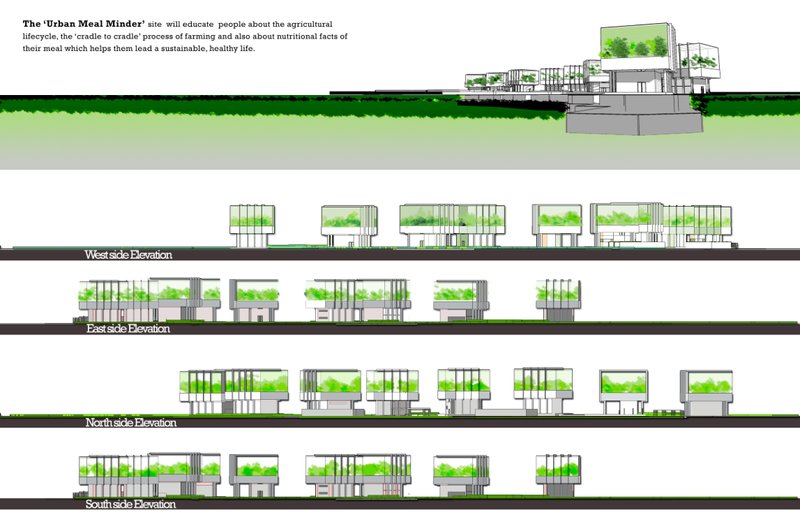
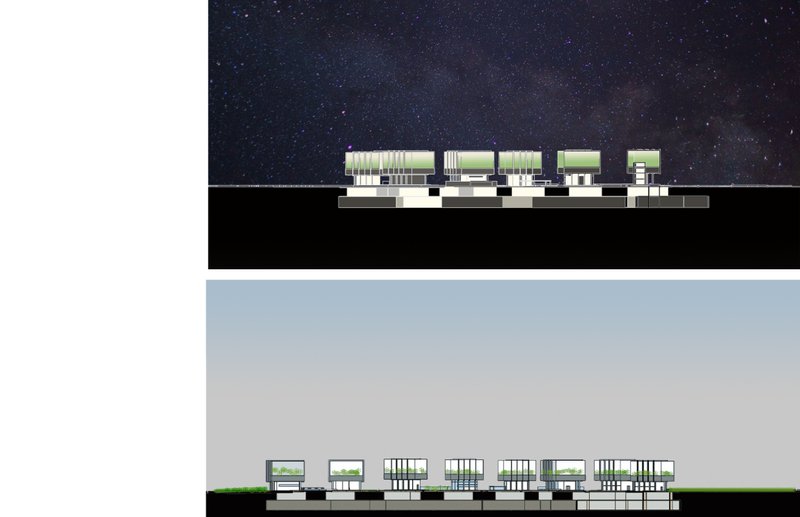
Four elevation drawings present the pavilions from west, east, north, and south orientations, each topped with green roofs that blur the line between architecture and landscape. The modular proportions suggest a system that could be replicated or adapted to different urban sites without losing its agricultural logic. The section drawings cut deeper, showing how upper floors harness natural sunlight through greenhouse enclosures while basement levels use controlled aeroponics and UV lighting to optimize yields regardless of season or weather.
This vertical separation is key to the project's ambition of meeting 75% of nutritional needs on site. Sun-hungry crops occupy the upper greenhouse levels where daylight is strongest; root vegetables and leafy greens that tolerate artificial light move underground into aeroponic systems. The night-sky and daytime horizon backdrops in the section drawings are not just aesthetic choices: they emphasize the round-the-clock nature of the food production cycle, where controlled-environment farming extends growing hours well beyond daylight.
Seasonal Activation: From Seed Sowing to Harvest Festivals
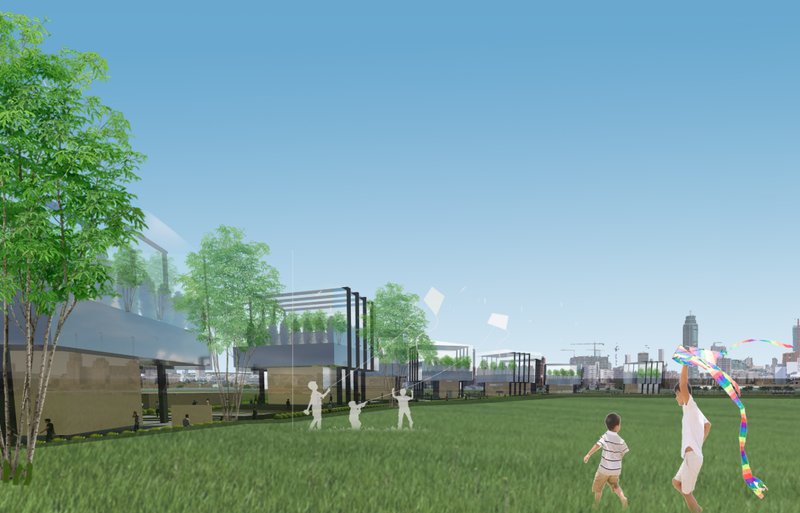
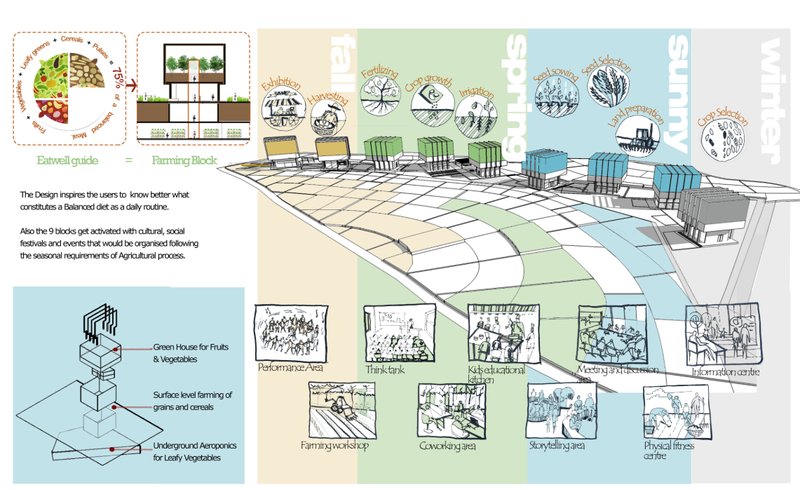
The rendering of children flying a kite on the lawn between pavilions under blue sky is telling. It insists that the project is not a research facility but a public park that happens to produce food. The nine blocks are activated seasonally, hosting exhibitions, harvesting festivals, crop growth celebrations, and seed-sowing ceremonies that tie the agricultural calendar to communal life. These are not add-on events but integral to the spatial programming, with designated areas for each activity visible in the axonometric drawing of educational and seasonal spaces.
The educational dimension runs through the entire scheme. Visitors and residents follow the agricultural lifecycle from land preparation to irrigation, learning about nutrition alongside the mechanics of growing food. Fitness facilities and social areas are woven into the blocks so that healthy eating and physical activity share the same spatial framework. The project transforms "farm-to-table" from a marketing phrase into an architectural program, making every step of the food chain visible and participatory.
Why This Project Matters
Urban farming proposals often stop at the diagram: a green roof here, a hydroponic wall there. The Urban Meal Minder pushes further by tying the quantity of food production to specific nutritional targets and by structuring the building's spatial program around the Eatwell guide rather than conventional floor plates. The 75% self-sufficiency target is ambitious, but its real value lies in forcing the design to account for crop variety, light access, and seasonal rotation at every level of the architecture.
More importantly, Harshitha's project refuses to treat food production as a technical problem isolated from culture. By embedding festivals, education, and community gathering into the same blocks that house greenhouses and aeroponic chambers, the design argues that resilient cities are built not just on efficient supply chains but on shared rituals and collective knowledge. The People's Choice Award suggests that this argument resonates: people want architecture that feeds them, teaches them, and brings them together.
View the Full Project
About the Designers
Designer: Harshitha
Enter a Design Competition on uni.xyz
uni.xyz runs architecture and design competitions year-round that reward proposals with spatial conviction and real site intelligence.
Project credits: Meal Minder by Harshitha Urban Meal Minder, (uni.xyz).




Popular Articles
Popular articles from the community

BAUEN Builds Two Rammed Earth Volumes in Paraguay Inspired by the Ovenbird's Nest
In San Bernardino, a house of compacted earth channels the instinct of a constructive bird to shelter life from the Paraguayan summer.
VEIVE Architects Builds a Mountain Hostel That Disappears into a Hangzhou Hillside
On the Huihang Ancient Trail in Xiangjian Village, a shelter of wood, steel, and rammed earth roots itself in the rural landscape.
BLDUS Turns a 250-Square-Foot Screened Porch into a Pine Forest Temple in East Hampton
A gabled cedar pavilion mimics the rhythm of surrounding pines, anchoring a 1990s wooded home to its hollow in Long Island.
gru.a Builds a 70 m² Timber Shelter That Opens Like a Farm Door in Brazil's Valley of the Vines
In the mountainous region near Rio de Janeiro, a compact retreat uses plywood panels and deep eaves to blur the line between inside and out.


Similar Reads
You might also enjoy these articles
D and P Associates Build a Pi-Shaped House of Rammed Earth Memory on Vietnam's Red River
A 640-square-metre residence in Ngoc Thuy channels the pisé wall traditions of Vietnam's northern highlands into a riverfront family home.
Johnston Architects Reimagines the Methow Valley Hay Barn as a Small-Town Library in Winthrop
A 7,300-square-foot timber library channels the region's agrarian vernacular to serve a rural Washington community of 400 year-round residents.
STILL YOUNG Builds a Glowing Campfire in the Snow for ARC'TERYX at a Chinese Ski Resort
A timber-framed pavilion at Beidahu Ski Resort in Jilin wraps warmth and glacier-like resin around outdoor retail.
gru.a Builds a 70 m² Timber Shelter That Opens Like a Farm Door in Brazil's Valley of the Vines
In the mountainous region near Rio de Janeiro, a compact retreat uses plywood panels and deep eaves to blur the line between inside and out.


Explore Educational Building Competitions
Discover active competitions in this discipline




The Global Benchmark for Architecture Dissertation Awards


Challenge to design public laboratory
Comments (0)
Please login or sign up to add comments
No comments yet. Be the first to comment!