
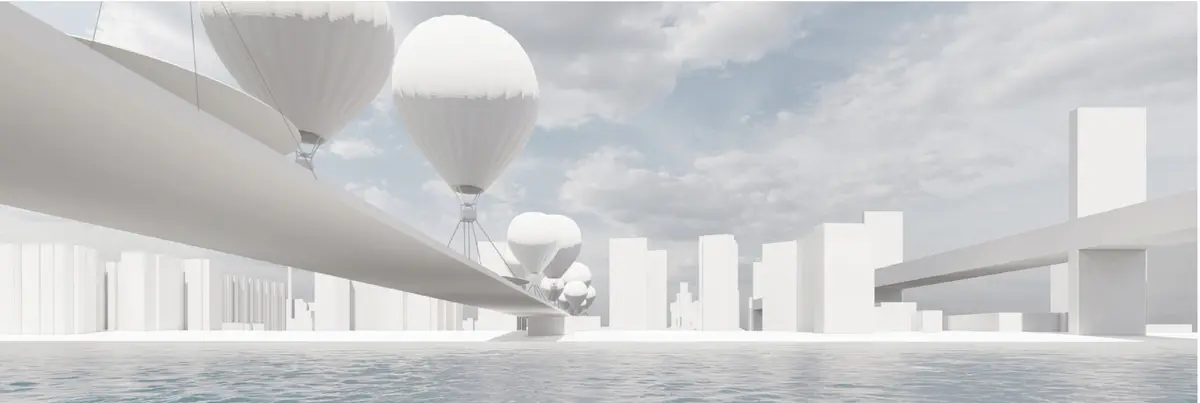
User-Bridge-Context: A Pedestrian Spine That Floats Between Urban Volumes
A linear transit intervention stitches two building masses together while hot air balloons mark its presence against the sky.


What if a bus stop wasn't a point but a line? User-Bridge-Context reimagines the transit halt as an elongated pedestrian spine, a connective tissue stretched between two urban volumes that transforms dead space into active passage. The project refuses the conventional shelter typology, proposing instead a low, undulating structure that serves as both infrastructure and public landscape, its roofline punctuated by tethered hot air balloons that turn wayfinding into spectacle.
Designed by Navaz Ahamed for the Halt competition on uni.xyz, the project takes a deceptively simple premise: a transit stop should do more than shelter waiting passengers. It should bridge. The intervention positions itself as a mediator between existing building masses and the pedestrian flows that move between them, turning a utilitarian pause into a spatial event that registers at both the street level and the skyline.
A Green Corridor Cut Through the Block
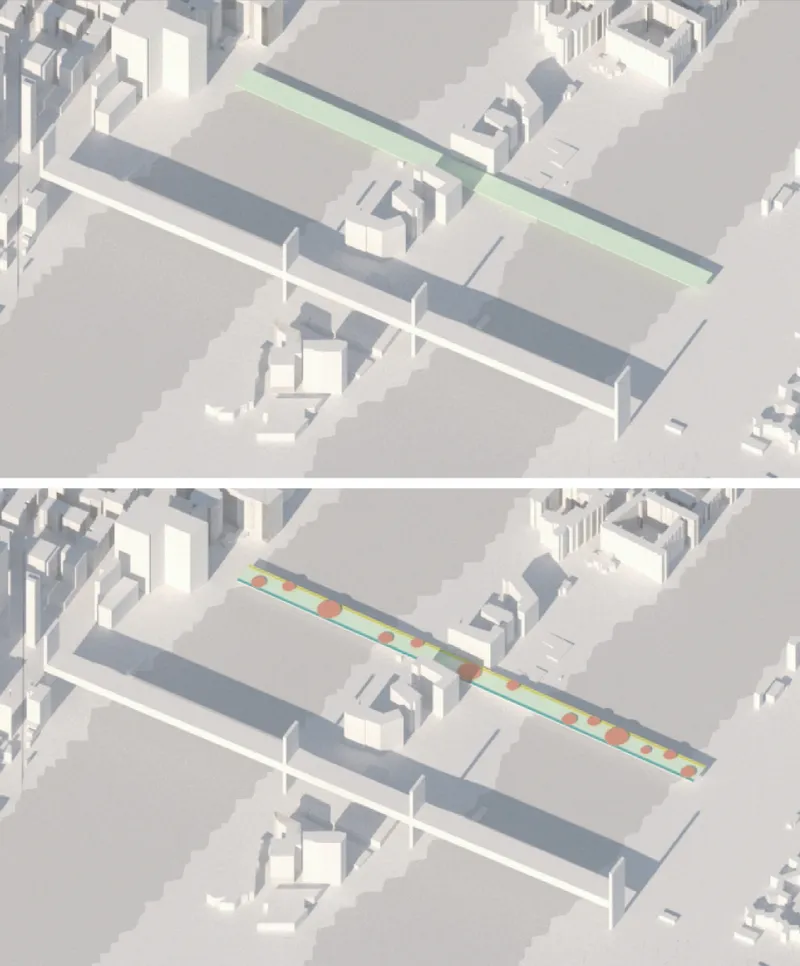
The axonometric drawing reveals the project's fundamental urban move: a linear green pathway sliced between two building volumes, connecting surrounding blocks through a continuous pedestrian route. Rather than designing an object, Ahamed designs a gap. The intervention reads less as architecture and more as urban surgery, carving out a legible corridor that privileges foot traffic over vehicles. The flanking volumes give the pathway spatial definition, creating a sense of enclosure without sealing it off from the surrounding context.
Balloons as Beacons: Wayfinding at the Scale of the City
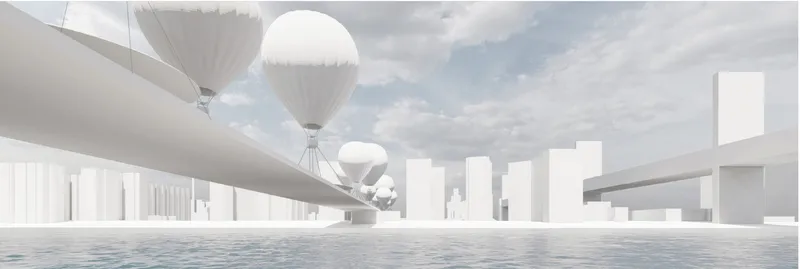
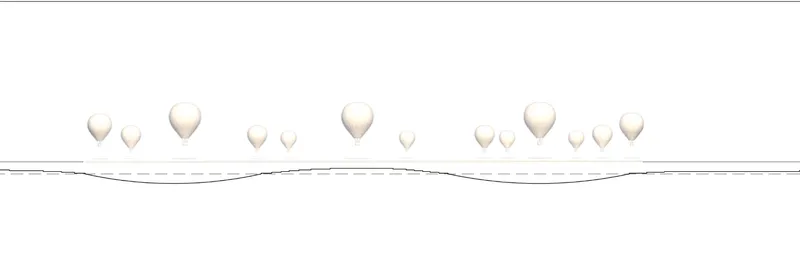
The most arresting element of the proposal is its use of white hot air balloons tethered above the roofline. Seen from street level, they hover against the sky like oversized markers, visible from blocks away. The elevation drawing makes the relationship between the balloons and the undulating roof profile explicit: the structure stays low and horizontal while the balloons provide vertical legibility. It is a clever inversion. The architecture crouches; the signage floats.
From a pragmatic standpoint, the balloons solve a real problem. Transit stops in dense urban fabrics are notoriously hard to locate, especially when they sit between taller buildings. By lifting the visual signal above the roofline, Ahamed ensures the halt announces itself at the scale of the neighborhood rather than the sidewalk. The choice of hot air balloons over conventional signage also introduces a playful, almost festival quality that could draw non-transit users into the space.
Two States of a Single Structure
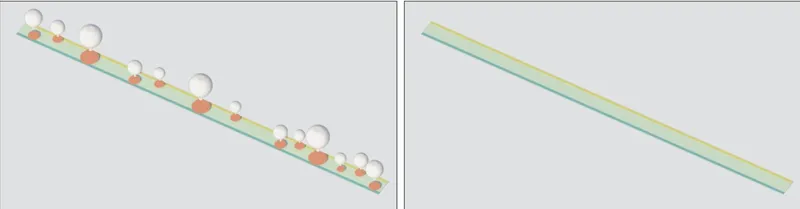
The diagram showing the linear structure in two configurations suggests a degree of adaptability built into the proposal. Colored spheres distributed along the spine imply programmatic or temporal variation: the halt isn't static. It shifts between states, perhaps responding to peak transit hours versus quieter periods, or differentiating zones for waiting, circulation, and gathering. The diagrammatic simplicity is welcome here. It communicates the concept without overcomplicating the mechanics, trusting the viewer to read the logic of transformation.
Why This Project Matters
User-Bridge-Context succeeds because it reframes the competition brief at its most fundamental level. Instead of asking "what should a bus stop look like," Ahamed asks "what should a bus stop connect?" The answer is not just passengers to buses but neighborhoods to each other, ground-level movement to skyline visibility, utilitarian infrastructure to public delight. The pedestrian spine operates simultaneously as transit halt, urban corridor, and landmark.
The project also demonstrates that small-scale interventions can have outsized urban effects when they work across multiple registers. The low horizontal form respects existing building heights. The green pathway introduces ecology. The balloons create identity. Each layer is simple on its own, but stacked together they produce something richer than the sum of their parts. For a competition asking designers to rethink the halt, this entry delivers a convincing argument that stopping and moving don't have to be opposites.
View the Full Project
About the Designers
Designer: Navaz Ahamed
Enter a Design Competition on uni.xyz
uni.xyz runs architecture and design competitions year-round that reward proposals with spatial conviction and real site intelligence.
Project credits: USER-BRIDGE-CONTEXT by Navaz Ahamed Halt (uni.xyz).


Popular Articles
Popular articles from the community


ETEH Reworks the Shared Spaces of São Domingos School in Brazil Around Timber, Color and Hanging Plants
At São Domingos School in Brazil, 436 m² of hall, refectory and library are recast with timber joinery, a yellow and blue code and trailing greenery.


The Amber Palace Opera: A Geological Fiction Surfaces on Tallinn's Baltic Waterfront
Pierre Brillard reimagines a Baltic legend as a public landscape, opera house, and waterfront promenade rooted in Tallinn's coastal identity.

Opera on the Sea: Driftwood Logic Shapes a Timber Opera House on Estonia's Coast
Trevor Orgill's opera house translates the entangled drift of floating timber into a civic building where wood, water, and music converge.

David Ortega Stacks a Two-Story Mexico City Penthouse Around a Steel Stair and a Pergola-Shaded Roof Terrace
In Colonia Roma, a 300 m² penthouse uses oak joinery, a planted steel stair and a slatted roof pergola to make a new-build apartment feel like a house.

Similar Reads
You might also enjoy these articles

Vereda Arquitetos Renovates a 40-Square-Meter Apartment Inside Niemeyer's Copan Building
A compact unit in São Paulo's most iconic residential tower gets a material overhaul that pairs exposed concrete with bold blue Formica.

Shakur's House: Exposed Brick as an Interior Organiser in a 168 m² Mashhad Residence
Brick moves indoors in this Mashhad residence, where masonry walls, glass partitions and teal planes sequence a compact home without closing it off.

Day and Night Park: A Time-Based Urban Newsstand in Beijing
A temporary urban newsstand in Beijing blending travel, light, and reading through poetic colors, compact form, and community-focused design.

Modernist Patio Renovation in El Masnou, Barcelona by Oliver Segura Arquitectura + Cebrià Arquitectura
Modernist patio renovation blending tradition and innovation with a movable pool, leveled floors, and Catalan materials in El Masnou.

Comments (0)
Please login or sign up to add comments
No comments yet. Be the first to comment!