
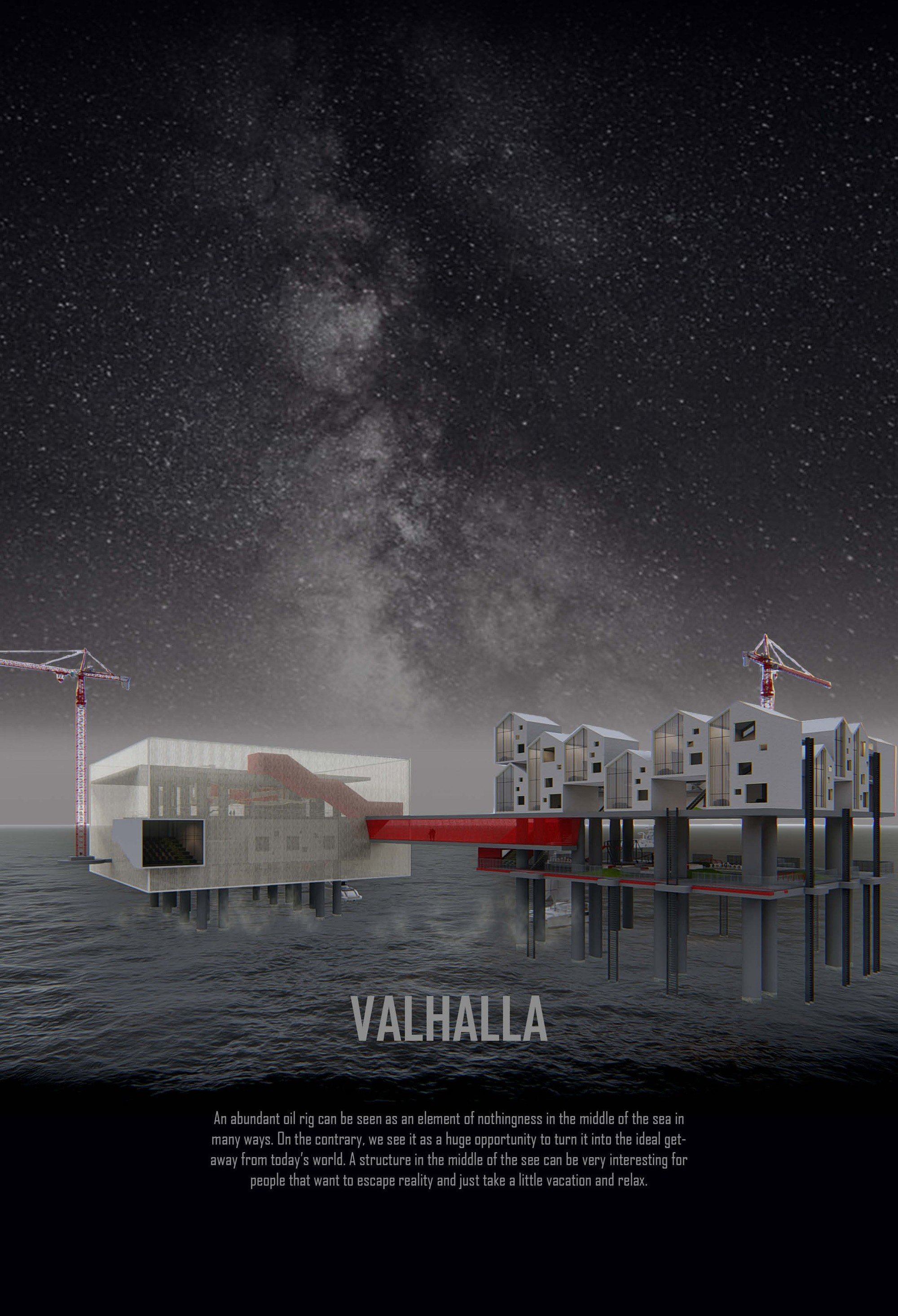
VALHALLA: Adaptive Floating Architecture Reimagining the Future of Abandoned Oil Rigs
A visionary adaptive reuse architecture project transforming obsolete oil rigs into floating cultural and residential ecosystems.

VALHALLA is an experimental adaptive reuse architecture project that rethinks the future of abandoned offshore oil rigs through modular living, public interaction, and cultural programming. Designed by Maria Boutros and Roy Chaaya, the proposal transforms industrial marine infrastructure into a multifunctional floating destination where architecture, leisure, research, and community coexist above the ocean.
The project explores how obsolete oil platforms can evolve beyond extraction-based economies and become active public environments. Instead of demolition or abandonment, VALHALLA introduces a sustainable architectural framework capable of extending the lifespan of offshore structures while introducing new social and environmental value.
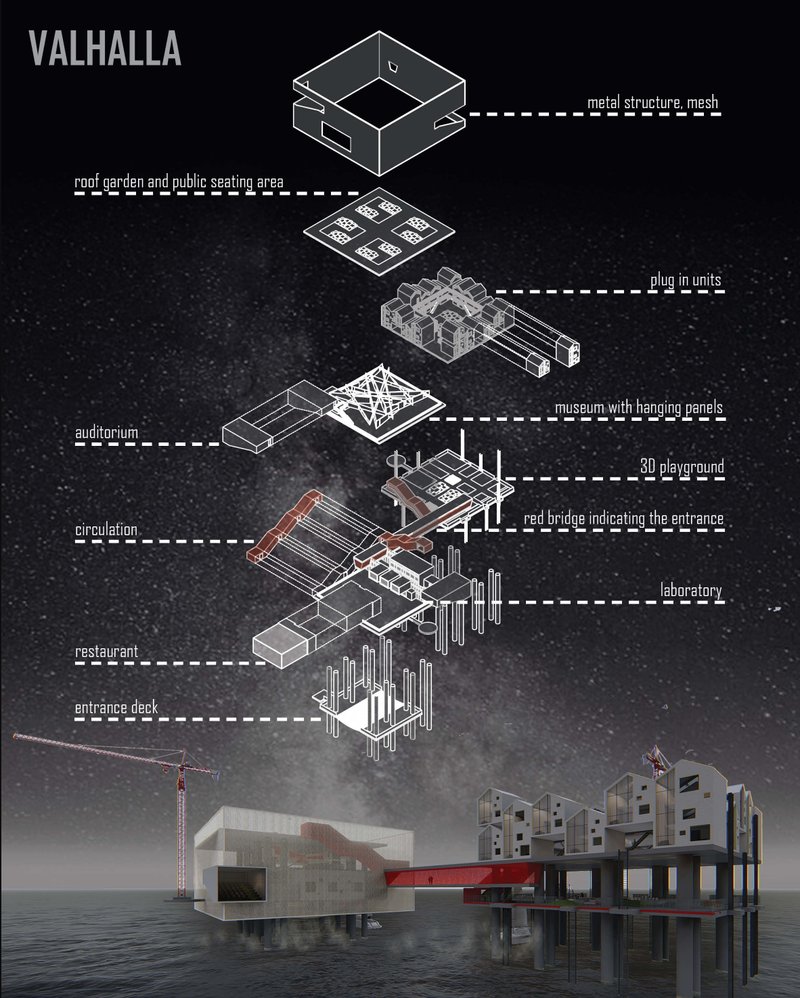
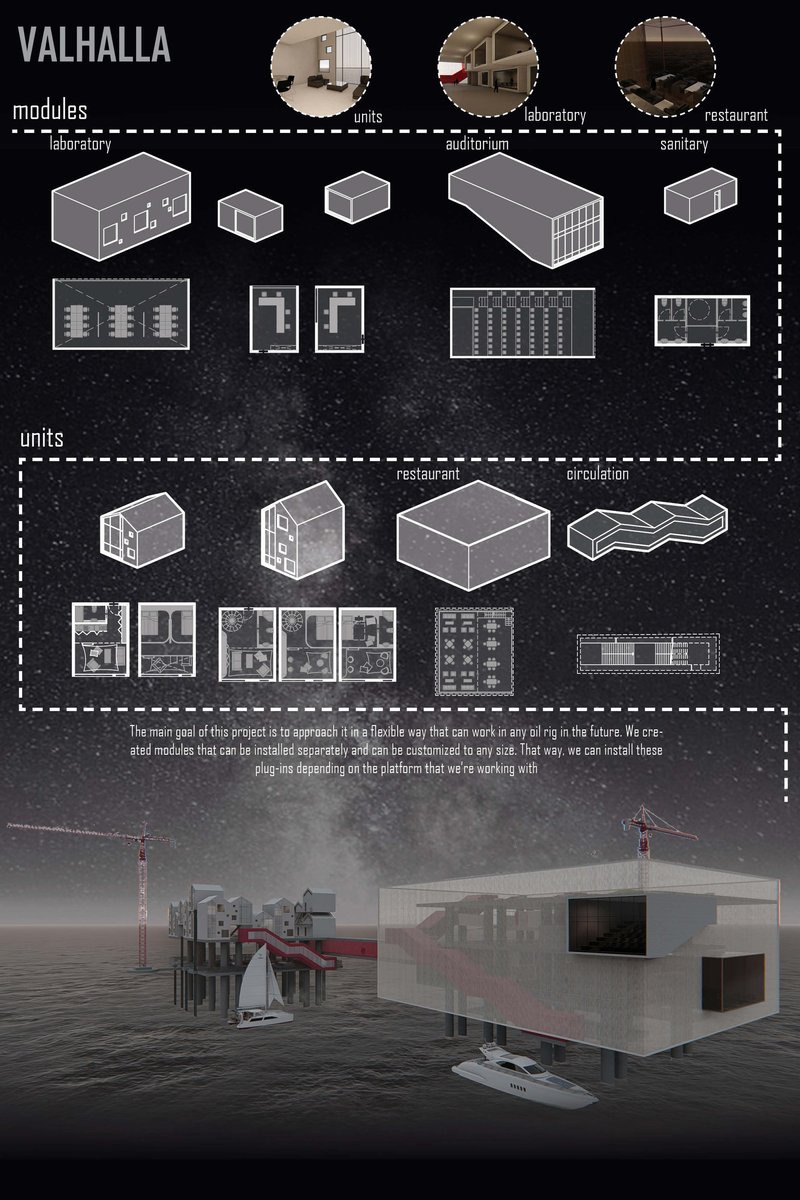
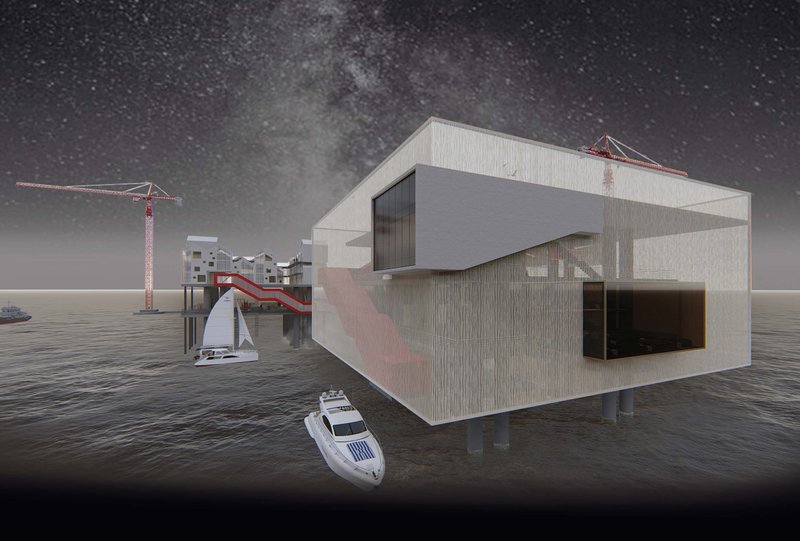
At its core, the proposal is an exploration of adaptive architecture. The oil rig is no longer viewed as industrial waste, but as a structural foundation for a new marine typology. Elevated above the sea on a modular platform system, the intervention creates an immersive spatial experience composed of circulation bridges, residential units, laboratories, museums, restaurants, public decks, and recreational landscapes.
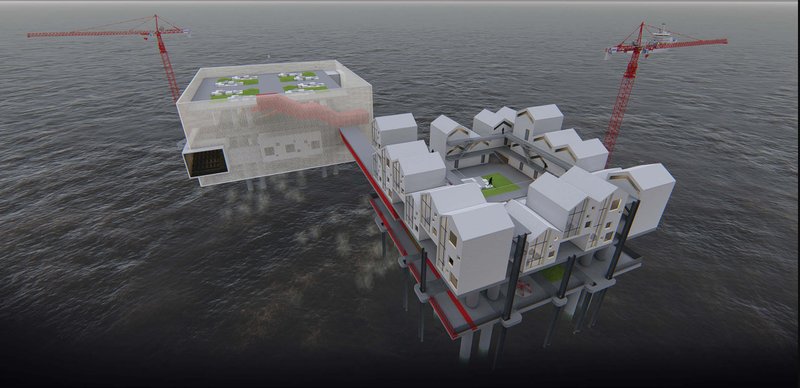
The architecture embraces a plug-in strategy where different functional modules can be inserted depending on the conditions and needs of a specific oil rig. This flexibility allows the system to adapt across multiple offshore contexts while maintaining a consistent structural language. The project proposes an expandable architectural network capable of evolving over time.
One of the strongest aspects of VALHALLA is its spatial sequencing. Arrival begins through a dramatic crane-assisted access point leading visitors toward the lower platform. The circulation path gradually reveals the core functions of the project, creating a layered architectural journey across public and private zones. Red bridges connect the different structures, acting both as circulation devices and visual identifiers within the vast ocean landscape.
The lower levels contain public and communal functions such as restaurants, laboratories, exhibition areas, and auditoriums. Large glazed façades frame uninterrupted views of the sea while allowing natural light to penetrate deep into the structure. The museum space introduces suspended installations and adaptable cultural programming, transforming the industrial platform into a floating center for art, experimentation, and interaction.
Above the public layer, modular residential units create a compact floating neighborhood. These elevated living spaces introduce a human-scale contrast against the heavy infrastructural framework of the rig. The repetitive pitched-roof housing modules generate a recognizable architectural identity while maximizing views, daylight, and cross ventilation.
The residential system is intentionally modular. Units can be configured for couples, families, or temporary visitors depending on occupancy needs. This adaptability reinforces the project’s broader vision of responsive and scalable offshore architecture. Instead of fixed planning, VALHALLA proposes a living framework capable of growth and transformation.
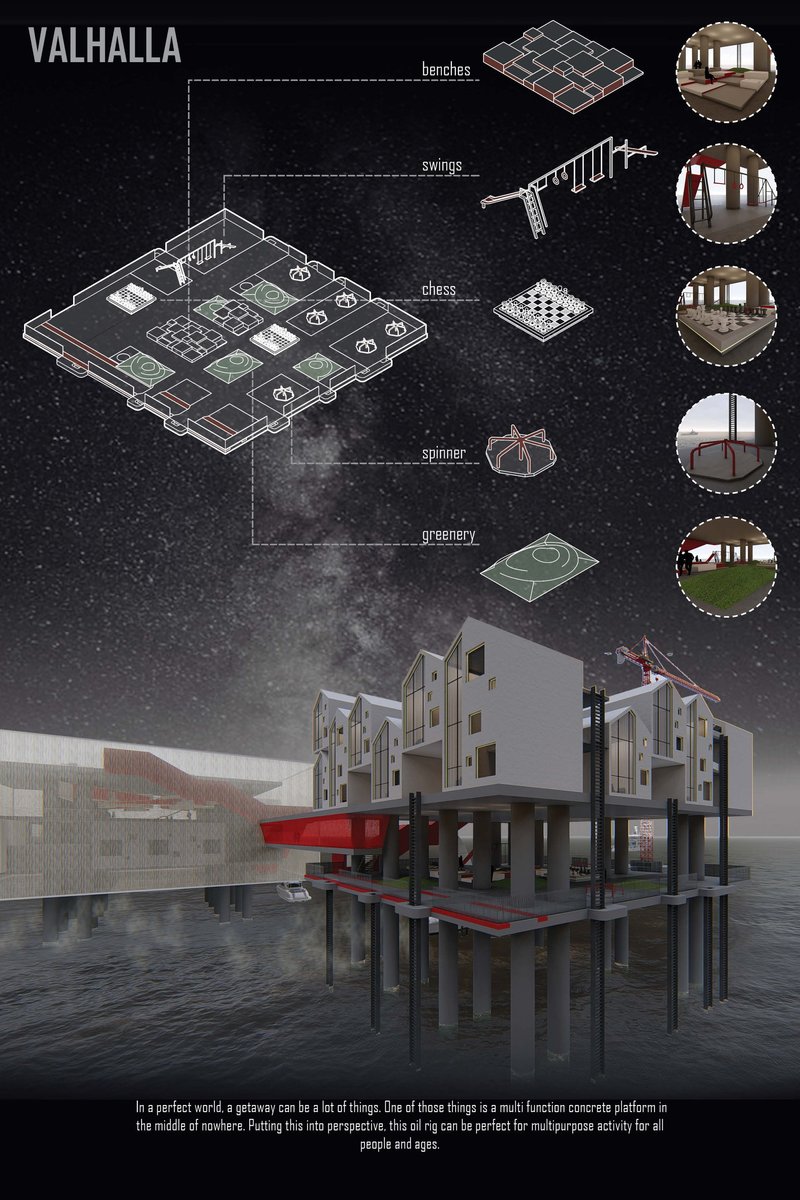
Public engagement is another defining component of the proposal. Rooftop playgrounds, seating landscapes, swings, chess areas, greenery, and open gathering zones transform the platform into an active recreational environment. The architecture introduces moments of play and relaxation within an otherwise isolated marine setting, encouraging interaction across age groups and user types.
The project also addresses the psychological condition of offshore isolation. By integrating entertainment, leisure, culture, and residential spaces into one interconnected environment, VALHALLA creates a sense of community rarely associated with oil rig infrastructure. The architecture becomes both a destination and a living ecosystem.
Visually, the project creates a striking contrast between industrial heaviness and lightweight inhabitation. The elevated white residential blocks appear almost suspended above the sea, while transparent circulation systems and open decks reinforce permeability and openness. The bold red circulation bridges introduce orientation and dynamism throughout the composition.
The sectional drawings reveal the complexity of the vertical organization. Public, semi-public, and private spaces are layered strategically across multiple elevations while maintaining uninterrupted movement between functions. The architecture leverages height not only structurally, but experientially, turning circulation into a continuous visual encounter with the surrounding ocean.
VALHALLA ultimately proposes a new future for marine infrastructure through adaptive reuse architecture. It challenges conventional narratives surrounding oil rigs and presents an alternative vision where industrial relics become spaces for habitation, learning, recreation, and cultural exchange.
Rather than erasing the past, the project reinterprets existing infrastructure into a resilient architectural system capable of supporting new forms of life above water. In doing so, VALHALLA positions adaptive reuse not simply as preservation, but as transformation through design innovation.
Project by Maria Boutros and Roy Chaaya



Popular Articles
Popular articles from the community

Non Architecture's Horrible Houses Competition Asks AI to Design the Ugliest Home Possible
A free global competition invited participants to use AI image generators to produce the most hideous house they could imagine.
Cro&Co Architecture Builds a 150-Meter Tower on Top of a Seven-Lane Highway in La Défense
Trinity Tower reimagines the office high-rise as a bioclimatic organism threaded with terraces, trees, and public ground in Paris's business district.
Inside a Timeless Mumbai Residence by Aether Studio
Aether Studio's 2,250 sq ft apartment in Malad, Mumbai uses marble, brass, boucle, and disciplined restraint to build a quiet retreat from the city.
ONA Threads Four Board-Formed Concrete Cabins Along a 260-Meter-Deep Site in Mendoza
At the edge of Argentina's wine country, a set of curved concrete lodges negotiate a razor-thin parcel between city and mountain.

Similar Reads
You might also enjoy these articles


Urban Forest: A Vertical Ecosystem for 5,000 Workers in Singapore's Changi Business Park
Radially stacked pods and layered green decks turn a 7-acre plot into 47 acres of ecological workspace projected for 2040.
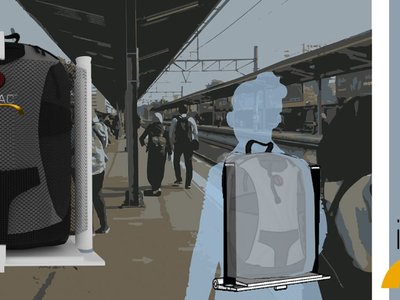
interACT: A Wearable Transit Object That Turns Commuting Into Social Infrastructure
A backpack-mounted foldable device transforms walking, waiting, and riding into moments of shared comfort across Jakarta's transit network.
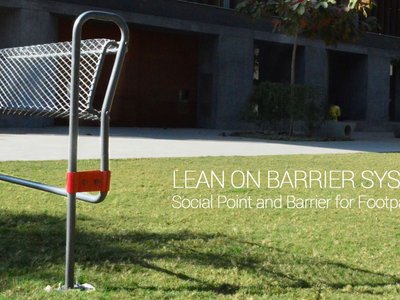
Lean On Barrier System: Where Traffic Safety Meets Chai Culture in Ahmedabad
A modular steel barrier doubles as informal seating and lean-on furniture at one of Ahmedabad's busiest intersections, keeping vendors in place.

The Black Bagh: A Living Monument Built from Water, Light, and Memory
On the banks of the Yamuna, two designers replace the myth of a marble mausoleum with a regenerative landscape of reflection and ritual.


Explore Educational Building Competitions
Discover active competitions in this discipline




The Global Benchmark for Architecture Dissertation Awards


Challenge to design public laboratory
Comments (0)
Please login or sign up to add comments
No comments yet. Be the first to comment!