

RAG Arquitectos Scatters Six Rammed Earth Pavilions Through a Mexican Pine Forest
Valle de la Plata House in San Antonio de las Alazanas treats nature as architecture's primary material, not its backdrop.


Most houses negotiate with their sites. Valle de la Plata House, designed by RAG Arquitectos and completed in 2022, simply refuses to. Rather than clearing a footprint and planting a building, lead architect Guillermo Durán Suárez and his team split the 505 square meter program into six discrete volumes and threaded them between every existing tree on the property in San Antonio de las Alazanas, near Monterrey in northern Mexico. The result is not a house with a garden. It is a forest with rooms.
What makes the project genuinely compelling is the way it operationalizes a philosophical position. RAG Arquitectos framed the brief around pre-Hispanic spatial traditions: courtyards, transitional thresholds, and the idea that moving between rooms should itself be an experience, not dead time. The six volumes are separated by increasing distances depending on how private the activity inside them is. Kitchen, living room, and library cluster tightly; bedrooms drift outward into the trees, each reached by a winding path through the landscape. Privacy here is measured in pine trunks, not walls.
A Constellation, Not a Compound
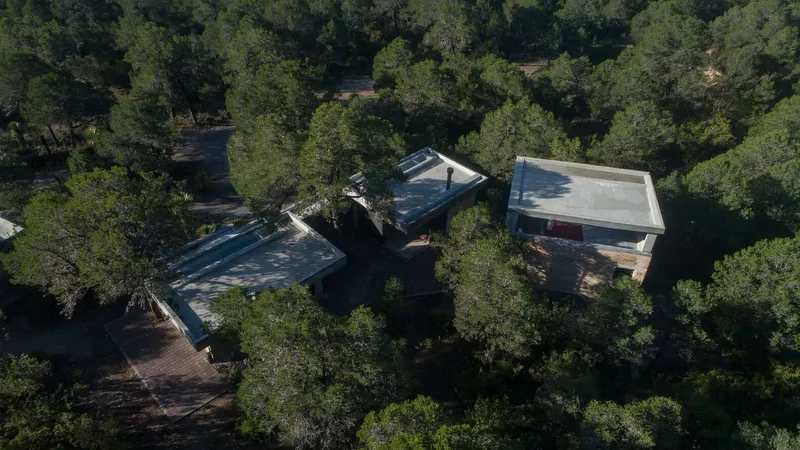
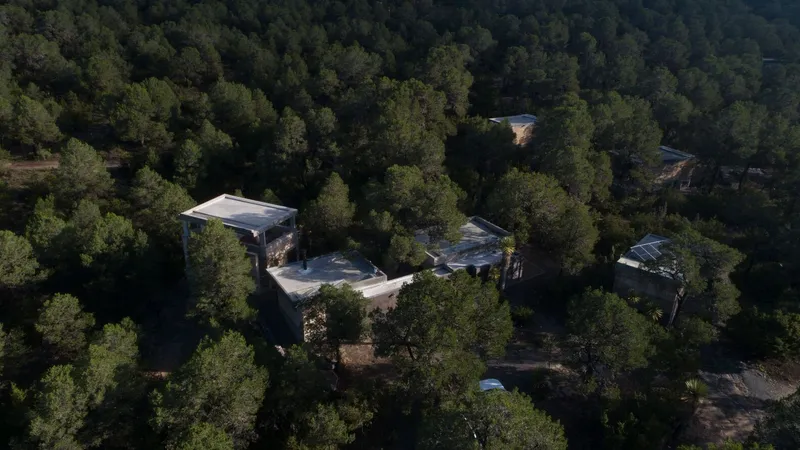
Seen from the air, the logic of the project clicks immediately. Flat-roofed concrete and rammed earth pavilions sit beneath the canopy like stones dropped into a stream, each one displaced just enough to preserve the trees around it. Pathways link the volumes but never straighten into corridors. The separation is calibrated: the library sits close to the living room, the kitchen steps slightly further away, and the bedrooms exist in near-total isolation. The architects describe nature as a "privacy filter," and from above that description reads as literal fact.
The drone perspective also reveals how the topography slopes toward a nearby river, a condition the design exploits rather than resists. The library volume gains two additional levels as the ground drops, generating a flexible bar and lounge space underneath and a lookout above the treetops. The house doesn't command the landscape; it occupies multiple altitudes within it.
Thresholds That Earn Their Keep
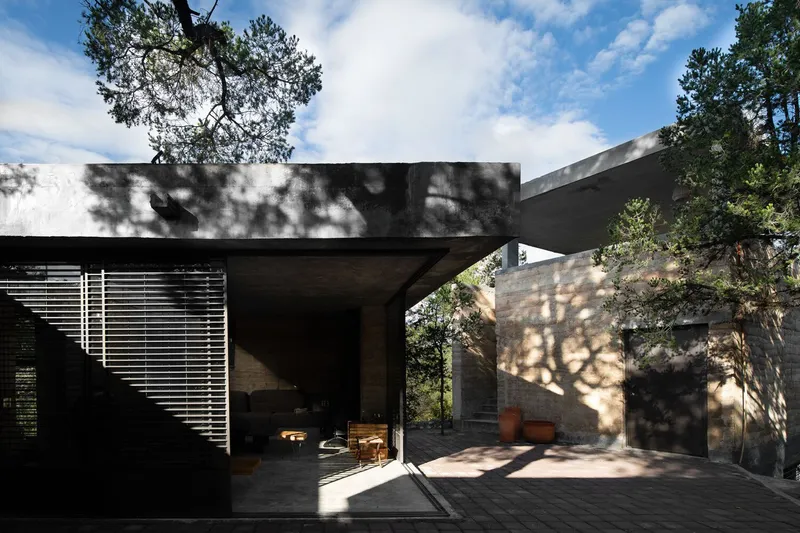
The covered entry courtyard sets the tone. Board-formed concrete walls frame a space that is neither fully inside nor fully outside, its floor dappled with tree shadows that shift through the day. RAG Arquitectos clearly understand that a threshold is not a formality; it is where the psychological transition from world to refuge actually occurs. The texture of the concrete carries the imprint of its formwork, rough enough to read as handmade, precise enough to signal control.
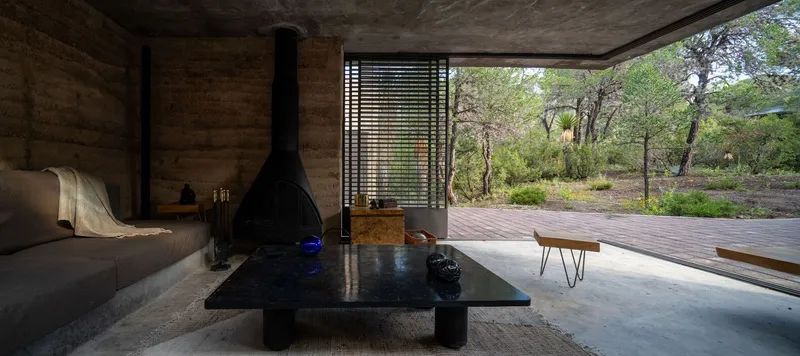
Elsewhere, a slatted metal screen mediates between a fireplace-anchored interior and a timber deck terrace. The screen does not block the view so much as slow it down, filtering light and breeze while keeping the boundary between inside and outside deliberately ambiguous. These in-between conditions are where the pre-Hispanic influence shows up most convincingly: not as decoration but as spatial choreography.
Earth Pulled from the Ground Beneath Your Feet

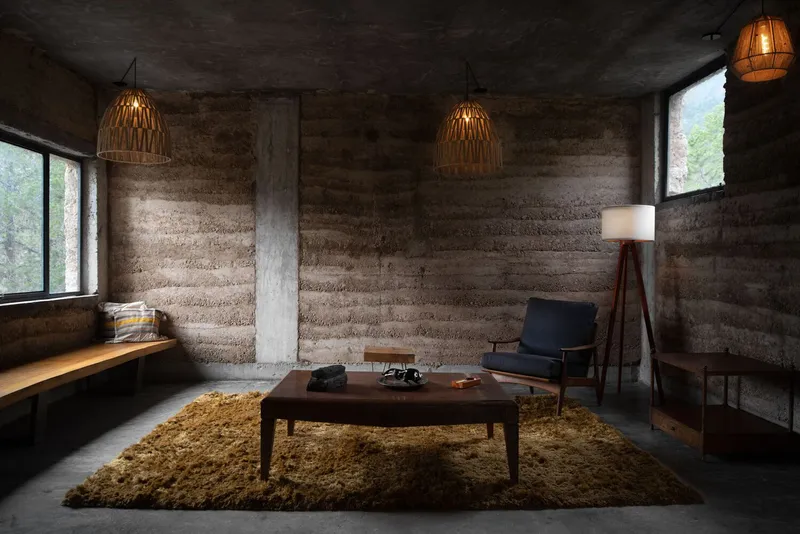
The rammed earth walls are the project's most assertive material gesture. Compacted from soil excavated on site, they carry the specific color and mineral composition of this particular piece of northern Mexico. In the living room, a clerestory slot cuts diagonal afternoon light across their layered surfaces, turning construction technique into atmospheric event. The striations in the earth are not decorative. They are a geological record of how the wall was built, course by course.
A second interior, photographed with woven pendant lights and a single freestanding concrete column, shows how the palette of earth, concrete, and wood operates at a quieter register. The column does real structural work, but its isolation in the room gives it the presence of a sculptural object. RAG Arquitectos keep the material vocabulary tight: three materials, honestly expressed, doing everything. There is no applied finish anywhere in these images, and the spaces are better for it.
The Tower in the Trees

At dusk, one volume breaks the canopy line. The concrete tower, housing the library's upper lookout, glows from within as interior lights catch its surfaces. It is the only vertical gesture in a project otherwise committed to horizontal restraint, and it works precisely because of that contrast. Below the treetops, the house disappears. Above them, this single element announces that someone lives here, like a lantern set out in the forest.
The move is strategically generous. Where every other volume privileges interiority and enclosure, the tower offers a panoramic relationship with the wider landscape. It reframes the experience of the house: after moving through tight courtyards, filtered screens, and shaded paths, you arrive at a point where the canopy drops away and the valley opens up. The sequence from compression to release is classical, and RAG Arquitectos execute it with confidence.
Plans and Drawings
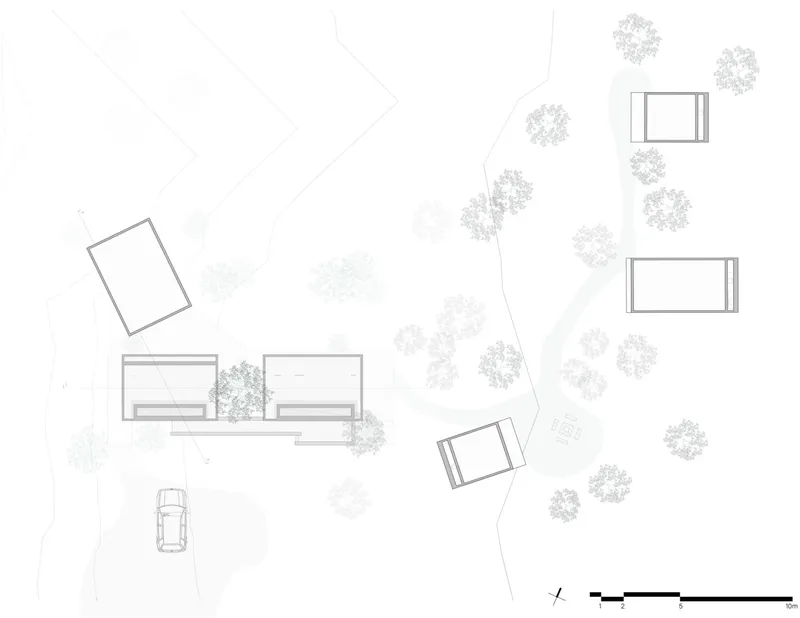
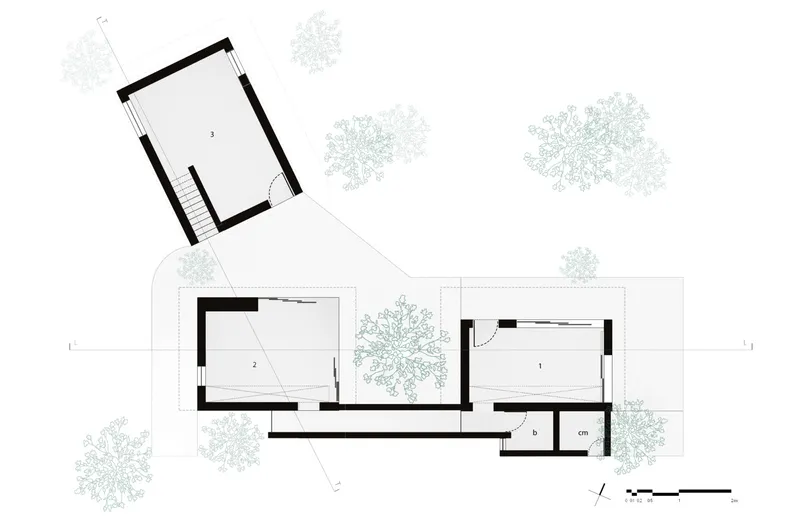
The site plan confirms what the aerial photographs suggest: the six volumes are distributed along a curving path that follows the natural contour of the land, with every significant tree drawn and accounted for. The floor plan of the three central pavilions reveals how they share a common courtyard while maintaining distinct orientations, each angled to capture views on at least two sides. The separations between volumes are not uniform; they widen and narrow in response to the existing vegetation, treating the gaps as programmatic space rather than leftover distance.
Why This Project Matters
Valle de la Plata House is a serious argument against the reflex to consolidate a residential program under one roof. By fragmenting the house into six volumes, RAG Arquitectos transform circulation into landscape experience, turn privacy into a spatial gradient rather than a locked door, and preserve the ecological character of a forested site without resorting to green-roof tokenism. The rammed earth construction, sourced directly from the excavation, closes the loop between site and building in a way that imported materials never could.
More broadly, the project demonstrates that pre-Hispanic spatial principles are not nostalgic references to be quoted in a concept statement and then ignored in plan. Courtyards, thresholds, and processional sequences are real architectural tools, and they produce real effects on how people inhabit a building. RAG Arquitectos have built a house that requires you to walk through a forest to get to your bedroom, and that is not a burden. It is the entire point.
Valle de la Plata House by RAG Arquitectos, San Antonio de las Alazanas, Mexico. 505 m². Completed 2022. Photography by Paco Álvarez.
About the Studio
Share Your Own Work on uni.xyz
If projects like this are the kind of work you want to make, uni.xyz is a place to publish your own, find collaborators, and enter design competitions.




Popular Articles
Popular articles from the community


The Ocean Hive: Sustainable Architecture for a Self-Sufficient Civilization at Sea
The Ocean Hive imagines sustainable architecture at sea, where modular habitats, algae, wave power and ocean waste sustain a growing colony.

AL-JANNAH: Sustainable Architecture and Permaculture for Afghan Widows
AL-JANNAH uses sustainable architecture and permaculture to create resilient oasis of housing, learning, work and renewal for Afghan widows.

Co-life: Sustainable Architecture for Age-Friendly Community Living
Co-life reimagines sustainable architecture for seniors through courtyards, rammed earth, shared gardens, and spaces designed for belonging.

Hill & Cross Opera: Sculptural Opera House Architecture Shaped by Tallinn’s Landscape and Identity
Hill & Cross Opera reimagines opera house architecture in Tallinn through its sculptural hill, civic plaza, glass wave and a luminous cross.

Similar Reads
You might also enjoy these articles


Hodi-Mandai Geram
Project Function: Preservation and revitalization of the Intangible heritage and socio-spatial identity of the Hodi by Housing, Cultural Memory Center, Sacred Grove, landscape, local tourism economy


Olio Towers: A Mid-Rise for Performers That Fuses Housing, Rehearsal, and Stage
Located blocks from Houston's Theater District, this modular tower stacks living units around a central performance atrium.

Oasis: Modular Green Housing Carved into Dhaka's Urban Fabric
A shortlisted Plugin Housing entry reclaims unauthorized settlements in Dhaka with stepped concrete volumes, green roofs, and ventilation-driven design.

Black Hole: A Floating Megastructure for the Post-Physical Era
Emiliano Mazzarotto envisions a spherical, self-scaling arena where e-sports, digital hotels, and holographic stadiums replace traditional public space.


Explore Architecture Competitions
Discover active competitions in this discipline



Challenge to reimagine the Iron Throne


Photograph architecture without architects


Illustrate the lost glory of Angkor Wat - Render Challenge


Design challenge to reuse E-waste
Comments (0)
Please login or sign up to add comments
No comments yet. Be the first to comment!