
Vallribera Arquitectes Stretches a 3.8-Meter-Wide Row House into a Garden in Terrassa
A meticulous restoration and extension in central Terrassa compensates for an impossibly narrow plot with soaring voids and timber warmth.


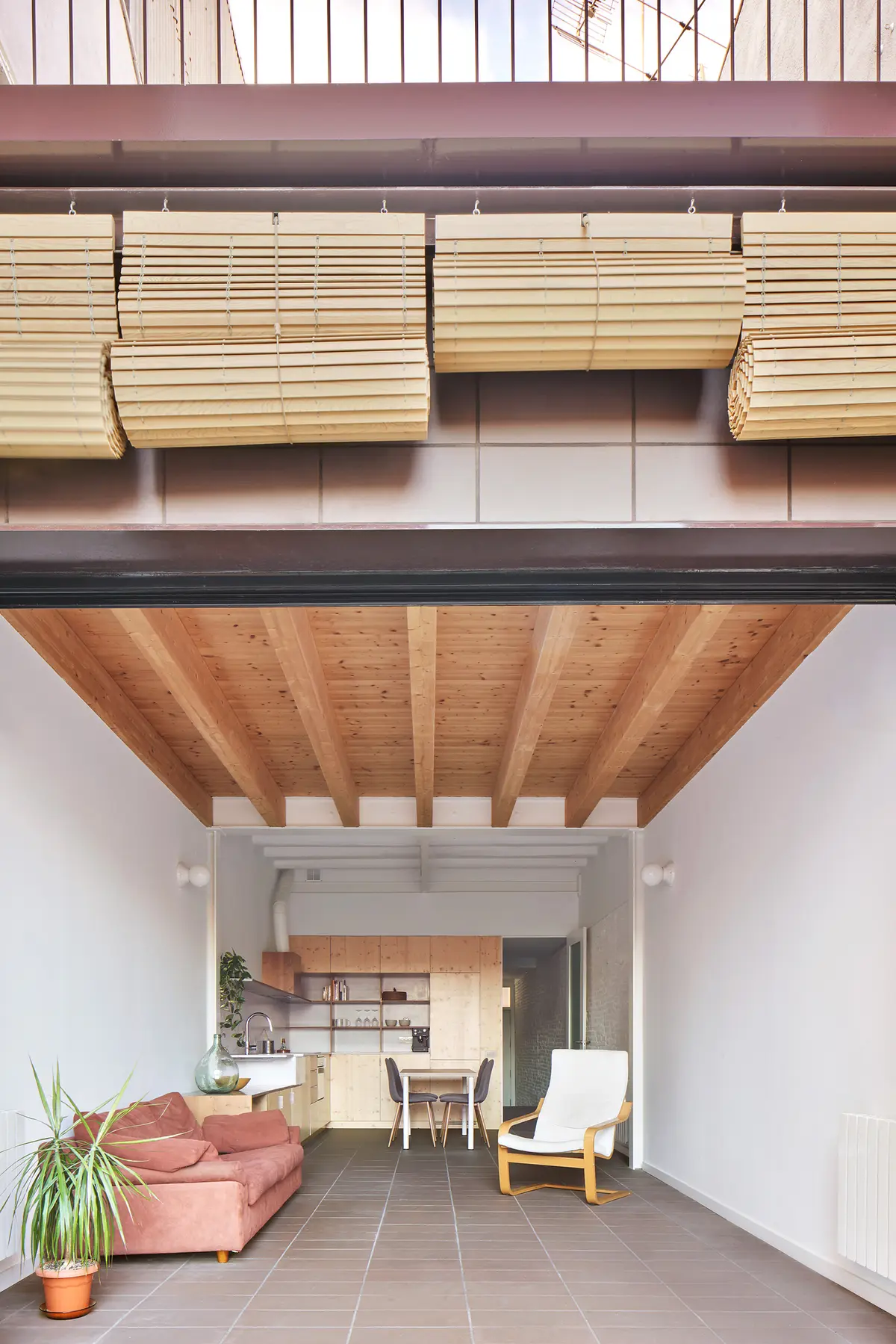
Narrow row houses force architects to think vertically, and 82SAN is an object lesson in that constraint. At just 3.8 meters wide, the plot in central Terrassa leaves almost no room for lateral invention. Vallribera Arquitectes, led by Llorenç Vallribera and Aleix Gil, responded by treating ceiling height as the primary spatial currency: bedrooms get low, smooth, white-painted ceilings for intimacy, while the public rooms explode upward with exposed timber beams, vaults, and multi-story voids that make the house feel several times its actual width.
The other decisive move is the rear extension, which pushes the kitchen, dining, and living areas out toward a long planted courtyard, bringing them to the same level as the garden and dissolving the boundary through folding glass doors. With an EPC rating of A and total primary energy consumption of just 50.57 kWh/m² per year, the project proves that heritage restoration and passive design ambition are not mutually exclusive. The result is a house that reads as generous despite its sliver footprint, a trick accomplished through material warmth, sectional drama, and a relentless focus on light.
A Burgundy Slot on the Street
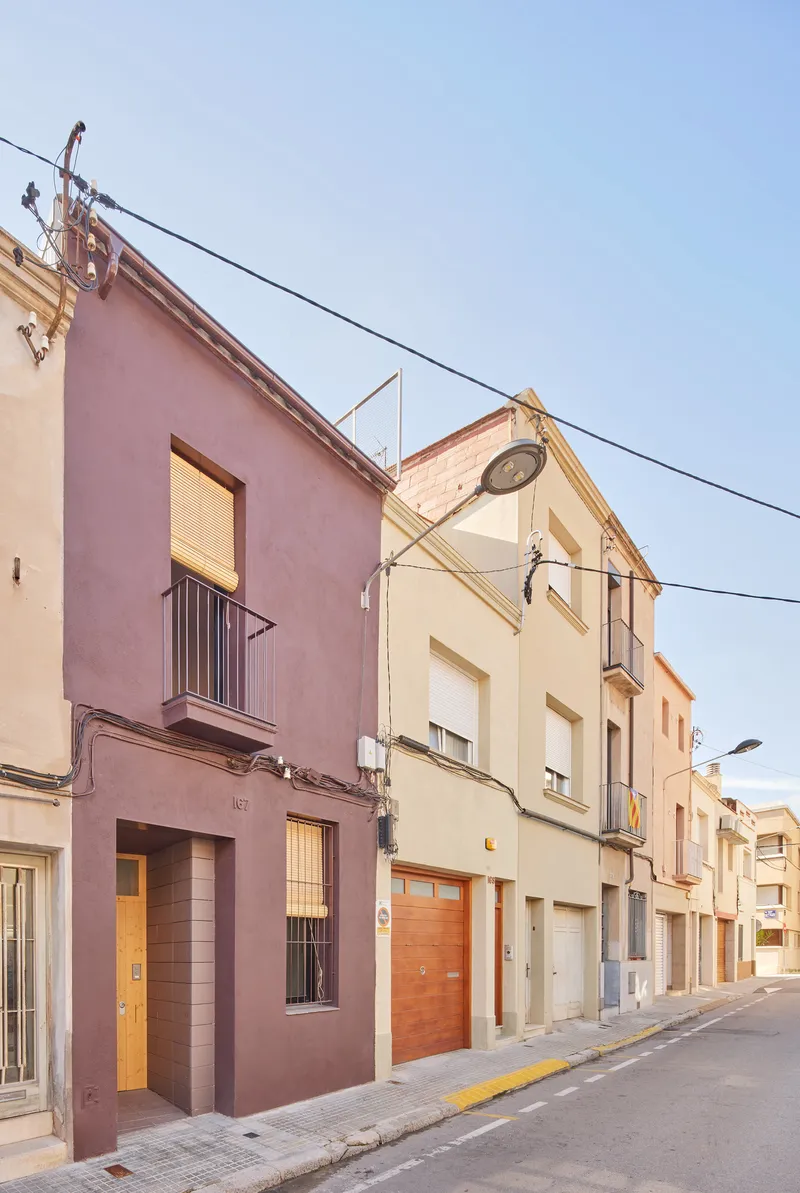
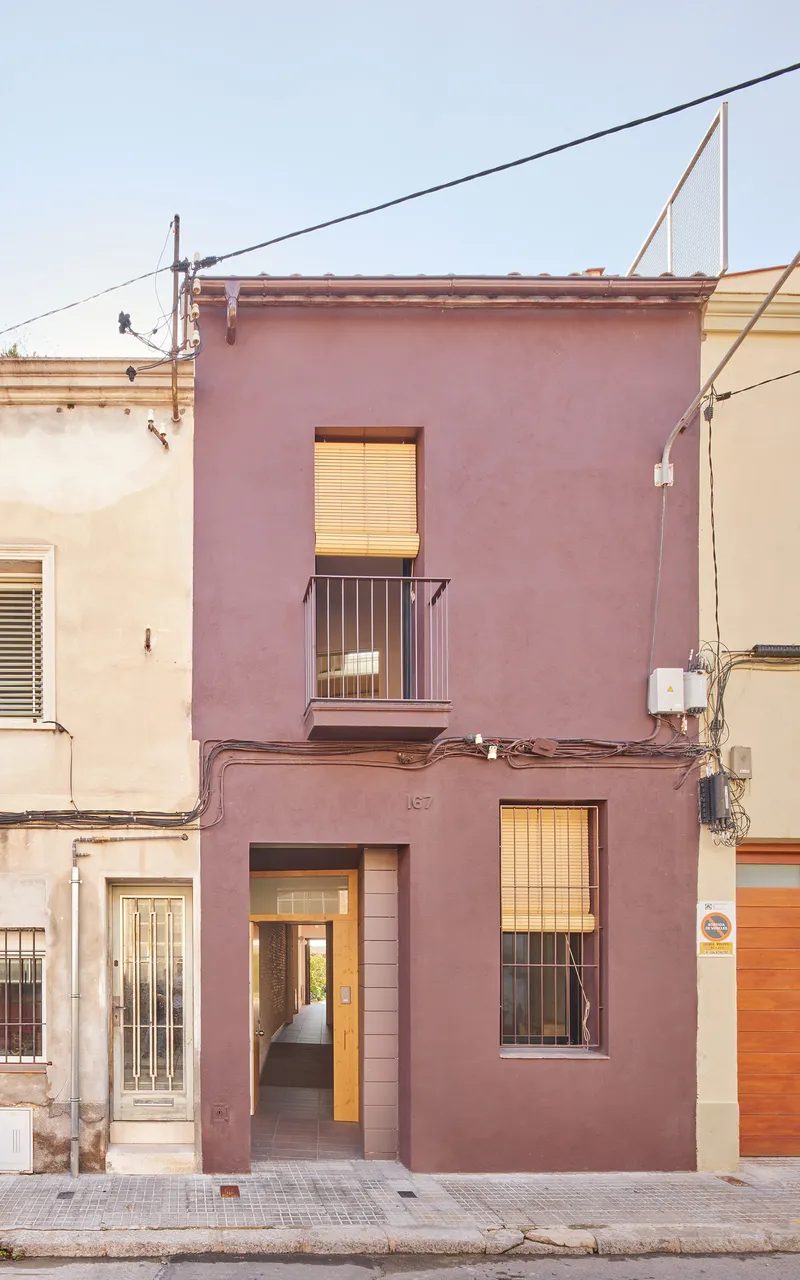
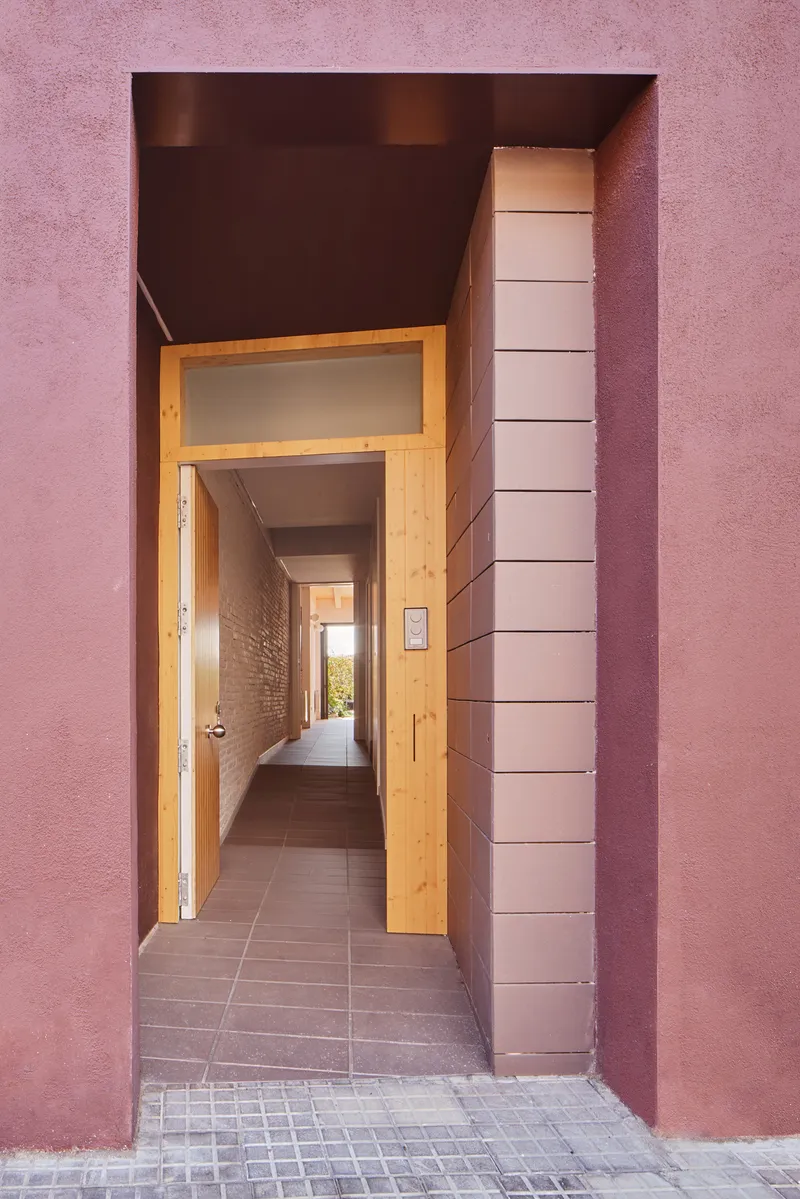
From the street, 82SAN announces itself with a mauve-burgundy plastered facade that sits quietly among its neighbors but holds its own identity. The color is specific enough to register without shouting, and the facade composition is deliberately restrained: a timber-screened window, a small balcony, and a recessed portal framing a timber door. The entrance corridor, paved in terracotta tile, draws you into the depth of the house like a compressed inhale before the spatial release that follows.
Vertical Space as Compensation
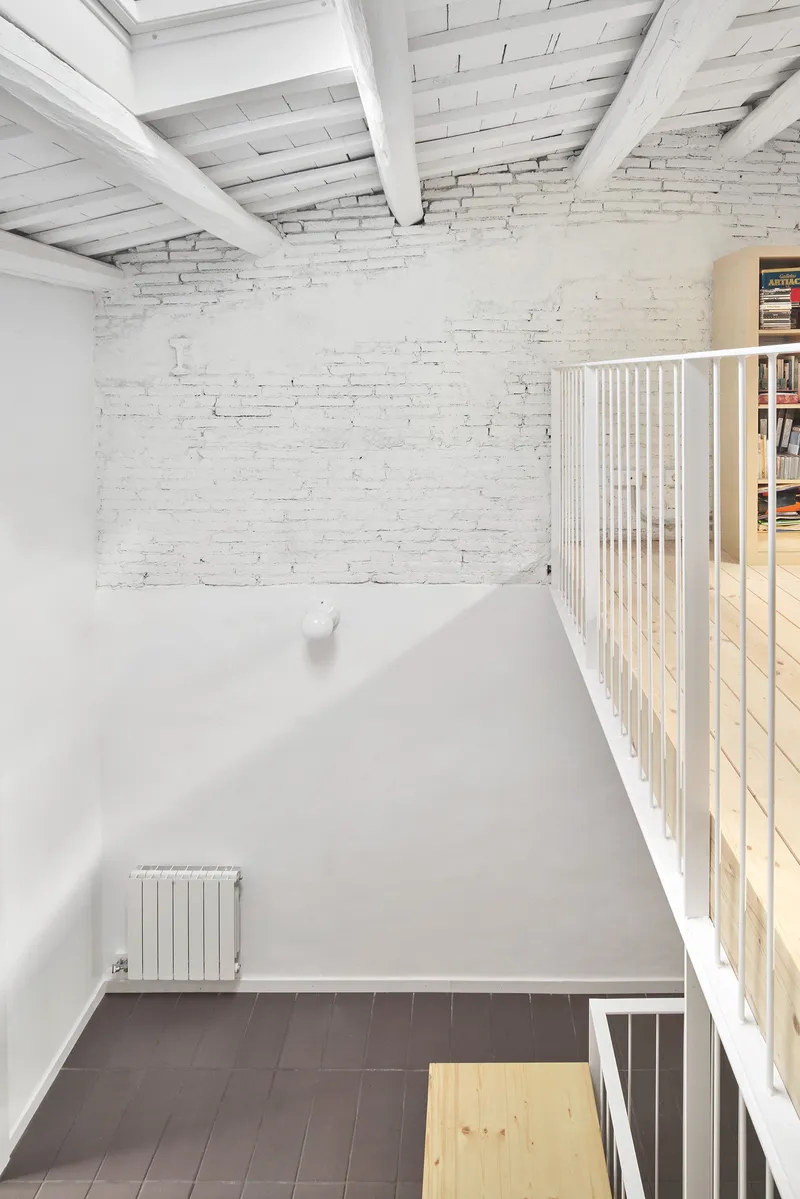
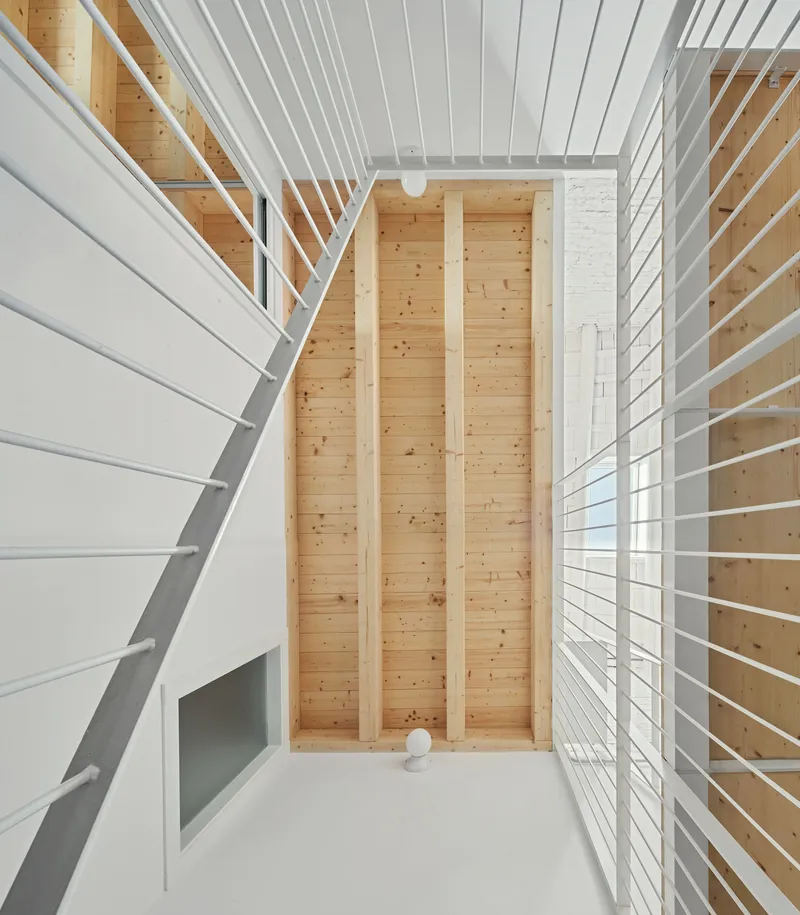
The central strategy of 82SAN is the manipulation of section. Where the plan cannot expand, the section does. A triple-height void with whitewashed brick walls and a skylight at its crown pulls daylight deep into the core of the house, while white metal railings and timber-clad columns frame views between levels. The mezzanine study area reaches more than four meters under the original sloped roof, turning what could have been dead attic space into the most dramatic room in the house.
This vertical openness does more than admit light. It connects the family visually and acoustically across floors, giving a narrow house the social permeability of a much larger one. The metal grid partitions that enclose the mezzanine levels are transparent enough to maintain sightlines without sacrificing the structural logic of load-bearing party walls.
Timber Structure, Thermal Mass, and Material Honesty
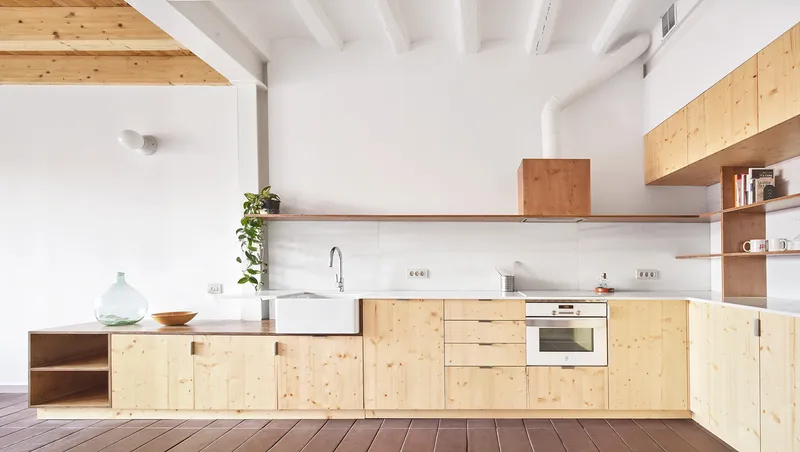
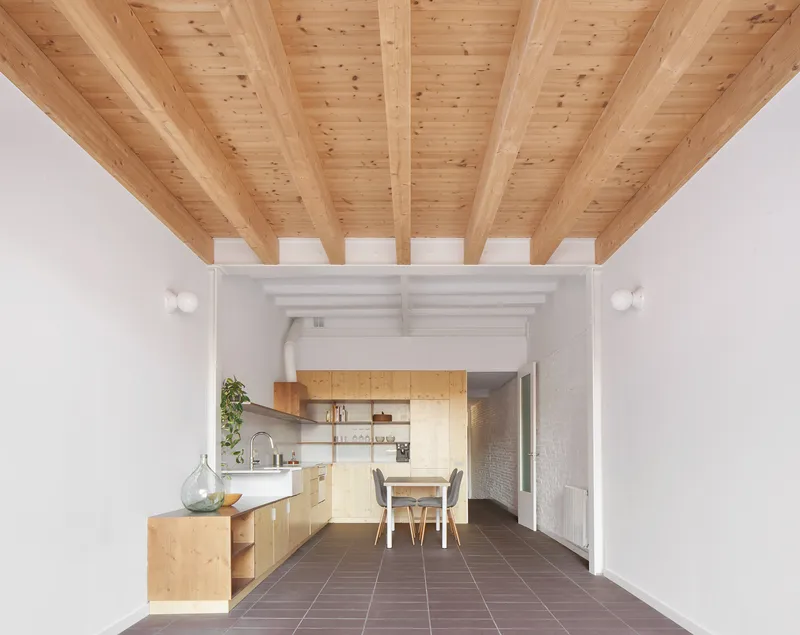
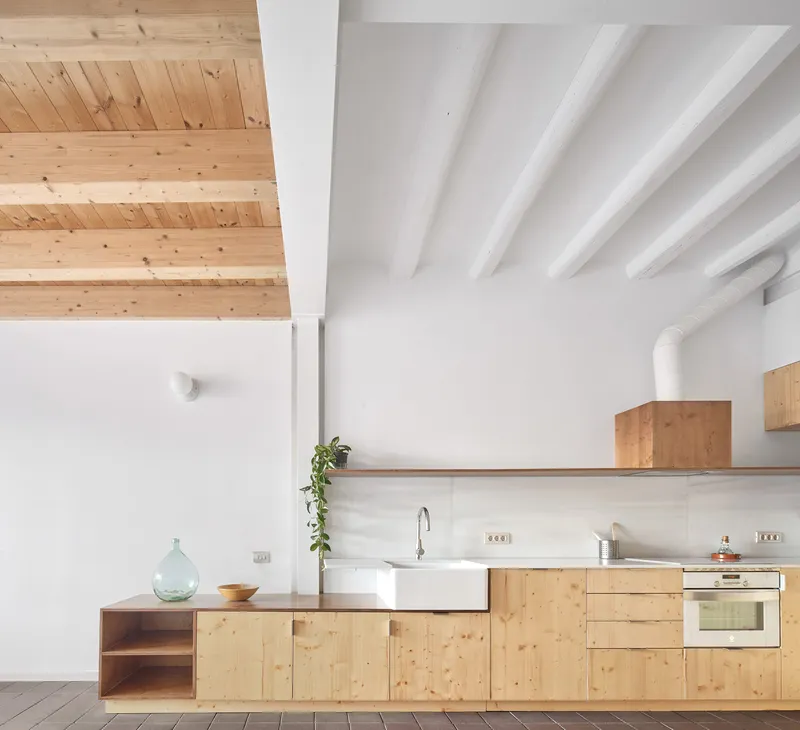
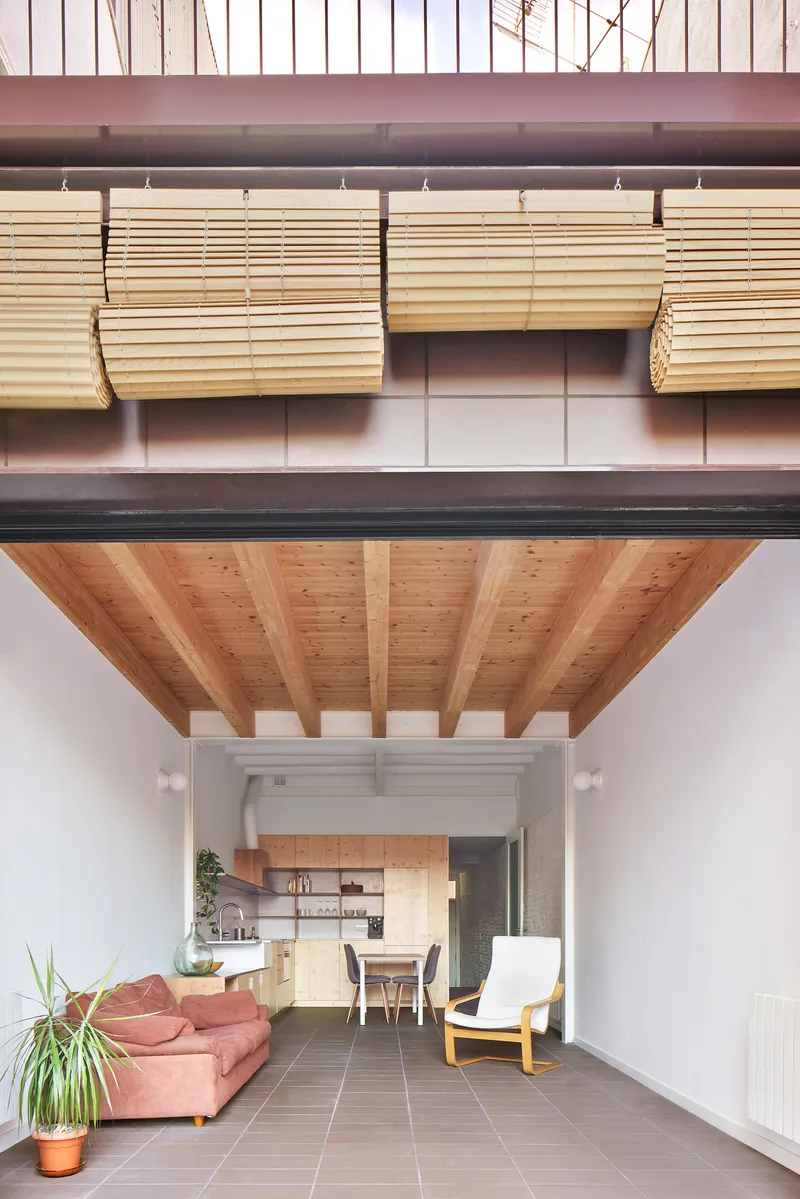
The material palette divides cleanly between old and new. In the restored portions of the house, original beams and vaults are exposed and painted white, preserving the rhythm of the historic structure while brightening the interiors. In the extension, new timber joists and plank ceilings are left in their natural pine tone, creating a warm contrast that immediately signals the contemporary intervention. Pine plywood cabinetry in the kitchen continues this language, paired with a farmhouse sink and dark floorboards that ground the lightness above.
Stone elements are embedded within walls for thermal inertia, absorbing heat during the day and releasing it slowly at night. Combined with a carefully thickened building envelope and calibrated window frames with integrated sun protection, these moves bring carbon emissions down to 10.59 kgCO2/m² per year. The architecture does not wear its environmental ambition on its sleeve; you feel it in the stable temperature and the quality of light, not in any visible gadgetry.
The Courtyard Extension
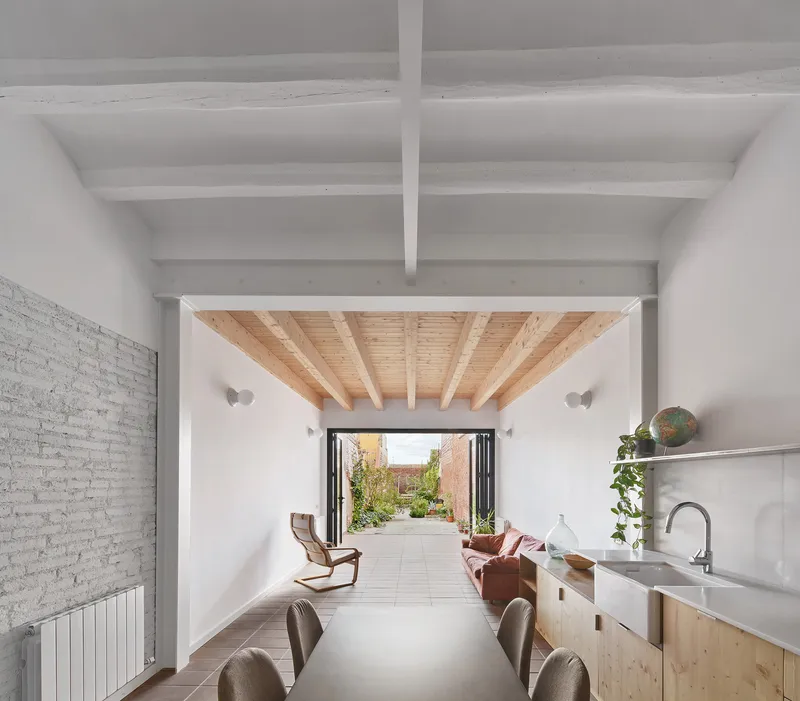
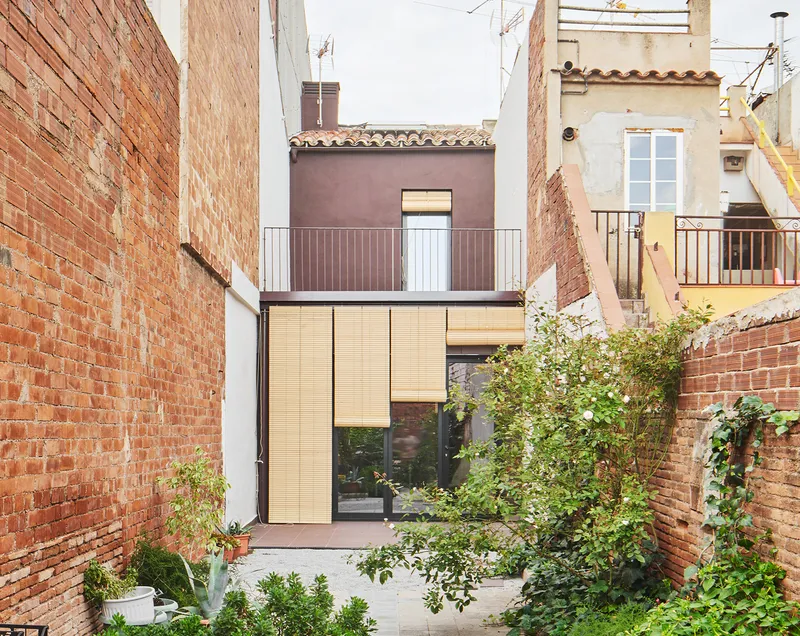
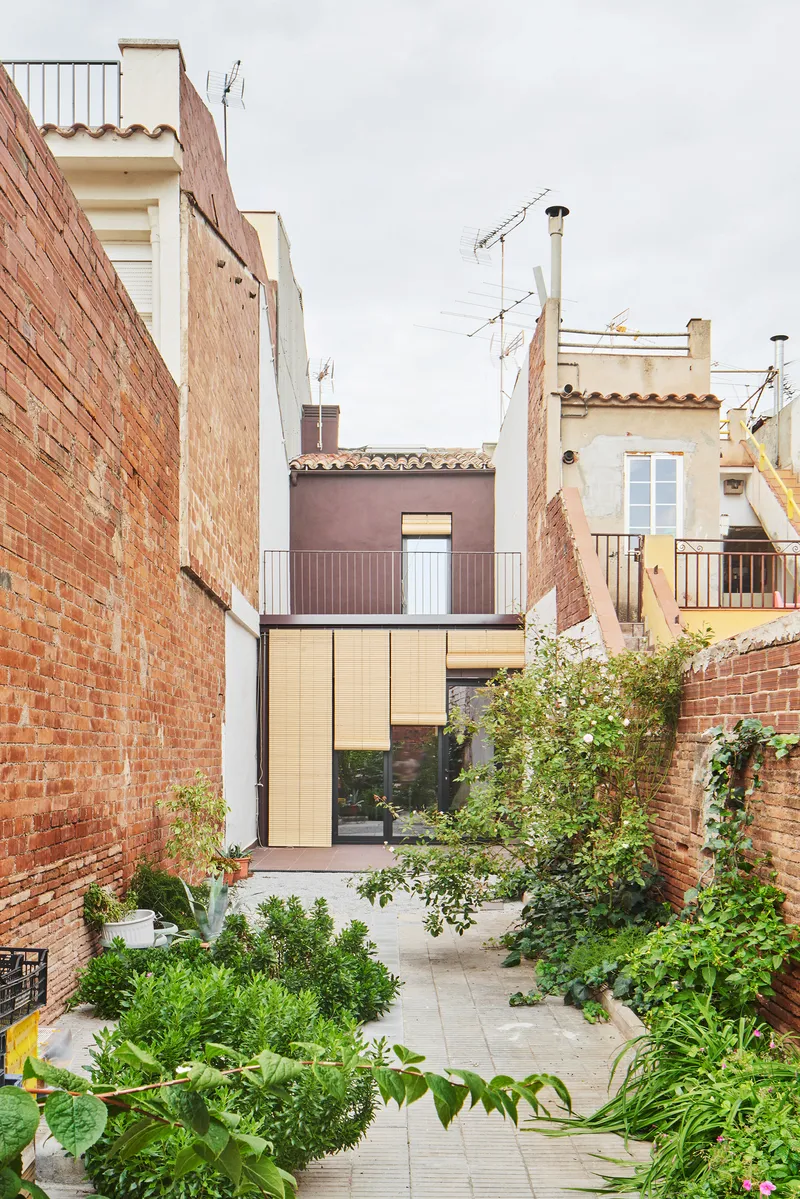
Terrassa's climate rewards the blurring of inside and outside, and 82SAN capitalizes on the long backyard that most narrow row houses waste. The rear extension brings the kitchen-dining-living room to grade with the courtyard, and full-height folding glass doors make the garden an extension of the interior. Dense plantings and simple paving transform what was likely a neglected service yard into the emotional center of the house.
Framed by exposed brick party walls on either side, the courtyard has a contained, almost cloister-like quality. It is private without being dark, and its proportions give the narrow plot a sense of depth that the street facade never hints at.
Operable Screens and Climate Control
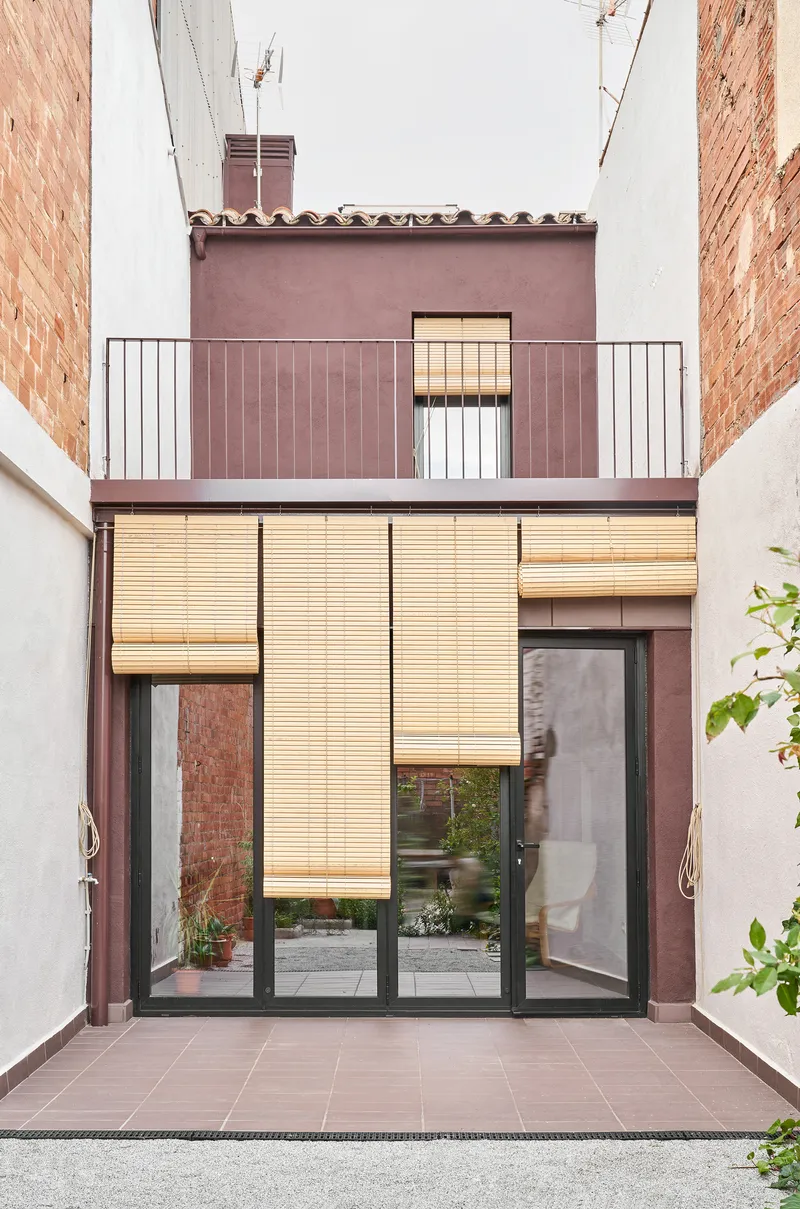
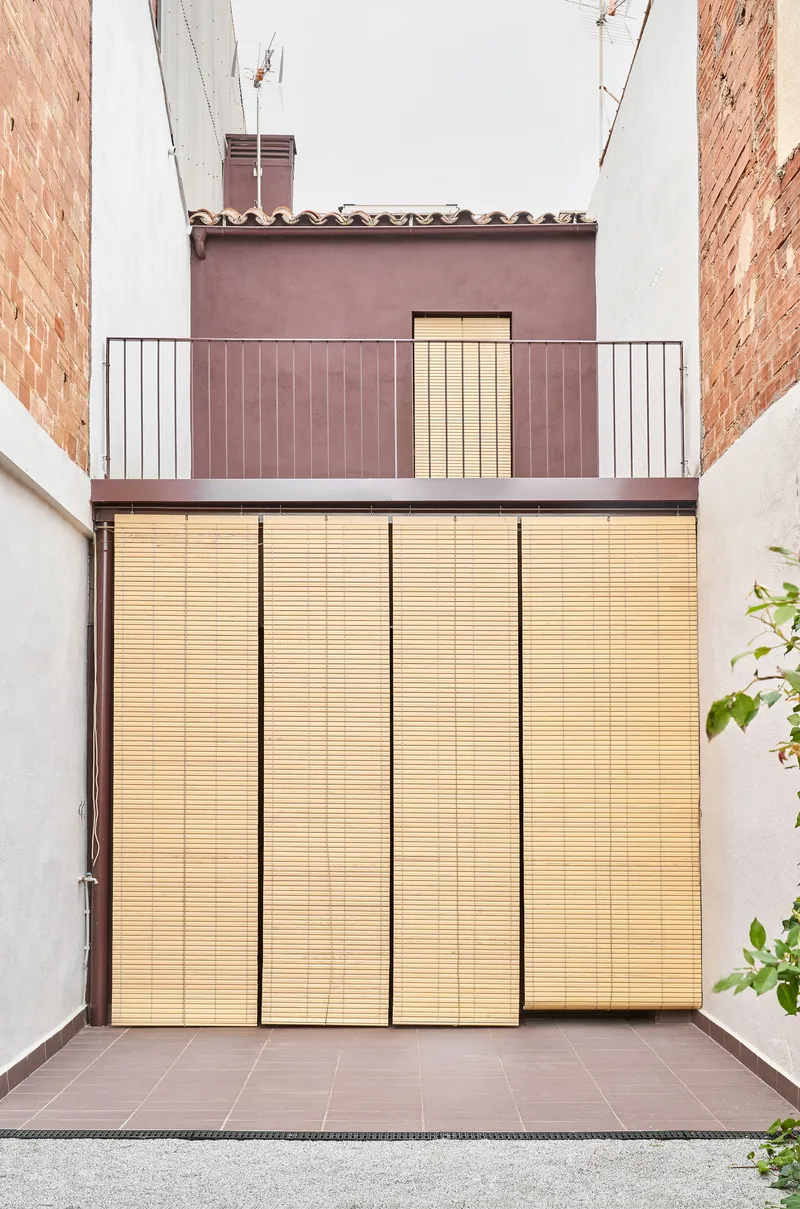
The rear facade is fitted with retractable timber slatted shutters that modulate light and heat gain across the day. Fully closed, they give the extension a fortified quality, the timber slats reading as a continuous warm surface between the rough brick party walls. Partially lowered, they filter direct sun into dappled stripes across the interior floors. These shutters are the primary mechanism for managing solar exposure on the south-facing garden elevation, and their manual operation keeps the house responsive to its occupants rather than to automated systems.
Living on the Upper Floors
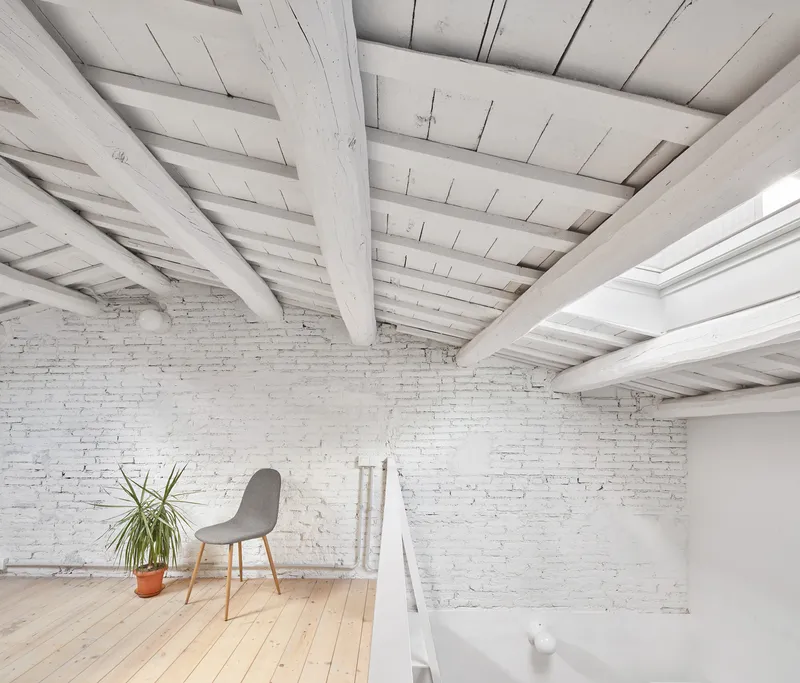
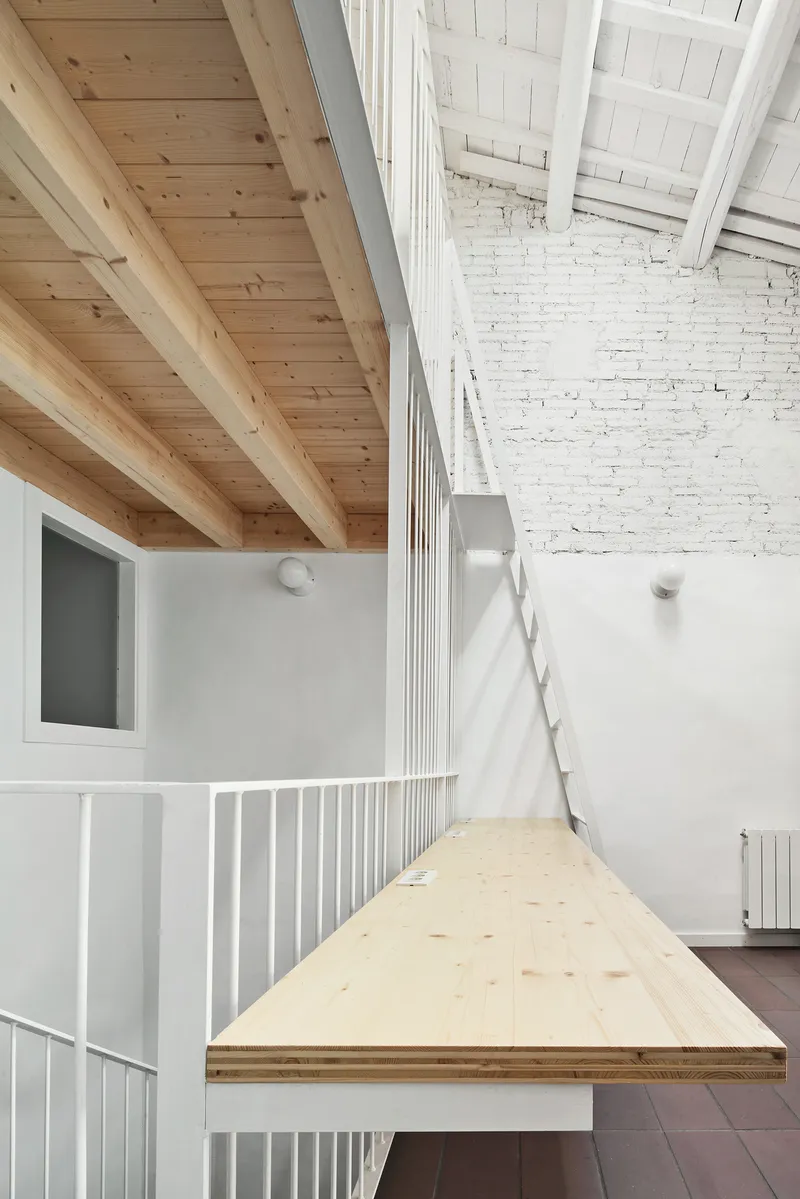
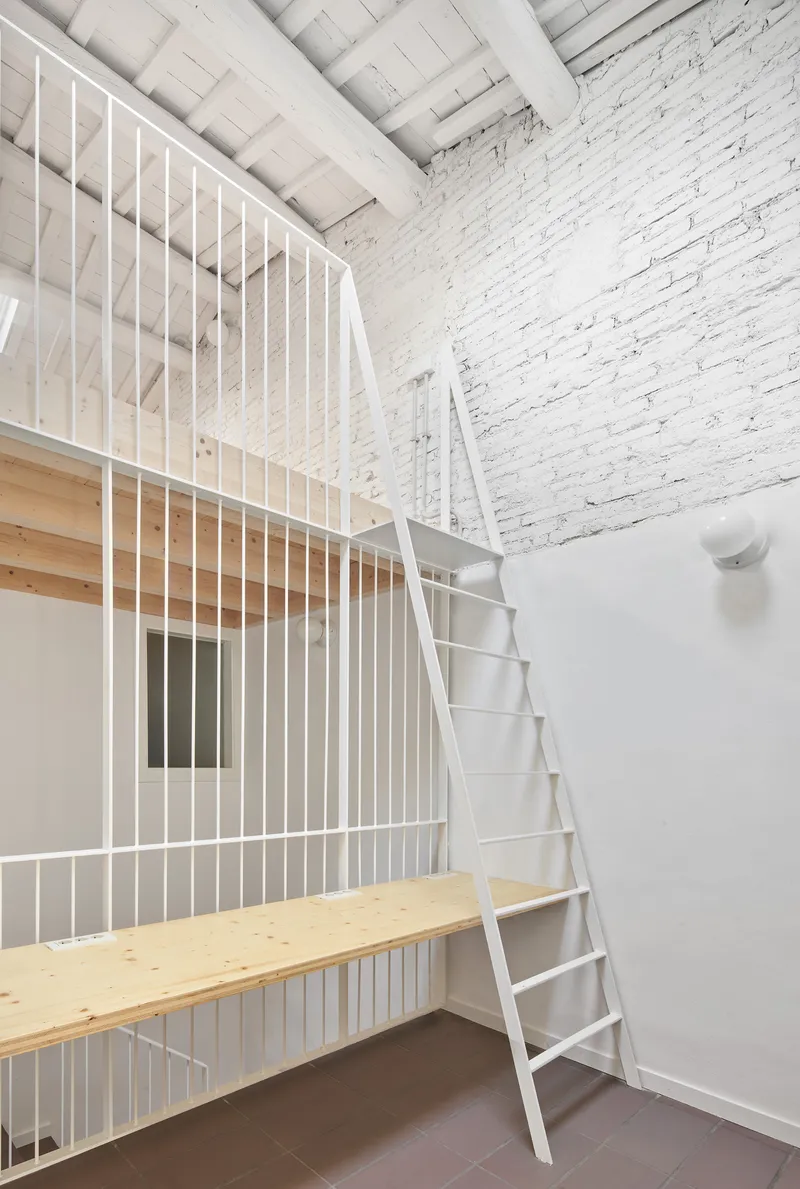
The bedrooms occupy the upper levels, distributed so that each has access to a facade. The couple's room and the younger son's room share the second floor, where bathroom and stairway heights compress to 2.2 meters to accommodate the roof geometry. That compression is intentional: it makes the adjacent high-ceilinged voids feel even more dramatic by contrast. The older son's bedroom sits at ground level facing the street, granting a measure of independence.
Cantilevered plywood platforms and a white ladder accessing a mezzanine lend the upper floors an almost playful, ship-like character. These are compact spaces, but the exposed timber joists, painted brick walls, and carefully placed openings prevent them from feeling cramped.
Circulation and Detail
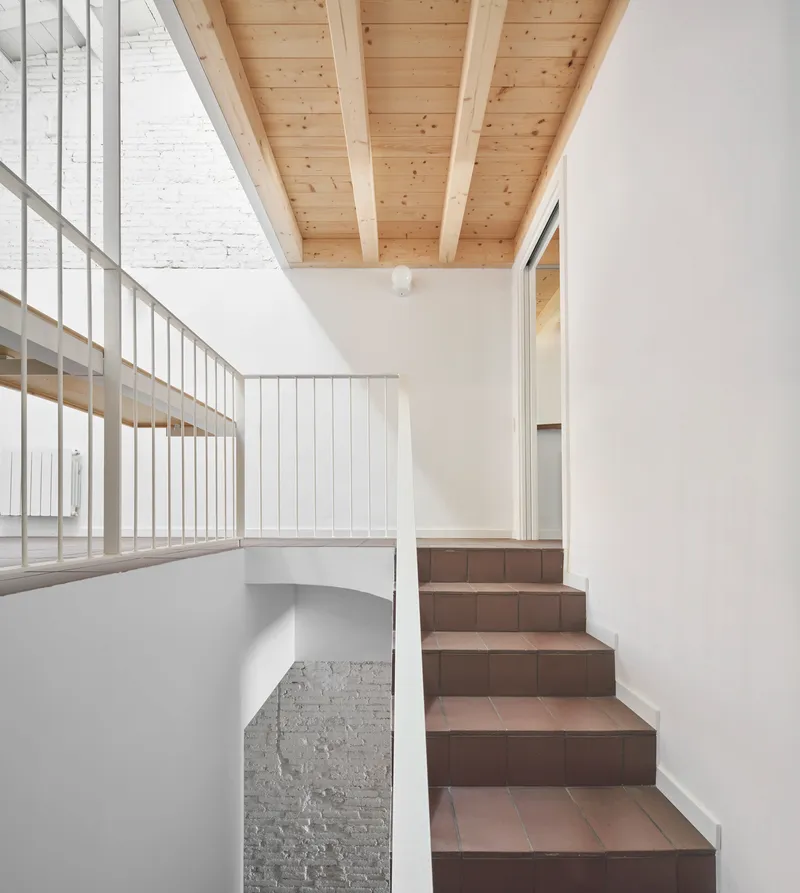
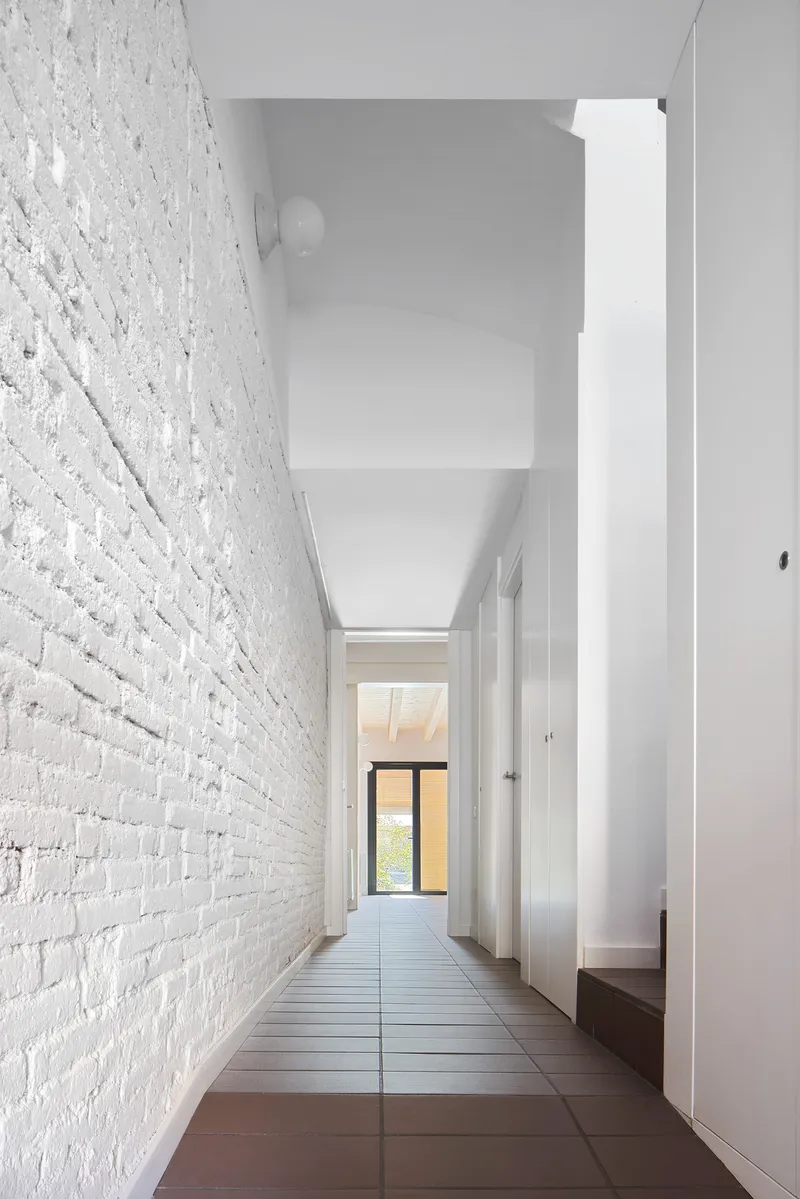
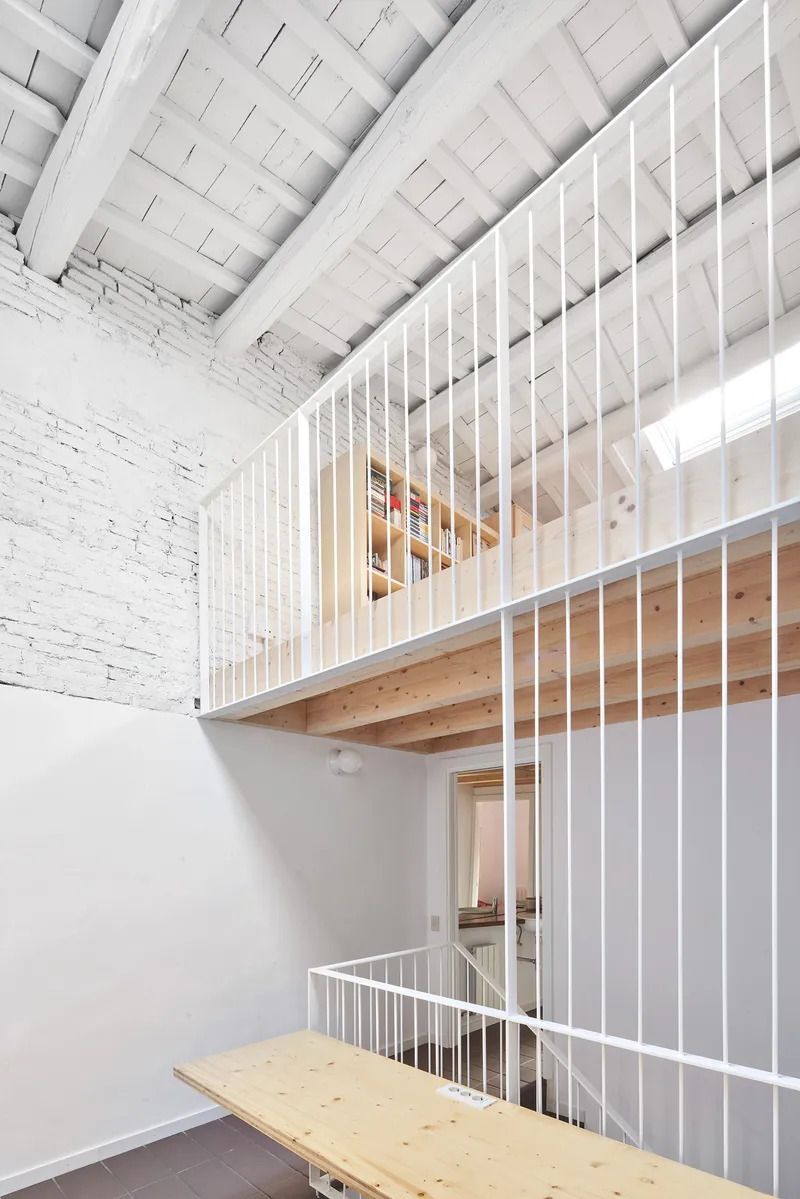
In a house this narrow, every corridor is doing double duty as both passage and atmosphere. The terracotta-treaded staircase with its white metal railing is efficient and elegant, while the narrow corridor with its painted white brick wall acts as a spatial decompression chamber between zones. White metal grid partitions reappear at mezzanine levels, maintaining transparency and structural clarity simultaneously.
The Bathrooms
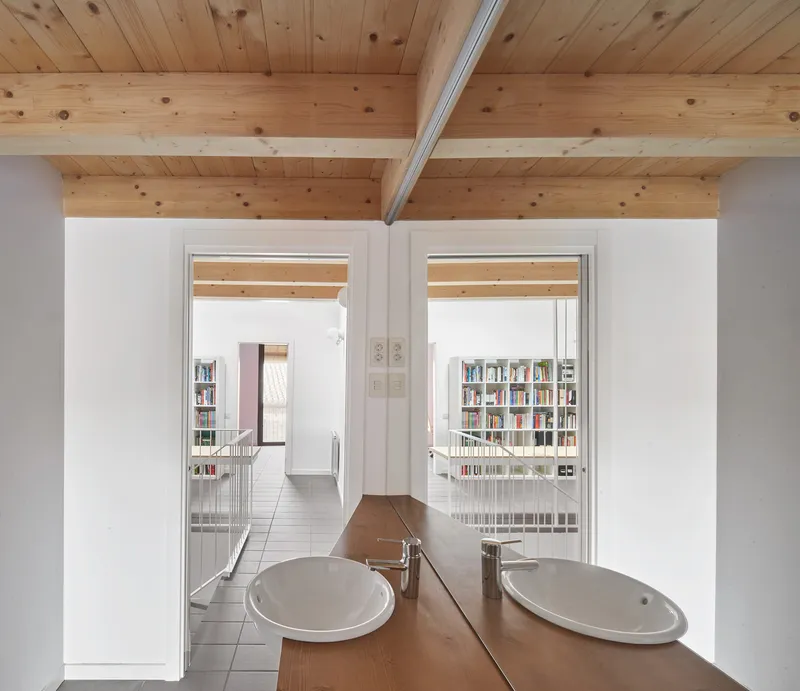
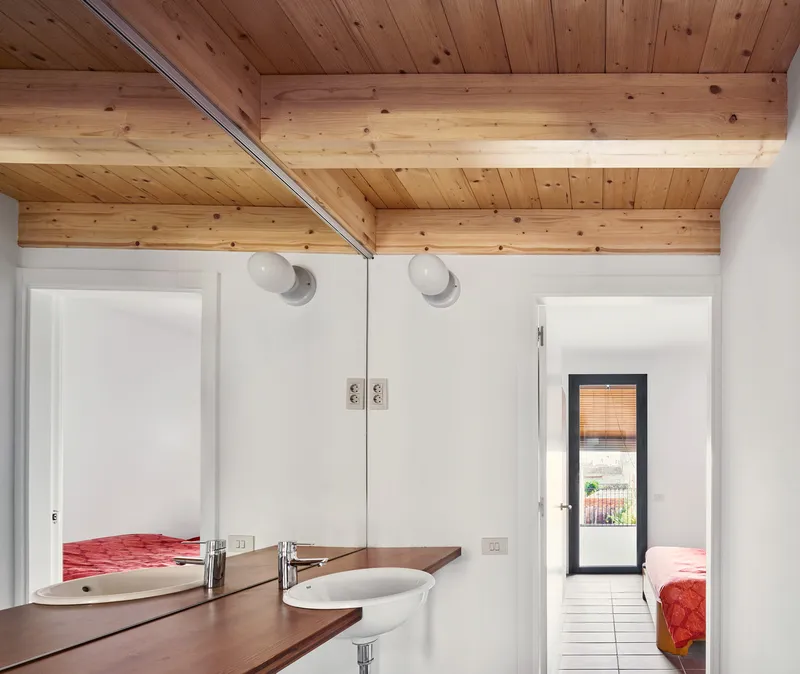
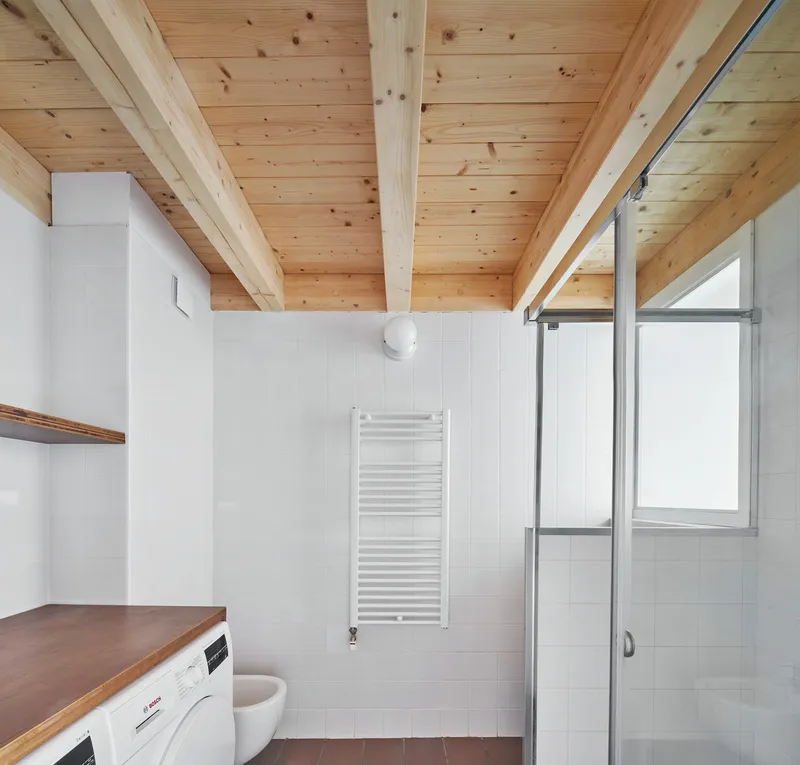
Both bathrooms share the project's material frankness. Timber vanities and countertops sit beneath exposed ceiling joists, and white tile walls keep the rooms bright despite their modest dimensions. Doorways are positioned to frame views through to bedrooms and circulation spaces beyond, a tactic that makes each room borrow depth from its neighbors. It is a small detail, but in a 3.8-meter-wide house, every borrowed centimeter counts.
Plans and Drawings
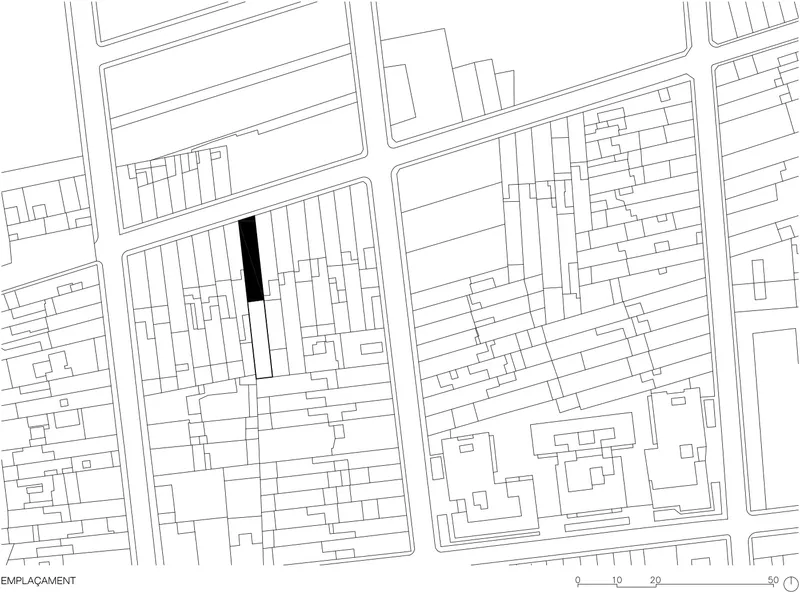
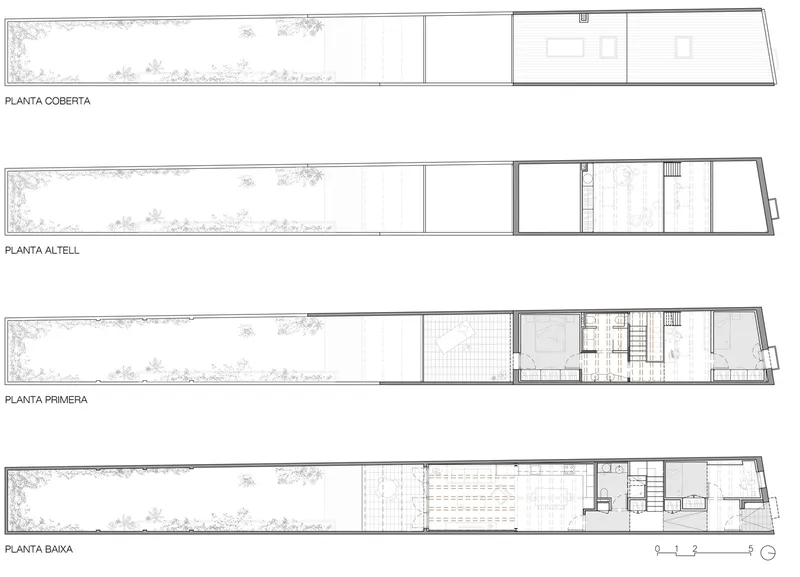
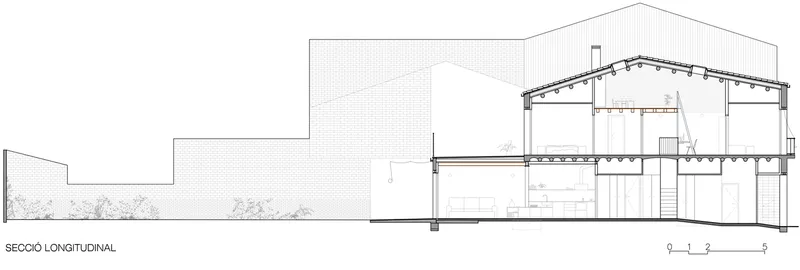
The site plan reveals the project's urban condition: a single narrow parcel embedded within a dense block structure, its depth stretching far beyond what the street facade suggests. The four-level floor plans trace the stair and courtyard placement that organize the linear sequence of rooms, while the longitudinal section is the drawing that tells the real story. It shows the double-height gabled hall with its exposed timber trusses, the stepping roofline, and the way the extension drops to meet the garden. The section makes clear that the drama of 82SAN is not compositional flair but structural consequence: every height change responds to existing roof geometry, party wall constraints, or the deliberate manipulation of ceiling quality.
Why This Project Matters
82SAN is a reminder that constraint, not freedom, produces architecture worth studying. The 3.8-meter width is not a limitation the architects overcome; it is the condition they exploit. By reading the section as the primary design tool and treating ceiling height as a spatial amenity, Vallribera Arquitectes turned a sliver plot into a house with genuine spatial variety. The lesson is transferable to any dense urban context where narrow lots dominate: width is not the only dimension that matters.
The project also demonstrates that passive design can emerge from construction logic rather than technological overlay. Thickened envelopes, stone thermal mass, operable timber screens, and careful orientation are all decisions embedded in the fabric of the building, not bolted onto it. The A-rated energy performance follows from spatial thinking, not from mechanical systems. That integration of environmental ambition with architectural ambition, without sacrificing the warmth and character of a family home, is what makes 82SAN worth attention.
82SAN Restoration and Extension of a House Between Dividing Walls by Vallribera Arquitectes (Llorenç Vallribera, Aleix Gil). Terrassa, Spain. 142 m². Completed 2018. Photography by José Hevia.
About the Studio
Share Your Own Work on uni.xyz
If projects like this are the kind of work you want to make, uni.xyz is a place to publish your own, find collaborators, and enter design competitions.


Popular Articles
Popular articles from the community


Manzana Morphosis: Stretching Barcelona's Grid into a Living Landscape for 2050
A radical reworking of the Eixample manzana turns density into a tool for generous public space, vertical ecology, and environmental performance.

Aquadapt: An Underwater Habitat That Rewrites Its Rooms by the Hour
Curved modules ring the seabed while one shell shifts from breakfast room to cinema, farm and football pitch as residents' needs change.


FCC Arquitectura Expands a Portuguese Granite House with a Board-Marked Concrete Wing
In Portugal, JV House pairs a cleaned-up whitewashed and granite dwelling with a timber-shuttered concrete extension, courtyards and a garden pool.

The Amber Palace Opera: A Geological Fiction Surfaces on Tallinn's Baltic Waterfront
Pierre Brillard reimagines a Baltic legend as a public landscape, opera house, and waterfront promenade rooted in Tallinn's coastal identity.

Similar Reads
You might also enjoy these articles

LAVA Architecten Gives Vocational Education a Sawtooth-Roofed Face on a Mechelen School Campus
In Mechelen, Belgium, a 2,053 m² STEM school on a 6×6 m grid turns workshops and classrooms into rooms that can be rearranged as teaching changes.

KEMA Studio Turns a Derelict Marvila Attic into a 60 m² Lighthouse Apartment Above Lisbon
In Lisbon's Marvila district, a rebuilt roof, four skylights and two plywood volumes turn an unlivable attic into a bright home facing the Tagus.

Pixel Gardens: One Repeated Module Stacked Into a Terraced Social Housing Tower for Famagusta
Salem Bader's shortlisted housing tower builds a vertical neighbourhood from one repeated module, offsetting units to carve terraces, light and air.

Bao Huynh Watercolor Atelier: A Serene Art Retreat in Hội An
Bao Huynh Watercolor Atelier in Hội An blends multifunctional art spaces, sustainable design, local materials, and family-friendly living in a serene environment.

Explore Building Extension Competitions
Discover active competitions in this discipline

Comments (0)
Please login or sign up to add comments
No comments yet. Be the first to comment!