
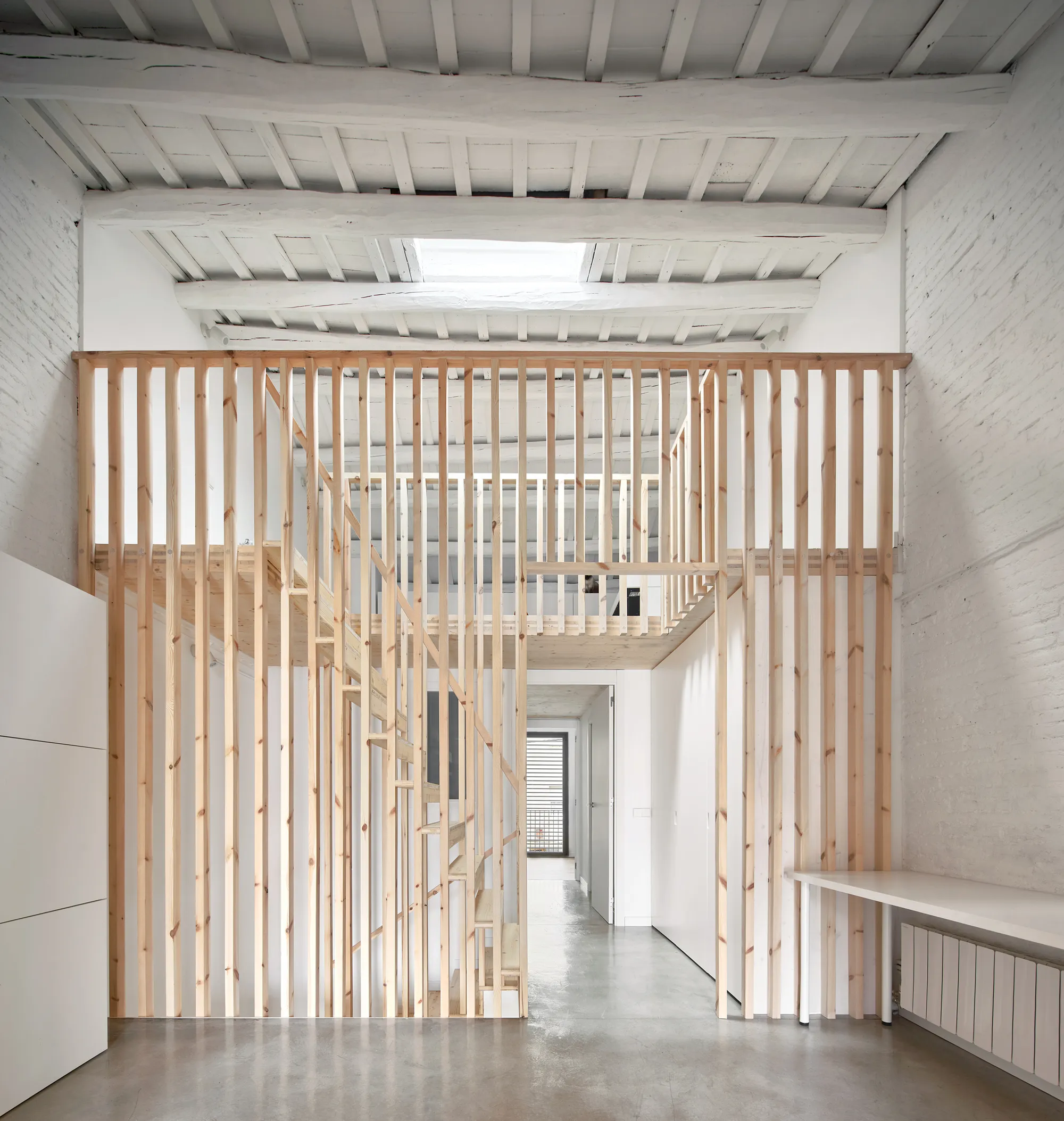
Vallribera Arquitectes Threads CLT and White Paint Through a Century-Old Terrassa Row House
A 4.5-metre-wide party-wall house in Barcelona's suburbs gains new timber rooms that read against its whitewashed bones.


The narrow party-wall house is the bread and butter of Mediterranean urbanism: a 4.5-metre-wide, 13-metre-deep slot punched into a continuous block, lit only from front, rear, and roof. In Terrassa, a dense city northwest of Barcelona, these plots multiply by the hundred, and most of the houses sitting on them are a century old. When Vallribera Arquitectes, led by Llorenç Vallribera and Aleix Gil, took on 95PLA for a family of four, the rear structure was already compromised by years of neglected roofing. The question was not whether to intervene but how to make the intervention legible.
Their answer is a two-tone material strategy that treats every existing element as white and every new addition as raw wood. Original beams, brick, plaster, and tiles get a coat of white paint. New stairs, ceilings, cabinetry, and a rear extension arrive in untreated cross-laminated timber panels. The result is a house you can read like a palimpsest: old bones and new organs, each plainly visible, alternating room by room and sometimes beam by beam.
Old White, New Wood

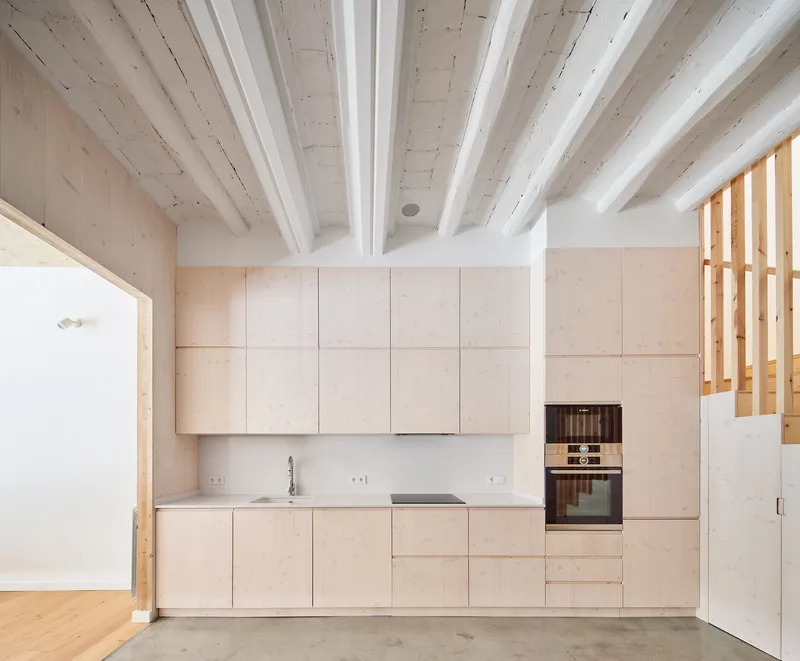
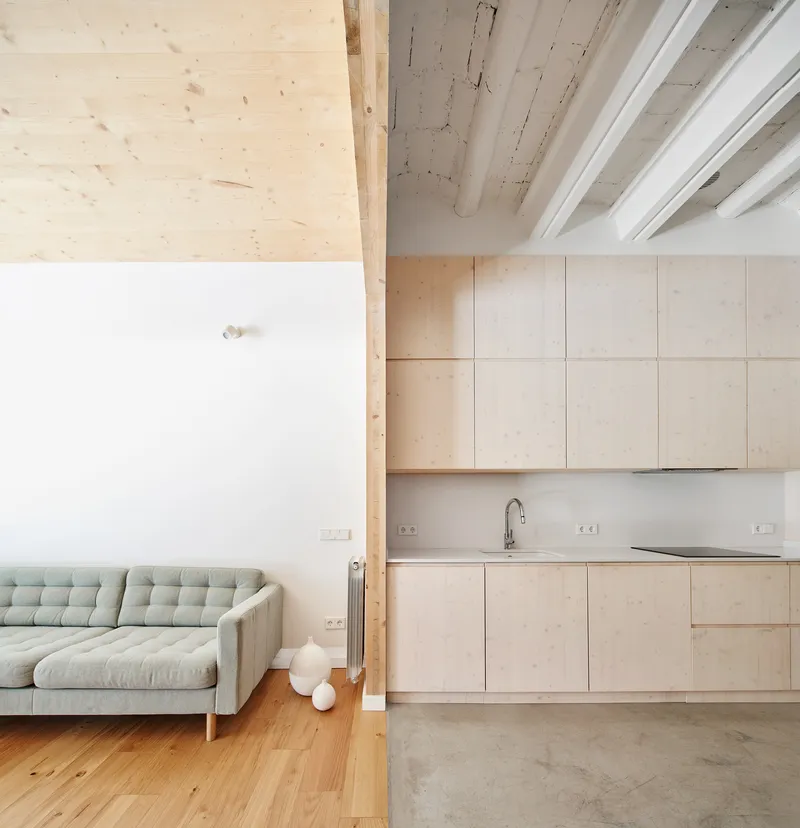
The kitchen and dining area make the material logic immediately clear. Whitewashed ceiling beams run overhead, their age visible in the slight irregularities of span and spacing, while plywood cabinetry wraps the kitchen wall in warm, pale pine. A polished concrete floor, poured as a structural reinforcement layer on the original slab, ties the two palettes together with a neutral grey datum. Nothing is hidden or clad: the project's honesty is its primary decoration.
The dining table sits almost exactly where old and new meet, bracketed by the painted brick of the party wall on one side and the timber stair enclosure on the other. Light arrives from both ends of the narrow plan, raking across surfaces that shift between matte white and grain.
A Staircase That Does Everything
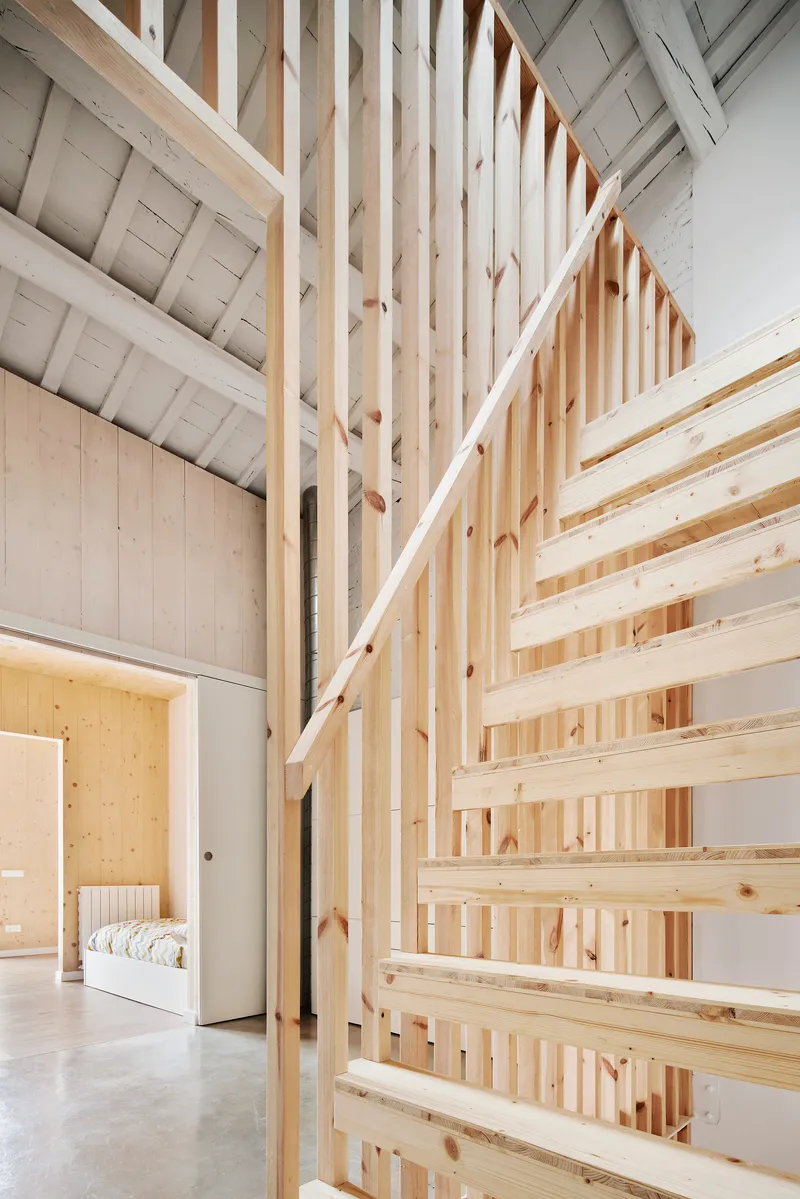
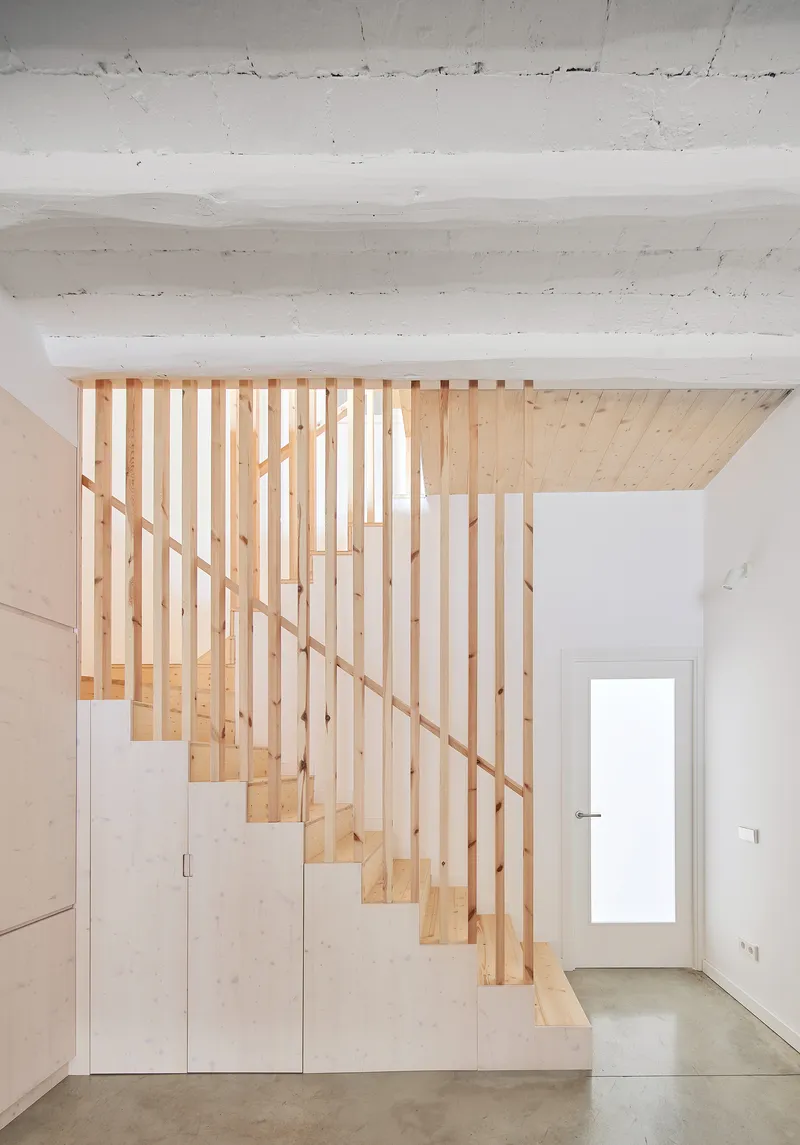
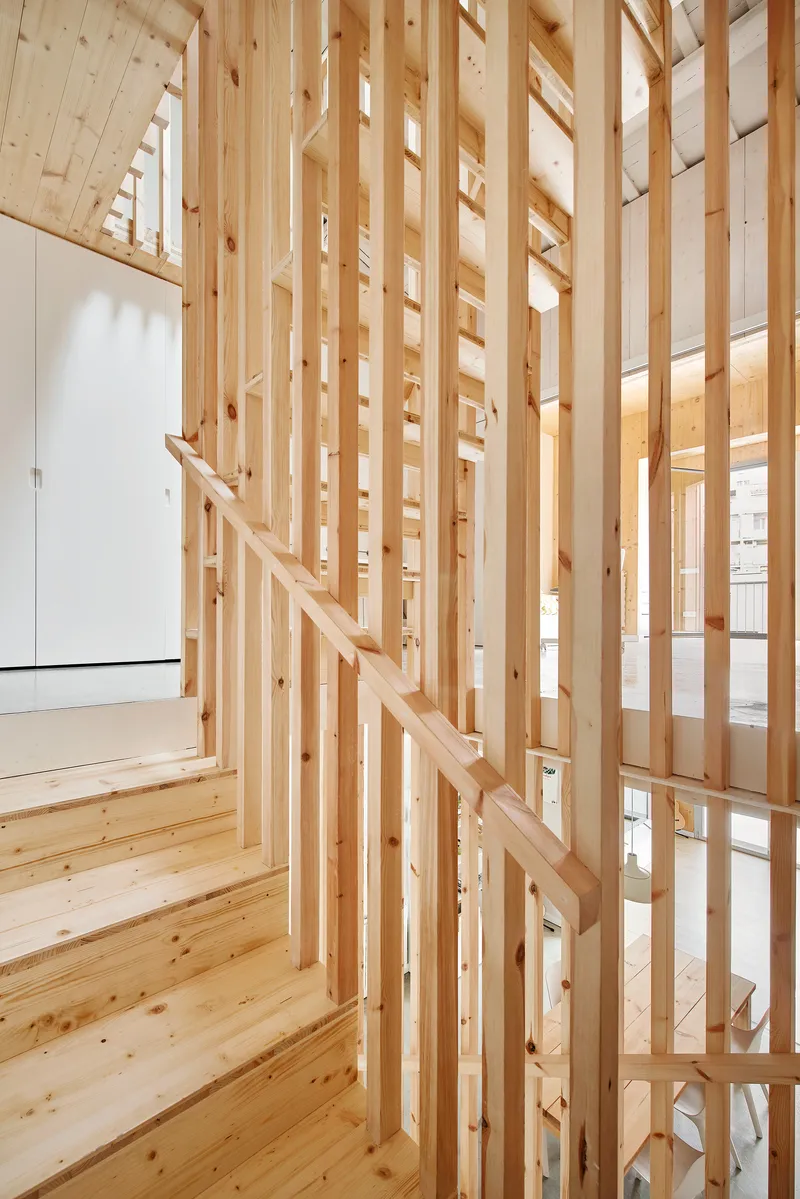
The original stairwell was demolished to make room for a ground-floor garage, so the new staircase had to be relocated and, in the process, became the building's central event. Built entirely of CLT and vertical timber slats, it rises through a double-height void, filtering light from a roof-level skylight down into the middle of the plan. The slatted screen does triple duty: guardrail, light filter, and spatial separator, giving the narrow house a sense of porosity it could never achieve with solid walls.
Storage cabinets in matching plywood tuck beneath the treads, turning dead space into practical volume. In a 164-square-metre house only 4.5 metres wide, every cubic centimetre matters, and the stair proves that vertical circulation can be a generous room rather than a grudging necessity.
Light From Above


Party-wall houses are notoriously dark in the middle. With only two short facades and a roof to work with, the architects carved a linear skylight into the ridge and left the stairwell open so that light could cascade through the slats and reach the ground floor. Looking up from below, you get a graphic composition of whitewashed joists, timber fins, and a bright seam of sky. The effect turns what would otherwise be the dimmest part of the house into its brightest.
Bedrooms as Timber Portals
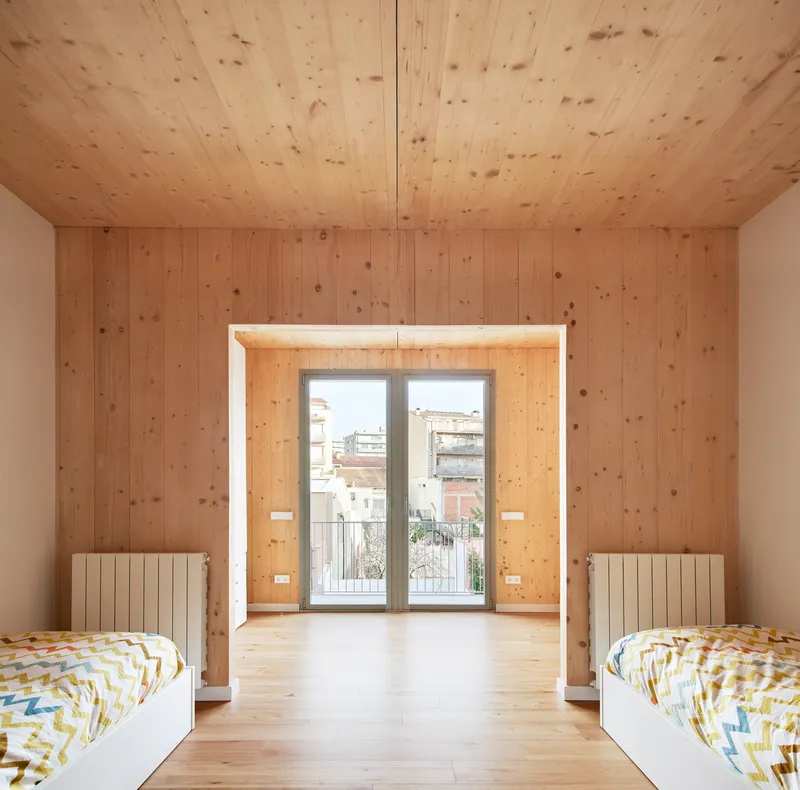


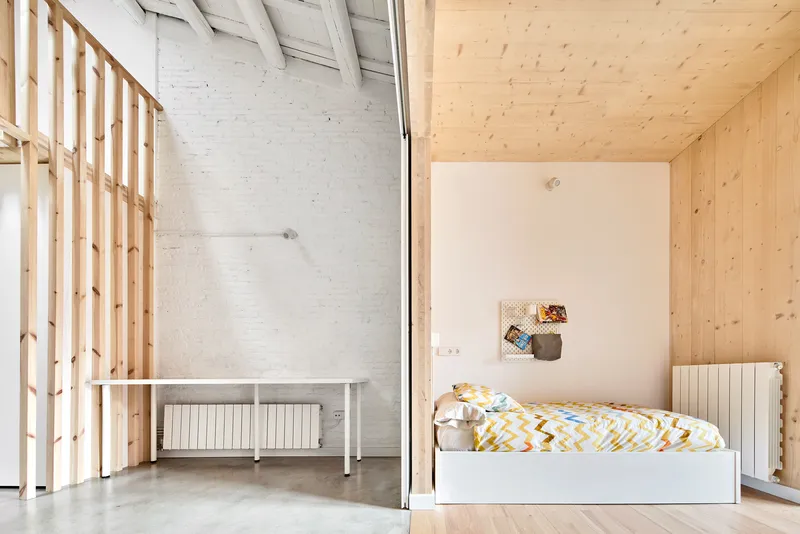
On the first floor, the bedrooms continue the old-white, new-wood alternation. The children's room features a deep timber-lined window opening that functions as a threshold, reading nook, and radiator enclosure all at once. Twin beds flank the opening symmetrically, and the pine ceiling overhead gives the room a cabin-like warmth. The main bedroom mirrors this language through framed doorways that compress and release the view as you move through the plan.
A sleeping alcove beside the slatted stair screen offers a quieter reading of the strategy: a single bed, polished concrete underfoot, timber verticals filtering light from the void. The rooms chain together in a continuous sequence, each one borrowing space and light from the next, a necessity in a plan this narrow and a virtue when handled this carefully.
The Enfilade and the Courtyard

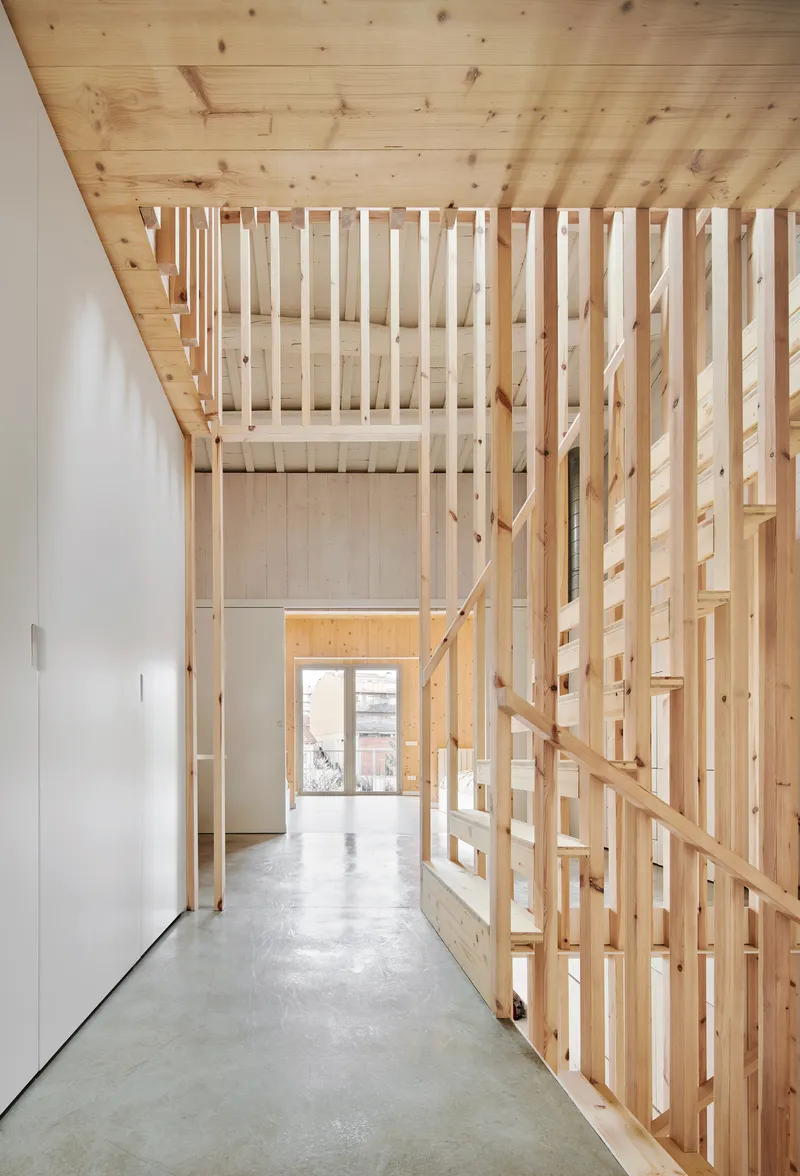

The corridor view, with its succession of aligned doorways, reveals the enfilade logic that structures the ground floor. From the street entrance through the foyer, past the kitchen, and into the living room, you can see all the way to the rear courtyard. A scooter parked midway is a reminder that this is a working family house, not a gallery. The polished concrete floor runs unbroken from front to back, making the 17-metre ground-floor depth feel longer still.
At the rear, the house opens to a small courtyard through full-height glazed doors. A bare tree stands against white stucco walls, and the transition from interior to exterior is essentially seamless. The rear volume, extended toward the patio, gives the living room direct access to outdoor air and light, compensating for the depth of the plan.
Street Presence and Skin


From the street, the house reads as a modest white-stucco facade with a louvered window, a garage door, and the terracotta brickwork of its neighbour pressing in. The adjustable louvers are part of a broader envelope strategy: the street facade has been insulated from the inside with drywall and mineral wool, all windows replaced, and the result is an Energy Performance Certificate rating of A, with total primary energy consumption of just 48 kWh per square metre per year. Those are serious numbers for a century-old shell.
Bathroom and Service Spaces


Even the bathrooms and corridors participate in the material dialogue. The main bathroom pairs white tile walls with a plywood ceiling and the same polished concrete floor found throughout the house. It is restrained, almost clinical, but the timber overhead keeps it from feeling institutional. Corridor transitions, where plywood ceilings meet whitewashed planks, are left as clean butt joints, honest about the shift from new to old.
Plans and Drawings


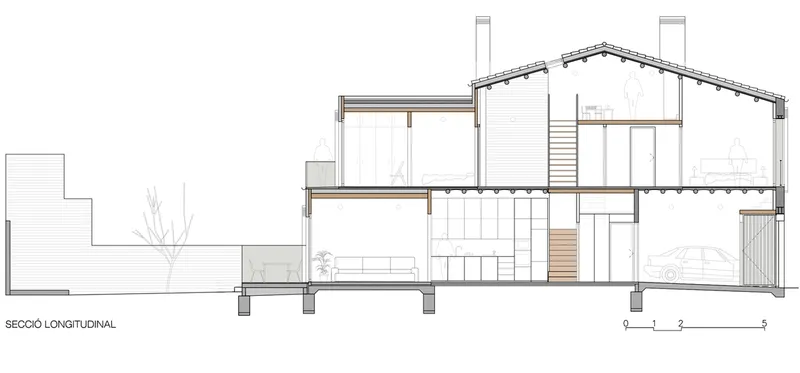

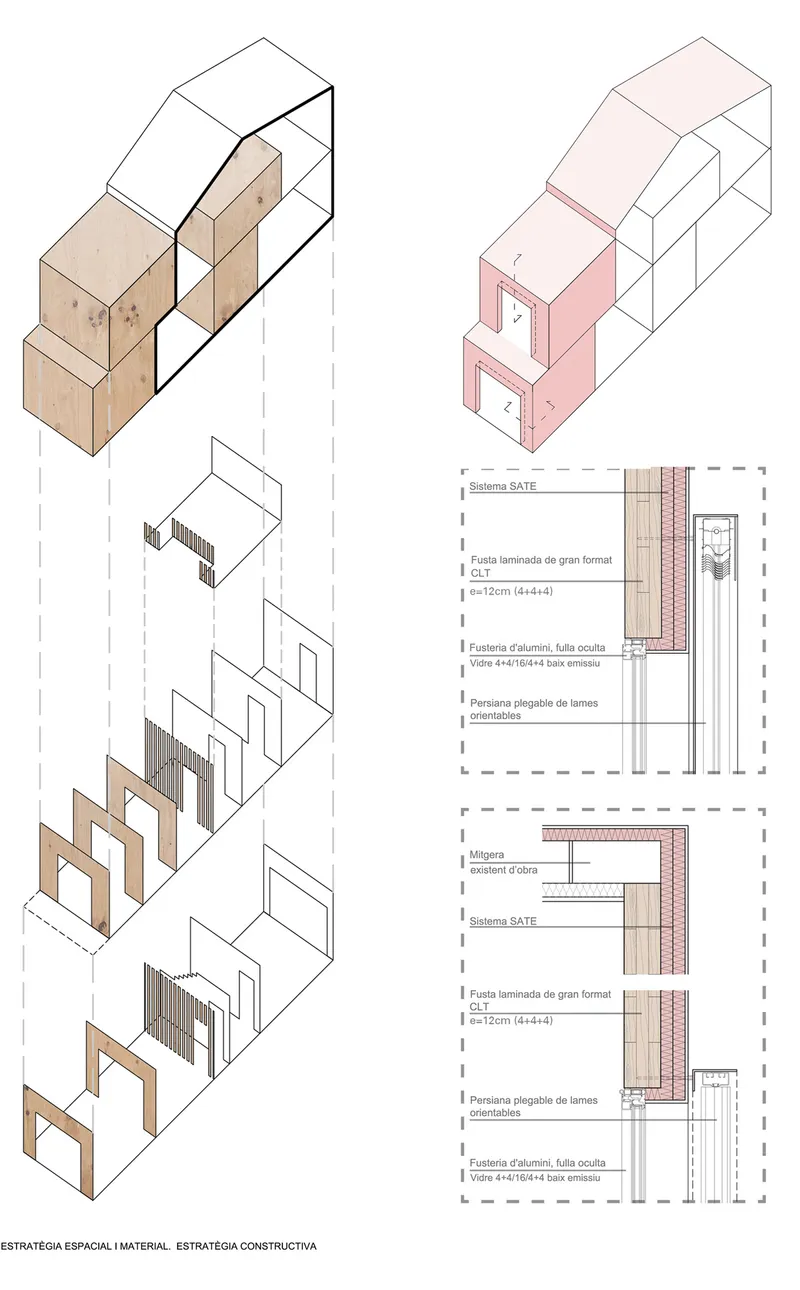
The site plan reveals just how tight the urban grain is: the plot is a sliver among slivers, sandwiched between party walls with no side light possible. Floor plans across four levels show the central staircase as the hinge around which every room pivots, while the longitudinal section exposes the relationship between the new skylight, the stair void, and the pitched roof. The axonometric and isometric diagrams make the CLT insertions legible as distinct objects slotted into the masonry shell, a graphic confirmation of the old-white, new-wood thesis visible in every photograph.
Why This Project Matters
The refurbishment of a narrow row house is, by definition, a constrained problem. You cannot widen the plan, you cannot add side windows, and you are stuck with someone else's structure. What Vallribera Arquitectes demonstrate here is that constraint is not a ceiling on ambition. By introducing CLT as a legible counterpart to the whitewashed originals, they give a 100-year-old house a second identity without erasing the first. The A-rated energy performance proves that deep retrofit and material honesty are not competing goals.
More broadly, 95PLA is a model for the thousands of similar party-wall houses across Catalonia and beyond. The strategy is replicable: keep what works, paint it white, build what's new in timber, and let the two speak for themselves. No heroic gestures, no gratuitous demolition, just a disciplined reading of what exists and a clear idea of what needs to be added. That kind of restraint is harder than it looks, and it deserves attention.
95PLA Refurbishment by Vallribera Arquitectes (Llorenç Vallribera, Aleix Gil). Terrassa, Spain. 164 m². Completed 2019. Photography by José Hevia.
About the Studio
Share Your Own Work on uni.xyz
If projects like this are the kind of work you want to make, uni.xyz is a place to publish your own, find collaborators, and enter design competitions.




Popular Articles
Popular articles from the community


The Ocean Hive: Sustainable Architecture for a Self-Sufficient Civilization at Sea
The Ocean Hive imagines sustainable architecture at sea, where modular habitats, algae, wave power and ocean waste sustain a growing colony.
EW PARK: Sustainable Architecture Reimagines the Future of Urban Parking
EW PARK reimagines city parking as a modular wooden tower combining automation, solar energy, electric mobility, and adaptable urban design.

Co-life: Sustainable Architecture for Age-Friendly Community Living
Co-life reimagines sustainable architecture for seniors through courtyards, rammed earth, shared gardens, and spaces designed for belonging.

Conexión: Biophilic Design Reimagines High-Rise Living in Hong Kong
Conexión reimagines high-rise living in Hong Kong through biophilic design, green facades, shared spaces, daylight, water and nature within.


Similar Reads
You might also enjoy these articles

Bao Huynh Watercolor Atelier: A Serene Art Retreat in Hội An
Bao Huynh Watercolor Atelier in Hội An blends multifunctional art spaces, sustainable design, local materials, and family-friendly living in a serene environment.

Atelier Macri Concept Store Interior Design by CASE-REAL
Atelier Macri store features a "ko" counter, walnut wood details, cork displays, blending retail, gallery, and seamless customer experiences.

Manuel Vargas Izquierdo Stadium and High-Performance Sports Center: Architectural Excellence in Jalpa de Méndez
The Manuel Vargas Izquierdo Stadium blends sustainable design, inclusive sports facilities, and cultural-inspired architecture, revitalizing Jalpa de Méndez’s public spaces.

KAKR Buluh Awar Hall: Revitalizing Community and Ecology Through Bamboo Architecture
Community built bamboo hall revitalizes Buluh Awar village, empowering youth, restoring ecology, celebrating vernacular craftsmanship through sustainable architecture and culture.


Explore Interior Design Competitions
Discover active competitions in this discipline


Challenge to design luxury tourism on rails


VR headsets Storefront design competition

Designing a staircase for a client
Comments (0)
Please login or sign up to add comments
No comments yet. Be the first to comment!