
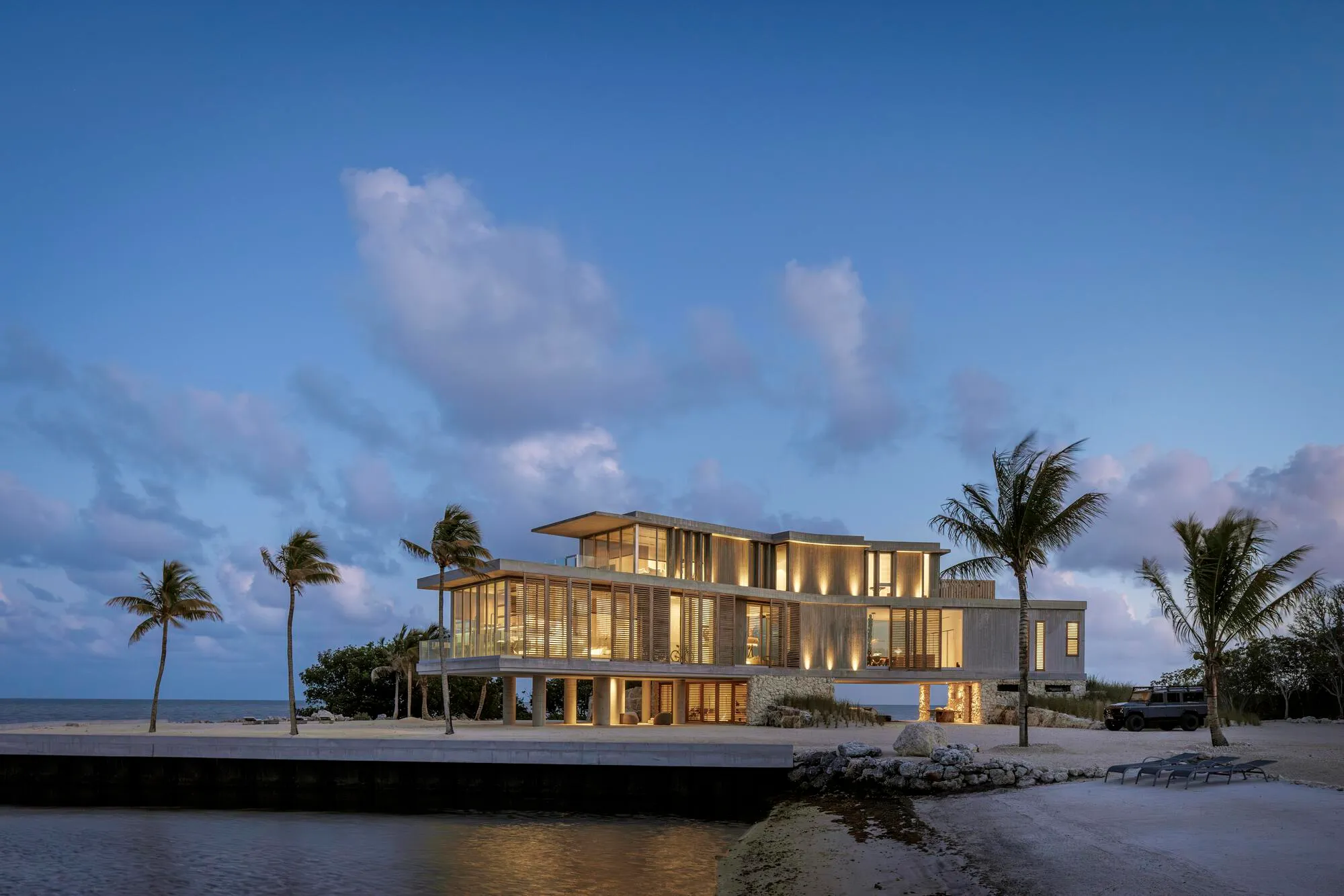
Van der Vlugt Residence by STRANG
A resilient waterfront house on a private island near Miami elevates concrete, timber, and glass into a calm dialogue with storm and sea.


Building on a private island in subtropical Florida is, by definition, a confrontation with nature. Not the gentle kind, not the postcard kind, but the kind that arrives as storm surge, salt spray, and relentless ultraviolet light. The Van der Vlugt Residence by STRANG treats that confrontation as a design premise rather than a problem to suppress. The house lifts itself off the ground on concrete piers, wraps itself in operable timber louvers, and opens floor-to-ceiling glazing toward mangroves and open water. It reads as both fortress and pavilion, depending on the hour and the weather.
What makes this project worth studying is the way it layers passive climate strategies into an architectural language that never feels didactic. There are no solar panels on display, no green roof serving as a signifier. Instead, the resilience is structural and spatial: elevated living planes that let storm water pass beneath, deep overhangs that block direct sun, louvered screens that modulate breeze and light. The house is quiet about its intelligence, which is exactly what makes it loud.
Lifting the House: Structure as Climate Strategy
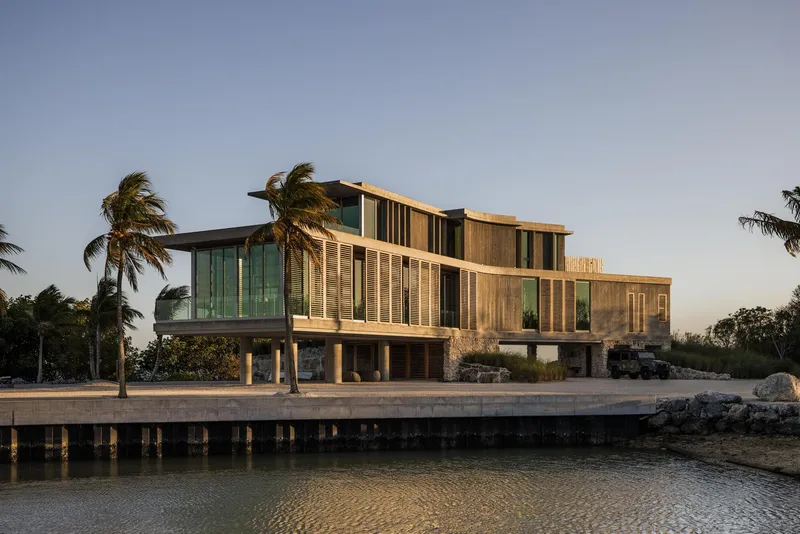
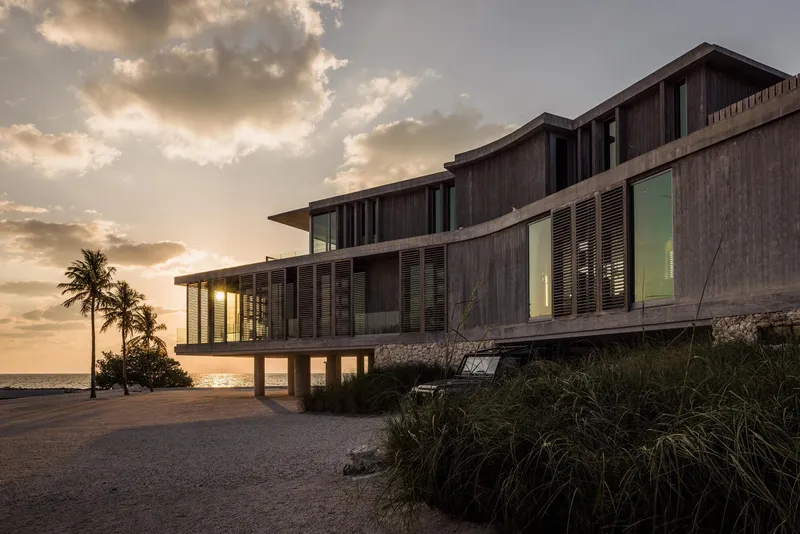
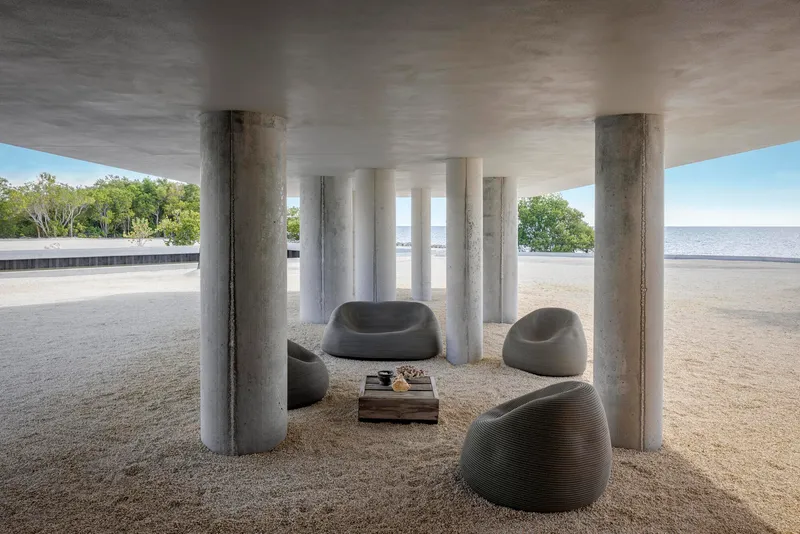
The most consequential decision STRANG made here was elevating the primary living volumes on pilotis. Cylindrical concrete columns carry timber-clad boxes above a ground plane of gravel, coral stone, and open air. The strategy is borrowed from mid-century tropical modernism, but the execution is sharpened for a climate era in which flood risk is not hypothetical. The ground level breathes: water can flow beneath; wind pressure is reduced; the inhabitable floors sit above the projected storm surge line.
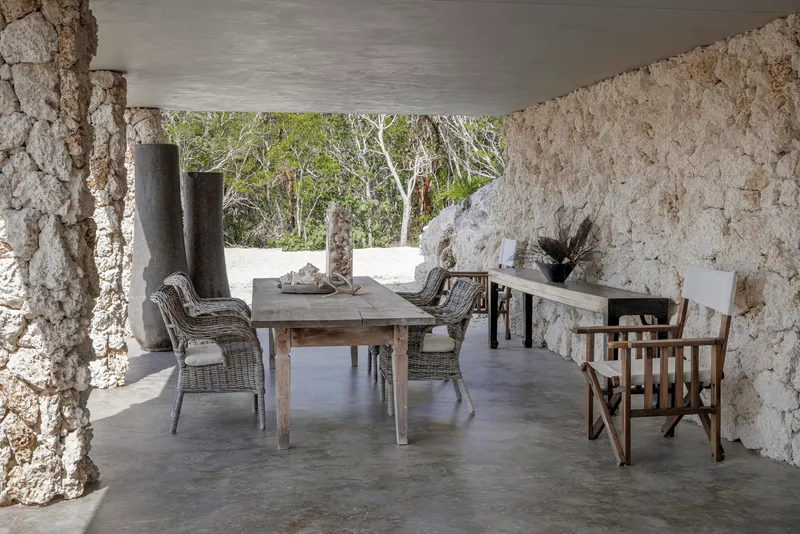
At ground level, shaded seating areas beneath the columns function as outdoor living rooms that remain cool even at midday. The cylindrical column profile minimizes wind resistance and gives the undercroft a sculptural rhythm. It is a generous gesture, turning what could have been dead space into one of the most pleasant zones of the house.
Island Context: Siting Among Mangroves
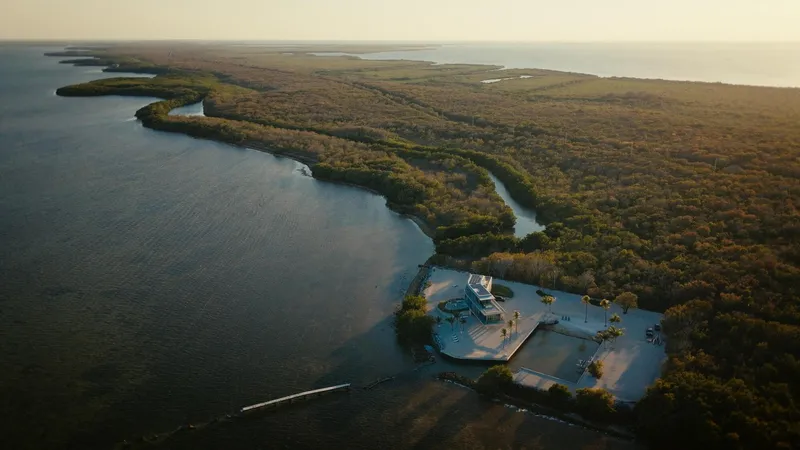
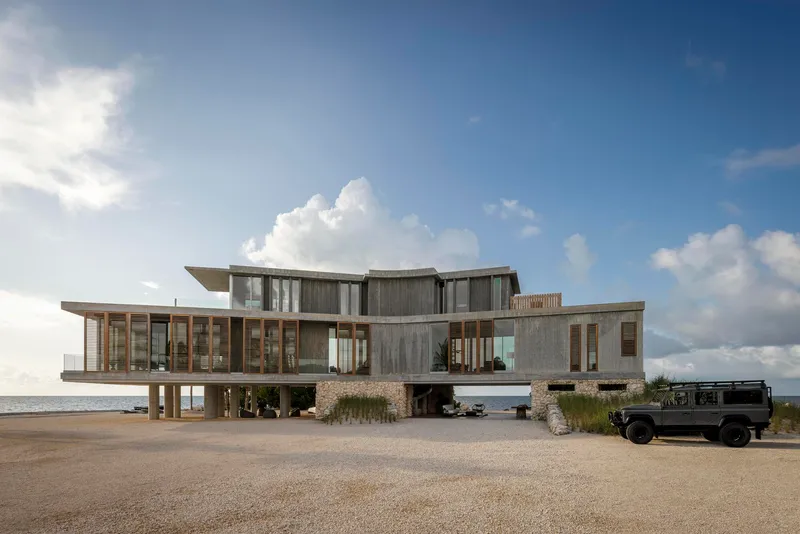
The aerial perspective reveals just how isolated the site is: a slender island ringed by mangroves, with open water on all sides. STRANG positioned the house to minimize its footprint on the landscape, clustering volumes tightly and keeping a central carport at grade. Arriving by car, you read the composition as a stack of horizontal planes, concrete at the base, timber in the middle, a thin cantilevered roof cap. The palette echoes the natural materials around it without pretending to be invisible.
The mangrove buffer is preserved rather than cleared, which matters ecologically and architecturally. It softens the boundary between built form and water, filters wave energy during storms, and gives the house a layered foreground that changes with the tide.
The Louvered Skin: Light, Air, Privacy
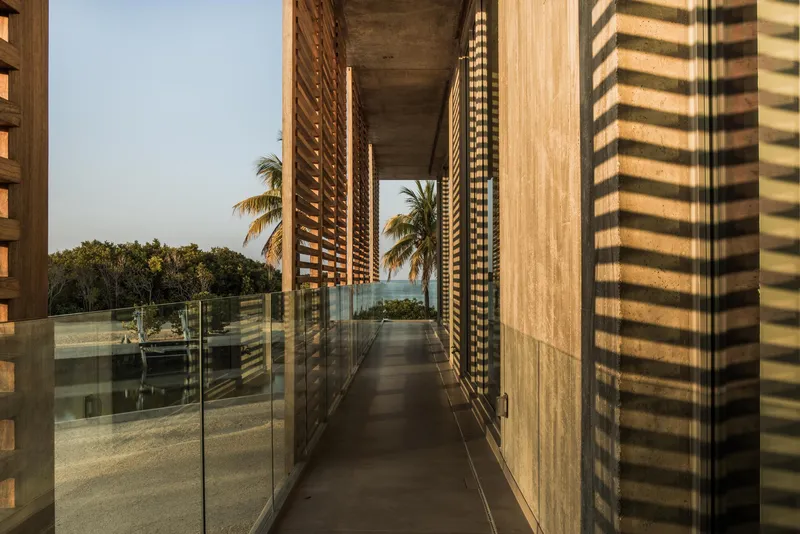
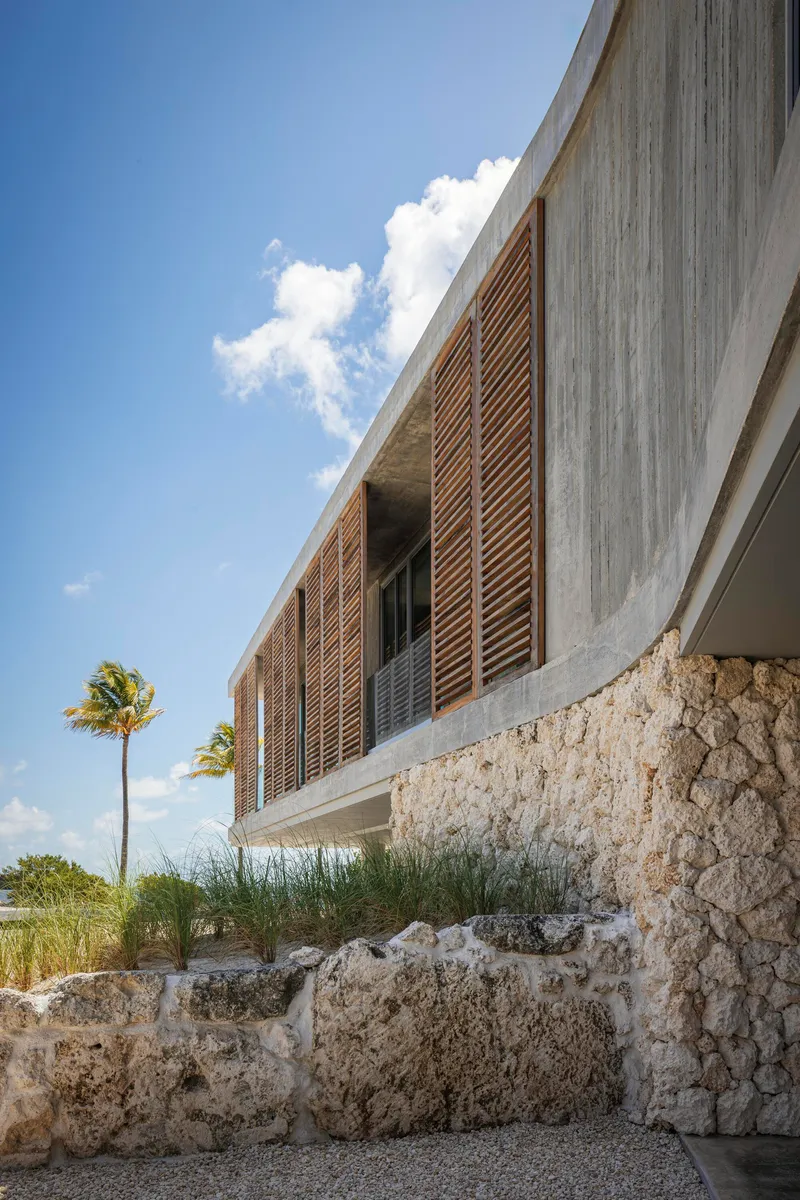
Timber louver screens wrap the facade at multiple levels, and they do more than one job. They filter direct sunlight into striped shadow patterns across interior floors and walls. They admit cross-ventilation while blocking the worst of the western exposure. And they give the occupants fine-grained control over privacy, something that matters even on a private island when service boats and neighbors pass by water.
The shadow play these screens produce is one of the house's strongest aesthetic qualities. In the covered walkways, afternoon light turns the circulation spine into a graphic experience, alternating bright slats with deep shadow. It is a technique as old as the mashrabiya, updated here in sustainably sourced timber with stainless steel hardware that will tolerate the salt air.
Interiors That Open Completely
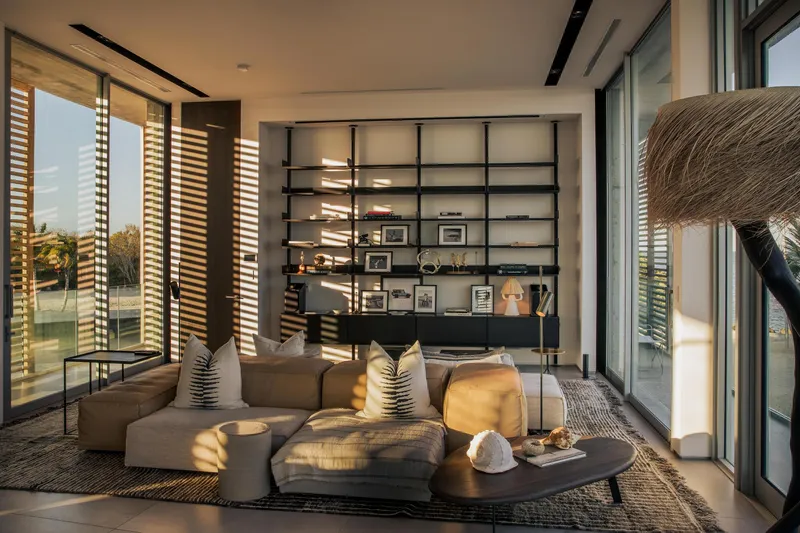
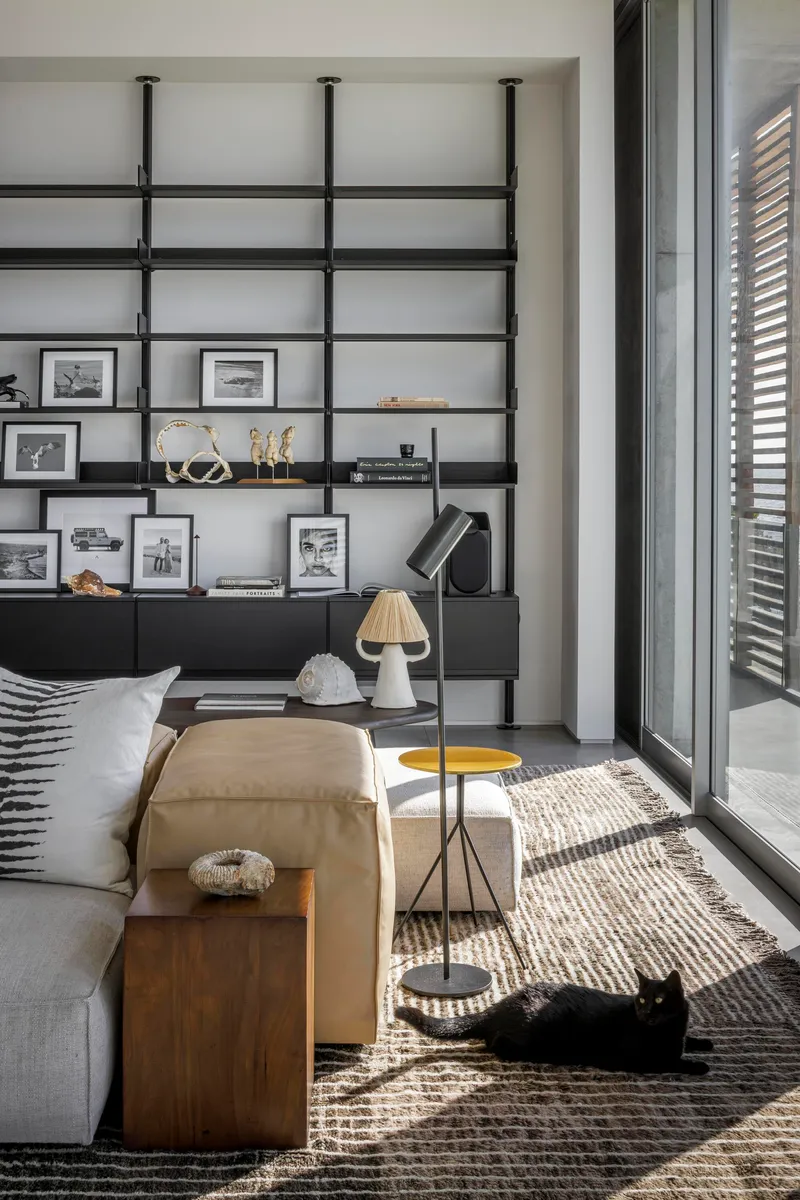
Inside, the living spaces carry the material language of the exterior inward. Timber louver panels appear behind shelving and dining areas, maintaining the striped light motif even when you are deep inside the plan. The living room features a steel shelving system that doubles as a room divider, its black frame grounding the warm wood tones. Furniture selections are restrained and low-slung, deferring to the architecture.
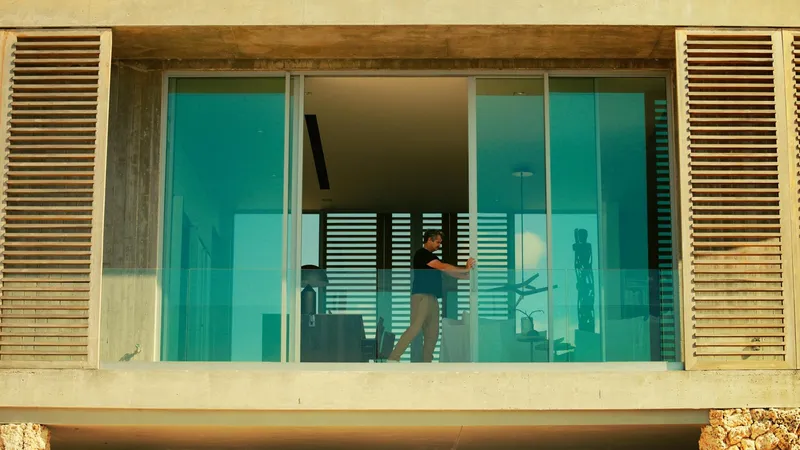
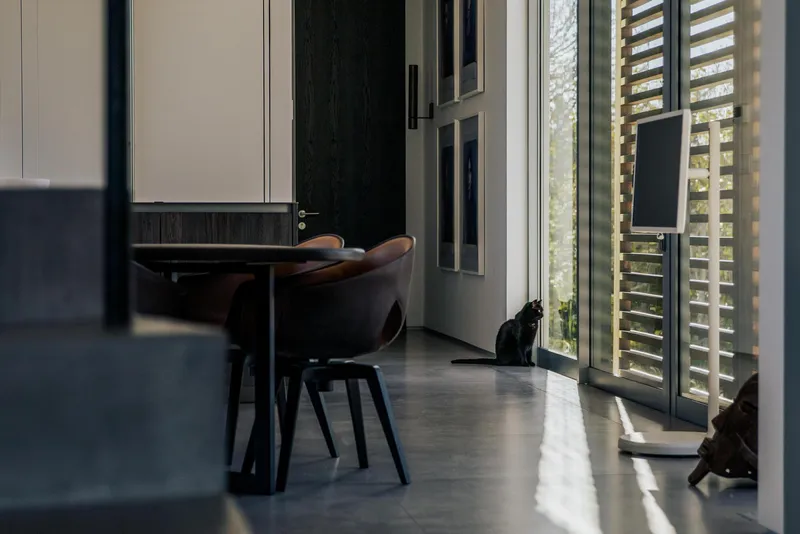
The dining area, anchored by a round table beneath a louvered wall, captures the essence of the house's spatial proposition: you are never far from filtered natural light, never fully enclosed, never disconnected from the landscape outside. Sliding glass panels at full height mean the rooms can open entirely, collapsing the boundary between terrace and interior in a way that makes the plan feel twice its measured area.
Private Quarters and the Ocean Threshold
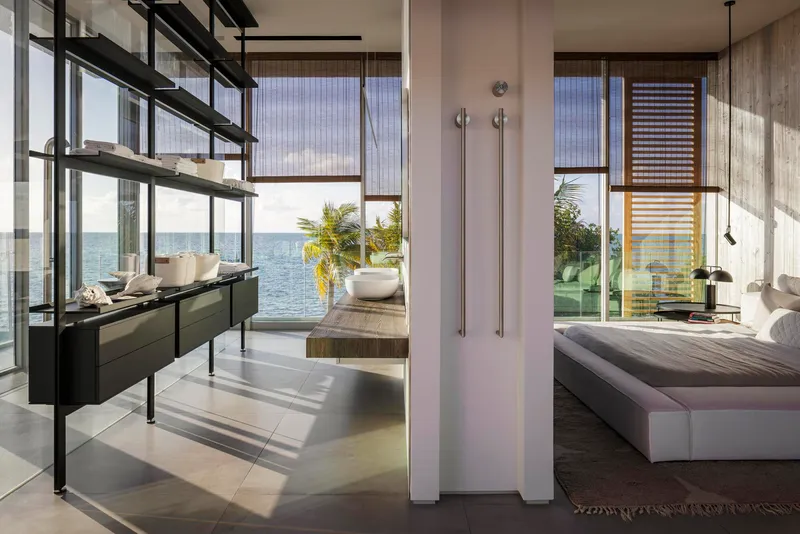
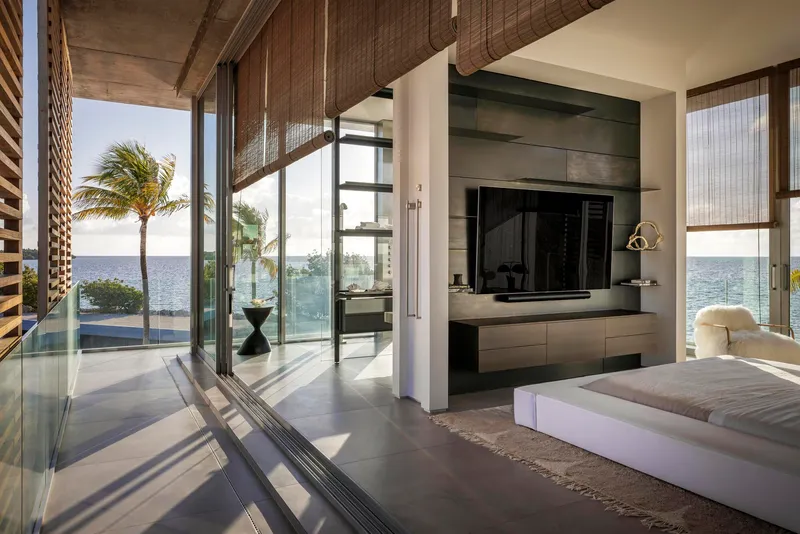
The bedrooms are positioned on upper levels where the views extend over the mangrove canopy to open water. A freestanding white partition in the primary suite separates sleeping and dressing zones without interrupting the continuous glazing. The effect is hotel-like in its luxury but domestic in its informality: no heavy curtains, no ornamental headboard, just space and light.
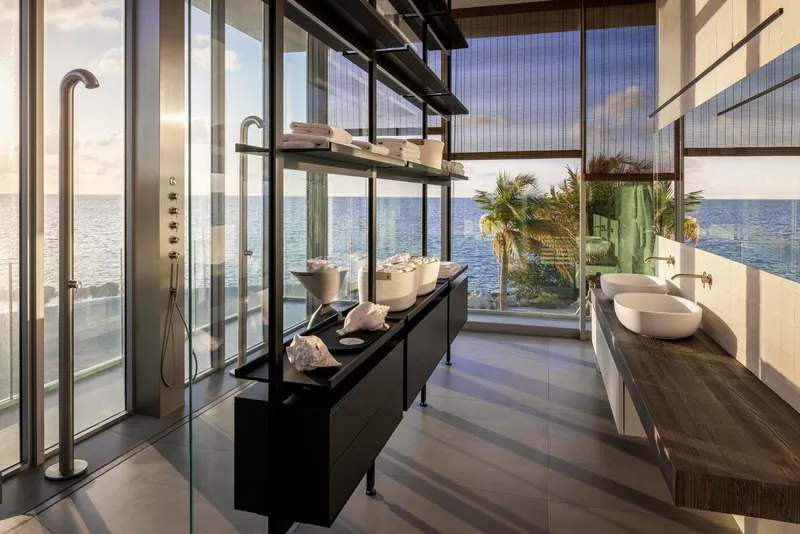
The glass-enclosed bathroom pushes the openness to its logical limit. A freestanding shower and double vanity sit in front of floor-to-ceiling windows that frame an ocean-view terrace. On a private island this is viable; the design exploits the site's seclusion to deliver the kind of spatial freedom that most waterfront houses only gesture toward. The poolside bedroom, with its integrated media wall and sliding doors, offers a more grounded alternative, connecting directly to the outdoor deck.
Concrete, Coral Stone, and Material Honesty
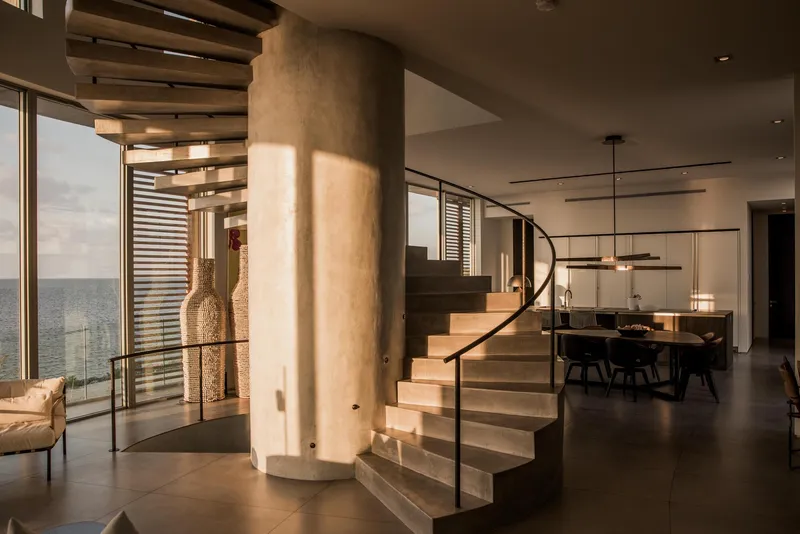
A curved concrete staircase wrapping a cylindrical column is the interior's sculptural centerpiece. It connects the elevated living level to the upper bedrooms while framing a sunset view through the dining area beyond. The concrete is left fair-faced, showing formwork marks that give it texture without ornament. It is the kind of detail that signals confidence in the material itself.
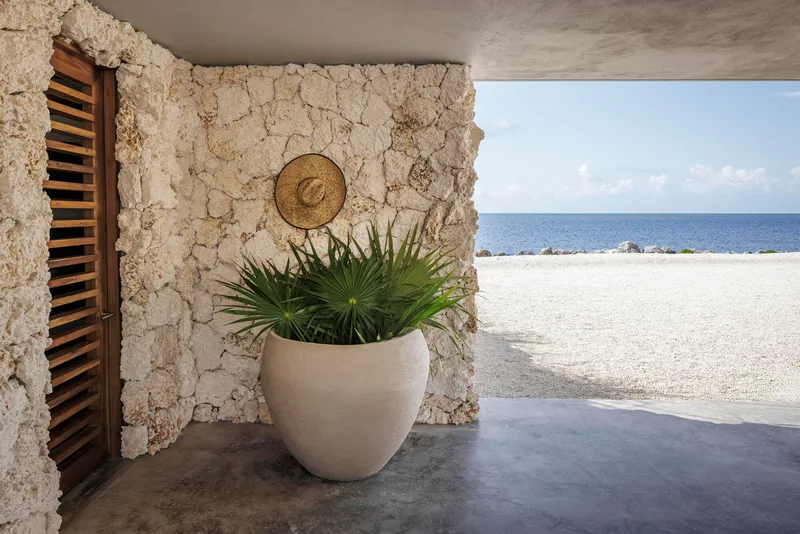
At the terraces, coral stone walls introduce a textural counterpoint to the smooth concrete and machined timber. Coral stone is a local material, porous and warm in tone, and its rough surface catches light in a way that polished finishes cannot. STRANG uses it as a datum: it appears at grade and at terrace walls, tying the house to the geological substrate of the island. The combination of coral stone, board-formed concrete, and oiled timber gives the palette a tightness that three materials rarely achieve.
Living Between Inside and Out
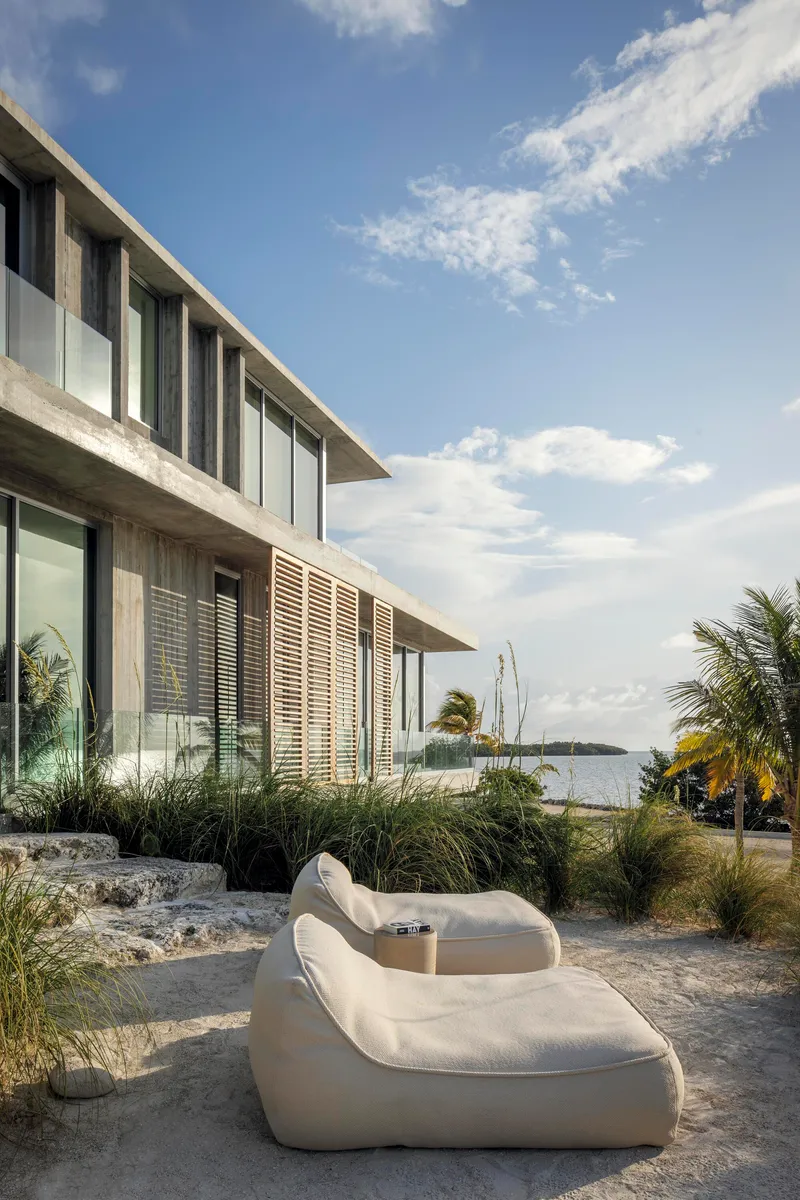
The outdoor terrace at dusk, with curved loungers oriented toward the water and planted grasses softening the edge, captures the real program of this house: it is designed for the hours between sunset and dark, when the Florida heat breaks and the landscape turns cinematic. Much of the square footage is, in fact, covered but open-air space, which is the honest way to build in a subtropical climate where conditioned interior volume should be minimized.
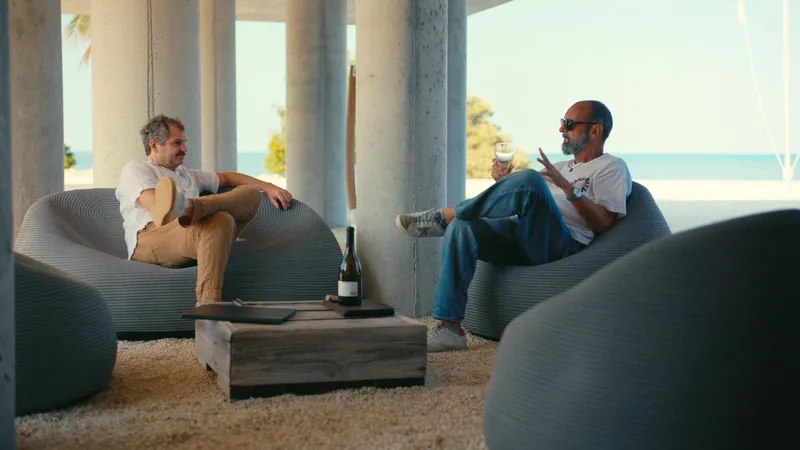
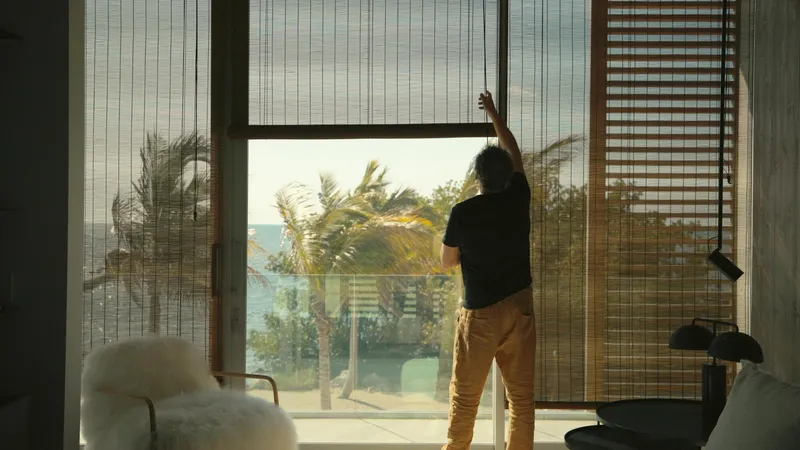
Interior moments reinforce this threshold condition. A figure adjusting bamboo blinds at a full-height window, two people conversing beside ocean-view glazing: the house is populated by moments of interaction with the envelope. Blinds are pulled, louvers are angled, doors slide open. The architecture is not static; it asks its occupants to participate in regulating comfort, which is the oldest and most effective form of environmental control.
Twilight Elevations
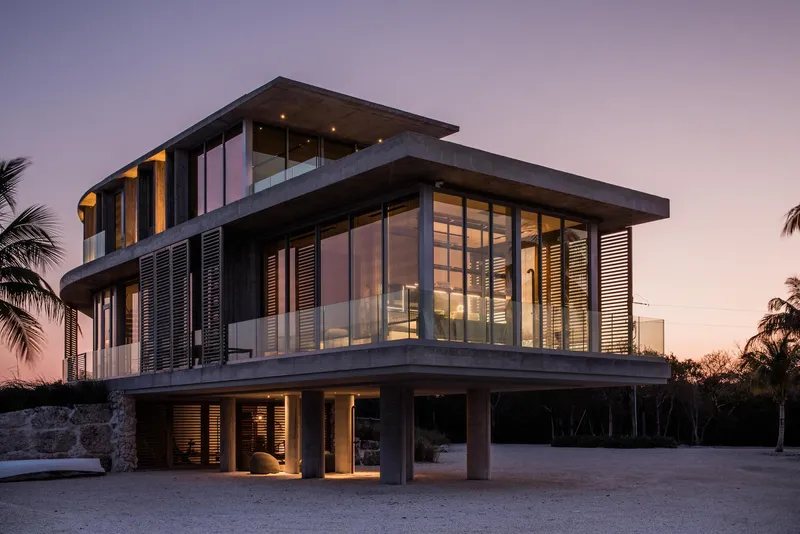
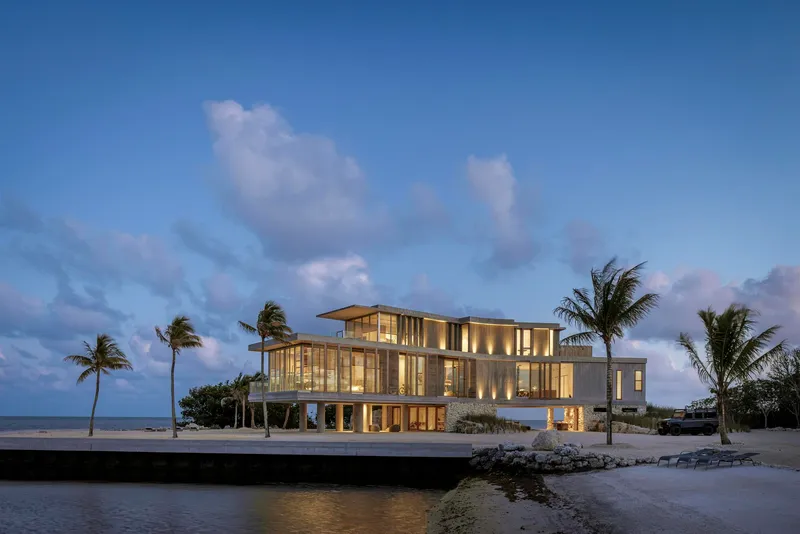
At dusk, the house reveals its vertical composition most clearly. Three levels are legible: the open ground plane, the timber-screened middle volume, and a glowing upper story. Interior lighting turns the louvered screens into lanterns, broadcasting warm horizontal lines into the tropical night. The effect is calibrated, not accidental: the architects clearly designed for how the house reads after dark, when silhouette and illumination replace color and texture as the primary architectural qualities.
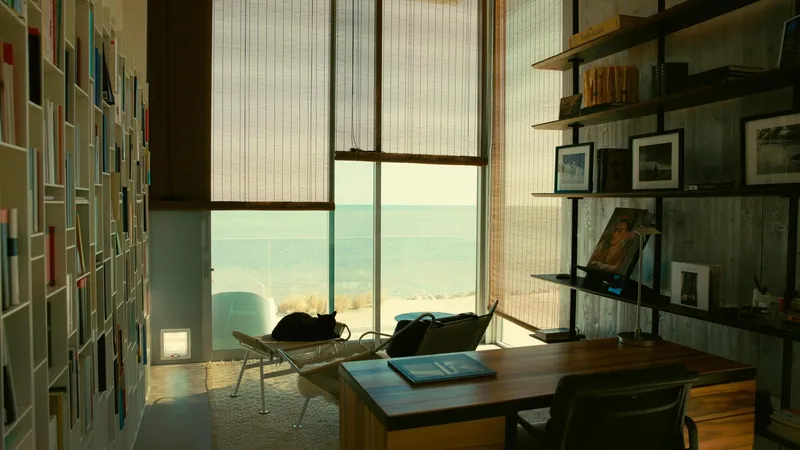
From the interior workspace on an upper floor, a person sits at a timber desk with a translucent shade half-drawn, the ocean visible beyond. It is a quiet image, but it captures the house's promise: that daily life here unfolds in constant visual contact with the sea, filtered just enough by architecture to remain comfortable rather than overwhelming.
Why This Project Matters
The Van der Vlugt Residence matters because it demonstrates that resilient coastal design and refined modern architecture are not competing agendas. Every storm-resistant strategy here, the elevated structure, the operable screens, the coral stone terracing, the preserved mangrove buffer, simultaneously produces the spatial and aesthetic qualities that make the house desirable to live in. There is no trade-off between performance and pleasure, which is a lesson the profession needs to internalize as coastal development intensifies under climate pressure.
STRANG has built a house that could become a reference point for a specific typology: the subtropical island residence that takes its environment seriously. It does not retreat behind hurricane shutters and sealed glass. It engages the wind, the light, the water, and the salt, deploying materials and geometries that age with the climate rather than against it. That kind of architectural realism, dressed in nothing more than concrete, timber, and glass, is harder to achieve than it looks, and more valuable than most of what passes for sustainable design today.
Van der Vlugt Residence by STRANG, United States, completed 2026. Photography by Ryan Lester (Architecture Sarasota) and Kris Tamburello.
About the Studio
Share Your Own Work on uni.xyz
If projects like this are the kind of work you want to make, uni.xyz is a place to publish your own, find collaborators, and enter design competitions.




Popular Articles
Popular articles from the community


Co-life: Sustainable Architecture for Age-Friendly Community Living
Co-life reimagines sustainable architecture for seniors through courtyards, rammed earth, shared gardens, and spaces designed for belonging.

Co-Life: Senior Housing Design That Reconnects Older Adults With the City
Co-Life reimagines senior housing design through healing gardens, shared streets, workshops, and a sustainable community across generations.

Conexión: Biophilic Design Reimagines High-Rise Living in Hong Kong
Conexión reimagines high-rise living in Hong Kong through biophilic design, green facades, shared spaces, daylight, water and nature within.

Riyadh For All: Intergenerational Urban Design for Active Aging in Rabat
Riyadh For All reimagines urban design in Rabat with intergenerational co-living, adaptive courtyards, and Moroccan cultural exchange today.

Similar Reads
You might also enjoy these articles

Bao Huynh Watercolor Atelier: A Serene Art Retreat in Hội An
Bao Huynh Watercolor Atelier in Hội An blends multifunctional art spaces, sustainable design, local materials, and family-friendly living in a serene environment.

Atelier Macri Concept Store Interior Design by CASE-REAL
Atelier Macri store features a "ko" counter, walnut wood details, cork displays, blending retail, gallery, and seamless customer experiences.

Manuel Vargas Izquierdo Stadium and High-Performance Sports Center: Architectural Excellence in Jalpa de Méndez
The Manuel Vargas Izquierdo Stadium blends sustainable design, inclusive sports facilities, and cultural-inspired architecture, revitalizing Jalpa de Méndez’s public spaces.

KAKR Buluh Awar Hall: Revitalizing Community and Ecology Through Bamboo Architecture
Community built bamboo hall revitalizes Buluh Awar village, empowering youth, restoring ecology, celebrating vernacular craftsmanship through sustainable architecture and culture.

Explore Residential Building Competitions
Discover active competitions in this discipline



Challenge to design a portable theatre


Challenge to design a portable music platform


Challenge to design an open learning module for the elderly


Challenge to design mud housing for contemporary communities
Comments (0)
Please login or sign up to add comments
No comments yet. Be the first to comment!