
Vector: A Kit of Timber Rooms That Rides the Abandoned Petite Ceinture Railway in Paris
Recycled rail cargo bases carry up to thirteen timber modules along Paris's Petite Ceinture, turning train velocity into a reconfigurable promenade.


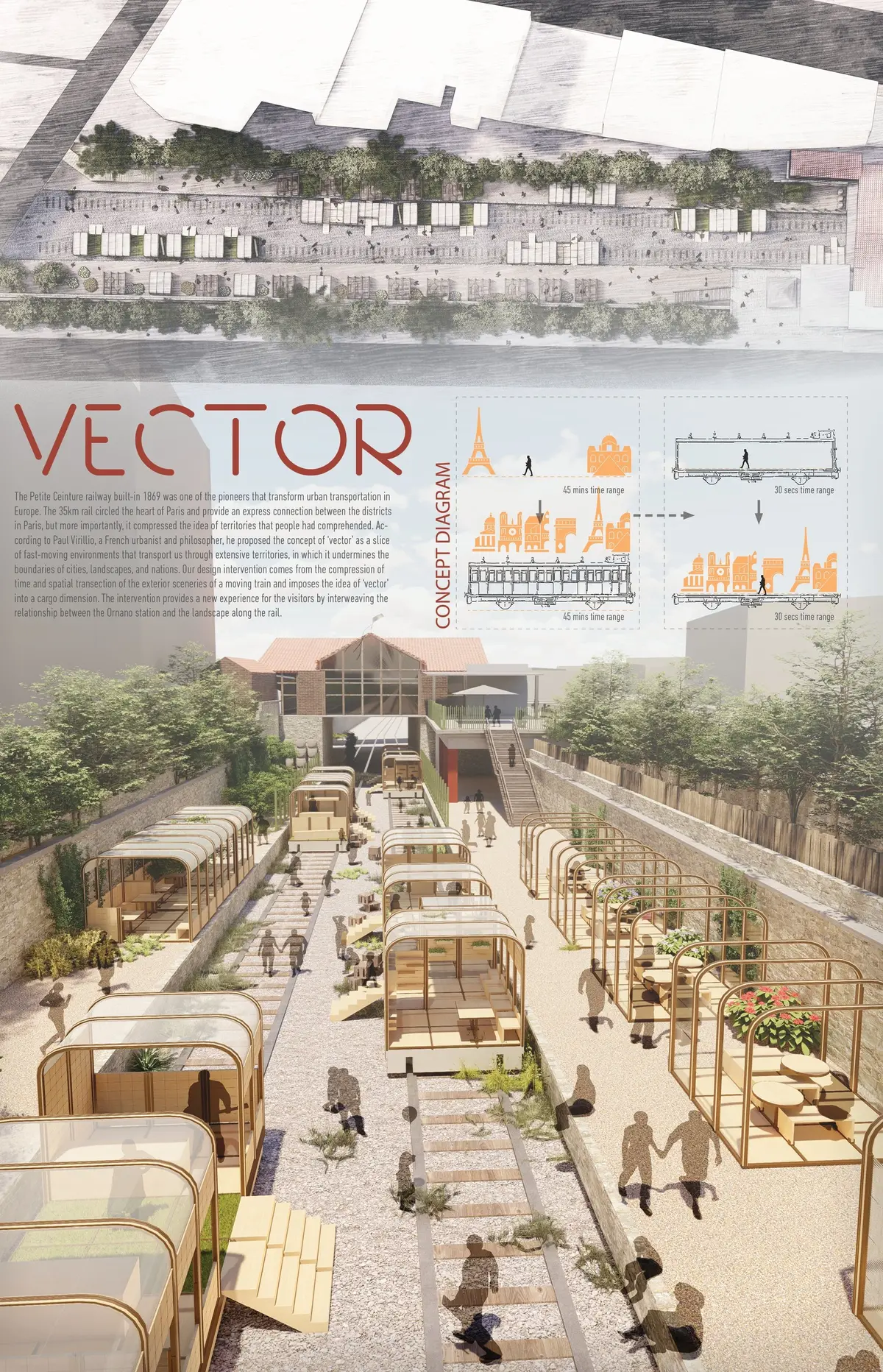
Most proposals for disused railways treat the track as a path to walk on and nothing more. Vector asks a sharper question: what if the railway kept its capacity to move, and architecture became the cargo? The project loads timber modules onto rolling bases and sets them along the old line, so the site's defining quality, speed compressed into a strip of land, becomes the organising principle of a new public space.
Designed by Jeremy Chan and Cheuk Hei Ryan Poon, the project works with the Petite Ceinture, the railway built in 1869 that once circled the heart of Paris and changed how the city moved. Rather than preserving the corridor as a relic, the designers focus on the stretch around the Ornano station and propose an active framework that reconnects the station to its neighbourhood. Their conceptual anchor is Paul Virilio's reading of vectors as fast-moving slices of environment, a theory they translate quite literally into spatial modules that compress time, landscape and movement.
A Cargo Base Built from the Railway's Own Scrap
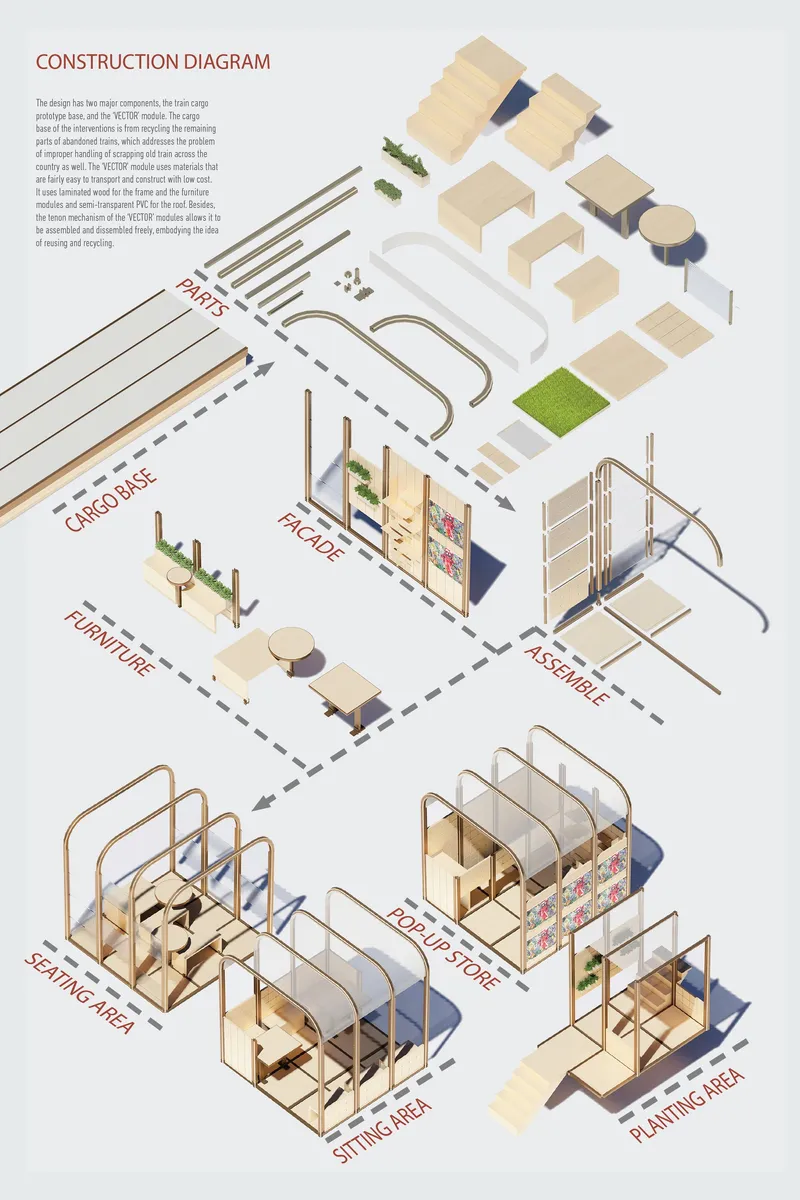
The construction diagram reads like an assembly manual, and that is its strength. Two components do all the work. The first is a cargo prototype base fabricated from recycled material salvaged from abandoned railway tracks, a decision that addresses the problem of improper rail disposal while giving the project a closed material loop. The base runs on the existing tracks and can host up to thirteen vertical VECTOR modules. Above it, timber parts, furniture and facade pieces click together into seating, pop-up stores and planting units.
The modules themselves use laminated wood frames, lightweight structural members and semi-transparent PVC roofing, joined through a tenon-based system. Tenon joints matter here because they make disassembly as easy as assembly. The architecture is not meant to be finished; it is meant to be reshuffled, carried off and reused, which is a more honest form of circular construction than recycled content alone.
Turning Linearity from Constraint into Script
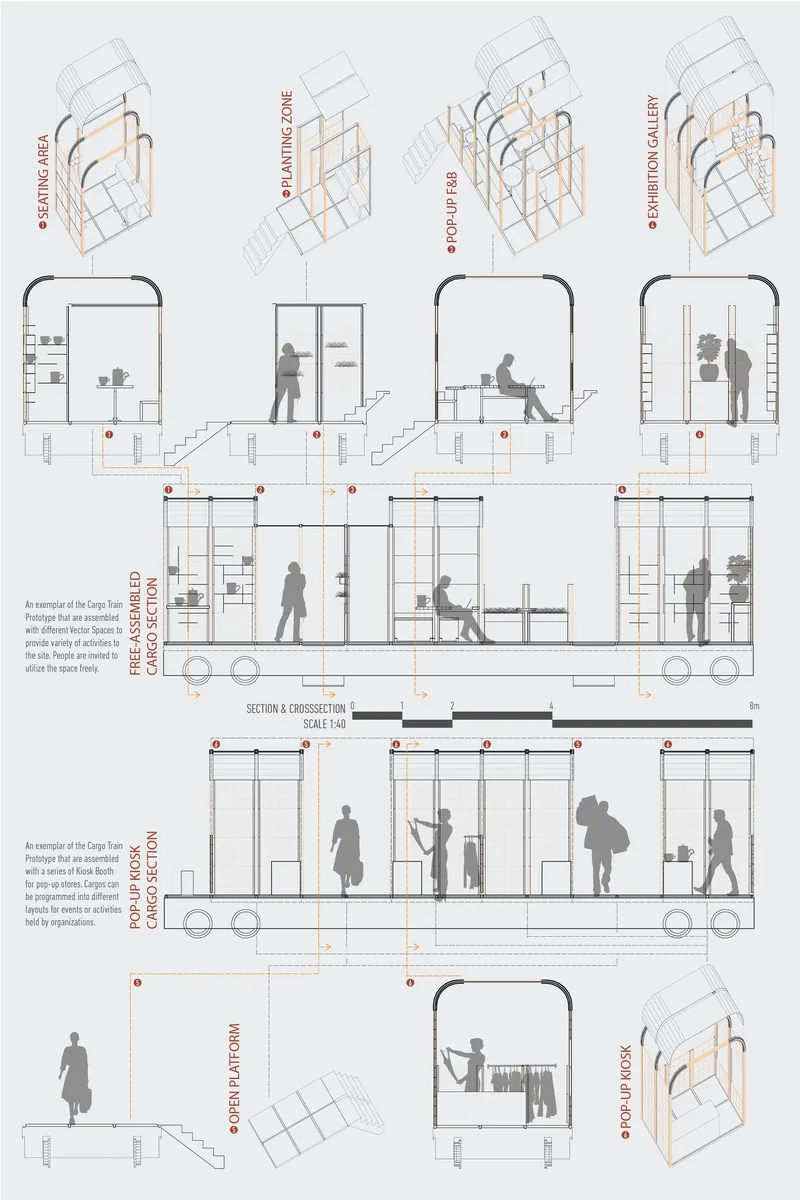
A railway corridor is narrow and relentlessly linear, the kind of site that usually defeats public programming. The section drawing shows how the designers invert that problem. Cargo units line up along the parallel tracks, scaled figures move between them, and small axonometrics demonstrate how the same frame becomes a bench row, a planting bed, a food counter or a gallery. Because modules can be mobilised laterally, the corridor becomes a sequence of changing conditions rather than a single long room.
The result is what the designers describe as a continuous transectional walk. Visitors pass from one spatial state to the next much as a passenger once watched the landscape slide past a train window. The motion has been transferred from the vehicle to the body, but the cinematic logic of the railway survives intact.
Arches That Frame a Tunnel of Light
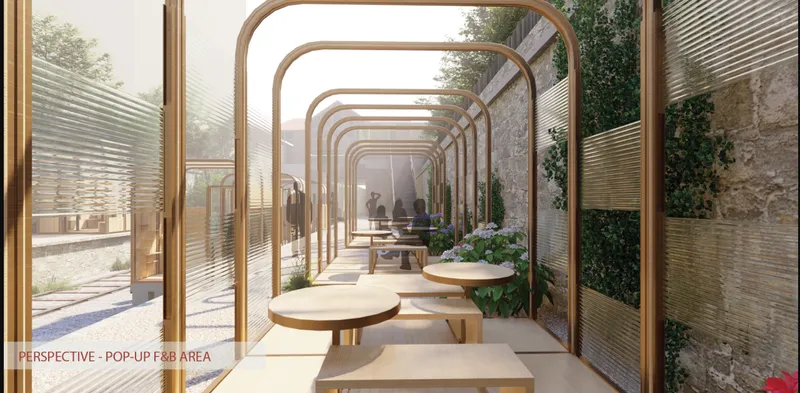
This interior view is where the concept becomes tangible. Repeated timber arches form a tunnel, round tables sit beneath ribbed glazing, and ivy climbs the stone retaining wall of the old cutting. The rhythm of the frames produces exactly the effect the project promises: a steady beat of structure that reads as velocity even when the space is still.
The translucent roofing is doing quiet but essential work. Daylight filters through the panels and stripes the floor with shadow, so walking the length of the module feels like moving through frames of film. Pairing warm laminated timber with the weathered masonry of the nineteenth-century cutting also sets the new insertion in clear, respectful contrast with its historic container.
Markets, Galleries and Quiet Benches on the Same Track
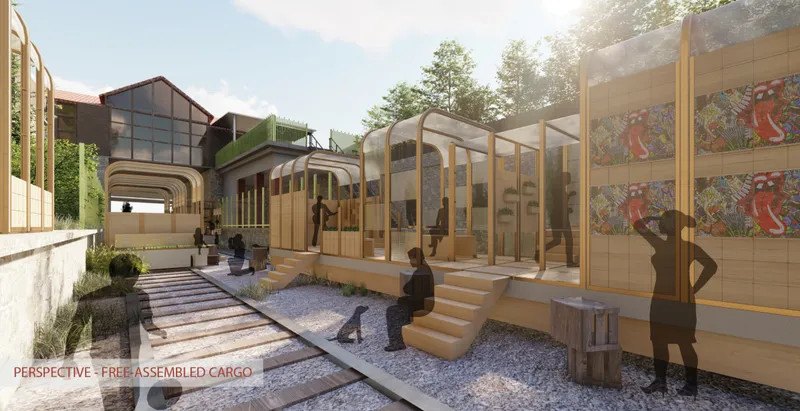
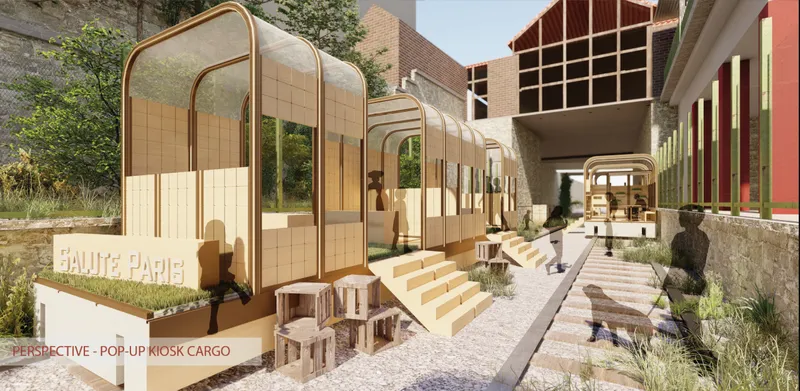
The two exterior renders show the system at different programmatic tempos. In one, timber cargo pavilions with painted panels sit beside the old rails, people settle onto the gravel and a dog wanders through, the corridor in its slow, contemplative mode. In the other, kiosk units with arched frames and glazed roofs gather around stepped seating and stacked crates, ready for a weekend market or food event. The designers also imagine the line converting into an exhibition gallery for cultural events.
Interchangeable mounting parts give event organisers, residents, tourists and local communities a direct hand in shaping the space. That shift in authorship is the project's most compelling social argument. The repetition of the arched frame keeps the corridor legible as one piece of infrastructure, while variation in configuration prevents the monotony that kills so many linear parks.
Why This Project Matters
Adaptive reuse of rail infrastructure has a familiar template: strip the tracks, plant the bed, add benches. Vector rejects that template by keeping the rails working. Its modules move on the original tracks, its bases are made from the original steel, and its spatial experience borrows directly from the original purpose of the line. The heritage is not framed behind glass; it is put back into operation.
The broader lesson is about designing systems instead of objects. By giving the Petite Ceinture a kit of tenon-jointed parts rather than a fixed building, Jeremy Chan and Cheuk Hei Ryan Poon propose public space that can change with each week and each community that uses it. For cities with miles of dormant infrastructure, that capacity to keep moving may prove more valuable than any single finished form.
View the Full Project
About the Designers
Designers: Jeremy Chan, Cheuk Hei Ryan Poon
Enter a Design Competition on uni.xyz
uni.xyz runs architecture and design competitions year-round that reward proposals with spatial conviction and real site intelligence.
Project credits: Vector by Jeremy Chan, Cheuk Hei Ryan Poon.


Popular Articles
Popular articles from the community


FCC Arquitectura Expands a Portuguese Granite House with a Board-Marked Concrete Wing
In Portugal, JV House pairs a cleaned-up whitewashed and granite dwelling with a timber-shuttered concrete extension, courtyards and a garden pool.

David Ortega Stacks a Two-Story Mexico City Penthouse Around a Steel Stair and a Pergola-Shaded Roof Terrace
In Colonia Roma, a 300 m² penthouse uses oak joinery, a planted steel stair and a slatted roof pergola to make a new-build apartment feel like a house.


Opera on the Sea: Driftwood Logic Shapes a Timber Opera House on Estonia's Coast
Trevor Orgill's opera house translates the entangled drift of floating timber into a civic building where wood, water, and music converge.

graciastudio Turns a Viewless Tijuana Lot Inward Around a Courtyard of Concrete, Timber and Trees
In Tijuana, Jorge Gracia's GA2 House stacks a timber-clad private floor over exposed concrete and replaces a missing view with a planted interior patio.

Similar Reads
You might also enjoy these articles
Healing Façade: A Modular Chapel System That Restores Ethiopia's Sacred Forests
Winner of the Eco-Chapel competition, this circular timber façade collects water from air to rebuild soil and reforest degraded Ethiopian landscapes.
Kaffeebühnen: Where Coffee Shop Architecture Becomes a Civic Stage in Vienna
A linear sequence of timber boxes, transparent shells, and open yards turns the Viennese café tradition into a public performance space.
Eco Chapel: A Modular Forest Pavilion That Grows Like the Landscape It Protects
Hexagonal timber modules weave through existing trees, turning a chapel into a living system for prayer, education, and reforestation.


Urban Forest: A Vertical Ecosystem for 5,000 Workers in Singapore's Changi Business Park
Radially stacked pods and layered green decks turn a 7-acre plot into 47 acres of ecological workspace projected for 2040.

Explore Urban Intervention Competitions
Discover active competitions in this discipline

Challenge to design a portable theatre

Challenge to design a portable music platform

Challenge to design an open learning module for the elderly
Comments (0)
Please login or sign up to add comments
No comments yet. Be the first to comment!