
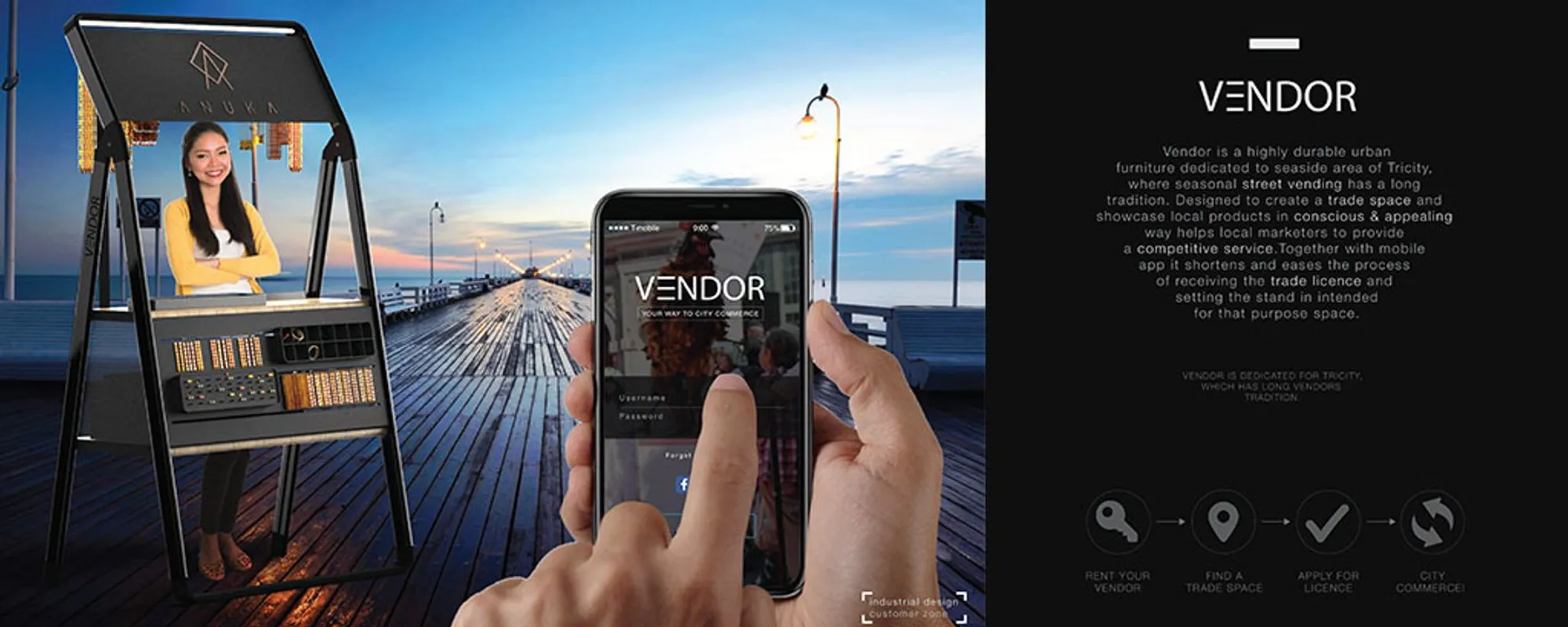
Vendor: Modular Urban Furniture That Keeps Street Sellers on the Promenade
A system of recycled plastic panels, aluminum frames, and a booking app designed to protect coastal vending culture in Tricity, Poland.


Street vendors are disappearing from Polish promenades, not because customers stopped showing up, but because regulations did them in. Strict rules on stall appearance, material standards, and placement have made it nearly impossible for small sellers to operate legally. In Warsaw alone, nearly 9,000 illegal vendors face mandates and court cases each year. Vendor proposes a way out of this bind: a modular, sustainably built piece of urban furniture that gives micro-commerce a legitimate, well-designed home in the public realm.
Designed by Ewelina Chylińska and published as a project on uni.xyz, Vendor is sited along the coastal promenades of Tricity, Poland, where seasonal vending has long been part of the region's identity. The project treats the vendor stall not as a temporary nuisance to be regulated away, but as a piece of urban architecture deserving the same care as a bench, a bus shelter, or a wayfinding kiosk.
The Scale of a Quiet Crisis
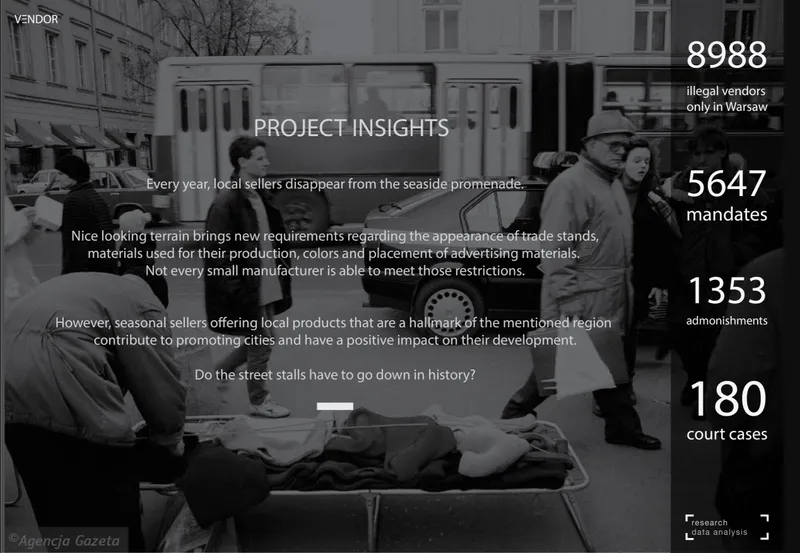
The infographic above sets the scene plainly. Overlaid on a monochrome urban backdrop of trams and pedestrians, statistical data maps the scope of the problem: thousands of vendors operating outside the law, thousands of enforcement actions, and a cultural tradition eroding year by year. What makes Chylińska's framing effective is its refusal to sentimentalize. The numbers speak. Street vending promotes regional products, draws tourists, and fuels city development. When vendors vanish, a part of the city's economic and cultural metabolism goes with them.
A Booking App That Makes Legality Simple
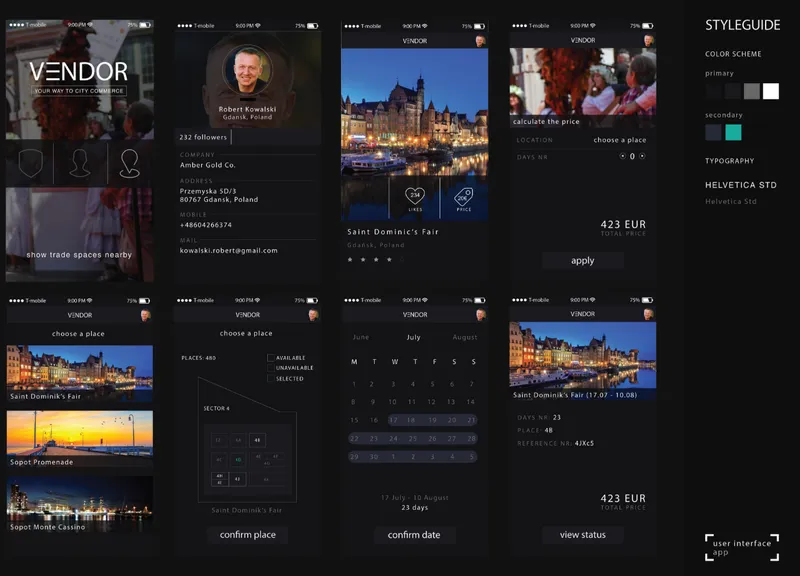
Vendor's ambition extends beyond the physical stall. A companion mobile app handles the bureaucratic side of vending: finding available trade spaces, booking locations via a calendar interface, applying for licenses, and managing rental payments. The screens shown here present a clean, functional interface alongside a photograph of the waterfront marketplace, grounding the digital tool in its real-world context. By streamlining the administrative process that currently drives vendors underground, the app transforms compliance from a burden into a straightforward transaction.
The digital-physical pairing is where the project becomes genuinely systemic rather than merely object-level. A well-designed stall solves one vendor's problem. A platform that manages city-wide commerce, allocates space equitably, and connects sellers with customers solves a structural one. Chylińska treats both layers as equally important.
Amber Beads and Black Steel on the Boardwalk
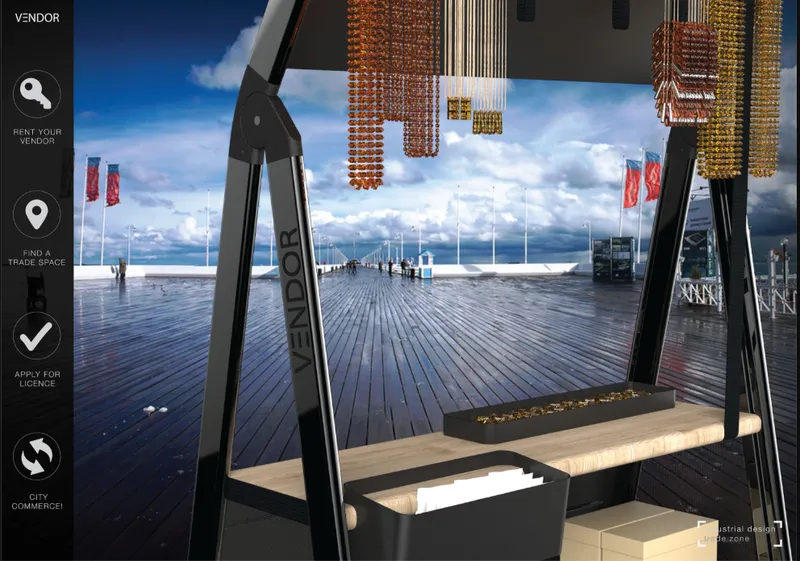
The rendered perspective looking through the stall's black steel frame tells you everything about the project's material sensibility. Hanging amber bead curtains soften the industrial geometry, referencing Tricity's Baltic coast and its amber trade in a gesture that is specific without being kitschy. The timber boardwalk, clouded sky, and open sightline toward the waterfront confirm that the stall is designed to sit within the promenade's visual rhythm, not against it. The structure reads as furniture for the city rather than an obstruction placed upon it.
Recycled Plastic, Aluminum Profiles, and LED Strips
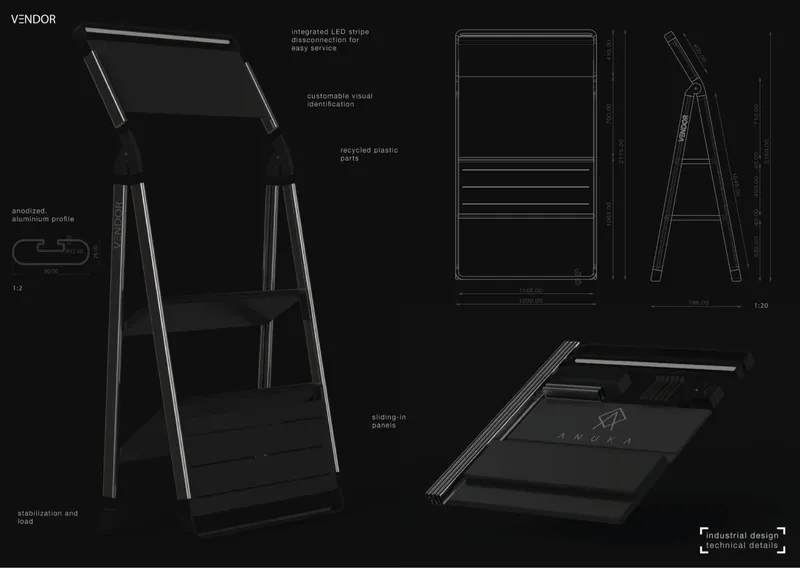
The technical drawing breaks the stall down into its constituent logic. Orthographic views and assembly details reveal a folding frame built from anodized aluminum profiles and recycled plastic parts, chosen for durability in a coastal climate. Sliding panels allow vendors to customize their display arrangement. Integrated LED strips provide visibility and safety after dark. Branding surfaces can be adapted by individual businesses, so the stalls serve a common urban language while accommodating commercial identity. The modularity is the key move: it lets the system scale across a promenade or an entire city without requiring bespoke fabrication for each site.
What elevates the detail sheet beyond standard product design is the awareness that every material choice carries a regulatory implication. By specifying materials that meet municipal standards out of the box, Vendor removes the compliance gap that forces vendors into illegality. The stall is, in effect, pre-approved by design.
Why This Project Matters
Vendor addresses a tension that plays out in cities worldwide: the collision between informal commerce and formal regulation. Most responses to this tension fall into two camps. Either cities crack down and vendors disappear, or vendors persist in legal limbo, vulnerable to fines and displacement. Chylińska's contribution is to reframe the stall itself as the mediating object, a piece of urban infrastructure that satisfies regulatory demands while preserving the economic and cultural role of street vending.
The project's strength lies in its refusal to treat design and policy as separate problems. The physical stall, the material specification, and the digital booking platform form a single system. Each component makes the others viable. That kind of integrated thinking, applied to something as ordinary as a market stall, is exactly where architecture can quietly reshape how cities work for the people who actually use them.
View the Full Project
About the Designers
Designer: Ewelina Chylińska
Enter a Design Competition on uni.xyz
uni.xyz runs architecture and design competitions year-round that reward proposals with spatial conviction and real site intelligence.
Project credits: Vendor by Ewelina Chylińska.



Popular Articles
Popular articles from the community


Co-Life: Senior Housing Design That Reconnects Older Adults With the City
Co-Life reimagines senior housing design through healing gardens, shared streets, workshops, and a sustainable community across generations.

Riyadh For All: Intergenerational Urban Design for Active Aging in Rabat
Riyadh For All reimagines urban design in Rabat with intergenerational co-living, adaptive courtyards, and Moroccan cultural exchange today.

Hill & Cross Opera: Sculptural Opera House Architecture Shaped by Tallinn’s Landscape and Identity
Hill & Cross Opera reimagines opera house architecture in Tallinn through its sculptural hill, civic plaza, glass wave and a luminous cross.

Co-life: Sustainable Architecture for Age-Friendly Community Living
Co-life reimagines sustainable architecture for seniors through courtyards, rammed earth, shared gardens, and spaces designed for belonging.


Similar Reads
You might also enjoy these articles

Lunar Spiral: Space Architecture Shaped by the Mathematics of the Universe
Lunar Spiral reimagines space architecture through Fibonacci geometry, lunar regolith, levitating habitats, and self-sustaining Moon living.
The Main Dream: Modular Architecture for Play, Learning, and Community
A modular playground turns recycled plastic into adaptable spaces where refugee children can play, build, learn, and reconnect.

Play: Fragments of Their World
Familiar architecture becomes modular playground design, creating safe spaces where displaced children can learn, connect, imagine and play.

Wadi Rum Observatory: Desert Architecture Designed for the Night Sky
Wadi Rum Observatory turns desert architecture into a quiet instrument for astronomy, hiding research spaces under Jordan's starlit terrain.


Explore Urban Furniture Competitions
Discover active competitions in this discipline



Challenge to merge furniture with learning


Competition to design a workstation for architects
Comments (0)
Please login or sign up to add comments
No comments yet. Be the first to comment!